
人教版七年级英语下册_代词、介词
一、本课词汇(七年级下册Unit Two & Unit Three):turn v.转弯;转变方向left adv.﹠n.向左;左边down adv.﹠prep.向下;下去;沿着right adv.﹠n.向右;右边on the right 在右边open adj.开着的;营业中的market n.市场;市集clean adj.清洁的;干净的quiet adj.宁静的dirty adj.肮脏的house n.房子;住宅welcome int. 欢迎garden n.菜园;花园 district n.区域;地方enjoy v.享受---的乐趣;欣赏walk n.散步;步行take a walk 散步through v.穿过;通beginning n.开始tour n.旅行;游历visit v.参观;游览place n.地方;地点fun n.愉快;开心 have fun 玩得开心if conj.(表条件)如果hungry adj.饥饿的arrive v.到达;抵达way n.路;路线;路途take v.乘;坐;搭(车、船) taxi n.出租车;的士;计程车airport n.飞机场pass v.通过hope v.希望;盼望;期待 yours pron.您的;你的(用在信末署名前,做客套语) koala n.(澳洲)树袋熊;考拉tiger n.老虎;虎elephant n.大象 dolphin n.海豚panda n.熊猫lion n.狮子penguin n.企鹅 giraffe n.长颈鹿zoo n.动物园 cute adj.可爱的;聪明的map n.地图;图 smart adj.聪明的;漂亮的animal n.动物box n.方框;盒;箱kind of 有几分south n.南;南方;adj.在南方的;南部的;向南的Africa 非洲 bingo n.宾戈(一种游戏)ugly adj.丑陋的;难看的clever adj.聪明的;机灵的friendly adj.友好的beautiful adj.美丽的;美好的shy adj.害羞的;怕羞的other adj.其他的;另外的grass n.草sleep v.睡;睡觉during prep在---期间 at night 在晚上;在夜里leaf n.叶;树叶lazy adj.懒惰的;懒散的meat n.(食用的)肉;肉类relax v.放松;休息二、本课语法(一):代词2.1人称代词人称代词是表示"我"、"你"、"他"、"她"、"它"、"我们"、"你们"、"他们"的词。
是表示自身或人称的代词。
(1)人称代词有人称、数和格的变化,见下表:(2)人称代词的用法a.人称代词在句中可以用作主语(用主格)和宾语(用宾格):He loves her, but she hates him.b.人称代词用于as, than之后时,可用宾格:“Who is it?”“It’s me.”He gets up earlier than me.He speaks English as well as her.但是,若than, as后的人称代词后跟由动词,则必须用主格:He gets up earlier than I do.c.单独使用的人称代词通常用宾格:me too.(3) 人称代词的排列顺序人称代词的排列顺序为:a.单数人称代词通常按“二三一”排列,即you, he and I:You, he and I are all middle school students.b.复数人称代词通常按“一二三”排列,即we, you and they:We, you and they will all go there.c.但若用于承担责任或错误等场合,则可把第一人称I置于其他人称代词之前:I and Tom are to blame.2.2物主代词表示所有关系的代词叫做物主代词。
(1)物主代词可分为形容词性物主代词和名词性物主代词两种。
列表如下:(2)物主代词的用法a. 形容词物主代词在句中作定语:I love my country. Is this your car?b. 名词性的物主代词可用作主语,宾语,表语以及与"of" 连接的定语:Li Hua's bike is red, and yours is green. These books are ours.That car is mine, not yours. Yesterday I met a friend of mine in the street.2.3指示代词指示代词是表示指示概念的代词,即用来指示或标识人或事物的代词。
主要的有this, that, these, those, 其中this和that为单数,these和those为复数。
指示代词在句中可作主语、宾语、表语、定语。
指示代词的用法:(1) this和that的用法两者的基本区别是this表近指,that表远指。
另外,当要回指上文提到的事情时,可用this或that,但是若要指下文叙述的事情,通常要用this:She married Jim, and this/that surprised me.I want to know this——Dose he love her?(2) that和those的用法that和those常常用来代替已提到过的名词,以避免重复。
The population of China is larger than that of Japan. The ears of a rabbit are longer than those of a fox.2.4举一反三1 ________(我) am a teacher.2 _______(他) often plays basketball after school.3 This is _______(我的) book. That is__________. (他的)4 Please pass_____(我们) the ball.5 This is not my shirt. It’s _______. (她的)6 My ruler is long. ________ (你的) is short.7 _______(我们) buy a pair of shoes for _______(她).8 _______(他们的) teacher is good. _____(你们的)is good too.9 Our chair is better than _________ ( they).10 I will give the presents to________(they).11 These books are________(I), and those are____(you).12 _____ like ______ car. 我喜欢他们的小汽车。
13 Who is there? It’s _____. 是谁啊?是我。
14 ______ are Chinese. 我们是中国人。
15 I want to buy some balloons for ______. 我想买些气球送给他。
2.5 知识巩固1 He is cleverer than ____. He can do it better than ____ do.A. me, meB. I, meC. me, ID. I, mine2 Look, the chair has lost one of ____ legs.A. hisB. herC. itsD. it’s3 Lily was 9 years old. _____ was old enough to go to school ________.A. She, sheB. She, herselfC. Her, herselfD. Her, she4 I want to finish it _____ .I won’t ask for help.A. yourselfB. myselfC. ourselvesD. ourselves5 Jim’s watch is much newer than _________.A. hersB. sheC. herD. herself6 ——Who taught you English last year?——Nobody taught me . I taught ______.A. youB. myselfC. herD. me7 She is a student, _____ name is Julia.A. itsB. herC. hersD. his8. She gave the erasers to Lucy and _______ .A. IB. meC. myD. mine9. That's not ______, it is_______. I made it ______ .A. ours, mine, myselfB. your, mine, myselfC. yours, her, myselfD. yours, my, myself10 We bought ______ a present, but _______ didn’t like it.A. they, themB. them, theyC. themselves , theirD. theirs, they三、介词3.1介词的定义介词是一种用来表示词与词, 词与句之间的关系的词。
在句中不能单独作句子成分。
介词后面一般有名词代词或相当于名词的其他词类,短语或从句作它的宾语。
介词和它的宾语构成介词词组,在句中作状语,表语,补语或介词宾语。
并且在定语从句“介词+whom/which”的结构中,不能用that 代替whom/which。
She is a good student from whom we should learn3.2表示地点位置的介词1)at ,in, on, to,forat (1)表示在小地方; (2)表示“在……附近,旁边”in (1)表示在大地方; (2)表示“在…范围之内”。
on 表示毗邻,接壤,“在……上面”。
to 表示在……范围外,不强调是否接壤;或“到……”2)above, over, on 在……上above 指在……上方,不强调是否垂直,与 below相对;over指垂直的上方,与under相对,但over与物体有一定的空间,不直接接触。
英语by,take,in,on表示乘坐用法

5. Tom sometimes
a bike to library.
A.ride B.in C.by D. take
6. My father never
my bike.
A.in B.take C. on D. by
人教版七年级下册Unit3
共同点:
by,in,on和with 都是介词,后跟名词、代词等构成介 宾短语放末尾作状语
区别用法
词性 中文 用法 句子成分
例句
take
V.动词 乘坐
take+冠词
作谓语
(the/an/a)+交通
工具单数名词
by
prep.介 通过,乘 by+交通工具单 作状语
词
坐,以... 数名词
的手段
in
prep.介 乘坐,在..... in+限定词
作状语
词
里
(the/an/a/物主代
词)+交通工具单
数名词
on
prep.介 通过,乘 0n+限定词
作状语
词
坐,在...... (the/an/a/物主代
上
词)+交通工具单
数名词
I take a bus to school. 我乘公交车去学校。
I go to school by bus. 我乘公交车去学校。
I go to school in a bus. 我乘公交车去学校。 I go to school in my father's car. 我乘坐我父亲的汽车去上学 I go to school on a bus. 我乘公交车去学校。
ቤተ መጻሕፍቲ ባይዱ
注意: ride v.动词“ 骑” 通常用于骑自行车,骑马等。如,ride a bike,
新人教版七年级英语语法知识总结

新人教版七年级英语语法知识总结英语七年级语法知识总结1.动词be(is,am,are)的用法我(I)用am,你(you)用are,XXX跟着他(he),她(she),它(it)。
单数名词用is,复数名词全用are。
变否定,更容易,be 后not加上去。
变疑问,往前提,句末问号莫丢弃。
还有一条须注意,句首大写莫忘记。
2.this,that和it用法1)this和that是指示代词,it是人称代词。
2)距离说话人近的人或物用this,距离说话人远的人或物用that。
如:This is a flower.这是一朵花。
(近处)That is a tree.那是一棵树。
(远处)3)放在一起的两样东西,先说this,后说that。
如:This is a pen。
That is a pencil.这是一支钢笔。
那是一支铅笔。
4)向别人介绍某人时说This is…,不说That is…。
如:This is Helen。
Helen。
this is Tom.这是XXX,XXX,这是XXX。
5)This is不能缩写,而That is可以缩写。
如:This XXX.这是一辆自行车。
那是一辆轿车。
6)打电话时,介绍自己用this,询问对方用that。
如:Hello。
Is that Miss Green?喂,是XXX小姐吗?Yes。
this is。
Who’s that?是的,我是,你是谁?注意:虽然汉语中使用“我”和“你”,但英语中打电话时绝不可以说:I am…。
Are you…?/Who are you?7)在回答this或that作主语的疑问句时,要用it代替this或that。
如:①—Is this a XXX?这是条记本吗?—Yes。
it is.是的,它是。
②—What’s tha t?那是甚么?—It’s a kite.是只鹞子。
3.these和those用法this。
that。
these和those是指示代词,these是this的复数形式,指时间,距离较近的或下面要提到的人或事;those是that 的复数形式,指时间、距离较远或前面已经提到过的人或事物。
人教版七年级英语各单元知识点
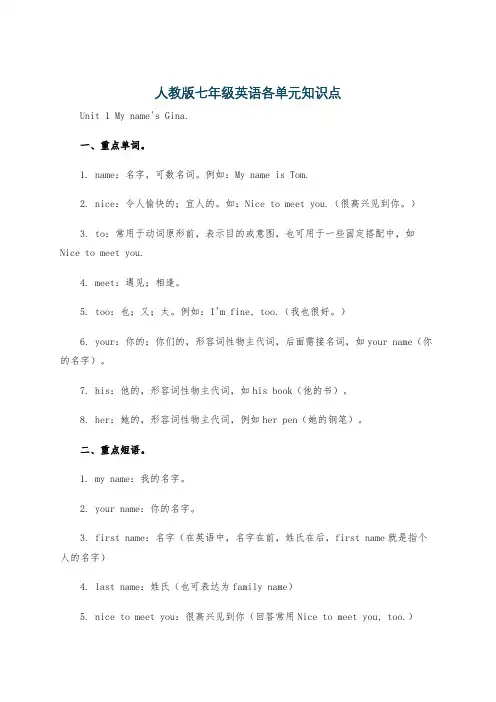
人教版七年级英语各单元知识点Unit 1 My name's Gina.一、重点单词。
1. name:名字,可数名词。
例如:My name is Tom.2. nice:令人愉快的;宜人的。
如:Nice to meet you.(很高兴见到你。
)3. to:常用于动词原形前,表示目的或意图,也可用于一些固定搭配中,如Nice to meet you.4. meet:遇见;相逢。
5. too:也;又;太。
例如:I'm fine, too.(我也很好。
)6. your:你的;你们的,形容词性物主代词,后面需接名词,如your name(你的名字)。
7. his:他的,形容词性物主代词,如his book(他的书)。
8. her:她的,形容词性物主代词,例如her pen(她的钢笔)。
二、重点短语。
1. my name:我的名字。
2. your name:你的名字。
3. first name:名字(在英语中,名字在前,姓氏在后,first name就是指个人的名字)4. last name:姓氏(也可表达为family name)5. nice to meet you:很高兴见到你(回答常用Nice to meet you, too.)三、重点句型。
1. —What's your name?(你叫什么名字?)—My name's Gina.(我的名字是吉娜。
)2. —Nice to meet you.(很高兴见到你。
)—Nice to meet you, too.(我也很高兴见到你。
)3. —What's his name?(他叫什么名字?)—His name's Tom.(他的名字是汤姆。
)4. —What's her name?(她叫什么名字?)—Her name's Mary.(她的名字是玛丽。
)Unit 2 This is my sister.一、重点单词。
七年级英语介词知识点

七年级英语介词知识点英语中,介词是一个非常重要的语法部分。
介词在句子中通常作为短语的组成部分,用来表示名词或代词与其他部分之间的关系,包括时间、地点、方向、原因、目的、方式等方面。
在这篇文章中,我们将讨论一些七年级英语介词的知识点。
一、时间介词时间介词用来描述时间上的关系,比如表示某一个事件发生的时间、持续的时间等。
以下是一些常用的时间介词:1. at:表示具体的时间点,比如at 5 o'clock(5点钟)2. on:表示某天具体的日期,比如on Monday(星期一)3. in:表示月份、季节、具体的一年或一段时间,比如in June (六月)、in winter(冬天)、in 2022(2022年)二、地点介词地点介词用来描述位置关系,比如表示某个物体或人所在的位置、方向等。
以下是一些常用的地点介词:1. in:表示在某个比较大的范围内,比如在城市、国家、房间里等。
比如in China(在中国)2. on:表示在某个比较平坦的表面上,比如在桌子上、在地图上等。
比如on the table(在桌子上)3. at:表示在一个具体的位置上,比如在门口、在街角等。
比如at the door(在门口)4. to:表示朝着某个方向,比如向前、向左等。
比如go to the left(向左走)三、方式介词方式介词用来描述某个动作的完成方式,比如表示用某种方法、手段等完成某个任务。
以下是一些常用的方式介词:1. by:表示通过某种手段或方法来完成某个任务。
比如by bus (乘坐公共汽车)2. with:表示使用某个工具或配件来完成某个任务。
比如write with a pen(用钢笔写)三、其他介词除了上述语法之外,在英语中还存在部分介词服从某些固定短语的语法要求。
以下是常见的一些情况:1. look after:照顾2. look for:寻找3. look up:查找4. depend on:依靠、取决于5. take care of:照顾总结:介词在英语语法学习中扮演着重要的角色,我们需要注意介词的使用方式和词性特点。
七年级下册英语unit one知识点

七年级下册英语unit one知识点七年级下册英语Unit One 知识点Unit One 主要介绍了关于“人”,“家庭”和“爱好”的词汇和语法结构,同时还包括了一些常用的句型和表达。
接下来,我们将对Unit One的主要知识点进行详细的介绍和总结。
一、关于“人”的词汇1.人称代词在英语中,人称代词主要分为三个人称:第一人称(I,me),第二人称(you),第三人称(he,she,it,they)。
例如:I am a student.(我是一名学生。
)You are my friend.(你是我的朋友。
)He is a teacher.(他是一名老师。
)2.形容词形容词用于描述人的外貌、性格和特征等。
例如:She is beautiful.(她很漂亮。
)He is smart.(他聪明。
)They are kind.(他们很善良。
)3.职业职业是描述人们工作岗位的词汇。
例如:She is a doctor.(她是一名医生。
)He is a policeman.(他是一名警察。
)They are engineers.(他们是一些工程师。
)二、关于“家庭”的词汇1.家庭成员家庭成员是用于描述家庭成员的词汇,主要有father(父亲)、mother(母亲)和sibling(兄弟姐妹)等。
例如:My father is a businessman.(我父亲是一名商人。
)My mother is a teacher.(我母亲是一名教师。
)I have two siblings.(我有两个兄弟姐妹。
)2.描述家庭用于描述家庭的词汇主要有house(房子)、room(房间)、kitchen(厨房)和garden(花园)等。
例如:We have a big house.(我们有一座大房子。
)My room is very cozy.(我的房间很舒适。
)We cook in the kitchen.(我们在厨房里做饭。
最全的人教版七年级英语语法总结(最新整理)
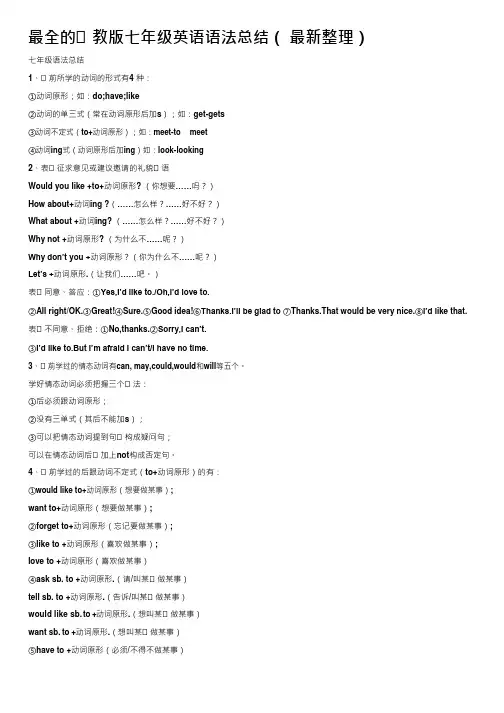
最全的⼈教版七年级英语语法总结(最新整理)七年级语法总结1、⽬前所学的动词的形式有4 种:①动词原形;如:do;have;like②动词的单三式(常在动词原形后加s);如:get-gets③动词不定式(to+动词原形);如:meet-to meet④动词ing式(动词原形后加ing)如:look-looking2、表⽬征求意见或建议邀请的礼貌⽬语Would you like +to+动词原形? (你想要……吗?)How about+动词ing ?(……怎么样?……好不好?)What about +动词ing? (……怎么样?……好不好?)Why not +动词原形? (为什么不……呢?)Why don’t you +动词原形?(你为什么不……呢?)Let’s +动词原形.(让我们……吧。
)表⽬同意、答应:①Yes,I’d like to./Oh,I’d love to.②All right/OK.③Great!④Sure.⑤Good idea!⑥Thanks.I’ll be glad to ⑦Thanks.That would be very nice.⑧I’d l ike that. 表⽬不同意、拒绝:①No,thanks.②Sorry,I can’t.③I’d like to.But I’m afraid I can’t/I have no time.3、⽬前学过的情态动词有can, may,could,would和will等五个。
学好情态动词必须把握三个⽬法:①后必须跟动词原形;②没有三单式(其后不能加s);③可以把情态动词提到句⽬构成疑问句;可以在情态动词后⽬加上not构成否定句。
4、⽬前学过的后跟动词不定式(to+动词原形)的有:①would like to+动词原形(想要做某事);want to+动词原形(想要做某事);②forget to+动词原形(忘记要做某事);③like to +动词原形(喜欢做某事);love to +动词原形(喜欢做某事)④ask sb. to +动词原形.(请/叫某⽬做某事)tell sb. to +动词原形.(告诉/叫某⽬做某事)would like sb. to +动词原形.(想叫某⽬做某事)want sb. to +动词原形.(想叫某⽬做某事)⑤have to +动词原形(必须/不得不做某事)⑥Nice/Glad/happy to +动词原形(很⽬兴做某事)如:Nice to meet you.I’m glad to be here.5、⽬前学过的后跟动词原形的有:①情态动词:can,may,could,would,will后;②助动词do,don’t,does,doesn’t后(does,doesn’t⽬出现,三单式要滚蛋);③动词please(请)后:如:Please tell him about the picnic.④短语Why not…/Why don’t you…后;⑤动词let 后;如:Let Jane help you. Let’s go home.⑥动词help后,也可带to;如:Let’s help Maria (to) carry water.⑦祈使句以动词原形开头,如:Have a seat , please.请坐下。
人教版七年级下册英语知识点复习(完整版)
人教版七年级下册英语知识点复习(完整版) Unit 1 Can you play the guitar?1,情态动词+V原can do= be able to do2,Play+ the+ 乐器+球类,棋类3,join 参加社团、组织、团体4,4个说的区别:say+内容Speak+语言Talk 谈论talk about sth talk with sb talk to sbTell 告诉,讲述tell sb (not)to do sthTell stories/ jokes5,want= would like +(sb)to do sth6,4个也的区别:too 肯定句末(前面加逗号)Either否定句末(前面加逗号)Also 行前be 后As well 口语中(前面不加逗号)7,be good at+ V-ing=do well in 擅长于be good for 对…有益(be bad for对…有害)be good to 对…友好(good 可用friendly,nice,kind替换)be good with和…相处好=get on/ along well with8,特殊疑问句的构成:疑问词+一般疑问句9,How/ what about+V-ing …怎么样?(表建议)10,感官动词(look, sound, taste, smell, feel)+adj/ like11,选择疑问句:回答不能直接用Yes或者No,要从中选择一个回答12,students wanted for school show(wanted表示招募,含有被动意义)13,show sth to sb=show sb sth give sth to sb=give sb sth14,help sb (to)do sthHelp sb with sthWith sb’s help= with the help of sbHelp oneself to 随便享用15,be busy doing sth/ be busy with sth16,need to do sth17,be free= have time18,have friends= make friends19,call sb at +电话号码20,on the weekend= on weekends21,English-speaking students 说英语的学生(带有连词符,有形容词性质)22,do kung fu表演功夫Unit 2 What time do you go to school?1,问时间用what time或者whenAt+钟点at 7 o’clock at noon/ at night(during/ in the day)On+ 具体某天、星期、特指的一天on April 1st on Sunday on a cold winter morningIn +年、月、上午、下午、晚上2,时间读法:顺读法逆读法:分钟≤30用past five past eight(8:05)half past eight(8:30)分钟>30用to a quarter to ten(9:45)整点用…o’clock 7 o’clock(7:00)3,3个穿的区别:wear 表状态,接服装、手套、眼镜、香水等Put on 表动作,接服装Dress 表动作,接sb/ oneself get dressed穿衣3,感叹句:How+adj+主谓!How+adj+a/an +n单+主谓!What+ a/an +adj+ n单+主谓!What+ adj+ n复/ 不可数+主谓!4,from…to…5,be/ arrive late for6,频度副词(行前be 后)Always usually often sometimes seldom hardly never7,一段时间前面要用介词for for half an hour for five minutes8,eat/ have…for breakfast/ lunch/ dinner/ supper9,either…or10,a lot of=lots of11,it is +adj+for sb +to do sth (adj修饰to do sth)It is important for me to learn English.it is +adj+of sb +to do sth (adj修饰sb)It is kind/ friendly/ nice of you to help me.Unit 3 How do you get to school?1,疑问词How 如何(方式)how long 多长(时间)答语常用“(For/ about +)时间段”how far多远(距离)答语常用“(It’s +)数词 +miles/ meters/ kilometers”how often多久一次(频率)答语常用“Always/ often/ every day/…”或“次数+时间”等表频率的状语How soon多快,多久以后,常用在将来时中。
2021-2022学年人教版英语七年级下册常见短语、词汇辨析(原稿)
七年级下册常见词汇、短语辨析1.the number of与a number of(1)the number of 意为“……的数量,其后接可数名词复数,作主语时谓语动词用单数。
The number of the students in our school is 2000.(2)a number of 意为“许多”,其后接可数名词复数,作主语时谓语动词用复数。
A number of students are playing on the playground now.2.too many, too much与much too(1)too many=many 意为“太多的……””,其后要接可数名词复数形式。
There are too many flowers in the garden.(2)too much=much 意为“太多的……”,后接不可数名词,还可修饰动词作状语。
I have too much homework this evening.(3)much too=too 意为“太……”,much用来增强语气,后面常接形容词或副词。
This little boy is much too fat.3.as 与like(1)as as介词,意为“作为”。
指身份或资格等,用于说明"同一"关系,即两者实为一体。
(2)like like介词,意为“像”,用于说明相似关系,即两者在形态上或性质上有相似之处,但并不等同。
4. spend, pay, cost与take(1)spendspend (spent, spent)作及物动词,意为“花费(时间、金钱)”。
指花费时间、金钱;主语为人。
常用结构:sb. spend(s) time/money on sth.(或in doing sth.) on后接名词,in后接v-ing形式,也可省略in。
(2)taketake其过去式是took,过去分词是taken,指花费时间。
人教版七年级英语下册知识点
人教版七年级英语下册知识点人教版七年级英语下册知识点概述一、词汇与短语1. 基础词汇- 学校设施:library, canteen, gym, etc.- 课程:math, science, history, etc.- 常见活动:play basketball, read books, etc.- 日常用品:pen, notebook, backpack, etc.- 常见食物:hamburger, pizza, ice cream, etc.- 家庭成员:mother, father, brother, sister, etc.- 职业:teacher, doctor, farmer, etc.2. 短语- 问路:Excuse me, where is the...?- 购物:Can I help you? How much is it?- 餐厅用语:A table for two, please. I'd like some... - 学校用语:Let's have a class meeting. It's time for class.- 家庭活动:Help with the housework. Do the dishes.二、语法点1. 一般现在时- 用法:描述经常发生的动作或状态。
- 结构:主语 + 动词原形/第三人称单数形式 + 其他。
- 例句:I usually play soccer on weekends.2. 一般过去时- 用法:描述过去某一时间发生的动作或状态。
- 结构:主语 + 动词的过去式 + 其他。
- 例句:He visited his grandparents last week.3. 现在进行时- 用法:描述正在进行的动作。
- 结构:主语 + am/is/are + 动词-ing + 其他。
- 例句:She is reading a book now.4. 可数名词与不可数名词- 可数名词:可以用数字计数的名词,如:book, apple。
新人教版初中英语七至九年级代词表汇总
新人教版初中英语七至九年级代词表汇总以下是新人教版初中英语七至九年级常用代词的汇总表:人称代词- 第一人称单数:I,我- 第一人称复数:we,我们- 第二人称单数:you,你/您- 第二人称复数:you,你们/您们- 第三人称单数:he,他/她/它- 第三人称单数:she,她/它- 第三人称单数:it,它- 第三人称复数:they,他们/她们/它们形容词性物主代词- 第一人称单数:my,我的- 第一人称复数:our,我们的- 第二人称单数:your,你的/您的- 第二人称复数:your,你们的/您们的- 第三人称单数:his,他的- 第三人称单数:her,她的- 第三人称单数:its,它的- 第三人称复数:their,他们的/她们的/它们的名词性物主代词- 第一人称单数:mine,我的- 第一人称复数:ours,我们的- 第二人称单数:yours,你的/您的- 第二人称复数:yours,你们的/您们的- 第三人称单数:his,他的- 第三人称单数:hers,她的- 第三人称单数:its,它的- 第三人称复数:theirs,他们的/她们的/它们的反身代词- 第一人称单数:myself,我自己- 第一人称复数:ourselves,我们自己- 第二人称单数:yourself,你自己/您自己- 第二人称复数:yourselves,你们自己/您们自己- 第三人称单数:himself,他自己- 第三人称单数:herself,她自己- 第三人称单数:itself,它自己- 第三人称复数:themselves,他们自己/她们自己/它们自己疑问代词- 主格:who,谁- 宾格:whom,谁- 物主代词:whose,谁的- 主格:what,什么- 宾格:what,什么- 物主代词:whose,谁的- 主格:which,哪一个- 宾格:which,哪一个- 物主代词:whose,谁的以上是新人教版初中英语七至九年级代词的汇总表。