
译林牛津版英语八年级下册 Unit 4 教学课件 Reading (1)
B. A few.
C. A large number.
Read the text again and answer the questions.
1.Did Gulliver know where he was when he woke up?
No, he didn’t.
2. Why did the tiny people tie Gulliver to the ground? (free answers)
3. Did Gulliver do anything to help himself out? What did he do?
Yes. At first, he shouted at the tiny people and then he tried to pull his hand free. Finally, he managed to break the ropes.
tells us Gulliver’s amazing adventures in some countries, including Lilliput (小人国), Brobdingnag (大人国), Laputa (飞岛国) and Houyhnms (智马国). The book became popular as soon as it was published.
by the time be tired out be tied to look down the same size as fall over continue doing sth. begin doing sth. manage to do sth. a huge many of run away get away
3. How big was the small man? He was the same size as Gulliver’s little finger.
4. Could Gulliver communicate with small man?
No, he could not.
Suppose you are Gullliver, can you tell others how strange it was in your own words?
Kitty is interested in the story. She is asking Sandy questions about it. Help Sandy answer the questions.
1.What did Gulliver after their ship crashed against the rocks?
A
B. Brobdingnag.
C. Laputa.
2. In this extract, who am “I”?
B
A. Jonathan SC. Sandy.
3. How many tiny people did “I” meet in
the end?
C
A. One.
He swam as far as he could. By the time he finally felt the land under his feet, he was tired out. He fell down the beach and went to sleep.
2. What did Gulliver find after he woke up? He found he could not move. His arms, legs and hair were tied to ground.
Let’s enjoy the movie clips of Gulliver's Travels.
Read the text quickly and answer the questions.
1.Which adventure does this extract belong to?
A. Lilliput.
Reading (1)
Do you like reading stories? What stories have you read? Why do you like them?
Have you ever read this book?
Gulliver’s Travels (1726, amended 1735) is a novel by British writer Jonathan Swift. It is Swift’s best known full-length work, and a classic of English literature. This novel
4. What were those tiny people’s reactions to Gulliver when he tried to help himself out?
At first, they were shocked by the loud noise that Gullliver made and they all fell over, but they soon got up again and continued moving across his body. Then they began talking to Gullliver. When Gullliver lifted his left hand into the air, they began to shout and a huge army of tiny people came straight towards Gulliver.
If Gullliver went to Brobdingnag, what would happen to him?
At the end of the extract, Gullliver saw a huge army of tiny people coming towards him. What will the tiny people probably do? Can Gulliver get away? Use your imagination to make up the rest of the story.
牛津译林版英语八上Unit4《Doityourself》(Reading1)说课稿

牛津译林版英语八上Unit 4《Do it yourself》(Reading1)说课稿一. 教材分析《牛津译林版英语八上Unit 4 Do it yourself》(Reading 1)的主要内容是关于一位名叫Mike的学生自己动手做家具的故事。
通过这个故事,学生可以学习到关于家具制作和房子的词汇,以及如何用英语描述一个房间的布局。
这篇文章题材新颖,贴近学生生活,能够激发学生的学习兴趣,同时培养学生独立思考和解决问题的能力。
二. 学情分析八年级的学生已经具备了一定的英语基础,能够理解和运用一些基本的词汇和语法知识。
然而,他们在阅读理解、词汇量和语言运用方面还存在一定的困难。
因此,在教学过程中,我将会关注学生的个体差异,尽量让每个学生都能参与到课堂活动中来,提高他们的英语水平。
三. 说教学目标1.知识目标:学生能够掌握文章中出现的关键词汇,如furniture, DIY,furniture store等;能够理解并运用文章中的句型,如“How much is it?”, “CanI help you?”等。
2.能力目标:学生能够独立完成阅读理解,把握文章的主旨大意;能够运用所学知识,描述一个房间的布局。
3.情感目标:通过学习这篇文章,学生能够培养自己动手解决问题的意识,提高自主学习能力。
四. 说教学重难点1.重点:学生能够理解文章的内容,掌握关键词汇和句型。
2.难点:学生能够运用所学知识,描述一个房间的布局,并能够流利地进行口语表达。
五. 说教学方法与手段1.任务型教学法:通过设定各种任务,让学生在完成任务的过程中,自然地学习和运用所学知识。
2.情境教学法:通过模拟家具店和房间布局的情境,让学生在真实的环境中进行语言实践。
3.小组合作学习:通过小组讨论和合作,培养学生独立思考和解决问题的能力。
六. 说教学过程1.导入:通过展示一些家具的图片,引导学生谈论自己喜欢的家具,激发学生的学习兴趣。
2.阅读理解:学生独立阅读文章,回答相关问题,检查学生的理解程度。
牛津译林版八年级英语下册Unit4Reading教学设计
提示:可以从探险家的动机、遇到的困难、解决问题的过程等方面展开叙述。
5.课后反思:请学生撰写一篇不少于100词的课后反思,内容包括:
a.本节课你学到了哪些知识?
b.在学习过程中,你觉得哪些方面做得好,哪些方面需要改进?
7.评价与反馈:采用多元化评价方式,包括自我评价、同伴评价和教师评价。关注学生在学习过程中的表现,及时给予反馈,指导学生改进学习方法。
8.课后拓展:鼓励学生课后阅读更多关于探险和古文明的文章,拓宽知识面。同时,布置相关写作任务,巩固课堂所学。
四、教学内容与过程
(一)导入新课
1.教学活动:教师展示一张埃及金字塔的图片,并提问:“Do you know where this is? Have you ever heard about the ancient Egyptian civilization?”(你们知道这是哪里吗?你们听说过古埃及文明吗?)
(二)过程与方法
在教学过程中,教师将采用以下方法引导学生学习:
1.预习:教师提前布置预习任务,让学生自主查找相关资料,了解探险和古文明的相关知识。
2.课堂导入:通过图片、视频等教学资源,激发学生的兴趣,引入本课的话题。
3.阅读策略:教师指导学生运用略读、寻读等阅读策略,提高阅读效率。
4.小组合作:学生在小组内进行讨论、交流,共同完成学习任务。
2.学生回答:学生根据已有知识,猜测图片中的地点,并分享对古埃及文明的了解。
3.教师引导:教师简要介绍古埃及文明,并引出本节课的主题——探险。
4.导入新课:教师宣布本节课将学习一篇关于探险的文章,激发学生的好奇心。
译林牛津版8A unit 4 Reading I 公开课教学课件PPT 8AU4
23.n. 供电中断;停电 24.n.管子,水管 25.vt.使充满 26.用…填充…
23.power cut 24.pipe 25.fill 26.fill… with 27.not only … but also…
27.不仅…而且…; .…和2…8.都ceiling
28.n.天花板
29.shelf/ shelves
2.最好/最好不要做had better do/ had better not do
3.这儿有…
Here is/ are…
4.它/它们在这儿
Here it is / they are.
5.没问题
No problem.
6.给你。
Here you are.
7.上面写着
It says…
8.一些DIY工具
some tools for DIY
51.correct-incollect 52.finished
53.adj.确定的
53.certain-uncertain
54.adj.积极的,活跃的54.active-inactive
55.adj.可能的
55.possible-impossible 56.tidy/ untidy
56.vi. & vt. 收拾,整理57.tidy up
put up a picture on the wall
23.敲裂水管
hit a pipe
24.把房间灌满了水 fill the room with water
25.把房子刷成蓝色 paint the house blue
26.不仅…而且…
not only...but also
27.建议某人(不要)做某事
Unit 4 单元复习课件-八年级英语下册(牛津译林版)
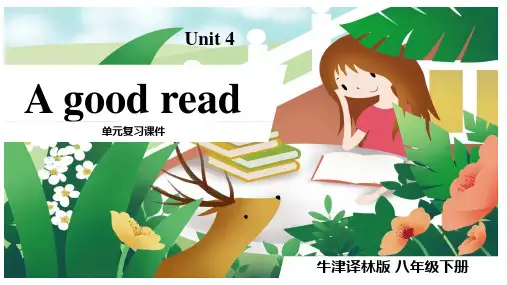
2. _s_ta_r_t_/_b_e_g_in_ doing 开始做
3. ___a_l_l_ over 到处
4. ___s_h_o_u_t_ at 对……大喊
7. ___r_u_n___ aw短ay语逃辨跑析
right away 立刻
8.
___g_e_t__
away 逃脱 go away
走开
9. talk _w_i_tht_h_r和ow…a…wa交y谈扔掉
Unit 4
A good read
单元复习课件
牛津译林版 八年级下册
Unit 4
知识点 语法
重点单词 重点短语 重点句子
疑问词+不定式 must 和 have to
Part 1 知识点回顾
踩地雷
玩法:任意读出一个单词,如果出
现魔法棒加1分,出现炸弹扣1分。
目标:检验新学单词的认读情况。
+1
-1
novel spare
Germany knowledge
French writer
消失的字母
u_gly _e _i the_r
玩法:说出以下单词所缺字母。 目标:检验新学单词中较难记的。
s_er_i _es Ca_na_d_i a_n
su_cc_ess ma_na_ge
音标拼读
玩法:说出以下音标相对应的单词。 目标:检验新学单词中较难记的。
2. It is ____n_o_t_ ___a_s___ _d_if_f_ic_u_l_t ___a_s___ I thought. 这没有我想象得那么困难。
3. He was __th_e____ ___s_a_m__e ___s_i_z_e_ ___a_s___ my little finger. 他和我的小手指一样大。
英语:Unit 4《Wild animals》Reading1教案(译林牛津版八年级上)
英语:Unit 4《Wild animals》Reading1教案(译林牛津版八年级上)一教学目标1.知识目标1.)知识并运用本课时的四会单词。
2) 理解并掌握描述熊猫外貌特性、它们所面临的危险以及采取保护措施的词组和句型。
2.能力目标1)能根据上下文猜测词汇在文中的含义。
2)能通过阅读了解名叫“希望”的大熊猫的成长过程、面临的危险以及采取的保护措施。
3.情感目标通过了解大熊猫的信息,我们意识到要善待大熊猫,它们是我们的朋友,我们应该尽力保护它们。
二、教学重难点理解文章的大意,掌握语言知识三、教学流程Part One Pre-readingStep 1 Guessing gameToday we are going to learn Unit 4 Wild animals Reading.We learned many wild animals, such as tigers, bears, kangaroos…First, let’s paly a game called ‘guessing game’I’ll describe one kind of animals, please tell me what it is at once.It is a sea animal and looks like a large fish. It is very clever and often plays some games for us in the zoo. Yes, it’s a dolphin.It’s a heavy wild animal with thick fur and sharp paws. It can walk upright.Yes, it’s a bear.It’s the king of the animal world. It has yellow fur and black stripes on its body.Yes, it’s a tige r.It jumps with its baby in its pocket. You can see it in Australia.Yes, it’s a kangaroo.It lives in China. It is black and white. Its favorite food is bamboo shoots and leaves.Yes, it’s a giant panda.Step 2 PracticeNow, let’s have a discussion.Which aniaml do you like best? Why?Which animal do you like least? Why?Part Two While-readingStep 1 PresentationI like giant pandas best. Because I think they are beautiful black and white animals. They are very lovely, quiet and peaceful.Today I will show you a passage about a giant panda called ‘Xi Wang.Step 2 ReadingWe can divide the passage into three parts.。
译林牛津版高中英语选修八Unit1Reading(1)(共15张PPT)
He uses the fortune (7) to move (move) to London and develops the shortcomings of being shallow and having prejudice, and even against his old companions. (8)However , by the end of the novel Pip has learned that wealth does not buy (9) happiness (happy) and that friends are more (10) important (importance) than a fancy education.
• 2. Avoidthe interference of the similar words.
Part II: Careful reading
1. According to the text, which of the following
is Not true?来自BA. All the classics were well written. L2
A. persuade readers to appreciate classic
literature
title & the 1st part
B. introduce Charles Dickens' novels to us
C. let readers know about Dickens
D. make a summary of Great Expectations
B. Oliver Twist was one of his famous novels.
牛津译林版英语八下Unit 4《A good read》(integrated skills)说课稿
牛津译林版英语八下Unit 4《A good read》(integrated skills)说课稿一. 教材分析《牛津译林版英语八下Unit 4 A good read》是一篇关于阅读理解和文学鉴赏的课文。
本节课的主要内容是让学生通过阅读一篇关于小说《动物农场》的评论文章,提高学生的阅读理解能力,同时培养学生的文学鉴赏素养。
教材中包含了丰富的语言知识,如词汇、语法和阅读策略,为学生提供了全面的语言学习材料。
二. 学情分析在八年级下学期的学生已经具备了一定的英语基础,能够理解和运用基本的英语语法和词汇。
然而,他们在阅读理解方面还存在一定的困难,特别是对于长篇复杂的文章。
此外,由于学生对文学作品的接触较少,他们在文学鉴赏方面的素养还有待提高。
因此,在教学过程中,教师需要关注学生的阅读理解能力和文学鉴赏素养的提升。
三. 说教学目标1.知识目标:学生能够掌握课文中的关键词汇和语法知识,如现在完成时、被动语态等。
2.能力目标:学生能够提高阅读理解能力,能够运用阅读策略理解长篇复杂的文章。
3.情感目标:通过阅读和讨论,学生能够培养对文学作品的鉴赏能力,激发对阅读的兴趣。
四. 说教学重难点1.重点:学生能够理解课文内容,掌握关键词汇和语法知识。
2.难点:学生能够运用阅读策略理解长篇复杂的文章,提高阅读理解能力。
五. 说教学方法与手段1.教学方法:采用任务型教学法,让学生在完成任务的过程中提高语言运用能力。
2.教学手段:利用多媒体课件、纸质教材和网络资源等,为学生提供丰富的学习资源。
六. 说教学过程1.导入:通过提问学生喜欢的书籍和作家,激发学生对文学作品的兴趣,引入本节课的主题。
2.阅读理解:学生自主阅读课文,回答相关问题,教师引导学生运用阅读策略理解文章。
3.词汇语法:学生通过课文学习新词汇和语法知识,教师进行讲解和练习。
4.小组讨论:学生分组讨论课文中的观点和表达方式,培养学生的批判性思维能力。
5.文学鉴赏:教师引导学生分析课文中的文学手法和特点,提高学生的文学鉴赏素养。
牛津译林版八年级下册Unit4《Agoodread》说课稿5
牛津译林版八年级下册Unit 4《A good read》说课稿5一. 教材分析《A good read》是牛津译林版八年级下册Unit 4的一篇阅读文章,主要介绍了一本好书对人们的影响以及如何选择适合自己的书籍。
通过本文的学习,学生可以提高阅读理解能力,了解好书对个人成长的重要性,并学会如何选择适合自己的书籍。
二. 学情分析八年级的学生已经具备了一定的英语基础,对阅读理解有一定的掌握。
但部分学生可能在阅读长篇文章时存在困难,对文章主旨和细节的把握不够准确。
因此,在教学过程中,需要关注学生的个体差异,引导他们掌握阅读技巧,提高阅读理解能力。
三. 说教学目标1.知识目标:学生能够掌握文章中的关键词汇和短语,理解文章的主旨和细节。
2.能力目标:学生能够运用阅读技巧,快速把握文章大意,提高阅读理解能力。
3.情感目标:学生能够认识到好书对个人成长的重要性,学会如何选择适合自己的书籍。
四. 说教学重难点1.重点:学生能够熟练阅读文章,理解文章的主旨和细节。
2.难点:学生能够运用阅读技巧,准确把握文章中的长句和难句。
五. 说教学方法与手段1.任务型教学法:通过设定各种任务,引导学生主动参与课堂,提高阅读理解能力。
2.合作学习:学生分组讨论,共同完成任务,培养团队协作能力。
3.情境教学法:创设情境,让学生在实际情境中运用所学知识。
4.信息技术手段:利用多媒体课件和网络资源,丰富教学内容,提高学生的学习兴趣。
六. 说教学过程1.导入:利用多媒体展示一些好书封面,引导学生谈论自己喜欢的书籍,激发学生的学习兴趣。
2.自主阅读:学生自主阅读文章,了解文章大意,回答相关问题。
3.课堂讨论:学生分组讨论,分享阅读心得,讨论如何选择适合自己的书籍。
4.深度阅读:教师引导学生分析文章结构,讲解重点词汇和短语,帮助学生准确理解文章内容。
5.实践环节:学生分组进行角色扮演,模拟推荐书籍的场景,运用所学知识。
6.总结提升:教师总结课堂所学,强调好书对个人成长的重要性,引导学生树立正确的阅读观念。
牛津译林版英语八年级上册Unit4_reading_1教学设计
牛津译林版英语八年级上册Unit4_reading_1教学设计一. 教材分析牛津译林版英语八年级上册Unit4_reading_1主要讲述了一个关于环境保护的故事。
通过描述一个小镇因为污染而变得不适宜居住,人们不得不搬离,来引起学生对环境问题的关注。
教材通过这个故事,让学生学会如何从文章中获取信息,提高阅读理解能力,并引导学生思考环境保护的重要性。
二. 学情分析八年级的学生已经具备了一定的英语基础,能够进行简单的阅读和口语交流。
但他们在阅读理解,尤其是推理判断和归纳总结方面还有待提高。
此外,学生对环境问题有一定的认识,但可能缺乏深入思考和探讨。
三. 教学目标1.能理解文章的主旨大意,把握文章的逻辑关系。
2.能从文章中获取相关信息,提高阅读理解能力。
3.能运用所学知识,讨论环境问题,并提出解决方案。
4.提高学生的思维能力,培养他们的环保意识。
四. 教学重难点1.重点:理解文章的主旨大意,把握文章的逻辑关系;从文章中获取相关信息,提高阅读理解能力。
2.难点:推理判断和归纳总结能力的运用;讨论环境问题,并提出解决方案。
五. 教学方法1.任务型教学法:通过完成各种任务,让学生在实践中学习,提高他们的阅读理解和口语表达能力。
2.启发式教学法:引导学生思考,激发他们的学习兴趣,培养他们的创新意识。
3.合作学习法:让学生分组讨论,培养他们的团队合作精神,提高他们的解决问题的能力。
六. 教学准备1.教材:牛津译林版英语八年级上册。
2.多媒体设备:用于展示课件和视频资料。
3.课件:根据教学内容设计的课件。
4.视频资料:与文章内容相关的环境问题的视频资料。
七. 教学过程1.导入(5分钟)利用视频资料,展示一些环境问题的现象,如空气污染、水污染等,引导学生关注环境问题,激发他们的学习兴趣。
2.呈现(10分钟)展示课件,介绍文章的主旨大意,让学生对文章有一个整体的认识。
同时,引导学生关注文章的标题,激发他们的阅读欲望。
2020-2021学年牛津译林版英语八年级下册 Unit 4 A good read Task 课件
opposite my home. My friends give me lots of advice on
books. We often meet togetwhehr oand discuss what to read.
Reading is always a wondewrfuhl tyime. Good books are good
buy books at bookshops
order books online
receive books as gifts
1. advice /əd'vaɪs/ n. 建议,劝告 2. 2. librarian /laɪ'breəriən/ n.图书管理员 3. habit /'hæbɪt/ n.习惯 4. classical /'klæsɪkl/ adj.古典的
I get most of my books from Sunshine Library —it is just opposite my home. My friends give me lots of advice on books. We often meet together and discuss what to read.