
五年级英语下册第4单元第2课时
外研版五年级下英语第四模块
外研版五年级英语下学期第四模块Module 4 Library单元备课一、单元导学目标学习句子:Where is/are the …about…,please?It’s/They’re…/They are on Shelf C.Where can you find out about…?You can find out about… in / on…学习单词: library, find等11个单词功能:U1: 如何在图书馆借书; U2 寻问和寻找相关信息。
任务:当图书馆管理员或商场导购员;当个“小灵通”,引导同学查找材料。
二、单元导学重点识记单词:library, find等11个单词能口头运用Where is/are the …about…,please?It’s/ They’re…/They are on Shelf C.Where can you find out about…?You can find out about… in / on…这类语句用英语进行交流。
三、单元导学难点学会如何在图书馆借书并用英语进行交流。
四、单元教学准备单词卡片,录音机及磁带,光盘,课件五、教学措施1.复习第五册M6-7中有关can 的句型,为新课作铺垫;2.U1的教学以听说为主,通过复习where的句型引出Where are the …? They are on Shelf C.的教学,让学生进行记忆游戏,在玩中使本句型达到熟能生巧的程度。
3.课文教学,利用本课提供的情景,让生了解去图书馆查找资料的整个过程,并结合课文的教学,让学生完成选拔优秀图书管理员或商场导购员,让学生进一步巩固所学,并能学以致辞用。
4.在U1的基础上,U2 的课文教学,先设计Mr Smith要来中国旅游,遇到一些困难,Can you help him?提出本课的任务---当旅游的小咨询员,给到中国旅游的外国朋友解决困难,引导他们去寻找自已想要的材料;接着进行freetalk,师问“Where can you find out about animals/ weather…?发散学生的思维,让学生竭尽所能,实现课堂上知识的滚动,进而引导学生学说:We can find out the books in the library/ in the dictionary/ in the CD-ROM/in the newspaper/in the timetable/ at the zoo/ on TV/….5.通过师生听音、讨论和学习课文,最后完成旅游小咨询员的任务,再次巩固新句型;6.本课的任务也可以设计为“当生活中的小灵通”,同样能很好地拓展本课的知识。
五年级下册英语-Lesson 4 Where do you live? Period 2 科普版
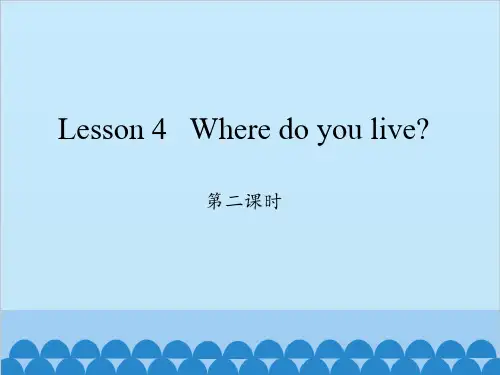
My wife is very ill. Can you come and see her?
Ok. Let’s go at once.
I live in a small village.
They walked for a long time and got to the village very late.
Lesson 4 Where do you live?
第二课时
Warming
I’m a student and I live in China. Where do you live?
Presentation
Where is it? It is New York.
Presentation
Where is it? It is Washington.
Practice in pairs
Where do you come from? I come from the UK. Where do you live? I live in London.
Practice in pairs
Where do you come from? I come from Russia. Where do you live? I live in Moscow.
Thank you.
Read for fun
Liu Jun is a doctor. He comes from Sichuan. Now he is working in a small town in Yunnan. He is always ready to help others.
Where do you live?
Liu Jun examined the sick woman and gave her some
Unit4 Seeing the doctor(单元解读)五年级英语下册(译林版三起)
五下Unit 4 Seeing the doctor单元解读一、单元教材分析本单元在英语核心素养的育人价值下进行,围绕单元主题“人与自我”范畴中的“生活与学习”展开教学。
教学重点是表示建议的情态动词should 和否定式shouldn’t 的用法。
有关询问和描述病情的句型What’s wrong with you? 和I have a headache. 也是本单元的另一个重点教学内容。
二、单元教学目标1.会听说读写词组:brush one’s teeth, drink water, eat sweets, have a rest , take medicine2.学会疑问句型“What’s the matter with you?”和“What should I do”,以及对它们的答语。
3.了解并掌握情态动词的用法。
4.读准字母组合ch 的发音。
三、教学重点1. 能理解Story time 的内容,并会复述。
2. 会使用如下两个句型,并能在日常对话中使用:What’s wrong with you? I have ....What should I do? You should.3. 掌握情态动词的用法。
4. 掌握字母ch 组合的发音四、教学难点1.会复述Story time 的内容。
2.会自如使用如下两个句型,并能在日常对话中使用。
What’s wrong with you? I have。
What should I do? You should.3.了解并掌握情态动词的用法。
4. 单词medicine temperature 的发音五、课时安排:(4 课时)第1课时: Story time (text,Ask and answer,Think and write)第2 课时: Grammar time&Fun time第3课时: Cartoon time & Sound time第4 课时: Culture time, Checkout time&Ticking time课时说明:第1课时:Story time:讲述的是苏海感冒去看医生的过程以及迈克去看牙医的过程由此引起新单词feel, check, should和新短语brush one’s teeth, drink water, eat sweets, 以及新句型What’s wrongwith you? I have… / I feel…。
PEP英语五年级下册第四单元教案Unit 4 When is the art show教案含反思

Unit 4 When is the art show?Part A 第一课时Let’s try & Let’s talk教学目标:1.能询问及回答节日所在月份及日期。
2.能理解Let’s talk 的大意,能用正确的语音语调朗读对话。
3.能在语境中运用When is the art show? It’s on May 1st.类似句型来交流相关节日月份及日期。
4.能够在情景中运用句型There are some special days in April.表达某月有多少特殊的日子。
5.能够在语境中理解单词special的意思,并能正确发音。
教学重点:能够用正确的语音、语调、意群朗读对话,并能分角色朗读。
教学难点:能够在情景中运用句型When is April Fool’s Day? It’s on April 1st. And Easter? It’s on April 5th this year.询问并回答节日的日期。
教学准备:教学光盘,节日的图片。
教学过程:Step 1: Warm-up1.Greetings 师生互相问候。
2.教师播放第三单元歌曲,学生齐唱。
3.师生对话:T: When is English test? /math test…Ss: It’s on…4.学生展示unit 3准备的对话或课本剧。
Step 2: Presentation1.Let’s try.(1)出示Let’s try板块的图片,描述图片。
(2)教师提问:Where is Zhang Peng? What is he doing? 学生回答后,教师说:Zhang Peng is practicing running. Mr Jones is talking to him. Which month are they talking about? Listen and tick, please.(3)学生听录音,完成听音选月份的练习。
上海沪教牛津版小学五年级英语下册Unit 4 Reading is fun 习题及答案
上海沪教牛津版小学五年级英语下册:Unit 4 Reading is fun 习题及答案第1课时一、选词填空。
1.There (are/is) many books in the library.2.I'm going to (bought/buy) some books.3.There's (an/a) storybook on the desk.4.It's Stories (for/of ) Children.二、单项选择。
( ) 1.-Do you like this storybook?-A.Yes, they are.B.No, it is.C.Yes. It's fun.( ) 2.Look at the picture my family.A.forB.ofC.with( ) 3.She is the bookshop.A.ofB.onC.at三、阅读理解,判断正(T)误(F)。
Mike is a student. He is my good friend. He is busy at the weekend.He is going to buy a storybook on Saturday morning. He is going to read a story every day. He likes reading books best.( ) 1.Mike is a good student.( ) 2.Mike is busy at the weekend.( ) 3.I'm going to buy a storybook on Saturday morning.( ) 4.Mike likes books very much.第2课时一、英汉互译。
1.制作海报2.在那边3.do a survey4.act…out二、找出问句对应的答语。
外研社小学英语五年级下册 module 4 第2课时 Unit 2 We can find information from books and CDs.

Unit 2 We can find information
from books and CDs.
(第2课时)
Read the words and translate
Warm-uplibra来自yputwrong ask
idea
heavy
2
Let’s chant
Let’s go to the library. There’s a lot to enjoy. Books, CDs and computers. You can read, listen and play!
20
Listen and say
ie
igh
pie
light
ir girl
lie
night
skirt
21
Talk about your school library and write Practice
We can find books about animals in our school library. We can find CDs about science in our school library.
Listen and answer the questions
1. What are they going to do? They are going to do a science project about animals.
2. What is the guide? This is a guide for us to get information from the school library.
We are going to do a science project about animals. 我们打算做一个关于动物的科学项目。 This is a guide for us to get information from the school library. 这是一个教我们如何从学校图书馆获取信息的指南。 We can find information from books and CDs. 我们能从书和光盘中找到信息。 We can find information from films and e-books as well. 我们也能从电影和电子书中找到信息。 There are lots of different ways to find information on this topic. 有很多不同的方式可以找到关于这个话题的信息。
PEP人教版五年级英语下册第四单元一课一练(附答案)
精品基础教育教学资料,仅供参考,需要可下载使用!PEP人教版五年级英语下册第四单元一课一练Unit 4 When is the art show?第一课时一、看图连线。
1. China’s National Day Jan.1st2. Children’s Day Apr.1st3. April Fool’s Day June 1st4. New Year’s Day Oct. 1st二、连词成句。
1.is, when, Day, Fool’s, April (?) ___________________________________________________2. some, in, are, there, July, special days (.) ___________________________________________________3. China’s, Day, is, When, National (?)__________________________________________________4.are, about, month, they, which, talking (?) __________________________________________________三、将下面的句子重新排列,组成对话。
()April Fool’s Day and Easter.()And Easter?()There are some special days in April.()Wow! I love April.()When is April Fool’s Day?()It’s on April 5th this year.()What are they?()It’s on April 1st.一、给下列单词排序,并按顺序写出它们的缩写形式。
fifth second first fourth third排序:____________________缩写:______________________________二、读一读,按照例子写一写。
人教PEP版英语五年级下册《Unit 4 Part B 第二课时》教学课件
This is the photo of Wu Yifan’s family.
When is … birthday? It’s on….
Act out
When is …’s birthday?
It’s on ….
Practice
Look and write
When is your birthday?
July 20th Mum’s birthday
—It’s __o_n___N_o_v_e_m_b_er__1_s_t_.
November 1st Dad’s birthday
Summary
1. 学习了下列单词:twelfth, twentieth,
七彩课堂 twenty-first, twenty-third, thirtieth等。
谢谢 大家
本课件是在Micorsoft PowerPoint的平台上制作的,可以在Windows环境下独立运 行,集文字、符号、图形、图像、动画、声音于一体,交互性强,信息量大,能多路 刺激学生的视觉、听觉等器官,使课堂教育更加直观、形象、生动,提高了学生学习 的主动性与积极性,减轻了学习负担,有力地促进了课堂教育的灵活与高效。
第十二(的)
What’s the twelfth gift? It’s a storybook.
第二十(的)
What’s the twentieth gift? It’s a bell.
第二十一(的)
What’s the twenty-first gift? It’s a bat.
第二十三(的)
二、用单词的适当形式填空。
1.—When is _G_r_an_d_p_a_’s_ birthday? —It’s in May. (Grandpa)
小学英语五年级下册Unit4单元教材及学情分析(人教版)
小学英语五年级下册Unit4单元教材及学情分析(人教版)小学英语五年级下册Unit 4单元教材及学情分析(人教版)1.单元教材分析本单元主要通过进一步研究月份日期(序数词)和节日名词,让学生掌握各个节日的具体时间及各个节日的活动,更进一步地研究一般将来时态和序数词,并进一步地了解一些西方的节日传统,培养学生日常口语的交际能力。
学会使用特殊疑问词when并会使用序数词和一般将来时态,学会用介词on和序数词的缩写形式。
涉及的主要句型有:When is Mid-AutumnXXX.教师在教学过程中要注意介词on的应用,这也是本单元的重点。
同时,要注重对西方文化的渗透。
涉及这方面的内容时,要结合学生已有的认知水平进行适当拓展。
本单元和第三单元紧密相连,因此,我们要把新旧知识融合在一起,研究新知识的时候也要巩固旧知识,让学生对知识有系统的了解。
本单位的教学重点是研究月份名词和序数词及其缩写形式:first(1st),second (2nd), third (3rd), fourth (4th), fifth (5th), sixth (6th), eight h (8th), ninth(9th) … twelfth (12th), fifteenth (15th) … twentieth (20th), twenty-first (21st)…以及询问某个节日时间的句型:When is …? It's in/on…表示在将来要做的工作的句型:We/I/… will +do(动词原形).这些也是本单位的教学难点。
此外A和B局部的Let's talk的对话也是本单位的难点。
教师要给学生提供适当情景,在情景中认知、熟新知,在社交中运用新知。
另外,Read and write局部教师要偏重阅读办法的指导,要有目的地指导学生,带着问题去阅读,并适当处理好生词。
Let'swrap it up为我们归纳了序数词的基本用法,在学会了应用后,我们可以适当地举行拓展,让学生了解更多的英语知识。
Unit4Don’ttalkhere第2课时(教学设计)湘少版英语五年级下册
学生在读D部分课文,完成表格。
请在他们喜欢的项目下画
Step 4 趣味活动(Let’s have fun)
1.解释呈现标志,学生说出祈使句的否定式。
2.I can read
学生选择任意一条规则,边做动作边读出句子。
3.I can draw
总结
作业设计
Step 5 作业布置(homework)
1.收集生活中见到的标志。
2.完成练习册unit 4。
板书设计
Unit 4 Don’t talk here
教学反思
师 生 活 动
教学环节
第二课时教学设计
二次备课
导入
Step 1 热身/复习(Warm-up/Revision)
1.Greetings
2.用课件出示B部分图片,看图片说英语。
新授
Step 2 阅读前(Pre-reading)
1.师生问答。
T: I like reading. What do you like?
S1: I like drawing/…
T: Do you like swimming?
S2:Yes, I like swimming./No, I like singing./…
2.谈论对季节的喜好。
Step 3 阅读中(While-reading)
1.初读课文。
学生快速阅读课文D部分,了解文章大意。完成下列判断题。
xx区xx小学集体备课教学设计
备课组年级:五年级 任教学科:英语 总第 12 课时
课题
Unit 4 Don’t talk here
课型
阅读课
课时安排
第2课时
备课时间
主备人