
牛津译林版 高中英语选修9-Unit 4 单元教案
M9 Unit 4 Teaching plan (Behind beliefs )Period l Welcome to the unitTeaching Objectives:1. Students learn about the beliefs or religions.2. Develop students’ speaking ability by talking about different beliefs or religions. Enable students to discuss their knowledge about beliefs or religious, famous religious places and festivals related to religion.3. Encourage students to express their opinions.Teaching important and difficult points:Understand and discuss then express the opinions about beliefs or religious.Procedures:Step 1 BrainstormingWhat religions do you know about? Today in this part we’ll deal with beliefs and religions.As we all know, different people have different religions or beliefs or faiths. Religions are very important to many people. For us, we should know something about religions of English-speaking countries.Do you know about the religions in China?Buddhism was introduced to China from India approximately in the 1st century AD, becoming increasingly popular and the most influential religion in China after the 4th century. Tibetan Buddhism, as a branch of Chinese Buddhism, is popular primarily in Tibet and Inner Mongolia. Now China has more than 13,000 Buddhist temples.Step 2 Sharing information Look at the following pictures and discuss them.Picture 1 What date is Christmas Day? (On 25th December.)What do you know about Christmas? (Christmas Day is a Christian holiday. It is regarded as the birthday of Jesus Christ.)What do people do on Christmas Day? ( Before Christmas Day,people will go to shops to buy Christmas decorations, Christmas cardsand presents together with wrapping paper for friends or relatives. OnChristmas Eve, family members get together or go to church to enjoythe Christmas carols. )What do people eat on Christmas Day?People will prepare lots of chocolates, nuts and snacks. A roast turkey or goose is usually served for Christmas dinner.Picture 2 Have you ever read this book? What do you know about it?● a classic piece of Chinese literature● a combination of myth, parable and comedy● a trip to India for Buddhism●main characters include a Buddhist monk who is also know as thePriest of Tang and his three followers, Monkey King, Pigsy and FriarSand.How many obstacles do they meet during the journey?There are 81 obstacles for the monk and his three followers on the way to the West.Why do you think they face these obstacles?● to give the monk and his three followers an insight into their own characters and show thatpeople must offer struggles to succeed● to symbolize the difficulties and challenges that people meet in the course of doing what they believe inPicture 3 What is a mosque used for?A mosque is a place for Muslims to worshipDo you know any famous mosques in China?● the Id Kah Mosque in Kashgar, Xinjing. This mosque was built in1442 and is the largest in China.●the Great Mosque in Xi’an, Shaanxi Province. It was built in the18th century with a traditional Chinese architectural style.Do you know of any famous mosques in China?There are many famous mosques in China. One of them is the Id Kah Mosque in Kashgar, Xinjiang. This mosque was built in 1442 and is the largest in China. Another famous one is the Great Mosque in Xi’an, Shanxi Province. It wa s built in the 18th century with a traditional Chinese architectural style.Picture 4● Taoism is one of the major religions in China. Taoism probablytook shape as a religion during the second century, based on thephilosophy of Lao Zi (traditionally said to be born in 604 BC) and hiswork, the Dao De Jing (Classic of the Way and Virtue). China nowhas more than 1,500 Taoist temples.● Taoism believes in ‘wuwei’, which means that everything mustfollow its course and happen naturally.Step3 Discussion1. Although there are so many beliefs or religions, do you think that they have something in common? ● Encourage people to do good ● Have a power to call on people to devote themselves to that religion ● Help people live their lives in a positive way● Motivate people to be compassionate, kind and loving2. Can you name any other religions around the world that you have heard of?Hinduism印度教Judaism犹太教Buddhism 佛教Islam伊斯兰教3. Do you know any famous religious places?The Mogao Grottoes (Dunhuang, Gansu ) The White Horse Temple (Luoyang, Henan)The Vatican (Italy) Anuradhapura (Sri Lanka) Mecca (Saudi Arabia)Mount Wudang (Hubei Province)4. Can you name some religious festivals around the world?For Buddhists, there is Nirvana Day, Buddha’s D ay or Bodhi Day.For Christians, there is Good Friday, Easter Day, All Saints’ Day, and of course Christmas Day. For Muslims, there is Eid, the festival of sacrifice, Muhammad’s Birthday or Forgiveness Day. For Hindus, there is Great Shiva Night, Humanity Day or the Festival of Lights.For Jews, there is Passover, Day of Atonement or Harvest Festival.Step 4 Homework 1. Search and discuss more knowledge about beliefs. 2. Preview the readingPeriod Two Reading (1) Biblical idioms in EnglishTeaching Objectives:1. Enable students to gain some knowledge about idioms, understand their original meanings and learn about their practical usage in English.2. Students are expected to understand the main idea about the passage, practice and reinforce their reading comprehension and improve their overall ability.Teaching important and difficult points:Gain some knowledge about idioms, and improve their overall abilityProcedures:Step 1 Lead-in 1. Ask: Have you read the Bible?Have you read Bible stories?Do you know any figures in the Bible? Which figure do you like best?2. Show pictures to students, and introduce something about the Bible.The Bible is often described as “the greatest book ever written.” This is because of its unend ing significance and influence on people throughout the ages. No other book in history has impacted peoples and cultures like the Bible.2. As we all know, there are many idioms in English, and most of them come from the Bible. Let’s look at the following dialogues. Can you guess the meanings of the underlined words?1. A:Oh, my God! What happened? Why are you black and blue?B:I got beaten by Peter’s brotherA:That’s a bad apple! Let’s think up a way and teach him a lesson. (坏蛋)2. A:Give the skates to me!B:You shut up!A:If you don’t know how to skate, why don’t you give the skates to me? Don’t be a dog in the manger. (占着茅坑不拉屎)3. A:There’s no point in losing temper on me. It’s unfair! (没理由)B:What did you do to him?A:If I did something bad, I wouldn’t blame him for getting angry with me. The point is that I did nothing wrong.B:Maybe he thought you reported him to the manager.4. A:I think it was Jason who stole my document.B:Fat chance! (微小的机会;极少的可能)A:He’s the only one who left here late.B:I know h im. He’ll never do that sort of thing.5. A:Where’s Annie?B:In the house.A:In the house? Where is she?B:Search me, I don’t know where she is now. [(非正式)不知道]Step 2 Fast readingGo through the passage as quickly as possible and try to find answers to the three questions in part A on Page 50. Pay attention to the most important information.What is an idiom?An idiom is a group of words or an expression whose meaning often cannot be understood by looking at the meanings of the separate words in it.Which languages was the Bible first written in?In Hebrew.Which idiom is often used to describe children?Apple of their parents’ eye.Step 3 Careful reading1. Listen to the recording and follow, then read it carefully and answer the following questions in Part C1. These questions interpret some information in the passage, so finish them and try to improve the students’ ability to find specific information.1) Why does the Bible have a lot of idioms?Because the Bible was first written in Hebrew and then translated into Greek, and many idioms are used in both of them. Because the Bible was translated into English hundreds of years ago, many Hebrew or Greek idioms have become part of the English language.2) What did ‘by and by’ originally mean in the Bible? Immediately.3) What does ‘by and by’ mean today? Before long.4) How many years ago was the Bible translated into English? Hundreds of years ago.5) What does ‘feet of clay’ mean?There is a hidden weakness in somebody whom we admire or respect.6) Which animals are featured in the idioms in the articles? Bird and clay.7) Which foods are included in the idioms in the article? Apple and salt.8) How is studying idioms useful in language learning? You can improve your comprehension and develop a high level of competence in level of competence in communication skills.Step 4 Practice Complete Part D. Students may refer to the reading passage on pages 50 and 51 for some help. D: 1j 2b 3a 4c 5e 6d 7f 8h 9g 10iStep 5 Language points1. lead a life of luxury: 过着...的生活/日子 to lead a happy life 过着快乐的生活to lead the life of the spirit 过崇尚精神的生活We lead a quiet life in the country. 我们在乡下过着安静的生活。
译林牛津版高中英语选修9教案:U4 Grammar and usage 5-9
牛津高中英语教学设计单元:Unit 4 Behind beliefs板块:Grammar and usage 1Thoughts on the design:本节课是以复习和归纳为主的语法教学课。
努力遵循认知规律,让学生在体验到真实的语言材料之后来进行发现——归纳——应用的实践。
其次,兼顾“知、情、意”即在语法教学中要有:知——语法知识、学习方法的学习;情——学生在学习中的成功体验,教师在教学中和学生的情感互动;意——人文精神和人生意义的体悟与提升。
Teaching aims:After learning“Analysis of complicated sentences”, the students will be able to understand the basic structure of simple sentences, compound sentences, complex sentences and complex-compound sentences. And they will be able to combine simple sentences into complicated ones and develop their reading skills on analyzing complicated sentences.Teaching procedures:Step 1 Members of sentences1. What makes a sentence? [PPT4]Generally, sentences are made up of two main parts: subject and predict.Subject is what the sentence is about.Predicate tells us something about the subject and always include a verb. [Explanation]明确句子的基本成分:主语和谓语。
高中英语 Unit4 Behind beliefs Welcome to the unit教案 牛津译林版选修9
1. The multimedia 2. The blackboard
【Teaching Procedures】
Step 1 Lead-in
1. Draw students’ attention by showing a picture of a school trip and ask them to imagine and think about the following questions”(PPT5)
3. Tell students that many religious people also believe that the religion gives answers which explain humankind’s relationship with the world and the universe.
What makes them believe that will help?(PPT7)
(Possible answer: They believe someone who is powerful may control their future. That is the influence of religion.)
(Possible answer:There are many famous historic religious sites inChina. The Mogao Grottoes inDunhuang,GansuProvince and the White Horse Temple inLuoyang,HenanProvince are the famous Buddhist sites.MountWudanginHubeiProvinceis famous for Taoism. ThePotalaPalaceinLhasa,Tibet, is the holy place for Tibetan Buddhism.)
【牛津译林版】选修九:Unit4《Behind beliefs》教案
Mudole 9 Unit4 behind beliefsReading 1学习目标 :本教学案用于本单元第一课时的课文阅读理解教学。
通过图片、文字等的展示,从泛读到精读到巩固提升层层开展教学,以达到 学习目的。
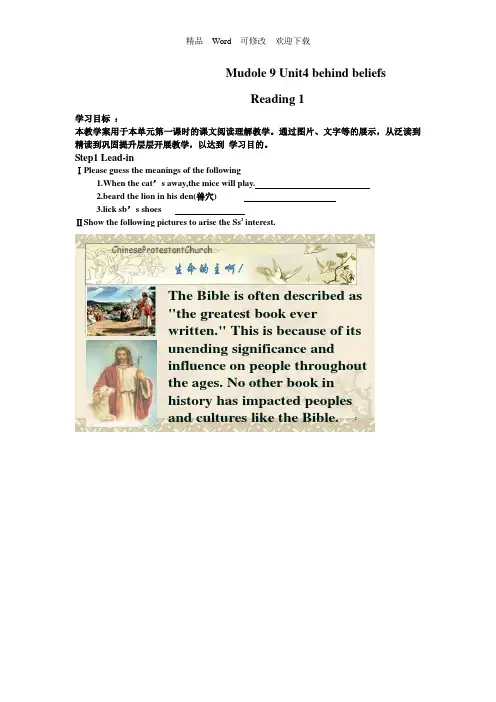
Step1 Lead-inⅠPlease guess the meanings of the following1.When the cat ’s away,the mice will play.2.beard the lion in his den(兽穴)3.lick sb ’s shoesⅡShow the following pictures to arise the Ss ’ interest.5The Bible is often described as"the greatest book everwritten." This is because of itsunending significance andinfluence on people throughoutthe ages. No other book inhistory has impacted peoplesand cultures like the Bible.6God created the world.7The birth of Jesus ChristⅢG uess the meanings of the underlined wordsAsk individual student to guess1.A:Oh, my God! What happened? Why are you black and blue?B:I got beaten by Peter’s brotherA:That’s a bad apple! Let’s think up a way and teach him a lessona bad apple:2. A:Give the skates to me!B:Y ou shut up!A:If you don’t know how to skate, why don’t you give the skates to me? Don’t bea dog in the manger.a dog in the manger3. A:There’s no point in losing temper on me. It’s unfair!B:What did you do to him?A:If I did something bad, I wouldn’t blame him for getting angry with me.The point is that I did nothing wrong.B:Maybe he thought you reported him to the manager.no point4 . A:I think it was Jason who stole my document.B:Fat chance!A:He’s the only one who left here late.B:I know him. He’ll never do that sort of thing.Fat chance:5. A:Where’s Annie?B:In the house.A:In the house? Where is she?B:Search me, I don’t know whereshe is now.Search me, I don’t know whereStep2 PresentationⅠ.Reading the article quickly and answer the following questions in Part A1. What is an idiom?2. Which languages was the Bible first written in?3. Which idiom is often used to describe children?Ⅱ.Careful readingRead it carefully and answer the following questions in Part C1.1. Why does the Bible have a lot of idioms?2. What did ‘by and by’ originally mean in the Bible?3. What does ‘by and by’ mean today?4. How many years ago was the Bible translated into English?5. What does ‘feet of clay’ mean?6. Which animals are featured in the idioms in the articles?7. Which foods are included in the idioms in the article?8. How is studying idioms useful in language learning?衔接T: How many idioms have been mentioned in this article? What are they?Ss :Six. They are by and by, feet of clay, a little bird told me, kill the fatted calf, apple of their parents, the salt of the earthT:Can you use them properly?Apply these idioms into practical usage.1. Sarah’s grandmother adores her; Sarah is ______________________________.2. Wilson was disappointed when he learnt that the coach had ___________.3. She knew it might take a long time for her teammates to change their minds, but shebelieved that the new plan would work _________.4.The people in my village are very honest and hard-working;they are .5.When my brother came back home from his trip to Europe, we _____________for him.6.She would not say who told her about the surprise party. She just said,‘_________________.’Step3 Consilidation1.PartD Guess these new words from the context.2.Part E on page 53T:Wang Gong wrote a short passage about idioms from the Bible, but part of the page smudged.Read the passage and help him fill the blanks with the words from the box below.Ask one student to give his or her answers in class.Then check the answers.3.DiscussionDiscuss with your partners and try to divide the text into 4 parts with thehelp of main ideas of each part given to you.(1)What is an idiom? (Para______)(2)Why does the Bible have a lot of idiom? (Para______)(3)What are the features of Biblical idioms? (Para______)(4)Why should we learn idioms well? (Para______)4. Detailed reading(1) Read Para. 1 and 2 again carefully. Answer the following T/F questions.a. The meanings of an idiom is always the same as the meanings of its components.b. Y ou can easily misunderstand a sentence if you don’t recognize an idiom is being used.c. The original meaning of Biblical idioms have never changed.(2) The features of Biblical idioms (Para3-5) :a. Biblical idioms originally had straightforward and clear meanings.b. Many idioms from the Bible that use animals to create an image.c. Another focus of Biblical idioms is often food or things related to food.(3) Read paragraph 6 again carefully and try to list the benefits of learning idioms①improving your _______________②Developing a high level of competence in your ___________ ___________③Giving help to you if you want to be an _____________or ______________④Better _____________ and ____________ the _________ and _____________ ofEnglish-speaking countriesStep4 Exercises1.Fill in the blanks with proper words according to the reading material.W: Hi. I’d like to know something about idiom. Could you please tell me?M: With pleasure. An idiom is a group of words or an (1)e_________ whose meaning often cannot be understood by looking at the meanings of the (2)s_________ words in it.Its meaning can be completely different from the meanings of its (3)c_________ . It you can’t recognize when an idiom is being used, you can (4)m_________ what you read or hear spoken.W: Then where do many idioms come from?M: They mostly come from the Bible which was first written in Hebrew and then translated in to Greek. However, many idioms have either lost their (5)o_________ meanings or have only a vague or loose (6)c_________ to Hebrew or Greek idioms.W: What meanings do Biblical idioms have?M: Biblical idioms originally had (7)s_________ and clear meanings because they were often meant to (8)u_________ the moral of a story and to give audiences an image to help them to understand the story better. And there are also many idioms from the Bible that use animals to create an image. Another focus of Biblical idioms is often food or things(9)r_________ to food.W: Should we master as many Biblical idioms as possible?M: Of course. Idioms are an important part of language and are used in everything. Studying them can help improve you comprehension, and by learning enough important idioms, you can develop a high level of (10)c_________ in your communication skills.2.Task-readingFill in the blanks with proper words.show this on the slides.Give them some time to prepare.then get some of them to give answers.Thedefinition ofanidiomA group of words or an expression whose meaning can only be understood by looking at the (1) meaning of the words in it Using a number of words to represent a single object ,person or concept, etc The (2)oflearningidioms(3)your comprehension Developing a high level of competence in your communication skills Giving (4)to you if you want to be an interpreter or translator Better understanding and appreciating the history and culture of English-speaking countries The (5)ofBiblical Idioms The Bibe (6) of image (8)(9)Feet of clay A hidden weakness (7) A little bird told me Used when people want to say that they know something but not who told them Kill the fatted calfHaving a large celebration Food-related Apple of their parents Meaning their parents love them very much when childrenare (10)as the appleThe salt of the earth A good and honest person whole/complete benefit Improving Examples help Meanings regarded Animal-relatedoriginTypesStep5Homework1.Read the text again after class and underline the expressions or sentences which are not clear about.2.Try to finish A1 and A2 in your workbookFeedback:。
译林牛津版高考英语选修9同步教案Unit 4 Behind beliefs 重点词汇讲解
U4 重点词汇讲解1. figure1) figure n. 数字;钱数His score is now well into double figures.他的得分现在已达到两位数了。
It is estimated that his property is up to a figure of $200 million.据估计他的财产已达两亿美元的金额。
2) figure n. 体形,体态How does she manage to keep her figure when she eats so much? 她吃这么多,究竟是怎样保持优美的身材的?3) figure n. 人物,重要人物He was the outstanding political figure of his time.他是他那个时代的著名政治人物。
4) figure n. 人影I can’t make out a dark figure in the distance.我看不清远处的一个黑色人影。
5) figure v. (经过思考后)认为,以为I figured that he was drunk and shouldn’t be allowed to drive.我认为他喝醉了,不应该让他开车。
6) figure v. 计算Larry figured his expenses for the past month.拉里计算了他上个月的开支。
词组:figure out 想出,理解(某事)Can you figure out how to do it?你能想出这件事该怎么办?It took me hours to figure those algebra problems out.我花几个小时才算出那些代数题。
2. in other words 换言之,也就是说In other words, our objective is to avoid losing.也就是说,我们的目标是要避免失败。
译林牛津版高中英语选修9教案:U4 Reading-2-9

from (《 are from . is牛津高中英语教学设计单元:Unit 4 Behind beliefs板块:Reading 1Thoughts on the design:《英语课程标准》的总体目标是学生综合语言运用能力的形成。
而英语阅读教学的目的不但是让学生通过阅读来获取并掌握一定的语言知识,而且要加强学生对文章内容、信息结构及阅读技能的学习和培养。
因此本节课的设计,教师在教学过程中注重引导鼓励学生从文章的整体结构分析,到细节信息的捕捉;从接受理解课文内容,到灵活运用所学知识;从书本,到课外;从师生互动,到小组合作。
调动听说看等多种感官,在了解本话题知识的同时,锻炼正确的阅读技巧,培养主动学习和合作精神。
Teaching aims:Afterlearningthe text,the studentswillbe able to gainsome knowledge about idiomsespeciallythe Biblicalidioms.Studentsare expected to practiceand reinforcetheirreadingcomprehension and improve their overall abilities.Teaching procedures:Step1Lead-in1. Introduce two famous sentences quotedConfucian Analects 论语》).The students canfind two Chinese idioms in these two sentences. (PPT5)2. IntroduceConfucian Analectsbriefly,especiallyitseffectson our historyand culture,emphasizing that now many Chinese idioms we often use Confucian Analects(PPT6)3. Introduce a sentence which contains an English idiom. This sentenceOLD quoted fromTESTAMENT (《圣经旧约》 ). (PPT7)the in the]to the ”the)4. Then IntroduceBiblebriefly, emphasizing that many basic concepts and principles of Westernculture have come down from Bible, and many common English phrases and expressionshave their origin Bibleas well. Then lead to the topic of this lesson.5. Biblical idioms in English. (PPT8-9)[Explanation英语老师反串语文老师,学生一定会感到很新鲜有趣。
英语高三译林牛津版选修9同步精品教案:unit4(task)
英语高三译林牛津版选修9同步精品教案:Unit4(Task)《牛津高中英语》(模块九·高三上学期)Unit 4 Task Telling a story about Father Christmas 一、Teaching goals1. Target language: new words and sentence structure2. Ability goals: Practice the students’ listening, speaking, reading andwriting.二、Teaching important and difficult pointsListening and writing.三、Teaching aidsA tape recorder and a computer.四、Teaching procedures and waysLead-inShow pictures to students to introduce the topic of this partA legendary person is a person who is very famous and who is talked by a lotof people. Often, legendary people are real people who lived a long time ago,so the information you find about them might be true but some of it might beimpossible or do not exist.Skill building 1: finding information about a legendary personIn order to find which information is real and which is not, you can listenout for the following expressions which people often use when discussingsomething which might not be real:He/She is said/supposed to…He/She is known/described/pictured as …People believe that …According to the stories, he/she …Apparently, he/she …I have heard that he/she …Step 1: taking notes about Father ChristmasA. Listen to a TV programmer about Father Christmas and fill in as much ofthe note sheet as possible.B. Now listen to the second half of the programmer and finish the notes above.Answers: 1) fat 2) white 3) red suit 4) black 5) North 6) toys 7) 12 8) deliver9) presents 10) tree 11) bed 12) pies 13) green 14) 1931TapescriptHost: Good morning. Today, I am going to interview someone who knows a lot about Father Christmas.Steve Smith is the owner of a toy shop. Now, Steve, I wonder if you couldquickly summarize who Father Christmas is and what he does.Steve: Well, the character Father Christmas has been around for hundreds of years, and he is known to many children around the world as the personwho brings them Christmas presents. He is often described as a happy,fat man with long white hair and a long white beard and moustache,dressed in a red suit with a black belt and black boots. However, hehasn’t always dressed like that. A famous advertisement used a pictureof him wearing red in nineteen thirty-one, but before that, he wasusually drawn wearing green.Host: Father Christmas comes to visit us at Christmas time, but where does he spend the rest of the years?Steve: Well, he is said to live near the North Pole with his wife and lots of little creatures called elves. The elves are his friends. They helpmake toys. He also has twelve reindeer that help him deliver thepresents on Christmas Eve.Host: When I was a child, I used to write to Father Christmas, so that he would know what I wanted.Steve: Many children do that several months before Christmas. They write to tell what presents they would like for Christmas. One of the traditionsin the UK is for children to take the list of presents they want andput it in the chimney.Host: What happens after that, on Christmas Eve?Steve: According to stories, on Christmas Eve, Father Christmas puts all of the presents onto his sled and flies across the sky with his twelvereindeer. Once Father Christmas arrives at a house, he goes down thechimney and places presents for the children in stockings or in frontof the family Christmas tree. Some people hang the stockings by theirbeds, but most people hang them by the fireplace. Many people say thatFather Christmas likes to eat mince pies, so they always leave someout for him to eat. Many people also leave a carrot out for the reindeer. Host: I didn’t know that! I’ll have to remember that in the future. Now we have time for one more question. Do you know where the idea for FatherChristmas came from?Steve: There is a connection between Father Christmas and ST Nicholas, who was a saint from hundreds of years ago. You can find more about STNicholas on the Internet.Host: Steve, thanks for talking to us today. I suggest that anyone who wants to find out more about Father Christmas should look on the Internet.There are many sites and there is much information aboutRead the article about Father Christmas on a web about ST Nicholas ON Page 59, and then answer the following questions.1. Where did ST Nicholas come from?--- ST Nicholas came from a village called Myra in Turkey.2. Why is Father Christmas modeled after him?--- Because he was very kind and generous especially to young people.3. What is the origin of Father Christmas coming down the chimney?--- Father Christmas threw small bags of gold down the chimney to help the three daughters in a poor family get married.4. Where did the idea of hanging stockings near the fireplace come from?--- One of his bags of gold fell into a stockings hanging up to dry over the fireplace.5. What does ST Nicholas look like?--- He is tall and thin with no beard and wears the traditional clothes of a priest.Skill building 2: asking questions about cultural differencesStep 2: finding out about different Christmas traditions● Is Father Christmas the same in every Western country?● What is Father Christmas called in different country?● Do people in Western countries all send presents to others on 24 December? Make a dialogue about the questions using the following structure.● Is/Are…the same everywhere?●What is/are …called in each country?● Which…is/are different in each country?● How is/are…different in each country?Skills building 3: writing a story about a legendary figureTips:1. When you write a story a legendary figure, you need a way to start the story to get your readers interested.e.g.● I am going to tell you a story about…● I am sure you have all heard about … Well, I am going to tell a story about him/her.2. Then you need to give descriptions of the legendary figures:●Opening sentence_________________● Identity______________________● Appearance____________________● Personality_______________________● Occupation____________________● Origin_____________________● Other interesting facts___________Homework:1. Write a story about Father Christmas.2. Preview Project part.。
译林牛津版高中英语选修9教案:U4 Reading3-9
牛津高中英语教学设计单元:Unit 4 Behind beliefs板块:Reading 2Thoughts on the design:课文教学,除了对文章内容的阅读理解之外,分段讲解课文语言知识点,也是相当重要的。
由于短语句子必须在一定语段的情景中才能更好地显示出它的语言交际能力,分析一些复杂句子的结构时,更是只有把句型教学与课文教学有机地结合起来,才能真正把句型学到手,并能在真实的交际中灵活运用。
因此在语言点的教学过程中,我主张以段为单位,先逐段通读,整体上把握内容含义,再逐个分析重要语言点,其中讲解操练相辅相成,学生和老师都要动起来。
最后再进行一系列由简到难的强化训练,当然都是要在一定语境基础上的,当场巩固当场掌握,从被动接受到主动运用。
Teaching aims:After learning the language points in this text, the students will be able to get familiar with the meanings of some words and expressions. Also, the students will be able to use them correctly. Students are expected to go over some important sentence structures and their ability of translating or paraphrasing will also be improved.Teaching procedures:Step1 Revision (Competition)Hold a competition by asking five students each representing his or her group to write idioms on the blackboard as many as possible. Then ask another five students from each group to explain the idioms written by their groupmates. The group which can write the most idioms and can offer right explanations will win the competition.[Explanation]一直感觉课文语言点的讲评课形式比较刻板,学生们基本上都是以听、记或者机械地回答问题为主,课堂气氛也比较沉闷。
牛津译林版高中英语选修9Unit 4Behind beliefsProject教案1
Part A
1. Please answer the following questions:
Do you know any historic religious sites in China? Have you even visited any of these sites?
Part 1(Paragraph1) brief introduction of the White Horse Temple
Part 2(Paragraphs 2-5) the story behind the temple
Part 3(Paragraph 6) the architecture of the White Horse Temple
( Let students analyze the compound sentence and use)
Homework _________ (finish), we went to bed very early.
Step4Homework:
1. Read thearticleagain.
2. Choose any ofreligious sites to write areport about it cooperating in groups
3. (L31) It was the White Horse Temple that first brought the meaning of ‘temple’ to the word ‘si’.
( Let students analyze the emphasize sentence and use)
2. Read the dialogue in Part A on page 130 and the newspaper article in Part B on page 131 inWorkbookso you will know more about this subject.
译林牛津版高中英语选修9教案:u4 word power
Book 9_教案_U4_Word power_4-9牛津高中英语教学设计教材:牛津高中英语(模块九) 高三上学期文档内容:教学设计——教案单元:Unit 4 Behind beliefs板块:Word powerThoughts on the design:本节课是以看,说,读为主的词汇教学课。
而且这部分学习的词汇都不是要求会应用掌握的考纲词汇,着重通过这课时的学习,熟悉五大宗教体系中最基本的宗教词汇,并且掌握并了解宗教词汇在现代英语中的活用,不仅仅是宗教里本身的含义。
也是从学生熟悉的场景开始引入中国的佛教圣地寺庙,然后介绍了伊斯兰教中的清真寺以及其他宗教中的主要活动场所。
通过这样的导入,让学生学会横向比较五种宗教的方法。
然后去阅读课文上的短文,总结归纳其中的要点,边分析要点,边了解宗教文化的异同点,完成书上表格练习。
然后再次提到学生已经很熟悉的圣经,从例句中帮助学生理解Bible这个单词在现代英语中的新意。
由此学习更多书上的宗教词汇,和补充练习其他宗教词汇的一词多意。
Teaching aims:After learning this section, the students will be presented different expressions related to religious and some religious words. They will read a passage about religions around the world and then learn some religious expressions that are used in everyday English without religious meaning. Exercises are designed for students to practice and reinforce the new vocabulary they have just learnt. Students are expected to make themselves familiar with the expressions related to religion.Teaching procedures:Step 1 Lead-in1. Holy places of different religions (PPT5-6)Show students pictures of temples of Buddhism.Temples are a good choice for Buddhists to worship in, and where do other religious people go to worship?(Possible answer: Muslims say prayers five times a day. They pray in a building called mosque.) 2. Introduction of mosque (PPT7-8)What are the architectural features of a mosque?(Possible answer: The architecture of mosque is unique. It is based on Muslim traditions and uses of the mosque.)It is said that the first mosque was built based on the structure of Muhammad’s house in the city of Medina. Basically, a mosque consists of a courtyard, a domed hall and a fountain. Before prayer, people need to wash themselves in the fountain and then they can worship in the courtyard or the hall facing the holy city of Mecca. The wall facing Mecca is called qibla. It is not allowed to draw human forms in the mosque, so all the decorations appear as shapes such as circles and squares.3. Other places for worshipShow pictures and introduce. (PPT9-11)Christians worship in a church.Jews pray in a synagogue and rest.Hindus worship at a Hindu temple.[Explanation]这个步骤是本课时的导入部分。
译林牛津版高考英语选修9同步教案Unit 4 Behind beliefs Grammar and usage 6-9
牛津高中英语教学设计单元:Unit 4 Behind the beliefs板块:Grammar and usage 2Thoughts on the design:本节课是语法学习和应用的第二课时,是对上一课学习的内容作综合的练习以达到巩固的目的。
在练习设计中,分别让学生练习用并列连词和从属连词来连接两个简单句。
之后,通过中译英,学生学会用复杂句的表达。
最后,通过一组高考题的练习,检验学生长难句的掌握情况。
Teaching aims:After the second session of ‘Analysis of complicated sentences’, the students will be able to use proper subordinators and coordinators to combine simple sentences together. With the exercises of translation and multiple choices, they will be able to analyse complicated sentences and complete them with proper subordinators and coordinators.Teaching procedures:Step 1 Revision and checking homework1. Check homework Part C1, on Workbook P128.Revise the subordinator used in attributive clauses.2. Check homework Part C2, on Workbook P128Revise the subordinator used in adverbial clauses, nominal clauses and attributive clauses.Step 2 Practice of coordinatorsFill in the blanks with suitable coordinators: [PPT4](and, not only … but also …, neither, nor, neither … nor …, either … or …, but, yet, still, however, while, when, for, so, thus, therefore)1. Some students are interested in music and others are fond of sports.2. Neither do I know his address, nor do my parents.3. He doesn’t like vegetables, nor /neither does his brother. [PPT5]4. You can stay here, or you can leave.5. Work hard now, or/or else/otherwise you will regret one day.Step 3 Practice of subordinatorsComplete the sentences according to the Chinese. [PPT6]1. What he did made his mother angry. 他所做的事情使他妈妈非常生气。