
外研版八年级英语上册Module1-2达标测试(含听力和答案)
英语测试题(Module1-2)听力部分(20分)一、听句子,根据句子的内容和所提的问题,选择符合题意的图画回答问题(5分)()1. What don’t we have?()2. Where is David?()3. How did Alice go to Hong Kong?()4. What is Tom doing?()5. Who is Mary going to see?二、听对话,根据对话内容回答问题。
(5分)听对话一,回答第1小题()1. What does Mike want to have?A. Some rice.B. Some fish.C. Some meat.听对话二,回答第2小题()2. Which does the girl like best?A. Potatoes.B. Tomatoes.C. Pears.听对话三,回答第3小题()3. What are they going to cook?A. Chicken.B. Fish and chips.C. Meat.听对话四,回答第4小题()4. Chen Hui likes ______.A. the tea with milkB. the tea with sugarC. the tea with nothing in it 听对话五,回答第5小题()5. What did Wei Hua have for breakfast?A. Bread, eggs and milk.B. Porridge and bread.C. Eggs and bread.三、听短文,选择正确答案。
(5分)( ) 1. _________ is going to give a birthday party for her daughter.A. Mrs. WhiteB. Mrs. KingC. Ann( ) 2. Ann is going to be ___________ years old.A. twentyB. tenC. thirteen( ) 3. ____________ are coming to the party.A. Thirty boysB. Twenty girlsC. Forty children( ) 4. Mrs. King is buying ____________ for the party.A. a cakeB. a lot of fruitC. some apples( ) 5. The party is going to begin at ___________ in the afternoon.A. two thirtyB. threeC. three thirty四、听写单词。
根据录音所读句子,补写出所缺的那个单词。
(5分)1. He won the first __________ in the sports meeting.2. Many farmers in the ______________ part of China are very poor.3. The cellphone rang ___________ I was sleeping.4. What’s your room ____________?5. Miss Chen asked us to ____________ the new words.笔试部分(80分)五、单词拼写(每小题1分,共10分)根据句意及首字母提示,完成下列单词拼写。
1. I’ll work hard to i____________ my English.2. Please c___________ the mistakes in the sentence.3. Li Hua won the school computer c______________ last year.4. He lives in the c___________ of the city.5. When you are nervous, you may take a deep b___________.6. The little boy can c____________ from 1 to 100.7. Tom likes h___________ food very much.8. It’s f___________ to climb mountains.9. We give our best w____________ to our teacher on Teachers’ Day.10. They had a f__________ holiday in Beijing.六、单项选择(每小题1分,共15分)( ) 1. How about _________ meat for lunch?A. to buy someB. buying someC. to buy anyD. buying any( ) 2. -Why don’t we go to the cinema? - ____________.A. Thank you.B. That’s enoughC. That’s nothingD. That’s a good idea. ( ) 3. He ________ never __________ the book.A. has, re adB. is, readingC. didn’t, readD. is, read( ) 4. I ___________ the film yet.A. have seenB. haven’t seenC. didn’t seeD. won’t see( ) 5. Don’t forget _________ up early tomorrow.A. gettingB. about gettingC. to getD. get( ) 6. You should ____________ shy.A. try not to beB. try to not beC. trying not to beD. not trying to be( ) 7. Do you know the answer ________ the question?A. ofB. forC. atD. to( ) 8. Look! He ____________ the teacher carefully.A. is listeningB. listenedC. listening toD. is listening to( ) 9. This is a good way __________ your English.A. in practisingB. to practisingC. of practiseD. of practising( ) 10. _________ do you _______ him?A. What, like aboutB. How, like aboutC. What, likeD. Why, like about( ) 11. He always dreams ____________ back to the USA.A. of goB. about goingC. goingD. to going( ) 12. I’m sorry, we __________ the t ickets.A. are sell outB. are sold outC. have sold outD. have sell out( ) 13. I always ___________ my parents when I’m away from home.A. think ofB. think aboutC. thinkD. think in( ) 14. This coat is too small for me. Can you show me __________ one?A. elseB. anotherC. otherD. the other( ) 15. The plane is going to _______ in Shantou and ________ in Beijing.A. taking off, landingB. take off, landC. landed, took offD. land, take off七、完形填空(每小题1.分,共10分)In England, people don't like 1 very much. You can go on a bus, 2 on a train, and people just sit looking 3 the window.Often they read. They read books and papers. But they don't talk 4 . When you meet English people, they often talk about one thing, 5 . So when you meet 6 in England, you should say, “Nice weather7 this time of year!”"But it was 8 cold yesterday." Someone may answer. "Well, it will get abit warmer later!" You can say. Talk 9 this, and the English will think. "How 10 you are!"( ) 1. A. laughing B. going about C. talking D. playing ( ) 2. A. or B. and C. either D. but( ) 3. A. from B. through C. at D. out of ( ) 4. A. much B. a bit C. a little D. sometimes ( ) 5. A. the food B. the work C. the time D. the weather ( ) 6. A. a man B. a woman C. everyone D. someone ( ) 7. A. at B. in C. on D. for( ) 8. A. much B. not C. a bit D. more ( ) 9. A. with B. in C. like D. for( ) 10. A. happy B. funny C. friendly D. careful八、阅读理解(每小题2分,共20分)AWe are learning English, but how can we learn English well? A student can know a lot about English, but maybe he can't speak English.If you want to know how to swim, you must get into the river. And if you want to be a football player, you must play football.So, you see. You can learn English only by using it. You must listen to your teacher in class. You must read your lessons every day. You must speak English to your classmates and also you must write something sometimes. Then one day, you may find your English very good.( ) 1. You know a lot about English but maybe _________.A. you can speakB. you can study itC. you can't study itD. you can't use it( ) 2. You must get into the river __________.A. to catch a fishB. to learn how to swimC. to go boatingD. to play with water( ) 3. If you want to be a football player, please _________.A. buy a good footballB. play footballC. watch others play footballD. put your football away( ) 4. If you want to study English well, you must often _____.A. speak EnglishB. write in EnglishC. listen to EnglishD. do all of A, B, C( ) 5. From the passage we know "_____".A. you know an apple good or not if you eat itB. you can do anything if you don't know how to do itC. you must speak English before you know how to use itD. swimming is a good example for you to learn English wellBOne of Henry's feet is bigger than the other. “I can't find good shoes for my feet,” he says to his friend Dick. “Why not go to a shoemaker?” Dick says. “A good one can make you the right shoes,” “Good idea!” Henry said. “But where can I find a good shoemaker?” “Oh, there is one in my town.” Dick say s.One day Henry goes to the shoemaker in Dick’s town and asks the shoemaker to make him right shoes. Henry goes to the shoemaker again a few days later and looks at the shoes. Then he says to the shoemaker angrily, “I tell you to make one bigger than the other. Why do you make one smaller than the other?”( ) 6. Henry’s feet are ________.A. very longB. very bigC. the sameD. different in size(尺码)( ) 7. His friend Dick _________.A. can make shoesB. has longer feetC. knows about a shoemakerD. always has a good idea( ) 8. Henry and Dick lives ____________.A. in the same townB. in the same buildingC. in different townsD. with their parents( ) 9. Why is Henry angry? Because he thinks _________.A. the shoemaker makes the wrong shoesB. Dick is not happyC. he has different feetD. the shoemaker doesn't make any shoes for him( ) 10. Who do you think is wrong?A. DickB. HenryC. The shoemakerD. Hen ry’s friend九、完成句子(每空2分,共10分)1. 你能给我提一些建议吗?Can you ______________________?2. 首先,你必须写下这些单词。
外研版八年级英语上册Module 2 达标测试卷附答案
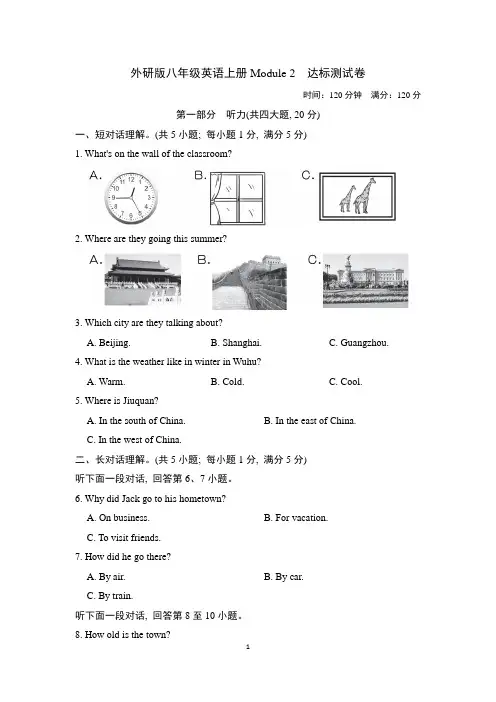
外研版八年级英语上册Module 2达标测试卷时间:120分钟满分:120分第一部分听力(共四大题, 20分)一、短对话理解。
(共5小题; 每小题1分, 满分5分)1. What's on the wall of the classroom?2. Where are they going this summer?3. Which city are they talking about?A. Beijing.B. Shanghai.C. Guangzhou.4. What is the weather like in winter in Wuhu?A. Warm.B. Cold.C. Cool.5. Where is Jiuquan?A. In the south of China.B. In the east of China.C. In the west of China.二、长对话理解。
(共5小题; 每小题1分, 满分5分)听下面一段对话, 回答第6、7小题。
6. Why did Jack go to his hometown?A. On business.B. For vacation.C. To visit friends.7. How did he go there?A. By air.B. By car.C. By train.听下面一段对话, 回答第8至10小题。
8. How old is the town?A. It is two hundred years old.B. It is three hundred years old.C. It is four hundred years old.9. What's the population of the town?A. About ten thousand.B. About six thousand.C. About five thousand.10. What is the town famous for?A. It's famous for its mountains.B. It's famous for its green tea.C. It's famous for its lakes and hills.三、短文理解。
外研社八年级英语上Module1-2练习
八年级英语上册Module1-2测试题一、单项选择(20分)()1. These words are very important, please .A. write down them .B .write down it C. write them down D. write it down()2. I’d like you to give me about how to learn English.A. some advicesB. some adviceC. an adviceD. a few advices()3. It’s a good idea __________ in the sea .A .swim B. swimming C. swam D .to swim()4. I often help my mother __________ some housework in my free time.A .in B. for C. with D .at()5. If you like this coat, why don’t you buy it to _________ your trousers(裤子)?A. compareB. matchC. sellD. buy()6. It’s hard _________ the American accent(口音).A. understandingB. understandC. to understandD. understood()7. --I don’t know how to get to the post office. -- You can ask someone ____.A. otherB. elseC. anotherD. others()8. ---Sorry, I’m late, Ms Ding. --- __________late again next time.A .Try to not beB .Try toC .Try not to beD .Try be()9. It’s too early, why ___________a rest with us?A. not haveB. not having C .not to have D .didn’t have()10.You should write down your _________ answers next to your mistakes.A. correctB. correctionC. correctedD. corrects()11. ----My spoken English is poor. What should do?-----That’s easy. Practise _________it as much as possible.A. speakingB. speakC. to speakD. spoke()12..Do you know the___________of this word?A. meanB. meaningC. meantD. means()13. He always ______in exam.A. make mistakesB. makes mistakesC. make mistakeD. makes mistake()14.-----Remember ________to my daughter’s dance show next Friday.-----Of course I will. I’ll never forget ________her dance for the first time last year.A. to come, to seeB. coming; to comeC. to come ; seeingD. coming; seeing ()15. If you don’t know this word, you can ________in your dictionary.A. look it upB. look up itC. look them upD. look up them()16. 12. Let’s _______ this afternoon.A. go shoppingB. go shopC. going shoppingD. to go shopping()17.-----It’s hot in the room.------Yes, ________the window?A. why not openB. why don’t openC. why not to openD. why opening()18. It’s a good idea ________the English club to improve your English.A. to joinB. join C .joining D. joins()19.You’d better not _______in the sun.A. to readB. readC. readingD. reads()20. There_______a basket match between Class Three and our class this afternoon.A. is going to beB. is going to haveC. will haveD. will hold二、完形填空(10分)Different languages are spoken in different countries. There is one language used in every country in the___1__. People, young and old, short and tall, thin and fat, use it very often.It's everybody's___2__language.It's very easy to understand, though(尽管) you can't ___3___it.It's sign language(手势语).Sometimes when you ___4__in the street. Suddenly you met a friend of yours. You want to say ___5___to him, but there's much noise there and he can't hear you. When you wave to him, you are using sign language. When you put ___6____your hand in class, you are saying, “Please__ 7____me, madam. I think I know the right answer.” When a__ 8____wants to stop cars or buses, he raises his hand. He's using sign language, too. Churchill’s(丘吉尔)__9___ V -for -victory(胜利) was also sign language. Sign language is useful in___10___places or places full of noise. Even when you are swimming with your friends, you can have a talk under water!Do you use sign language every day!()1.A.space B. universe C. sky D. world()2. A. first B. second C. favourite D strange()3. A. hear B. see C. understand D. touch()4. A. lie B. walk C. sit D. play()5. A. sorry B. glad C. hello D. goodbye()6. A. in B. to C. up D. on()7. A. ask B. save C .answer D. help()8. A .policeman B. student C. soldier D. farmer()9. A. interesting B. famous C. forgetful D. unknown()10. A. safe B. dangerous C. happy D. quiet三.阅读理解(20分)AMy and Mrs Jones never go out in the evening, but last S aturday Mrs Jones said to her husband, “There is a good film at the cinema tonight. Shall we go and see it?” Mr Jones was quite happy about it. So they went, and both of them enjoyed the film very much .When they came out of the cinema, it was already 11 o’clock .They got into the ir car and began driving home. It was quite dark. Mrs Jones said,” Look, a woman is running along the road very fast and a man is running after her . C an you see them?”Mr Jones said, “Yes, I can.” He drove the car slowly near the woman and said to her, “Can I help you ?”“No, thanks,” said the woman, but she did not stop runnin g. “My husband and I always run home after the cinema. Because whoever (不论谁) gets home late will wash dishes (碗碟).”()1. Mr and Mrs Jones ______________ .A. often stay at home in the eveningB. often go out in the eveningC. often go out to have supperD. often go to the cinema in the evening()2 . Last Saturday, they ______________ .A. went out for a walkB. went to see a filmC. went to see a womanD. went to buy a car()3. __________ enjoyed the film very much .A. Mr JonesB. Mrs JonesC. Both Mr and Mrs JonesD. The woman()4. On their way home , they saw _________ .A. a man running after a womanB. two men running togetherC. a woman running after a manD. two women running together()5. Why were the man and the woman running ? Because _____________ .A. the woman’s husband was angry with herB. they liked runningC. neither the man nor the woman wanted to wash the dishesD. they tried to catch the carBCan plants eat people? Probably not, but there are many plants that eat meat. Some of them are big. And th eycan eat small animals. One famous meat-eating plant is the Venus flytrap(捕蝇草).The Venus flytrap is a very strange plant. It grows in dry parts of the United States. Its leaves are like the pa ges of a book. They can open and close very quickly. Inside the leaves, there are three small hairs. If a fly touc hes one of the hairs, the leaf closes quickly. The fly cannot get out. In about half an hour, the leaf presses(挤压)the fly until it is dead. Then, the plant covers the fly. Slowly, the plant eats the fly.Most plants get what they need from the sun, the air, and the ground. In some places, the ground is very poo r. It doesn’t have all these important things, especially nitrogen(氮). Animal meat has a lot of nitrogen, so some plants eat meat to get what they need. Let’s hope that some of the bigger plants don’t get the same idea!1. What’s the name of one famous meat-eating plant? ___________________________________________ ___2. Where does it grow? ___________________________________________________________________ ___3. What does it look like? _________________________________________________________________ ___4. How can it eat a fly? ___________________________________________________________________ ___5. Why do plants do it? ___________________________________________________________________ ___四.单词拼写或用单词的适当形式填空。
外研版初二上册英语Module1测试试题及答案
外研版初二上册英语Module1测试试题及答案作为初二学生的我们,应该为即将到来的英语考试做出什么样的准备呢?下面是店铺整理的外研版初二上册英语Module 1测试试题以供大家阅读。
外研版初二上册英语Module 1测试试题一、听力测试(满分15分)(一)听句子,选择适当的答语。
(每个句子读一遍)(每小题1分,满分5分)1. A. Excuse me. B. I’m sorry. C. That sounds nice.2. A. Good idea. B. Yes, please. C. Never mind.3. A. Sorry, I can’t. B. Thank you for your help. C. Yes, I’d love to.4. A. The same to you. B. Have a good time. C. You’re so kind.5. A. You’re welcome. B. That’s right. C. I’m afraid not.(二)听对话,选择正确答案。
(对话读两遍)(每小题1分,满分5分)6. Why hasn’t Amy done her maths homework yet?A. Because it’s too difficult for her.B. Because she wants to wait for Daniel.C. Because she wants to watch TV first.7. Where are Daniel and Amy going to do their homework together after school?A. At Daniel’s home.B. At Amy’s home.C. In the classroom.8. When are they going to meet after school?A. At four o’clock.B. At five o’clock.C. At six o’clock.9. How much of the English project(课题)has Daniel done?A. Most of it.B. None of it.C. A bit of it.10. What are they going to do after they finish their homework?A. They are going to watch TV.B. They are going to the cinema.C. They are going to play table tennis.(三)听短文, 判断正误。
最新外研版八年级上册英语单元试卷及答案(全册)

最新外研版八年级上册英语单元试卷及答案(全册)英语·八年级上册·WYModule 1综合能力检测卷时间:60分钟满分:100分一、单项填空(每小题1分,共10分)1.—Why didn't your sister talk with me?—She is a girl. She is afraid to speak in front of others.A. politeB. shyC. cleverD. good2.—I think drinking milk is good for our health.—Yes, I you.A. care aboutB. hear fromC. agree withD. ask for3.—Could you please offer me some in my research(研究)? —Yes, sure.A. ideaB. messageC. suggestionD. advice4.Englishmen often talk about the weather to start a .A. dreamB. secretC. sentenceD. conversation5.—Do you know the opening time of the museum?—Sorry, I don't know. You can on the Internet.A. look it upB. turn it downC. make it upD. cut it down6.—How about taking a walk after supper?—.A. It's trueB. Very wellC. Thanks a lotD. That's a good idea7.My sister her bike to work every day.A. ridesB. rodeC. will rideD. is riding8.—Believe it or not, a pig from South Africa started painting several months ago.—Anything is .A. livelyB. possibleC. expensiveD. personal9.— to New York with Henry this summer?—No, I didn't. But next summer, I there with him for business.A. Are you going; wentB. Did you go; am goingC. Are you going; am goingD. Did you go; went10.—Our team won the football match.—______. You did a good job.A. I'm sorryB. ExcellentC. ExactlyD. No problem二、完形填空(每小题1.5分,共15分)Learning to take notes in class is important. Note-taking is a(n)11 that can helpyou do well in all your schoolwork. You need to prepare a 12 for each subject so that you can find everything 13when a test comes. If your teacher writes notes on theblackboard, that's great. You can copy them or write down the most 14 points of all in class. If (如果) your teacher doesn't like to write 15 down on the blackboard, you will have to write down something important that is said again and again by him. If you can't16 what the teacher is saying, don't be afraid to ask your teacher to 17 what you miss again. Of course, you may ask him after class. In your free time, you may 18 your notes with others'. Maybe you can find some mistakes in your notes. It can be good for your learning. After class or before tests, review (复习) the most important and useful 19 in your notes, and you will 20 less time reviewing and get better grades. Your notes are a good study record and taking notes is one of the best ways to improve your grades.11.A. thought B. skill C. order D. problem12.A. textbook B. pen C. notebook D. dictionary13.A. easily B. suddenly C. slowly D. quietly14.A. important B. interesting C. exciting D. boring15.A. nothing B. everything C. something D. anything16.A. find B. believe C. follow D. change17.A. say B. understand C. write D. remember18.A. bring B. talk C. lend D. compare19.A. pictures B. news C. answers D. parts20.A. cost B. take C. spend D. pay三、阅读理解(每小题2分,共30分)ASome books have a list of words called a glossary at the back.A glossary tells you what words mean, like a little dictionary. Read this glossary from a book about plants.flower the coloured part of a plant where the seed or fruit growsleaf a flat green part of a plant that grows from the stem or branch or rootlight something plants need to growroot the part of a plant in the soil(土壤)seed the small hard part that can grow into a new plantseedling a young plant that has grown from a seedstem the main long thin part of a plant above the groundwater something plants need to grow21.What is a glossary?A. A list of words.B. A list of book names.C. A list of addresses.D. A list of telephone numbers.22.Which part of a plant grows under the ground?A. The leaf.B. The stem.C. The root.D. The flower.23.How many things mentioned in the passage can help plants grow?A. One.B. Two.C. Four.D. Five.24.Which is TRUE about a seedling?A. It is the main long thin part of a plant.B. It grows from the stem.C. It is flat and green.D. It is a young plant.25.You should know these words if you want to learn about .A. plantsB. animalsC. chemistryD. physicsBHere are some English study skills for English beginners (初学者).★ ListeningListening is a great way to improve your pronunciation and intonation (语调). You canstart by listening to short stories for children because they are usually easy.★ ReadingReading is a good way to help you learn new words. And it will also help you learn English grammar. Children's books are great for beginners.★ VocabularyWhen you come across a new word in the reading, write it down in your notebook.You can write down the translation in your native language(母语) to help you understand.★ SpeakingWhile doing your reading exercises, read them aloud.You can also look for somearticles(文章) on the Internet to read.Learning any language needs practice — lots of practice.You don't have to spend hours studying each day; just 30 minutes a day for four or five days a week will help you improve it.26.We can improve our pronunciation by .A. listeningB. watching TVC. writingD. learning grammar27.How do beginners learn new words according to the passage?A. By remembering the words in the dictionary.B. By writing down the new words while reading.C. By looking for new words on the Internet.D. By reading the new words many times a day.28.The underlined word "translation" means "" in Chinese?A. 翻译B. 发音C. 位置D. 拼写29.How much time should beginners spend studying English?A. Two hours every day.B. An hour every week.C. Two hours every week.D. One hour every day.30. What's the best title for the passage?A. How to Improve English ReadingB. Ways to Study English GrammarC. The Importance(重要性) of EnglishD. Study Skills for English BeginnersCPeople often ask me for advice about how to learn English. As for it, everyone is different. I'll share some of my experience. I once took a school year English course in Wuhan University, but I mostly learned English on my own.One thing I can tell you is that, once you've started learning, you should try to think in English as much as you can. If you see something when you're riding your bike or walking down the street, just think about "How would I say them in English?" At first, it might be with simple words or phrases, but later you should think about longer phrases and sentences. Now I'm in America, and for most of the time, I would think in English and speak it directly. It's amazing how much this helps.For several years after I started learning, I was often afraid of talking with others in English because I didn't want to make mistakes (错误). Finally I overcame it. And while traveling in America, I'd try to hang out (闲逛) with friends who couldn't speak Chinese, so that I'd have no choice but to speak English. And I also decided that if I said something stupid (愚蠢的) and other people laughed at me, then so be it. After that, my English started improving much more quickly.Besides, it may be a good idea to ask your American friendsto look at the way you're writing, and give you some advice for improvement.31. The writer learned English in Wuhan University for about.A. a weekB. a monthC. a termD. a year32.According to the writer,is a good way to improve your English.A. thinking in EnglishB. learning English grammarC. watching English filmsD. reading English books33.The underlined phrase "overcame it" in Paragraph 3 means "" in English.A. gave it upB. looked it upC. got over itD. understood it34.To the writer's surprise, his English improved quickly.A. in the universityB. in the middle schoolC. in ChinaD. in America35.The best title for this passage should be.A. The Importance of EnglishB. My English Learning ExperienceC. My University LifeD. My American Friends四、从方框中选择最佳选项补全对话(有两项多余)(每小题1分,共5分)A: Hello! This is Hope English Club. Can I help you?B: Yes, I'm not good at English.36A: I see. We are sure to help you.B: I can't follow my teacher when she speaks English in class.A: Well. 37B: I'll have a try. And I have trouble in writing English articles.A: Oh. Maybe keeping a diary is a good method (方法).B: Besides, my spoken English needs improving too.A:38You can communicate with the foreigners here.B: Good idea.39A: You can come here and fill in a form.Then you can choose your favorite course.Would you like to come here at 2:00 pm?B: Sorry. I'll be busy then. 40 Is it OK?A: All right.That would be fine. Keep trying and your English will be better soon.五、任务型阅读(每小题2分,共10分)How Can You Become a Successful Learner?Everyone is born with the ability to learn. But whether or not you can do this well depends on (取决于) your learning habits. Research shows that successful learners have somegood habits in common.1.Creating an interest in what they learnStudies show that if you are interested in something,your brain(脑) is more active and it is also easier for you to pay attention to it for a long time.Good learners often connect what they need to learn with something interesting. For example, if they need to learn English and they like music or sports,they can listen to English songs or watch sportsprograms in English.This way they will not get bored.2.Practicing and learning from mistakesGood learners think about what they are good at and what they need to practice more. Remember,"Use it or lose it." Even if you learn something well, you will forget it unless(除非) you use it. "Practice makes perfect."Good learners will keep practicing what they have learned, and they are not afraid of making mistakes. Alexander Graham Bell did not invent the telephone overnight. He succeeded (成功) by trying many times and learning from his mistakes.3.Developing their study skillsIt is not enough to just study hard. Good learners know the best ways they can study. For example, they may take notes by writing down key words. They also look for ways to go over what they have learned.They may do this by reading their notes every day or by explaining the information to another student.4.Asking questionsGood learners often ask questions during or after class. They even ask each other andtry to find out the answers. Knowledge comes from questioning.Learning is a lifelong journey because every day brings something new. Everything that you learn becomes a part of you and changes you, so learn wisely and learn well.根据短文内容回答下列问题41.According to the passage, what can make you become a successful learner?42.How can learners create an interest in what they learn?43. Why is it important to practice using what you've learned?44.What study skills does the writer talk about?45. What is the last good learning habit in the passage?六、用方框中所给单词的适当形式补全短文(每词限用一次)(每小题1分,共10分)★Fluency (流利)Fluent speaking is very important. You don't have to know many difficult grammatical structures (结构)! First of all, try to speak as fluently as 46.You may make some grammar mistakes, but don't 47. After making your speaking fluent, you can focus on(集中精力于)your 48 learning.★English vocabulary learningMany people think that knowing a lot of words is the 49 to fluent speaking, but some of them still have a problem with fluency. They 50to learn many words because they think vocabulary is their problem, but the real 51 is something else. They always try to use the exact translation of every word, so they often have to stop 52 when they don't know a word.If you have the same problem, just speak in some 53ways. When you are speaking and have to stop because you don't know a word,54 it! Try to say it in other words. 55is the real key to fluent English conversation!46.47.48.49.50.51.52.53.54.55.七、书面表达(20分)假定你是T om,你的好朋友王伟发电子邮件向你请教如何学好英语。
外研版英语八年级上册Module 1、Module 2模块综合检测题及答案(各一套)
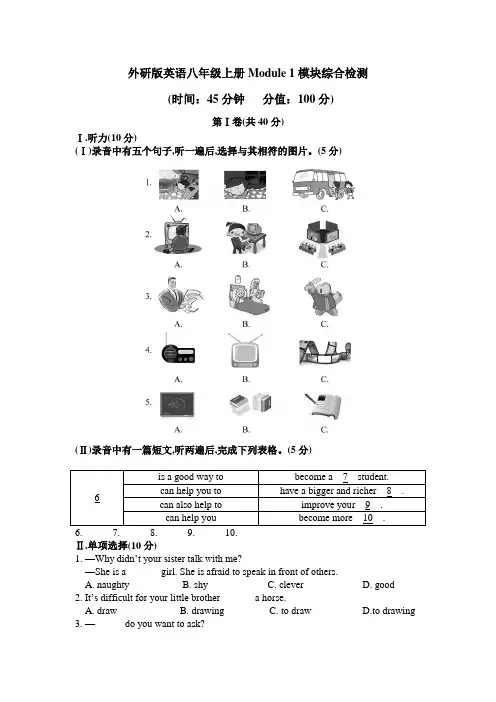
外研版英语八年级上册Module 1模块综合检测(时间:45分钟分值:100分)第Ⅰ卷(共40分)Ⅰ.听力(10分)(Ⅰ)录音中有五个句子,听一遍后,选择与其相符的图片。
(5分)(Ⅱ)录音中有一篇短文,听两遍后,完成下列表格。
(5分)Ⅱ.单项选择(10分)1. —Why didn’t your sister talk with me?—She is a ______ girl. She is afraid to speak in front of others.A. naughtyB. shyC. cleverD. good2. It’s difficult for your little brother ______ a horse.A. drawB. drawingC. to drawD.to drawing3. —______do you want to ask?—Nothing. Thank you.A. What otherB. What elseC. Other whatD. Else what4. At the class meeting our teachers gave us ______.A. some advicesB. many advicesC. some adviceD.an advice5. —This book is a bit difficult. ______ read something easier?—All right.A. Why not toB. Why don’tC. Why notD. Why not you6. —I tried ______ it out in this way, but I failed.—Why not try ______ it in another way?A. to work; doingB. working; to doC. to work; to doD. working; doing7. —Could you please tell me ______ the camera?—I don’t know, either.A. how to usingB. what to useC. how to useD. how using8. Please remember ________ back the book to the library on time.A. to giveB. givingC. giveD. gives9. —I think we must obey(遵守)the traffic rules.—I ______ you.A. agree toB. agree withC. agree onD. agree10. —Let’s go to see the stamp collection show.—______A. Good idea!B. Don’t worry.C. What a shame!D. What a pity! Ⅲ.完形填空(10分)In learning English, one should first pay attention to listening and speaking. It is the groundwork of reading and writing. You’d better __1__ your best to speak while you do much listening. Don’t be __2__ of making mistakes. But be careful not to let them stop you from improving your __3__.While you are doing this, a good __4__ is to write—keep a diary, write notes or letters. Then if you can, ask some others to go through __5__ you have written and tell you where it is wrong. Many mistakes in your speaking will be __6__ found when you write. Through correcting mistakes, you can do better in learning English.If you are slow in speaking, don’t__7__ about it. One of the helpful ways is reading, either aloud or to yourself. The important thing is to choose __8__ interesting to read. It can’t be too difficult for you. When you are reading __9__ this way, don’t stop to __10__ the new words if you can guess their meanings when they have nothing to do with the sentences. You can do that some other time.1. A. have B. send C. make D. try2. A. sure B. afraid C. proud D. tired3. A. English B. Chinese C. Korean D. French4. A. start B. idea C. way D. manner5. A. how B. when C. why D. what6. A. happily B. easily C. really D. slowly7. A. talk B. fear C. worry D. hurry8. A. something B. everything C. anything D. nothing9. A.by B. on C.at D.in10. A. look at B. look for C. look up D. look over Ⅳ.阅读理解(10分)Here are some ideas for learning English faster.You are like a new babyBabies learn their language slowly. First they learn to listen. Then they learn to talk. Finally, they can read and write.Listen to English every dayListen to English radio, watch English TV, go to see English movies or use online lessons.Practise the conversationsMake up conversations and practise the conversations. You’d better use beginner textbooks.Read English storiesStart with children’s storybooks. Try to read stories for ESL readers. Read ads and so on. Try for young learners.Write down new wordsStart a new word notebook. Write words in alphabetical order(A...B...C).Make some sentences. Try to use an English-English dictionary.Keep an English diaryStart with one sentence. Like how do you feel? How is the weather? What did you do today? Write another sentence tomorrow.1. How do babies learn their languages?A. Slowly.B. Quickly.C. Loudly.D. Quietly.2. What does the underlined phrase “alphabetical order” mean in Chinese?A. 按音标顺序B.按字母顺序C.按简易顺序D.按长短顺序3. The writer gave us ______ ideas for learning English faster.A. fourB. fiveC. sixD. seven4. What kind of books do we start to read when learning English?A. Children’s storybooks.B. Children’s textbooks.C. Children’s picture books.D. Ch ildren’s music books.5. Which of the following is TRUE for English learning according to the passage?A. Babies learn to read and write first.B. Listening to English radio is not helpful.C. We should always use an English-Chinese dictionary.D. We can start with one sentence to keep an English diary.第Ⅱ卷(共60分)Ⅴ.词汇运用(10分)(Ⅰ)根据句意及首字母或汉语提示完成单词。
Module 1 ---2模块自测 外研版英语八年级上册(含答案)

八上Module 1测试卷一、单选题1.Could you please speak a little more ________? I can't follow you.A. quietlyB. quicklyC. slowlyD. loudly2.When you don't know a word, you can ________ in the dictionary.A. look it upB. set it upC. give it upD. pick it up3.Lisa talks _______ in the class. All of us don't like her.A. all the timeB. sometimesC. at timesD. never4.______ does Mary ______ reading online?A. How; think aboutB. What; think aboutC. How; think overD. What; think over in5.—What are you doing, Cathy?—I am ______my cat. I can it find it.A. looking forB. looking atC. looking upD. looking after6.Colors can change our moods and make us ______ or sad,active or sleepy.A. to feel happyB. feel happilyC. feel happyD. feeling happy7.Bob, _______ TV on weekdays.A. not try to watchB. try not to watchC. don’t try watchD. try to not watch8.—What about ______ a rest?—OK.A. to takeB. takeC. takingD. takes9.Don’t forget______ the lights when you leave the room.A. to turn offB. turningC. turnsD. to turn on10.—The sun is shining brightly.—Why not wear a _________ sunglasses to protect your eyes?A. pairB. pairs ofC. pair ofD. pairs11.Rom,s handwriting is better than______.A. anyone elseB. anyone, s elseC. anyone, sD. anyone else, s12.There are many new words on the blackboard. Please______.A. write down themB. write down itC. write them downD. write it down13.__What about travelling during the summer holiday?__It can relax us and open our eyes.A.Why not?B.What for?C.I think so.D.Why don,t?14.He just gave _______advice.A.aB. anC. /D. some15.There are many new words on the blackboard. Please______.A.write down themB. write down itC. write them downD. write it down二、完形填空Mike Tarn is a 16-year-old boy. He has many good (16) —he exercises every morning and reads books every night. He is doing well in studies and his favorite (17) are science and history.Both of Mike's parents are good swimmers. When Mike was four years old, hisfather (18) to teach him how to swim. After two months of learning, Mike could swim (19) a fish.Each week, Mike has to spend at least 16 hours (20) . He spends two hours practicing swimming every day before school. After morning practice, he goes to school by bike. He likes riding bikes, (21) it is good for his health.On Saturday, he gets up at 7:00 a.m. He swims in the pool for four hours. After that, he goes home to do his homework. He (22) watching movies, so he goes to the cinema every Sunday. "It is (23) to watch movies with my friends," he said. His parents often go to the pool on weekends to encourage(鼓励) (24) when they don't have to work.Mike doesn't mind(介意) spending a lot of time practicing. "I love swimming, and practice can help me get good (25) in competitions(比赛)," he said.16. A. orders B. programs C. habits D. dreams17. A. books B. subjects C. colors D. symbols18. A. started B. disliked C. forgot D. followed19. A. into B. across C. over D. like20. A. practicing B. drawing C. cleaning D. driving21. A. or B. although C. because D. but22. A. enjoys B. finishes C. stops D. remembers23. A. tidy B. relaxing C. boring D. difficult24. A. her B. me C. you D. him25. A. uniforms B. results C. rules D. prices三、阅读理解Harry keeps a diary.He writes every day.Here is his diary for a week in June.Monday June 15th.It rained all day,so we did not do any sports.We stayed in our classroom and read librarybooks.Tuesday June 16th.I missed (错过)the bus and was late for school.It wasn't my fault.The bus was 10minutes early.Wednesday June 17th.I had an English test today.I got an A+.It's my best grade ever!I made only one spelling mistake (错误).Thursday June 18th.I went swimming with Adam and Steve.Steve is a good swimmer and he taught us a lot.I hope (希望)he will win the school swimming competition next Monday.Friday June 19th.I didn't go to school.I caught a cold at the swimming pool.I stayed in bed and slept all day.I felt better in the evening.Mom didn't go to work.She looked after (照顾)me at home.Saturday June 20th.I feel much better today,but Mom made me stay at home.I watched TV all day.It was boring.Sunday June 21st.I didn't do anything interesting today.26.What did Harry do on Monday?______A. He slept all day.B. He did some reading.C. He went to the library.D. He watched a lot of TV.27.What does the underlined word"fault"mean?______A. 职责B. 理由C. 权利D. 过错28.How did Harry feel on Wednesday?______A. Happy.B. Sorry.C. Bored.D. Tired.29.There was a swimming competition in Harry's school on ______ .A. June 15thB. June 18thC. June 22ndD. June 25th30.Why didn't Harry's mother go to work on Friday?______A. Because the weather was bad.B. Because she had to go to a doctor.C. Because she had to look after Harry at home.D. Because the bus was 10minutes early and she missed it.四、单词拼写-单句31.You should________(纠正)your mistakes.32.We can watch English films t________ with our friends.33.Every year, she i________ her friends to her party.34.English has a large _________(词汇量).35.They__________ (建议)that I stay in my home town.答案和解析一、单选题1-5 CAABA 6-10 CBCAC 11-15 DCADC二、完形填空16-20 CBADA 21-25 CABDB三、阅读理解26-30 BDACC四、单词拼写-单句31. correct32. together33. invites34. vocabulary35.suggest八上Module 2测试卷一、单选题36.—Which country has_____ population, Australia or Canada?—Sorry, I don’t know.A. the largerB. largerC. the smallerD. the most37.The world’s population is growing ______ and there is ______ land and water forgrowing rice.A. more;lessB. larger;fewerC. larger;lessD. more;fewer38._______ is the city’s population?A. HowB. WhatC. How manyD. How much39.The population of Australia ________ about 21 million.A. isB. areC. hasD. have40.______ an umbrella ______ you, it may rain later.A. Give; withB. Bring; toC. Take; toD. Bring; with41._________ people come to Beijing to look for jobs every year.A. Million ofB. Millions ofC. Three millionsD. Three millions of42.My father thinks writing is as ______ as reading.A. interestingB. interestedC. more interestingD. more interested43.You will be________ if you eat_____ and take _____exercise.A. thiner;less;moreB. thinner;more;lessC. thiner;more;lessD. thinner;less;more44.Try ______ Chinese in English class.A. not speakB. not to speakC. not sayD. not to say45.The population of the US is _________ than _________ of China.A. larger; thatB. smaller; thatC. bigger; itD. more; it46.Debbie is growing fast. She is even _______ than her mother.A. tallB. tallerC. tallestD. the tallest47.More and more people have a low-carbon life (低碳生活) and the air is getting much________ than a few years ago.A. cleanB. cleanestC. cleanerD. the cleanest48.The population of China is_____ than _____ of any other country in the world.A. larger;the oneB. more;whichC. larger;thatD. more;that49.—______is the population of Shenzhen?—It’s over ten______.A. What;millionsB. What;millionC. How;millionsD. How;million50.Can you tell me ______ tomorrow?A. how will the weatherB. what will the weather beC. how will the weather likeD. what the weather will be like二、完形填空Jim was a taxi driver. Usually he was (16) , but sometimes he didn’t have much work to do. It was a cold night. There were (17) people in the street. When Jim went by the train station, he saw a young man coming out (18) two bags in his hands. So he quickly opened the door of the (19) and asked, “(20) do you want to go, sir?”“To the Star Hotel,” the young man answered. When Jim heard that, he didn’t feel happy. The young man would give him only three dollars because the hotel was (21) from the station. But suddenly, he had an idea. He took the young man (22) many streets of the big city. After a long time, the car reached the hotel. “You should (23) me fifteen dollars,” Jim said to the young man. “What? Fifteen dollars! Do you think I’m a fool(傻瓜)?” the young man said (24). “Only last week, I took a taxi from the station to the same hotel and I only paid the driver thirteen dollars. I know how much I should pay. I won’t pay you onedollar (25) than I paid last week.”51. A. busy B. worried C. free D. lazy52. A. little B. a little C. much D. few53. A. of B. with C. for D. on54. A. train B. bus C. subway D. car55. A. Where B. What C. How D. When56. A. not far B. far C. not near D. long57. A. between B. till C. through D. from58. A. buy B. give C. show D. spend59. A. angrily B. happily C. easily D. sadly60. A. many B. much C. most D. more三、阅读理解Sometimes the easiest way to get somewhere is on the back of a bike.More and more people are using cars in many places in Africa today. However, things are different in Malawi(马拉维). Bikes are the most popular in this African country.Bike riding is a way of life in Malawi. People use them to carry heavy things. They also use bikes to carry people, especially tourists. These years, taking a "bicycle taxi" to travel around Malawi has become quite popular among tourists from all over the world.If you go to Malawi, you will find a lot of bike taxis waiting on the sides of the roads. The riders make the bikes comfortable for passengers to sit on. You can jump on a bike taxi and get around at a very low cost.Alice is a 21-year-old student from Canada. She enjoys the special bike riding a lot. "I really like the bike taxi," she says. "It's easy and cheap." Alice usually pays just $1 for going shopping in town.28-year-old Panjira Khombe began to ride a bike taxi two years ago. The young man enjoys this job. "I used to make boats for a living, but that's a hard job. Being a bike taxi rider is easy for me and I don't mind carrying heavy people," he says.61.In Malawi _________ are the most popular way for people to get somewhere.A. carsB. bikesC. trainsD. buses62.Which of the following uses is NOT mentioned in the passage?A. To carry heavy things.B. To carry people.C. To play.D. To travel.63.The passage tells us that Alice enjoys the bike taxi because it's _________.A. on the side of the roadB. popular and heavyC. all over the countryD. cheap and easy64.From the passage we learn Panjira Khombe thinks that _______.A. going shopping is easyB. making boats is difficultC. riding a bike taxi is cheapD. carrying heavy people is interesting65.The best title of the passage may be ________.A. Bike RidersB. A Special CountryC. Bike TaxisD. A Cheap Journey四、单词拼写-单句66.The teachers in our school are much ___________(忙的)than those in that school.67.Cambridge has lots of old buildings and churches, and a well-known _________(大学).68.The c________(沙滩)not far from here.69.American movies are very ______ (受欢迎的)in China.70.I ______ (尤其)hate noise?答案和解析二、单选题1-5 BCBAD 6-10 BADBB 11-15 BCCBD 三、完形填空16-20 ADBDA 21-25 ACBAD三、阅读理解26-30 BCDBC四、单词拼写-单句31. busier32. university33. coast34. popular35.especially第11页,共11页。
外研版八年级英语上册Module 1 测试卷附答案
外研版八年级英语上册Module 1测试卷(100分, 90分钟)听力部分(25分)一、听力(共15小题, 第一节每小题1分, 第二、三节每小题2分, 满分25分) 第一节: 听小对话, 从A、B、C三个选项中选出正确的选项。
每段对话读一遍。
()1. What mistake does the girl often make?A. Pronunciation mistakes.B. Grammar mistakes.C. Listening mistakes.()2. What does Mr Smith advise the girl to do?A. To listen to the word.B. To write the word.C. To repeat the word.()3. What does the girl want Mike to do?A. To listen to music.B. To write down the right answers.C. To write down the mistakes.()4. What are they going to do?A. To join an English club.B. To have an English class.C. To watch an English film.()5. How does the boy prepare for the English exam?A. By studying with a group.B. By asking his teacher questions.C. By remembering all the words.第二节: 听长对话, 从A、B、C三个选项中选出正确的选项。
每段对话读两遍。
听下面一段较长对话, 回答6—7小题。
()6. Where is Jack now?A. In a bookshop.B. In the library.C. At the swimming pool.()7. Who will give the talk?A. Mrs Smith.B. Jack.C. Mr Smith.听下面一段较长对话, 回答8—10小题。
2020年外研版八年级英语上册Module1-2测试卷(含答案)
英语测试题(Module1-2)听力部分(20分)一、听句子,根据句子的内容和所提的问题,选择符合题意的图画回答问题(5分)()1. What don’t we have?()2. Where is David?()3. How did Alice go to Hong Kong?()4. What is Tom doing?()5. Who is Mary going to see?二、听对话,根据对话内容回答问题。
(5分)听对话一,回答第1小题()1. What does Mike want to have?A. Some rice.B. Some fish.C. Some meat.听对话二,回答第2小题()2. Which does the girl like best?A. Potatoes.B. Tomatoes.C. Pears.听对话三,回答第3小题()3. What are they going to cook?A. Chicken.B. Fish and chips.C. Meat.听对话四,回答第4小题()4. Chen Hui likes ______.A. the tea with milkB. the tea with sugarC. the tea with nothing in it 听对话五,回答第5小题()5. What did Wei Hua have for breakfast?A. Bread, eggs and milk.B. Porridge and bread.C. Eggs and bread.三、听短文,选择正确答案。
(5分)( ) 1. _________ is going to give a birthday party for her daughter.A. Mrs. WhiteB. Mrs. KingC. Ann( ) 2. Ann is going to be ___________ years old.A. twentyB. tenC. thirteen( ) 3. ____________ are coming to the party.A. Thirty boysB. Twenty girlsC. Forty children( ) 4. Mrs. King is buying ____________ for the party.A. a cakeB. a lot of fruitC. some apples( ) 5. The party is going to begin at ___________ in the afternoon.A. two thirtyB. threeC. three thirty四、听写单词。
外研版八年级英语上册Module 1 综合素质评价试卷 附答案 (2)
外研版八年级英语上册Module 1 综合素质评价60 分钟100 分一、单项选择(每小题1. 5 分, 共15 分)1. I can’t answer this question, so I want to ask my teacher ________ help.A. withB. inC. toD. for2. My teachers advise us ________ computer games. That is bad for our eyes.A. to playB. playingC. not to playD. not play3. Look at the new words. Please ________ in your notebook.A. write it downB. turn it downC. write them downD. turn them down4. My teacher gave me much ________ on how to study English well .A. adviceB. questionC. suggestionD. problem5. ________ easy for strangers ________ lost in a big city.A. That’s; to getB. This is; to getC. It’s; to getD. It’s; getting6. Why not ________ an English club to practise ________ English?A. join; speakingB. to join; speakC. join; speakD. to join; speaking7. If you don’t know the meaning of the word, try to ________ it.A. matchB. guessC. forgetD. pronounce8. [2022·海南改编] —Peter, don’t forget ________ the light off when you leave the classroom.—OK. It’s a good way to save energy.A. turnB. turningC. to turnD. turns9. —Why doesn’t your sister talk with me?— She is a ________ girl. She is afraid to speak in front of others.A. politeB. shyC. cleverD. good10. —Why don’t you go to Lao She Teahouse tonight?—________.A. Thank youB. Sounds greatC. It doesn’t matterD. Sorry to hear that二、[2023 ·佛山三中月考] 完形填空(每小题1. 5 分, 共15 分)I have been to London twice. In October 2016, I went there for the first time. I learned English in a language school and 11. ________ with a host family (寄宿家庭) for six months. My host family Mr and Mrs Brown were both very 12. ________ to me. They helped me and told me a lot of interesting things about Britain. I had 13. ________ with them. I enjoyed different kinds of English food. I also did some activities with them. We often 14. ________ TV, went shopping, played games and took a walk in the park together. At weekends, I usually went 15. ________ to different interesting places in London, such as the National Gallery, Buckingham Palace and the British Museum. I even had a boat trip along the River Thames.During my stay in London, I 16. ________ many people enjoyed DIY(do-it-yourself). They grew vegetables, 17. ________ the grass in the garden, or made cakes or different kinds of food themselves.In September 2019, I went to London for the second time and stayed there for a year. I 18. ________ Chinese in a middle school. I also told the students about Chinese food and 19. ________ them pictures of some interesting places in China. The students were all 20. ________ in my class. Many of them hoped that they could come to China one day.11. A. moved B. lived C. entered D. counted12. A. enjoyable B. quiet C. nice D. strict13. A. conversations B. meals C. questions D. practice14. A. looked B. read C. noticed D. watched15. A. travelling B. swimming C. boating D. dancing16. A. changed B. collected C. found D. helped17. A. put B. cut C. lost D. met18. A. studied B. followed C. taught D. missed19. A. took B. left C. bought D. showed20. A. interested B. bored C. sad D. safe三、阅读理解(每小题2 分, 共20 分)A [2022·武汉改编]All through grade school, I got extra help with schoolwork. If I got a D, I was very happy. If I got a C minus (C-), I had got greatness. A’s and B’s were a kingdom I could never enter.My teacher, Miss Mills, gave me a list of ten spelling words. My mother and I went over the list until I knew those words. I felt great. I thought, “Wow! This time, I’m going to pass”. The next day, I went into the classroom and began to write down the words. The first word was carpet. I wrote that one down: c-a-r-p-e-t. I was feeling pretty confident. Then came neighbor—I wrote down the letter n. Then rhythm—I knew there was an r. Suburban—I wrote s-u-b. My confidence failed me. I had gone from 100 percent to maybe a D minus. Where did the words go?Some people talk about information sliding off your brain. That was my life. I was an underachiever (未能充分发挥学习潜力者).Now I know I have dyslexia (诵读困难症). A person with dyslexia might see the as teh, and bird as brid. My brain learns differently. A learning disability can really change the way you feel about yourself. Now I know that even if I learn differently, I can still be filled with greatness.Today when I visit schools as an actor, director, and co-author of children’s books, I tell children that everyone has something special inside. It’s our job to find out what that is and get it out, and give it to the world as a gift.21. What’s the writer’s problem in grade school?A. He had trouble spelling.B. He often got C minuses.C. He was absent-minded.D. He had a physical disability.22. From Paragraph 2, we can infer that the writer ________.A. wrote down 20% words correctlyB. knew he had dyslexia thenC. felt upset about himself at lastD. studied hard and passed the test23. The underlined phrase “sliding off” in Paragraph 3 probably means ________.A. coming intoB. going throughC. moving aroundD. disappearing from24. After the writer knew he had dyslexia, he ________.A. felt very excitedB. had more difficulties in studyC. was filled with sadnessD. changed his view of himself25. What would be the best title for the passage?A. A Change for SureB. A Great UnderachieverC. A Gift from the WorldD. A Special Spelling BeeB[荣德原创]As the economic cooperation (经济合作) between China and Ghana continues, Ghanaian students at the Confucius Institute (孔子学院) at the University of Cape Coast immerse (沉浸于) themselves in learning the language and about Chinese culture. Let’s listen to their stories.Because I studied Chinese, I got the chance to study in Chinatotally for free. When I finished my first degree, I spent a yearabroad, and when I returned, I was hired as a translator by acompany. After completing my master’s degree, I got the offer toteach at the Confucius Institute at the University of Cape Coast.PeterWhen I first started learning the language, it was difficult, but I realized (意识到) that a number of companies in Ghana would liketo employ Ghanaians who speak Chinese. Now I have been studyingChinese for three years. The Chinese have come to learn ourlanguage, so it’s also best for us to learn their language in order tocommunicate with them easily.MaryOur institute has opened many kinds of courses, includingChinese martial arts (武术), singing, dancing, handicrafts(手工艺)and calligraphy (书法). The Confucius Institute has seen manylocals make a difference in their lives after studying Chinese. Wewill try to improve our teaching and provide high-quality lessons toour students.Miss Chen26. What does the underline d word “offer” in Paragraph 2 mean?A. 表扬信B. 邀请函C. 辞职信D. 发言稿27. The two Ghana’s students learn Chinese ________.A. to find a better job and change their livesB. to get more moneyC. to live in ChinaD. to come to China and work here in the future28. Which courses are not mentioned?A. Chinese and calligraphy.B. Singing and dancing.C. Chinese martial arts and handicrafts.D. Beijing Opera and Crosstalk.29. [新考法]What is the structure of the passage? (Paragraph=P)30. Which of the following is True?A. Peter got a chance to study in China with a high fee.B. Mary has been studying Chinese for four years.C. The people in Ghana don’t like learning Chinese.D. Many locals make a difference in their lives after studying Chinese.四、词汇运用(每小题2 分, 共10 分)根据汉语意思完成句子或翻译句子。
初中英语外研版八年级上册Module 1Unit 2练习题(附参考答案)
八年级英语上册M1U2练习题班级考号姓名总分一、根据句意及首字母或汉语提示完成单词1.My teacher ________ (建议) me to write the new words down.2.He is very s______ and she is afraid to talk with others.3.I don’t a_______ with what you saiD.4.It’s n__________ to help each other.5.What are the four ________ (基本的) questions about learning English?6.It is a successful ____________ (谈话).7.We should try our best to i_________ English.8.I think having a large ___________ (词汇量) is a very important for English.9.I should do my homework as __________ (快速地) as possible.10.Please remember to c________ the wrong answers.二、用所给词的适当形式填空11.Please read these words many ________ (time).12.Listening to the English tape is a good way________ (learn) English.13.He advises the little boy _________ (listen) to teacher carefully in class.14.It’s _________ (nature) to forget the new words when we learn English.15.Why don’t you _______ (speak) to the old man?16.He finishes his work _________ (quick) so that he can go home early.17.I ask my teacher for advice about how _________(learn) English.18.Watching English movies _______ a good way to learn English.19.You should _______ (look) up the dictionary if you don’t know these words.20.I don’t know how to practise ________ (speak)Eng lish.三、单项选择( )21.Please remember _______ your homework after class.A.doB.to doC.doesD.doing( )22._______ vegetables and fruits is good for your health.A.EatingB.EatsC.EatD.To eat( )23.The girl suggests ________ (go) out for a walk after supper.A.goB.to goC.goesD.going( )24.Please don’t speak English so ________, I can’t follow you.A.slowB.slowlyC.quickD.quickly( )25.My mother advises me ________ TV all the time.A.to watchB.not to watchC.to watchingD.not to watching( )26.It’s important ______ me _______ English.A.for; to learnB.of; to learnC.for; learningD.of; learning( )27.There are _________ to see and do.A.anything interestingB.interesting somethingC.interesting anythingD.something interesting( )28.She is afraid _______ the questions in front of the class.A.answeringB.answeredC.answerD.to answer( )29.When you have difficulty, do remember to ______.A.make a decisionB.ask for helpC.give upD.give some advice( )30.How about ______ hello to them and asking them where they are from?A.sayB.saidC.sayingD.to say四、翻译句子31.玛丽害怕在全班面前说话。