
2017年12月大学英语四级考试真题及答案(三套全)
2017年12月大学英语四级考试真题及答案(第一套)Part I Writing (25 minutes)Directions: For this part, you are allowed 30 minutes to write a short easy on how to besthandle the relationship between doctors and patients. You should write at least 120 words but no more than 180 words.Part II Listening Comprehension (25 minutes)Section ADirections: In this section, you will hear three news reports. At the end of each news report, you will hear two or three questions. Both the news report and the questions will be spoken only once. After you hear a question, you must choose the best answer from the four choices marked A), B), C) and D). Then mark the corresponding letter on Answer Sheet 1 with a single line through the centre.Questions 1 and 2 are based on the news report you have just heard.1. A) Her friend Erika. C) Her grandfather.B) Her little brother. D) Her grandmother.2. A) By taking pictures for passers-by. C) By selling lemonade and pictures.B) By working part time at a hospital. D) By asking for help on social media.Questions 3 and 4 are based on the news report you have just heard.3. A) Finding cheaper ways of highway construction.B) Generating electric power for passing vehicles.C) Providing clean energy to five million people.D) Testing the efficiency of the new solar panel.4. A) They can stand the wear and tear of natural elements.B) They can be laid right on top of existing highways.C) They are only about half an inch thick.D) They are made from cheap materials.Questions 5 to 7 are based on the news report you have just heard.5. A) Endless fighting in the region. C) Inadequate funding for research.B) The hazards from the desert. D) The lack of clues about the species.6. A) To observe the wildlife in the two national parks.B) To identify the reasons for the lions’ disappearance.C) To study the habitat of lions in Sudan and Ethiopia.D) To find evidence of the existence of the “lost lions”.7. A) Lions walking. C) Some camping facilities.B) Lions’ tracks. D) Traps set by local hunters.Section BDirections:In this section, you will hear two long conversations. At the end of each conversation, you will hear four questions. Both the conversation and the questions will be spoken only once. After you hear a question, you must choose the best answer from the four choices marked A), B), C), and D). Then mark the corresponding letter on Answer Sheet 1 with a single line through the centre.Questions 8 to 11 are based on the conversation you have just heard.8. A) Her ‘lucky birthday’. C) Her wedding anniversary.B) A call from her dad. D) A special gift from the man.9. A) Gave her a big model plane. C) Took her on a trip overseas.B) Bought her a good necklace. D) Threw her a surprise party.10. A) The gift her husband has bought.B) The trip her husband has planned.C) What has been troubling her husband.D) What her husband and the man are up to.11. A) He will be glad to be a guide for the couple’s holiday trip.B) He will tell the women the secret if her husband agrees.C) He is eager to learn how the couple’s holiday turns out.D) He wants to find out about the couple’s holiday plan.Questions 12 to 15 are based on the conversation you have just heard.12. A) They are sensitive to the dynamics of a negotiation.B) They see the importance of making compromises.C) They know when to adopt a tough attitude.D) They take the rival’s attitude into account.13. A) They know how to adapt. C) They know when to make compromises.B) They know when to stop. D) They know how to control their emotion.14. A) They are patient. C) They learn quickly.B) They are good at expression. D) They uphold their principles.15. A) Make clear one's intentions. C) Formulate one's strategy.B) Clarify items of negotiation. D) Get to know the other side.Section CDirections: In this section, you will hear three passages. At the end of each passage, you willhear three or four questions. Both the passage and the questions will be spoken onlyonce. After you hear a question, you must choose the best answer from the four choices marked A), B), C), D). Then mark the corresponding letter on AnswerSheet 1 with a single line through the centre.Questions 16 to 18 are based on the passage you have just heard.16. A) When America's earliest space program started.B) When the International Space Station was built.C) How many space shuttle missions there will be.D) How space research benefits people on Earth.17. A) They accurately calculated the speed of the orbiting shuttles.B) They developed objects for astronauts to use in outer space.C) They tried to meet astronauts' specific requirements.D) They tried to make best use of the latest technology.18. A) They are extremely accurate. C) They were first made in space.B) They are expensive to make. D) They were invented in the 1970s.Questions 19 to 21 are based on the passage you have just heard.19. A) It was when her ancestors came to America.B) People had plenty of land to cultivate then.C) It marked the beginning of something new.D) Everything was natural and genuine then.20. A) They believed in working for goals. C) They had all kinds of entertainment.B) They enjoyed living a living a life of ease. D) They were known to be creative.21. A) Chatting with her ancestors. C) Polishing all the silver work.B) Furnishing her country house. D) Doing needlework by the fire.Questions 22 to 25 are based on the passage you have just heard.22. A) Use a map to identify your location. C) Sit down and try to calm yourself.B) Call your family or friends for help. D) Try to follow your footprints back.23. A) You may find a way out without your knowing it.B) You may expose yourself to unexpected dangers.C) You may get drowned in a sudden flood.D) You may end up entering a wonderland.24. A) Look for food. C) Start a fire.B) Wait patiently. D) Walk uphill.25. A) Inform somebody of your plan. C) Check the local weather.B) Prepare enough food and drink. D) Find a map and a compass.Part Ⅲ Reading Comprehension ( 40 minutes )Section ADirections: In this section, there is a passage with ten blanks. You are required to select one word for each blank from a list of choices given in a word bank following the passage. Read the passage through carefully before making your choices. Each choice in the bank is identified by a letter. Please mark the corresponding letter for each item on Answer Sheet 2 with a single line through the centre. You may not use any of the words in the bank more than once.A rat or pigeon might not be the obvious choice to tend to someone who is sick, but these creatures have some 26 skills that could help the treatment of human diseases.Pigeons are often seen as dirty birds and an urban 27 , but they are just the latest in a long line of animals that have been found to have abilities to help humans. Despite having a brain no bigger than the 28 of your index finger, pigeons have a very impressive 29__ memory. Recently it was shown that they could be trained to be as accurate as humans at detecting breast cancer in images.Rats are often 30 with spreading disease rather than 31 it, but this long-tailed animal is highly 32 . Inside a rat's nose are up to 1,000 different types of olfactory receptors (嗅觉感受器), whereas humans only have 100 to 200 types. This gives rats the ability to detect __33 smells. As a result, some rats are being put to work to detect TB(肺结核). When the rats detect the smell, they stop and rub their legs to 34 a sample is infected.Traditionally, a hundred samples would take lab technicians more than two days to 35 , but for a rat it takes less than 20 minutes. This rat detection method doesn't rely on specialist equipment. It is also more accurate — the rats are able to find more TB infections and, therefore, save more lives.A) associated I) slightB) examine J) specifyC) indicate K) superiorD) nuisance L) suspiciousE) peak M) tipF) preventing N) treatedG) prohibiting O) visualH) sensitiveSection BDirections: In this section, you are going to read a passage with ten statements attached to it. Each statement contains information given in one of the paragraphs. Identify the paragraph from which the information is derived. You may choose a paragraph more than once. Each paragraph is marked with a letter. Answer the questions by marking the corresponding letter on Answer Sheet 2.Do In-Class Exams Make Students Study Harder?Research suggests they may study more broadly for the unexpected rather than search for answers.[A] I have always been a poor test-taker. So it may seem rather strange that I have returned to college to finish the degree I left undone some four decades ago. I am making my way through Columbia University, surrounded by students who quickly supply the verbal answer while I am still processing the question.[B] Since there is no way for me to avoid exams, I am currently questioning what kind are the most taxing and ultimately beneficial. I have already sweated through numerous in-class midterms and finals, and now I have a professor who issuestake-home ones. I was excited when I learned this, figuring I had a full week to do the research, read the texts, and write it all up. In fact, I was still rewriting my midterm the morning it was due. To say I had lost the thread is putting it mildly.[C] As I was suffering through my week of anxiety, overthinking the material and guessing my grasp of it, I did some of my own polling among students and professors. David Eisenbach, who teaches a popular class on U.S. presidents at Columbia, prefers the in-class variety. He believes students ultimately learn more and encourages them to form study groups. “That way they socialize over history outside the class, which wouldn’t happen without the pressure of an in-class exam,” he explained,“Furthermore, in-class exams force students to learn how to perform under pressure, and essential work skill.”[D] He also says there is less chance of cheating with the in-class variety. In 2012, 125 students at Harvard were caught up in a scandal when it was discovered they had cheated on a take-home exam for a class entitled “Introduction To Congress.”Some colleges have what they call an “honor code,” though if you are smart enough to get into these schools, you are either smart enough to get around any codes or hopefully, too ethical to consider doing so. As I sat blocked and clueless for two solid days, I momentarily wondered if I couldn’t just call an expert on the subject matter which I was tackling, or someone who took the class previously, to get me going.[E] Following the Harvard scandal, Mary Miller, the former dean of students at Yale, made an impassioned appeal to her school’s professors to refrain fromtake-hone exams. “Students risk health and well being, as well as performance in other end-of-term work, when faculty offers take-home exams without clear,time-limited boundaries,” she told me. “Research now shows that regular quizzes, short essays, and other assignments over the course of a term better enhance learning and retention.”[F] Most college professors agree the kind of exam they choose largely depends on the subject. A quantitative-based one, for example, is unlikely to be sent home, where one could ask their older brothers and sisters to help. Vocational-type classes, such as computer science or journalism, on the other hand, are often more research-oriented and lend themselves to take-home testing. Chris Koch, who teaches “History of Broadcast Journalism” at Montgomery Community College in Rockville, Maryland, points out that reporting is about investigation rather than the memorization of minute details. “In my field, it’s not what you know—it’s what you know how to find out,” says Koch. “There is way too much information, and more coming all the time, for anyone to remember. I want my students to search out the answers to questions by using all the resources available to them.[G] Students’ test-form preferences vary, too, often depending on the subject and course difficulty. “I prefer take-home essays because it is then really about the writing, so you have time to edit and do more research,” says Elizabeth Dresser, a junior at Barnard. Then there is the stress factor. Francesca Haass, a senior at Middlebury, says, “I find the in-class ones are more stressful in the short term, butthere is immediate relief as you swallow information like mad, and then you get to forget it all. Take-homes require thoughtful engagement which can lead to longer term stress as there is never a moment when the time is up.” Meanwhile, Olivia Rubin, a sophomore at Emory, says she hardly even considers take-homes true exams. “If you understand the material and have the ability to articulate (说出) your thoughts, they should be a breeze.”[H] How students ultimately handle stress may depend on their personaltest-taking abilities. There are people who always wait until the last minute, and make it much harder than it needs to be. And then there those who, not knowing what questions are coming at them, and having no resources to refer to, can freeze. And then there are we rare folks who fit both those descriptions.[I] Yes, my advanced age must factor into the equation (等式), in part because of my inability toaccess the information as quickly. As another returning student at Columbia, Kate Marber, toldme, “We are learning not only all this information, but essentially how to learn again. Ourfellow students have just come out of high school. A lot has changed since we were last inschool.”[J] If nothing else, the situation has given my college son and me something to share, When Iasked his opinion on this matter, he responded, “I like in-class exams because the time isalready reserved, as opposed to using my free time at home to work on a test,”he responded.It seems to me that a compromise would be receiving the exam questions a day or two inadvance, and then doing the actual test in class the ticking clock overhead.[K] Better yet, how about what one Hunter College professor reportedly did recently for her finalexam: She encouraged the class not to stress or even study, promising that, “It is going to be apiece of cake.” When the students came in, sharpened pencils in hand, there was not a bluebook in sight. Rather, they saw a large chocolate cake and they each were givena slice.36. Elderly students find it hard to keep up with the rapid changes in education.37. Some believe take-home exams may affect students' performance in other courses.38. Certain professors believe in-class exams are ultimately more helpful to students.39. In-class exams are believed to discourage cheating in exams.40. The author was happy to learn she could do some exams at home.41. Students who put off their work until the last moment often find the exams more difficult thanthey actually are.42. Different students may prefer different types of exams.43. Most professors agree whether to give an in-class or a take-home exam depends on type ofcourse being taught.44. The author dropped out of college some forty years ago.45. Some students think take-home exams will eat up their free time.Section CDirections: There are 2 passages in this section. Each passage is followed by some questions or unfinished statements. For each of them there are four choices marked A), B), C) and D). You should decide on the best choice and mark the corresponding letter on Answer Sheet 2 with a single line through the centre.Passage OneQuestions 46 and 50 are based on the following passage.That people often experience trouble sleeping in a different bed in unfamiliar surroundings is a phenomenon known as the “first-night” effect. If a person stays in the same room the following night they tend to sleep more soundly. Yuka Sasaki and her colleagues at Brown University set out to investigate the origins of this effect.Dr. Sasaki knew the first-night effect probably has something to do with how humans evolved. The puzzle was what benefit would be gained from it whenperformance might be affected the following day. She also knew from previous work conducted on birds and dolphins that these animals put half of their brains to sleep at a time so that they can rest while remaining alert enough to avoid predators (捕食者). This led her to wonder if people might be doing the same thing. To take a closer look, her team studied 35 healthy people as they slept in the unfamiliar environment of the university’s Department of Psychological Sciences. The participants each slept in the department for two nights and were carefully monitored with techniques that looked at the activity of their brains. Dr. Sasaki found, as expected, the participants slept less well on their first night than they did on their second, taking more than twice as long to fall asleep and sleeping less overall. During deep sleep, the participants’ brains behaved in a similar manner seen in birds and dolphins. On the first night only, the left hemispheres (半球) of their brains did not sleep nearly as deeply as their right hemispheres did.Curious if the left hemispheres were indeed remaining awake to process information detected in the surrounding environment, Dr. Sasaki re-ran the experiment while presenting the sleeping participants with a mix of regularly timed beeps (蜂鸣声) of the same tone and irregular beeps of a different tone during the night. She worked out that, if the left hemisphere was staying alert to keep guard in a strange environment, then it would react to the irregular beeps by stirring people from sleep and would ignore the regularly timed ones. This is precisely what she found.46. What did researchers find puzzling about the first-night effect?A) To what extent it can trouble people. C) What circumstances may trigger it.B) What role it has played in evolution. D) In what way it can be beneficial.47. What do we learn about Dr. Yuka Sasaki doing her research?A) She found birds and dolphins remain alert while asleep.B) She found birds and dolphins sleep in much the same way.C) She got some idea from previous studies on birds and dolphinsD) She conducted studies on birds’ and dolphins’ sleeping patterns.48. What did Dr. Sasaki do when she first did her experiment?A) She monitored the brain activity of participants sleeping in a new environment.B) She recruited 35 participants from her Department of Psychological Sciences.C) She studied the differences between the two sides of participants’ brains.D) She tested her findings about birds and dolphins on human subjects.49. What did Dr. Sasaki do when re-running her experiment?A) She analyzed the negative effect of irregular tones on brains.B) She recorded participants’ adaptation to changed environment.C) She exposed her participants to two different stimuli.D) She compared the responses of different participants.50. What did Dr. Sasaki find about the participants in her experiment?A) They tended to enjoy certain tones more than others.B) They tended to perceive irregular beeps as a threat.C) They felt sleepy when exposed to regular beeps.D) They differed in their tolerance of irregular tones.Passage TwoQuestions 51 to 55 are based on the following passage.It’s time to reevaluate how women handle conflict at work. Being overworked or over-committed at home and on the job will not get you where you want to be in life. It will only slow you down and hinder your career goals.Did you know women are more likely than men to feel exhausted? Nearly twice as many women than men ages 18-44 reported feeling “very tired” or “exhausted”, according to a recent study.This may not be surprising given that this is the age range when women have children. It's also the age range when many women are trying to balance careers and home. One reason women may feel exhausted is that they have a hard time saying "no." Women want to be able todo it all volunteer for school parties or cook delicious meals-and so their answer to any request is often “Yes, I can.”Women struggle to say “no” in the workplace for similar reasons, including the desire to be liked by their colleagues. Unfortunately, this inability to say "no" may be hurting women's heath as well as their career.At the workplace, men use conflict as a way to position themselves, while women often avoid conflict or strive to be the peacemaker, because they don't want to be viewed as aggressive or disruptive at work. For example, there’s a problem that needs to be addressed immediately, resulting in a dispute over should be the one to fix it. Men are more likely to face that dispute from the perspective of what benefitsthem most, whereas women may approach the same dispute from the perspective of what's the easiest and quickest way to resolve the problem-evenif that means doing the boring work themselves.This difference in handling conflict could be the deciding factor on who gets promoted to a leadership position and who does not. Leaders have to be able to delegate and manage resources wisely – including staff expertise. Shouldering more of the workload may not earn you that promotion. Instead, it may highlight your inability to delegate effectively.51. What does the author say is the problem with women?A) They are often unclear about the career goals to reach.B) They are usually more committed at home than on the job.C) They tend to be over-optimistic about how far they could go.D) They tend to push themselves beyond the limits of their ability.52. Why do working women of child-bearing age tend to feel drained of energy?A) They struggle to satisfy the demands of both work and home.B) They are too devoted to work and unable to relax as a result.C) They do their best to cooperate with their workmates.D) They are obliged to take up too many responsibilities.53. What may hinder the future prospects of career women?A) Their unwillingness to say “no”.B) Their desire to be considered powerful.C) An underestimate of their own ability.D) A lack of courage to face challenges.54. Men and woman differ in their approach to resolving workplace conflicts in that______.A) women tend to be easily satisfiedB) men are generally more persuasiveC) men tend to put their personal interests firstD) women are much more ready to compromise55. What is important to a good leader?A) A dominant personality. C) The courage to admit failureB) The ability to delegate. D) A strong sense of responsibility.Part Ⅳ Translation (30 minutes)Directions: For this part, you are allowed 30 minutes to translate a passage from Chinese intoEnglish. You should write your answer on Answer Sheet 2.华山位于华阴市,据西安120公里。
2017年12月大学英语四级真题及答案(第3套)
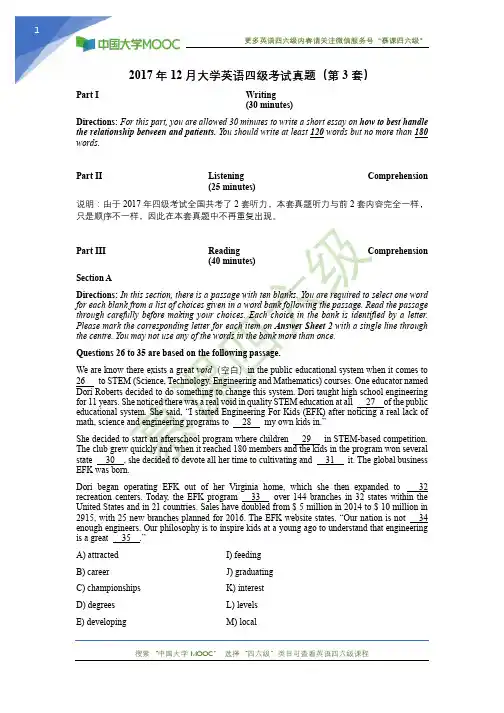
2017年12月大学英语四级考试真题(第3套)Part I Writing(30 minutes)Directions:For this part, you are allowed 30 minutes to write a short essay on how to best handle the relationship between and patients. You should write at least 120 words but no more than 180 words.Part II Listening Comprehension(25 minutes)说明:由于2017年四级考试全国共考了2套听力,本套真题听力与前2套内容完全一样,只是顺序不一样,因此在本套真题中不再重复出现。
Part III Reading Comprehension(40 minutes)Section ADirections: In this section, there is a passage with ten blanks. You are required to select one word for each blank from a list of choices given in a word bank following the passage. Read the passage through carefully before making your choices. Each choice in the bank is identified by a letter. Please mark the corresponding letter for each item on Answer Sheet 2 with a single line through the centre. You may not use any of the words in the bank more than once.Questions 26 to 35 are based on the following passage.We are know there exists a great void(空白)in the public educational system when it comes to 26 to STEM (Science, Technology, Engineering and Mathematics) courses. One educator named Dori Roberts decided to do something to change this system. Dori taught high school engineering for 11 years. She noticed there was a real void in quality STEM education at all 27 of the public educational system. She said, “I started Engineering For Kids (EFK) after noticing a real lack of math, science and engineering programs to 28 my own kids in.”She decided to start an afterschool program where children 29 in STEM-based competition. The club grew quickly and when it reached 180 members and the kids in the program won several state 30 , she decided to devote all her time to cultivating and 31 it. The global business EFK was born.Dori began operating EFK out of her Virginia home, which she then expanded to 32 recreation centers. Today, the EFK program 33 over 144 branches in 32 states within the United States and in 21 countries. Sales have doubled from $ 5 million in 2014 to $ 10 million in 2915, with 25 new branches planned for 2016. The EFK website states, “Our nation is not 34 enough engineers. Our philosophy is to inspire kids at a young ago to understand that engineering is a great 35 .”A) attracted I) feedingB) career J) graduatingC) championships K) interestD) degrees L) levelsE) developing M) localF) enroll N) operatesG) exposure O) participatedH) feasibleSection BDirections:In this section, you are going to read a passage with ten statements attached to it. Each statement contains information given in one of the paragraphs. Identify the paragraph from which the information is derived. You may choose a paragraph more than once. Each paragraph is marked with a letter. Answer the questions by marking the corresponding letter on Answer Sheet 2.Why aren’t you curious about what happened?A) “You suspended Ray Rice after our video,” a reporter from TMZ challenged National Football League Commissioner Roger Goodell the other day. “Why didn’t you have the curiosity to go to the casino (赌场) yourself?” The implication of the question is that a more curious commissioner would have found a way to get the tape.B) The accusation of incuriosity is one that we hear often, carrying the suggestion that there is something wrong with not wanting to search out the truth. “I have been bothered for a long time about the curious lack of curiosity,” said a Democratic member of the New Jersey legislature back in July, referring to an insufficiently inquiring attitude on the part of an assistant to New Jersey Governor Chris Christie who chose not to ask hard questions about the George Washington Bridge traffic scandal. “Isn’t the mainstream media the least bit curious about what happened?” wrote conservative writer Jennifer Rubin earlier this year, referring to the attack on Americans in Benghazi, Libya.C) The implication, in each case, is that curiosity is a good thing, and a lack of curiosity is a problem. Are such accusations simply efforts to score political points for one’s party? Or is there something of particular value about curiosity in and of itself?D) The journalist Ian Leslie, in his new and enjoyable book Curious: The Desire to Know and Why Your Future Depends on It, insists that the answer to that last question is ‘Yes’. Leslie argues that curiosity is a much-overlooked human virtue, crucial to our success, and that we are losing it.E) We are suffering, he writes, from a “serendipity deficit.” The word “serendipity” was coined by Horace Walpole in an 1854 letter, from a tale of three princes who “were always making discoveries, by accident, of things they were not in search of.” Leslie worries that the rise of the Internet, among other social and technological changes, has reduced our appetite for aimless adventures. No longer have we the inclination to let ourselves wander through fields of knowledge, ready to be surprised. Instead, we seek only the information we want.F) Why is this a problem? Because without curiosity we will lose the spirit of innovation and entrepreneurship. We will see unimaginative governments and dying corporations make disastrous decisions. We will lose a vital part of what has made humanity as a whole so successful as a species.G) Leslie presents considerable evidence for the proposition that the society as a whole is growing less curious. In the U.S. and Europe, for example, the rise of the Internet has led to a declining consumption of news from outside the reader’s borders. But not everything is to be blamed on technology. The decline in interest in literary fiction is also one of the causes identified by Leslie. Reading literary fiction, he says, makes us more curious.H) Moreover, in order to be curious, “you have to be aware of a gap in your knowledge in the first place.” Although Leslie perhaps paints a bit broadly in contending that most of us are unaware of how much we don’t know, he’s surely right to point out that the problem is growing: “Google can give us the powerful illusion that a questions have definite answers.”I) Indeed, Google, for which Leslie express admiration, is also his frequent whipping boy (替罪羊).He quotes Google co-founder Larry Page to the effect that the “perfect search engine” will “understand exactly what I mean and give me back exactly what I want.” Elsewhere in the book, Leslie writes: “Google aims to save you from the thirst of curiosity altogether.”J) Somewhat nostalgically (怀旧地), he quotes John Maynard Keynes’s justly famous words of praise to the bookstore: “One should enter it vaguely, almost in a dream and allow what is there freely to attract and influence the eye. To walk the rounds of the bookshops, dipping in as curiosity dictates, should be an afternoon’s entertainment.” If only!K) Citing the work of psychologists and cognitive (认知的) scientists, Leslie criticizes the received wisdom that academic success is the result of a combination of intellectual talent and hard work. Curiosity, he argues, is the third key factor—and a difficult one to preserve. If not cultivated, it will not survive: “Childhood curiosity is a collaboration between child and adult. The surest way to kill it is to leave it alone.”L) School education, he warns, is often conducted in a way that makes children incurious. Children of educated an upper-middle-class parents turn out to be far more curious, even at early ages, than children of working class and lower class families. That lack of curiosity produces a relative lack of knowledge, and the lack of knowledge is difficult if not impossible to compensate for later on. M) Although Leslie’s book isn’t about politics, he doesn’t entirely shy away from the problem. Political leaders, like leader of other organizations, should be curious. They should ask questions at crucial moments. There are serious consequences, he warns, in not wanting to know.N) He presents as an example the failure of the George W. Bush administration to prepare properly for the after-effects of the invasion of Iraq. According to Leslie, those who ridiculed former Defense Secretary Donald Rumsfeld for his 2002 remark that we have to be wary of the “unknown unknowns” were mistaken. Rumsfeld’s idea, Leslie writes, “wasn’t absurd—it was smart.” He adds, “The tragedy is that he didn’t follow his own advice.”O) All of which brings us back to Goodell and the Christie case and Benghazi. Each critic in those examples is charging, in a different way, that someone in authority is intentionally being incurious.I leave it to the reader’s political preference to decide which, if any, charges should stick. But let’s be careful about demanding curiosity about the other side’s weaknesses and remaining determinedly incurious about our own. We should be delighted to pursue knowledge for its own sake—even when what we find out is something we didn’t particularly want to know.36. To be curious, we need to realize first of all that there are many things we don’t know.37. According to Leslie, curiosity is essential to one’s success.38. We should feel happy when we pursue knowledge for knowledge’s sake.39. Political leaders’ lack of curiosity will result in bad consequences.40. There are often accusations about politicians’ and the media’s lack of curiosity to find out the truth.41. The less curious a child is, the less knowledge the child may turn out to have.42. It is widely accepted that academic accomplishment lies in both intelligence and diligence.43. Visiting a bookshop as curiosity leads us can be a good way to entertain ourselves.44. Both the rise of the Internet and reduced appetite for literary fiction contribute to people’s declining curiosity.45. Mankind wouldn’t be so innovative without curiosity.Section CDirections:There are 2 passages in this section. Each passage is followed by some questions or unfinished statements. For each of them there are four choices marked A), B), C) and D). You should decide on the best choice and mark the corresponding letter on Answer Sheet 2 with a single line through the centre.Passage OneQuestions 46 and 50 are based on the following passage.Aging happens to all of us, and is generally thought of as a natural part of life. It would seem silly to call such a thing a “disease.”On the other hand, scientists are increasingly learning that aging and biological age are two different things, and that the former is a key risk factor for conditions such as heart disease, cancer and many more. In that light, aging itself might be seen as something treatable, the way you would treat high blood pressure or a vitamin deficiency.Biophysicist Alex Zhavoronkov believes that aging should be considered a disease. He said that describing aging as a disease creates incentives to develop treatments.“It unties the hands of the pharmaceutical (制药的) industry so that they can begin treating the disease and not just the side effects,” he said.“Right now, people think of aging as natural and something you can’t control,” he said. “In academic circles, people take aging research as just an interest area where they can try to develop interventions. The medical community also takes aging for granted, and can do nothing about it except keep people within a certain health range.”But if aging were recognized as a disease, he said, “It would attract funding and change the way we do health care. What matters is understand that aging is curable.”“It was always known that the body accumulates damage,” he added. “The only way to cure aging is to find ways to repair that damage. I think of it as preventive medicine for age-related conditions.”Leonard Hayflick, a professor at the University of California, San Francisco, said the idea that aging can be cured implies the human lifespan can be increased, which some researchers suggest is possible. Hayflick is not among them.“There’re many people who recover from cancer, stroke, or heart disease. But they continue to age, because aging is separate from their disease,” Hayflick said. “Even if those causes of death were eliminated, life expectancy would still not go much beyond 92 years.”46. What do people generally believe about aging?A) It should cause not alarm whatsoever.B) They just cannot do anything about it.C) It should be regarded as a kind of disease.D) They can delay it with advances in science.47. How do many scientists view aging now?A) It might be prevented and treated.B) It can be as risky as heart disease.C) It results from a vitamin deficiency.D) It is an irreversible biological process.48. What does Alex Zhavoronkov think of “describing aging as a disease”?A) It will prompt people to take aging more seriously.B) It will greatly help reduce the side effects of aging.C) It will free pharmacists from the conventional beliefs about aging.D) It will motivate doctors and pharmacists to find ways to treat aging.49. What do we learn about the medical community?A) They now have a strong interest in research on aging.B) They differ from the academic circles in their view on aging.C) They can contribute to people’s health only to a limited extent.D) They have ways to intervene in people’s aging process.50. What does Professor Leonard Hayflick believe?A) The human lifespan cannot be prolonged.B) Aging is hardly separable from disease.C) Few people can live up to the age of 92.D) Heart disease is the major cause of aging.Passage TwoQuestions 51 to 55 are based on the following passage.Female applicants to postdoctoral positions in geosciences were nearly half as likely to receive excellent letters of recommendation, compared with their male counterparts. Christopher Intagliata reports.As in many other fields, gender bias is widespread in the sciences. Men score higher starting salaries, have more mentoring(指导), and have better odds of being hired. Studies show they’re also perceived as more competent than women in STEM (Science, Technology, Engineering, and Mathematics) fields. And new research reveals that men are more likely to receive excellent letters of recommendation, too.“Say, you know, this is the best student I’ve ever had,” says Kuheli Dutt, a social scientist and diversity officer at Columbia University’s Lamont campus. “Compare those excellent letters with a merely good letter: ‘The candidate was productive, or intelligent, or a solid scientist or something that’s clearly solid praise,’ but nothing that singles out the candidate as exceptional or one of a kind.”Dutt and her colleagues studied more than 1,200 letters of recommendation for postdoctoral positions in geoscience. They were all edited for gender and other identifying information, so Dutt and her team could assign them a score without knowing the gender of the student. They found that female applicants were only half as likely to get outstanding letters, compared with their male counterparts. That includes letters of recommendation from all over the world, and written by, yes, men and women. The findings are in the journal Nature Geoscience.Dutt says they were not able to evaluate the actual scientific qualifications of the applicants using the data in the files. But she says the results still suggest women in geoscience are at a potential disadvantage from the very beginning of their careers starting with those less than out-standing letters of recommendation.“We’re not trying to assign blame or criticize anyone or call anyone consciously sexist. Rather, the point is to use the results of this study to open up meaningful dialogues on implicit gender bias, be it at a departmental level or an institutional level or even a discipline level.” Which may lead tosome recommendations for the letter writers themselves.51. What do we learn about applicants to postdoctoral positions in geosciences?A) There are many more men applying than women.B) Chances for women to get the positions are scarce.C) More males than females are likely to get outstanding letters of recommendation.D) Male applicants have more interest in these positions than their female counterparts.52. What do studies about men and women in scientific research show?A) Women engaged in postdoctoral work are quickly catching up.B) Fewer women are applying for postdoctoral positions due to gender bias.C) Men are believed to be better able to excel in STEM disciplines.D) Women who are keenly interested in STEM fields are often exceptional.53. What do the studies find about the recommendation letters for women applicants?A) They are hardly ever supported by concrete examples.B) They contain nothing that distinguishes the applicants.C) They provide objective information without exaggeration.D) They are often filled with praise for exceptional applicants.54. What did Dutt and her colleagues do with the more than 1,200 letters of recommendation?A) They asked unbiased scholars to evaluate them.B) They invited women professionals to edit them.C) They assigned them randomly to reviewers.D) They deleted all information about gender.55. What does Dutt aim to do with her study?A) Raise recommendation writers’ awareness of gender bias in their letters.B) Open up fresh avenues for women post-doctors to join in research work.C) Alert women researchers to all types of gender bias in the STEM disciplines.D) Start a public discussion on how to raise women’s status in academic circles.Part IV Translation (30 minutes)Directions:For this part, you are allowed 30 minutes to translate a passage from Chinese into English. You should write your answer on Answer Sheet 2.黄山位于安徽省南部。
2017年12月大学英语四级CET4真题及答案(第3套)

2017年12月大学英语四级考试真题(第3套)Part I Writing (30 minutes) Directions:For this part, you are allowed 30 minutes to write a short essay on how to best handle the relationship between doctors and patients. You should write at least 120 words but no more than 180 words.Part II Listening Comprehension (25 minutes) 说明:由于2017年12月四级考试全国共考了2套听力,本套真题听力与前2套内容完全一样,只是顺序不一样,因此在本套真题中不再重复出现。
Part ⅢReading Comprehension ( 40 minutes )Section ADirections: In this section, there is a passage with ten blanks. You are required to select one word for each blank from a list of choices given in a word bank following the passage. Read the passage through carefully before making your choices. Each choice in the bank is identified by a letter. Please mark the corresponding letter for each item on Answer Sheet 2 with a single line through the centre. You may not use any of the words in the bank more than once.Questions 26 to 35 are based on the following passage.We all know there exists a great void(空白)in the public educational system when it comes to 26 to STEM(Science, Technology, Engineering and Mathematics)courses. One educator named Dori Roberts decided to do something to change this system. Dori taught high school engineering for 11 years. She noticed there was a real void in quality STEM education at all 27 of the public educational system. She said, “I started Engineering For Kids (EFK)after noticing a real lack of math, science and engineering programs to 28 my own kids in”She decided to start an afterschool program where children 29 in STEM-based competitions. The club grew quickly and when it reached 180 members and the kids in the program won several state 30 , she decided to devote all her time to cultivating and 31 it. The global business EFK was born.Dori began operating EFK out of her Virginia home, which she then expanded to 32 recreation centers. Today, the EFK program 33 over 144 branches in 32 states within the United States and in 21 countries. Sales have doubled from $5 million in 2014 to $10 million in 2015,with 25 new branches planned for 2016. T he EFK website states, “Our nation is not 34 enough engineers. Our philosophy is to inspire kids at a young age to understand that engineering is a great 35 .”Section BDirections:In this section, you are going to read a passage with ten statements attached to it. Each statement contains information given in one of the paragraphs. Identify the paragraph from which the information is derived. You may choose a paragraph more than once. Each paragraph is marked with a letter. Answer the questions by marking the corresponding letter on Answer Sheet 2.Why aren't you curious about what happened?A) “You suspended Ray R ice after our video,” a reporter from TMZ challenged National Football League Commissioner Roger G oodell the other day. “W hy didn’t you have the cur iosity to go to the casino (赌场) yourself?” The implication of the question is that a more curious. commissioner would have found a way to get the tape.B) The accusation of incuriosity is one that we hear often, carrying the suggestion that there is something wrong with not wanting to search out the truth. “I have been bothered for a long time about the curious lack of curiosity,” said a Democratic member of the New Jersey legislature back in July, referring to an insufficiently inquiring attitude on the part of an assistant to New Jersey Governor Chris Christie who chose not to ask hard questions about the George Washington Bridge traffic scandal. “Isn’t the mainstream media the least bit curious about what happened?” wrote conservative writer Jennifer Rubin earlier this year, referring to the attack on Americans in Benghazi, Libya.C) The implication, in each case, is that curiosity is a good thing, and a lack of curiosity is a problem. Are such accusations simply efforts to score political points for one's party? Or is there something of particular value about curiosity in and of itself?D) The journalist Ian Leslie, in his new and enjoyable book Curious: The Desire to Know and Why Your Fatter Depends on It, insists that the answer to that last question is ‘Yes.’ Leslie argues that curiosity is a much-overlooked human virtue, crucial to our success, and that we are losing it.E)We are suffering, he writes, from a “serendipity deficit.” The word “serendipity” was coined by Horace Walpole in an 1854 letter, from a tale of three princes who “were always making discoveries, by accident, of things they were not in search of,” Leslie worries that the rise of the Internet, among other social and technological changes, has reduced our appetite for aimless adventures. No longer have we the inclination to let ourselves wander through fields of know ledges, ready to be surprised. Instead, we seek only the information we want.F) Why is this a problem? Because without curiosity we will lose the spirit of innovation and entrepreneurship. We will see unimaginative governments and dying corporations make disastrous decisions. We will lose a vital part of what has made humanity as a whole so successful as a species.G) Leslie presents considerable evidence for the proposition that the society as a whole is growing less curious. In the U.S. and Europe, for example, the rise of the I nternet has led to a declining consumption of news from outside the reader’s borders .But not everything is to be blamed on technology. The decline in interest in literary fiction is also one of the causes identified by Leslie. Reading literary fiction, he says ,make us more curious.H)Moreover, in order to be curious, “you have to be aware of a gap in your knowledge in the first place.” Although Leslie perhaps paints a bit broadly in contending that most of us are unaware of how much we don’t know, he’s surely right to point out that the problem is growing: “Google can give us the powerful illusion that all questions have definite answers.”I)Indeed, Google, for which Leslie expresses admiration, is also his frequent whipping body(替罪羊). He quotes Google co-founder Larry Page to the effect that the “perfect search engine” will“understand exactly what I mean and give me back exactly what I want.” Elsewhere in the book, Leslie writes: “G oogle aims to save you from the thirst of curiosity altogether.”J) Somewhat nostalgically(怀旧地), he quotes John Maynard K eynes’s justly famous words of praise to the bookstore: “One should enter it vaguely, almost in a dream, and allow what is there freely to attract and influence the eye. To walk the rounds of the bookshops, dipping in as curiosity dictates, should be an afternoons entertainment.” If only!K) Citing the work of psychologists and cognitive( 认知的)scientists, Leslie criticizes the received wisdom that academic success is the result of a combination of intellectual talent and hard work. Curiosity, he argues, is the third key factor--and a difficult one to preserve. If not cultivated, it will not survive: “Childhood curiosity is a collaboration between child and adult. The surest way to kill it is to leave it alone.”L) School education, he warns, is often conducted in a way that makes children incurious. Children of educated and upper-middle-class parents turn out to be far more curious, even at early ages, than children of working class and lower class families. That lack of curiosity produces a relative lack of knowledge, and the lack of knowledge is difficult if not impossible to compensate for later on.M)Although L eslie’s book isn’t about politics, he doesn’t entirely shy away from the problem. Political leaders, like leader of other organizations, should be curious. They should ask questions at crucial moments . There serious consequences, he warns, in not wanting to know.N) He presents as an example the failure of the George W. Bush administration to prepare properly for the after-effects of the invasion of Iraq. According to Leslie, those who ridiculed former. Defense Secretary Donald Rumsfeld for his 2002 remark that we have to be wary of the “unknown unknowns” were mistaken. R umsfeld’s idea, L eslie writes, “wasn’t absurd- it was smart.”H e adds, “T he tragedy is that he didn’t follow his own advice.”O) All of which brings us back to Goodell and the Christie case and Benghazi. Each critic in those examples is charging, in a different way, that someone in authority is intentionally being incurious. I leave it to the reader's political preference to decide which, if any, charges should stick. But let’s be careful about demanding curiosity about the other side’s weaknesses and remaining determinedly incurious about our own. We should be delighted to pursue knowledge for its own sake--even when what we find out is something we didn’t particularly want to know.36. T o be curious, we need to realize first of all that there are many things we don’t know.37. According to L eslie, curiosity is essential to one’s success.38. W e should feel happy when we pursue knowledge for knowledge’s sake.39. Political leader s’ lack of curiosity will result in bad consequences.40. T here are often accusations about politicians' and the media’s lack of curiosity to find out the truth.41. The less curious a child is, the less knowledge the child may turn out to have.42. It is widely accepted that academic accomplishment lies in both intelligence and diligence.43. Visiting a bookshop as curiosity leads us can be a good way to entertain ourselves.44. Both the rise of the Internet and reduced appetite for literary fiction contri bute to people’s declining curiosity.45. M ankind wouldn’t be so innovative without cur iosity.Section CDirections: There are 2 passages in this section. Each passage is followed by some questions or unfinished statements. For each of them there are four choices marked A), B), C) and D). You should decide on the best choice and mark the corresponding letter on Answer Sheet 2 with a single line through the centre.Passage OneQuestions 46 to 50 are based on the following passage.Aging happens to all of us, and is generally thought of as a natural part of life. It would seem silly to call such a thing a “disease.”On the other hand, scientists are increasingly learning that aging and biological age are two different things, and that the former is a key risk factor for conditions such as heart disease, cancer and many more. In that light, aging itself might be seen as something treatable, the way you would treat high blood pressure or a vitamin deficiency.Biophysicist Alex Zhavoronkov believes that aging should be considered a disease. He said that describing aging as a disease creates incentives to develop treatments.“It unties the hands of the pharmaceutical(制药的)industry so that they can begin treating the disease and not just the side effects,” he said.“Right now, people think of aging as natural and something you can’t control,” he said. “In academic circles, people take aging research as just an interest area where they can try to develop interventions. The medical community also takes aging for granted, and can do nothing about it except keep people within a certain health range.”But if aging were recognized as a disease, he said, “It would attract funding and change the way we do health care. What matters is understanding that aging is curable.”“I t was always known that the body accumulates damage,” he added. “The only way to cure aging is to find ways to repair that damage. I think of it as preventive medicine for age-related conditions.”Leonard Hayflick, a professor at the University of California, San Francisco, said the idea that aging can be cured implies the human lifespan can be increased, which some researchers suggest is possible. Hayflick is not among them.“There’re many people who recover from cancer, stroke, or heart disease. But they continue to age, because aging is separate from their disease,” Hayflick said. “Even if those causes of death were eliminated, life expectancy would still not go much beyond 92 years.”46. What do people generally believe about aging?A) It should cause no alarm whatsoever.B)They just cannot do anything about it.C) It should be regarded as a kind of disease.D)They can delay it with advances in science.47. How do many scientists view aging now?A) It might be prevented and treated.B) It can be as risky as heart disease.C) It results from a vitamin deficiency.D)It is an irreversible biological process.48. What does Alex Zhavoronkov think of “describing aging as a dis e ase”?A) It will prompt people to take aging more seriously.B) It will greatly help reduce the side effects of aging.C) It will free pharmacists from the conventional beliefs about aging.D)It will motivate doctors and pharmacists to find ways to treat aging.49. What do we learn about the medical community?A) They now have a strong interest in research on aging.B) They differ from the academic circles in their view on aging.C)They can contribute to people’s health only to a limited extent.D) T hey have ways to intervene in people’s aging process.50. What does Professor Leonard Hayflick believe?A)The human lifespan cannot be prolonged.B)Aging is hardly separable from disease.C) Few people can live up to the age of 92.D) Heart disease is the major cause of aging.Passage TwoQuestions 51 to 55 are based on the following passageFemale applicants to postdoctoral positions in geosciences were nearly half as likely to receive excellent letters of recommendation, compared with their male counterparts. Christopher Intagliata reports.As in many other fields, gender bias is widespread in the sciences. Men score higher starting salaries, have more mentoring (指导), and have better odds of being hired. Studies show they’re also perceived as more competent than women in STEM(Science, Technology, Engineering, and Mathematics) fields. And new research reveals that men are more likely to receive excellent letters of recommendation, too.“Say, you know, this is the best student I’ve ever had,” says Kuheli Dutt, a social scientist and diversity officer at Columbia U niversity’s Lamont campus. “C ompare those excellent letters with a merely good letter: ‘The candidate was productive, or intelligent, or a solid scientist or something that’s clearly solid praise,’ but nothing that singles out the candidate as exceptional o r one of a kind.”Dutt and her colleagues studied more than 1,200 letters of recommendation for postdoctoral positions in geoscience. They were all edited for gender and other identifying information, so Dutt and her team could assign them a score without knowing the gender of the student. They found that female applicants were only half as likely to get outstanding letters, compared with their male counterparts. That includes letters of recommendation from all over the world, and written by, yes, men and women. The findings are in the journal Nature Geoscience.Dutt says they were not able to evaluate the actual scientific qualifications of the applicants using the data in the files. But she says the results still suggest women in geoscience are at a potential disadvantage from the very beginning of their careers starting with those less than outstanding letters of recommendation.“W e’re not tryin g to assign blame or criticize anyone or call anyone conscious sexist. Rather, the point is to use the results of this study to open up meaningful dialogues on implicit gender bias, be it at a departmental level or an institutional level or even a discipline level.” Which may lead to some recommendations for the letter writers themselves.51. What do we learn about applicants to postdoctoral positions in geosciences?A) There are many more men applying than women.B)Chances for women to get the positions are scare.C) More males than females are likely to get outstanding letters of recommendation.D) Male applicants have more interest in these positions than their female counterparts.52. What do studies about men and women in scientific research show?A) Women engaged in postdoctoral work are quickly catching up.B) Fewer women are applying for postdoctoral positions due to gender bias.C) Men are believed to be better able to excel in STEM disciplines.D)Women who are keenly interested in STEM fields are often exceptional.53.What do the studies find about the recommendation letters for women applicants?A)They are hardly ever supported by concrete examples.B)They contain nothing that distinguishes the applicants.C) They provide objective information without exaggerate.D)They are often filled with praise for exceptional applicants.54.What did Dutt and her colleagues do with the more than 1, 200 letters of recommendation?A)They asked unbiased scholars to evaluate them.B)They invited women professionals to edit them.C)Them assigned them randomly to reviewers.D) They deleted all information about gender.55. What does Dutt aim to do with her study?A) R aise recommendation writers’ awareness of gender bias in their letters.B)Open up fresh avenues for women post-doctors to join in research work.C) Alert women researchers to all types of gender bias in the STEM disciplines.D) S tart a public discussion on how to raise women’s status in academic circles.Part ⅣTranslation (30 minutes) Directions: For this part, you are allowed 30 minutes to translate a passage from Chinese into English. You should write your answer on Answer Sheet 2.黄山位于安徽省南部。
2017年12月大学英语四级考试真题及答案

2017年12月大学英语四级考试真题及答案(第一套)Part I Writing (25 minutes)Directions: For this part, you are allowed 30 minutes to write a short easy on how to besthandle the relationship between doctors and patients. You should write at least120 words but no more than 180 words.Part II Listening Comprehension (25 minutes)Section ADirections: In this section, you will hear three news reports. At the end of each news report, you will hear two or three questions. Both the news report and the questions will be spoken only once. After you hear a question, you must choose the best answer from the four choices marked A), B), C) and D). Then mark the corresponding letter on Answer Sheet 1 with a single line through the centre.Questions 1 and 2 are based on the news report you have just heard.1. A) Her friend Erika. C) Her grandfather.B) Her little brother. D) Her grandmother.2. A) By taking pictures for passers-by. C) By selling lemonade and pictures.B) By working part time at a hospital. D) By asking for help on social media.Questions 3 and 4 are based on the news report you have just heard.3. A) Finding cheaper ways of highway construction.B) Generating electric power for passing vehicles.C) Providing clean energy to five million people.D) Testing the efficiency of the new solar panel.4. A) They can stand the wear and tear of natural elements.B) They can be laid right on top of existing highways.C) They are only about half an inch thick.D) They are made from cheap materials.Questions 5 to 7 are based on the news report you have just heard.5. A) Endless fighting in the region. C) Inadequate funding for research.B) The hazards from the desert. D) The lack of clues about the species.6. A) To observe the wildlife in the two national parks.B) To identify the reasons for the lions’ disappearance.C) To study the habitat of lions in Sudan and Ethiopia.D) To find evidence of the existence of the “lost lions”.7. A) Lions walking. C) Some camping facilities.B) Lions’ tracks. D) Traps set by local hunters.Section BDirections:In this section, you will hear two long conversations. At the end of each conversation, you will hear four questions. Both the conversation and the questions will be spoken only once. After you hear a question, you must choose the best answer from the four choices marked A), B), C), and D). Then mark the corresponding letter on Answer Sheet 1 with a single line through the centre.Questions 8 to 11 are based on the conversation you have just heard.8. A) Her ‘lucky birthday’. C) Her wedding anniversary.B) A call from her dad. D) A special gift from the man.9. A) Gave her a big model plane. C) Took her on a trip overseas.B) Bought her a good necklace. D) Threw her a surprise party.10. A) The gift her husband has bought.B) The trip her husband has planned.C) What has been troubling her husband.D) What her husband and the man are up to.11. A) He will be glad to be a guide for the couple’s holiday trip.B) He will tell the women the secret if her husband agrees.C) He is eager to learn how the couple’s holiday turns out.D) He wants to find out about the couple’s holiday plan.Questions 12 to 15 are based on the conversation you have just heard.12. A) They are sensitive to the dynamics of a negotiation.B) They see the importance of making compromises.C) They know when to adopt a tough attitude.D) They take the rival’s attitude into account.13. A) They know how to adapt. C) They know when to make compromises.B) They know when to stop. D) They know how to control their emotion.14. A) They are patient. C) They learn quickly.B) They are good at expression. D) They uphold their principles.15. A) Make clear one's intentions. C) Formulate one's strategy.B) Clarify items of negotiation. D) Get to know the other side.Section CDirections: In this section, you will hear three passages. At the end of each passage, you willhear three or four questions. Both the passage and the questions will be spoken onlyonce. After you hear a question, you must choose the best answer from the fourchoices marked A), B), C), D). Then mark the corresponding letter on AnswerSheet 1 with a single line through the centre.Questions 16 to 18 are based on the passage you have just heard.16. A) When America's earliest space program started.B) When the International Space Station was built.C) How many space shuttle missions there will be.D) How space research benefits people on Earth.17. A) They accurately calculated the speed of the orbiting shuttles.B) They developed objects for astronauts to use in outer space.C) They tried to meet astronauts' specific requirements.D) They tried to make best use of the latest technology.18. A) They are extremely accurate. C) They were first made in space.B) They are expensive to make. D) They were invented in the 1970s.Questions 19 to 21 are based on the passage you have just heard.19. A) It was when her ancestors came to America.B) People had plenty of land to cultivate then.C) It marked the beginning of something new.D) Everything was natural and genuine then.20. A) They believed in working for goals. C) They had all kinds of entertainment.B) They enjoyed living a living a life of ease. D) They were known to be creative.21. A) Chatting with her ancestors. C) Polishing all the silver work.B) Furnishing her country house. D) Doing needlework by the fire.Questions 22 to 25 are based on the passage you have just heard.22. A) Use a map to identify your location. C) Sit down and try to calm yourself.B) Call your family or friends for help. D) Try to follow your footprints back.23. A) You may find a way out without your knowing it.B) You may expose yourself to unexpected dangers.C) You may get drowned in a sudden flood.D) You may end up entering a wonderland.24. A) Look for food. C) Start a fire.B) Wait patiently. D) Walk uphill.25. A) Inform somebody of your plan. C) Check the local weather.B) Prepare enough food and drink. D) Find a map and a compass.Part Ⅲ Reading Comprehension ( 40 minutes )Section ADirections: In this section, there is a passage with ten blanks. You are required to select one word for each blank from a list of choices given in a word bank following the passage. Read the passage through carefully before making your choices. Each choice in the bank is identified by a letter. Please mark the corresponding letter for each item on Answer Sheet 2 with a single line through the centre. You may not use any of the words in the bank more than once.A rat or pigeon might not be the obvious choice to tend to someone who is sick, but these creatures have some 26 skills that could help the treatment of human diseases.Pigeons are often seen as dirty birds and an urban 27 , but they are just the latest in a long line of animals that have been found to have abilities to help humans. Despite having a brain no bigger than the 28 of your index finger, pigeons have a very impressive 29__ memory. Recently it was shown that they could be trained to be as accurate as humans at detecting breast cancer in images.Rats are often 30 with spreading disease rather than 31 it, but thislong-tailed animal is highly 32 . Inside a rat's nose are up to 1,000 different types of olfactory receptors (嗅觉感受器), whereas humans only have 100 to 200 types. This gives rats the ability to detect __33 smells. As a result, some rats are being put to work to detect TB(肺结核). When the rats detect the smell, they stop and rub their legs to 34 a sample is infected.Traditionally, a hundred samples would take lab technicians more than two days to 35 , but for a rat it takes less than 20 minutes. This rat detection method doesn't rely on specialist equipment. It is also more accurate — the rats are able to find more TB infections and, therefore, save more lives.A) associated I) slightB) examine J) specifyC) indicate K) superiorD) nuisance L) suspiciousE) peak M) tipF) preventing N) treatedG) prohibiting O) visualH) sensitiveSection BDirections: In this section, you are going to read a passage with ten statements attached to it. Each statement contains information given in oneof the paragraphs. Identify the paragraph from which the information is derived. You may choose a paragraph more than once. Each paragraph is marked with a letter. Answer the questions by marking the corresponding letter on Answer Sheet 2.Do In-Class Exams Make Students Study Harder?Research suggests they may study more broadly for the unexpected rather than search for answers.[A] I have always been a poor test-taker. So it may seem rather strange that I have returned to college to finish the degree I left undone some four decades ago. I am making my way through Columbia University, surrounded by students who quickly supply the verbal answer while I am still processing the question.[B] Since there is no way for me to avoid exams, I am currently questioning what kind are the most taxing and ultimately beneficial. I have already sweated through numerous in-class midterms and finals, and now I have a professor who issues take-home ones. I was excited when I learned this, figuring I had a full week to do the research, read the texts, and write it all up. In fact, I was still rewriting my midterm the morning it was due. To say I had lost the thread is putting it mildly.[C] As I was suffering through my week of anxiety, overthinking the material and guessing my grasp of it, I did some of my own polling among students and professors. David Eisenbach, who teaches a popular class on U.S. presidents at Columbia, prefers the in-class variety. He believes students ultimately learn more and encourages them to form study groups. “That way they socialize over history outside the class, which wouldn’thappen without the pressure of an in-class exam,” he explained, “Furthermore, in-class exams force students to learn how to perform under pressure, and essential work skill.”[D] He also says there is less chance of cheating with the in-class variety. In 2012, 125 students at Harvard were caught up in a scandal when it was discovered they had cheated on a take-home exam for a class entitled “Introduction To Congress.” Some colleges have what they call an “h onor code,” though if you are smart enough to get into these schools, you are either smart enough to get around any codes or hopefully, too ethical to consider doing so. As I sat blocked and clueless for two solid days, I momentarily wondered if I couldn’t just call an expert on the subject matter which I was tackling, or someone who took the class previously, to get me going.[E] Following the Harvard scandal, Mary Miller, the former dean of students at Yale, made an impassioned appeal to her school’s pr ofessors to refrain from take-hone exams. “Students risk health and well being, as well as performance in other end-of-term work, when faculty offers take-home exams without clear, time-limited boundaries,” she told me. “Research now shows that regular quizzes, short essays, and other assignments over the course of a term better enhance learning and retention.”[F] Most college professors agree the kind of exam they choose largely depends on the subject. A quantitative-based one, for example, is unlikely to be sent home, where one could ask their older brothers and sisters to help. Vocational-type classes, such as computer science or journalism, on the other hand, are often more research-oriented and lend themselves totake-home testing. Chris Koch, who te aches “History of Broadcast Journalism” at Montgomery Community College in Rockville, Maryland,points out that reporting is about investigation rather than the memorization of minute details. “In my field, it’s not what you know—it’s what you know how to find out,” says Koch. “There is way too much information, and more coming all the time, for anyone to remember. I want my students to search out the answers to questions by using all the resources available to them.[G] Students’ test-form preferences vary, too, often depending on the subject and course difficulty. “I prefer take-home essays because it is then really about the writing, so you have time to edit and do more research,” says Elizabeth Dresser, a junior at Barnard. Then there is the stress factor. Francesca Haass, a senior at Middlebury, says, “I find the in-class ones are more stressful in the short term, but there is immediate relief as you swallow information like mad, and then you get to forget it all. Take-homes require thoughtful engagement which can lead to longer term stress as there is never a moment when the time is up.” Meanwhile, Olivia Rubin, a sophomore at Emory, says she hardly even considers take-homes true exams. “If you understand the material and have the ability to articulate (说出) your thoughts, they should be a breeze.”[H] How students ultimately handle stress may depend on their personal test-taking abilities. There are people who always wait until the last minute, and make it much harder than it needs to be. And then there those who, not knowing what questions are coming at them, and having no resources to refer to, can freeze. And then there are we rare folks who fit both those descriptions.[I] Yes, my advanced age must factor into the equation (等式), in part because of my inability toaccess the information as quickly. As another returning student at Columbia, Kate Marber, toldme, “We are learning not only all this information, but essentially how to learn again. Ourfellow students have just come out of high school. A lot has changed since we were last inschool.”[J] If nothing else, the situation has given my college son and me something to share, When Iasked his opinion on this matter, he responded, “I like in-class exams because the time isalready reserved, as opposed to using my free time at home to work on a test,” he responded.It seems to me that a compromise would be receiving the exam questions a day or two inadvance, and then doing the actual test in class the ticking clock overhead.[K] Better yet, how about what one Hunter College professor reportedly did recently for her finalexam: She encouraged the class not to stress or even study, promising that, “It is going to be apiece of cake.” When the students came in, sharpened penci ls in hand, there was not a bluebook in sight. Rather, they saw a large chocolate cake and they each were given a slice.36. Elderly students find it hard to keep up with the rapid changes in education.37. Some believe take-home exams may affect students' performance in other courses.38. Certain professors believe in-class exams are ultimately more helpful to students.39. In-class exams are believed to discourage cheating in exams.40. The author was happy to learn she could do some exams at home.41. Students who put off their work until the last moment often find the exams more difficult thanthey actually are.42. Different students may prefer different types of exams.43. Most professors agree whether to give an in-class or a take-home exam depends on type ofcourse being taught.44. The author dropped out of college some forty years ago.45. Some students think take-home exams will eat up their free time.Section CDirections: There are 2 passages in this section. Each passage is followed by some questions or unfinished statements. For each of them there are four choices marked A), B), C) and D). You should decide on the best choice and mark the corresponding letter on Answer Sheet 2 with a single line through the centre.Passage OneQuestions 46 and 50 are based on the following passage.That people often experience trouble sleeping in a different bed in unfamiliar surroundings is a phenomenon known as the “first-night” effect. If a person stays in the same room the following night they tend to sleep more soundly. Yuka Sasaki and her colleagues at Brown University set out to investigate the origins of this effect.Dr. Sasaki knew the first-night effect probably has something to do with how humans evolved. The puzzle was what benefit would be gained from it when performance might be affected the following day. She also knew from previous work conducted on birds and dolphins that these animals put half of their brains to sleep at a time so that they can rest while remaining alert enough to avoid predators (捕食者). This led her to wonder if people might be doing the same thing. To take a closer look, her team studied 35 healthy people as they slept in the unfamiliar environment of the university’s Department of Psychologi cal Sciences. The participants each slept in the department for two nights and were carefully monitored with techniques that looked at the activity of their brains. Dr. Sasaki found, asexpected, the participants slept less well on their first night than they did on their second, taking more than twice as long to fall asleep and sleeping less overall. During deep sleep, the participants’ brains behaved in a similar manner seen in birds and dolphins. On the first night only, the left hemispheres (半球) of their brains did not sleep nearly as deeply as their right hemispheres did.Curious if the left hemispheres were indeed remaining awake to process information detected in the surrounding environment, Dr. Sasakire-ran the experiment while presenting the sleeping participants with a mix of regularly timed beeps (蜂鸣声) of the same tone and irregular beeps of a different tone during the night. She worked out that, if the left hemisphere was staying alert to keep guard in a strange environment, then it would react to the irregular beeps by stirring people from sleep and would ignore the regularly timed ones. This is precisely what she found.46. What did researchers find puzzling about the first-night effect?A) To what extent it can trouble people. C) What circumstances may trigger it.B) What role it has played in evolution. D) In what way it can be beneficial.47. What do we learn about Dr. Yuka Sasaki doing her research?A) She found birds and dolphins remain alert while asleep.B) She found birds and dolphins sleep in much the same way.C) She got some idea from previous studies on birds and dolphinsD) She conducted studies on birds’ and dolphins’ sleeping patterns.48. What did Dr. Sasaki do when she first did her experiment?A) She monitored the brain activity of participants sleeping in a new environment.B) She recruited 35 participants from her Department of Psychological Sciences.C) She studied the differences between the two sides of participants’ brains.D) She tested her findings about birds and dolphins on human subjects.49. What did Dr. Sasaki do when re-running her experiment?A) She analyzed the negative effect of irregular tones on brains.B) She recorded participants’ adaptation to changed environment.C) She exposed her participants to two different stimuli.D) She compared the responses of different participants.50. What did Dr. Sasaki find about the participants in her experiment?A) They tended to enjoy certain tones more than others.B) They tended to perceive irregular beeps as a threat.C) They felt sleepy when exposed to regular beeps.D) They differed in their tolerance of irregular tones.Passage TwoQuestions 51 to 55 are based on the following passage.It’s time to reevaluate how women handle conflict at work. Being overworked or over-committed at home and on the job will not get you where you want to be in life. It will only slow you down and hinder your career goals.Did you know women are more likely than men to feel exhausted? Nearly twice as many women than men ages 18-44 reported feeling “very tired” or “exhausted”, according to a recent study.This may not be surprising given that this is the age range when women have children. It's also the age range when many women are trying to balance careers and home. One reason women may feel exhausted is that they have a hard time saying "no." Women want to be able todo it all volunteer for school parties or cook delicious meals-and so their answer to any request is often “Yes, I can.”Women struggle to say “no” in the workplace for similar reasons, including the desire to be liked by their colleagues. Unfortunately, this inability to say "no" may be hurting women's heath as well as their career.At the workplace, men use conflict as a way to position themselves, while women often avoid conflict or strive to be the peacemaker, because they don't want to be viewed as aggressive or disruptive at work. For example, there’s a problem that needs to be addressed immediately, resulting in a dispute over should be the one to fix it. Men are more likely to face that dispute from the perspective of what benefits them most, whereaswomen may approach the same dispute from the perspective of what's the easiest and quickest way to resolve the problem-evenif that means doing the boring work themselves.This difference in handling conflict could be the deciding factor on who gets promoted to a leadership position and who does not. Leaders have to be able to delegate and manage resources wisely – including staff expertise. Shouldering more of the workload may not earn you that promotion. Instead, it may highlight your inability to delegate effectively.51. What does the author say is the problem with women?A) They are often unclear about the career goals to reach.B) They are usually more committed at home than on the job.C) They tend to be over-optimistic about how far they could go.D) They tend to push themselves beyond the limits of their ability.52. Why do working women of child-bearing age tend to feel drained of energy?A) They struggle to satisfy the demands of both work and home.B) They are too devoted to work and unable to relax as a result.C) They do their best to cooperate with their workmates.D) They are obliged to take up too many responsibilities.53. What may hinder the future prospects of career women?A) Their unwillingness to say “no”.B) Their desire to be considered powerful.C) An underestimate of their own ability.D) A lack of courage to face challenges.54. Men and woman differ in their approach to resolving workplace conflicts in that______.A) women tend to be easily satisfiedB) men are generally more persuasiveC) men tend to put their personal interests firstD) women are much more ready to compromise55. What is important to a good leader?A) A dominant personality. C) The courage to admit failureB) The ability to delegate. D) A strong sense of responsibility.Part Ⅳ Translation (30 minutes)Directions: For this part, you are allowed 30 minutes to translate a passage from Chinese intoEnglish. You should write your answer on Answer Sheet 2.华山位于华阴市,据西安120公里。
2017年12月大学英语四级考试真题及参考答案(三套全)

2017年12月大学英语四级考试真题及答案(第一套)Part I Writing (25 minutes)Directions: For this part, you are allowed 30 minutes to write a short easy on how to besthandle the relationship between doctors and patients. You should write at least 120 words but no more than 180 words.Part II Listening Comprehension (25 minutes)C) They are only about half an inch thick.D) They are made from cheap materials.Questions 5 to 7 are based on the news report you have just heard.5. A) Endless fighting in the region. C) Inadequate funding for research.B) The hazards from the desert. D) The lack of clues about the species.6. A) To observe the wildlife in the two national parks.B) To identify the reasons for the lions’ disappearance.C) To study the habitat of lions in Sudan and Ethiopia.D) To find evidence of the existence of the “lost lions”.7. A) Lions walking. C) Some camping facilities.B) Lions’ tracks. D) Traps set by local hunters.Section BDirections:In this section, you will hear two long conversations. At the end of each conversation, you will hear four questions. Both the conversation and the questions will be spoken only once. After you hear a question, you must choose the best answer from the four choices marked A), B), C), and D). Then mark theC) They know when to adopt a tough attitude.D) They take the rival’s attitude into account.13. A) They know how to adapt. C) They know when to make compromises.B) They know when to stop. D) They know how to control their emotion.14. A) They are patient. C) They learn quickly.B) They are good at expression. D) They uphold their principles.15. A) Make clear one's intentions. C) Formulate one's strategy.B) Clarify items of negotiation. D) Get to know the other side.Section CDirections: In this section, you will hear three passages. At the end of each passage, you willhear three or four questions. Both the passage and the questions will be spoken onlyonce. After you hear a question, you must choose the best answer from the four choices marked A), B), C), D). Then mark the corresponding letter on AnswerSheet 1 with a single line through the centre.B) They enjoyed living a living a life of ease. D) They were known to be creative.21. A) Chatting with her ancestors. C) Polishing all the silver work.B) Furnishing her country house. D) Doing needlework by the fire.Questions 22 to 25 are based on the passage you have just heard.22. A) Use a map to identify your location. C) Sit down and try to calm yourself.B) Call your family or friends for help. D) Try to follow your footprints back.23. A) You may find a way out without your knowing it.B) You may expose yourself to unexpected dangers.C) You may get drowned in a sudden flood.D) You may end up entering a wonderland.24. A) Look for food. C) Start a fire.B) Wait patiently. D) Walk uphill.25. A) Inform somebody of your plan. C) Check the local weather.B) Prepare enough food and drink. D) Find a map and a compass.Part Ⅲ Reading Comprehension ( 40 minutes )Section Arats the ability to detect __33 smells. As a result, some rats are being put to work to detect TB(肺结核). When the rats detect the smell, they stop and rub their legs to 34 a sample is infected.Traditionally, a hundred samples would take lab technicians more than two days to 35 , but for a rat it takes less than 20 minutes. This rat detection method doesn't rely on specialist equipment. It is also more accurate — the rats are able to find more TB infections and, therefore, save more lives.A) associated I) slightB) examine J) specifyC) indicate K) superiorD) nuisance L) suspiciousE) peak M) tipF) preventing N) treatedG) prohibiting O) visualH) sensitiveSection Bthe morning it was due. To say I had lost the thread is putting it mildly.[C] As I was suffering through my week of anxiety, overthinking the material and guessing my grasp of it, I did some of my own polling among students and professors. David Eisenbach, who teaches a popular class on U.S. presidents at Columbia, prefers the in-class variety. He believes students ultimately learn more and encourages them to form study groups. “That way they socialize over history outside the class, which wouldn’t happen without the pressure of an in-class exam,” he explained,“Furthermore, in-class exams force students to learn how to perform under pressure, and essential work skill.”[D] He also says there is less chance of cheating with the in-class variety. In 2012, 125 students at Harvard were caught up in a scandal when it was discovered they had cheated on a take-home exam for a class entitled “Introduction To Congress.”Some colleges have what they call an “honor code,” though if you are smart enough to get into these schools, you are either smart enough to get around any codes or hopefully, too ethical to consider doing so. As I sat blocked and clueless for two solidknow how to find out,” says Koch. “There is way too much information, and more coming all the time, for anyone to remember. I want my students to search out the answers to questions by using all the resources available to them.[G] Students’ test-form preferences vary, too, often depending on the subject and course difficulty. “I prefer take-home essays because it is then really about the writing, so you have time to edit and do more research,” says Elizabeth Dresser, a junior at Barnard. Then there is the stress factor. Francesca Haass, a senior at Middlebury, says, “I find the in-class ones are more stressful in the short term, butthere is immediate relief as you swallow information like mad, and then you get to forget it all. Take-homes require thoughtful engagement which can lead to longer term stress as there is never a moment when the time is up.” Meanwhile, Olivia Rubin, a sophomore at Emory, says she hardly even considers take-homes true exams. “If you understand the material and have the ability to articulate (说出) your thoughts, they should be a breeze.”[H] How students ultimately handle stress may depend on their personaltest-taking abilities. There are people who always wait until the last minute, andhe responded.It seems to me that a compromise would be receiving the exam questions a day or two inadvance, and then doing the actual test in class the ticking clock overhead.[K] Better yet, how about what one Hunter College professor reportedly did recently for her finalexam: She encouraged the class not to stress or even study, promising that, “It is going to be apiece of cake.” When the students came in, sharpened pencils in hand, there was not a bluebook in sight. Rather, they saw a large chocolate cake and they each were givena slice.36. Elderly students find it hard to keep up with the rapid changes in education.37. Some believe take-home exams may affect students' performance in other courses.38. Certain professors believe in-class exams are ultimately more helpful toPassage OneQuestions 46 and 50 are based on the following passage.That people often experience trouble sleeping in a different bed in unfamiliar surroundings is a phenomenon known as the “first-night” effect. If a person stays in the same room the following night they tend to sleep more soundly. Yuka Sasaki and her colleagues at Brown University set out to investigate the origins of this effect.Dr. Sasaki knew the first-night effect probably has something to do with how humans evolved. The puzzle was what benefit would be gained from it whenperformance might be affected the following day. She also knew from previous work conducted on birds and dolphins that these animals put half of their brains to sleep at a time so that they can rest while remaining alert enough to avoid predators (捕食者). This led her to wonder if people might be doing the same thing. To take a closer look, her team studied 35 healthy people as they slept in the unfamiliar environment of the university’s Department of Psychological Sciences. The participants each slept in the department for two nights and were carefully monitored with techniques thatA) She found birds and dolphins remain alert while asleep.B) She found birds and dolphins sleep in much the same way.C) She got some idea from previous studies on birds and dolphinsD) She conducted studies on birds’ and dolphins’ sleeping patterns.48. What did Dr. Sasaki do when she first did her experiment?A) She monitored the brain activity of participants sleeping in a new environment.B) She recruited 35 participants from her Department of Psychological Sciences.C) She studied the differences between the two sides of participants’ brains.D) She tested her findings about birds and dolphins on human subjects.49. What did Dr. Sasaki do when re-running her experiment?A) She analyzed the negative effect of irregular tones on brains.B) She recorded participants’ adaptation to changed environment.C) She exposed her participants to two different stimuli.D) She compared the responses of different participants.50. What did Dr. Sasaki find about the participants in her experiment?Women struggle to say “no” in the workplace for similar reasons, including the desire to be liked by their colleagues. Unfortunately, this inability to say "no" may be hurting women's heath as well as their career.At the workplace, men use conflict as a way to position themselves, while women often avoid conflict or strive to be the peacemaker, because they don't want to be viewed as aggressive or disruptive at work. For example, there’s a problem that needs to be addressed immediately, resulting in a dispute over should be the one to fix it. Men are more likely to face that dispute from the perspective of what benefitsthem most, whereas women may approach the same dispute from the perspective of what's the easiest and quickest way to resolve the problem-evenif that means doing the boring work themselves.This difference in handling conflict could be the deciding factor on who gets promoted to a leadership position and who does not. Leaders have to be able to delegate and manage resources wisely – including staff expertise. Shouldering more of the workload may not earn you that promotion. Instead, it may highlight your inability to delegate effectively.A) women tend to be easily satisfiedB) men are generally more persuasiveC) men tend to put their personal interests firstD) women are much more ready to compromise55. What is important to a good leader?A) A dominant personality. C) The courage to admit failureB) The ability to delegate. D) A strong sense of responsibility.Part Ⅳ Translation (30 minutes)Directions: For this part, you are allowed 30 minutes to translate a passage from Chinese intoEnglish. You should write your answer on Answer Sheet 2.华山位于华阴市,据西安120公里。
2017年12月英语四级真题参考答案
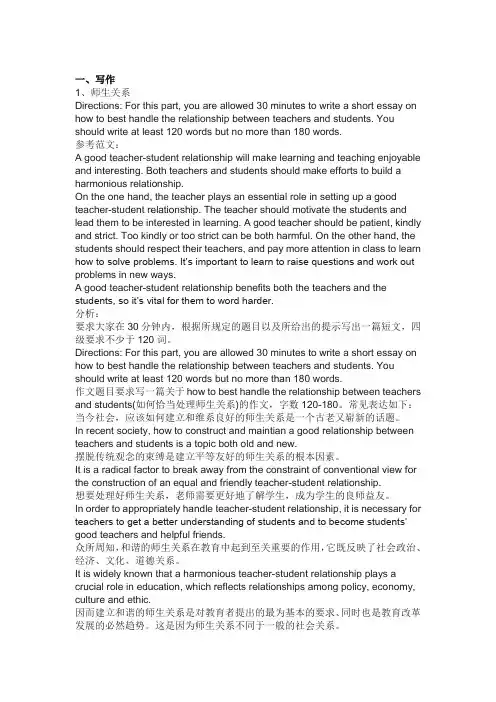
一、写作1、师生关系Directions: For this part, you are allowed 30 minutes to write a short essay on how to best handle the relationship between teachers and students. You should write at least 120 words but no more than 180 words.参考范文:A good teacher-student relationship will make learning and teaching enjoyable and interesting. Both teachers and students should make efforts to build a harmonious relationship.On the one hand, the teacher plays an essential role in setting up a good teacher-student relationship. The teacher should motivate the students and lead them to be interested in learning. A good teacher should be patient, kindly and strict. Too kindly or too strict can be both harmful. On the other hand, the students should respect their teachers, and pay more attention in class to learn how to solve problems. It’s important to learn to raise questions and work out problems in new ways.A good teacher-student relationship benefits both the teachers and the students, so it’s vital for them to word harder.分析:要求大家在30分钟内,根据所规定的题目以及所给出的提示写出一篇短文,四级要求不少于120词。
2017年度12月大学英语四级真命题及答案解析(第三套)
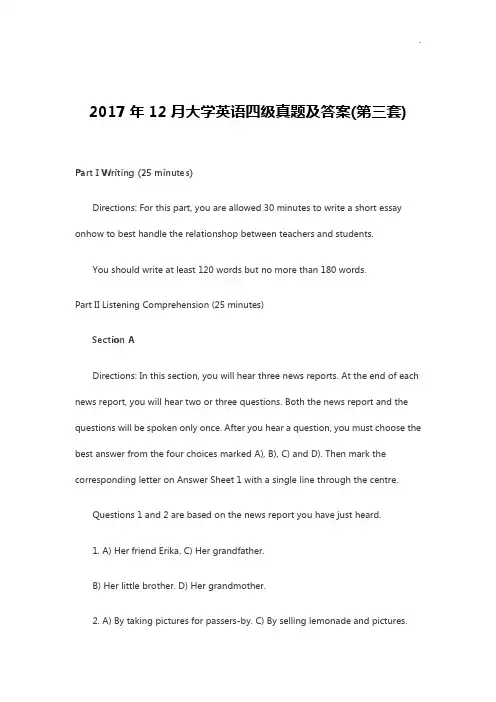
2017年12月大学英语四级真题及答案(第三套) Part I Writing (25 minutes)Directions: For this part, you are allowed 30 minutes to write a short essay onhow to best handle the relationshop between teachers and students.You should write at least 120 words but no more than 180 words.Part II Listening Comprehension (25 minutes)Section ADirections: In this section, you will hear three news reports. At the end of each news report, you will hear two or three questions. Both the news report and the questions will be spoken only once. After you hear a question, you must choose the best answer from the four choices marked A), B), C) and D). Then mark the corresponding letter on Answer Sheet 1 with a single line through the centre.Questions 1 and 2 are based on the news report you have just heard.1. A) Her friend Erika. C) Her grandfather.B) Her little brother. D) Her grandmother.2. A) By taking pictures for passers-by. C) By selling lemonade and pictures.B) By working part time at a hospital. D) By asking for help on social media. Questions 3 and 4 are based on the news report you have just heard.3. A) Finding cheaper ways of highway construction.B) Generating electric power for passing vehicles.C) Providing clean energy to five million people.D) Testing the efficiency of the new solar panel.4. A) They can stand the wear and tear of natural elements.B) They can be laid right on top of existing highways.C) They are only about half an inch thick.D) They are made from cheap materials.Questions 5 to 7 are based on the news report you have just heard.5. A) Endless fighting in the region. C) Inadequate funding for research.B) The hazards from the desert. D) The lack of clues about the species.6. A) To observe the wildlife in the two national parks.B) To identify the reasons for the lions’disappearance.C) To study the habitat of lions in Sudan and Ethiopia.D) To find evidence of the existence of the “lost lions”.7. A) Lions walking. C) Some camping facilities.B) Lions’tracks. D) Traps set by local huntersSection BDirections:In this section, you will hear two long conversations. At the end of each conversation, you will hear four questions. Both the conversation and the questions will be spoken only once. After you hear a question, you must choose the best answer from the four choices marked A), B), C), and D). Then mark the corresponding letter on Answer Sheet 1 with a single line through the centre.Questions 8 to 11 are based on the conversation you have just heard.8. A) Her ‘lucky birthday’. C) Her wedding anniversary.B) A call from her dad. D) A special gift from the man.9. A) Gave her a big model plane. C) Took her on a trip overseas.B) Bought her a good necklace. D) Threw her a surprise party.10. A) The gift her husband has bought.B) The trip her husband has planned.C) What has been troubling her husband.D) What her husband and the man are up to.11. A) He will be glad to be a guide for the couple’s holiday trip.B) He will tell the women the secret if her husband agrees.C) He is eager to learn how the couple’s holiday turns out.D) He wants to find out about the couple’s holiday plan.Questions 12 to 15 are based on the conversation you have just heard.12. A) They are sensitive to the dynamics of a negotiation.B) They see the importance of making compromises.C) They know when to adopt a tough attitude.D) They take the rival’s attitude into account.13. A) They know how to adapt. C) They know when to make compromises.B) They know when to stop. D) They know how to control their emotion.14. A) They are patient. C) They learn quickly.B) They are good at expression. D) They uphold their principles.15. A) Make clear one's intentions. C) Formulate one's strategy.B) Clarify items of negotiation. D) Get to know the other side.Section CDirections: In this section, you will hear three passages. At the end of each passage, you willhear three or four questions. Both the passage and the questions will be spoken onlyonce. After you hear a question, you must choose the best answer from the fourchoices marked A), B), C), D). Then mark the corresponding letter on Answer Sheet 1 with a single line through the centre.Questions 16 to 18 are based on the passage you have just heard.16. A) When America's earliest space program started.B) When the International Space Station was built.C) How many space shuttle missions there will be.D) How space research benefits people on Earth.17. A) They accurately calculated the speed of the orbiting shuttles.B) They developed objects for astronauts to use in outer space.C) They tried to meet astronauts' specific requirements.D) They tried to make best use of the latest technology.18. A) They are extremely accurate. C) They were first made in space.B) They are expensive to make. D) They were invented in the 1970s.Questions 19 to 21 are based on the passage you have just heard.19. A) It was when her ancestors came to America.B) People had plenty of land to cultivate then.C) It marked the beginning of something new.D) Everything was natural and genuine then.20. A) They believed in working for goals. C) They had all kinds of entertainment.B) They enjoyed living a living a life of ease. D) They were known to be creative.21. A) Chatting with her ancestors. C) Polishing all the silver work.B) Furnishing her country house. D) Doing needlework by the fire.Questions 22 to 25 are based on the passage you have just heard.22. A) Use a map to identify your location. C) Sit down and try to calm yourself.B) Call your family or friends for help. D) Try to follow your footprints back.23. A) You may find a way out without your knowing it.B) You may expose yourself to unexpected dangers.C) You may get drowned in a sudden flood.D) You may end up entering a wonderland.24. A) Look for food. C) Start a fire.B) Wait patiently. D) Walk uphill.25. A) Inform somebody of your plan. C) Check the local weather.B) Prepare enough food and drink. D) Find a map and a compass.Part ⅢReading Comprehension ( 40 minutes )Section CDirections:There are 2 passages in this section. Each passage is followed by some questions or unfinished statements. For each of them there are four choices marked A), B), C) and D). You should decide on the best choice and mark the corresponding letter on Answer Sheet 2with a single line through the centre.Passage OneQuestions 46 and 50 are based on the following passage.Aging happens to all of us, and is generally thought of as a natural part of life. It would seem silly to call such a thing a “disease.”On the other hand, scientists are increasingly learning that aging and biological age are two different things, and that the former is a key risk factor for conditions such as heart disease, cancer and many more. In that light, aging itself might be seen as something treatable, the way you would treat high blood pressure or a vitamin deficiency.Biophysicist Alex Zhavoronkov believes that aging should be considered a disease. He said that describing aging as a disease creates incentives to develop treatments.“It unties the hands of the pharmaceutical(制药的)industry so that they can begin treating the disease and not just the side effects,”he said.“Right now, people think of aging as natural and something you can’t control,”he said. “IN academic circles, people take aging research as just an interest area where they can try to develop interventions. The medical community also takes aging for granted, and can do nothing about it except keep people within a certain health range.”But if aging were recognized as a disease, he said,“It would attract funding and change the way we do health care. What matters is understand that aging is curable.”“It was always known that the body accumulates damage,”he added. “The only way to cure aging is to find ways to repair that damage. I think of it as preventive medicine for age-related conditions.”Leonard Hayflick, a professor at the University of California, San Francisco, said the idea that aging can be cured implies the human lifespancan be increased, which some researchers suggest is possible. Hayflick is not among them.“There’re many people who recover from cancer, stroke, or heart disease. But they continue to age, because aging is separate from their disease,”Hayflick said. “Even if those causes of death were eliminated, life expectancy would still not go much beyond 92 years.”46. Whatdo people generally believe about aging?A) It should cause not alarm whatsoever.B) They just cannot do anything about it.C) It should be regardedas a kind of disease.D) They can delay it with advances in science.47.How do many scientists view aging now?A) It might be prevented and treated. C) It results from a vitamin deficiency.B) It can be as risky as heart disease. D) It is an irreversible biological process.48. What does Alex Zhavoronkov think of “describing aging as a disease”?A) It will prompt people to take aging more seriously.B) It will greatly help reduce the side effects of aging.C) It will free pharmacists from the conventional beliefs about aging.D) It will motivate doctors and pharmacists to find ways to treat aging.49. What do we learn about the medical community?A) They now have a strong interest in research on aging.B) They differ from the academic circles in their view on aging.C) They can contribute to people’s health only to a limited extent.D) They have ways to intervene in people’s aging process.50. What does Professor Leonard Hayflick believe?A) The human lifespan cannot be prolonged.B) Aging is hardly separable from disease.C) Few people can live up to the age of 92.D) Heart disease is the major cause of aging.Passage TwoQuestions 51 to 55 are based on the following passage.Female applicants to postdoctoral positions in geosciences were nearly half as likely to receive excellent letters of recommendation, compared with their male counterparts. Christopher Intagliata reports.As in many other fields, gender bias is widespread in the sciences. Men score higher starting salaries, have more mentoring(指导), and have better odds of being hired. Studies show they’re also perceived as more competent than women in STEM (Science, Technology, Engineering, and Mathematics) fields. And new research reveals that men are more likely to receive excellent letters of recommendation, too.“Say, you know, this is the best student I’ve ever had,”says Kuheli Dutt, a social scientist and diversity officer at Columbia University’s Lamont campus. “Compare those excellent letters with a merely good letter: ‘The candidate was productive, or intelligent, or a solid scientist or something that’s clearly solid praise,’but nothing that singles out the candidate as exceptional or one of a kind.”Dutt and her colleagues studied more than 1,200 letters of recommendation for postdoctoral positions in geoscience. They were all edited for gender and other identifying information, so Dutt and her team could assign them a score without knowing the gender of the student. They found that female applicants were onlyhalf as likely to get outstanding letters, compared withtheir male counterparts. That includes letters of recommendation from all over the world, and written by, yes, men and women. The findings are in the journal Nature Geoscience.Dutt says they were not able to evaluate the actual scientific qualifications of the applicants using the data in the files. But she says the results still suggest women in geoscience are at a potential disadvantage from the very beginning of their careers starting with those less than out-standing letters of recommendation.“We're not trying to assign blame or criticize anyone or call anyone consciously sexist. Rather, the point is to use the results of this study toopen upmeaningful dialogues on implicit gender bias, be it at a departmental level or an institutional level or even a discipline level.”Which may lead to some recommendations for the letter writers themselves.51. What do we learn about applicants to postdoctoral positions in geosciences?A)There are many more men applying than women.B)Chances for women to get the positions are scarce.C)More males than females are likely to get outstanding letters of recommendation.D)Male applicants have more interest in these positions than their female counterparts.52. What do studies about men and women in scientific research show?A) Women engaged in postdoctoralwork are quickly catching up.B) Fewer women are applying for postdoctoralpositions due to gender bias.C) Men are believed to be better able to excel in STEM disciplines.D) Women who are keenly interested in STEM fields are often exceptional.53. What do the studies find about the recommendation letters for women applicants?A) They are hardly ever supported by concrete examples.B) They contain nothing that distinguishes the applicants.C) They provide objective information without exaggeration.D) They are often filled with praise for exceptional applicants.54. What did Dutt and her colleagues do with the more than 1,200 letters of recommendation?A) They asked unbiased scholars to evaluate them.B) They invited women professionals to edit them.C) They assigned them randomly to reviewers.D) They deleted all information about gender.55. What does Dutt aim to do with her study?A) Raise recommendation writers’awareness of gender bias in their letters.B) Open up fresh avenues for women post-doctors to join in reaserach work.C) Alert women researchers to all types of gender bias in the STEM disciplines.D) Start a public discussion on how to raise women’s status in academic circles. Part ⅣTranslation (30 minutes)Directions: For this part, you are allowed 30 minutes to translate a passage from Chinese into English. You should write your answer on Answer Sheet 2.黄山位于安徽省南部。
2017年12月大学英语四级考试真题及答案
2017年12月大学英语四级考试真题及答案(第一套)Part I Writing (25 minutes)Directions: For this part, you are allowed 30 minutes to write a short easy on how to besthandle the relationship between doctors and patients. You should write at least120 words but no more than 180 words。
Part II Listening Comprehension (25 minutes)Section ADirections: In this section,you will hear three news reports。
At the end of each news report,you will hear two or three questions. Both the news report and the questions will be spoken only once。
After you hear a question,you must choose the best answer from the four choices marked A), B),C)and D)。
Then mark the corresponding letter on Answer Sheet 1 with a single line through the centre.Questions 1 and 2 are based on the news report you have just heard.1。
A) Her friend Erika。
C)Her grandfather.B)Her little brother. D)Her grandmother。
2017年12月大学英语四级真题及答案解析(全三套)
2017年12月大学英语四级真题及答案解析(全三套) 四级听力第一套:News Report 1A 9-year-old girl in New Mexico has raised more than $500 for her little brother who needs heart surgery in Houston, Texas this July. Addison Witulski's grandmother Kim Allred, said Addison probably overheard a conversation between family members talking about the funds needed to get her little brother to treatment. "I guess she overheard her grandfather and me talking about how we're worried about how we're going to get to Houston, for my grandson's heart surgery," said Allred. She decided to go outside and have a lemonade stand and make some drawings and pictures and sell them.” That's when Addison and her friends Erika and Emily Borden decided to sell lemonade for 50 cents a cup and sell pictures for 25 cents each.Before Allred knew it, New Mexico State Police Officers were among the many stopping by helping them reach a total of $568. The family turned to social media expressing their gratitude saying, "From the bottom of our hearts, we would like to deeply thank each and every person that stopped by!"1: Who did Addison raise the money for?2: How did Addison raise the money?1.D) Her little brother.2.B) By selling lemonade and pictures.News Report 2:Last week, France announced that the country will pave 621 miles of road with solar panels over the next five years with the goal of providing cheap, renewable energy to five million people. Called the Ward Way, the roads will be built through joint efforts with the French road building company Colas and the National Institute of Solar Energy. The companyspent the last five years developing solar panels that are only about a quarter of inch thick and are strong enough to stand up to heavy highway traffic without breaking or making the roads more slippery. The panels are also designed so that they can be installed directly on top of the existing roadways, making them relatively cheap and easy to install. France is the first country to kick around the idea of paving its roads with solar panels. In November 2015, the Netherlands completed a 229-foot long bike path paved with solar panels as a test for future projects. However, this is the first time a panel has been designed to be laid directly on top existing roads and the first project to install the panels on public highways.3: What was France’s purpose of constructing the Ward Way?4: What is special about the solar panels used in the Ward Way?3.B) Providing clean energy to five million people.4.C) They can be laid right on top of existing highways.News Report 3Lions have disappeared from much of Africa, but for the past few years scientists have wondered if the big cats were hanging on in remote parts of Sudan and Ethiopia. Continuous fighting in the region has made surveys difficult. But scientists released a report Monday documenting with hard evidence the discovery of "lost lions." A team with Oxford University’s Wildlife Conservation Research Unit, supported by a charity organization, spent two nights in November camping in a national park in northwest Ethiopia on the Ethiopia-Sudan border. The researchers set out six camera traps, capturing images of lions, and the identified lion tracks. The scientists concluded that lions are also likely to live in a neighboring national park across the border in Sudan. The International Union for Conservation of Nature had previously considered the area a "possible range" for the species, and local people had reported seeing lions in the area, but no one presented convincing evidence.5: What has made it difficult to survey lions in remote parts of Sudan and Ethiopia?6: What was the main purpose of the research?7: What did the researchers find in the national park?5.C)Endless fighing in the region.6.D)To find evidence of the lions'disappearance.7.A)Lions'tracks.Conversation OneM: I beg you’re looking forward to the end of this month. Aren’t you?W: Yes, I am. How did you know?M: David told me you had a special birthday coming up.W: Oh, yes. That’s right. This year would be my golden birthday.M: What does that mean? I’ve never heard of a golden birthday.W: I’ve actually just learned of this concept myself. Fortunately, just in time to celebrate. A golden or lucky birthday is when one turns the age of their birth date. So, for example, my sister’s birthday is December 9th and her golden birthday would have been the year she turns 9 years old. Come to think of it , my parents did throw her a surprise party that year. M: Intere sting. Too bad I missed mine. My golden birthday would’ve been four years ago.I assumedly got a big plan then.W: Actually yes. My husband is planning a surprise holiday for the two of us next week. I have no idea what he’s gotten in mind, but I’m excited to find out. Has he mentioned anything to you?M: He might have.W: Anything you’d like to share? I’m dying to know what kind of trip he has planned where we’re going.M: Yeah, nothing at all.W: Not a clue. Hard to imagine, isn’t it! Though I must say, I think it has been even more fun keeping the secret for me the past few weeks.M: I’m sure both of you will have a fantastic time. Happy golden birthday! I can’t wait to hear all about it when you get back.8. What does the woman looking forward to?9. W hat did the woman’s parents do on her sister’s lucky birthday?10. What is the woman eager to find out about?11. What does the man say at the end of the conversation?8.D) Her "lucky brithday".9.A) Threw her a superise party.10.C) The trip her husband has planned.11.B) He is eager to learn how the couple's holiday turns out.Conversation TwoW: Mr. Green, What do you think makes a successful negotiator?M: Well, It does hard to define, but I think successful negotiators have several things in common. They are always polite and rational people, they are firm, but flexible. They can recognize power and know how to use it. They are sensitive to the dynamics in the negotiation, the way it raises and falls, and how may change the direction. They project the image of confidence, and perhaps most importantly, they know when to stop.W: And what about an unsuccessful negotiator?M: Well, this probably all of us when we start out. We are probably immature and over-trusting, too emotional or aggressive. We are unsure of ourselves and want to be liked by everyone. Good negotiators learn fast, pool negotiators remain like that and go on losing negotiations,W: In your opinion, can the skills of negotiation be taught?M: Well, you can teach someone how to prepare for negotiation. There perhaps six stages in every negotiation, get to know the other side, stay your goals, start the process, clarify there is a disagreement or conflict, reassess your position, making acceptable compromise, and finally reach some agreements and principals. These stages can be studied, and strategies to be used in each can be planned before-hand. But I think the really successfulnegotiator is probably born with the sixth sense that may respond properly to the situation at hand.W: The artistic sense you just described?M: Yes, that’s right12. What’s the man say about good negotiators?13. What does the man say, maybe the most important thing to a successful negotiator?14. How is a good negotiator different from a poor one?15. What’s th e first stage of a negation according to the man?12. A) They are sensitive to the dynamics of a negotiation.13. B) They know when to stop.14. C) They learn quickly.15. D) Get to know the other side.Passage OneSome people wonder why countries spend millions of dollars on space projects. They want to know how space research helps people on earth. Actually, space technology helps people on earth every day. This is called spin-off technology. Spin-off technology is space technology that is now used on earth. In early space programs, such as the Apollo missions of the 1960s and 1970s and in the space shuttle missions today, scientists developed objects for the astronauts to use on the moon and in space. We now use some of these objects every day. For example, we have quartz crystal clocks and watches accurate to within one minute a year. We purify the water we drink with the water filter designed for the astronauts to use in space. The cordless hand held tools we use in our homes, such as vacuum cleaners, flashlights, drills came from the technology of these early space programs. On cold winter days, we can stay warm with battery-operated gloves and socks, especially made coats and jackets. All the clothes are similar to the space suits designs that kept astronauts comfortable in the temperatures of the moon, in our spin offs from space technology. These products are only a few examples of the many ways spacetechnology helps us in our everyday lives. No one knows how new spin off technology from the international space station will help us in the future.16. What do some people want to know about space exploration?17. What did scientist do for the space shuttle missions?18. What does the speaker say about the quartz crystal clocks and watches?16. D) How space research benefits people on Earth.17. B) They developed objects for astronauts to use in outer space.18. C) They are extremely accurate.Passage TwoWell, if I could get back in history and live, I'd like to get back to the 18th century and perhaps in colonial America in Yankee new England where one of my ancestors lived, because it was the beginning of something. By the 18th century, there was a feeling of community that had grown. My ancestor was the preacher traveling around countryside. People lived in small communities. It was fisherman and farmers who provided fresh food that tasted and looked like food. Unlike today’s supermarkets, and there were small towns and New York wasn't that far away. I'm deeply attached to the puritan tradition not in a religious sense. But they believed in working for something, working for goals. And I like that. They worked hard at whatever they did, but they had a sense of achievement. They believed in goodness, in community, and helping one another. I love the colonial fabrics or the silver works, the furnishings, the combination of elegance simplicity. I'd love it. The printing, the books, I’m very attached to all that kind of thing. That may not all be very entertaining in the modern sense of the world, but I would have enjoyed spending my evenings in that environment, discussing new ideas, building a new world, and I can see myself sitting on a small chair by the fire doing needle work.19. Why does the speaker say she would like to go back and live in the 18th century America?20. What does the speaker say about the Puritans?21. What would the speaker like doing if she could go back to the past?19. C)It marked the beginning of something new.20. A)They believed working for goals.21. D)Doing needlework by the fire.Passage threeIf you are lost in the woods, a little knowledge concerned with some people called a hardship into an enjoyable stay away from the troubles of modern society. When you think you're lost,sit down on the log or rock, or lean against the tree, and recite something you are memorized to bring your mind to the point where is under control. Don’t run blindly if you must move, don't follow stream unless you know it, and in that case you're not lost. Streams normally flow through wide land before they reach a lake or river though there are more eatable plants, there may also be wild animals, poisonous snakes, and other hazards. Many experts feel it is the wisest to walk up hill. At the top of most hills and mountains are trails living back to civilizations. If there are no trails, you're much easier to be seen on top of the hill. And you may even spot the highway or railroad from this point. Nowadays, the first way some of you search for you is by air. In the wide lands or in dense grass, we're very hard to spot. Anytime you are going to the woods, somebody should know where you're going, and when you are expected to return, also when someone comes to looking, you should be able to signal to them.22. What does the speaker advise you to do first if you are lost in the woods?23. What will happen if you follow an unknown stream in the woods?24. What do many experts think is the wisest thing to do if you're lost in the woods?25. What should you do before you go into the woods?22. C) Sit down and try to calm yourself23. B) You may expose yourself to unexpected dangers.24. D) Walk uphill.25. A) Inform somebody of your plan.四级听力第二套:答案:1.D) It has got one of its injured.2.C) Its videos were posted on social media.3.A) The distance travelled.4.B) Gas consumption is soaring.5.B) He helps a stranger to carry groceries to his car.6.C) He raised a large sum of money for him.7.A) He works hard to support his family.8. A) Attend an economics lecture9. C) Attend his brother’s birthday party10. D) Join him in his brother’s birthday celebration11. B) By train12. A) Taking a vacation abroad.13. C) Working part time as a waiter.14. B) Save enough money..15. A) He has rich sailing experience.16. D) She was also a Nobel Prize winner.17. B) She developed X-ray facilities for military hospitals.18. A) Both died of blood cancer.19. C) They discovered Iceland in the ninth century.20. D) It was a rocky mass of land covered with ice.21. A) Thee Viking’s ocean explorations.22. C) Dream about the future.23. B) Change what he has for his past imaginary world.24. D) International business.25. B) Be content with what you have.四级阅读第一套:选词填空26. [K] superior27. [D] nuisance28. [M] tip29. [O] visual30. [A] associated31. [F] preventing32. [H] sensitive33. [I] slight34. [C] indicate35. [J] specify匹配题36. [I] Elderly students find it hard to keep up with the rapid changes in education.37. [E] Some believe take-home exams may affect students' performances in others courses.38. [C] Certain professors believe in-class exams are ultimately more helpful to students39. [D] In-class exams are believed to discourage cheating in exams.40. [B] The author was happy to learn she could do some exams at home.41. [H] Students who put off their work until the last moment often find the exams more difficult than they actually are.42. [G] Different students may prefer different types of exams.43. [F] Most professors agree whether to give an in-class or a take-home exam depends on the type of course being taught.44. [A] The author dropped out of college some forty years ago.45. [J] Some students think take-home exams will eat up their free time.仔细阅读46. B They just cannot do anything about it.47. A It might be prevented and treated.48. D It will motivate doctors and pharmacists to find ways to treat aging.49. C They can contribute to people's health only to a limited extent.50. A The human lifespan cannot be prolonged.51. C More males than females are likely to get outstanding letters of recommendation.52. C Men are believed to be better able to excel in STEM disciplines.53. B They contain nothing that distinguishes the applicants.54. D They deleted all information about gender.55. D Start a public discussion on how to raise women's status in academic circles.四级阅读第二套:选词填空We all know there exists a great void(空白)in the public educational system when itcomes to 26 to STEM (Science, Technology, Engineering andMathematics) courses. One educator named Dori Roberts decided to do somethingto change this system. Dori taughthigh school engineering for 11 years. Shenoticed there was a real void in quality STEM education at all 27 ofthe public educational system. She said, “I started Engineering For Kids (EFK)after noticing a real lack of math, science and engineering programs to 28 myown kids in.”She decided to start an afterschool programwhere children 29 in STEM-based competitions. The clubgrew quickly and when it reached 180 members and the kids in the program wonseveral state 30 , she decided to devote all her time tocultivating and 31 it. The global business EFK was born.Dori began operating EFK out of her Virginiahome, which she then expanded to 32 recreation centers. Today, the EFK program 33 over 144 branches in 32 states within theUnited States and in 21 countries. Sales have doubled from $5 million in 2014to $10 million in 2015, with 25 new branches planned for 2016. The EFK websitestates, “Our nation is not 34 enough engineers. Our philosophy is to inspirekids at a young age to understand that engineering is a great 35 .”26. G exposure27. L levels28. F enroll29. O participated30. C championships31. E developing32. M local33. N operates34. J graduating35. B career匹配题36. To be curious, we need to realize first of all thatthere are many things we don’t know.H)Moreover,in order to be curious , ” you have to aware of a gap in your knowledge in thefirst place.” Although Leslie perhaps paints a bit broadly in contending thatmost of usare unaware of how much we don’t know, he’s surely right to pointout that the problem is gro wing:”Google can give us the powerful illusion thatall questions have definite answers.”37. According to Leslie, curiosity is essential to one’ssuccess.D) Thejournalist Ian Leslie, in his new and enjoyable book Curious: The Desire to Know and Why Yo ur Future Depends on It,insists that the answer to that last question is “Yes”. Leslie argues thatcuriosity is a much-overlooked human virtue, crucial to our success, and thatwe are losing it.38. We should feel happy when we pursue knowledge forknowledg e’s sake.O) All of which brings us back to Goodelland the Christie case and Benghazi. Each critic in those examples is charging,in a different way, that someone in authority is intentionally being incurious.I leave it to the reader's political preference to decide which, if any,charges should stick. But let’s be careful about demanding curiosity about theother side’s weaknesses and remaining determinedly incurious about our own. Weshould be delighted to pursue knowledge for its own sake—even when what we findout is something we didn't particularly want to know.39. Political leaders’ lack of curiosity will result inbad consequences.M) AlthoughLeslie’s book isn’t about politics, he doesn’t entirely shy away from theproblem. Political leaders, like leaders of other organizations, should becurious. They should ask questions at crucial moments. There are seriousconsequences, he warns, in not wanting to know.40. There are often accusations about politicians’ andthe media’s l ack of curiosity to find out the truth.B) Theaccusation of incuriosity is one that we hear often, carrying the suggestionthat there is something wrong with not wanting to search out the truth. “I havebeen bothered for a long time about the curious lac k of curiosity,” said aDemocratic member of the New Jersey legislature back in July, referring to aninsufficiently inquiring attitude on the part of an assistant to New JerseyGovernor Chris Christie who chose not to ask hard questions about the GeorgeWashi ngton Bridge traffic scandal. “Isn’t the mainstream media the least bitcurious about what happened?” wrote conservative writer Jennifer Rubin earlierthis year, referring to the attack on Americans in Benghazi, Libya.41. The less curious a child is, the less knowledge thechild may turn out to have.L) Schooleducation, he warns, is often conducted in a way that makes children incurious.Children of educated and upper-middle-class parents turn out to be far morecurious, even at early ages, than children of working class and lower classfamilies. That lack of curiosity produces a relative lack of knowledge, and thelack of knowledge is difficult if not impossible to compensate for later on.42. It is widely accepted that academic accomplishmentlies in both intelligence and diligence.K) Citingthe work of psychologists and cognitive(认知的)scientists, Leslie criticizes the received wisdomthat academic success is the result of a combination of intellectual talent andhard work. Curiosity, he argues, is the third key factor—and a difficult one topreserve. If not cultivated, it will not survive:“Childhood curiosity is a collaboration between childand adult. The surest way to kill it is to leave it alone.”43. Visiting a bookshop as curiosity leads us can be agood way to entertain ourselves.J) Somewhatnostalgically(怀旧地),he quote John Maynard Keynes’s justlyfamous words of praise to the bookstore:”One should enter it vaguely, almost ina dream, and allowwhat is there freely to attract and influence the eye. Towalk the rounds of the bookshops, dipping in as curiosity dictates, should bean afternoon’s entertainment.” If only!44. Both the rise of the Internet and reduced appetitefor literary fiction contribute to people’s declining curiosity.G) Lesliepresents considerable evidence for the proposition that the society as a wholeis growing less curious. In the U.S. and Europe, for example, the rise of theInternet has led to a declining consumption of news from outside the reader’sborders. But not e verything is to be blamed on technology. The decline ininterest in literary fiction is also one of the causes identified by Leslie.Reading literary fiction, he says, make us more curious.45.Mankind wouldn’t be so innovative without curiosity.F) Why isthis a problem? Because without curiosity we will lose the spirit of innovationand entrepreneurship. We will see unimaginative governments and dyingcorporations make disastrous decisions. We will lose a vital part of what hasmade humanity as a whole so successful as a species.仔细阅读46. What do we learn from the passage about cities in sub-Saharan Africa?B)They are growing fast without becoming richer47. What does the author imply about urbanisation in other parts of the world?B) It started whe n people’s income was relatively high.48. Why is sub-Saharan Africa unappealing to investors?A) It lacks adequate transport facilities.49. In what way does author say African cities are different?C) They have developed at the expense of nature.50. What might be a solution to the problems facing African cities?D) A more responsible government51. It used to be commonly acknowledged that to succeed in America, one had to have___.B) an ambition to get ahead52. What is the finding of the latest National Journal poll concerning the American dream?C) Americans’ idea of it has changed over the past few decades.53. What do Americans now think of the role of college education in achieving success?A) It still remains open to debate.54. How do some people view college education these days?D) It helps broaden their minds.55. What is one factor essential to success in America, according to Will Fendley?D) A clear aim and high motivation.四级阅读第三套:选词填空26. K superior27. D nuisance28. M tip29. O visual30. A associated31. F preventing32. H sensitive33. I slight34. C indicate35. B examine匹配题36. I37. E38. C39. D40. B41. H42. G43. F44. A45. J仔细阅读46. What do people generally believe about aging?B) They just cannot do anything about it.47. How do many scientists view aging now?A) It might be prevented and treated.48. What does Alex Zhavoronkov think of “describing aging as a disease”?D) It will motivate doctors and pharmacists to find ways to treat aging.49. What do we learn about the medical community?C) They can contribute to people’s health only to a limited extent.50. What does Professor Leonard Hayflick believe?A) The human lifespan cannot be prolonged.51. What do we learn about applicants to postdoctoral positions in geosciences?C) More males than females are likely to get outstanding letters of recommendation.52. What do studies about men and women in scientific research show?C) Men are believed to be better able to excel in STEM disciplines.53. What do the studies find about the recommendation letters for women applicants?B) They contain nothing that distinguishes the applicants.54. What did Dutt and her colleagues do with the more than 1,200 letters of recommendation?D) They deleted all information about gender.55. What does Dutt aim to do with her study?D) Start a public discussion on how to raise women’s status in academic circles.四级翻译一:泰山位于山东省西部。
2017年12月英语四级考试真题试卷 ( 第3套)
Part I Writing (30 minutes)Directions: For this part, you are allowed 30 minutes to write a short essay on how to best handle the relationship between doctors and patients. You should write at least 120 words but no more than 180 words.Part II Listening Comprehension (25 minutes)说明:由于2017年12月四级考试全国共考了两套听力,本套真题听力与前两套内容相同,只是选项顺序不同,因此在本套真题中不再重复出现。
Part Ⅲ Reading Comprehension (40 minutes)Section ADirections: In this section, there is a passage with ten blanks. You are required to select one word for each blank from a list of choices given in a word bank following the passage. Read the passage through carefully before making your choices. Each choice in the bank is identified by a letter. Please mark the corresponding letter for each item on Answer Sheet 2 with a single line through the centre. You may not use any of the words in the bank more than once.We all know there exists great void (空白) in the public educational system when it comes to 26 to STEM(Science, Technology, Engineering Mathematics) courses. One educator named Dori Roberts decided to do something to change this system. Dori taught high school engineering for 11 years. She noticed there was a real void in quality STEM education at all 27 of the public educational system. She said, "I started Engineering For Kids (EFK) after noticing a real lack of math, science and engineering programs to 28 my own kids in."She decided to start an afterschool program where children 29 in STEM-based competitions. The club grew quickly and when it reached 180 members and the kids in the program won several state 30 , she decided to devote all her time to cultivating and 31 it. The global business EFK was born.Dori began operating EFK out of her Virginia home, which she then expanded to 32 recreation centers. Today, the EFK program 33 over 144 branches in 32 states within the United States and in 21 countries. Sales have doubled from $5 million in 2014 to $10 million in 2015, with 25 new branches planned for 2016. The EFK website states, "Our nation is not 34 enough engineers. Our philosophy is to inspire kids at a young age to understand that engineering is a great 35 ."A) attracted B) career C) championships D) degrees E) developing F) enroll G) exposure H) feasible I) feeding J) graduating K) interest L) levels M) local N) operates O) participatedSection BDirections: In this section, you are going to read a passage with ten statements attached to it. Each statement contains information given in one of the paragraphs. Identify the paragraphfrom which the information is derived. You may choose a paragraph more than once. Each paragraph is marked with a letter. Answer the questions by marking the corresponding letter on Answer Sheet 2.Why aren't you curious about what happened?A)"You suspended Ray Rice after our video," a reporter from TMZ challenged National Football League Commissioner Roger Goodell the other day. "Why didn't you have the curiosity to go to the casino (赌场) yourself?" The implication of the question is that a more curious commissioner would have found a way to get the tape.B) The accusation of incuriosity is one that we hear often, carrying the suggestion that there is something wrong with not wanting to search out the truth. "I have been bothered for a long time about the curious lack of curiosity," said a Democratic member of the New Jersey legislature back in July, referring to an insufficiently inquiring attitude on the part of an assistant to New Jersey Governor Chris Christie who chose not to ask hard question about the George Washington Bridge traffic scandal. "Isn't the mainstream media the least bit curious about what happened?" wrote conservative writer Jennifer Rubin earlier this year, referring to the attack on Americans in Benghazi, Libya.C) The implication, in each case, is that curiosity is a good thing, and a lack of curiosity is a problem. Are such accusations simply efforts to score political points for one's party? Or is there something of particular value about curiosity in and of itself?D) The journalist Ian Leslie, in his new and enjoyable book Curious: The Desire to Know and Why Your Future Depends on It, insists that the answer to that last question is 'Yes'. Leslie argues that curiosity is a much-overlooked human virtue, crucial to our success, and that we are losing it.E) We are suffering, he writes, from a "serendipity deficit." The word "serendipity" was coined by Horace Walpole in an 1854 letter, from a tale of three princes who "were always making discoveries, by accident, of things they were not in search of." Leslie worries that the rise of the Internet, among other social and technological changes, has reduced our appetite for aimless adventures. No longer have we the inclination to let ourselves wander through fields of knowledge, ready to be surprised. Instead, we seek only the information we want.F) Why is this a problem? Because without curiosity we will lose the spirit of innovation and entrepreneurship. We will see unimaginative governments and dying corporations make disastrous decisions. We will lose a vital part of what has made humanity as a whole so successful as a species.G) Leslie presents considerable evidence for the proposition that the society as a whole is growing less curious. In the U.S and Europe, for example, the rise of the Internet has led to a declining consumption of news from outside the reader's borders. But not everything is to be blamed on technology. The decline in interest in literary fiction is also one of the causes identified by Leslie. Reading literary fiction, he says, make us more curious.H) Moreover, in order to be curious, "you have to be aware of a gap in your knowledge in the first place." Although Leslie perhaps paints a bit broadly in contending that most of us are unaware of how much we don't know, he's surely right to point out that the problem is growing: "Google can give us the powerful illusion that all questions have definite answers."I) Indeed, Google, for which Leslie expresses admiration, is also his frequent whipping body (替罪羊). He quotes Google co-founder Larry Page to the effect that the "perfect search engine" will "understand exactly what I mean and give me back exactly what I want." Elsewhere in the book, Leslie writes: "Google aims to save you from the thirst of curiosity altogether." J) Somewhat nostalgically (怀旧地), he quotes John Maynard Keynes's justly famous words of praise to the bookstore: "One should enter it vaguely, almost in a dream, and allow what is there freely to attract and influence the eye. To walk the rounds of the bookshops, dipping in as curiosity dictates, should be an afternoon's entertainment." If only!K) Citing the work of psychologists and cognitive (认知的) scientists, Leslie criticizes the received wisdom that academic success is the result of a combination of intellectual talent and hard work. Curiosity, he argues, is the third key factor—and a difficult one to preserve. If not cultivated, it will not survive: "Childhood curiosity is a collaboration between child and adult. The surest way to kill it is to leave it alone."L) School education, he warns, is often conducted in a way that makes children incurious. Children of educated and upper-middle-class parents turn out to be far more curious, even at early ages, than children of working class and lower class families. That lack of curiosity produces a relative lack of knowledge, and the lack of knowledge is difficult if not impossible to compensate for later onM) Although Leslie's book isn't about politics, he doesn't entirely shy away from the problem. Political leaders, like leaders of other organizations, should be curious. They should ask questions at crucial moments. There are serious consequence, he warns, in not wanting to know.N) He presents as an example the failure of the George W. Bush administration to prepare properly for the after-effects of the invasion of Iraq. According to Leslie, those who ridiculed former Defense Secretary Donald Rumsfeld for his 2002 remark that we have to be wary of the "unknown unknowns" were mistaken. Rumsfeld's idea, Leslie writes, " wasn't absurd—it was smart." He adds, "The tragedy is that he didn't follow his own advice."O) All of which brings us back to Goodell and the Christie case and Benghazi. Each critic in those examples is charging, in a different way, that someone in authority is intentionally being curious. I leave it to the reader's political preference to decide which, if any, charges should stick. But let's be careful about demanding curiosity about the other side's weaknesses and remanding determinedly incurious about our own. We should be delighted to pursue knowledge for its own sake—even when what we find out is something we didn't particularly want to know.36. To be curious, we need to realize first of all that there are many things we don't know.37. According to Leslie, curiosity is essential to one's success.38. We should feel happy when we pursue knowledge for knowledge's sake.39. Political leaders' lack of curiosity will result in bad consequences.40. There are often accusations about politicians' and the media's lack of curiosity to find out the truth41. The less curious a child is, the less knowledge the child may turn out to have.42. It is widely accepted that academic accomplishment lies in both intelligence and diligence.43. Visiting a bookshop as curiosity leads us can be a good way to entertain ourselves.44. Both the rise of the Internet and reduced appetite for literary fiction contribute to people'sdeclining curiosity.45. Mankind wouldn't be so innovative without curiosity.Section CDirections: There are 2 passages in this section. Each passage is followed by some questions or unfinished statements. For each of them there are four choices marked A), B), C) and D). You should decide on the best choice and mark the corresponding letter on Answer Sheet 2 with a single line through the centre.Passage OneQuestions 46 to 50 are based on the following passage.Aging happens to all of us, and is generally thought of as a natural part of life. It would seem silly to call such a thing a "disease."On the other hand, scientists are increasingly learning that aging and biological age are two different things, and that the former is a key risk factor for conditions such as heart disease, cancer and many more. In that light, aging itself might be seen as something treatable, the way you would treat high blood pressure or a vitamin deficiency.Biophysicist Alex Zhavoronkov believes that aging should be considered a disease. He said that describing aging as a disease creates incentives to develop treatments."It unties the hands of the pharmaceutical (制药的) industry so that they can begin treating the disease and not just the side effects," he said."Right now, people think of aging as natural and something you can't control," he said. "In academic circles, people take aging research as just an interest area where they can try to develop interventions. The medical community also takes aging for granted, and can do nothing about it except keep people within a certain health range."But if aging were recognized as a disease, he said, "It would attract funding and change the way we do health care. What matters is understanding that aging is curable.""It was always known that the body accumulates damage," he added. "The only way to cure aging is to find ways to repair that damage. I think of it as preventive medicine for age-related conditions."Leonard Hayflick, a professor at the University of California, San Francisco, said the idea that aging can be cured implies the human lifespan can be increased, which some researchers suggest is possible. Hayflick is not among them."There're many people who recover from cancer, stroke, or heart disease. But they continue to age, because aging is separate from their disease," Hayflick said. "Even if those causes of death were eliminated, life expectancy would still not go much beyond 92 years."46. What do people generally believe about aging?A) It should cause no alarm whatsoever.B) They just cannot do anything about it.C) It should be regarded as a kind of disease.D) They can delay it with advances in science.47. How do many scientists view aging now?A) It might be prevented and treated.B) It can be as risky as heart disease.C) It results from a vitamin deficiency.D) It is an irreversible biological process.48. What does Alex Zhavoronkov think of "describing aging as a disease"?A) It will prompt people to take aging more seriously.B) It will greatly help reduce the side effects of aging.C) It will free pharmacists from the conventional beliefs about aging.D) It will motivate doctors and pharmacists to find ways to treat aging.49. What do we learn about the medical community?A) They now have a strong interest in research on aging.B) They differ from the academic circles in their view on aging.C) They can contribute to people's health only to a limited extent.D) They have ways to intervene in people's aging process.50. What does professor Leonard Hayflick believe?A) The human lifespan cannot be prolonged.B) Aging is hardly separable from disease.C) Few people live up to the age of 92.D) Heart disease is the major cause of aging.Passage TwoQuestions 51 to 55 are based on the following passage.Female applicants to postdoctoral positions in geosciences were nearly half as likely to receive excellent letters of recommendation, compared with their male counterparts. Christopher Intagliata reports.As in many other fields, gender bias is widespread in the sciences. Men score higher starting salaries, have more mentoring (指导), and have better odds of being hired. Studies show they're also perceived as more competent than women in STEM (Science, Technology, Engineering, and Mathematics) fields. And new research reveals that men are more likely to receive excellent letters of recommendation, too."Say, you know, this is the best student I've ever had," says Kuheli Dutt, a social scientist and diversity officer at Columbia University's Lamont campus. "Compare those excellent letters with a merely good letter: 'The candidate was productive, or intelligent, or a solid scientist or something that's clearly solid praise,' but nothing that singles out the candidate as exceptional or one of a kind."Dutt and her colleagues studied more than 1,200 letters of recommendation for postdoctoral positions in geoscience. They were all edited for gender and other identifying information, so Dutt and her team could assign them a score without knowing the gender of the student. They found that female applicants were only half as likely to get outstanding letters, compared with their male counterparts. That includes letters of recommendation from all over the world, and written by, yes, men and women. The findings are in the journal Nature Geoscience.Dutt says they were not able to evaluate the actual scientific qualifications of the applicants using the data in the files. But she says the results still suggest women in geoscience are at a potential disadvantage from the very beginning of their careers starting with those less than outstanding letters of recommendation."We're not trying to assign blame or criticize anyone or call anyone conscious sexist. Rather, the point is to use the results of this study to open up meaningful dialogues on implicit gender bias, be it at a departmental level or an institutional level or even a discipline level." Which may lead to some recommendations for the letter writers themselves.51. What do we learn about applicants to postdoctoral positions in geosciences?A) There are many more men applying than women.B) Chances for women to get the positions are scare.C) More males than females are likely to get outstanding letters of recommendation.D) Male applicants have more interest in these positions than their female counterparts.52. What do studies about men and women in scientific research show?A) Women engaged in postdoctoral work are quickly catching up.B) Fewer women are applying for postdoctoral positions due to gender bias.C) Men are believed to be better able to excel in STEM disciplines.D) Women who are keenly interested in STEM fields are often exceptional.53. What do the studies find about the recommendation letters for women applicants?A) They are hardly ever supported by concrete examples.B) They contain nothing that distinguishes the applicants.C) They provide objective information without exaggeration.D) They are often filled with praise for exceptional applicants.54. What did Dutt and her colleagues do with the more than 1,200 letters of recommendation?A) They asked unbiased scholars to evaluate them.B) They invited women professionals to edit them.C) They assigned them randomly to reviewers.D) They deleted all information about gender.55. What does Dutt aim to do with her study?A) Raise recommendation writers' awareness of gender bias in their letters.B) Open up fresh avenues for women post-doctors to join in research work.C) Alert women researchers to all types of gender bias in the STEM disciplines.D) Start a public discussion on how to raise women's status in academic circles.Part IV Translation (30 minutes)Directions: For this part, you are allowed 30 minutes to translate a passage from Chinese into English. You should write your answer on Answer Sheet 2.黄山位于安徽省南部。
2017年12月大学英语四级第三套真题附答案
2017年12月四级真题(第三套)Part I WritingDirections: For this part, you are allowed 30 minutes to write a short essay on how to best handle the relationship between doctors and patients. You should write at least 120 words but no more than 180 words.Part II Listening Comprehension❤温馨提示:每年的四级考试全国共考两套听力,其中的第三套真题听力与前两套内容相同,只是选项顺序不同而已,故不再重复给出。
Part III Reading ComprehensionSection ADirections: In this section, there is a passage with ten blanks. You are required to select one word for each blank from a list of choices given in a word bank following the passage. Read the passage through carefully before making your choices. Each choice in the bank is identified by a letter. Please mark the corresponding letter for each item on Answer Sheet 2 with a single line through the centre. You may not use any of the words in the bank more than once.We all know there exists a great void (空白) in the public educational system when it comes to 26 to STEM (Science, Technology, Engineering and Mathematics) courses. One educator named Dori Roberts decided to do something to change this system. Dori taught high school engineering for 11 years. She noticed there was a real void in quality STEM education atall 27 of the public educational system. She said, “I started E ngineering For Kids (EFK) after noticing a real lack of math, science and engineering programs to 28 my own kids in.”She decided to start an afterschool program where children 29 in STEM-based competitions. The club grew quickly and when it reached 180members and the kids in the program won several state 30 , she decided to devote all her time to cultivating and 31 it. The global business EFK was born.Dori began operating EFK out of her Virginia home, which she then expanded to 32 recreation centers. Today, the EFK program 33 over 144 branches in 32 states within the United States and in 21 countries. Sales have doubled from $5 million in 2014 to $10 million in 2015, with 25 new branches planned for 2016. The EFK website states, “Ou r nation is not 34 enough engineers. Our philosophy is to inspire kids at a young age to understand that engineering is a great 35 .”A) attractedB) careerC) championshipsD) degreesE) developingF) enrollG) exposureH) feasible I) feedingJ) graduating K) interestL) levelsM) localN) operates O) participatedSection BDirections: In this section, you are going to read a passage with ten statements attached to it. Each statement contains information given in one of the paragraphs. Identify the paragraph from which the information is derived. You may choose a paragraph more than once. Each paragraph is marked with a letter. Answer the questions by marking the corresponding letter on Answer Sheet 2.Why aren't you curious aboutwhat happened?A) “You suspended Ray Rice after our video,” a reporter from TMZ challenged National Football League Commissioner Roger Goodell the other day. “Why didn't you have the curiosity to go to the casino (赌场) yourself?” The implication of the question is that a more curious commissioner would have found a way to get the tape.B) The accusation of incuriosity is one that we hear often, carrying the suggestion that there is something wrong with not wanting to search out the truth. “I have been bothered for a lo ng time about the curious lack of curiosity,” said a Democratic member of the New Jersey legislature back in July, referring to an insufficiently inquiring attitude on the part of an assistant to New Jersey Governor Chris Christie who chose not to ask hard questions about the George Washington Bridge traffic scandal. “Isn't the mainstream media the least bit curious about what happened?”wrote conservative writer Jennifer Rubin earlier this year, referring to the attack on Americans in Benghazi, Libya.C) The implication, in each case, is that curiosity is a good thing, and a lack of curiosity is a problem. Are such accusations simply efforts to score political points for one's party? Or is there something of particular value about curiosity in and of itself?D) The journalist Ian Leslie, in his new and enjoyable book Curious: The Desire to Know and Why Your Future Depends on It, insists that the answer to that last question is ‘Yes’. Leslie argues that curiosity is a much-overlooked human virtue, crucial to our success, and that we are losing it.E) We are suffering, he writes, from a “serendipity deficit.” The word “serendipity” was coined by Horace Walpole in an 1854 letter, from a tale of three princes who “were always making discoveries, by accident, of things they were not in search of.” Leslie worries that the rise of the Internet, among other social and technological changes, has reduced our appetite for aimless adventures. No longer have we the inclination to let ourselves wander through fields of knowledge, ready to be surprised. Instead, we seek only the information we want.F) Why is this a problem? Because without curiosity we will lose the spirit of innovation and entrepreneurship. We will see unimaginative governments and dying corporations make disastrous decisions. We will lose a vital part of what has made humanity as a whole so successful as a species.G) Leslie presents considerable evidence for the proposition that the society as a whole is growing less curious. In the U.S. and Europe, for example, the rise of the Internet has led to a declining consumption of news from outside the reader's borders. But not everything is to be blamed on technology. The decline in interest in literary fiction is also one of the causes identified by Leslie. Reading literary fiction, he says, makes us more curious.H) Moreover, in order to be curious, “you have to be aware of a gap in your knowledge in the first place.” Although Leslie perhaps paints a bit broadly in contending that most of us are unaware of how much we don't know, he's surely right to point out that the problem is growing: “Google can give us the powerful illusion that all questions have definite answers.”I) Indeed, Google, for which Leslie expresses admiration, is also his frequent whipping boy (替罪羊). He quotes Google co-founder Larry Page to the effect that the “perfect search engine” will “understand exactly what I mean and give me back exactly what I want.” Elsewhere in the book, Leslie writes: “Google aims to save you from the thirst of curio sity altogether.”J) Somewhat nostalgically (怀旧地), he quotes John Maynard Keynes's justly famous words of praise to the bookstore: “One should enter it vaguely, almost in a dream, and allow what is there freely to attract and influence the eye. To walk the rounds ofthe bookshops, dipping in as curiosity dictates, should be an afternoon's entertainment.” If only!K) Citing the work of psychologists and cognitive (认知的) scientists, Leslie criticizes the received wisdom that academic success is the result of a combination of intellectual talent and hard work. Curiosity, he argues, is the third key factor – and a difficult one to preserve. If not cultivated, it will not survive: “Childhood curiosity is a collaboration between child and adult. The surest way to k ill it is to leave it alone.”L) School education, he warns, is often conducted in a way that makes children incurious. Children of educated and upper-middle-class parents turn out to be far more curious, even at early ages, than children of working class and lower class families. That lack of curiosity produces a relative lack of knowledge, and the lack of knowledge is difficult if not impossible to compensate for later on.M) Although Leslie's book isn't about politics, he doesn't entirely shy away from the problem. Political leaders, like leaders of other organizations, should be curious. They should ask questions at crucial moments. There are serious consequences, he warns, in not wanting to know.N) He presents as an example the failure of the George W. Bush administration to prepare properly for the after-effects of the invasion of Iraq. According to Leslie, those who ridiculed former Defense Secretary Donald Rumsfeld for his 2002 remark that we have to be wary of the “unknown unknowns” were mistaken. R umsfeld's idea, Leslie writes, “wasn't absurd –it was smart.” He adds, “The tragedy is that he didn't follow his own advice.”O) All of which brings us back to Goodell and the Christie case and Benghazi. Each critic in those examples is charging, in a different way, that someone in authority is intentionally being incurious. I leave it to the reader's political preference to decide which, if any, charges should stick. But let's be careful about demanding curiosity about the other side's weaknesses and remaining determinedly incurious about our own. We should be delighted to pursue knowledge for its own sake – even when what we find out is something we didn't particularly want to know.36. To be curious, we need to realize first of all that there are many things we don't know.37. According to Leslie, curiosity is essential to one's success.38. We should feel happy when we pursue knowledge for knowledge's sake.39. Political leaders' lack of curiosity will result in bad consequences.40. There are often accusations about politicians' and the media's lack of curiosity to find out the truth.41. The less curious a child is, the less knowledge the child may turn out to have.42. It is widely accepted that academic accomplishment lies in both intelligence and diligence.43. Visiting a bookshop as curiosity leads us can be a good way to entertain ourselves.44. Both the rise of the Internet and reduced appetite for literary fiction contribute to people's declining curiosity.45. Mankind wouldn't be so innovative without curiosity.Section CDirections: There are 2 passages in this section. Each passage is followed by some questions or unfinished statements. For each of them there are four choices marked A), B), C) and D). You should decide on the best choice and mark the corresponding letter on Answer Sheet 2 with a single line through the centre.Passage OneQuestions 46 to 50 are based on the following passage.Aging happens to all of us, and is generally thought of as a natural part of life. It would seem sill y to call such a thing a “disease”.On the other hand, scientists are increasingly learning that aging and biological age are two different things, and that the former is a key risk factor for conditions such as heart disease, cancer and many more. In that light, aging itself might be seen as something treatable, the way you would treat high blood pressure or a vitamin deficiency.Biophysicist Alex Zhavoronkov believes that aging should be considered a disease. He said that describing aging as a disease creates incentives to develop treatments.“It unties the hands of the pharmaceutical (制药的) industry so that they can begin treating the disease and not just the side effects,” he said.“Right now, people think of aging as natural and something you can't control,” he said. “In academic circles, people take aging research as just an interest area where they can try to develop interventions. The medical community also takes aging for granted, and can do nothing about it except keep people within a certain heal th range.”But if aging were recognized as a disease, he said, “It would attract funding and change the way we do health care. What matters is understanding that aging is curable.”“It was always known that the body accumulates damage,” he added. “The on ly way to cure aging is to find ways to repair that damage. I think of it as preventive medicine for age-related conditions.”Leonard Hayflick, a professor at the University of California, San Francisco, said the idea that aging can be cured implies the human lifespan can be increased, which some researchers suggest is possible. Hayflick is not among them.“There’re many people who recover from cancer, stroke, or heart disease. But they continue to age, because aging is separate from their disease,” Hayfl ick said. “Even if those causes of death were eliminated, life expectancy would still not go much beyond 92 years.”46. What do people generally believe about aging?A) It should cause no alarm whatsoever.B) They just cannot do anything about it.C) It should be regarded as a kind of disease.D) They can delay it with advances in science.47. How do many scientists view aging now?A) It might be prevented and treated.B) It can be as risky as heart disease.C) It results from a vitamin deficiency.D) It is an irreversible biological process.48. What does Alex Zhavoronkov think of “describing aging as a disease”?A) It will prompt people to take aging more seriously.B) It will greatly help reduce the side effects of aging.C) It will free pharmacists from the conventional beliefs about aging.D) It will motivate doctors and pharmacists to find ways to treat aging.49. What do we learn about the medical community?A) They now have a strong interest in research on aging.B) They differ from the academic circles in their view on aging.C) They can contribute to people’s health only to a limited extent.D) They have ways to intervene in people’s aging process.50. What does Professor Leonard Hayflick believe?A) The human lifespan cannot be prolonged.B) Aging is hardly separable from disease.C) Few people can live up to the age of 92.D) Heart disease is the major cause of aging.Passage TwoQuestions 51 to 55 are based on the following passage.Female applicants to postdoctoral positions in geosciences were nearly half as likely to receive excellent letters of recommendation, compared with their male counterparts. Christopher Intagliata reports.As in many other fields, gender bias is widespread in the sciences. Men score higher starting salaries, have more mentoring (指导), and have better odds of being hired. Studies show they're also perceived as more competent than women in STEM (Science, Technology, Engineering, and Mathematics) fields. And new research reveals that men are more likely to receive excellent letters of recommendation, too.“Say, you know, this is the best student I've ever had,” says Kuheli Dutt, a social scientist and diversity officer at Columbia University's Lamont campus. “Compare those excellent letters with a merely good letter: ‘The ca ndidate was productive, or intelligent, or a solid scientist or something that's clearly solid praise,’ but nothing that singles out the candidate as exceptional or one of a kind.”Dutt and her colleagues studied more than 1,200 letters of recommendation for postdoctoral positions in geoscience. They were all edited for gender and other identifying information, so Dutt and her team could assign them a score without knowing the gender of the student. They found that female applicants were only half as likely to get outstanding letters, compared with their male counterparts. That includes letters of recommendation from all over the world, and written by, yes, men and women. The findings are in the journal Nature Geoscience.Dutt says they were not able to evaluate the actual scientific qualifications of the applicants using the data in the files. But she says the results still suggest women in geoscience are at a potential disadvantage from the very beginning of their careers starting with those less than outstanding letters of recommendation.“We're not trying to assign blame or criticize anyone or call anyone consciously sexist. Rather, the point is to use the results of this study to open up meaningful dialogues on implicit gender bias, be it at a departmental level or an institutionallevel or even a discipline level.” Which may lead to some recommendations for the letter writers themselves.51. What do we learn about applicants to postdoctoral positions in geosciences?A) There are many more men applying than women.B) Chances for women to get the positions are scarce.C) More males than females are likely to get outstanding letters of recommendation.D) Male applicants have more interest in these positions than their female counterparts.52. What do studies about men and women in scientific research show?A) Women engaged in postdoctoral work are quickly catching up.B) Fewer women are applying for postdoctoral positions due to gender bias.C) Men are believed to be better able to excel in STEM disciplines.D) Women who are keenly interested in STEM fields are often exceptional.53. What do the studies find about the recommendation letters for women applicants?A) They are hardly ever supported by concrete examples.B) They contain nothing that distinguishes the applicants.C) They provide objective information without exaggeration.D) They are often filled with praise for exceptional applicants.54. What did Dutt and her colleagues do with the more than 1,200 letters of recommendation?A) They asked unbiased scholars to evaluate them.B) They invited women professionals to edit them.C) They assigned them randomly to reviewers.D) They deleted all information about gender.55. What does Dutt aim to do with her study?A) Raise recommendation writers' awareness of gender bias in their letters.B) Open up fresh avenues for women post-doctors to join in research work.C) Alert women researchers to all types of gender bias in the STEM disciplines.D) Start a public discussion on how to raise women's status in academic circles.Part IV TranslationDirections: For this part, you are allowed 30 minutes to translate a passage from Chinese into English. You should write your answer on Answer Sheet 2.黄山位于安徽省南部。