
7年级下册英语导学案 外研版
7年级下册英语导学案外研版目录课题:Module 1 Lost and found Unit 1 Whose bag is this? (3)课题:Module 1 Lost and found Unit 2 Are they yours? (4)课题:Module 1 Lost and found Unit 3 Language in use (5)课题:Module 2 What can you do Unit 1 I can play the piano (7)课题:Module 2 What can you do Unit 2 I can run really fast (8)课题:Module 2 What can you do Unit 3 Language in use (9)课题:Module 3 Making plans Unit 1 What are you going to do at the weekend? (11)课题:Module 3 Making plans Unit 2 We’re going to cheer the players (12)课题:Module 3 Making plans Unit 3 Language in use (13)课题:Module 4 Life in the future Unit 1 Everyone will study at home (16)课题:Module 4 Life in the future Unit 2 Every family will have a small plane (17)课题:Module 4 Life in the future Unit 3 Language in use (18)课题:Module 5 Shopping Unit 1 What can do for you? (21)课题:Module 5 Shopping Unit 2 You can buy everything on the Internet (22)课题:Module 5 Shopping Unit 3 Language in use (23)课题:Module 6 Around town Unit 1 Could you tell me how to get to the National Stadium? (25)课题:Module 6 Around town Unit 2 The London Eye is on your righ (26)课题:Module 6 Around town Unit 3 Language in use (27)课题:Module 7 My past life Unit 1 I was born in a small village (29)课题:Module 7 My past life Unit 2 I was born in Quincy (30)课题:Module 7 My past life Unit 3 Language in use (31)课题:Module 8 Story time Unit 1 Once upon a time (33)课题:Module 8 Story time Unit 2 Goldilocks hurried out of the house (34)课题:Module 8 Story time Unit 3 Language in use (35)课题:Module 9 Life history Unit 1 He left school and began work at the age of twelve (37)课题:Module 9 Life history Unit 2 He decided to be an actor (38)课题:Module 9 Life history Unit 3 Language in use (39)课题:Module10 A holiday journey Unit 1 What did you do? (41)课题:Module10 A holiday journey Unit 2 This morning we took a walk (42)课题:Module10 A holiday journey Unit 3 Language in use (42)课题:Module 11 Body language Unit 1 They touch noses! (43)课题:Module 11 Body language Unit 2 Here are some ways to welcome them (46)课题:Module 11 Body language Unit 3 Language in use (47)课题:Module 12 Western music Unit 1 It’s so beautiful! (49)课题:Module 12 Western music Unit 2 Vienna is the European classical music. (50)课题:Module 12 Western music Unit 3 Language in use (51)课题:Module 1 Lost and found Unit 1 Whose bag is this?课题:Module 1 Lost and found Unit 2 Are they yours?课题:Module 1 Lost and found Unit 3 Language in use课题:Module 2 What can you do Unit 1 I can play the piano课题:Module 2 What can you do Unit 2 I can run really fast.课题:Module 2 What can you do Unit 3 Language in use课题:Module 3 Making plans Unit 1 What are you going to do at the weekend?课题:Module 3 Making plans Unit 2 We’re going to cheer the players课题:Module 3 Making plans Unit 3 Language in use课题:Module 4 Life in the future Unit 1 Everyone will study at home课题:Module 4 Life in the future Unit 2 Every family will have a small plane课题:Module 4 Life in the future Unit 3 Language in use课题:Module 5 Shopping Unit 1 What can do for you?课题:Module 5 Shopping Unit 2 You can buy everything on the Internet课题:Module 5 Shopping Unit 3 Language in use课题:Module 6 Around town Unit 1 Could you tell me how to get to the National Stadium?课题:Module 6 Around town Unit 2 The London Eye is on your righ课题:Module 6 Around town Unit 3 Language in use课题:Module 7 My past life Unit 1 I was born in a small village课题:Module 7 My past life Unit 2 I was born in Quincy.课题:Module 7 My past life Unit 3 Language in use课题:Module 8 Story time Unit 1 Once upon a time...课题:Module 8 Story time Unit 2 Goldilocks hurried out of the house课题:Module 8 Story time Unit 3 Language in use课题:Module 9 Life history Unit 1 He left school and began work at the age of twelve课题:Module 9 Life history Unit 2 He decided to be an actor.课题:Module 9 Life history Unit 3 Language in use课题:Module10 A holiday journey Unit 1 What did you do?课题:Module10 A holiday journey Unit 2 This morning we took a walk.课题:Module10 A holiday journey Unit 3 Language in use课题:Module 11 Body language Unit 1 They touch noses!课题:Module 11 Body language Unit 2 Here are some ways to welcome them.课题:Module 11 Body language Unit 3 Language in use课题:Modu le 12 Western music Unit 1 It’s so beautiful!课题:Module 12 Western music Unit 2 Vienna is the European classical music.。
外研版七年级英语下册导学案
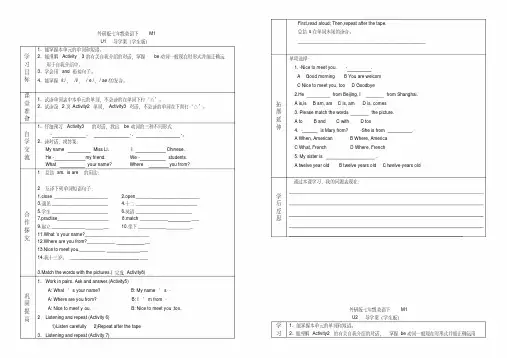
外研版七年级英语下M1 U1导学案(学生版)学习目标1、能掌握本单元的单词和短语。
2、能理解Activity 3的有关自我介绍的对话,掌握be动词一般现在时形式并能正确运用于自我介绍中。
3、学会用and 衔接句子。
4、能掌握/i:/,/i/,/ e /,/ ae /的发音。
课堂准备1、试读单词表中本单元的单词,不会读的在单词下打“△”。
2、试读第2页Activity2单词,Activity3对话,不会读的单词在下面打“△”。
自学交流1、仔细预习Activity3的对话,找出be动词的三种不同形式:- 、-、-。
2、读对话,找答案:My name Miss Li. I Chinese.He - my friend. We - students.What your name? Where you from?合作探究1.总结am、is are的用法:2.互译下列单词短语句子:1.close_____________________2.open_________________________3.遇见______________________4.十二________________________5.学生______________________6.英语______________________7.practise____________________8.match ___________ ___9.起立_____________ __ 10.坐下___________ _11.What’s your name?________________ __12.Where are you from?___________ __13.Nice to meet you.__________ ___14.我十三岁。
____ ___3.Match the words with the pictures.(完成Activity8)巩固提高1、Work in pairs. Ask and answer.(Activity5)A: What’s your name? B: My name’s…A: Where are you from? B: I’m from…A: Nice to meet y ou,…B: Nice to meet you ,too.2.Listening and repeat (Activity 6)1)Listen carefully 2)Repeat after the tape3、Listening and repeat (Activity 7)First,read aloud; Then,repeat after the tape.总结s在单词末尾的读音。
新外研版七年级英语下册导学案(M3-Unit 1讲义)
Module 3 Making PlansUnit 1 What are you going to do at the weekend?第一课时一、学习目标(1) 理解对话并能用所给信息谈论周末计划。
(2) 掌握本单元的单词,学会用be going to do 句型。
二、学习重点go over ,on , nobody, at , nothing, silly, fantasticWhat are you going to do…? I’m going to …Are you going to…? Yes ,we are./ No, we aren’t.三、学习难点be going to do sth. ;would like的用法课前预习一、使用说明与学法指导1、必须掌握重点单词。
2、预习要注意:(1)5分钟完成单词的学习,要求读音正确。
(2)15分钟完成课文的预习,所有生单词都画出来并标注汉语,疑点做出标记,并找出导学案上的词组和句子。
3、将预习中不能解决的问题标出来,并写在我的疑问处。
二、教材助读请同学们预习课文的基础上写出下列词组,并在书本上将这些词组画线。
查询我的电子邮件______________复习功课________________上钢琴课______________________看电影__________________野餐________________________帮助做家务_________________在周末______________________在周六的早上_______________呆在家里____________________ 别傻了_____________________三、预习自测题1.翻译下列单词picnic________ housework ______ else ________ nobody _______nothing_______ fantastic________2.翻译下列短语Do homework_________ help with the housework __________see a movie___________ Check emails____________have a piano lesson________ have a picnic___________Go over lessons___________ a fantastic weekend______________四、我的疑问_________________________________________________________________课内探究1、T: What day is it today? S:Today is Friday/...T:What's the weather like?S:It's sunny/...T:What are you going to do at the week end? S:I'm going to have a picnic/...2、利用句型,根据实际情况回答问题1、—What are you going to do this Sunday?—I'm going to...2、—What is your mother going to do at the weekend? —She is going to ...3、—what are your friends going to do at the weekend?—They are going to...3、听录音掌握大意并完成Activity4.(一)1、听力练耳Listen and match (听录音,连线组成短语,然后朗读这些短语,背诵)2、Write the phrases in Activity1 and the picture.(Activity2)(二)对话处理读前听Listen to the dialogue, and answer the questions.1、Is Daming going to check his email?2、Is Betty going to a party at a friend’s home on Saturday evening?3、What is Daming going to do on Saturday afternoon?听后读:最大声、最准确的朗读对话一遍,说一说Betty和Daming的计划。
2023年外研版七年级英语下册Module 2 Unit 2 I can run really fa

Module 2 Unit 2 I can run really fast导学案【学习目标】1.学生能根据音标正确拼读本单元的单词;(见课本P104-105)2.学生了解课本P10-11出现的短语和重点句型、熟练使用情态动词can;3.技能目标:学生能够听懂关于竞选班委的对话;能够表达自己的长处在哪;4.情感态度与价值观:引导学生肯定自我的能力,培养学生增强自信心以及以主人翁的意识积极为班级服务的精神。
【学法指导】探究中学习,合作中提升。
【重点与难点】情态动词can的用法;撰写一份竞选班委的讲稿。
Self-study(自主学习):1、自学自读本单元单词(结合词汇表的音标),把不会读的单词在书上画出来并整理在导学案上。
2. 阅读课文P10 Activity 2 找到以下短语并结合单词表或联系上下文写出它们对应的英文或中文:①新学期的开始②想要成为③与……相处融洽④work very hard⑤do well at school ⑥be always ready to help others⑦promise to do sth. ⑧be really good at⑨在家做家务⑩一个干净整洁的屋子⑪就像家一样⑫使我们的教室漂亮Cooperative study(合作学习)1、预习1情况交流,师生共同解决预习中存在的问题。
2、读Activity 2,师生或生生相互探讨解决其中的语言知识点(并划出你认为重要的、较难或精彩的词组或句子),完成预习2&3的检查。
3、学生小组合作完成预习4的检查,。
知识点链接:1.get on well with . 表示“与……相处的很好”“get on badly with .”是这个词组的反义词表示“与……相处的不好”。
对于“与……相处的怎么样”的询问,用特殊疑问词how. eg:--How do you get on with your classmates?2.I work very hard, and I do well at school.我在学校学习努力,表现很好。
初中英语外研版七年下M6U17B-M6-U1导学案

初中英语外研版七年下M6U17B-M6-U1导学案Module 6 Around townUnit 1 Could you tell me how to get to the National Stadium?学习目标:1. 能重点掌握以下单词及短语:bank, museum, underground, bookshop,along,across, cross, opposite,excuse me, why not, over there2. 通过听理解对话内容3. 通过真实语境下的练习,掌握问路与指路的句型。
Ⅰ. 课前自主预习:单词过关:1. 银行 _____________ 2. 博物馆_____________3. 书店 ________________4. 地铁______________5. 沿着._______________6. 在...的对面______________7. 越过______________ 8. 穿过v.____________________9. 游客______________短语互译: 1. 劳驾,对不起_____________ 2. 为什么不...呢?__________________3. turn left _______________4. 在那边__________________5.乘坐地铁 ________________课前检测:完成教材活动4Ⅱ. 课堂互动探究1. 借助图片提示,完成猜词活动2. 听对话,回答问题1.How many places does she want to go?2.What are they?3. 分层听对话,找到目的地、画出路线图4.跟读课文并进行复述①Betty and Lingling are standing in front of Tian'anmen Square. A tourist asksthem the way to Wangfujing Dajie. Betty tells him to go _______ Dong Chang'an Jie andgo along the street. Turn left _______ the third street _______ the left. It's nearso the tourist can _______ there.②The tourist also wants to buy a guidebook about Beijing. Lingling tells himthere is a big bookshop just Xi Chang'anJie. It's on the _______, opposite the bank.③The tourist wants to _______ the National Stadium too. But Lingling doesn't_______ the way. She tells the tourist to _______ the policeman over there. The policemantells the tourist to go along the street and he will _______ an underground station._______ the underground _______ the Olympic Sports Centre. He can also take a bus _______a taxi.5. 语言点学习:(1) Asking for directionsExcuse me, how do / can I get to …?Excuse me, where is the …?Excuse me, can you tell me the way to the …?( ) 1 . Could you tell me ________ to the bank .A . how to doB . how to getC . how to2.Go along the street and you’ll see t he underground station.(根据答句写出相应问句)the underground station?3.How can I get to the National Stadium?(改为同义句)you to the National Stadium?Could you tell me the National Stadium?(2) Giving directionsGo straight ahead. / Go along …Go across …, turn left / right into …It’s over there. It’s on the left / right.It’s opposite …It’s between … and …It’s next to …It’s on the corner of …()1.-Could you tell me if there is a hospital near here?- You may ask someone else.A . No, I couldn’t.B .Sorry, I’m new here.C . My pleasure.(3)Asking and giving direction politely.-Excuse me.-Thanks a lot.-Sorry, I'm not sure.-You're welcome. Have a nice day!6.对话练习①- the hotel?- the street and it’s the railway station.②- the bank?- and then . It’s.答案:Ⅰ. 课前自主预习:单词过关:1bank 2.museum3. bookstore4. underground5. along6. opposite7.across 8.cross9.tourist短语互译:1. excuse me 2. why not3.向左转4. over there5. take the underground课前检测:完成教材活动4:excuse, street, tourist, policeman, Could, underground Ⅱ. 课堂互动探究1~4 详见PPT5.语言点学习B, Where is, Could, tell me the way, how to get to, B6.详见PPT。
外研版七年级英语下册导学案 Module 9 Unit 1

Module9Unit 1He left school and began work at the age of twelve.
课型:Listening and Vocabulary
主备人
完成时间
议课时间
共案发放时间
上课时间
审核人
第周
第周
第周
第周
班级:
姓名:
小组:
学
习
目
标
1. Key vocabulary: March, April, May, June, July, August, September, October, November, December, writer, real, exact, newspaper, date, become
4)Mark Twain became very famous in the 1960s and began his stories.
5)Mark Twain went to Europe and China.
2、作者简介:
Time
Facts
In 1835
At the age of twelve
In the 1860s
一、英语报,第30期,第三版, Unit 1, 第一大题
根据句意及汉语提示,写出正确的单词。
1. My sister was born on ______ (11月) 16, 2000.
2. --- Can you tell me the ______ (准确的) time if the meeting?
--- Yes, of course.
3. We went to Beijing and had fun there last ______ (8月).
新外研版七年级英语下册导学案(M6-Unit 2)
Unit 2 The London Eye is on your right.第三课时一、学习目标:1.知识目标:能够使用下列单词和词组: painting clear ,boat ,off ,tower ,tourist 理解下列单词;gallery ,parliament ,guidebook, religious2.语言技能目标:学生能听懂指路的语句并找到该地点。
能够给别人指路。
3.学习策略目标:能够将语言学习与实际应用结合起来,问路指路要有礼貌。
4.情感态度目标:A诱导学生积极参与其中,充分调动其积极性。
B在教学过程中加强与学生的互动,从而加强了与学生的亲和力,充分发挥情感教学的技巧。
二、学习重点:问路和指路的表达方式:How do I get to----? Can you tell me the way to ------?三、学习难点:指路和问路的准确表达及伦敦的地名;学生对一些地名的读音和理解;掌握描述某地位置和路线的基本方法,写完整的语篇课前预习一、使用说明与学法指导:1、试读单词表中本单元的单词,不会读的在单词下用红笔划上横线2、使用快读和细读两种阅读的方法里查找文章的信息二、预习自测:plete the conversation.A: Excuse me, can you tell me the way ___ the museum, please?B: Yes, it’s near the station. You go ______ this street to the end. Then _______ left,go _______ the bridge and the museum is _____ your right.A: Thanks a lot.B: ______________.2. 识记本单元单词,填表格.名词n. 单词words 名词n. 单词words 形容词adj 中文意思游览教堂famouse广场铁路high油画桥clear米动词v. middle河完成介词prep.pastabove三、我的疑惑:________________________________________________________课内探究STEP 1: Lead in问一问同学们去过什么地方?---How many places of interest do you know? ---I have been to…由此导出Have you ever been to London? 学生肯定没有去过,这时候教师说:Let me takeyou around London, will you? [ 伦敦市区地图]STEP 2: pre-reading.Learn some places about LondonShow some pictures of some places of interest in London.伦敦著名建筑首先学习一些建筑,可以为接下来学习英国的著名景点做准备。
外研版七年级下册英语Module-2导学案
5、Who teaches___ቤተ መጻሕፍቲ ባይዱ______(他们)music this term.
二、翻译下列短语和句子
弹钢琴________________打乒乓球________________担心----________________
课堂巩固
一、根据句义完成下列各题:
1、We have got some new subjects this__________.
2、Look at the notes on the __________,“No fishing.”
3、There are many kinds of books for you to __________ in the book shop..
play the piano
4、增强自我和提高自我能力的情感。
自学准备
一、词汇(熟练拼读音标,并写出单词和中文)
['tenɪs]_______ _________[pɪ'ænəʊ]_______ _________[raɪd]_______ _________[klʌb]_______ _________[bɔːd]_______ _________[tɜːm]_______ _________['wʌrɪ]_______ _________[tiːtʃ]_______ _________[ðen]_______ _________
加入游泳俱乐部__________________________加入唱歌俱乐部__________________________
2023年外研版七年级英语下册Modul 6 Unit 1 导学案
Module 6 Around town导学案Unit 1 Could you tell me how to get to the National Stadium?【学习目标】1.知识目标:掌握下重点列单词、短语以及句型的意思及用法:along, across, excuse, excuse me, street, turn, third, right, why not …? could句型:Can you tell me the way to...?Go across …Go along the street and turn left at …Is there a(n)… near …?How can I get …?Could you tell me how to get to …?2. 能力目标:能听懂问路、指路的简短对话,并能用英语说出来.3. 情感目标: 让学生养成积极热情,乐于助人的良好品德。
【重点及难点】1. 重点:会用有关的句型及短语进行问路与指路。
2. 难点:有关问路的一些交际用语及知识点,并能灵活运用所学的问路用语询问方向、路线。
即问路的常用表达方式,指路的常用表达方式。
【学习步骤】:一、课前预习㈠、补全下列单词1. b__n__2. a__o__g3. mu__ __um4. a__ __oss5. opp__s__te6. t__u__i__t7. str__ __t8. unde__gr__ __nd㈡.翻译短语1.劳驾,对不起______________2.为什么不。
呢?__________________2.到达体育馆_______________4.天安门广场的前面___________________ 5.去...的路________________6.穿过东长安街_____________________7.沿着街道走________________8.向左转___________________9.在第三个路口_______________10.买一本关于...的导游手册__________ 11.在银行的对面______________12.一个地铁站_________________13.乘地铁到奥体中心_______________二、课堂学习过程【合作探究】Step1. Listen and number the places.Listen again and answer the questions:Where is the tourist going?Step 2. Listen to the conversation twice and answer the questions:1) What does the tourist want to buy?2) Can you name the places he wants to visit?Step 3. Read the conversation and finish the Activity 3 and Activity 4Step 4. Listen to the sentences, and talk about how to ask for and give directions, then say your answers.Step 5. Read the conversation in Activity 3 again and complete the table.(Activity 6)Step 6. Sumarise the useful words and phrases about ask for and give directions, then finish The Activity7.【知识结构】How to ask for directions: Can you tell me the way to...?Is there a(n)… near …?How can I get …?Could you tell me how to get to …?How to give directions: Go across …Go along the street and turn left at …【当堂检测】一.按要求完成句子1. I can get to the library by bus.(就划线部分提问)________ ________ I get to the library?2. He does well in English.(同义句)He ________ ________ ________English.3. The bookstore is across from the bank. (同义句)The bookstore is ________ the bank.4. Can you tell me how ________(get) there?.5. ________(walk) in the park is good for you.6. Why ________(not) you come with us?.二.翻译句子1.请问去车站怎么走?2.请问去警察局怎么走?3.请问去动物园我该走哪条路?4.劳驾,最近的邮局在哪儿?5.请问你能帮我找到那家水果店吗?6.劳驾,往第十四中学怎么走?7.劳驾,附近有医院吗?8.劳驾,去书店怎么走?9.穿过马路,你会看见一个入口。
新外研版七年级英语下册导学案(M4-Unit 3)
Unit 3 Language in use第五课时一、学习目标:1. 复习巩固本模块的短语、词汇及语法。
2. 通过复习,自己能够查漏补缺,进一步巩固基础知识。
3. 通过复习巩固,提高学习英语的兴趣。
二、学习重点:一般将来时态的各种句式结构;三、学习难点:形容词的一般用法。
课前预习一、使用说明与学法指导:1.掌握一般将来时及其句式的变化。
2. 把不懂的勾出来并把它写在我的疑问处。
二、教材助读:1. 复习词汇:见生词表,熟读、背诵。
2. 复习重点短语:能默写,会应用。
(1) study at home (2)send…..to (3)by email (4)in the future(5) talk to/ talk with (6)read books (7)use the Internet (8)write ….with(9) all year =all the year round (10)get warm (11)the North Pole(12) bad weather (13)heavy rain (14)strong wind (15)no one(16) lots of =a lot of (17)heavy and difficult jobs (18)light and easy work(19)free time (20) three days a week3.复习语法:一般将来时态三、预习自测:完成P24-25的相应习题四、我的疑惑课内探究1.一般将来时态(1)概念:一般将来时态表示在将来某个时间要发生的动作或存在的状态。
常与表示将来的时间状语连用,如:tomorrow, next week, in two days 等。
(2)肯定句式:________________________________________________. 否定句式:________________________________________________.疑问句式:________________________________________________?(3)will 或shall 用在疑问句中,可用来表示有礼貌地征求对方意见。
新外研版七年级英语下册导学案(M3-Unit 3讲义)
Unit 3 Language in use第五课时一、学习目标1.归纳并学会本模块中新学词汇。
2.归纳并总结be going to的用法,并能利用一般将来时be going to 来写自己的学习,旅游计划;二、学习重点be going to的意义和用法三、学习难点1. 掌握be going to do中be动词的变化。
2. 学习并掌握be going to表将来课前预习一、使用说明与学法指导1. 进一步了解be going to表将来及其句式的变化。
2. 把不懂的勾出来并把它写在我的疑问处。
二、教材助读1、朗读学过的单词、短语、对话、课文等。
2、写出下列短语:复习;练习_________ 野餐_________ ……的计划_________帮助做家务_________ 盼望_________ 交朋友_________过得愉快_________ 观光_________ 散步_________做运动_________ 加入我们_________三、预习自测题一、翻译句子1.今天晚上我打算查看电子邮件。
_____________________________________________________2.他这个周末有堂钢琴课。
_____________________________________________________3.他们这个周末会去野餐。
_____________________________________________________二、句型变化①I am going to visit China.(改为一般疑问句)。
_________________________________________________②He is going to buy some clothes.(改为一般疑问句)_________________________________________________③They are going to have a party.(改为否定句)_________________________________________________我的疑问课内探究be going to的用法点拨1.be going to是一种固定结构,它后面要接动词原形,用来表示按计划或安排要发生的动作,有时也可以表示推测将要或肯定会发生的动作,有“准备;打算”的意思。