
新概念第一册lesson5
Ford
An American car
be good at 擅长 Mary is good at singing.
be good for 对…有好处 Milk is good for us.
morning 早上,上午
• Good morning. • 回答也是:Good morning. • noon n. 中午 • at noon 在中午 • afternoon n. 下午 • in the afternoon 在下午 • evening n. 晚上 • in the evening 在晚上
an
What make is your car? / What is the make of your car? What make is his car? / What is the make of his car?
news newspaper
student n. 学生
• pupil
n. 学生,小学生
我是一名学生。 I am a student. 索菲亚是一名新学生。 Sophie is a new student.
meet v. 遇见
• see v. 看见 • Nice to meet you. 见到你很高兴。 • (用于初次见面)
( 6 )French ( 3 )Mr.
( 1)good
(7 )German
( 4 )new
( 5 )student (12 )Chinese
( 2 )morning ( 8 )nice (13)too
China (Chinese) Dongfeng
Beijing
a Chinese car
Japan (Japanese)
Nice to meet you, too!
Nice to meet you!
make
make n. (产品的)牌子
What is the make of this car? What make is it? 这辆车是什么牌子的?
• v. 做
She is making dumplings. 她正在包饺子。
Mr.
先生
用于姓氏之前或全名之前 1. This is Mr. Green. 这是格林先生。 2. This is Mr. Jim Green. 这是吉姆格林先生
Miss n. (对未婚女子或少女的称呼)小姐
Mrs n. 夫人,女士(用于已婚女士的称呼
new 新的
old
旧的;老的
She is a new student. 她是一个新学生。
“an”用在以元音开头的词前 “a”用在以辅音开头的词前
• 冠词分为不定冠词"a,an"(表示泛指)、定 冠词"the"(表示特指)和零冠词三种。零冠 词指的是不用冠词的情况。
• 不定冠词有“a和an”两种形式。“a”用在以 辅音开头的词前,“an”用在以元音开头的 词前
• 判断一个词是以元音开头还是以辅音开头, 是根据读音而不是根据字母。
England (English)
London 伦敦
Mini
an English car
good adj. 好的
America (American)
nice 好的,美的; fine 美好的,晴朗 excellent 极好的,优秀的 well (作形容词, 指身体好)
Statue of Liberty Hollywood
Toyota
Tokyo 东京
a Japanese car
Korea (Korean)
Daewoo
Seoul 首尔
a Korean car
France (French)
Peugeot
Paris 巴黎
a French car
Germany (German)
Berlin 柏林
Mercedes
a German car
Mary is an Italian student. She isn’t a French student.
Naoko is a Japanese teacher. She isn’t a Korean teacher.
merican erman
a
a
an
Unit 3
Lesson5 Nice to meet you Lesson 6 What make is it?
Is Hans French?
No, he isn’t. He’s German.
Unit 3
Unit 3
Unit 3
(9 )meet (10)Japanese (11)Korean
• either adv. “也”
用于否定句中
• She doesn't like milk, either. 她也不喜欢牛奶
Mary _________ singing. A. be good at B. be good for
She doesn't like milk, _____.
A. too B. either
回答是:Nice to meet you, too.
• meeting n. 会议;大会 We have a meeting. 我们开会了。
too adv. 也
• 用于肯定句或疑问句末, 表示“也” I am Chinese, too. 我也是中国人。
• 用于形容词或副词前,表示“太” It’s too late to go for a walk. 现在太晚了, 不能去散步。
冠词(一)
• an apple 一个苹果
• a desk 一张桌子
• •
an eraser 一块橡皮泥
an ice cream 一个冰n orange 一个橙子 • a shirt一件衬衣
• an umbrella 一把伞 • a useful book一本有用
的书
Unit 3
Unit 3
英语中的选择疑问句
• Is it a French car ? 一般疑问句 • Is it a French car or a Japanese car? 选择疑问句 结构:一般疑问句+ or + 另外一个选择答案?
这是一个苹果还是一个梨子? Is this an apple or a pear?
新概念英语第一册 Lesson 5完整版本
疯狂的 事实
男人 旗帜
手 猫 抓住 老鼠
Lesson 5 Nice to meet you.
he
China 中国
Chinese 中国人
Japan 日本
[dʒə‘pæ n]
he
she
Japanese 日本人
[‘dʒæ pə’ni:z]
Korea 韩国
[kə’riə]
he Korean 韩国人
[kə’riən]
再见
good bye
晚安
good night
祝你好运 good luck
课文讲解
• Good用法拓展 • 1,be good at 善于,在 …方面学的好 • 2,be good to sb 对某人好 • 3,be as good as one’s words 说话算数 • 4,as good as 和…一样好
he
France 法国
[fra:ns]
French 法国人
[frentʃ]
he
Germany 德国
[’dʒə:məni]
巴拉克
German 德国人
[’dʒə:mən]
某国
(中) China [‘t∫aɪnə]
(日) Japan [dʒə‘pæ n]
(韩) Korea [kə’riə]
(德) Germany [’dʒɜ:məni]
• ② adj. 和蔼的,友好的 He is very nice to his neighbours.
• ③ adj. 使人高兴的,令人愉快的 It is so nice to have you here.
too
• adv.用于肯定句中(强调也) • adv.太过于…… • eg:She talks too much.
新概念英语第一册Lesson5教案

Lesson5 Nice to meet you. 很高兴见到你。
一、教学任务:Back vowels & special question,特殊疑问句,及小词Nice to meet you.二、教学目标:1. 学生掌握特殊疑问句的结构及常用疑问词2. 会使用This is来介绍他人3. 掌握后元音的读音三、教学重点:后元音和特殊疑问句四、教学难点:特殊疑问词的掌握五、教学过程:1. Review the Phonetic alphabet2. Back V owels <发音时舌后部抬起的音叫后元音>[a:]小汽车car --- 带读--- 点线面---ask字母ar发什么音。
发音规则:嘴巴张得最大,舌身平放后缩,舌尖离开下齿。
带读点答[ɒ] dog 狗--- 带读--- 点线面--- ask字母o发什么音发音规则:双唇稍稍收圆,舌身尽量降低并后缩(不要突出)带读点答[ɔ:]ball球---带读--- 点线面--- ask字母al发什么音。
发音规则:舌后部抬得比[ɒ]略高,双唇也收的更圆更小,并向前突出。
带读点答[ʊ]book书---带读---点线面--- ask字母oo发什么音。
发音规则:发音时舌后部抬起,边发音边把下嘴唇往回收。
带读点答[u:]blue 蓝色的---带读--- 点线面--- ask字母u发什么音。
发音规则:发音时舌后部抬的比[u]高,双唇收的比[u]更圆更小。
带读点答A.呈现:---汽车how to say?(car)---letter ‘ar’ how to pronounce?( [a:])<带读,点读,教发音规则,做手势>---狗how to say?(dog)--- the last le tter ‘o’ how to pronounce?( [ɒ])<带读,点读,教发音规则,做手势>---球how to say?(ball)---letter ‘al’ how to say?( [ɔ:])<带读,点读><教发音规则,做手势>---书how to say?(book)---letter ‘oo’ how to say?( [ʊ])<带读,点读><教发音规则,做手势>---蓝色的how to say?(blue)---letter ‘u’ how to say?( [u:])<带读,点读><教发音规则,做手势>B.总结:---这几个音都是?音(元音)--- Why? (气流没有受到嘴巴的阻碍) ---T: Read the vowelstogether, what’s the common ground? How about our tongue? (都是舌头后部需要隆起) --- Great, sowho can give them a name? (后元音) --- Wonderful, tell me, what is back vowel? (舌头后部隆起的元音叫后元音)--- I will have a check, 读对几个加几分C. Word: 拼读---拼写---过关morning ['mɔ:nɪŋ]早晨student['stju:dənt,]学生German['dʒə:mən]德国人T: How many vowels, how many syllables(有多少元音就有多少音节) ---Look at this word, Howmany vowels? (Two) ---How many syllables? (Two) --- What is the first vowel? ([ɔ:]) --- What is thesecond vowel? ([ɪ]) --- <S每找出一个元音T划出一个音节;每次增加一个辅音让S拼读时T划下画线标注> [mɔ:] how to read?---[ɪŋ] how to read? ---[nɪŋ] how to read? --- 重音在第几个音节(第一个)--- read them together. ['mɔ:nɪŋ] ---带读,过关--- <Fast reaction> [ɔ:]which letters? (or) --- [ɪ]which letter? (i) <点答过关> ---[m] which letter? (m) --- [n] which letter? (n) --- [ŋ] which letters?(ng) ---[mɔ:] which letters?(mor) ---[nɪŋ]which letters? (ning) --- [mɔ:nɪŋ] how to spell? (morning )3. Grammar一、Nice to meet/see you! 见到你很高兴!回答:Nice to meet/see you , too见到你也很高兴!二、将别人介绍给他人时,用this is…..A. 呈现:---T ask Ss: Who want to have a talk with me? --- (S…) --- Hello, what’s your name? (Myname is ...) --- Oh, *** , nice to meet you. (Nice to meet you, too)--- (tell another students)This ismy friend,****, please remember his name. <introduce another students>B. 讲解:--- Ok, please tell me: what did I do just now? (交朋友,然后把朋友介绍给别人) --- good,那么我们交到朋友了,要对他说?(Nice to meet you)<板书,带读,背诵> --- what’s the meaning?( 很高兴见到你。
新概念第一册lesson 5 nice to meet you 很高兴认识你
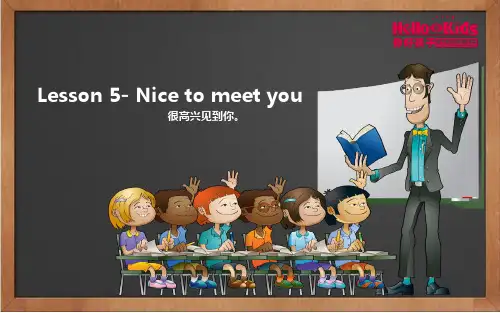
新概念一级 lesson-5 Nice to meet you
16
Nationality国籍
Brazil
巴西
新概念一级 lesson-5 Nice to meet you
17
Nationality国籍
Brazilian
They are Brazilian.
巴西人
What nationality are they ?
Grammar - 1
an只用在以元音音标开头的单词前,读作[æn]。 比如:It is an umbrella.它是一把雨伞。 This is an old car.那是一辆旧的汽车。
其他情况下一律用a,读作[ə] 比如:Sophie is a new student. 苏菲是一位新同学。 This is a nice handbag.这是一个不错的手提包。
新概念一级 lesson-5 Nice to meet you
12
Nationality国籍
South Korea
(南)韩国
新概念一级 lesson-5 Nice to meet you
Nationality国籍
Korean
What nationality are they ? They are South Korean.
8
Nationality国籍
Germany德国
新概念一级 lesson-5 Nice to meet you
9
Nationality国籍
German德国人
What nationality are they ? They are German.
新概念一级 lesson-5 Nice to meet you
新概念第一册Lesson5

Chinese
China
It is Chinese.
It is from China.
English
England
American
America
Jaห้องสมุดไป่ตู้anese
Japan
Crayon Shinchan
Korean
Korea
French
France
German
Germany
New Swan Stone Castle 新天鹅石城堡
This is Mr. Blake. He is a teacher. She is a new student. She is French.
Hans
He is German. Nice to meet you.
Naoko
She's Japanese.
Chang-woo
He's Korean.
You are my good friend. You are a doctor. You are beautiful.
第三人称单数 He or She or It 配合is使用。 句型解析:She(He, It) is +……
She is a good girl. He is kind. It is a nice day.
Italian
Italy
The Leaning Tower of Pisa
[mis] [njuː] ['stju:dənt] [nais] [mi:t] ['mistə(r)]
瑞典的 Swedish
This is a Volvo. What make is it? It's a Swedish car.
新概念第一册lesson53&54
always 与现在进行时、过去进行时连用时, 表示“一直,总是”或经常反复的动作。
He is always talking big. 他总是吹牛。 There is always love in a family. 家里总是充满 了爱。
north n.北方
The weather’s often cold in the North. 北部的天气常常寒冷。
weather
January March May July September November
1月 3月 5月 7月 9月 11月
February 2月 April 4月 June 6月 August 8月 October 10月 December 12月
玛丽和汤姆之间的对话真有意思。
dialogue是对话,必须有两个人在互相说话,一般 是书面语; talk可以是任何形式的说话,一个人对一群人的讲 话也可以用talk; conversation是一个人以上的说话,一般是讨论一 个主题; chat是聊天,不一定有个主题,就是随便说话(比 如网上聊天)
dry adj. 干燥的
rise
v.升起
rise是“上升,上涨,起床,站立”的意思。 该词含义较广,总的意思是指依次上升, 如自然界的日、月、星、雾、云的上升, 人体从睡、跪、坐、躺等姿势站立起来等。 该词为不及物动词, raise v. 举起raise用作及物动词,其基本含 义是“使升起来,举起”
German[ˈd ʒɜ:mən]
Italian[ɪˈt æ ljən] Norwegian[nɔ:ˈwi:d ʒən] Russian[ˈr ʌʃən] Spanish[ˈsp æ nɪʃ]
新概念英语第一册单词表Lesson5

★⽆忧考新概念英语频道为⼤家整理的新概念英语第⼀册单词表Lesson 5,供⼤家参考。
更多阅读请查看本站频道。
Lesson 5 Nice to meet you很⾼兴见到你Listen to the tape then answer this question. Is Chang-woo Chinese?听录⾳,然后回答问题。
昌宇是中国⼈吗?MR. BLAKE: Good morning.STUDENTS: Good morning, Mr. Blake.MR. BLAKE: This is Miss Sophie Dupont.Sophie is a new student.She is French.MR. BLAKE: Sophie, this is Hans.He is German.HANS: Nice to meet you.MR. BLAKE: And this is Naoko.She's Japanese.NAOKO: Nice to meet you.MR. BLAKE: And this is Chang-woo.He's Korean.CHANG-WOO: Nice to meet you.MR. BLAKE: And this is Luming.He is Chinese.LUMNG: Nice to meet you.MR. BLAKE: And this is Xiaohui.She's Chinese, too.XIAOHUI: Nice to meet you.参考译⽂布莱克先⽣:早上好。
学⽣:早上好,布莱克先⽣。
布莱克先⽣:这位是索菲娅·杜邦⼩姐。
索菲娅是个新学⽣。
她是法国⼈。
布莱克先⽣:索菲娅,这位是汉斯。
他是德国⼈。
汉斯:很⾼兴见到你。
布莱克先⽣:这位是直⼦。
她是⽇本⼈。
直⼦:很⾼兴见到你。
布莱克先⽣:这位是昌宇。
他是韩国⼈。
新概念英语第一册 Lesson 5完整版本
• 掌握两课中的单词及专业词汇。 • 熟练运用课堂所讲解的日常用语。
What is the country?
• China • Japan • Korea • France • England
Chinese Japanese Korean French English
课文讲解
• Morning用法拓展 • 1,in the morning
• 2,在星期天早上: on Sunday morning • 3,在一个冬天的早晨: on a winter morning
• Eg:I go to school____8 o’clock in the morning. A.at B.in C.on D.for
he
France 法国
[fra:ns]
French 法国人
[frentʃ]
he
Germany 德国
[’dʒə:məni]
巴拉克
German 德国人
[’dʒə:mən]
某国
(中) China [‘t∫aɪnə]
(日) Japan [dʒə‘pæ n]
(韩) Korea [kə’riə]
(德) Germany [’dʒɜ:məni]
What is the country?
• America • Italy • Sweden • Germany
American Italian
Swedish German
Details on new words
• 国家及人的表达: • 1、-ese: ____________________ • 2、-n: ______________________ • 3、-ish: _____________________ • 4、-ch: _____________________
新概念英语第一册第5课_课件
五. Chant :
宾格代词顺口溜: The end !
我是me,你是You ;
男他him ,女她her ,动物的它是 It;
我们us ,你们You ,他们them.
Homework 1.一课一练5,6课 2.课单词背写,准备听写 3.背诵第5课课文。
[ɔ]
闭音节中的o
job clock long song shop stop lost got boss hot
a 发[ɔ]的 watch water
句子
1. She lost that job, but she got this job.
2. The clock often stops. 3. The boss lost a clock
Chinese---China French---France
France
eg. I come from France. I’m from France. 我来自法国。
German---Germany
---Are you a _____ (德国人)? ---Yes, I am. eg. He can speak _____
ቤተ መጻሕፍቲ ባይዱ
nice 同义词good
eg. You are a nice boy. It’s a nice day. It’s a nice food.
meet 同音词meat
非正式问候---Nice to meet you.
--- Nice to meet
you, too.
正式问候 --- How do you do?
She is (a) French.
美好的 nice 见到你很高兴。 Nice to meet you. 遇见 meet
新概念第一册lesson5NicetoMeetYou课件
LUMNG:
Nice to meet you.
MR. BLAKE: And this is Xiaohui. She's Chinese, too.
XIAOHUI: Nice to meet you.
Lesson 6 What make is it?
[meɪk]
What make is it ?
Daewoo['dɑ:wu:] n.大宇
Mini ['mini] n.迷你
Ford [fɔ:d] n.福特
Fiat ['fi:æ t] n.菲亚特
选择疑问句
Is he tall or short? Do you like apples or bananas? Would you like beer or whisky?
It's a French car.
Mercedes [mə'seɪdi:z] n.梅赛德斯
A: What make is it ? B: It’s a Mercedes. It's a German car.
Toyota ['təʊjəʊtə] n.丰田
A: What make is it ? B: It’s a Toyota. It's a Japanese car.
Seven
What are they talking about?
Nice to meet you. Name and nationality.
[ˈmɔ:nɪŋ]
[ˈstju:dnt]
[nju:]
[naɪs]
[ˌdʒæ pə'ni:z]
[ˈdʒɜ:mən] [kə'rɪən]
新概念英语第一册课后练习题答案:Lesson5
Lesson 5 阅读理解
答案与解析
4
1. T。
根据⽂章第⼀句可知。
2. F。
We go to school at seven in the morning.的意思是:我们早晨七点去上学,⽽不是下午。
3. T。
由I have a clock...on the desk 可知。
4. F。
由...Jim has a new watch 可知。
5. F。
阅读短⽂可知现在时间是四点⼆⼗五分,⽽不是四点四⼗五分。
答案与解析
1. 从Is this your pen, Jim?来看,问的是钢笔。
应填pen。
2. It was on my desk.已经指明,它在Sue 的课桌上。
要填desk。
3. 对话中提到,Jim 看见了书上的名字。
故应填name。
4. Sue 在问她的书在哪⼉,Jim 说在她的书包⾥。
应当填写book。
5. Jim 告诉了Sue 她的书包在Han Mei 的课桌上,说明他看见了。
该空要填bag。
英汉翻译
1. Good morning.
2. This is Mary. She is a new student.
3. Nice to meet you.
4. He is Chinese.
5. I am Japanese.
6. She is French.
7. How do you do?
8. He is a Korean teacher.。