
二年级英语上册Unit课件沪教牛津版_1
上海牛津版小学英语二年级上册第一课时教学ppt课件

A: How many plates in the kitchen? B: There is one plate in the kitchen. There are ___ plates in the kitchen.
There is one plate in the kitchen. There are two plates in the kitchen. There are three plates in the kitchen.
Module 3 Unit 1 In the kitchen
Period 1
D_ _E F T _U _V _QR _S
W_ X _Y
_L M_ N G H_ _I
_x _y z h _i _j _o p _q
_r s _t
_j _k l u _v _w
k_i tchen
is in insect
How many ____s in the kitchen ?
ThereBiblioteka in the kitchen.
This is my kitchen. It’s _____(colour/ big/ nice…) There is one _____ in the kitchen.
…
s There are ___ ___ in the kitchen.
b o__w_ l
know yellow
Look at the plate. It’s ____.(colour, nice, big, round…) Put the bowl on the plate. There is one bowl on the plate.
How many bowls in the kitchen?
二年级英语上册Unit1Goodmorning精选教学PPT1牛津上海版

清冷的月,让我惆怅的心,那么疼。 不眠的夜。
那么就醒着吧,只有醒着,才能看得更清。 那么就笑着吧, 只有笑着,我才不会喊疼。 有些东西,即使喜欢,也要避而远之。就像咖啡,每次喝它都会让我疼。可还是会好了伤疤忘了疼,偶尔嘴馋喝上一杯。就像有些爱,是你不能碰的,一碰就成了心底念念不忘的伤。其实有些病只能自己控制,自己医。 即使疼痛,即使悲伤,也学会阳光般的微笑吧。 对自己微笑,对生活微笑,对挫折微笑。学会让自己在微笑里变得快乐。 当我们不快乐的时候,我们要学会控制自己的负面情绪,不要让负面情绪把我们控制。 不快乐的时候,那就记得冲着阳光微笑吧。也许笑着笑着,你就快乐了。
四:我想要的…… 我需要一次返璞归真的旅行 ,去卸载心上超重的负担。 甩开约束,忘记纷扰,远离伤痛,洗去心尘。 我需要一次自由行走的旅行,去看山看水看风情。去我想去的地方,看我想看的人,做我想做的事。
我需要一次忘我的旅行,开心的笑,痛快的哭,任性的疯,自由的呼吸。 没有念想,没有贪欲,没有生死离别,没有爱恨情仇。饿了吃 ,困了睡。不记得我是谁,更不记得你是谁。
4
输入内容
请输入内容请输入内容请输入内容请输入内容请输入 内容请输入内容请输入内容请输入内容
Thanks 公司名公司名公司名公司名
有一段青春,留作永恒。剪一段时光,放在最美的段落。好好保存留作永远,时间过去岁月的路过。只是多了一道曾经,流年一路改变了我们的模样。送走了我们的青春,留给了我们曾经。这样的夜别样的心情,倒影的年华。深夜想用文字表达我内心的段落,可是终究写不出整个心情。背着这些流年在岁月里流浪,终究没有安静的场所。来安放我这沉淀的一切,似乎不能放也不能放。因为只有装进心里,才最为合适。也没有地方比装进心里,更安全。就这样让这段流年,从此埋在心里。不再提起,让时间的尽头。留作无声的永恒, 有一段青春,埋葬的时间。总有一些人拼了命的,挽留最终还是留不住。总有一些话始终未能说出口,直至最后再也不必说出口。埋葬过去,我们有着太多的沉默。像是在时间的路刚好遇见,只是你装做什么也没看见。很多年过去了,我始终在这里执着。时间走过这里并没有,我想要的段落。也许下一段时光,会遇见一个更好的彼岸。流年划过陌路,我们终于渐行渐远。来不及说再见,也来不及为那段。往事而伤心哭泣,一切要走都是上天。许早准备好的,只待我们路过此地。
牛津上海版英语二年级课本培训课件

牛津上海版英语二年级课本牛津上海版英语二年级课本第一学期Module 1 Getting to know you1.HelloVocabulary: morning, afternoon, evening, nightDaily expressions: Good morning. Good afternoon. Good evening. Good night.2.I’m DannyVocabulary: boy, girl, big, small I’m…/ You’re…3. A new classmateVocabulary: seven, eight, nine, ten Are you…? Yes, I’m… No, I’m…Module 2 Me, my family and friends1.I can swimVocabulary: run, write, swim, fly Can you…? Yes, I can. No, I can’t.2.That’s my familyVocabulary: young, old Is he/she…? Yes, he/she is. No, he/she isn’t.3.My hair is shortVocabulary: hair, head, faceModule 3 Places and activities1.In the Children’s gardenVocabulary: slide, swing, seesaw What can you see? I can see…2.In my roomVocabulary: bag, box, desk, chair Put…in/on…3.In the kitchenVocabulary: bowl, plate, spoon, chopsticks Give me…, please.Module 4 The natural world1.In the skyVocabulary: sun, moon, star Can you see…? Yes, I can./ No, I can’t.2.In the forestVocabulary: fox, hippo, meat, grass I like… It like…3.In the streetVocabulary: flower, treeDaily expressions: Don’t… I’m sorry.第二学期Module 1 Using my five senses1.What can you see?Vocabulary: white, purple, pink, orange, brown, black What colour are…? They’re…2.Touch and feelVocabulary: watch, bag, soft, hard, rough, smoothDaily expressions: Guess. It’s for you. Thank you.3.What can you hear?Vocabulary: train, bus, car, van, bicycle, ship What can you hear? I can hear…Module 2 My favourite things1.Things I likeVocabulary: run, skate, hop, skip, ride a bicycle Do you like(doing)…? Yes./No.I like (doing)…2.My favourite foodVocabulary: salad, carrot, fish, chicken, banana What do you like eating? I like eating…3.Animals I likeVocabulary: giraffe, snake, elephant, zebra What are they? They are…Module 3 Things around us1.The four seasonsVocabulary: autumn, winter, cool, cold Do you like…? Yes, I do./No, I don’t.2.RulesVocabulary: light, stop, go, wait3.My clothesVocabulary: trousers, sweater, shirt, coat I have…Module 4 More things to learn1.ActivitiesVocabulary: play football, play basketball, play ping-pong, play cardsCan he/she/…? Yes, he/she can. No, he/she can’t.2.Mother’s DayVocabulary: letter, balloon, carnation3.Story timeVocabulary: hungry, thirsty, bread, milk I want… I don’t like…。
二年级英语上册 Unit 1 Period 13教案 沪教牛津版
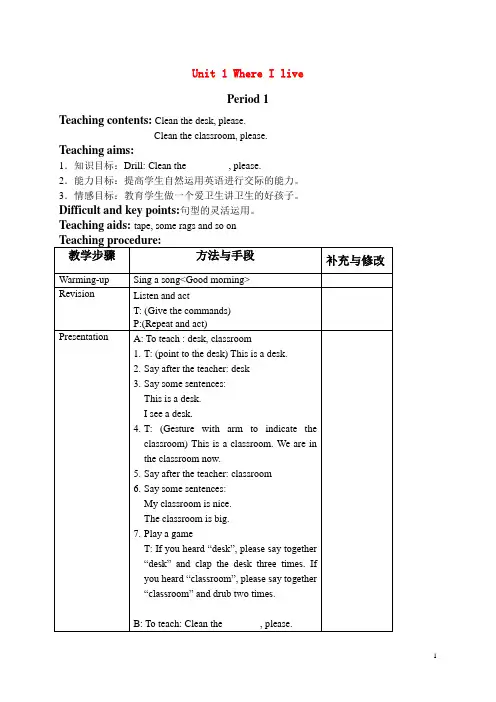
Unit 1 Where I livePeriod 1Teaching contents: Clean the desk, please.Clean the classroom, please. Teaching aims:1.知识目标:Drill: Clean the ________, please.2.能力目标:提高学生自然运用英语进行交际的能力。
3.情感目标:教育学生做一个爱卫生讲卫生的好孩子。
Difficult and key points:句型的灵活运用。
Teaching aids: tape, some rags and so onUnit 1 Where I livePeriod 2Teaching contents:I live in Shanghai.I love Shanghai.Teaching aims:1.知识目标:Drills: I live in ________. I love __________. 2.能力目标:提高学生实际运用英语的能力。
3.情感目标:激发学生热爱祖国热爱家乡的美好情感。
Difficult and key points:句型的灵活运用。
Teaching aids: tape, some pictures and so onUnit 1 Where I livePeriod 3Teaching contents: 1. Look and learn2. LettersTeaching aims:1.知识目标:To learn the new words and letters.2.能力目标:Read the new words and letters properly.3.情感目标:教育学生热爱家园,保持家园安洁。
Difficult and key points: Pronounce words and letters properly. Teaching aids: tape, pictures, word and letter cardsTeaching procedure:。
上海牛津版小学英语二年级上册2教学ppt课件

Let’s read
A, a, cake. I have a cake. The cake is sweet. The cake is big.
E, e, bee. I can see a bee. The bee is small. The bee can fly.
Hi, Alice. Let’s go the zoo. Look! There are three pandas on the slide. They are black and white. There are two bears on the swing. Wow! They are happy!
It’s sunny today. There is the ___(sunny/sun) in the sky. There ___(are/is) three birds in the sky. There ___(is/are) flowers and bees. And there ___(are/is) a big tree. There are two girls __(in/on) the seesaw. They ___(is/are) happy. Oh, how nice! I like sunny days.
Hello, Doraemon. Look, this is my kitchen. There is a spoon on the plate. There is a spoon in the bowl. There is a bowl and a plate in the kitchen. How clean!
There _a_r_e_ three pandas on the slide. _T__h_e_y are black and white. There are two b_e_a_r_s_ on the swing.
小学英语沪教版二年级上册牛津版 册 Unit 1 Where I live 教案 1

小学英语沪教版二年级上册Unit 1 Where I livePeriod 1Language focus:Using imperatives to give simple instructionsUsing definite article to refer to specific classroom objectsLanguage skills:ListeningLocate specific information in response to simple instructionSpeakingUse modeled phrases to communicate with other learnersMaterials:Student’s Book 2A page 2Cassette 2A and a cassette playerCome ragsPre-task preparation1.Point to a desk and say ‘desk’. Encourage the class to point to their owndesks and say ‘desk’.2.Gesture with your arm to indicate the classroom and say ‘This is a classroom.We are in the classroom now.’3.Say Our classroom is nice. We must help to keep it clean.While-task procedure1.Say ‘Clean the desk.’ And wipe a desk with a rag.2.Invite a more able student to come to the front. Give the rag to him/her andsay ‘Clean the desk, please.’The student performs the action and repeats your command.3.Invite more students to come to the front. Let the more able student give thecommand and others do the action.4.Clean the classroom by sweeping the floor, putting rubbish into the wastebasket and cleaning the blackboard with an eraser. Invite another more able student to come up and say the command.5.Open the book to page2. Play the cassette tape. Let the students listen to theinstructions ‘Clean the desk, please.’ And ‘Clean the classroom, please.’ Ask students to repeat and mime the actions.6.Invite individual students to act out the scene.Post-task activities1.Divide students into pairs. Have one student give the commands and othermime the actions. Then let them change roles.2.Invite pairs of students to act out the dialogue to the class. Students vote forthe best pairs.Period 2Language focus:Using the simple present tense to indicate factsUsing the simple present tense to express interests and preferencesUsing proper nouns to indicate placesLanguage skill:SpeakingUse modeled phrases to communicate with other learnersMaterials:Student’s Book 2A page 3Cassette 2A and a cassette playerWallcharts 2AA picture of Shanghai, a stamped envelope, a toy bearWorkbook 2A page 2Pre-task preparationAsk the students Where do you all live?Show a picture of Shanghai. Say That’s right, we all live in Shanghai. Shanghai is our home.While-task procedure1.Put up the wallchart for page 3. Tell a story something like this:Sam and his father went for a walk on Sunday. After a while they sat down to rest and watched the ferries to by. They could see the Oriental Pearl Tower and o lot of tall buildings. Can you recognize any? Sitting on the bench next to them were some tourists. The boy asked Sam where he lived and Sam replied ‘I live in Shanghai’. Sam was pleased. Children, do you love Shanghai? If you do, you must help to keep it clean. Do not litter. Throw all rubbish into the bin. Can you find a bin in this picture? Point to it.2.Ask questions such as the following:Where does Sam live?Where do you live?Does Sam love Shanghai?Do you love Shanghai?What is this?3.Hold up a stamped envelope and say My friend in Canada sent this to me.She had to write ‘Shanghai’ on it because I live in Shanghai. Say ‘I live in Shanghai’. And ask students to copy you.4.Hug a toy bear and say This is my bear. Her name is Sally. I love Sally. Hugthe bear more tightly and say “I love Sally.’ Show the picture of Shanghai again. Hug it and say ‘I love Shanghai.’Repeat. Get students to say after you.5.Open the book to page 3. play the cassette tape to let students hear thecorrect pronunciation of the words and sentences. Then ask individual students to say ‘I live in Shanghai.’ And ‘I love Shanghai.’Post-task activities1.Give each student a sheet of white drawing paper. Ask them to draw apicture of the place they live.2.Ask students to say something about their pictures by using the sentences ‘Ilive in …, I love…’ConsolidationWorkbook page 2:look, listen and repeat the correct sentence.Listen and draw.Period 3Language focus:Using nouns to identify objectsUsing proper nouns to refer to placesLanguage skills:SpeakingPronounce words properlyLearn the names and sounds of the letters ‘Aa,Bb’Materials:Student’s Book 2A page 4Cassette 2A and a cassette playerWallcharts 2AWorkbook 2A page 3Pre-task preparationPut up the wallchart for page 3. Ask the students to say something about the picture by using the sentences they have learned in the previous lesson: ‘I live in…’ and ‘I love…’While-task procedure1.Still referring to the wallchar, discuss what you can see in the picture.Introduce the word ‘building’. Hold up the picture card for ‘building’and say ‘building’. Ask students to repeat.2.Ask What things to you sometimes see lying on the pavement? Showexamples of rubbish that people throw away soft drink cans, plastic bags, food wrappers, etc. Ask How do they get there? Does it make Shanghai look beautiful? What should we always do with our rubbish? Show a toy bin and say ‘bin’ slowly. Ask students to repeat.3.Show the pictures of a park and a road. Ask Do you often go to the park? Toelicit the new words ‘park’ and ‘road’. Say the words slowly. Ask students to repeat.4.Put up the picture and word cards on the board in random order. Thenrearrange them by putting the word cards below their corresponding picture cards, as shown in their Student’s Books. Read the words with the students.5.Open the book to page 4. Play the cassette tape. Students listen and repeat.Ask students to point to each picture as the word is being read out.6.Show students the picture cards for ‘apple’and say Apple begins with thesound ‘a’. Show the word card for ‘apple’ and say ‘A… apple’. Repeat. Post-task activitySay something about the wallchart, using the new words students have just learnedConsolidationWorkbook page 3:A.Colour the word in the puzzle.B.Trace the lettersPeriod 4Language focus:Asking ‘wh-’ questions to find out various kinds of specific information about a personUsing the simple present tense to express truthLanguage skills:Use modeled phrases to communicate with other learnersOpen an interaction by eliciting a responseMaintain an interaction by providing informationMaterials:Student’s Book 2A page 5Cassette 2A and a cassette playerA big map of ChinaPre-task preparationSay yesterday we learned some new words. Do you remember what they are? Put up the picture cards for ‘bin’, ‘park’, ‘road’, ‘building’ and ‘Shanghai’. Hold up the word cards. Ask individual student to come up, take one, and put it under the corresponding picture. Continue until all cards have been matched. Then remove the pictures but leave the word cards. Ask various students to come up and get the word that you say.While-task procedure1.Put up a big map of China. Show students where Shanghai is.2.Ask ‘Where do you live?’. Encourage students to answer ‘I live inShanghai.’3.Play a ‘tourist game’ with the students. Invite a more able student to come tothe front.4.Get the students to open the book to page5. Play the cassette tape forstudents to listen to native speakers saying the lines while they look at the pictures in their own books.5.Divide students into groups of four. Have one student ask the question‘Where do you live?’ and other three answer it. Then let them change roles. 6.Invite groups of students to act out the dialogue to the class. ConsolidationWorkbook page 4: listen and draw the lines to find where they livePeriod 5Language focus:Using the simple present tense to express interests and preferences Language skills:ListeningIdentify key word in an utterance by recognizing stressSpeakingPronounce correctly words in connected speech by linking together and using appropriate stressMaterialsCassette 2A and a cassette playerA toy binPre-task preparation1.Flash the picture cards and word cards for ‘bin’, ‘building’, ‘park’, ‘road’and ‘Shanghai’ to check that students remember the words.2.Ask various students to point to each picture and say ‘This is …’.While-task procedure1.i nvite some students to clean the classroom with you. Put rubbish into a toybin you have brought to class. Say We use the bin every day. We keep Shanghai clean every day.2.Get students to open the Students’ book page 6. Discuss with students whereSam and May live and what they are doing now.3.Invite two students to be Sam and May putting rubbish into the bin.4.Read the rhyme slowly line by line. Practise saying both verses.5.Explain the words and phrases ‘use’, ‘every day’and ‘keep it clean’instudent’s mother tongue.6.Play the cassette for the rhyme. Students follow and read the rhyme.7.Invite pairs of students to act out the rhyme to the class.Post-task activityHave pairs of students practise saying a new rhyme substituting ‘Shanghai’with ‘Beijing’ or ‘Guangzhou’. Invite pairs to say their rhymes to the class.。
二年级英语上册Unit1Goodmorning精选教学PPT2牛津上海版
清冷的月,让我惆怅的心,那么疼。 不眠的夜。
那么就醒着吧,只有醒着,才能看得更清。 那么就笑着吧, 只有笑着,我才不会喊疼。 有些东西,即使喜欢,也要避而远之。就像咖啡,每次喝它都会让我疼。可还是会好了伤疤忘了疼,偶尔嘴馋喝上一杯。就像有些爱,是你不能碰的,一碰就成了心底念念不忘的伤。其实有些病只能自己控制,自己医。 即使疼痛,即使悲伤,也学会阳光般的微笑吧。 对自己微笑,对生活微笑,对挫折微笑。学会让自己在微笑里变得快乐。 当我们不快乐的时候,我们要学会控制自己的负面情绪,不要让负面情绪把我们控制。 不快乐的时候,那就记得冲着阳光微笑吧。也许笑着笑着,你就快乐了。
Ⅱ. 在B栏中选出与A栏相对的答语。
A
B
(C) 1. How are you ? A. Good morning!
(A) 2. Good morning! B. Good evening.
(D) 3. Hello,Jim.
C. I’m fine, thanks.
(B) 4. Good evening. D. Hello, Li lei.
4. Hi: 在现代英语中,Hi比Hello用得 更多,显得更随和。例如:
A: Hi, Han Meimei. 你好,韩梅梅。 B: Hi, Lucy. 你好, 露西。
Good
Good afternoon
afternoon
下午好
Good afternoon
Good evening! 晚上好!
Good evening!
有一段痛,我选择永远沉默。有些话选择不再提起,有些路选择安静走过。有些人有些情,有些时间注定。是陌路的相峰,有些人从我们生命路过。从不留下任何痕迹,有些人注定留下痕迹。但误以为别生活的悲剧,从来都没有停止过。只是换了种方式,换了个地点换了一批人。有些痛我们并不需要,向每一个人诉说。因为不是所有的痛都能说出口,有些伤真的是没有语言。可以表达只能用文字默默埋葬,这是我们的世界也是流年的见证。 最初的你,终经历一段落幕。变成坚强的自己,带上自己的梦。终于如愿以偿,记得最开始。你还是那个好笑的那一个,转眼时间走过。我们多了几份沉默,却少了几份语言。走在相识的最初,回想那么走远的画面。仿佛就在昨天发生的一样,无言以对历在那段时光。我们总以为我们还在,只是再次回到现在早已告秋还冬。路过你忧伤的心,最初的你。只是随着时间的沉淀而沉淀,我们曾写下的模样。只是再也找不到当初的那份勇气,只是再也翻不出那份。沉默已久的流年,
二年级英语上册(沪教牛津版)《Module 1 Unit2 I'm Danny(2)》
Talk about yourself and make friends.
Hi. I’m Danny. I’m tall.
I'm not fat. Nice to meet you.
You're Danny. You're tall.
Next period
Who am I?
I'm Mary. I'm tall.
You’re Mary. You’re tall.
I’m Danny. I’mI’mnoftafta. t.
YYYooouuu’’r’rereeDEAKdalindctniteeyy... YYoYouou’u’rr’eerenshotahtolirflna.t.t.
Let's chant
Cute cat, cute cat. Cc What do you see?
I see cute cat. Cute, cute cat.
Dolly duck, dolly duck. Dd What do you see?
I see dolly duck. Dolly, dolly duck!
You're not fat. Nice to meet you, too.
Know your friends
Name tall short fat thin big small
Danny ✔
❌
You're Danny. You're tall.
You're not fat.
Goodbye!
Goodbye!
Let’s learn