
外研版英语七年级上册Module 4教案
外研版英语七年级上册Module 4教案Book1 Module 4 Healthy food一、教学内容:Unit1 We’ve got lots of apples.二、课型:Listening and speaking三、教学目标:1、能正确运用本单元的词汇及短语: food, drink, candy, fruit, meat, vegetable, apple, bean, beef,carrot, chicken, chocolate, coffee, juice, milk, potato, tea, tomato, water,kind, some, bad, go shopping, have/has got, lots of, too much2、能听懂关于食物和饮料的对话。
3、能掌握have got的肯定句、否定句、疑问句及其回答。
4、能谈论自己喜欢的食品、健康食品以及购买食物。
四、教学重难点:掌握have got的肯定句、否定句、疑问句及其回答. 并能运用have got来谈论食物、饮料。
五、教学准备:本课指导学生通过听力获取信息,培养学生听力技能。
课堂上采用多媒体手段辅助教学,在轻松愉快的氛围中,在较真实的语境下,并联系学生生活实际,结合已有的知识和经验,运用所学的语言基础知识自我学习、互相学习,让学生在语言实践中相互启发、生成,体验成功。
培养学生的合作精神,发展其思维和想象等能力。
在教学过程中,采用多媒体手段辅助教学,利用各种图片和习题任务贯穿整个教学过程。
因此,本节课需准备:PPT课件、挂图、跟挂图有关的某些实物、录音机、课堂练习表格、奖品。
六、预习要求:根据音标自学本课新单词;七、教学过程:教学步骤教师活动学生活动设计意图Step One W a r m i n g -u p (3’)Lead in1.Free talk:(1)Show some pictures and ask Ss like these:Are you hungry?What’s you favorite food?(2)Show more pictures and let Ss talk about them.1.An s w er theq u es ti o ns.(2)Talk with partnersa b out food.让学生在freet a lk的过程中感受新的语言项目,通过这个环节,既可以活跃课堂气氛,还调动了学生的学习兴趣。
Step Two P r e-t a s k (5’)Task1: Check the new words.1. Word game: Show some pictures and things to get the students to sayout the new words quickly.2. Guessing game:Let the Ss play a guessing game .3.Ask the Ss to look at the pictures and talk about them.(Activity 1)4. Ask the Ss to label the food in the pictures with the words from the boxes. (Activities 2,3)1. Look atthepictures an d thingsto sa y out the n ew wordsquickly.2.P la y aguessinggame. Guess ou t:W h at’s int h eb ag?Use the s entence: Hav e y以游戏的形式引导学生快速说出实物及pp t上的食物、饮料的名称,从而引导学生学习新词汇,然后以猜的游戏形式巩固词汇和学习新句型,通过图片、o u g ot an y…?3.Loo k at t h e pictu res a nd ta lk ab out t h e m.(A c t i v i t y 1) 4. La bel t he fo od in the pictu r e s with t h e w o r d s f r o m t h e b oxes. (Ac t ivitie s2, 3)情景学单词,做到词不离句。
Step Three While -t a s k (20’)Task2:listeningPlay the tape, ask students to listen and check (∨) the food and drink Betty a n d h e r m o t h e r h a v e g ot. (Activity 4)Task 3: Listening and Reading(1)Tell students they are going to listen to Tony and his father talking abL i s ten tothetapea n dc h o ose che c k利用听读,练习的方式加强学生对课文out going shopping and complete the table. (Activity 5)(2).Organize the students to read the conversation with the video.(3).Ask the Ss to work with their groups to read the conversation.(4). Have a competition: Read the dialogue in groups and choose the best group.Task 4: Solve the language points(1).Organize students to come to the blackboard and show out some diffic ult language points that they found.(2).Help the students to solve the difficult points.Task5: Retell the dialogue(1)Ask students to retell the conversation with the information in the table in Activity 5 in groups.(2)Ask two of the students to retell the dialogue.(∨)the foo d an d dr i n kBettya n dh e rm otherh a v eg ot.(A c t iv i t y4)(1) Listent o To n ya n dhis f athertalkin g ab o u tgoing s ho p p in g co m p lete the table and .(A c t iv i t y5)(2).Read t的理解,培养学生细节听力的技巧,能够听取信息,训练和培养学生细节听力技巧。
通过看视频听读对话,帮助学生进一步理解课文内容。
小组活动能通过学生间的自主、合作学习,让学h e c onver s a t i o n wit h th e vid eo.(3) R ead t h e c onver s a t i o n in g r o u ps.(4) R ead t he di alogu e in g r o u p s a n d c h o o s e the best gro up.(1). S t u d e nts c ome to th e bla c k b o ard t o s h ow o ut so 生充分地实践运用语言,并培养团结合作精神。
通过让学生上台展示他们所找的语言点,既培养了学生的胆量,又培养了他们自主学习的能力。
教师点拨、补充语言点,让学生进一步理解知识me l a n g u a g e point s,t h e oth e r s t u d e n ts lis ten t o the m ca refull y a n d n o te .(2).S olve t h e diffic ult p oints. with t h e teac h e r’s h e l p.(1)T r y to retel l th e c o n versa tion with th e i n f o r m a t i on in 点。
通过复述对话,加深对课文的掌握,同时也锻炼了口语。
(2). Have the Ss to talk about what the friends’home have got.(3).Ask students to do someExercises and then check.(2). Talk ab o u tw h at thef r i e nds’homeh a ve g ot(3)Dothe exerc ises,thenc h e ck.固本课时的语言重点。
通过笔头练习,进一步巩固所学。
Step Five S u m m a r y (2’)1. Get the students to sum up the language points.T: What have we learned today?Ss…2. Let the students to choose the best team in this lesson.1. Sum upt h el a ng u a ge points.2. Toc h oose th e best gr o u ps.引导学生对这节课的总结,让学生做自由发言,培养学生自主学习,自主总结的良好学习习惯。
简短的评价使学生的课堂表现得到肯定并且可以激励学生的学习兴趣,树立学习英语的信心。
Step SixH o m e-work (1’)(1)Make dialogues with partners to talk about the food.(2)Finish the exercises in the workbook of Unit 1.F i n i sh theh om e work.课后作业有助于学生巩固已学的知识,补充其他方面的锻炼。
外研版英语七年级上第四模块教材分析
教学重点、 四.教学重点、难点 教学重点
教学重点: 教学重点:
Key vocabulary—email, him, have got, uncle Key structures---there is/are… I have got…
教学难点: 教学难点:
have/has got 和there be 句型的区别。 句型的区别。
5. small 与 little 区别 都含有“ 的意思。 主要强调形状、 (1)small和little 都含有“小”的意思。但small主要强调形状、面积等小, ) 和 主要强调形状 面积等小, 它不含有任何的感情色彩。 它不含有任何的感情色彩。 Eg: The box is too small. 这个盒子太小。 这个盒子太小。 主要指年龄小,含有很强的感情色彩, (2)little 主要指年龄小,含有很强的感情色彩,主观上表示对人或某种小 ) 动物含有喜爱之意。 动物含有喜爱之意。 Eg: The little girl is Mr Wang’s daughter. 那个小女孩是王先生的女儿。 那个小女孩是王先生的女儿。 6. Thank you for your email. 谢谢你的电子邮件。 谢谢你的电子邮件。 短语: 短语:Thank you for… 剖析: 表示……而感谢你。” 介词 而感谢你。 介词for 后可以接名词、代词或动词的 后可以接名词、代词或动词的-ing 剖析: “表示 而感谢你 形式。其另一种表达方式是Thanks for…。 形式。其另一种表达方式是 。 Eg: Thanks/Thank you for helping me. 谢谢你对我的帮助。 谢谢你对我的帮助。 thanks for 与thanks to的区别 的区别 因某事而感激某人” 表示对对方的行为表示感谢。 (1)thanks for 是“因某事而感激某人”,表示对对方的行为表示感谢。 ) 则表示“由于,多亏” (2)thanks to 则表示“由于,多亏”,其中的介词短语在句中作原因状 ) 常位于句首。 语,常位于句首。
七年级英语外研版上StarterModule4Unit1教案

Starter Module 4Activities and the weather模块学习目标小小罗盘,导引学习方向!【目标导学】学会用英语询问天气,并能作出正确的回答。
学会用情态动词can进行提问。
学会用like doing来描述喜欢做的事情。
教材全解【知识结构】类别课程标准准要求掌握的内容必备单词动词:play,drive,swim,speak形容词:warm,cold,hot,cool名词:sport,football,television,computer,autumn,spring, winter常考短语listen to,play football,watch television,like singing,speak English.drive a car,in winter经典句型1.—Do you like watching television?—Yes.2.一Can you speak English?—Yes,I can./No,l can’t.3.一What’s the weather like in summer? 一It’s hot.重点语法情态动词can的用法模块阅读提示提纲挈领,总揽知识重点!Unit 11.①listen的用法 (66)②辨析:listen与hear (66)③music的用法 (66)2.play的用法 (66)3.①watch的用法 (66)⑦辨析:watch-see与look (67) 4.sport的用法 (67)5.解读句型。
Do+主语+like…? (67)6.like的用法 (67)7.swimming的用法 (68)8.hobby的用法 (68)Unit 21.can的用法 (70)2.drive的用法 (70)3.①ride的用法 (70)②辨析:ride与drive (71)4.①speak的用法 (71)②辨析:speak。
新外研版七年级英语上册Module4 Unit1 教案
新外研版七年级英语上册Module4 Unit1教案教学目标- 研究并掌握有关学校设施的英语词汇与表达;- 学会询问与回答有关学校设施的问题;- 能够描述自己的学校设施。
教学准备- 海报或图片展示学校设施;- 教学PPT或投影仪。
教学过程1. 导入新课(5分钟)- 通过展示海报或图片引起学生对学校设施的兴趣;- 与学生进行简单讨论:你们学校有哪些设施?你们对学校哪些设施比较喜欢?2. 研究新词汇(10分钟)- 引导学生跟读新词汇并进行词汇操练。
3. 研究句型(15分钟)- 出示PPT或写在黑板上句型:“What facilities are there in your school?” 和“There is/are...”;- 解释句型用法,引导学生进行模仿和问答练。
4. 听力训练(15分钟)- 播放录音材料,要求学生听录音并回答问题,了解学校设施情况。
5. 合作探究(10分钟)- 让学生分小组,互相讨论并编写一篇关于自己学校设施的描述;- 鼓励学生通过合作分享和扩展知识。
6. 小结与展示(5分钟)- 随机选择几组学生进行展示他们写的描述;- 引导学生总结学到的知识点和句型。
7. 课后作业(5分钟)- 布置学生任务:以小组为单位,对比你们学校和我们学校的设施,并写一篇短文进行对比。
教学反思本节课通过展示学校设施、引导讨论、教授新词汇和句型、听力训练以及合作探究等多种教学方法,使学生能够掌握有关学校设施的英语表达。
同时,通过组织小组活动,培养了学生的合作能力和积极参与意识。
整节课时间紧凑,学生参与度高,达到了预期的教学目标。
新外研版七年级上册英语 Module 4 Unit 2 教案(教学设计)

Module 4 Healthy foodUnit 2 Is your food and drink healthy?单词delicious ,hamburger, sugar, sweet,1、学会用but和and来描述自己最喜欢的食物学会用but和and来描述食物。
StepⅠWarming upTalk in pairs : What is your favorite food, fruit, and vegetables, which is healthy and which is not healthy?Step ⅡPre-readingTask 1: Finish Activity1—2(先独立完成,再小组讨论)【温馨提示】根据活动要求完成任务,任务很简单,同学们一定要积极参与Task 2 :Close your books and listen to Activity3 and say “What is Healthy food and drink?”【温馨提示】这是锻炼你们听力的好机会,你们要认真听哟!Task 3 : Finish Activity3(先独立完成,然后结对练习)【温馨提示】小组间展开竞争,看哪一组最棒。
Step ⅢWhile-reading自读短文并能按以下导词进行复述:Noodles and rice are …but too much meat is not… … are sweet and too much sugar is … you. Eat the … food and be … … are good for your eyes, …are good for your teeth.. Have a lot of …when you are a bit tired. It’s important to remember…【温馨提示】学生先跟读课文,纠正语音,语调,解决里面的生词,然后自读课文,接着教师领述,最后学生试着自己练习复述,并小组展示。
七年级上册Module4Healthyfood外研版七年级上Module4Unit1教案

外研版七年级上Module 4 Unit 1教案花板小学校何琼华Teaching aims:1.To master the important words and phrases: food, drink, candy, fruit, meat, vegetable, apple, have/has got;To master the key sentences:(1)We've got lots of apples.(2)Let's go shopping for food and drink.(3)How about some orange juice?2.To be able to talk about healthy food;Teaching importances and difficulties:1.To master the important words and phrases: food, drink, candy, fruit, meat, vegetable, apple, have/has got;To master the key sentences:(1)We've got lots of apples.(2)Let's go shopping for food and drink.(3)How about some orange juice?Teaching steps:Step 1. Lead-inAsk students three questions:1.What's your favourite food?2.What's your favourite drink?3.What/s your favourite fruit?Step 2. Activity 1Work in pairs. Look at the pictures and talk about them.Step 3. Activity 2Label the food in the pictures with the words from the box.Step 4. Activity 3Label the food and drink in the pictures with the words from the box.Step 5. Listen and readListen to the video and complete the table.1.Listen and repeat.2.Listen again and check the answers.3.Underline the key sentences and read them.Step 6. Work in pairs.Make a conversation using z/have/has got…”Step 7. Summary1.Key words and phrases.2.Important sentences.Step 8. HomeworkCopy the new words and phrases.1.Read the text.。
七年级英语上册Module4教案外研版
七年级英语外研版(上)学案Module 4 My family一、学习目标:1.单词和短语:many , people , aunt , grandfather , grandmother , grandparent , uncle , have got , email , him2.交际用语:1) How many people are there in your family ? 你们家有多少人?2) Thank your for your email . 谢谢你的电子邮件。
3) We’ve got a small family . 我们有个小家庭。
4) — Have you got any brother ? 你有兄弟吗?— Yes , I have . / No , I haven’t . 是的,我有。
/ 不,我没有。
5) He hasn’t got any brothers . 他没有兄弟。
3. 语法:have / has got 的用法。
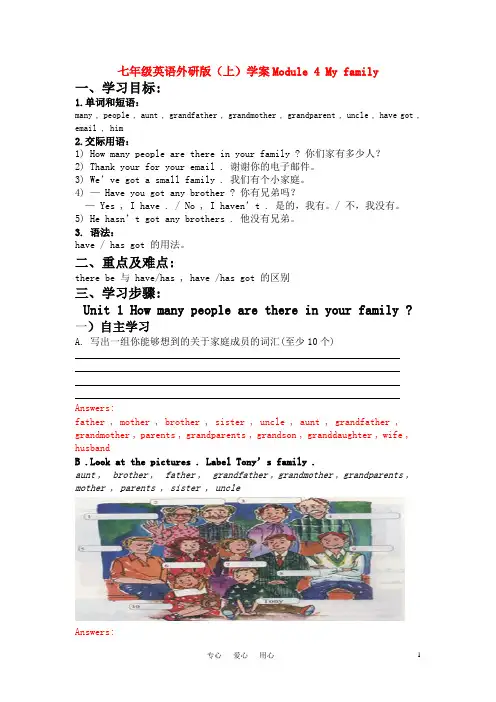
二、重点及难点:there be 与 have/has , have /has got 的区别三、学习步骤:Unit 1 How many people are there in your family ? 一)自主学习A. 写出一组你能够想到的关于家庭成员的词汇(至少10个)____________________________________________________________________________________________________________________________________________________________________________________________________________________________________________________________________ Answers:father , mother , brother , sister , uncle , aunt , grandfather , grandmother , parents , grandparents , grandson , granddaughter , wife , husbandB .Look at the pictures . Label Tony’s family .aunt , brother , father , grandfather , grandmother , grandparents , mother , parents , sister , uncleAnswers:1. grandmother2. grandfather3. grandmother4. grandfather5. uncle6. aunt7. mother8. father9. uncle 10. sister二)知识点学习1. family home和house的区别1) family的意思是“家庭、家庭成员”,与居住的房子无关。
山东省聊城市高唐县第二实验中学外研版七年级英语上册教案:Module3-Module4复习
(2)语法:一般现在时的疑问句构成及使用,特别是主语为第三人称单数时,谓语动词的变化。
举例:学生在构造一般现在时的疑问句时,容易忽略主语为第三人称单数时,谓语动词的变化。教师应通过举例和练习,让学生掌握该语法点。
3.文化意识:通过学习英语国家的家庭文化和日常生活,增进学生对不同文化的理解和尊重,培养跨文化交际意识。
4.学习能力:鼓励学生积极参与课堂活动,培养自主学习、合作学习和探究学习的能力,为终身学习奠定基础。
三、教学难点与重点
1.教学重点
(1)词汇:Module 3中的家庭成员、职业及日常活动相关词汇,如family, brother, sister, mother, father, doctor, teacher等;Module 4中的时间表达及日常作息相关词汇,如time, o'clock, half past, quarter to, school, home等。
在教学过程中,教师要针对以上重点和难点进行有针对性的讲解和练习,确保学生能够透彻理解并掌握核心知识。同时,注重激发学生的学习兴趣,提高他们的英语实际运用能力。
四、教学流程
(一)导入新课(用时5分钟)
同学们,今天我们将要复习的是Module 3-Module 4的内容。在开始之前,我想先问大家一个问题:“你们在日常生活中是如何向别人介绍你的家庭成员和一天的生活作息的呢?”这个问题与我们将要复习的知识点密切相关。通过这个问题,我希望能够引起大家的兴趣和好奇心,让我们一同回顾并巩固这些知识。
(三)实践活动(用时10分钟)
1.分组讨论:学生们将分成若干小组,每组讨论一个与家庭成员或日常活动相关的场景,并尝试用英语进行描述。
2024秋七年级英语上册Module4Healthyfood教案(新版)外研版
五、教学过程
1.导入:通过展示食物图片,引导学生谈论自己喜欢的食物,为新课学习做好铺垫。
2.呈现:介绍本节课的主要内容,展示健康食物的相关词汇和句型。
3.实践:学生通过小组讨论、互动交流等方式,运用所学知识介绍自己的饮食习惯,并询问他人。
2.课程平台:学校教学管理系统、英语学习网站等。
3.信息化资源:健康饮食相关的视频资料、图片、网络文章等。
4.教学手段:任务型教学、小组合作、情境教学、差异化教学等。
5.教具:食物图片、卡片、食物模型等。
6.教材:外研版七年级英语上册Module 4 Healthy food相关教材及辅助材料。
教学流程
在行为习惯方面,学生需要培养良好的学习习惯和团队合作精神。在课堂中,教师可以通过小组讨论、同伴互助等方式,引导学生积极参与课堂活动,培养他们的合作意识和团队精神。同时,教师还需要关注学生的个体差异,给予不同层次的学生适当的指导和关爱,帮助他们建立自信,克服学习中的困难。
四、教学策略
1.情境教学:通过展示食物图片、视频等方式,引导学生进入真实的学习情境,激发他们的学习兴趣。
(2)语法检测:请学生们运用一般现在时态的肯定句和否定句结构,描述自己的饮食习惯。
(3)听力检测:播放一段关于健康饮食的对话,请学生们回答相关问题。
(4)口语检测:学生们分组进行角色扮演,模拟在餐厅点餐的情境,检测他们的口语表达能力。
(5)综合检测:请学生们运用所学知识,编写一个关于健康饮食的宣传海报,包括词汇、语法和表达能力。
2.实验操作:为了加深理解,我们将进行一个简单的实验操作。这个操作将演示如何选择健康食物的基本原则。
外研版英语七年级上Module 4 Family第一课时教案
外研版英语七年级上Module 4 FamilyII. Teaching material analyzing本模块以家庭为话题,以家庭介绍为任务,训练have / has got 句型的使用,并介绍了英语写作时应注意的标点符号问题。
通过对本模块内容的学习学生能够了解不同国家家庭结构的不同。
值得一提的是,班内可能会有单亲家庭,教师在授课时应注意该问题,在不伤害学生自尊心的同时注意培养学生的移情能力。
Unit 1 通过听、读、说训练,初步学习询问对方家庭情况和介绍自己的家庭成员。
其中活动1 要求学生将适当的词汇和人物联系起来。
活动有一定难度,教师可提醒学生注意利用图中所看到的有用信息。
活动2训练学生从听力材料中听出father,mother,sister,grandfather 等词汇。
活动3、4要求学生听对话并完成填词任务,活动6要求根据提示口头练习询问及介绍家庭情况。
Unit 2 通过读写训练,让学生进一步掌握如何介绍自己的家庭成员的相关表达。
活动1-2通过词汇匹配、小组活动(介绍自己家庭成员)的活动为下面的阅读做词汇和话题上的准备。
活动3要求学生阅读电子邮件,从中获取有用信息并回答相关问题。
活动4学习英语中标点的用法。
教材中没有具体的写作任务,教师可根据本模块话题增加写作活动。
Unit 3 共设计了6项活动内容。
活动1-4复习所学内容,进一步巩固所学have / has got 的用法。
Around the world通过图片让学生来了解东西方家庭模式的不同。
完成本模块学习后,教师可安排学生将自己的家庭状况写下来。
III.Class types and periodsPeriod 1 Listening and speaking (Unit 1)Period 2 Reading and writing (Unit 2)Period 3 Integrating skills (Unit 3)Period 1 Listening and speakingLanguage goals1. Key vocabularymany, people, aunt, grandfather, grandmother, grandparent, uncle, have got2. Key structuresThere is / are …have / has got …3. Ability goalsEnable students to briefly introdu ce one’s family.Teaching methodsBottom-up approach.Teaching aidsTape recorder, video.Teaching procedures and waysStepⅠWarming up and lead-inGive students some school things such as books, pens, notebooks, ask students who get one, using have got.T: What have you got?S: I have got a blue pen.S: I have got an English book.Show the following.have / has got = have / hashave got 表示“某人有…”常用在英国英语中,美国朋友则常用have 来表达这一意义。
七年级英语外研版上册教案:StarterModule4Unit1
七年级英语外研版上册教案:StarterModule4Unit1Unit 1What day is it today?Ⅰ.Teaching modelListening and speakingⅡ.Teaching aims1.To learn the names of days2.To know how to ask and answer 〝What day is it?〞3.To understand the conversation about asking the daysⅢ.Teaching aidsTape recorder,PPTⅣ.Teaching stepsStep 1:Warming-up and lead-in1.Write down a number and tell students the number is between 1 and 30.Ask students to guess what the number is. 2.Ask students to look at the picture in Activity 2 and review the numbers from 1 to 30.3.Play the tape and have students point out the new words in Activity 2.4.Have the students read the names of a week.5.Show students a calendar by PPT,ask students to ask and answer like this:—What day is it today?—It's…—What day is it tomorrow?—It's…Step 2:Listening and reading1.Play the tape,ask students to listen the conversation in Activity 1 carefully.2.Have students read it and ask students to mark the language points that they can't understand.3.Explain the main points to students and solve the problems.4.Ask them to read the conversation aloud.5.Let them act it out.Step 3:Practice1.Have students read the sentences in Activity 3 and then match them.2.Play the recording and ask students to listen and check.Keys:1-c2-d3-b4-a3.Play the recording again and ask students to listen and repeat.4.Come to Activity 4.Let students ask and answer in pairs like this:—Today is…What day is it tomorrow?—It's…Step 4:Listening and writing1.Play the tape and have them listen and write in Activity 5.2.Ask students to read and write in Activity 6.3.Call back the answers from the whole class and check the answers.4.Play the tape and have them listen and check.Keys:1.day 2.Wednesday 3.Saturday 4.Sunday5.ThursdayStep 5:Work in pairsAsk students to work in pairs in Activity 7.Step 6:Homework1.Revise all the key points in this unit.2.Recite the conversation in Activity 1.3.Finish off the workbook exercises.Blackboard DesignUnit 1What day is it today?1.—What day is it today?—It's Monday.2.—What day is it tomorrow?—Tuesday.。