
译林版8B八下英语复习教案(8B Unit 1)
译林版8B八下英语复习教案(8B Unit 1)【考点精讲】一、核心词汇1.past n.[考点点拨] past作名词,意为“过去”,其还可作介词和形容词,可用于如下情况:in the past (n.)在过去;half past(prep.)five 5点半;in the past(adj.)three years在过去的3年里。
如:When he walks past our desks, he always knocks ourbooks and pens off the desks.当他走过我们课桌的时候,他总是把我们的书本和钢笔从课桌上碰掉下来。
The boy finished his homework with the help of his father in the past.这个男孩过去是在他父亲的帮助下完成作业的。
2.present n.[考点点拨]present作名词,意为“现在,目前”。
At present=at the moment=right now目前;其还可作形容词,your present job你目前的工作;present用作名词,还可表示“礼物”,a birthday present -份生日礼物。
如:He is washing his clothes at present.现在他正在洗衣服。
3.northern adj。
[考点点拨] 方位词:north-northern; west-western; south-southern; east-eastern。
如:in the north of China =in the northern part of China在中国北部East China华东;North China华北The northern part of the city used to be sparsely populated, but has now become a cultural centre. 城北过去人口稀少,但现在成了文化中心。
4.pollution n.[考点点拨] 常见短语:air pollution空气污染;noise pollution噪音污染;light pollution光污染。
如:I could hardly believe she had made a video about water pollution by herself.我几乎不能相信她靠自己制作了一份有关水污染的录像。
pollute作动词,意为“污染”,pollute the air污染空气。
5.interview n.& vt.[考点点拨] interview作名词,意为“采访,会见”,还可作动词,意为“采访,面试”;interviewer 作名词,意为“采访者,面试官”。
如:interview sb.=have an interview with sb.采访某人Sally became a member of the company after the job interview.萨莉在求职面试后成为了这家公司的一员。
I interviewed Mr Zhang yesterday afternoon=I had an interview with Mr Zhang yesterday afternoon.昨天下午我采访了张先生。
6.return v.[考点点拨] return作“返回”讲时是不及物动词,相当于come/get back: 作“归还”讲时是及物动词,相当于giveback。
return to someplace回到某处;return sth to sb. =give sth.back to sb.把某物还给某人。
return本身含有back的意思,不能再和back连用。
如:他借了我的手机,还没还给我。
正:He borrowed my mobile phone and hasn't returned it to me.误:He borrowed my mobile phone and hasn't returned it back to me.二、核心句型1. Y ou used to share food with me!你过去常和我分享食物![考点点拨] used to do sth过去常常做某事(现在不做了);be used to do sth. =be used for doing sth是被动语态结构,意为“被用来做某事”;be used to doing sth意为“习惯于做某事”,其中to为介词,后接名词、代词或动名词。
如:I used to play tennis but I don't play it very often now.我过去常打网球,但现在不常打了。
Stamps are used to post letters.=Stamps are used for posting letters.邮票是用来寄信的。
I am used to going to school by bus.我习惯于坐公交车去学校。
2. When I got married in 1965, my wife and I moved two blocks away and we've lived in this area since then.当我1965年结婚时,我和妻子搬到两个街区以外,从那以后一直住在这个地区。
[考点点拨] marry sb.嫁给/娶某人;get married结婚(动作);be married to sb.与某人结婚(状态);getmarried to so. 与某人结婚(动作)。
如:They married their daughter to an old rich man.他们把女儿嫁给了一位年老的富人。
This couple have been married for 50 years.这对夫妇结婚已有50年了。
3. Anyway, it's good to see the amazing changes in the town.不管怎样,看到小镇这些令人吃惊的变化还是很好的。
[考点点拨]“It's+adj. (easy,important,bad,nice…)+ (for sb.) to do sth”是英语中应用非常广泛的一个句型,意为“(对某人来说)做某事是(容易的,重要的,坏的,好的……)”。
其中it是形式主语,无实际意义,真正的主语是后面的动词不定式to do sth。
如:It is important for us to master a foreign language.掌握一门外语对我们来说很重要。
三、重点语法现在完成时1.基本结构为:助动词have/has+动词的过去分词(1)表示过去发生的行为、动作或情况对现在造成的影响或结果。
时间副词常用just(刚刚),already(已经),still(仍然),recently(最近),yet(还、尚),ever(曾经),never(从不)。
其中just,already用于肯定句;yet,ever,never常用于疑问句或否定句;still,recently可用于肯定句、否定句或疑问句。
如:Have you ever been to Hong Kong?你曾经去过香港吗?I haven't got the letter from my uncle yet.‘我还没收到我叔叔的信。
(2)表示从过去开始并持续到现在的行为、动作或情况。
常与for或since引导的时间状语连用。
for表示一段时间,后接时间段.;since表示“自从”,后接时间点。
(3)也常与so far(迄今为止),in the past several years(在过去几年里),ever since(迄今),in/during/over the past/last few years(在过去几年里)这类从过去到现在的时间状语连用。
在此类句子中,谓语动词要用持续性动词,而不能是短暂性动词。
如:The children have been away from home since the new term began.(木用left)自从新学期开始,孩子们就已经离开了家。
2.具体的几组时间短语辨析ago用于一般过去时(用瞬间动词);since...ago用于现在完成时;in the past用于一般过去时;in the past few years用于现在完成时;just now(置于句末)用于一般过去时;just(置于句中)用于现在完成时。
如:I bought this dictionary three years ago.=I have had this dictionary for three years.=I have had this dictionary since three years ago.这本字典是我三年前买的。
还可以用“It is/has been+时间段+since从句”改写为:It is three years since I bought this dictionary.【考点精练】一、单项选择( )1. (2014.泰安)-Can you find our city _______ a lot in recent years?-Y es. The road is wider and the buildings are taller.A.has changed B changesC changed D.will change( )2. (2014.沈阳)I'm not hungry because I have_______ had lunchA everB never C.just D.still( )3. (2014.黔南)He came back late, so his father was very angry.(选出与画线部分意思相同或相近的一项)A arrivedB gave backC returned D.reached( )4. (2014.南充)She used to _______ a bus to school, but now she is used to _______ to school.A taking; walkB take; walkC taking; walking D. take; walking( )5. (2014.平凉)She _______ for ten years and now she has a lovely daughter.A. married B has been marriedC. got marriedD. has got married二、根据句意及中文提示完成单词1.What was your hometown like in the_______(过去)?2.Do you know what you should do at_______(现在,目前)?3.I think there will be more_______(污染)in fifty years.三、用所给单词的适当形式填空1. (2014.常州)-Guo Tao's new book about his stories with his son_______ (come) out.- Really? Why not go to the bookshop and buy one right now?2. Y ancheng is in the_______ (north) part of Jiangsu.3. (2014.镇江)Li Jianrou was_______ (interview) shortly after she won the first gold medal for China in the 22nd Winter Olympic Games.4. It is necessary for us_______ (listen) carefully in class.【参考答案】一、1—5 ACCDB二. 1. past . 2. present 3. pollution三. 1. has come 2. northern 3. interviewed 4. to listen。
译林版英语八年级下册第一单元全套教案
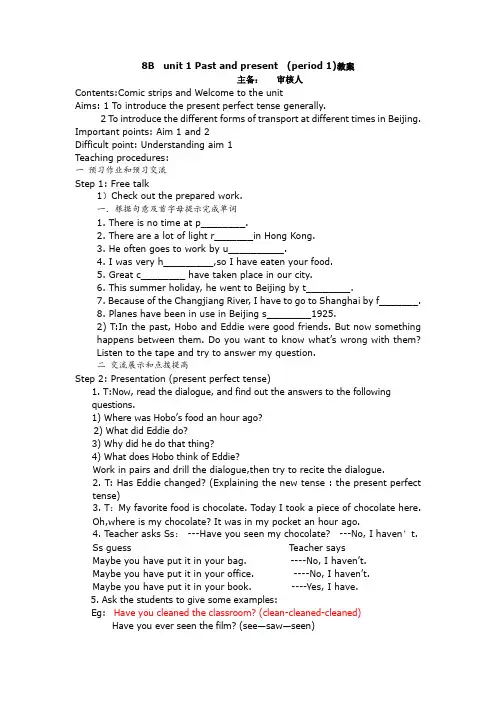
8B unit 1 Past and present (period 1)教案主备:审核人Contents:Comic strips and Welcome to the unitAims: 1 To introduce the present perfect tense generally.2 To introduce the different forms of transport at different times in Beijing. Important points: Aim 1 and 2Difficult point: Understanding aim 1Teaching procedures:一预习作业和预习交流Step 1: Free talk1)Check out the prepared work.一.根据句意及首字母提示完成单词1. There is no time at p________.2. There are a lot of light r_______in Hong Kong.3. He often goes to work by u__________.4. I was very h_________,so I have eaten your food.5. Great c________ have taken place in our city.6. This summer holiday, he went to Beijing by t________.7. Because of the Changjiang River, I have to go to Shanghai by f_______.8. Planes have been in use in Beijing s________1925.2) T:In the past, Hobo and Eddie were good friends. But now somethinghappens between them. Do you want to know what’s wrong with them?Listen to the tape and try to answer my question.二交流展示和点拨提高Step 2: Presentation (present perfect tense)1. T:Now, read the dialogue, and find out the answers to the followingquestions.1) Where was Hobo’s food an hour ago?2) What did Eddie do?3) Why did he do that thing?4) What does Hobo think of Eddie?Work in pairs and drill the dialogue,then try to recite the dialogue.2. T: Has Eddie changed? (Explaining the new tense : the present perfecttense)3. T:My favorite food is chocolate. Today I took a piece of chocolate here.Oh,where is my chocolate? It was in my pocket an hour ago.4. Teacher asks Ss:---Have you seen my chocolate? ---No, I haven’t.Ss guess Teacher saysMaybe you have put it in your bag. ----No, I haven’t.Maybe you have put it in your office. ----No, I haven’t.Maybe you have put it in your book. ----Yes, I have.5. Ask the students to give some examples:Eg: Have you cleaned the classroom? (clean-cleaned-cleaned)Have you ever seen the film? (see—saw—seen)I’ve (I have) already eaten it. (eat—ate—eaten)We have not done this work yet.(do—did—done)……6. Do some exercises about different tenses and the comic strip.一.用动词的适当形式填空。
牛津译林版八年级下册unit1教案(1)
牛津译林版八年级下册unit1教案一、教学内容本节课选自牛津译林版八年级下册Unit 1《Past and present》,围绕“变化”这一主题展开。
具体内容包括:Grammar部分的一般过去时和一般现在时的区别与运用;Reading部分的“Changes in Beijing”和“Changes in my hometown”;以及Speaking和Writing部分的相关练习。
二、教学目标1. 能够掌握一般过去时和一般现在时的区别及用法。
2. 能够通过阅读,了解北京和家乡的变化,提高阅读理解能力。
3. 能够运用所学知识,描述生活中的变化。
三、教学难点与重点1. 教学难点:一般过去时和一般现在时的区别及运用。
2. 教学重点:阅读理解及描述生活中的变化。
四、教具与学具准备1. 教具:PPT、黑板、录音机。
2. 学具:教材、笔记本、彩色笔。
五、教学过程1. 导入:通过展示一组过去和现在的图片,引发学生对“变化”这一主题的兴趣。
2. 课堂活动:a. 针对Grammar部分,讲解一般过去时和一般现在时的区别与用法,并举例说明。
b. 针对Reading部分,让学生阅读“Changes in Beijing”和“Changes in my hometown”,并完成相应的练习。
c. 针对Speaking部分,组织学生进行小组讨论,描述生活中的变化。
d. 针对Writing部分,让学生尝试用一般过去时和一般现在时描述生活中的一个变化。
3. 例题讲解:针对Grammar和Reading部分的重点内容,给出例题并详细讲解。
4. 随堂练习:让学生完成教材上的相关练习,巩固所学知识。
六、板书设计1. Unit 1 Past and present2. 内容:a. Grammar:一般过去时与一般现在时的区别与用法b. Reading:Changes in Beijing / Changes in my hometownc. Speaking:描述生活中的变化d. Writing:用一般过去时和一般现在时描述变化七、作业设计1. 完成教材上的练习题。
牛津译林版八年级英语下册 Unit1 复习教案
牛津译林版八年级英语下册Unit1 复习教案学科:任课教师:授课时间:年月日时:分姓名性别年级总课时:教学内容8B Unit 1 Past and present教学目标①Used to和be used to的含义的区别②过去分词的变化规则重点难点现在完成时的含义、结构以及时间状语的辨别课前检查作业完成情况:○ 全部完成○ 基本完成○部分完成○ 没有完成上次授课回顾:○ 完全掌握○ 基本掌握○ 部分掌握○ 没有掌握难点标记授课过程Welcome1. 曾经____________________2. 在不同的时期__________________3. 不同的交通方式________________4. 写一篇报告_______________________5. 在过去的100多年里____________6. 进行一个历史课题探究_____________7. 轮流讨论它____________ 8. 等下一辆_____________1. ---Eddie,have you seen my food? 埃迪,你看到我的食物了吗?---Yes. I've just eaten it. 是的。
我刚刚把它吃了。
现在完成时由“助动词have/has+过去分词”构成,其中I've是I have的缩略形式,seen 是see的过去分词,eaten是eat的过去分词。
--- Have you eaten your breakfast? 你吃过早饭了吗?--- Yes,I have. 是的,我吃过了。
( )- Would you like to go and see Avatar with me tonight?- Thank you very much, but I_______ it already.A. seeB. will seeC. have seenD. am seeing2.You've eaten my food?你吃了我的食物?本句为陈述句,但句末用问号,表示疑问。
八年级英语下册 Unit1精品教学案(共10课时) 牛津译林版

8B Unit1 Past and present8B Units1导学案参考答案Unit1第一课时:一、1.was 2.has eaten 3.to have 4.to play 5.is eating 6.took 7.rode8.will be二、1.would like , grows up 2.walks to school 3.goes to work by bus 4.flies to5.don’t want to any more第二课时:一、1.know about 2.get married 3.move out 4.water pollution 5.in the centreof6.feel lonely7.turn into8.from time to timeed to do 10.in some ways二、well has lived southern got married in the centre of children has changed a lotmarket stallsHas turned into to play cards pleasant shoe factory waste waterfish and plants polluted took action cleaner in some ways open space lonely第三课时:一、1. I don’t want to play with you any more.2.There used to be the home of birds.3.He live in Beijing since he moved here.4.In the past ,many people had no money to go to school.5.Nanjing has changed a lot in the past five years.6.Many friends have moved to other places ,so I feel lonely from time to time.7.I had an interview with my Chinese teacher this morning.8.It has bee more difficult to play chess with my old friends.二、1.Where have they gone ..2.How long has lived3.When was born4.you helping me第四课时:一、1.dishonest 2.unhappy 3.unlucky 4.impolite 5.unkind二、D C C B C A三、1.cheaper 2.healthiest 3.impossible 4.safely 5.well better第五课时:一、1.They haven’t read the book yet.Have they read the book yet? Yes, they have/ No , they haven’t1.How long has Daniel stayed in Shanghai?2. I have known him for ten years.3.Sandy has been in Beijing for half an hour.二、1. Have seen have did see2.lent hasn’t given 3.have been did visit第六课时:一、C C A A D B二、1. He has already finished homework.2.Have you ever been to Beijing?3.I have known Linda for 3years.4. I have just seen Lily.5.We haven’t heard from him for a long time.第七课时:一、1.is 2.do 3.will be 4.shall go 5.taught 6.has taught 7.has gone8.Have seen 9.have learned 10.will arrive二、1.How long have you known him?2.Has Jane finished her homework?3.I haven’t worked in this school for two years.4.Why hasn’t Jim finishedhis homework?5.when did you buy this watch?6.Who is the old man next to Lily?7.Which girl is my sister?8.How far is your home from your school?第八课时:一、1.advantages 2.reduce 3.changed 4.developments 5.service6.interview7.realizes 9.repair二、1.recently 2.unpleasant 3.impolite 4.have done 5.left6.southern7.polluted8.Has arrived arrived9.has eaten 10.have been第九课时:第十课时:一、1.as often as before 2. have an interview with sb ed to do sth 4.so big and modern5.in the north of二、1. was has lived 2.was made 3.Has arrived arrived 4.has eaten5.safely6.has been7.have been三、1.B 2.C 3.B 4.C 5.D 6.A四、1.Have you anything 2.doesn’t provide any longer 3.since ago ed to5.has been to。
译林版英语八下现在完成时态讲解1-3单元
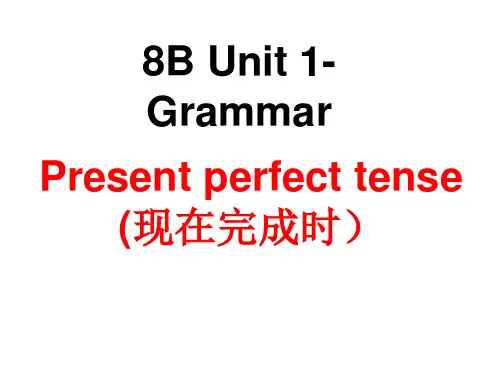
四、动词的过去式和过去分词的构成: 1. 规则变化
visit visited visited repair repaired repaired watch watched watched finish finished finished
verb+ed
move moved live lived love loved like liked
• 原形、过去式和过去分词的词形和读音都相同的 单词,结尾字母一般是t或d。
• 特殊:动词read的过去式和过去分词虽然词形与 原形一致,read-read-read,但发音分别是[ri:d][red]-[red]。
ABA
有些动词的过去分词与原形是一样的:
run-ran-run come-came-come become-became-become overcome-overcame-overcome
moved lived loved liked
以e结mopped trap trapped trapped plan planned planned
双写+ed
注:以一个辅音字母结尾的重读闭音节词, 双写最后一个辅音字母+ed
study studied studied hurry hurried hurried
eg. He has eaten supper.
They have eaten supper.
2.疑问句 现在完成时的一般疑问句式是把助动词have或has提
到主语之前。 (回答用“Yes,---have/has./“No, ---haven’t/hasn’t.” )
eg. Has he eaten supper?
say,pay,lay
-n
牛津译林版八年级下册unit1教案
牛津译林版八年级下册unit1教案教案:牛津译林版八年级下册Unit 1一、教学内容本节课的教学内容来自牛津译林版八年级下册Unit 1,主要讲述了关于一般过去时态的用法。
教材内容包括:1. 引入部分:通过图片和情境引入一般过去时态的概念;2. 语法部分:讲解一般过去时态的构成、用法和注意事项;3. 对话部分:学习一段关于过去发生的事件的对话;4. 阅读部分:阅读一篇关于过去时态的短文;5. 练习部分:通过各种练习题巩固一般过去时态的用法。
二、教学目标1. 学生能够正确理解和运用一般过去时态描述过去发生的事情;2. 学生能够听懂、说出一般过去时态的句子,并在实际情境中运用;3. 学生能够通过阅读和练习提高自己的语言运用能力。
三、教学难点与重点重点:一般过去时态的构成和用法;难点:正确运用一般过去时态描述过去发生的事情,并在实际情境中灵活运用。
四、教具与学具准备1. PPT课件;2. 图片;3. 练习题;4. 录音机和磁带。
五、教学过程1. 引入:通过展示图片和情境,引导学生思考过去发生的事情,引出一般过去时态的概念。
2. 讲解:讲解一般过去时态的构成、用法和注意事项,让学生理解并掌握。
3. 对话学习:学习一段关于过去发生的对话,让学生听懂、会说一般过去时态的句子。
4. 阅读理解:阅读一篇关于过去时态的短文,提高学生的阅读理解能力。
5. 练习:通过各种练习题,让学生巩固一般过去时态的用法。
六、板书设计1. 一般过去时态的构成;2. 一般过去时态的用法;3. 注意事项。
七、作业设计1. 根据题目要求,用一般过去时态写一篇小作文,描述过去发生的一件事情。
题目:请写一篇关于你最喜欢的节日的作文,要用到一般过去时态。
答案:略八、课后反思及拓展延伸1. 课后反思:对本节课的教学效果进行反思,看看是否达到了教学目标,学生是否掌握了知识点。
2. 拓展延伸:布置一些拓展性作业,让学生进一步巩固和提高一般过去时态的运用能力。
2022年牛津译林版八年级英语下册Unit 1 Past and present教案
Unit 1 Past and present教案总课题8B Unit 1 Past and present 总课时8 第1 课时课题Welcome to the unit 课型New教学目标1 To introduce the present perfect tense generally.2 To introduce the different forms of transport at different times in Hong Kong.教学重难点1.To introduce the present perfect tense generally.2 To introduce the different forms of transport at different times in Hong Kong.学法指导task-centered approach教具准备课件教学步骤二次备课Step 1: Free talkIn the past, Hobo and Eddie weregood friends. But now somethinghappens between them. Do you wantto know what’s wrong with them?Step 2: PresentationRead the dialogue, and find out the answers to the followingquestions.1)What was in the bowl an hour ago?2) What did Eddie do?3) Why did he do that thing?4) Why does Hobo think Eddie has changed?Explaining the new tense :the present perfect tenseEg: 1) Have you seen my food?(see—saw—seen)2)I’ve (I have) eaten it.(eat—ate—eaten)3) We have not seen him for a long time ……4) How has he changed?Let Ss read the dialogue in pairs.Step 3: Presentation1. Show the pictures . Discuss them with the Ss.: What’s the use ofit?Where do you usually see it?Is it a special one? Why?Which transport do you like best?2. Write the correct names under the pictures.Step 4: PracticeFinish part B (Back to the past) & complete the timeline.作业设计1.背诵本课的单词与词组2.预习Reading,完成预习作业教学反思总课题8B Unit 1 Past and present 总课时8 第2课时课题Reading 1 课型New 教学目标1 To grasp some useful expressions2 To infer general meaning from title and context教学重难点The unders tanding of the reading学法指导Task-centered approach教具准备课件教学步骤二次备课Step 1 Free talk .Where is your hometown?Has it changed a lot?Can you tell us something about the changes to your hometown?As you know, I am a teacher now. But five years ago, I was ateacher, too. So I have worked here for 3 years. I think our schoolchanged a lot. Do you think so? Everything has changed a lot?Step2: Presentation.Have you been to Beijing? Now, look at some pictures of it. Witnessgreat changes to it over 100 years. Show pictures.Step 3 Reading A1. Would you like to listen to Mr Chen, Daniel’s grandpa? Play theta pe for Ss 2 times. Answer the following questions.How long has Mr Chen known Sunshine Town?Did Mr Chen live there all the time? Why?Does Mr Chen think the place changed a lot?What are the differences between the past and present?2.Check the answers if they can not answer.3. Explain some difficul t points.4. Ask Ss to read in pairs and try to act it out.Step4: Practice.1.Do the exercise on page 10 B1Match the words on the left with the meanings on the right.2. Finish off the exercises of partB2,3 on P.(T/F).S tep 5 Finish Part D on page 11作业设计1.背诵本课的单词与词组2.完成《课课练》上本课时的作业教学反思总课题8B Unit 1 Past and present总课时8 第 3 课时课题Reading 2课型New教学目标To grasp some useful expressions and understand the new tense-Present perfect tense;To retell the main idea of the text;教学重难点To get more detailed information about the changes to the town and understand the new tense-Present perfect tense.学法指导Task-centered approach教具准备课件教学步骤二次备课Step 1: Pre-checking.Translate the phrasesAsk some students to give us the answers and then correct;Ask themto read together.B.预习交流作业(见学案)小组核对-----集体校对-----质疑交流C.Further understanding the text.Ask and answer.Who is Mr Chen?(He is Daniel's grandpa who lived in Sunshine Town before.)What do you know about Mr Chen?(He got married in 1965.Then he and his wife moved to another flat inthe center of town. Lase Last year, they moved again. Now, he oftenmeets his friends in the park.He feels a bit lonely from time to time.)What was in Sunshine Town in the past?(There was some small restaurants,shops and market stalls. There wasalso a small post office and an old cinema.)How many people lived there in the past?(30,000people.)What is the town centre now?(It's a park. )What does Mr Chen do in the park?(He meets his friends to play cardsand chinese Chinese chess.)Why is there less water pollution than before?(Because thegovernment has took taken action to reduce the pollution. )Step2:PresentationA. Present perfect tense:①概念:动词结构:have/has+动词的过去分词基本用法:表示这个动作发生在不确定的过去时间并对现在有影响。
新牛津译林版英语八年级下册第一单元复习导学案
新牛津译林版英语八年级下册第一单元复习导学案8B Unit 1复习导学案(I)教学目标:1. 复习并扩展有关交通工具及形容词的反义词的词汇。
2. 复习有关阳光镇过去和现在变化的内容。
3. 复习有关现在完成时的结构及其用法。
一、词汇过关:根据提示写出正确的单词:1.The _____________ ( develop ) of China is very fast ,but we must realize clearly that China is still a ______________ (develop ) country now.2.The factory used to ___________________ ( pollution ) the river, but the river is getting cleaner.3.I hope that a pleasant ___________( feel ) of the trip and enjoy yourself.4. Can you work out this Maths problems in different___________(方法).5.Simon likes sports . He is _______( especial ) interested in playing basketball.6._________ ( luck ),we didn’t get there on time because of the bad weather.7.---Have you seen any films _________ (recent ) ? --- No .8. He is very young, but he looks____________(health)9.I don’t believe your family has ____________(拥有)a car for ten years .10. It’s about changes in Beijing over the past ___________(百年).11.I lived in a house alone. Sometimes I feel ____________ (孤独)12.The government has taken actions to __________ (减少) the pollution.13.We should take __________ ( advantage ) of what we have to win the match.14.My mother has taught in that school for ten years since she got ___________.(marry)15.I want to look up a word . Do you have a English-Chinesed ___________ ?二、短语收藏1、在过去2、在现在3、不同时期的交通方式4、不再(两种表达)5、与某人玩6、在镇南部(两种表达)7、与某人结婚8、变化很多9、顺便问一下10、把变成11、过去经常12、采取措施做某事13、减少污染14、在某种程度上来说15、开阔地16、感到有点儿寂寞17、不时地,偶尔18、把他们扔掉19、采访某人(两种表达)20、实际上三、语法点拨:现在完成时含义:①动作发生在过去但对目前产生了影响或造成了结果。
牛津译林版 8B八年级下册 Unit1 Past and present 知识点梳理
八年级下册Unit1 Past and present知识点梳理【重点单词】past [pɑːst]过去present ['preznt] 现在,目前just [dʒʌst] 刚才used to (过去持续或常发生)曾经since [sɪns] 自…以来ever ['evə] 曾经,永远,这以前northern ['nɔːðən] 北方的,北部的married [ˈmærɪd] 已婚的,结婚的wife [waɪf] (妻子block [blɒk] 街区since [sɪns] 自…以来over ['əʊvə] 在…期间turn ... Into ... 把…变成…pollution [pəˈluːʃ(ə)n] 污染;污染物factory ['fæktəri] 工厂waste [weɪst] 废料;废品realize ['rɪəlaɪz] 意识到;实现improve [ɪm'pruːv]改进,改善situation [sɪtjʊˈeɪʃ(ə)n] 形势,情况in some ways 在某种程度上however [haʊ'evə] 然而impossible [ɪmˈpɒsəbl] 不可能的before [bɪ'fɔː]以前,过去,已经lonely ['ləʊnli] 孤独的,寂寞的from time to time [frɒm//taɪm//tuː//taɪm] 不时,有时,偶尔anyway [ˈenɪweɪ] 尽管,即使这样husband ['hʌzbənd] 丈夫interview [ˈɪntəvjuː]采访;会见all one's life 一生yet [jet] 还,仍recently ['riːsntli]近来,最近past [pɑːst]过去environment [ɪn'vaɪrənmənt] 环境transport [trænsˈpɔːt]交通车辆,运输工具condition [kənˈdɪʃ(ə)n] 环境,条件,状况return [rɪ'tɜːn]返回last [lɑːst]最近,上一次;最后abroad [ə'brɔːd]到(在)国外primary [ˈpraɪməri] 小学教育的;初级的keep in touch 保持联系communicate [kəˈmjuːnɪkeɪt] 交流,交际communication [kəmjuːnɪˈkeɪʃ(ə)n] 交流,交际exactly [ɪg'zæktli] (答语)正是,没错be/get used to 习惯于,适应于narrow [ˈnærəʊ] 狭窄的open space 开阔的空地【重点词组】1.in the bowl an hour ago一个小时之前在碗里的ed to do sth.过去常常做某事be used to doing sth. 习惯于做某事be used to do sth. 被用来做某事3.do a history project on the changes in Beijing over the years做个有关这些年北京的变化的历史调查4.write a report on the changes in your home town 写一个有关你家乡的变化的报道5.know about the different forms of transport 对不同形式的交通工具很了解6.talk about transport at different times 讨论不同时期的交通工具7.take turns to do sth.=do sth. by turns 轮流做某事8.go to school by bike = ride a bike to school 骑自行车去学校9.wait for the next one 等下一辆车10.go to school by bus= take a bus to school= go to school on the bus乘公交车去学校11.interview sb. to get some information 为了得到些信息采访某人12.know sunshine town very well 对阳光镇很了解13.be born 出生14.move house 搬家15.in the northern part of town 在这个镇的西部16.get married to sb.= marry sb.= be married to sb.和某人结婚17.marry sb. to sb. 把某人嫁给某人18.move two blocks away搬到两个街区以外19.live in this area 住在这个地区20.since then 自从那以后since I was born/ since last Saturday/since three days ago21.over the years 这些年over the past century 在过去的几个世纪22.in the town centre= in the centre of the town 在镇中心23.turn/change/put sth. into 把某物变成某物24.a steel factory 一个钢铁厂25.put the waste into the river 把垃圾倒入河里put down 记下put away 收好put on 穿上put off 推迟、延期26.take action to improve the situation采取行动改善这种情况27.in some ways 在某些方面on the way (to ) 在……的路上by the way 顺便说no way 没门in any way 无论如何28.most of my old friends大部分我的老朋友29.move away 搬走/move to(into) another town30.see each other as often as before像以前一样经常看到对方31.play cards and Chinese chess 打牌和下棋32.feel a bit lonely 感到有点孤单33.from time to time = at times = sometimes 有时34.because of being alone 因为独自一人35.a group of buildings with streets on all sides街道两边全是高楼on both sides/ on each side36.interview sb.= have an interview with sb. 采访某人37.all his life 整个他的一生38.in the past 在过去at present 现在39.make some notes 做些笔记40.waste sth. on sth./ sb.浪费某物在某物/某人上41.repair over ten bicycles= repair more than ten bicycles修理超过10辆自行车42.teach sb. a lot about the history of China教我很多有关中国的历史43.talk about a film about the history of Beijing讨论一个有关北京历史的影片44.learn more about Beijing’s past and present对北京的过去和现在了解更多45.hear about/of 听说hear from sb.= receive/ get one’s letter=receive/get a letter of sb.收到某人来信46.living conditions 居住条件47.return sth. to sb. 把某物归还给某人48.go abroad 去国外at home or abroad 在国内外49.at primary school 在小学50.keep in touch with each other 互相保持联系51.make communication much easier使得联系更容易Communicate with sb.和某人保持联系52.take place发生(有目的有计划的)、举行happen发生(偶然发生)53.green hills all around到处都是绿山54.a river runs through the centre of town一条小河穿过镇中心55.get used to the changes of life习惯了生活的变化56.on one’s own = by oneself = alone独自57.throw rubbish 扔垃圾58.in some large open spaces在一些大的开阔的地方59.move into new flats搬到新公寓去60.in their free time在他们业余时间61.travel around the town在镇里转转62.have their own cars= have cars of their own有他们自己的汽车e the new words to talk about my hometown用些新词来讨论我的家乡e facts to support my opinions用事实来支持我的观点【重点句型】1.There were always too many people on the bus, and it took a long time to wait for the next one.公共汽车上总是有太多的人,并且要花费很长时间等待下一趟。
【最新】牛津译林版八年级英语下册《8B Unit 1 Past and present》教案:Task
《8B Unit 1 Past and present》教案:TaskTeaching aims:1. To describe two pictures explaining the differe nces between past and present situ ations.2. To generate ideas to describe specific details shown in pictures.3. To organize language and descriptions to write a comparison.4. To select descriptive information to write a report.5. T o describe the changes to a place.Important points:To select descriptive information to write a report.Difficult points:To describe and write the changes to a placeMethods: Reading and writing.New words: advant age, recent, describe.Teaching procedures:Step1 Revision1. Everyday English2. Check homework3. Finish off Checkout (the present perfect tense)Step 2 Presentation1. Do you still remember the changes t o Moonlight Town. Let’s compare it’s past and present.2. Some language points.Step 3 Main task: Moonlight Town: Past and Present1.Questions about Moonlight Town:⑴Where is Moonlight Town?⑵What did it use to be ?⑶Was it a good place for wildlife ?⑷H ow could people go to Moonlight Town before ?⑸How can people go to Moonlight Town now ?⑹Do you think the changes to it have brought benefits ?⑺Have the changes caused problems ?2. Useful expressions1.) no longe r = not ...any longer2.) bring many benefits3.) cause many problemsStep 4 Presentation (Changes to…)How to write a report about changes to some places.(refer to P22)Step 5 WritingAsk students to look a t the tw o giv en pictures (Jianye District in Nanjing) Homework:.1.Review the key points in this unit.2.Finish off the other exercises.当堂检测(20分)______________________________________________________________________________ _______________________________________________________________________________ _______________________________________________________________________________ _______________________________________________________________________________ _______________________________________________________________________________ _____________________________________________________________________________________________________________教后记:。