
chinese festivals说课稿
Unit7 Chinese Festivals说课稿Good morning my dear teachers,it’s my pleasure to be here sharing my lessons with you.I will introduce my lesson in this following aspects:Teaching material,Teaching objectives,Key and difficult points,Teaching methods,Teaching process and Blackboard design.The text is the reading period of unit 7 in oxford English 5B. The text talks about chinese festivals. Such a topic is related to our traditional customs,so it is easily to raise S’s interest. According to the Standard of English Curriculum and our S’s growing of mind,I design 3 teaching objectives:knowledge objective,ability objective,and emotion objective.Knowledge objective:Ss can read and understand the text independently and fluently.Ss know the traditional customs of chinese festivals。
Ability objective:Ss grasp reading skils like:skimmimg and scanning to improve their reading ability.Emotion objective:Cultivate S’s good habit in English reading.Inspire Ss to love our traditional culture.Arouse S’s interest in learning Eng lish.Develop S’s team spirit.Now,lets move to key and difficult points.The key point of my lesson is that after reading and understanding the text independently and fluently,Ss know some traditional culture about chinese festivals.The difficult point is to express traditional customs of chinese festivals in english.In order to achieve my teaching aims,I will make use of Task-based Teaching Method,Communicative Teaching Method.Now ,I will focus on my teaching process.To realize the teaching process sestematically and effiently,I divide this process into 3 steps:pre-reading,while-reading,and post reading.Step1 pre-reading:In this part,I arrange 2 activities.Activity1, play a game,30-Second Non-Stop Talking,I encourage some Ss come to the blackboard to play the game.They are required to say out Chinese festivals they have known in 30 seconds.The person who says the most will have an award. This game is not only related to my lesson,but also Ss will review the knowledge they have learned.More importantly,the atmosphere of the classroom can be animated.Activity2 look and guess.Ss are required to look at the pictures on PPT,then guess: which Chinese festival does it describe?what do people uaually eat at that day?I will encourage and guide Ss to answer the questions.At the same time,some new words are shown on PPT.By this showing,Ss can grasp some new words,it is helpful for their following reading.Next,we start to read the text.first,skimming.I will ask Ss to read the whole text quickly,then answer the question”How many festivals does the text introduce?and what are they?In this step,Ss should grasp how to catch the main idea of a text by ter, scanning. Ss read the text independently and carefully,then finish the T/F questions.Ss should know how to scanning to search some detail information by answering these questions.At last, Ss and I analyse the text paragraph by paragraph.After analyzing,I will ask some students to fill the blanks to check their understanding.Now,Ss are familiar with the text,they know Chinese festivals very well.we can move to post-reading.I design 3 activities for consolidation and extension.Activity1, describe and guess Ss are divided into several groups. one student will be encouraged to describe the festivals they know well,bu t the name of the festival can’t be told,so that other studebts will be interested in geussing what they are.It can avoid bordom from mechanical drills,in thisway,Ss can remember festivals and customs of festivals unconsciously and effectively.Activity2,Disscussion Ss work in groups and have a disscusion:1What else festivals do you know in china?2Which festival in china is most important for children?young people? old people? man and woman?why?After discussing,each group choose one student as representative to come to the blackboard and share their views with others.By discussion, Ss are encouraged to thinking and speak English,especially for those Ss who are shy or have difficulty in learning English.It is considered that children can keep their attentions in a limit time,so in activity3,we will have a debet. Ss are divided into two groups to discuss :Whether celebrating festivals is a waste of time and money.One group is for while the other group is against.A debet can practice the ability of thinking. their team spirit can be developed. Homework is also very important,it consolidate what Ss have learned today.Ss are required to choose one chinese festival you like best,and write an article about it.The article should include the time of the festival,how do people celebrate it? Why do you like this festival? The emotional and moral education are following:Ss should be told to love and protect their traditional culture.the traditional customs should be inherited forever.Cultivate good habit of English reading.Arouse Ss interest in English .Encourage Ss speak English.After the class,I find that the students can express chinese festivals very well ,and the atmosphere around the students is thick.Above is the lecture notes of my lesson,here is my blackboard design.thank you.。
英语下册Unit7Chinesefestivals第2课时教案译林牛津版

第2课时(总第课时)上课时间:月日课型:课一、教学内容Unit 7 Chinese festivals(Grammar time &Fun time)二、教学目标1. 能掌握单词March, April, July, August, December。
2. 能掌握句型... is in...。
3. 能掌握12个月份的缩写及规律。
4. 能够综合月份和四季的语言知识,描述四季的天气,活动,饮食以及节日。
三、教学重点1. 能掌握单词March, April, July, August, December.2. 能掌握句型... is in...。
3能掌握12个月份的缩写及规律。
四、教学难点能够综合月份和四季的语言知识,描述四季的天气,活动,饮食以及节日。
五、教学准备Multi-media六、教学过程Step 1: Warm up1.T:Look at the pictures, let’s review the Chinese festivals. What are they?2.T: Let’s describe them one by one.Step 2: Grammar time1.T: Well done! They are Chinese traditional festivals. Let’s learn some other Chinese festivals:Lantern Festival, Qingming Festival and Double Seventh Festival.2.T:Read the sentences and find these are months.Now do some riddles.From the riddles, learn some other months: March, April, July, August and December.T: Now play a game: say from January to December.Then play another game according to the pictures, speak out the festival is in which month.3.T: Look at the months, find the rules of abbreviation.We can use the first three letters and a dot to express month.May and September are different from other months.4.T: Read the sentences and find the rules.... is in ...Play a game: girls PK boys, the festival is in the month.5.T:After these, let’s do some exercises.①Can you tell me the month of your birthday with this sentence?②Do you know the months of four seasons?Spring is in____________________________________.Summer is in___________________________________.Autumn is in____________________________________.Winter is in____________________________________..Step 3: Fun time1.Ask and answerT:How many seasons are there in a year?S:Four seasons.T:What are they?S:Spring,summer,autumn and winter.T:What months are in spring/summer/autumn/winter?2.Talk about seasonsA:Which season do you like best?B:I like…A:When is …?B:The …is in…,…and…A:What’s the weather like in…?B:It’s…A:What can you see in…?B: I can see…A:What do you usually do in…?B:I usually…A:What do you eat in…?B: I eat…A:Are there any festivals in …?What are they?B:Yes,there are. They are…3.Describe my favorite season for an example4.Draw and talk about the season with partner.Step 4: Homework1.Know about other festivals and holidays in China or in western countries.2.Make an English calendar.Step 5: Show on the blackboardUnit 7 Chinese festivalsJanuary JulyFebruary AugustMarch SeptemberApril OctoberMay NovemberJune December... is in ...。
高中英语《Chinese seasonal festival》优秀说课稿
高中英语《Chinese seasonal festival》优秀说课稿Good morning/afternoon everyone,Today I'm going to present a lesson about Chinese seasonal festivals to a group of high school students. The main objective of this lesson is to help students understand and appreciate the cultural significance of the festivals, and to learn some related vocabulary and expressions.Before starting the lesson, I will begin with a short warm-up activity to capture students' interest. I will show them several pictures of different Chinese seasonal festivals, such as the Spring Festival (Chinese New Year), Mid-Autumn Festival, and Dragon Boat Festival. I will ask the students to discuss in pairs or small groups what they know about these festivals and what they think they signify. After a few minutes, I will then have a brief whole-class discussion to share their ideas and knowledge.Next, I will give a clear and concise introduction to Chinese seasonal festivals. I will explain that these festivals are celebrated throughout the year in China, marking important events such as the arrival of a new season or the harvest. I will also emphasize the cultural significance of these festivals, highlighting the ancient traditions and customs that are still practiced today.After the introduction, I will focus on one festival in particular, such as the Spring Festival. I will provide some background information about this festival, explaining that it is the most important festival in China, symbolizing the beginning of a new year. I will also discuss the traditional customs and activities associated with the Spring Festival, such as family reunions, the exchange of red envelopes, and the lion dance performance.To reinforce the vocabulary and expressions related to the festival, I will incorporate some interactive activities. For example, I will show students a video clip or some pictures of the lion dance and ask them to describe what they see using appropriate vocabulary words and expressions. I will also give them a handout with some dialogue examples related to the festival, and ask them to practice speaking in pairs or small groups.To further develop students' understanding and appreciation of Chinese seasonal festivals, I will have them work in small groups to research and prepare a presentation on a different festival. Each group will be assigned a specific festival, such as the Lantern Festival or Dragon Boat Festival, and they will be responsible for gathering information about the festival's history, traditions, and significance. They will then present their findings to the class, allowing students to learn about multiple festivals and compare their similarities and differences.To assess students' comprehension and retention of the lesson content, I will end the class with a short quiz. The quiz will consist of multiple-choice and short-answer questions, testing their knowledge of the vocabulary and concepts covered in the lesson.In conclusion, this lesson aims to introduce high school students to the rich cultural heritage of Chinese seasonal festivals. Through engaging activities and interactive discussions, students will not only learn about specific festivals, but also develop a deeper understanding and appreciation for the cultural traditions that have been passed down through generations.。
Unit7ChineseFestivals(教案)译林版英语五年级下册(1)
Students try to introduce the time,food and activities about the other Chinese festivals.
Students tell the reasons.
Ss: Yes.
When’s...?
What do people usually do at ...?
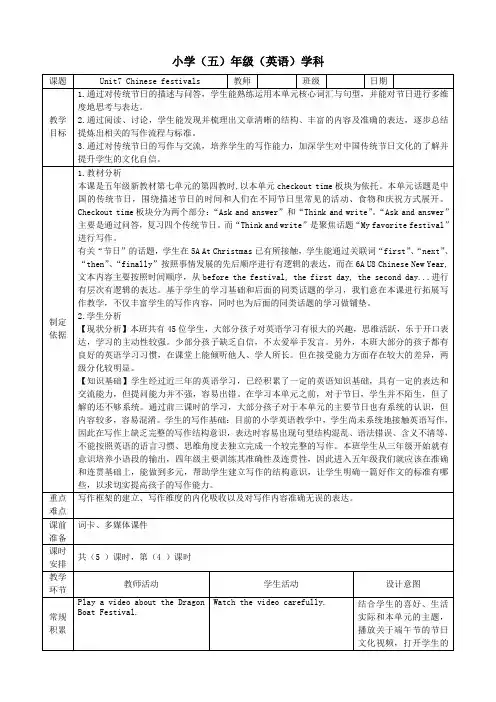
小学(五)年级(英语)学科
课题
Unit7 Chinese festivals
教师
班级
日期
教学目标
1.通过对传统节日的描述与问答,学生能熟练运用本单元核心词汇与句型,并能对节日进行多维度地思考与表达。
2.通过阅读、讨论,学生能发现并梳理出文章清晰的结构、丰富的内容及准确的表达,逐步总结提炼出相关的写作流程与标准。
Read the writings.
Discuss in a group of 4, then tell the reasons.
Find the structure of writing.
Read the writing again ,then discuss with partners.
Ss; can, also, but...
Write the passage according
to the writing criteria.
Give an assessment.
S1:I think she writes well.
She writes beautifully.
S2: She uses the link words.
S3: I like this sentence…
T: What aspects does ... introduce?
festivals 说课稿
festivals 说课稿节日说课稿一、教学背景分析在中国,节日是人们生活中重要的组成部分。
不同的节日有着不同的文化内涵和庆祝方式,通过学习和了解节日,可以帮助学生更好地了解和尊重自己的文化传统,培养他们的文化自信心和团队合作精神。
本节课将以“节日”为主题,通过多媒体展示、小组合作等形式,让学生了解和探索不同节日的由来、庆祝方式以及背后的文化内涵。
二、教学目标1. 知识目标:a. 了解和掌握几个重要的中国传统节日,如春节、中秋节、端午节等。
b. 了解和掌握几个国际节日,如圣诞节、万圣节、情人节等。
c. 掌握描述节日的词汇和表达方式。
2. 能力目标:a. 能够通过听、说、读、写等方式,表达对节日的认识和喜爱。
b. 能够进行简单的节日活动策划和组织。
3. 情感目标:a. 培养学生的文化自信心,增强对传统文化的认同感。
b. 培养学生的团队合作精神和创新思维能力。
三、教学重点和难点1. 教学重点:a. 了解和掌握几个重要的中国传统节日和国际节日。
b. 掌握描述节日的词汇和表达方式。
2. 教学难点:a. 学生对于国际节日的了解相对较少,需要引导他们主动获取相关信息。
b. 学生在描述节日时,需要运用到一定的词汇和表达方式,需要提前进行相关知识的讲解和练习。
四、教学过程安排1. 导入(10分钟)a. 利用图片或视频展示不同的节日场景,引发学生对节日的思考和讨论。
b. 引导学生回忆自己最喜欢的节日,并简单介绍一下原因。
2. 新课呈现(20分钟)a. 利用多媒体展示,介绍几个重要的中国传统节日和国际节日的由来、庆祝方式以及背后的文化内涵。
b. 教师提供相关词汇和表达方式,引导学生理解和记忆。
3. 合作探究(30分钟)a. 将学生分成小组,每个小组选择一个节日进行深入研究。
b. 学生通过互联网、图书、采访等方式,获取相关节日的信息,并进行整理和展示。
c. 学生展示完毕后,其他小组进行提问和评论。
4. 拓展延伸(20分钟)a. 学生自由发挥,设计一个新的节日活动,并进行简单的策划和组织。
译林版(三起)五年级下册英语教案:Unit7Chinesefestivals第2课时
译林版(三起)五年级下册英语教案:Unit7 Chinese festivals第2课时一、教学目标1. 知识与技能:(1)学生能够理解并正确运用本课时所学的词汇和句型;(2)学生能够用英语简单介绍中国的传统节日;(3)学生能够通过图片和实物展示,理解并运用一般现在时描述中国传统节日的习俗。
2. 过程与方法:(1)通过图片、实物展示和情景创设,引导学生用英语描述中国传统节日的习俗;(2)通过小组讨论、角色扮演等活动,培养学生合作学习的能力;(3)通过课后作业和课后反思,提高学生的自主学习能力。
3. 情感、态度与价值观:(1)培养学生对中国传统文化的热爱和传承意识;(2)培养学生尊重和了解不同文化的包容心态;(3)培养学生积极参与课堂活动,乐于与他人合作的良好习惯。
二、教学内容1. 词汇:lantern, dragon boat, moon, mooncake, dumpling, spring festival, MidAutumn Festival, Dragon Boat Festival, Double Ninth Festival, Lantern Festival2. 句型: What do people do at ? People3. 语法:一般现在时三、教学重点与难点1. 教学重点:(1)学生能够正确理解和运用本课时所学的词汇和句型;(2)学生能够用英语简单介绍中国传统节日的习俗;(3)学生能够通过图片和实物展示,理解并运用一般现在时描述中国传统节日的习俗。
2. 教学难点:(1)正确运用一般现在时描述中国传统节日的习俗;(2)正确理解和运用词汇:lantern, dragon boat, moon, mooncake, dumpling, spring festival, MidAutumn Festival, Dragon Boat Festival, Double Ninth Festival, Lantern Festival。
Unit 7 Chinese festivals 说课稿(Checkout time)-五年级英语下
Unit 7 Chinese festivals 说课稿(Checkout time)教学背景本篇说课稿主要是面向五年级英语下册同步备课译林版(三起)的教材,属于第七单元的教学内容。
该单元是以介绍中国的传统节日为主要内容进行设计的,旨在让学生了解中国节日的传统文化,扩展学生的文化视野,同时也促进学生的语言运用。
教学目标知识目标1.学习掌握中国传统节日的基本知识,比如春节、清明节、端午节、中秋节等;2.学生能够在日常生活中使用与中国传统节日相关的词汇及句型;3.学生了解与中国传统节日相关的习俗和活动。
能力目标1.学生能够自主学习并获取与中国传统节日相关的信息;2.学生能够运用英语进行表达和交流;3.学生能够进行简单的文化比较,了解不同国家的文化特点。
情感目标1.学生对中国传统节日的文化有浓厚的兴趣和好奇心;2.学生能够学会尊重和欣赏不同的文化;3.学生学会感恩和珍惜自己的传统文化。
教学内容及步骤Step 1:导入通过复盘学生所学过的关于节日的知识,比如学生已经了解了圣诞节等西方传统节日,本次课将介绍中国传统节日。
Step 2:呈现通过PPT或者多媒体教学软件展示几幅有关中国传统节日的图片,比如春节的灯笼、端午节的粽子等,进一步激发学生的兴趣和探究欲望。
Step 3:输入与输出1.引导学生了解中国几个重要的传统节日,包括春节、清明节、端午节、中秋节等。
教师可以通过给学生展示精美的动画短片、图片和相关的词汇与短语等方式进行知识输入。
2.学生在已学的基础上,通过回答教师提出的问题,进行语音语调、词汇、语法等方面的输出练习。
Step 4:学以致用学生分组研究并介绍一个中国传统节日,可以自由选择喜欢的或者已经熟知的节日。
让学生在小组内选择一个传统节日,编写一个海报或手抄报,然后展示给全班同学。
同时让学生使用英语和小组成员们讨论与节日有关的话题,增强英语教学的实践应用。
Step 5:总结讲解中国传统节日的习俗和特点,同时引导学生进行简单的文化比较,了解以及尊重不同国家的文化。
译林版(三起)五年级下册英语教案:Unit7 Chinese festivals 第3课时
译林版(三起)五年级下册英语教案:Unit7 Chinese festivals第3课时教学目标1.通过教学,学生能够对中国传统节日有一定的了解。
2.学生能够运用所学英语知识,描述中国传统节日的起源和庆祝方式。
3.学生能够通过模仿,合作学习等方式,提高他们的口语表达及交际能力。
教学重难点•教学重点: 学生能够理解并运用所学英语知识来描述中国传统节日的起源和庆祝方式。
•教学难点: 学生能够在交际情境中积极运用所学知识并结合语言材料进行表达教学准备1.教学PPT2.教学录音3.相关教材教学过程Warm-up (10分钟)1.老师打招呼并询问学生如何度过上一个节日。
2.学生分享经历并描述相关活动。
Presentation (20分钟)1.老师介绍中国传统节日,并放映相关图片。
2.学生听录音,回答问题。
录音包含以下内容:–龙舟节–中秋节–春节3.学生自己阅读相关课文,完成问题。
课文包含以下内容:–清明节–端午节Practice (35分钟)1.学生分组,针对所学内容,进行模拟对话,练习表达能力。
对话包括以下内容:–针对某个节日的问候及祝福;–询问对方关于这个节日的了解;–描述庆祝方式。
2.步骤1后,学生对话内容进行评价,并给出意见和建议。
3.老师编写语言交际情境,让学生在情景中练习英语口语表达。
–学生将不同的节日分类,并用英语介绍节日和节日的庆祝方式。
–学生围绕自己最喜欢的一个节日进行英文口头介绍。
Production (15分钟)1.学生排队轮流介绍他们喜欢的节日和庆祝方式。
2.整理评分表,鼓励学生积极参与。
Homework (5分钟)要求学生为自己喜欢的节日写一篇英文短文,并提交给老师。
总结•教学过程中,学生参与积极。
通过模拟对话、情景中练习等方式,学生提高了他们的英语口语表达和交际能力。
•学生能够理解并运用所学英语知识来描述中国传统节日的起源和庆祝方式。
•学生在课下可以继续巩固所学内容,针对老师要求,进行巩固练习和写作练习。
传统节日作业设计说课稿范文
传统节日作业设计说课稿范文英文版Chinese Traditional Festival Lesson Plan SampleChinese traditional festivals are an important part of our cultural heritage. They are not only a time for celebration and joy, but also an opportunity to pass down our customs and values to the next generation. In this lesson plan, we will explore the significance of traditional festivals in Chinese culture and discuss various activities that can be incorporated into the classroom to help students learn more about these important events.To begin with, it is important to introduce students to the history and background of Chinese traditional festivals. For example, the Spring Festival, also known as Chinese New Year, is the most important festival in Chinese culture. It marks the beginning of the lunar new year and is a time for families to come together, enjoy special meals, and exchange gifts. By providing students with this background information, they will have a better understanding of the significance of the festival.In addition to learning about the history of traditional festivals, students can also participate in various activities to help them better appreciate the customs and traditions associated with these events. For example, students can create their own paper lanterns to celebrate the Mid-Autumn Festival, or make dumplings to celebrate the Dragon Boat Festival. These hands-on activities not only help students learn more about the festivals, but also provide them with a fun and engaging way to connect with Chinese culture.Overall, incorporating traditional festivals into the classroom is a great way to help students learn more about Chinese culture and heritage. By providing students with background information and engaging activities, they will be able to develop a deeper appreciation for these important events and the values they represent.中文版中国传统节日是我们文化遗产的重要组成部分。
牛津上海版五下Unit11《ChineseFestivals》word教案
牛津上海版五下Unit11《ChineseFestivals》word教案一、教学目标:1、知识目标:学生通过阅读故事《年的传奇》,巩固和拓展语言知识的同时了解中国传统文化,能听,说,读,写单词village last end 通过look and learn栏目,关心学生学习本单元的生词。
学生通过Think and write 的写作练习,运用已学句型介绍节日。
2、技能目标:学生能综合运用各种句型介绍中国的传统节日,并了解西方国家的圣诞节。
二、教学重难点能把握单词monster, moon cake, last, at the end of会运用句型 What do you usually do/ eat at… festival? I/ We usually三、教学过程:Step 1: Warm upT: Boys and girls , before our class, let’s review what we learnt last class.Ss: OK.T: First, let’s read the pictures and the words, them try to match themT: Then, let’s read the pictures one by one, then we should choose the right sentence for each picture.分别读四副图片,然后为每一幅图片选择正确的描述语句。
Step 2: New words看图学习单词monster, moon cake, last, at the end of同时讲解at last 和at the end of 的区别。
Step 3:L et’s learn.Read and answerI’m Nian. I l ive in the____________. It’s the end of the year. I’m hungry. I’m goingto the___________. I want to_______ people. I see many_______ things. I’m ___________. I’m going back to the hills.阅读“年”的故事,依照故事回答问题。
译林英语五下说课稿Unit 7Chinese festivals 第二课时
译林英语五下说课稿Unit 7 Chinese festivals 第二课时课程背景本节课是小学五年级下册英语课程中的第七单元,名为“Chinese festivals”,总共分为四个部分。
本节课属于第二部分,主要介绍中国传统节日中的元宵节。
此课程的背景就是中国传统节日。
教学目标•知道中国传统节日元宵节的主要习俗和意义;•能够听懂并使用一些和元宵节相关的英文单词和短语;•能够描述元宵节的主要内容和过程,并且具有阐述观点的能力。
教学准备•PPT课件;•有关元宵节的图片、视频或者其他相关实物模型等;•学生用的课堂笔记本和笔。
教学过程Step 1 导入新课老师和学生进行互动式的问答,来导入新的课程内容。
如:Teacher: Hello, everyone.Students: Hello, teacher.Teacher: What is today?Students: Today is Monday.Teacher: What did we learn in the last class?Students: We learned about Chinese New Year.Teacher: That’s right. Today we are going to talk about another traditional Chinese festival. Do you know what it is?Students: (Raise hand and answer)Teacher: Yes, it’s Lantern Festival, also known as Yuanxiao Festival.Step 2 展示课程内容老师播放PPT,呈现出与元宵节有关的图片及文字。
例如:•The traditional Chinese festival - Lantern Festival;•Hold on the 15th day of the first lunar month;•Celebrate the end of Chinese New Year;•Eat yuanxiao or tangyuan, also known as sweet glutinous rice balls.Step 3 学习关键词和短语老师介绍与元宵节相关的英文单词和短语,并让学生们跟读、模仿。