
人教版英语七年级下册-Unit 10 Section A(2a--2d)教案
-What kind of noodles would you like ?
-I’d like beef and tomato noodles,please .
-What size bowl of noodles would you like?
- I’d like a large/ medium/ small bowl of noodles, please.
Waitress: Yes. There are some tomatoes.
Sally: OK. _________one bowl of beef soup.
Waitress: Sure. __________would you like?
Sally: Large, please.
Tom: We’d also like _______________and some _________ with rice.
Look at Tom.He is tall and strong.Ithink he needs to eat a little more.SoI’’ll givethema largebowlofnoodles.Look at pictures, there are threebowls. (Point at the first one) the bowl is large.The bowl ismedium.The bowl is small. What size bowl of noodles? Ss: a large bowl of noodle.…
9.Open your books to page56.Look at the pictures and what are they?Read the works and then listen and check the names of the foods you hear.
10.Check the answers.Hohat are they?
T: What kind of noodles would you like?
S1:I’d like chicken, potato and cabbage noodle.
S2: What size bowl of noodles would you like?
S3:I’d like a medium bowl of noodles.
17.Read the conversationquietlyand fill in the blanks.
Waitress: Good afternoon. May I _______________?
Sally: Yes. Are there ______________in the beef soup?
T: What kind of noodles?
S: Beef and tomato noodles.
…(6 pictures)
3.Practice
A: What kind of noodles would you like?
B:I’d like….
C: What kind of noodles would he / she like?
7.Practice
A: What size bowl of noodles would you like ?
B: I’d like a small / medium / large bowl of … .
Givemore pictures to practice.
A: What kind of noodles would you like?
Try to order food in English using the target language.
学情分析
经过七年级上学期的学习,学生已经掌握了一些基本的日常用语,能够用英语很流畅的交流信息,表达喜好和情感。有了解异国文化,习俗的强烈愿望。在英语学习中,他们能够积极参与和合作,有共同完成各种任务的意识。这为本节课任务活动的开展奠定了基础。
S2: What kind of noodles would you like?
S3:I’d like beefandtomato noodles
13.There is another restaurant.Let’s go and see.
This is a menu of this restaurant.There are some specials.What’s this? Ss: It’sgongbaochicken.What’s this? Ss: It’smapotofu. What’s this? Ss: it’s beef soup.I’m a waitress.Who wants to be a customer?
Step II Revision and presentation
1.Revision
Look at the pictures of delicious food, and ask students to practice the conversation.
A: What would ou like?
Culture awareness :Search the internet to know different cultures of noodles
Affective attitude :Try to have a healthy diet ,stay away from junk food .
Waitress: OK. ________________beef soup, one gongbao chicken, and one mapo tofu with rice.
Customer: I’d like some noodles.
Waitress: What kind of noodles would you like?
Customer: I’d like beef noodles. Are there
any vegetables in the beef noodles?
B: I’d like….
C: What would he / she like?
D: He / She would like….
2.Presentation
Amy is also good at cooking noodles.There are many kind of noodles in her restaurant.
Waitress: Yes, there are some tomatoes.
Customer: OK. I’d like the beef and tomato noodles.
5.Pair-work
Practice the conversation with partners.
6.Presentation
课题
Unit10I’d like the noodles.Section A (2a-2d)
教
学
目
标
Language knowledge :
Vocabularies : would, I’d=I would, noodle, beef, mutton, cabbage, potato, special, drink, large, size, bowl, he’d= he would
T: Who is she?
S: She is a customer.
T: What is she doing now?
S: She is ordering the noodles.
T:I’m a waitress.Who wants to be acustomer?
Waitress: What would you like?
T: May I take your order?
S1: I’d like one mapo tofu with rice.
T: Would you like some orange juice?
S2: Yes, please. / No, thanks.
14.Pair work
Look at the picture and practice the conversation in pairs.
D: He / She would like….
4.Practice
T: Look at the pictures.There are two women.Where are they?
S: They are in Amy’s restaurant.
T: Who is she?
S: She is a waitress.
情感态度和价值观
培养学生运用What does he /she look like ? He /she is /has …等
句型来描述人物外貌特征,并能通过听他人的描述描绘人物.
引导学生评价一个人的美丑,逐步使学生能够领悟到外貌丑的人
也可以美丽,外貌美的人不一定是美丽的人,心灵美重于外表美。
重点
难点
15.Sally and Tom are hungry.They come to this restaurant and order the food.Listen tothe conversation in 2d, and check their food.
16.Check the answer.
B: I’d like … .
A: What size bowl of noodles would you like ?
B: I’d like a small / medium / large bowl of … .
人教版英语七年级下册-Unit 10 Section A(1a-2d)教案
Unit 10 I’d like some noodlesSection A 教学设计一、教学内容:Unit 10 Section A 1a-2d二、教材分析:本单元围绕What would you like? What kind of noodles would you like?等一系列的问题,学习食物名称、点餐用语以及交际用语等表达。
三、学情分析:学生这节课的接受能力比较快,学习的主动性较强,因为所学的食物是生活中的必需品,他们对中西方食品的表达方式也很感兴趣,有较强的求知欲和表现欲。
四、设计理念:1.在英语教学中,老师把这节课带到了生活中去,把教学目标改善为任务型活动,在活动中掌握要学会的知识,既能发挥教师的创造性又能提高学生学习的主动性。
2.本节课我采用的教学模式是任务型闯关游戏模式,把本单元的基本词汇和表达法转为智力答题式课程任务,学生在完成任务的过程中,通过感知、体验、实践、参与创作等方式,完成任务目标,感受成功。
3.小组合作学习是课堂教学中必不可少的重要组成部分,让小组为单位学生积极创作出“WPS”,自主地学习与交流,整合本节课的知识,融会贯通地掌握重点内容,为学生搭建展示自我的平台。
教师及时给予课堂评价。
五、教学目标:知识与能力:掌握新单词: noodles, beef, mutton, chicken, cabbage, potatoes, tomatoes, large. 学会would like构成的疑问句及回答,并能够使用该语言进行交际对话。
过程与方法:提高学生听说的能力,培养学生自学的能力,在学习表达点菜﹑订餐和购物等活动中培养合作的能力。
情感态度与价值观:“在用中学,在学中用”,在活动中让学生体会学习英语的乐趣,激发和培养学生学习英语的兴趣,树立学习英语的信心;模拟生活场景,在交流中增长学生生活经验,促进人际交往。
学习策略目标:改变传统的死记硬背,倡导自主合作学习。
初中英语人教版七年级下册Unit 10 Section A 教案
Unit 10 I’d like some noodles.教案I. Teaching Contents: Unit 10 I’d like some noodles.II: Analysis of the Teaching Material1.Status and function The topic of this unit is about food. The students will learn how to order food or take-away. In this unit, the students will be able to use “would like” to express their need for food and learn how to ask others’ information and provide their personal information during the process.2.Teaching aims and demands(1)Knowledge objectsa.To master how to order food or take-away;b.To master the modal verb “would” and “what” questions.c.To master the usage of countable nouns and uncountable nouns. (2)Ability objectsa.To use “would like” to talk about the need for food.b.To improve students’ abili ty of communication and social practice.(3) Sensibility objects: Let the students experience the happiness of learning English, cultivate their ability to do things and foster the spirit of cooperation in group activitiesThe first periodI .Teaching Aims and Demands1.Knowledge objects(1)Key words: noodles, beef, mutton, chicken, cabbage, potatoes, tomatoes.(2)Target Language: What kind of noodles would you like?I’d like beef and tomato noodles, please.(3)Listening practice and speaking practiceIndividual design(4)To learn the countable and uncountable nouns.2.Ability objectsTo train students’ ability of listening and speaking.II. Teaching Focuses1. To learn the names of food and the countable and uncountable nouns;2. To learn how to order food;3. To make pair work.III. Teaching ProceduresStep 1 PresentationShow a picture and let the students answer the questions below:1)Can you see three bowls?2) What are in them?3) Do you like noodles?4)Can you find the differences among the three bowls of noodles?5)Show the sign ___Special 1, Special2, Special3 to understand their meanings.Step2. Presentation1. Teach the new words of food used in noodles.Individual design2. Look at the numbered list of ingredients. Read and repeat.3. Ask students to match each word with the foods in 1a.Step3. Grammar1.Present the countable and uncountable nouns.2.List many words let the students discuss in groups and tell us what kinds of nouns these words are.Step4. PresentationPresent the target language as following:A: What kind of noodles would you like?B: I’d lik e beef and tomato noodles, please.Step5. Practice the drill1、Read the conversation above.2、Ask students to work in pairs. One person is the waiter, the other one is the customer. Then let them perform the conversation in front of the classroom.Step6. Listening1、Show three bowls of noodles in picture. Ask: What ingredients are inthese noodles?2、Play the recording the first time .Students only listen.3、Play the recording a second time and correct the answers. Step7. Homework1.Review the knowledge learned in this period.2.Copy the new words.。
人教版七年级英语下册Unit10_Section_A(1a-2d)名师教案

Unit10 Section A(1a-2d)名师教案【教材版本与册数】新目标人教版七年级下册【单元名称】Unit 10 I’d like some noodles.【课时】Section A1a-2d(第1课时)【课型】Listening and speaking(听说课)附:教学活动设计步骤过程措施(教师活动与学生活动)目的持续性评价1预备与激活先期知识Step 1Greeting andLeading in(2mins)Show a picture and let the students answer the questionsbelow:1)Can you see three bowls?2)What are in them?3) Do you like noodles?4)Can you find the differences among the three bowls ofnoodles?通过图片引入话题,并通过提问引入课时单词学习。
部分学生能说出“noodles”,少部分学生能说出“beef noodles”。
2获取新知识Step 2Pre-listening(3mins)1. Teach the new words of food used in noodles.2. Look at the numbered list of ingredients. Read andrepeat.3. Ask students to match each word with the foods in 1a.4. Present the countable and uncountable nouns.5.List many words, and let the students discuss in groupsand tell us what kinds of nouns these words are.Ss practice in pairs like this:A: What kind of noodles would you like?B: I’d like beef and tomato noodles, please.A: What size bowl of noodles would you like?为1b的听力作铺垫准备和搭支架,这样通过直观图片和单词匹配的方式,能让学生更容易记住这些食物名称,也为后面的听说活动扫清了一部分词汇障碍。
人教版七年级英语下册Unit 10 Section A 教案
Unit10I’d like some noodles.Section A1(1a-2d)一、教学目标:1.语言知识目标:1)能掌握以下单词:noodles,mutton,beef,cabbage,potato,special,would,would like,order,bowl, size,tofu能掌握以下句型:①—What would you like?②—I'm not sure yet.Are there any vegetables in the beef noodles?③May I take your order?④—Can we have two bowls of beef soup then?—Sure.What size would you like?—Medium,please.2)能了解以下语法:情态动词would的用法;3)能掌握订餐或叫外卖等的用语。
2.情感态度价值观目标:体会学习英语的乐趣,做到“在用中学”“在学中用”。
养成一个良好的饮食习惯。
二、教学重难点1.教学重点:1)学习掌握本课时的重点词组及表达方式。
2)引导学生们做听、说的训练。
2.教学难点:通过role-play的方式掌握如何订餐等用语。
三、教学过程Ⅰ.Warming-upWhat's your favorite food/drink?Do you like noodles?What kind of noodles do you like?Ⅱ.Presentation1.(show some pictures of food on the big screen)Present some new words and expressions to the Ss.2.Ss learn the new words and expressions by themselves and try to remember them.3.Work on1a:Read the words on the left and look at the pictures on the right.Write the letters of the food on the line.Then check the answers.1.mutton__2.beef__3.noodles__4.chicken__5.cabbage__6.potatoes__7.tomatoes__8.carrots__Ⅲ.Game(Guess the food.)(Show some pictures of food on the big screen)Let Ss guess what food it is.Ⅳ.Listening1.T:In the following conversation,one man is ordering some food.Now,let’s listento the tape,find out the right noodles the person orders.____Special1____Special2____Special32.Play the recording for the Ss to listen and check the answers.3.Listen and complete the conversation.Waitress:____________________?Boy:I’m not sure yet.Are there any vegetables in the___________?Waitress:Yes,there are some_________.Boy:OK,I’d like the___________,please.Ⅴ.Pair workWork on1c.1.Make their own conversations using the noodles in the picture.2.Let some pairs act out their conversations.Ⅵ.Listening1.Work on2a;T:Now,look at the pictures on the right,listen to the conversations and check the names of the foods you hear.1.__noodles2.__beef3.__mutton4.__chicken5.__tomatoes6.__cabbage7.__potatoes8.__vegetablesPlay the recording for the first time,students only listen carefully.Then,listen to the recording again,and check the names of the foods.Check the answers.2.Work on2b:Play the recording for the Ss to listen and complete the sentences.Play the recording twice.The first time Ss just listen.And the second time,Ss listen and write down the words.Boy:1.I’d like a______bowl of noodles.2.I’d like_______,______and________noodles.Girls:1.I’d like a_________bowl.2.I’d like_____and________noodles,please.If necessary,use the pause button to help Ss.3.Check the answers.Ⅶ.Pair work1.Ask and answer questions with your e the information in2a.2.Show the conversations of2a on the big screen to the Ss.3.Make a model for the Ss.T:What kind of noodles would you like?S1:I'd like beef noodles,please.…3.Ss work in pairs and practice the conversations.Ⅷ.Reading1.Learn some new words.2.Ask Ss to read the conversation in2d and check their food.3.Check the answers with the Ss.4.Ss work with their partners and role-play the conversation.Waiter:Good afternoon.May I______________?Sally:Yes.Are there___vegetables in the beef soup?Waiter:Yes.There are_____tomatoes.Sally:OK.We’d like____________beef soup.Waiter:Sure.What____would you like?Sally:Large,please.Tom:We’d also like_______________and some_________with rice.Waiter:OK.One large bowl of______,one gongbao chicken,and one mapo tofu with rice.Tom:Yes,that’s right.5.Read the conversation carefully and answer the questions.1)What size of beef soup would they like?2)What others would they like?6.Read the sentences one by one.Ⅸ.Summarybeef/mutton noodles牛/羊肉面would like愿意;喜欢take one’s order点菜one bowl of...一碗……what size/kind什么尺寸/种类small/medium/large bowl小/中/大碗beef/tomato and egg soup牛肉/西红柿鸡蛋汤-What kind of…would you like?-I’d like…,please.-What size would you like?I’d like a small/medium/large bowl,please.-Is/Are there any…in the…?-Yes,there.../No,there...Ⅹ.Language points1.What kind of noodles would you like?would like表示“想要”,与want同义,但比want更委婉。
英语人教版七年级下册Unit 10 Section A 2a-2d
Unit10 I’d like some noodles.(Section A 2a—2d)Aims: 1)To learn the new words and phrases.2)To learn how to make a conversation with a waiter or a waitress in a restaurant.3 ) To learn how to show your love to your mother.Key points : take one’s order a large bowl of a small bowl ofa medium bowl tofu what size Difficulties : How to make a conversation with a waiter or a waitress ina restaurant.Analysis of the students:1.大部分学生来自农村,学习英语不到一年成绩差底子薄,学生发音方言化,学习积极性有待提高。
2.部分学生性格内向,不善于表达,学生学习能力一般,对英语学习缺乏信心,课堂表现力差。
ProcedureStep 1. Greeting (1mint)The students stand up and greet the teacher as usual.Step 2. Revision (3mints)1)Ask students “ Do you like delicious food? ” and get the answer.设计意图:通过图片展示,激发学生学习兴趣并为后面的游戏环节做好铺垫。
2).Play the words snatching game and get the students to say the food and drink words quickly.设计意图:复习所学食物和饮料的单词为后面训练环节打好基础。
人教版英语七年级下Unit 10 Section A 教案2
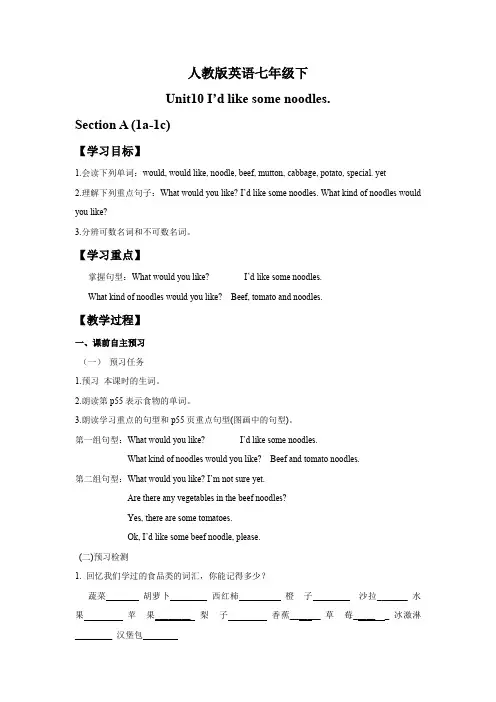
人教版英语七年级下Unit10 I’d like some noodles.Section A (1a-1c)【学习目标】1.会读下列单词:would, would like, noodle, beef, mutton, cabbage, potato, special. yet2.理解下列重点句子:What would you like? I’d like some noodles. What kind of noodles would you like?3.分辨可数名词和不可数名词。
【学习重点】掌握句型:What would you like? I’d like some noodles.What kind of noodles would you like? Beef, tomato and noodles.【教学过程】一、课前自主预习(一)预习任务1.预习本课时的生词。
2.朗读第p55表示食物的单词。
3.朗读学习重点的句型和p55页重点句型(图画中的句型)。
第一组句型:What would you like? I’d like some noodles.What kind of noodles would you like? Beef and tomato noodles.第二组句型:What would you like? I’m not sure yet.Are there any vegetables in the beef noodles?Yes, there are some tomatoes.Ok, I’d like some beef noodle, please.(二)预习检测1. 回忆我们学过的食品类的词汇,你能记得多少?蔬菜胡萝卜西红柿橙子沙拉_______ 水果苹果________ 梨子香蕉_______ 草莓_____ _ 冰激淋_______ _ 汉堡包2. 写出关于食品的新单词.面条羊肉牛肉卷心菜马铃薯豆腐3. 将上面1、2小题的单词按要求分类:Countable noun可数名词:Uncountable noun不可数名词:Countable and uncountable noun既是可数名词又是不可数名词:4.难点释疑:What would you like ?你想要什么?Would like 意为“想要”,与want同义,表示意愿,但语气比want婉转。
人教版七年级英语下册Unit10SectionA(2a2d)优秀教学案例
1.教师引导学生对自己的学习过程进行反思,总结自己在学习一般过去时态中的优点和不足。
2.设计自我评价表,让学生对自己的学习成果进行评估,提高他们的自我认识和自我改进能力。
3.教师对学生的学习过程和成果进行评价,及时给予肯定和鼓励,增强他们的学习动力。
4.利用同伴评价和小组评价,让学生互相评价和学习,培养他们的评价能力和尊重他人意识。
四、教学内容与过程
(一)导入新课
1.利用多媒体手段,如图片、视频等,展示过去和现在的生活场景,引发学生的共鸣,激发他们对一般过去时态的兴趣。
2.向学生提出问题,如:“你们还记得小时候的一些有趣的事情吗?”引导学生思考和讨论过去的事情,为新课的导入做好准备。
3.教师简要介绍一般过去时态的概念和用法,引发学生的兴趣和好奇心。
(二)讲授新知
1.教师通过示例和讲解,详细解释一般过去时态的构成、疑问句和回答等知识点。
2.用生动的例句和情境,让学生理解一般过去时态的用法,如:“昨天我去了公园,玩得很开心。”
3.通过互动式教学,让学生参与课堂活动,如:填空练习、翻译练习等,巩固他们对一般过去时态的理解。
4.教师引导学生进行句子构建练习,让学生运用一般过去时态描述过去发生的事情。
4.创设互动式的课堂氛围,鼓励学生提问、回答问题,增强他们的参与感和主动性。
(二)问题导向
1.设计具有启发性和引导性的问题,引导学生思考和探索一般过去时态的用法和意义。
2.通过问题链的形式,引导学生逐步深入探究一般过去时态的构成、疑问句和回答等知识点。
3.鼓励学生主动提出问题,培养他们的问题意识和解决问题的能力。
在整个教学过程中,我注重发挥学生的主体作用,鼓励他们积极参与课堂活动,培养他们的自主学习能力。同时,我运用多样的教学手段和评价方式,对学生的学习过程进行有效监控和反馈,确保他们能够扎实掌握学生能够掌握一般过去时态的构成和用法,理解一般过去时态的疑问句和回答。
人教版英语七年级下册-Unit 10 Section A(1a-~2d)教案
Unit10 《I’d like some noodles.(1a-2d)》该单元总课时总4课时,以第1课时为例翻转课堂。
一、学习内容分析本单元以“食物”为谈话主题,学生们将学习用英语询问他人喜欢的食物以及谈论自己喜欢吃的食物。
在上学期学生已经学会了可数名词、不可数名词的用法,并掌握了一定的蔬菜和肉类的词汇,为本课的学习奠定了基础。
本部分主要学习各种食物名称和点餐的基本表达。
1a-1c部分首先通过图文展现了在餐馆里点餐的场景,并根据这一场景的特点呈现各种常见的食物名称,输入与点餐相关的核心句型。
2a-2d则在巩固1a-1c的词汇和句型基础上,增加了更为丰富的语言输入,不仅谈论食物种类,还涉及中餐里常见的“大份、中份、小份”的词汇和语言表达等。
通过这些听说活动,学生要学会在相应的语境中运用核心句型和重点词汇进行初步的口头语言输出。
二、学习目标分析1. 知识目标:运用下列词汇、短语和句型并能够识记。
词汇、短语:noodle,mutton,beef,potato,special,would,yet,order,bowl,size,large, would like,take one’s order,one(large)bowl of句型:What kind of noodles would you like? I’d like beef noodles,please.What size would you like? I’d like a large bowl,please.Would you like a large bowl? Yes,please.Is there any meat in the tomato and egg soup?No,there isn’t any./No,there’s no meat.2.能力目标:学会描述食物,会以“食物”为话题的角色表演,充分展示自我。
3. 情感目标:让学生在交流中学会热情好客,礼貌待客,培养乐于助人的良好品质。
人教版英语七下Unit 10 Section A(2a-2d)集体备课教案设计
Step3 Listening
1.Listen to 2a and check the food you hear.
2.Go through the sentences in 2b.
3.Listen and finish 2b. Check the answers.
_____________________________________________
III【当堂检测】:
I、找朋友
( )1. Iwould likea cup of tea.
A. likeB. want C. have
( )2.Chinais alargecountry.
A. very big B. very small C. not big or small.
集体备课教案
年级: 七 科目:英语
首备人
刘珍
复备人
课型
听说课
课时编号
2
授课人
授课时间
授课班级
备课组
初一英语
课题
Unit 10 I’d like some noodles.
Section A 2a — 2d (P56)
二次备课
学习
目标
继续学习如何预定食物,并会表达自己的喜好和选择。
--May I take/ have your order?
( )3. --What would you like?
-- A cup ofjuice, please.
A. a kind of foodB. a kind of vegetables
人教版英语七年级下册-Unit 10 Section A(2a--2d)教案
S1:I’d like chicken, potato and cabbage noodle.
S2: What size bowl of noodles would you like?
S3:I’d like a medium bowl of noodles.
Sentences :
-What kind of noodles would you like ?
-I’d like beef and tomato noodles,please .
-What size bowl of noodles would you like?
- I’d like a large/ medium/ small bowl of noodles, please.
Step II Revision and presentation
1.Revision
Look at the pictures of delicious food, and ask students to practice the conversation.
A: What would ou like?
15.Sally and Tom are hungry.They come to this restaurant and order the food.Listen tothe conversation in 2d, and check their food.
16.Check the answer.
B: I’d like….
C: What would he / she like?
D: He / She would like….