
外研版八上 Module 10 Unit 1 It might snow教案
Unit 1 It might snow教学内容:Unit1 It might snow.课型:Listening and speaking教学目标:能够正确使用下列单词和词组:cloud, shower, snow, storm, cloudy, rainy, snowy, sunny, windy, skate, thick, ice, joke, might, temperature, minus, degree, although, wet, terrible, wish, probably, come on.能正确使用下列句型:1.Are you joking?2. Sounds great!3. Me neither.e on, better get going!5. What’s the temperature?6. It’s probably sunny and hot there.7.Rainy weather is terrible!8.I like sunny weather ,and I like snow as well.9. What’s the weather like in America in winter?能够听懂谈论天气的谈话并完成相关的听力任务。
4、能用有关天气的名词或形容词、情态动词及询问天气的句型谈论天气。
5、通过对本单元的学习,了解各种气象,培养学生爱护和保护环境良好品德。
教学重难点:能够熟练运用有关天气的名词或形容词及情态动词谈论天气。
教学准备:课堂整体运用任务型教学模式,培养学生独立自主的学习能力。
本课指导学生通过听说获取信息,培养学生的听说技能。
在教学过程中,采用多媒体手段辅助教学,利用各种图片、实物和习题任务贯穿整个教学过程。
因此,本节课需准备:PPT课件、挂图、录音机、实物、课堂练习表格、奖品教学过程:教学步骤教师活动学生活动设计意图Step One Warming-up (3’)Warming-up1. Have the students see aflah:How is the weather?Free talk: “ What’s theweather like today? Do youlike cold weather? ”1. See a flah:How is theweather?2. Free talks about weather.让学生通过看一个关于天气的flash,进行课前热身,从视觉和听觉方面刺激学生思维,活跃了课堂气氛。
以旧引新,先引导学生进入新的模块内容,训练了学生的反应的同时又引入了新单词。
玩有关天气的Step Two Pre-task (5’)1 .Play a game :brain stormabout weather.Show themsome pictur es about weatherand have the students sayout the words.Show students somepictures of new words andlearn the new words.Have the students listenand check the correctinformation in the table inActivity 2.Have the students work inpairs.Listen again andcorrect the wronginformation in the table inActivity 2.Work in pairs ,ask andanswer like this about thetable1. Look at the pictures and saythe words of weather.2. Look at the pictures andlearn the new words.3.Listen and check the correctinformation.4 Listen again and correct thewrong information in the tablein Activity 2 in pairs.Talk about the weather in thetable like this:A:What’s the weather likein…? B:It’swindy\cloudy\snowy…A: What’s the temperature?B: …头脑风暴游戏,活跃了课堂气氛的同时也让学生复习了学过的单词。
引导学生谈论图片,训练学生描述事情的能力。
在描述的同时学习新单词和句型,做到词不离句,为学生扫清听的障碍。
通过听两遍及完成两个听力任务,培养学生听取细节的能力。
先听后说,让学生跟同伴用询问天气的句型谈论表中城市的天气,巩固句型和词语。
Step Three While -task (24’)1. Listen and answer:Have the students listen tothe tape and complete thesentence:①What’s the temperature?It’s between minus ___andminus_____degrees!②It is ____ in winter and____ in summer in America.2.Listen and read:Have the students listenand read the dialogue bythemselves and check thetrue sentences in Activity4.Then check their answersin pairs, then in class.1.Listen and complete thesentence:What’s the temperature?①It’s between minus ___andminus_____degrees!②It is ____ in winter and ____in summer in America.2.Listen and read and check theanswers in pairs. Correct thewrong sentences as well .让学生带着问题去听课文,让学生从听觉上对课文有初步的理解,同时培养学生通过听获取细节信息技巧。
让学生通过听和跟读课文纠正自己的语音并且进一步熟悉课文内容后check 正确的句子并且更正3.Read and rememberAsk students to read the dialogue in groups and try to find out some important language points by th emselves then help them solve the difficult points if necessary.4. Act out the dialogue. 3. The students read thedialogue in groups and find outthe import language points.4. Read the dialogue in groupsand then ask several groups toact out the dialogue in class.错误的句子,培养了学生通过读获取细节信息能力。
通过小组活动提高学生间的自主、合作学习,让学生充分地实践运用语言,并激发学生创造性思维的发展。
Step Four Post- task (10’)plete the passage.Let the students completethe passage with the wordsin Activity 1(Activity 5).2.Make a weather forecast.Give the students somepictures about the weatherin different cities inChina. In groups ,ma ke aweather forecast..1. Complete the passage ofActivity 5 and ask 2 volunteersto say out their answers.2. Make a weather forecast ingroups. Use thesent ence :It’llprobably …Then choose the best“weatherman”.让学生根据自己的实际完成文段,并学会如何正确表达自己关于各项球类运动的情况的同时也了解他人的情况。
通过小组的活动,让学生做天气预报员,充分地实践运用语言,并无形中突破了本课的难点。
Step Five Summary (2’)1.Get the students sum upthe language points.T: What have we learnedtoday?Ss:……2.Let the students choosethe best team in thislesson.1.Sum up the language points.2.To choose the best groups.引导学生对这节课的总结,让学生做自由发言,培养学生自主学习,自主总结的良好学习习惯。
简短的评价使学生的课堂表现得到肯定并且可以激励学生的学习兴趣,树立学习英语的信心。
Step Six Home- work (1’)1. Complete the sentenceswith the words in thebox(Activity4).Finish the homework. 课后作业有助于学生巩固和运用已学的知识。
七、板书设计:Book 3 Module10 The weatherUnit1. It might snow.1.Are you joking?2. Sounds great!3. Me neither.e on, better get going!5. What’s the temperature?6. It’s probably sunny and hot there.7.Rainy weather is terrible!8.I like sunny weather ,and I like snow as well.9. What’s the weather like in America in winter?达标训练题一、根据句子意思,用适当的词填空:1) It rains a lot in summer in Beijing. It’s often ________.2) There’re a lot of clouds. It’s _________.3) The weather is snowy and there’s a lot of __________ in the park.4) The sun is out. It’s very ____________ and hot today.5) The wind is very strong. It’s so __________ that it’s difficult to walk.二、选择正确的答案:( ) 1. - ________? I t’s cold.A.What’s the weatherB.What’s the weather likeC. How’s weatherD. How’s the weather like( ) 2. - I don’t like rainy weather. -________.A. I don’t like,too.B. Are you joking?C. Me neither.D. Sounds great!( ) 3. It’s very cold and cloudy. It might _____tomorrow.A. snowB.snowedC. snowyD. snowing( )4. — Where are you going thisweekend?.— I’m not sure.I ______go to the zoo.A. canB. mayC. needD. must( )5. She likes red and green _______.also B. either C. neither D.as well。
2019秋外研版八年级英语上册教案:Module10Unit1Itmightsnow

Байду номын сангаас五、教学反思
在今天的教学中,我尝试了多种方法来帮助学生理解和掌握Module 10 Unit 1 "It might snow"这一章节的内容。首先,通过提问学生在日常生活中预测天气的经历,我发现学生们对这个话题非常感兴趣,这为接下来的学习营造了一个积极的学习氛围。
在讲授一般将来时和情态动词预测的理论知识时,我注意到学生们对于“might”和“may”的用法区分存在一些困难。我采用了大量的例句和对比练习,希望这样能够帮助他们更清晰地理解这两个词的用法差异。在接下来的实践活动中,我让学生们分组讨论并进行了角色扮演,这样他们能够在实际语境中运用所学的知识。
3.成果展示:每个小组将向全班展示他们的讨论成果和角色扮演的结果。
(四)学生小组讨论(用时10分钟)
1.讨论主题:学生将围绕“天气预测在实际生活中的应用”这一主题展开讨论。他们将被鼓励提出自己的观点和想法,并与其他小组成员进行交流。
2.引导与启发:在讨论过程中,我将作为一个引导者,帮助学生发现问题、分析问题并解决问题。我会提出一些开放性的问题来启发他们的思考。
3.重点难点解析:在讲授过程中,我会特别强调一般将来时的用法和情态动词“might”与“may”的区别。对于难点部分,我会通过举例和比较来帮助大家理解。
(三)实践活动(用时10分钟)
1.分组讨论:学生们将分成若干小组,每组讨论一个与天气预测相关的实际问题。
2.实验操作:为了加深理解,我们将进行一个简单的角色扮演活动,模拟天气预报员预测天气。
外研版八年级上册Module 10 Unit1 It might be snow 教案
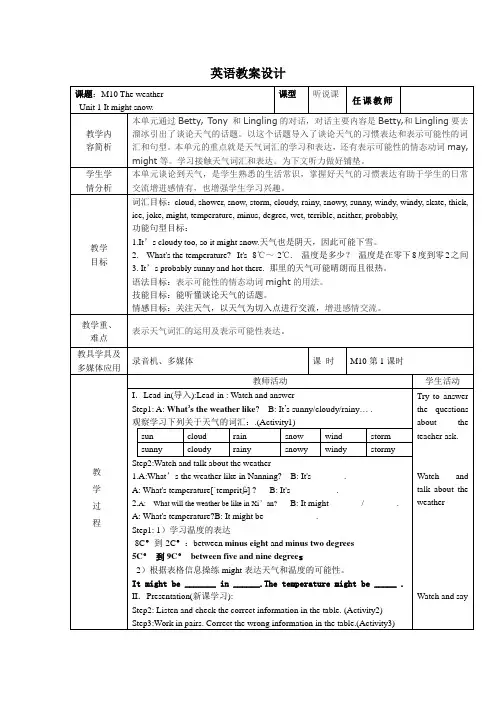
It might be _______ in ______.The temperature might be _____ .
II.Presentation(新课学习):
Step2: Listen and check the correct information in the table. (Activity2)
Step3:Work in pairs. Correct the wrong information in the table.(Activity3)
Step4:Listen and read.(Activity4)
Check (√) the true sentences.
1. Tony and Daming are going to skate.
IV .Summary:
1.Everyday English(日常用语)
1.Are you joking?你是在开玩笑的吧?2. Sounds great!听起来不错!
3. Me neither!我也不。4. I like sunny weather.我喜欢阳光明媚的天气。
2.Key sentences(核心句子):
6. Tony does not like windy weather.
Step5: Read theconversationloudly!
III.Exercises:
1.Fill in the blank(补全对话)
A:Betty and Lingling,Where are you going?
功能句型目标:
1.It’s cloudy too, so it might snow.天气也是阴天,因此可能下雪。
Module10Unit1Itmightsnow.教案-2020年秋外研版八年级英语上册

(三)实践活动(用时10分钟)
1.分组讨论:学生们将分成若干小组,每组讨论一个与天气预报相关的实际问题,如如何为周末的户外活动准备合适的衣物。
2.实验操作:为了加深理解,我们将进行一个简单的角色扮演活动。学生们将模拟天气预报员,使用一般将来时态和所学词汇来预报天气。
在课堂管理方面,我注意到在小组讨论时,部分学生可能会稍微偏离主题。为了提高讨论效率,我将在以后的课程中明确讨论规则,并提供更具体的讨论指导。
Module 10 Unit 1 It might snow.教案-2020年秋外研版八年级英语上册
一、教学内容
《Module 10 Unit 1 It might snow.》为本教案的核心内容,选自2020年秋外研版八年级英语上册。教学内容主要包括以下几部分:
1.本单元的核心词汇和短语:weather forecast, snow, rain, cloudy, sunny, windy, might, perhaps, definitely等。
(二)新课讲授(用时10分钟)
1.理论介绍:首先,我们要了解一般将来时态的基本概念。一般将来时态是用来描述未来发生的事情或预测未来状况的时态。它在日常交流中非常重要,尤其是在谈论天气、计划等话题时。
2.案例分析:接下来,我们来看一个具体的天气预报案例。这个案例展示了如何使用一般将来时态来描述未来天气,以及它如何帮助我们了解和规划日常活动。
本节课将围绕以上内容,结合实际教学活动,提高学生对英语天气表达和一般将来时态的理解和应用能力。
二、核心素养目标
外研版英语八年级上册 Module 10 unit 1-教案
Unit 1 It might snow1.能掌握并准确运用本单元的重点单词和短语:cold snow storm cloudyrainy snowy windy skate probably2.能读懂并了解有关天气的对话。
能根据所学谈论天气。
教学目标教学重点教学难点1.掌握并准确运用本单元的重点单词和短语。
读懂并了解有关天气的对话。
1.句子W hat’s the weather like?/What’s the temperature?根据所学谈论天气。
学生经过一年多的学习,有了一定的英语基础知识和听说能力,正逐渐向读、学情分析写过渡。
经过一年的新课程理念的熏陶及实践,有了初步的自主、合作、探究、实验的能力。
本单元采用了交际对话的形式来进一步练习学生们的听说能力,为下一单元的读写作铺垫。
课前已安排学生了解和搜集有关天气的词语和句子。
学法指导Listening, speaking and writing教学过程效果预测教学内容教师活动学生活动(可能出现的问题)一、Lead in.1.提问一些有关1.找出与天1.同补救措施1.增说出一些有关天气天气的形容词,待学的形容词,了解后并提问生了解后并提问What’s the weather like?What’s the weather进一步提出What the like?进一步提出weather might/may be What the weatherlike?引出本课。
二、听对话,回答下列两个问题。
might /may be like?引出本课。
2.播放听力,给出两个问题,练习同气有关的形容词,学们能够加对话的回答What’s theweather like?/What the weather掌握与天练读。
气有关的形容词,并might /may be like?能回答出两个问题。
2.听听力,回答问题。
一些简单的提问,但在描述气温时可能1.What’s the 学们的听力。
外研版八年级英语上册教案 Moddule 10 Unit 1
Module 10 The weatherUnit 1 It might snow.一、教学目标1. 掌握词汇:cloud, shower, snow, storm, cloudy, rainy, snowy, sunny, windy, skate, thick, ice, joke, might, temperature, minus, degree, although, wet, neither, terrible, wish, probably, come on2. 掌握句型:(1) What’s the temperature?(2) It’s between minus eight and minus two degrees!(3) Most Decembers are wet and rainy.(4) Not usually, although this year it snowed quite a lot.3. 能够听懂谈论天气的对话。
4. 能够谈论,描述天气情况。
5. 能够了解语调在口语表达中的重要作用。
6. 能够正确运用表示可能性的单词和句型。
7. 能够通过了解天气情况,培养学生对学习地理知识的愿望和兴趣。
二、教学重点及难点重点:掌握表示天气的词汇的用法。
难点:掌握表示天气和可能性的句型。
三、教学准备1. 多媒体设备和课件;2. 设计课后巩固练习;3. 教学图片。
四、教学过程Step 1 Warming-upLook at the pictures and talk about the weather.T: Boys and girls, you know weather has an important effect on our lives. If we’re planning a trip or getting dressed in the morning, we always have to know what the weather will be like. Look at the pictures. What’s the weather like?S: It’s sunny.S: I t’s cloudy.S: It’s raining....【设计意图】通过多媒体屏幕向学生展示表示天气的单词,非常直观明了,易于帮助学生加深记忆。
外研八上M10U1 It might snow教案
Module 10 The weatherUnit 1 It might snow.教学目标【知识目标】1、能够正确使用以下单词和词组:cloud, shower, snow, storm, cloudy, rainy, snowy, sunny, windy, skate, thick, ice, joke, might , temperature, minus, degree, although, wet, terrible, wish, probably, come on.2、能正确使用以下句型:1. Are you joking?2. Sounds great!3. Me neither.4. Come on, better get going!5. What’s the temperature?6. It’s probably sunny and hot there.7. Rainy weather is terrible!8. I like sunny weather, and I like snow as well.9. What’s the weather like in America in winter?【能力目标】1、能够听懂谈论天气的谈话并完成相关的听力任务。
2、能用有关天气的名词或形容词、情态动词及询问天气的句型谈论天气。
【情感态度目标】通过对本单元的学习,了解各种气象,培养学生保护和保护环境良好品德。
教学重难点【教学重点】能够熟练运用有关天气的名词或形容词及情态动词谈论天气。
【教学难点】熟练运用may和might。
教学过程Step 1 Warming upWeather report:1) Show some pictures of the weather.2) Ask and answer: What's the weather like in …?Step 2 Work in pairs.1. Show some pictures of the weather. Ask the students to talk about the weather.2. Introduce the new words.1) sun n.太阳→ sunny adj.晴朗的2) rain n.雨→ rainy adj. 多雨的;下雨的3) cloud n.云→ cloudy adj. 多云的4) snow n.雪;v. 下雪→ snowy adj.多雪的;下雪的5) wind n.风→ windy adj.多风的;刮大风的6) storm n. 暴风雨→ stormy adj.有暴风雨的7) shower n. 阵雨;→ showery adj.有雷阵雨的3. Learn the new words.4. Read the new words.5. Exercises:边学边练:根据句子意思,用适当的词填空:1) It rains a lot in summer in Beijing. It’s often ________.2) There’re a lot of clouds. It’s _________.3) The weather is snowy and there’s a lot of __________ in the park.4) The sun is out. It’s very ____________ and hot today.5) The wind is very strong. It’s so __________ that it’s difficult to walk.6. Ask the students tocheck with a partner.7. Check the answers:Keys: 1. rainy 2. cloudy 3. snow 4. sunny 5. windy8. Learn the new words.Step 3 Listening1. Listen and check ( √ ) the correct information in the box.2. Ask and answer like this:What’s the weather like in Beijing / Shanghai …?3. Play the recording and ask the students to listen to the recording carefully.4. Listen and check ( √ ) the correct information in the box.5. Ask the students to check their answers with a partner.6. Call back the answer from the whole class and check the answer.7. Work in pairs. Correct the wrong information in the table.Step 4 Listen and read.1. Show some pictures, and ask the students to talk about them.2. Ask the students to read the conversation silently.3. Play the recording and ask the students to listen and read the conversation.4. Read the conversation.Step 5 Check ( √ ) the true sentences.1. Ask the students to read the conversation again.2. Now check ( √ ) the true sentences.1) Tony and Daming are going to skate.2)Winter is colder in Beijing than in England.3)It sometimes snows in England in winter.4)It usually snows in New York in winter.5)It is not hot in the US in summer.6)Tony doesn’t like windy weather.3. Ask the students tocheck with a partner.4. Check the answers:Keys:1. ×2.√3.√4.√5. ×6.√Step 6 Complete the passage.1. Ask the students to complete the passage with the words in the box.2. Check with a partner.Keys: 1. skate 2. may 3. temperature 4. minus 5. degree 6. dangerous 7. joking 5. Read the passage by yourself.Step 7 Listen and repeat.1. Play the recording once without stopping.2. Play the recording again and ask the whole class to repeat.3. Listen to the speaker asking a question.What’s the weather like?4. Now listen to the speaker showing surprise.What’s the weather like?5 Listen and write *if the speaker is asking a question or **if he is showing surprise.Step 8 Language points1. 问气温:—What’s the temperature? 气温怎么?—It’s between minus five and minus two degrees! 零下5度到零下2度之间。
外研版八年级英语上册Module 10 unit1 It might be snow 教案_1
外研版八年级英语上册Module 10 unit1 Itmight be snow 教案教材版本:外研版(新标准2023)八年级上册教学内容:Module10 Unit1 It might snow.授课教师:单位:教学目标:1.To know the signs of weather in English.2.To master the description of the weather:sunny 、cloudy 、rainy、snowy、showery、temperature、degree 、probably.3.To understand the conversation about weather4.To use the words and expressions to report weather学情分析:学习者是八年级的学生。
本节课的内容是Module10 The weather的第一单元,课型为听说课。
因七年级时学生们有接触过一些有关天气的简单表达方式,比如描述季节和天气状况的词汇:(warm, hot, cool, cold, spring, summer, autumn, winter, what's the weather like ),所以会很容易进入主题。
但同时对英文的天气预报不太熟悉。
本节课会扩充有关天气的词汇,进一步帮助学生更好地掌握天气的习惯表达方式。
重点难点The important and difficult language points:1.To master the words and expressions about weather2.To know the rule how nouns about weather change to adjectives3.To be able to report the weather解决措施:利用电子白板和交互式多媒体教学系统插入图片,声音,视频等多种功能激发学生学习的兴趣,增强学生参与性,提高学生的自我主动学习能力。
八年级英语上册Module10TheweatherUnit1Itmightsnow教案(新版)外研版
Module 10 The weather一、学习目标:A. 单词和短语:cloud, shower, snow, storm, cloudy, rainy, snowy, sunny, windy, skate, thick, ice, joke, might, temperature, minus, degree, although, wet, terrible, wish, probably, come on, mile, northwest, umbrella, southeast, from time to timeB. 交际用语:1. You’re joking!2. Sounds great!3. Come on!4. When is the best time to visit your country?5. What clothes should she bring?6. What’s the temperature?7. Where are you going?8. It’ll probably be cold tomorrow.9. It might be rainy.10. It’s probably sunny and hot there.11. Bring a map because you may want to travel around.二、教学目标1. Function: Describing the weather.2. Structure: may, might, probably (for possibility)3. Skills:1) Listening and understanding familiar topics (weather).2) Giving weather forecast based on clues; predicting about future weather using probably.3) Reading and finding specific information.4) Writing a short passage about the best time to visit your town, using because, so andbut.4. Around the world: The wettest place5. Task: Preparing some advice on the best time to visit China三、重点及难点:1. Describing the weather.2. Grammar: The using of may, might, probably (for possibility)四、教学设计:Unit 1 It might snow.ⅠTeaching modelListening and speakingⅡTeaching methodInteractive approachⅢ Teaching aims1. To understand conversations about the weather;2. To get specific information from the listening material;3. To talk about possibilitiesⅣ Teaching Objectives1. Key vocabulary: cloud, shower, snow, storm, cloudy, rainy, snowy, sunny, windy, skate,thick, ice, joke, might, temperature, minus, degree, although, wet,terrible, wish, probably, come on2. Key structures: may, might, probably (for possibility)3. Key sentences:1) —What’s the temperature?—It’s between minus five and minus two degrees!2) —What’s the weather like in …? = How is the weather in …?—It’s snowy (cloudy, rainy, sunny, windy ...).3) … although this year it snowed a lot.4) Come on, better get going!5) It’s probably sunny and hot there.It’ll probably be cold tomorrow.ⅤTeaching aidsTape recorder, OHP, videoⅥ Teaching StepsStep 1 Warming upShow some pictures of the weather,and ask and answer:What kind of weather do you like?Step 2 Work in pairs.1. Show some pictures of the weather. Ask the students to talk about the weather.2. Introduce the new words.1) sun n.太阳→ sunny adj.晴朗的2) rain n.雨→ rainy adj. 多雨的;下雨的3) cloud n.云→ cloudy adj. 多云的4) snow n.雪;v. 下雪→ snowy adj.多雪的;下雪的5) wind n.风→ windy adj.多风的;刮大风的6) storm n. 暴风雨→ stormy adj.有暴风雨的7) shower n. 阵雨;→ showery adj.有雷阵雨的3. Learn the words and expressions.Step 3 Listening1. Listen and check (√) the correct information in the table.2. Ask and answer like this:What’s the weather like in Beijing / Shanghai …?3. Play the recording again and ask the students to listen to the recording carefully, thenfill in the blanks.What’s the weather like in Beijing?In Beijing, there will be ______ in the early morning, and it will be between __________ and _________ degrees.What’s the weat her like in Shanghai?Shanghai will be _____ and _____, and it will be between ____ and ____ degrees. What’s the weather like in Xi’an?Xi’an will be ______ and ______, and it will be between _______ to ___ degrees. What’s the weather like in Guangzhou?Guangzhou will be ______. There may be some _______, and the it will be between ____ and ____ degrees.4. Check the answers1. Play the recording and ask the students to answer the questions.1) Who wants to skate?2) What’s the weather like today?3) Where are they going to skate?2. Read and fill in the blanks.1) What’s the weather like in England in December?Not usually, although this year it ________ a lot. Most Decembers are _____ and ______.2) What’s the weather like in Eng land in America?It is ____ in winter and ____ in summer. It’s _______ in New York in winter.3) What’s the weather like in England in Australia in winter?It’s probably ______ and _____ th ere.4) What’s the weather like in Hainan Island?It’s ________.3. Read again and check (√) the true sentences.1) Tony and Daming are going to skate.2) Winter is colder in Beijing than in England.3) It sometimes snows in England in winter.4) It usually snows in New Yo rk in winter.5) It is not hot in the US in summer.6) Tony doesn’t like windy weather.4. Check the answers.Step 5 Language points1. 问气温:—What’s the temperature? 气温怎么?—It’s between minus five and minus two degrees! 零下5度到零下2度之间。
Module10unit1Itmightbesnow.教案外研版英语八年级上册
Objectives:By the end of this lesson, students will be able to:➢Use the modal verb “might”to express possibility.➢Recognize and describe different weather conditions.➢Use weather-related vocabulary in context.➢Ask and answer questions about the weather using “might.”Materials:✓Pictures or flashcards of different weather conditions✓Weather-related vocabulary cards✓Chart paper or whiteboard for brainstorming✓Handouts for practice activitiesWarm-up:1.Start the lesson by asking students what the weather is like today.Write their responses on the board.2.Show pictures of different weather conditions (e.g., sunny, rainy,snowy, windy) and elicit the names of each weather condition from the students.Introduction:1)Introduce the modal verb “might”to express possibility. Write“might”on the board and explain that it is used to talk about something that could happen or be true.2)Give examples using “might”to describe weather conditions, suchas “It might rain tomorrow”or “It might be sunny later.”Emphasize that “might”expresses uncertainty or possibility.Vocabulary:1.Introduce weather-related vocabulary words, such as rain, snow, wind,cloud, sunshine, storm, etc. Show pictures or flashcards of each word and have students repeat the words after you.2.Practice the pronunciation and spelling of each word with thestudents.Modeling and Guided Practice:1)Model a conversation with a student using “might”to ask andanswer questions about the weather. For example:●Student A: What’s the weather like today?●Student B: It might be sunny. I’m not sure.2)Have students work in pairs or small groups. Give them a list ofweather conditions and have them take turns asking and answering questions about the weather using “might.”3)Monitor the groups and provide assistance as needed. Encouragestudents to use the vocabulary words they have learned.Group Activity:1.Divide the class into small groups and give each group a piece ofchart paper or a whiteboard marker.2.In their groups, ask students to brainstorm different weatherconditions they know and write them on the chart paper or whiteboard.3.Have each group present their list of weather conditions to the class.Encourage students to use “might”in their descriptions, such as “It might snow in the winter,”or “It might be windy at the beach.”Independent Practice:1)Distribute handouts with sentences describing different weatherconditions. Ask students to complete the sentences using “might”and the appropriate weather vocabulary word. For example, “It ________ rain tomorrow.”2)Collect and review the completed handouts to assess students’understanding of using “might”to express possibility and describe weather conditions.Closing:❖Review the key points of the lesson, including the use of “might”to express possibility and the different weather vocabulary.❖Ask students to share one thing they learned about the weather and using “might”today.❖Assign any additional homework or extension activities related to weather or modal verbs, if desired.。
Module10TheweatherUnit1Itmightsnow.教案
(五)总结回顾(用时5分钟)
今天的学习,我们了解了一般将来时态和情态动词might的基本概念、重要性和应用。同时,我们也通过实践活动和小组讨论加深了对天气预报的理解。我希望大家能够掌握这些知识点,并在日常生活中灵活运用。最后,如果有任何疑问或不明白的地方,请随时向我提问。
-时态的掌握:一般将来时态对于学生来说是新知识,尤其是使用might进行委婉预测,学生可能难以区分和运用。
-口语表达:学生在口语交流中可能会出现语法错误,如时态混淆、动词形式错误等。
-听力理解:理解并准确获取听力材料中的天气信息,对于一些学生来说可能是一道"rainy"的意思,但在描述未来天气时可能会忘记使用"might",例如,应该使用"It might rain tomorrow"而不是"It rain tomorrow"。
实践活动环节,学生们在分组讨论和实验操作中表现出积极的参与态度。他们围绕天气预测这一主题展开讨论,不仅巩固了所学知识,还提高了口语表达能力。在讨论过程中,我作为引导者,及时发现问题并进行针对性指导,帮助学生更好地理解和运用一般将来时态和might。
然而,我也发现了一些不足之处。首先,部分学生对一般将来时态的掌握还不够熟练,容易在口语表达中出现时态混淆。在今后的教学中,我需要加强对这一知识点的复习和巩固。其次,在小组讨论环节,有些学生参与度不高,可能是因为他们对讨论主题不够感兴趣或自信心不足。针对这一问题,我将在接下来的课程中尝试引入更多贴近学生生活的讨论主题,提高他们的参与热情。
2.掌握一般将来时态的用法,特别是might表示预测的用法;