
高一英语unit4 earthquakes-discovering the useful structures
e.g.
But remember the one who loved you so true. 被修饰: 先行词 引导连接: 关系词 修饰(定语从句)
Guessof four and choose one of your classmates to describe; each member thinks of at least an attributive sentence to describe the person; show your sentences and the rest of the class guess who they are talking about.
Homework
Write a short passage (at least five sentences) describing yourself or one of your classmates. Try to use
attributive clauses.
Thank you!
“who”
1. The one million people of the city, who
thought little of these events, were asleep
as usual that night. (主语)
2. The number of people who were killed or
should write.(宾语)
Summary: 何时可以省略? 做宾语时可以省略
指人 that which who 指物 主语 宾语
√ × √ √ √
√ √
√ √ √ ×
√ √ √(口语) √
× ×
√
whom whose
定语
According to the pictures , create your own sentences with attributive clauses
Basic concept
The attributive clause: a sentence that is used
to modify a noun or a pronoun (the antecedent),
and this noun or pronoun will take up a certain
Unit4 Earthquakes
Discovering useful structures— the attributive clause
Listen to the song “red river valley” and fill in the blanks.
… the sunshine that has lighted my pathway awhile. Come and sit by my side if you love me. Do not hasten to bid me adieu. But remember the Red River Valley, and the one that has loved you so true. Just remember the Red River Valley, and the one who has loved you so true.
“that”
1. A huge crack that was eight kilometers long
and thirty meters wide cut across houses,
roads and canals. (主语)
2. The
book
that
I
bought
yesterday
is
interesting. (宾语) 3. Mark Twain is the writer that wrote The adventures of Tom Sawyer. (主语) 4. The girl that we saw yesterday is Jim’s sister. (宾语)
They are watering the They are two little boys. vegetable. lettuce.
They watering vegetables. The are vegetable is named
They are watering the They are two little boys vegetable which/that is who/that are watering called lettuce. vegetables.
An attributive clause could begin with a relative pronoun such as that, who, which, whose.
Find the sentences with attributive clauses from the reading passage, and classify them according to different relative pronouns.
He is a basketball player whose name means “bright”.
He is playing the violin which/that is brown.
It’s an animal that/which has long nose and big ears.
2. Workers built shelters for survivors whose
homes had been destroyed. (定语)
Add up: “whom”
1. The person to whom you just talked is Mr.
Li. (宾语)
2. Mr. Read is the professor to whom you
injured reached more than 400,000. (主语)
3. The army organized teams to dig out those
who were trapped. (主语)
“whose”
1. It was a city whose hospitals, 75%of its factories and buildings and 90% of its homes were gone. (定语)
“which”
1. It was felt in Beijing, which is more than two hundred kilometers away. (主语) 2. Another big quake which was almost as strong as the first one shook Tangshan. (主语) Add up: The fish which we bought were not fresh. (宾语)
人教版高中英语必修第一册 《Unit 4:Earthquakes》教案
人教版高中英语必修第一册 《Unit 4:Earthquakes》教案一、教学目标1.知识目标o学生能够掌握与地震相关的重点词汇和短语,如 “earthquake, ruin, destroy, rescue, shock” 等。
o学生能够理解并运用描述地震现象、危害和救援的句型和表达方式。
2.技能目标o学生能够听懂有关地震的简单对话和新闻报道,获取关键信息。
o学生能够阅读并理解关于地震的文章,分析文章结构和主旨。
o学生能够用英语简单讲述地震的相关知识和个人应对地震的措施。
o学生能够写一篇关于地震预防或救援的短文,表达自己的观点和建议。
3.情感目标o培养学生对自然灾害的认识和防范意识。
o激发学生的同情心和社会责任感,关注地震受灾地区和人群。
二、教学重难点1.教学重点o重点词汇和短语的记忆与运用。
o对课文中地震相关内容的理解和语言表达的学习。
o培养学生用英语描述地震和表达应对措施的能力。
2.教学难点o如何帮助学生理解地震的复杂科学原理和巨大危害,并能用英语进行准确描述。
o引导学生在写作中清晰、有条理地阐述地震预防或救援的观点和建议。
三、教学方法1.直观演示法:通过图片、视频等展示地震的场景和数据。
2.问题引导法:以问题为导向,引导学生思考和探究。
3.讨论交流法:组织学生讨论地震相关话题,促进学生之间的思想交流。
四、教学过程(一)导入(5 分钟)1.播放一段地震的视频片段,展示地震的破坏力。
2.提问学生:What do you see in the video? How do you feel about earthquakes?(二)词汇学习(10 分钟)1.呈现本单元的重点词汇和短语,结合地震的情景进行讲解。
2.通过词汇练习,如填空、选择等,巩固学生对词汇的理解和掌握。
(三)阅读前准备(5 分钟)1.让学生观察课文标题和图片,预测文章的主要内容。
2.提出一些引导性问题,如:What might the article talk about earthquakes?(四)课文阅读(15 分钟)1.学生快速阅读课文,概括文章的主旨。
高一英语的必修一Unit4Earthquakes课件.ppt
2020/3/2
What do you think of when you see the data?
2020/3/2
Wen chuan Earthquake
2020/3/2
Do you know another big earthquake happened in china?
3.Learn to protect ourselves if an earthquake happened.
2020/3/2
well
井
destroy 摧毁
crack
破裂 brick
砖
smelly
臭的 track
轨道
farmyard 农家 useless 无用的
pipe
管道 shock
震惊
million
Part 1: Para 1
Part 2: Para 2&3 Part 3: Para 4
2020/3/2
signs damage rescue
Careful reading
Task1. Read Part1 carefully and find out the proper information. Task2. Read Part2 to Para3 carefully first make a timeline and then fill in the blanks.
2020/3/2
2020/3/2
※ Don’t be nervous and
keep calm. ※ Don’t try to run out of
the classroom. ※ Protect your head by
《高中英语必修课件:Unit4Earthquakes》
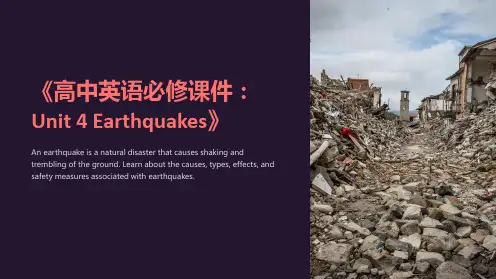
Earthquakes are common in subduction zones, where one tectonic plate is forced beneath another, causing intense pressure and potential release of energy.
2
Building Codes and Regulations
Enforce strict construction standards for buildings in earthquake-prone areas to ensure structural integrity and resistance to seismic forces.
Surface waves are slower than P
and S waves but cause the most
destruction. They move along the
Earth's surface and produce rolling
and shaking motions.
Types of Earthquakes
Magnitude
Each increase of one unit on the Richter scale represents a tenfold increase in the amplitude of ground shaking and approximately 31.6 times more energy release.
高中英语人教版必修一Unit4《Earthquakes》教案

Unit 4 Earthquakes1.Knowledge:Learn and master the new words and expressions in this period.Words:Ability:1.Train the students’ listening ability.2.train the students’ listening ability.3.Train the students’ ability to use the Internet to search for some usefulinformation.4.Train the students’ ability to cooperate with others.Emotion:1.Know the damage that an earthquake2.Know the ways to reduce the losses of an earthquake.Teaching important pointsTrain the students’ speaking ability by describing, talking and discussion. Difficulties:Train the students’ listening ability.Step1 Warming-upT:Do you know what happened in the Indian Ocean at the end of last year? It shocked or we can say frightened the whole world.S: A terrible tsunami broke out there on 26th December. More than 200 000 people were killed.T: Yes. It is said that it is the biggest in the fore decades. A tsunami is an undersea earthquake. Then have you heard of any land earthquakes? Would you please list some? 学.科.S: We can often hear that earthquakes occur in Japan. In 1906, an earthquake struck San Francisco, USA. About 700 people died in the earthquake and the fires. And as many as 250 000 people lost homes.T: But do you know any famous earthquakes that happened in our county?S: The Tangshan Earthquake that happened in 1976.T: Can you tell me what mighty happen in an earthquake? You may look at the two pictures on Page 25.Step 2 ListeningT: Before we learn the passage about an earthquake, let’s first know why there are earthquakes in the world. So let’s do some listening on Page 62. listen to the tape for the first time and try to get a general idea of the passage.Listen to the tape and check the answers.( It is about the cause of earthquakes and how we can reduce losses from them.)T: Listen to the tape for the second time and judge whether the statements in Part 1 are true of false.T: Let’s check the answers. Listen again and try to correct the statements that are false.T: Listen again and try to complete the table in Part 2.A few minutes later, check the answers. 学,科,网Z,X,X,K]Step 3 Homework1.Preview the reading passage on Page 26 and do exercise I in the part “Learningabout language”.2.Ask the to look for more ways of reducing losses from earthquakes. The studentscan go to the library or use the Internet to search for information. After searching for the information, each group should make a poster, informing people how to reduce the losses of an earthquake. 学_科_网Z_X_X_K]Record after teaching :_____________________________________________________________________ _____________________________________________________________________ _____________________________________________________________________ _____________________________________________________________________ _____________________________________________________________________ _____________________________________________________________________ _____________________________________________________________________ _____________________________________________________________________ _____________________________________________________________________The Second PeriodKnowledge:Learn some new, phrases and some new sentence patterns.Ability:1.learn some detailed information about an earthquake.2.improve the students’ reading ability.3.train the students’ ability to grasp key information while listening.4.train the students’ speaking ability.Emotion:1.Train the students’ ability to cooperate with others.2.Know the deadliness of an earthquake and the signs before an earthquake iscoming.3.Learn from the bravery of people in Tangshan to face the reality and rebuild thecity.Teaching important points:1 The new words and expressions.2. Learn some detailed information about an earthquake.3. Train the students’ ability to cooperate with others.4. Train the students’ speaking ability.Teaching difficulties:1 Words: shake, burst, rise, destroy, shock, fresh, injure2. Phrases: right away, at an end3. Sentence patterns:(1) It seemed/ seems that…(2) The number of sb./sth. Reached/reaches…(3)All hope was not lost.4. Improve the students’ reading ability.5. Train the students’ ability to grasp key information while listeningTeaching procedures:Step 1 Pre-readingT: Suppose you are warned of a coming earthquake. Now you have time to take only one thing. Tell your partner what you will take and the reason.T: If an earthquake is around the corner, there must be some abnormal phenomena. Carefully look at the four pictures on Page 25 and try to describe what you have seen. Step2 ListeningT: Everyone knows that an earthquake is very terrible. Today, we will learn something about the strongest earthquake in China’s history, which happened in Tangshan, Hebei, in 1976. First listen to the tape with your textbooks closed and check whether the following statements are true or false. If it is false, try to correct it.1.People in Tangshan were warned of the earthquake and didn’t go to bed that night.(F)2.People in Beijing also felt the earthquake. (T)3.More than 400 000 people were killed in the quake. (F)4.Many rescue workers and doctors were trapped under the ruins during theaftershock. (T)5.People tried to get fresh water from under the ground in Tangshan. (F)Step 3 Reading1.Finish Part 1-2 in Comprehending on Page 27.2.Finish Part 3 in Comprehending on Page 27.3.Read the passage again to get important information about Tangshan Earthquakeand fill in the blanks. ( 百思英语Page 44 )Step 4 Speaking or Reading aloudIf your students are good at English, ask them to do this exercise:Suppose one of you was a newspaper reporter, and the other was a witness of the 1976 Tangshan Earthquake. Now the newspaper reporter is asking the witness some questions. Work in pairs please.If your students are very poor in English, ask them to do this exercise:Play the tape for the students to listen and follow in order to let them know how to read the text.Step 5 Homework1.Read the text several times.2.Do exercise 3 on Page 28.3.Do exercise 2 on Page 28 in the exercise book and hang it in tomorrow.4.Learn some words and phrases in this unit and make some sentences with them.( Ss’ Book, Page 82-84)Record after teaching :_____________________________________________________________________ __________________________________________________________________________________________________________________________________________ ____________________________________________________________________ _____________________________________________________________________ _____________________________________________________________________ _____________________________________________________________________ _____________________________________________________________________ _____________________________________________________________________ _ZxxkThe Third PeriodKnowledge:1.words: crack, burst, ruin, injure, destroy, shock, last2.phrases: at an end, right away, dig out3.sentence patterns:All hope was not lost.Ability:1.Train the students’ ability to read different numbers in English.2.Learn the usage of some difficult words and expressions.3.Train the students’ ability to remove the difficulties while reading.Emotion:1.Train the students’ ability to cooperate with others.2.Know the deadliness of an earthquake and the signs before an earthquake iscoming.3.Learn from the bravery of people in Tangshan to face the reality and rebuild thecity.Teaching important points:1.Train the students’ ability to read different numbers in English.2.Train the students’ ability to cooperate with others.Teaching difficulties:1.The explanation of some difficult words and expressions.2.Train the students’ ability to remove the difficulties while reading.Teaching procedures:Step 1 Revision1.T: In the last period , we learned something about the terrible Tangshan Earthquake in 1976, which is the deadliest earthquake in China’s history. Now I am going to ask you some questions based on the Reading passage.(1)What did people in Tangshan see in the sky before the earthquake? 学|科|(2)What did people notice in the wells?(3)Did people pay any attention to these abnormal phenomena?(4)When did the earthquake begin?(5)Were there any aftershocks?(6)Did the survivors deny the city and go to live in other places?2. Check the homework (Ex2 on P28). Ask them to recite it after class.Step 2 Learning about NumbersTurn to Page 28 and look at Part 3. Match each word to the number that has the same meaning. Allow the students several minutes to finish the task. Check the answers. Step 3 Important pointsAsk the students to turn to Page 82. Ask some students to make some sentences with the words or phrases. Deal with some difficulties. You can add more phrases.Step 4 homeworkIn order to master the usage of these words and expressions, please do some related exercises.1.Finish off the two parts in Using Words and Expressions on Page 63.2.Translate the sentences on Page 63 into English. Write the English sentences inone of your exercise book and hand it in tomorrow.Record after teaching :_____________________________________________________________________ _____________________________________________________________________ _____________________________________________________________________ _____________________________________________________________________ _____________________________________________________________________ _____________________________________________________________________ _____________________________________________________________________ _____________________________________________________________________ _____________________________________________________________________The Fourth PeriodKnowledge: ZXXK]1.Learn the Attributive Clause.2.Learn the difference between Relative Pronouns for the Attributive Clauses. Ability:1.Learn to choose the correct Relative Pronouns for the Attributive Clauses.2.Train the students’ ability to report what others have said.Emotion;Train the students’ ability to cooperate with each other.Teaching important points:1.Learn the Attributive Clause.2.Train the students’ ability to report what others have said.Teaching difficulties:Learn to choose the correct Relative Pronouns for the Attributive Clauses.Teaching procedures:Step 1 revisionCheck the homework exercises.Step 2 Grammar( The teacher writes the sentence “ Workers built shelters for survivors whose homeshad been destroyed.” On the blackboard before class begins.)T: Please look at the sentence on the blackboard, paying special attention to the underlined part. What kind of clause is it?Ss: The Attributive Clause.T: Yes. The Attributive Clause tells us which person or thing (or what kind of person or thing ) the speaker means.e.g. The woman who lives next door is a teacher.A sen tence with an attributive clause contains two shorter sentences. In the sentence above, the two short sentences are: “The woman is a teacher.”And “The woman lives next door.” The Attributive Clause is the answer to the question: Which woman is a teacher?Would you try to divide the sample sentence on the blackboard into two short sentences?T: That’s right. Now try to find all the sentences with Attributive Clauses in the reading passage and divide each sentence into two short sentences.T: Next I will say s omething about the common relative pronouns.“Who”is used for people. “Which”is used for things. “That” is used for things or people. “Whose” is used instead of his/her/their/somebody’s. “Whom” is quite formal, and in most cases it is all right to use who instead. But when whom has a preposition before it, it cannot be replaced by who.Ste p 3 Practice1. Now look at Part 2 in Discovering Useful Structures on Page 28. try to complete each sentence using that, which, who, or whose.Let the students do this exercise and check the answers.2.Do more exercises in Ex 3 on Page51 in《导学》Step 4 HomeworkAfter class, read the passage on Page 64. It’s about advice on how to protect your home from an earthquake. Complete the sentences below, using who, whom, which, that or whose.Record after teaching;_____________________________________________________________________ _____________________________________________________________________ _____________________________________________________________________ _____________________________________________________________________ _____________________________________________________________________ _____________________________________________________________________ _____________________________________________________________________ _____________________________________________________________________ _____________________________________________________________________ .The Fifth PeriodKnowledge:1.Know how to write a speech.2.Know how to write a newspaper story.Ability:1.Train the students’ speaking ability.2.Train the students’ ability to search for doing something.3.Train the students’ ability to do things step by step.Emotion:1.Honor the great people of Tangshan.2.Learn to cooperate to each other.Teaching Important Points:1.Train the students’ speaking ability.2.Train the students’ ability to search for doing something.Teaching Difficulties:1.Know how to write a speech.2.Know how to write a newspaper story.3.Learn to cooperate to each other.Teaching Procedures:Step 1 RevisionT: In the last period, we learned the Attributive Clause and how to choose a proper relative pronoun. Now let’s check your homework exercises. Please open your textbooks and turn to Page 64. Look at Part 1 in Using Structures. I will ask some of you to read the sentences out.(The teacher corrects mistakes if there are any.)Step 2 Readi ng and WritingT: Read the letter on Page 29.In the blank at the beginning of the letter, write the last number of the year it is now. Then in the blank near the end of the letter, use a number to say how many years ago the quake happened.(After several minutes, the teacher checks the answers with the class.)T: Suppose you are the student who was invited to give the speech. What should you include in your speech?(Students give their different answers.)T: Y es, while writing, don’t forget to contain the information. Now I will give you 15 minutes to write the speech. You can follow the points in part 3 on this page. (While the students are writing, the teacher gets around the classroom and helps the students to deal with any difficulties that they have.)(After 15 minutes)T: Are there any volunteers to read his or her speech?( If there is nobody, the teacher asks one to read, and give some assessments.)Step 3 SpeakingT: Imagine that after your speech, Zhangsha asks you to give a short talk about the new stamps about Tangshan to honor the city. First, ask and answer the following questions in pairs.(1)What do these stamps show?(2)Do you think these stamps are very important and why?(3)Will you collect these stamps? Why and why not?(After the students ask and answer these questions in pairs.) 学科T: Now try to fill in the lines in the little talk. You can use some of the answers to the questions.T: Next I will ask one of you to read the little talk.Step 4 WritingT: By now you have learned writing a speech and a little talk. Now you are going to write an article for a newspaper about a special event that happed in your hometown. First, let’s learn some skills of writing news paper stories. Before you write, you should write an outline. This is very useful. Today, we will learn how to write an outline. Please turn to Page 31. Read the instructions in bold and pay attention to some questions I prepared to you.Q1: Why is an outline important?Q2: What should an outline include?Q3: Why is a headline important?Q4: What are the steps to finish a newspaper story?Q5: What is the feature of a newspaper story?Suggested answers:1.Because an outline will prepare you to write a better story.2. A good outline should have a headline, a list of main ideas and a list of importantdetails.3. A headline can tell the readers what the topic is, so it can attract the readers’attention since the reader may not have bought the newspaper before they read the headline.4.First, organize the main ideas. Next, put some details into each paragraph.5. A newspaper stor y gives the most important news first and the least importantnews last.T: Now let’s read the example of a newspaper story. Try to find the headline, main idea and details of each paragraph. You may work in groups of three.(After several minutes, the teacher asks the students the following questions :)Q1: What is the headline of the newspaper story?Q2: What is the main idea?Q3: What is the detailed information?T: Now turn to Page 32 and check your main ideals and detailed information.Step 5 HomeworkT: So now you know how to write a passage step by step. Prepare the outline for a short newspaper story for China Daily. Use the example to help you to organize your outline. You can first have a discussi on with your partner and decide which event you will write about. Try to write down the title, main ideas and detailed information. Then put them into a short passage.ZXXK]Record after teaching:_____________________________________________________________________ _____________________________________________________________________ __________________________________________________________________________________________________________________________________________ _____________________________________________________________________ _____________________________________________________________________ _____________________________________________________________________ _____________________________________________________________________ _____________________________________________________________________The Sixth PeriodKnowledge:Learn a passage about the San Francisco EarthquakeAbility:1. Learn to compare two similar passages.2. Train the students’ listening ability.Emotion:1. Learn to cooperate with others.2. Learn from the bravery of the people of San Francisco to face the reality. Teaching Important Points:1.Train the students’ listening ability.2. Learn a passage about the San Francisco EarthquakeTeaching Difficulties:Learn to compare two similar passages.Teaching Procedures:Step 1 RevisionT: In the second period of this unit, you learnt some detailed information about the Tangshan Eearthquake. Can you use several sentences to summarize the passage? S: Let me have a try. The terrible earthquake struck the city of Tangshan while people were sleeping. More than 400 000 people were killed or injured in the quake. After the quake, people found nearly everything was destroyed. But people in Tangshan didn’t lose heart. They rebuilt the city with the help of soldiers.T: Quite good. ZxxkStep 2 Reading and ComparingT: In the first period, we also talked about the earthquakes that happe ned in San Francisco. Today, we will learn a passage titled “The Story of an Eyewitness”, which is about the San Francisco Earthquake in 1906. It was written by Jake London, who was a famous American writer.T: First read the passage carefully. While reading, please think about the following questions:(1)How did the author feel about the earthquake?(2)How did the author feel about the people of San Francisco?(Ss read the passage, then the teacher asks someone to give their answers and checks the answers)(Answers will vary.)T: Quite good. You can keep your own answers as long as you think they are reasonable and you can find proofs from the passage.Read the first paragraph in this passage .Then go back and read again the first paragraph of the passage on Page 26. Compare the ways both writers give you details about the earthquakes. Try to finish the 4 exercises on Page 66. You may discuss i n group of three.(Ss read the two passage and finish the exercises.)(Then the teacher checks the answers.)T: Next I will play the tape of this passage for you to listen. Please pay special attention to the intonation.(After listening.)T: Now I will give you several minutes to read the third paragraph with feelings. Step 3 ListeningT: Just now we learned a passage written by an eyewitness about the terrible San Francisco earthquake in 1906. Now we will listen to a story told by a man who was a survivor of the earthquake. Listen to the tape the first time, and try to tell whether the statements in part 1 are true or false.(Teacher plays the tape for the students to listen and finish the task.)(After listening, the teacher checks the answers with the class.)T: Now let’s listen to the tape again and try to answer the questions in Part 2.(After listening, the teacher checks the answers) ZXXK]T: While listening to the tape, you should not only pay attention to the contents, but also the pronunciation and intonation. The sentences in Part 3 show us the sequence. I will play the tape again, you should mark liaison and incomplete explosion in these sentences. Then practice reading them aloud.Step 4 HomeworkT: In this class we read and listened to two stories ,both of which are about the 1906 San Francisco earthquake. The stories are true and were written for the Museum of the City of San Francisco. The museum has many such personal accounts and photos at /1906/06.html. If you are interested in them, you can surf in the site I’ve given to you.Record after teaching:_____________________________________________________________________ _____________________________________________________________________ _____________________________________________________________________ _____________________________________________________________________ _____________________________________________________________________ _____________________________________________________________________ _____________________________________________________________________ _____________________________________________________________________ _____________________________________________________________________The Seventh PeriodKnowledge:1.Learn how to make an earthquake plan.2.Learn what to contain in a personal earthquake bag.Ability:1.Train the students’ listening abil ity.2.T rain the students’ speaking ability.3.Learn to find reasons for their choices.4.Learn to sum up what they have learned in the unit.Emotion:Learn to coop erate with others.Teaching Important Points:1. Train the students’ listening ability.2. Tra in the students’ speaking ability.Teaching Difficulties:Learn to find reasons for their choices.Teaching Procedures:Step 1 GreetingsGreet the whole class as usual.Step 2 ListeningT: These days Earthquakes are always our central topic. We have learned many things about it. Up till now, earthquakes are difficult to predict. We can hardly avoid an earthquake. But actually we can do things to reduce the losses of an earthquake. Let’s look at the form on Page 66 and have a discussion about the earthquake plan with your partner.( Ss give their answers)T: What should you do if you are outside?(Ss give their answers)T: What should you do if you are in the living room?(different answers)T: What should you do if you are in the house room?(different answers)T: Next we are going to listen to the tape and write down the three “things” that are mentioned.(After listening, teacher checks the answers with the students.)T: Then let’s listen again. This time you should write down more details about each of th e “things”.(After listening, teacher checks the answers with the class. Play the tape again if necessary.)Step 3 SpeakingT: You know every family should have an earthquake bag, in which there are enough things that you can use in case of an earthquake. Here we have a list of possible items for the personal earthquake bag. Choose only eight things, which you think are the most essential, from the list. They must last you five days. Discuss with your partner.(After several minutes.)T: Now join another pair and discuss your choices. Put all the things you agree on into a final list. Discuss the other items explaining your reasons and trying to agree which ones are the most suitable.(After several minutes.)T: Each group should choose one representative. Now be prepared to present your list to the class and give your reasons for each choice.Step 4 Learning TipT: In order to learn a language well, you should do a lot of practice, including listening, speaking, reading and writing. Only when we understand what is said to us can we have a conversation with somebody. So listening to English is very important. After class, you should listen to the English news on CCTV International. You will not only get a lot of information about what is happening around the world, but also improve your listening and learn more English words and expressions. At the same, you will improve your pronunciation and intonation.Step 5 Summing upT: Now let’s sum up what you have learnt in this unit. Work with your partner. First write down what you have learned about earthquakes. Then write down the verbs, nouns, expressions and new grammar items that you have learned from this unit. Step 6 Homework1.Review Unit 4. .2.Preview Unit 5.Record after teaching:_____________________________________________________________________ _____________________________________________________________________ _____________________________________________________________________ _____________________________________________________________________ _____________________________________________________________________ _____________________________________________________________________ _____________________________________________________________________ _____________________________________________________________________ _____________________________________________________________________The End。
高一英语 上册Unit 4 Earthquakes
1 Have you got the main idea of the text? 1) Strange things were happening in the countryside in northeast Hebei. 2) The disaster happened and caused a lot of loss. 3) All hope was not lost.
Unit 4 Earthquakes
The First Period Reading
A Night the Earth Didn’t Sleep
fire
typhoon
snow slide
mudflow
泥流
volcano eruption
火山爆发
tornado
龙 卷 风
sandstorm
5. How were the survivors helped?
The last paragraph.
CompreheEB D A
Exercise 2
1 The walls of the village wells had
cracks in them
2 Roads got huge cracks. 3 Brick buildings were destroyed. 4 The army helped the survivors. 5 Shelters were put up for those with no homes.
At that time people didn’t have knowledge of an earthquake. 3. What events probably made the disaster wors
《Unit4Earthquakes》教案高中必修1英语
《Unit4Earthquakes》教案高中必修1英语爱因斯坦曾经说过:“兴趣和爱好是最好的老师”。
浓厚的学习兴趣,可以使人集中力量,深入思考。
下面是小偏整理的《Unit4Earthquakes》教案高中必修1英语,感谢您的每一次阅读。
《Unit4Earthquakes》教案高中必修1英语教学准备教学目标1.Sswillbeabletomasterthefollowingusefulnewwordsandexpr essions.well,smelly,pond,burst,canal,steam,dirt,injure,brick,dam,usel ess,steel,shock,rescue,quake,electricity,army,shelter,fresh,organize,bury,atanend,digout,coalmine,inruins2.SswillbeabletoknowthebasicknowledgeaboutEarthquake教学重难点1.Theusagesofsomewordsandexpressions.2.Howtotrainthestudents’readingabilityinlearningthetext.教学工具课件教学过程StepIlead-inLetstudentsseeashortvideoandanswerthequestions1.Whathappenedinthevideo?Earthquakes2.Howdoyoufeelseeingtheplots(情节)?Students’discussion.StepIIFastreading1.Whatisthepassagemainlyabout?InTangshan,earthquakesha ppenedonJuly28th19762.SkimthetextandanswerthequestionsThetypeofwriting(写作体裁)NarrativewritingTopicsentenceofParagraph1Sentence1TopicsentenceofParagraph2Sentence2TopicsentenceofParagraph3Sentence1TopicsentenceofParagraph4Sentence1StepIIIDetailedreadingAskstudentstoreadthetextcarefullyandanswerthequestions Task1:Whatwerethenaturesignsofthecomingearthquake?(选择)Para11.Waterinwell(G)2.Wellwalls(D)3.Chickens&pigs(F)4.Mice(A)5 .Fish(E)6.Brightlights(B)7.Waterpipes(C)A.RanoutoffieldsB.intheskyC.CrackedandburstD.DeepcracksE .JumpedoutofpondsF.ToonervoustoeatG.Roseandfell,fellandroseTask2FillintheblanksMainIdeaDetailsDamagecausedbyearthquakePara2-3At_____am,the__________earthquakeofthe20thcenturybegan._______burstfromholesintheground.Hardhillsoftherockbecameriversof____.________coveredthegroundlikeredautumnleaves.Two_______andmostofthebridgesfell.Therailwaytrackswerenow_________piecesof_______.______nowfilledthewellsinsteadofwater.Water,food,and______________werehardtoget.Thereconstruction(重建)aftertheearthquakePara41.Thearmy_____________2.Workers____________forsurvivors.3._____________wastakentothecity.Details:1.At3:42am,thegreatestearthquakeofthe20thcenturybegan.2.Steamburstfromholesintheground.3.Hardhillsoftherockbecameriversofdirt.4.Brickscoveredthegroundlikeredautumnleaves.5.Twodamsandmostofthebridgesfell.6.Therailwaytrackswerenowuselesspiecesofsteel.7.Sandnowfilledthewellsinsteadofwater.8.Water,food,andelectricitywerehardtoget.StepIVconsolidation(当堂巩固)LetstudentsfilltheblanksaccordingtothepassageStrangethingswerehappeninginthecountrysideofnortheastH ebei.Forthreedaysthewaterinthevillagewellskeptrisingand1______ ___(fall).Farmersnoticedthatthewellwallshaddeepcracks2_________ __them.Asmellygascameoutofthecracks.In3_________farmyards,th echickensandeventhepigsweretoonervous4__________(eat).5_____ ____(mouse)ranoutofthefieldslookingforplaces6________(hide).Fis hjumpedoutOftheirbowlsandponds.Atabout3amonJuly28,1976,somepeo plesawbrightlights7_________thesky.Thesoundofplanescould8____ ____(hear)outsidethecityofTangshaneven9_________noplaneswerei nthesky.Inthecity,thewaterpipesinsomebuildingscrackedandburst.Bu ttheonemillionpeopleofthecity,________thoughtlittleoftheseevents,wereasleepasusualthatnight.1falling2in3the4toeat5mice6tohide7in8beheard9when10wh o这部分目的是让学生进一步巩固课文的内容。
高中英语 Unit4 Earthquakes教案 新人教版必修1
高一英语教案新人教版必修1 Unit4 Earthquakes同步教材导学Unit 4Earthquakes(一)【单元导航】Moved by mother’s great love She had died when the rescuers found her.She was buried by the crushed house.Through gaps of those ruins,we can see her last posture(姿态).Being on her knees,the upper part of the body was prostrate (趴着的) forward,with her hands on the ground to support her body.That was something like an ancient who was kowtowing. The rescuers confirmed her death by touching her through the gaps of ruins.They shouted at the ruins again and again,knocked the bricks using the crowbar(铁棍), but no response inside. Then the rescuing team went to next building,suddenly the leader ran back,calling “come here”.He came to the body,stretched his hands under the woman, feeling and touching,then shouted loudly “there is someone,a baby,still living” . Through some efforts,rescuers cleaned up the ruins carefully which blocked her.Under her body lay her baby,who was wrapped in a small red quilt with yellow flowers scattered in red.He was about 3 or 4 months’ old.Since well protected by mother’s body,he was totally safe.He was sleeping on both ears when the rescuer carried him out,and his lovely and peaceful face warmed everyone around him.The doctor along with the rescuing team unfastened the quilt to check if the baby was all right,and he found there was a mobile phone filled in the quilt.The doctor looked at the screen subliminally,a written message was already there: “My dear baby, if you could fc1 live,don’t forget how much I love you”.As a doctor,he experienced too much of parting forever;but at this moment,he wept.The mobile was passed, every person who saw this message shaded tears.Section One Warming Up and ReadingⅠ.Lead in 1.Who can remember what happened in Yushu,in Qinghai Province in the year 2010?A terrible earthquake broke out there on April 14th.More than 2,200 people were killed. 2.Do you know any other natural disasters?tornadoes;typhoons/hurricanes;volcano eruption;drought;floods;etc. 3.Can you tell some famous land earthquakes? (1)Pakistan Earthquake:On October 8th,2005,a terrible earthquake which measured 7.6 on the Richter scale happened in Pakistan,Afghanistan and India.And Pakistan was the most seriousaffected country,in which 38,000 people died,62,000 people injured and 25,000 people were homeless.(2)San Francisco:On October 17,1989,an earthquake measuring 7.1 on the Richter scale struck San Francisco.(3)The Wenchuan Earthquake in 2008. 4.Do you know why an earthquake happens? The plates are moving constantly.Sometimes these two plates stop and do not move for years.Then suddenly,they jump and an earthquake happens.As a result of the movement of these plates ,west America near the sea has always been a bad place for earthquakes. 5.What do you think may happen before an earthquake? Mice ran out of the fields looking for places to hide.Fish jumped out of bowls and ponds.The chickens and even pigs were too nervous to eat.The dog barked loudly again and again.People could see bright lights in the sky.(二).速读课文,回答下列问题速读课文1.What happened?2.Where did it happen?3.How long did it last?4.Who helped to rescue the trapped people?(三).精读课文,回答下列问题精读课文1.概括每一部分的大意Part 1(Para.1):Before the earthquake,strange things began to happen but no one took any notice of them.Part 2(Paras.2~3):The earthquake destroyed the city of Tangshan and shockedthe people very much.Part 3(Para.4):The army came to help the survivors,bringing hope for a new life.2.True or false?(1)People in Tangshan were warned of the earthquake and didn’t go to bed that night.(F)(2)People in Beijing also felt the earthquake.(T)(3)More than 400,000 people were killed in the earthquake.(F)(4)Many rescue workers and doctors were trapped under the ruins during the aftershock.(T)(5)People tried to get fresh water from under the ground in Tangshan.(F)3.完成下列空格Main idea northeast Hebei. The water in the wells ( 2 )rose and ( 3 )fell. Signs before the earthquake (Para.1) A ( 4 )smelly gas came out of the cracks. The chickens and even the pigs were too ( 5 )nervous to ( 6 )eat. Mice ( 7 )ran out of the fields looking for places to hide. Fish about ( 8 )jumped out of their bowls and ponds. At about ( 9 )3∶00 a.m. on July 28,1976,people saw ( 10 )bright lights in the sky. At ( 11 )3∶42 a.m.,the ( 12 )greatest earthquake of the 20th century began. ( 13 )Steam burst from holes in the ground. Damage caused by earthquake (Paras fc1 .2~3) Hard hills of rock became rivers of ( 14 )dirt. ( 15 )Bricks covered the ground like red autumn leaves. Two ( 16 )dams and most of the bridges fell. The railway tracks were now ( 17 )useless piecesof ( 18 )steel. ( 19 )Sand now filled the wells instead of water. Water,food,and ( 20 )electricity were hard to get.4.填入正确的数据(1)1/3 of the nation felt the earthquake. (2)A huge crack that was 8 kilometres long and 30 metres wide cut across houses, roads and canals. (3)In 15 terrible seconds a large city lay in ruins. (4)2/3 of the people died or were injured during the earthquake. Details (1)Strange things were happening in the countryside of (5)The number of people who were k illed or injured reached more than 400,000. (6)All of the city’s hospitals,75% of its factories and buildings and 90% of its homes were gone.5.与同桌讨论、理解下列长难句并尝试翻译成汉语与同桌讨论1.Mice ran out of the fields looking for places to hide. 句子结构分析:现在分词短语 looking for places to hide 在句中表伴随,作伴随状语。
高中英语必修一Unit4《Earthquakes》教学设计全面版
高中英语必修一Unit4 Earthquakes教学设计第一课时Warming up第一步:看多媒体图像和图片了解有关地震海啸等自然灾害,让学生结合看的内容说出描写自然灾害词汇和词组:shake, rise, burst, canal, steam, ruin, injure, destroy, shock, quake, rescue, disaster, survivor……第二步:根据所看的内容介绍结合自己对地震的了解,组织两人活动,让学生讨论书中的问题,充分发挥想象力,描述地震后两个城市可能会出现的情况。
Pre-reading第一步:让同学们想象如果家里发生地震了,应该做些什么第二步:分五组分别讨论以下话题:What are the predictions of an earthquakeHow to rescue others in a proper way.Do you know the cause of earthquakeHow to reduce the damage of an earthquake这些问题的设置目的不在于让学生来准确回答,而是在于给学生一个发散思维的空间,让学生置身于这一单元的主题当中,才更能激发学习兴趣和动机。
第三步:看图描述地震前会出现哪些征兆。
(建议教师放映一些有关话题的影像材料,增加学生的感性认识,同时印发一些有关地震的文字资料,在此基础上组织学生进行讨论,他们才会更有话说)第四步:两人讨论更多关于地震的话题:(1) Have you experienced an earthquake(2) How much do you know about it(3) Besides earthquake what other natural disasters do you know(flood,typhoon,hurricane,cyclone,volcano,sandstorm,landslide)(4) Do you know how to measure the strength of earthquake (Richter Scale)Workbook P62(这部分听力材料的内容刚好是针对以上话题的,关于地震产生的原因和影响)第一步:先让学生猜测练习一中的陈述哪些是正确的,哪些是错误的。
高中英语 Unit4 Earthquakes二教案 新人教版必修1
(1)C(2)D(3)B(4)B
3. Language problems
While checking the answers with the whole class, deal with any language problems that the students can’t understand.
C. There wouldn’t have been such a great earthquake, if people had paid enough attention to some natural signs.
D. If some natural signs had not been ignored, more people might have had a chance to survive.
教学过程
学生活动
修改意见
3)Choose the best answer:
(1)What is the mood of this passage?
A. Sad.B. Serious.C. Serious and a bit sad.D. Calm.
(2)What can be inferred from the passage?
→Step 4 Game
Work in pairs. Suppose you are a newspaper reporter, and the other is a witness of the 1976 Tangshan Earthquake. Now the newspaper reporter is interviewing the witness.
B. One should not trust situations that seem peaceful since bad things may happen.
人教版高一Unit4Earthquakes说课稿
人教版高一Unit4Earthquakes说课稿Unit 4 Earthquakes说课稿各位老师:大家好!我是XX号考生顾雨,来自河南财经政法大学成功学院。
我今天所说的课题是高中一年级英语上册第4单元Earthquakes。
我说课的内容包括五部分,1.教材内容分析今天我说课的内容是高一英语必修1第4单元Earthquakes,内容主要涉及“中国唐山地震的不眠之夜”“地震后重建的新唐山”“地震的基本知识”“地震中如何自救,救人”,通过本单元学习,掌握如何表达过去的事情,让学生对地震有更多认识,加强自我保护。
2、教学目标分析新课标提出了立体三维教学目标,本课我设计的教学目标如下:1)知识目标:熟悉本课的一些新单词,短语和句型。
语法方面掌握以which,that,who,whose引导的定语从句。
并学会先拟定提纲在写新闻报道的方法。
2)能力目标:训练学生的阅读技巧(略读、寻读等),形成用英语获取信息、处理分析信息的能力。
并鼓励学生开口说英语。
3)情感态度目标:①通过学习激发学生对英语学习的浓厚兴趣;②使学生在领会语言丰富多彩性的同时对地震有更多认识,加强自我保护。
学会在地震中如何自救和救人。
③通过对课文学习的小组讨论等形式,帮助学生养成团结、协作的品质。
3、教学重点、难点:1)教学重点:①让学生熟悉与本话题相关的一些重点单词、短语。
②提高学生的阅读能力,掌握多种阅读方法,如寻读,精读,理解等。
2)教学难点:对阅读中所获取的信息进行加工学习,形成有效的学习策略。
鼓励学生开口说英语。
高一年级的学生已经在初中阶段的英语学习中,已经积累了一定的词汇基础,并掌握了一些简单的学习策略和技巧,具有初步的英语听说读写能力。
但学生的英语水平参差不齐,教学既要进一步培养尖子的学习能力又要保证能力稍弱的学生能听懂,调动他们的积极性,使他们愿意学,在学习的过程中享受到乐趣。
虽然对英语有一定的兴趣但其学习主动性仍有待提高,未能积极主动地通过其他渠道获取信息,自主学习、探究学习的能力还有待于提高。