
验货必备纺织术语疵点描述中英文对照
验货必备--纺织术语,疵点描述--中英文对照
验货必备--纺织术语,疵点描述--中英文对照
本人在SGS的CTS部门工作5年,
涉及到的产品种类有:陶瓷,玻璃,餐具,家具,家紡,五金(户内,户外),等一些大的种类,小的分类就不在此细说了,如(PE;PVC手套,钉子,等).涉及客户有:CGSA,WGAL,KAL,OBI,THD,TESCO,LENOX,AUCHAN, SIPLEC,等一些客户,其他的小客户就不在此赘述了.
抽检标准执行ANSI/ASQZ1.4-2003.AQL可依据客户要求而定.主要以F.R.I.为主,如果是I.P.C.或者L/S也可以.
验货标准可依据欧标或者美标来执行,也可依据客户要求来执行.
本人承接河北省地区的验货.非诚勿扰.联系方式:EMAIL: my2099@
以下附上(纺织术语,疵点描述--中英文对照),本人不敢说非常精化,纯粹个人多年经验积累.如有不当之处,还请大家添补指正.
"hand feel"not as sample(tough&feel)手感与样品不符
1/2hip measure xx cm from waist("V"meas./straight
meas.)1/2坐围
1/2waist relaxed or stretched1/2腰围
2years limited warranty for sleeping bag睡袋有2年保质期
2/4-hole button2/4孔扣
3/4/5/6/7panels cap三/四/五/六/七瓣帽
4dry crock and3wet crock:color fastness standard色牢度标准:4干/3湿摩擦
5thread overlock(5TH OL)五线包缝
60count yarn60支纱
a candlewick bedspread灯芯纱盘花床罩
a crisscross pattern十字形花样
a dress suit男式夜礼服
a gym suit体操衣
a lounge suit男式普通西服
a monogrammed shirt有字母组合图案的衬衫
a three-piece suit三件一套的西服
a veiled design woven in fabric暗花
a veiled or covered button(on clothing)暗扣
A/B/C-cup brassiere(bra)小/中/大号奶罩
abdomen girth腹围
abdominal belt腹带,肚带,兜肚(妇女,儿童用)
above crotch(裤)衩上
above-the-knee pants膝上短裤
abrasion resistance耐磨性
abrasion磨损(织物,表皮),磨损处,擦伤处,刮除,擦掉,磨蚀absorbent finishing吸湿整理
abutted seam拼合缝
abutted stitching/stitch拼合线缝/迹
accent colour强调色
accessory inventory辅料储存
accessory辅料,配料,附件
accordion-pleat skirt百褶裙
acid wash(ing)酸洗,雪花洗
acid-proof fabric耐酸织物
across back shoulders总肩(宽)
across back后胸阔
across ball area(widest part)鞋底前宽
across chest前胸阔
across shoulder(armhole to armhole,upper width)肩宽acrylic embroidery thread腈纶绣花线
acrylic fibres腈纶
acrylic sweater腈纶(毛)衫
acrylic丙烯酸的纤维,塑料或树脂
additive dress多层式女服
adhesive label粘贴商标/标签
adhesive woven interlining有纺黏合衬
adhesive/fusible interlining黏衬
adhesive-bonded interlining黏合衬
adjust tab调节袢
adjustable band袖口调节袢
advertising T-shirt广告衫
aftertreatment后整理
afterwelt(鞋面与鞋底的)后接缝革条,镶边,贴
边
agraffe(盔甲,衣服上的)搭扣,搭钩
air permeability透气性
albow肘围
all cotton stretch yarn全棉弹力纱
all the zippers used on garments must have a terminal/stopper security in order to guarantee the slide can not come out of the fastener拉链头应有防滑出止口(两侧均要有)
all-around pleated skirt百褶裙
all-weather coat晴雨外套,风雨衣
amber/ambre琥珀(色),褐色
ambisextrous clothing中性服装,男女不分的服装
anchored pants踩脚裤(针织紧身裤,脚口套踩在脚下)
angle pocket斜袋,插袋
angler's vest钓鱼背心(多口袋的背心)
angora gloves兔毛手套
ankle strap系踝鞋带
anti-crease finish防皱整理
anti-curl finish防卷边整理
anti-fuzzing finish防起毛整理
anti-laddering finish防抽丝整理
anti-pilling finish抗起球整理
anti-shrinking finish防滑移整理
anti-snag finish防钩丝整理
any double stitching or poor,repairs affecting serviceability or appearance重线或修补影响使用性或外观
any irregular stitching that affects appearance不规则线迹影响外观
any loop length/opening not as specified(Major:>0.5cm)环长/开口与资料不符
any raw edges that affects appearance/serviceability毛边影响外观或使用性
any serious uneven edge at seams(pocket mouth,waist band)严重不规则边在缝/袋口/腰头
any sewing operation omitted,eg.top stitching,buttonhole uncut etc.缝纫环节缺失
any specified ends of stitching not back stitches未打倒针(与资料
不符)
any twist,loose,tight,puckered,pleated seam affecting the appearance or serviceability扭曲/松/紧/起褶的缝影响外观或使
用性
any uneven dart/pleat length(major:>1/4")省/褶长不
对称
apron围裙,工作裙
arched stitch弓形线迹
arm badge臂章,袖章
arm cover袖套,套袖
arm width袖宽,中袖
armoured vest防弹背心
armpit腋窝,腋下
artificial leather人造革
artworks embroidery工艺刺绣
assembling装配,缝合
assort by color and size分色分码
asymmetric bucket,lock etc.搭扣/锁等不对称
asymmetrical epaulet肩牌不对称
asymmetrical neckline/skirt不对称领口/裙
asymmetrical pocket corner shape袋布角位不对称
attach at side seam top of waist on left when wearing钉于腰头左侧
缝(穿时)
attach belt loop绱(音shang:两部分合缝一起)裤带袢
(以上共100条,本人积累了共1724条,如果大家支持的话,以后再拿出来与大家分享.)。
棉布 纺织品瑕疵介绍中英文对照版

一、纺织品瑕疵介绍由纤维原料到最后制造成织物成品,需要经过纺纱、织造、印染等工序,且每道工序中,又需经过连续多个加工过程(Process)才能完成。
在各层次的加工过程中,如果设定条件不当,人员操作疏忽亦或机械故障等,均可能造成产品发生外观上的疵点。
在织物外观所能见到的此种疵点,称为织物瑕疵(Fabric Defect)。
但坯布合格无疵点,而经漂、染加工后则有可能显现,此一般称为潜隐瑕疵(Latent Defect)或隐性瑕疵。
二、织物瑕疵之外观特征与成因由纤维至成品,加工阶段可分为纺纱(Spinning),织造(Weaving),练漂、染色、印花(Scouring &,Bleaching,Dyeing,Printing)与整理加工(Finishing)四大阶段。
现就工序中可能发生的瑕疵的外观特征及成因分述如下:1.属于纤维原料、纱支原因2.属于织造原因3.属于印染整理原因4.生成原因难以归属及专业加工1.属于纤维原料、纱支原因(1)棉粒(Nep)外观:布面呈现类似接头大小的棉纤维团,且系纺入纱中者。
如将之拔下,则纱呈断裂或将断裂的状态。
低等级原棉纺成的粗纱,常有此种瑕疵。
成因: 1.原棉中有坏棉纤维团,在清花过程中未彻底除去。
2.梳棉时锡林或针板的针不够尖锐,或两者间隔距设定不当,未能充分发挥梳理作用。
(2)棉籽皮(Seeds)外观:纯棉或棉纤维混纺坯布面,有甚小黑色或深色非纤维纤碎片点。
成因:1.轧棉工程在将棉纤维与棉籽分离时,纤维根端带有棉籽皮,或棉籽被碾碎而掺附于原棉中。
2.清花过程未能将棉籽皮彻底清除。
(3)粗结(Slub)外观:织物经纱或纬纱上,偶有一小段长约5至20mm较纱之正常直径为粗,较正常捻数为少的簇状纤维。
成因:1.精纺时喂入的粗纱内,纤维内密度不均匀,有较小型密集的梭状纤维束。
2.精纺机皮辊及皮圈未能均匀将喂入粗纱把持。
(4)飞花(Flyer)外观:与粗结相似,但其较粗,不像粗结般细长,纤维成团状。
纺织行业标准用语疵点定义

2.定义:2.1疵点defects纺织品上呈现的削弱其质量性能及影响外观的缺陷.2.2纱疵Yarn defects纱线上存在的疵点.2.3织疵woven defects在织造过程中产生的织物疵点.2.4经向疵点 warp direction defect由经纱形成或在织物经向上呈现的疵点.2.5纬向疵点 weft direction defects由纬线形成或在织物纬向上呈现的疵点.2.6边部疵点 selvedge defects在布边或距布边一定距离内呈现的疵点.同义词:边疵,布边疵点2.7整修疵点repaired defects对织物上疵点经整修后留下痕迹形成的疵点.2.8染整疵点defects due to dyeing, printing or finishing染色、印花、整理工艺过程中产生的疵点.2.9局部性疵点local defects在织物上所占部位较小或仅在一处,易于计量其尺寸数量的疵点.2.10散布性疵点spread defects在织物上分散面积较大,不易计量其尺寸、数量的疵点.2.11破损性疵点damaging defects织物经纬纱断裂,组织受到破坏的疵点.2.12线状疵点line织物上呈现的粗细如线条状的疵点.2.13条状疵点streak织物上呈现有一定宽度的条、块状疵点.2.14严重疵点serious defects在性质程度上对织物外观质量有较大影响的疵点.3.由纱疵形成的织物疵点3.1粗节slub牵伸不良的纱织入,致织物上呈现一根中部较粗、两端呈锥形的纱线,其中部直径数倍于邻近正常纱线.连续的粗节纱片段称为竹节.同义词:枣核纱3.2偏细纱fine yarn, thin pick, thin end织物上一根或数根纱线的细度明显小于邻近纱线.同义词:细径,细纬3.3扭结纱cockled yarn牵伸过程中意外夹入一些纤维或形成扭结或卷曲等原因,使织物上呈现有可拉伸的小粗节纱段3.4裂纱split yarn纱线受磨损或张力过大,使一根纱线的一部分如长丝中的一根单丝,双股线中的一股断裂,织物上呈现一根纱线部分偏细.同义词:单头3.5毛丝broken filaments络筒或织造过程中长丝的单根丝断裂,织物局部或散布性地呈现纤维端突出或茸毛状外观.3.6亮丝bright yarn纺丝过程加工不良,如消光剂分布不匀等原因,织物上一根纱线的光泽比邻近的纱线亮. 3.7结头不良ending mark结头不合规格的纱织入,织物单根经纱或纬纱上有尘污、油污等污迹.3.8污渍纱soiled yarn带有尘污、油污或其他污迹的纱织入,织物单根经纱或纬纱上有尘污、油污等污迹.3.9杂物织入gout纺纱或织造过程中,有回丝等杂物夹入,使织物上有杂乱的块状疵点.3.10膨体变形不良faulty texturing织物上一根膨体纱部分卷曲程度和变形特征不同于正常膨体纱.3.11布面条干不匀unevenness of textile strands条干不匀的纬纱织入,织物纬向部分辐宽内呈现纱粗细不匀.4.经向疵点4.1直条痕strip织物经向一根或几根相邻或不相邻纱线异于邻近正常纱线,形成经向直条痕迹.4.2粗经coarse end, thick end织物上一根经纱比邻近的经纱粗.4.3松经slack end单根经少张力松弛织入,布面上一根经纱外表起皱.4.4紧经tight end单根经纱捻度过多,使织物上部分经纱屈曲程度比邻近正常经纱低,常形成纬纱突出于表面.4.5吊经draw-back, tie-back, warp holding place织物上部分经纱张力过大,致织物上呈现经纱拉紧,其旁纬纱突起.4.6缺经broken end, missing end, end out经纱断裂未接复,织物通匹或一段长度缺少一根经纱.同义词:断经4.7断疵lappers经纱断头纱尾织入布内.4.8经缩shrinked end经纱张力失调,织物经向呈现块状或条状起伏不平,程度较轻的为经缩波纹,较重的为经缩浪纹.4.9双经double end织物上呈现不应有的两根经纱并列或重叠.4.10筘痕reed mark钢筘不良或损坏,织物局部辐宽或全部辐宽呈现经纱排列不匀的小空隙.4.11筘路reeediness筘齿排列不匀致织物上相邻两根经纱之间有明显的空隙.4.12穿错misdraw, wrong draft, wrong draw经纱穿综、筘未按工艺要求,次序错乱、致织物上组织紊乱或经纱排列不匀,分为综穿错及筘穿错.4.13错经wrong end织物上呈现部分经纱与邻近正常经纱明显不同.4.14针路pin marks断纬自停装置针头不良,造成经向密集的针痕.4.15布辊痕sand roller marks坯布经过卷布辊时,张力不当,织物在布辊中间部位处形成经向折痕.同义词:木辊皱5.纬向疵点5.1纬档weft bar, filling bar织物纬向呈现一条边缘明显,外观不同于相邻正常织物的档子.同义词:横档5.2开关档set marks, starting place织机停车或重新启动时操作不当,织物纬向呈现出一条或稀或密的横档,开始界限清晰,逐渐趋于与正常织物一致.同义词:开关痕,开车档5.3粗纬coarse weft, thick weft织物上一根纬纱明显比相邻纬纱粗.5.4松纬slack filling, slack seft一根纬纱的引纬张力低于相邻纬纱,织物上一根纬纱比相邻纬纱稍呈起皱.5.5紧纬tight filling, tight weft一根纬纱的引纬张力高于相邻纬纱,织物上一根纬纱比相邻纬纱较紧直,屈曲波小.5.6弓纬bow weft织物全辐宽或部分辐宽纬纱过度弯曲,呈弓形.5.7断纬broken pick, dropped pick织物部分辐宽缺少一根纬纱.5.8拖纬dragged-in-weft, jerked-in-weft换纬管后松散纱尾被其后的纬纱带入梭口,致一段额外纬纱引入织物部分辐宽内,一般5.9稀纬weft crackiness织物全辐宽或部分辐宽呈现纬向隙缝.5.10纬缩kinky weft, weft kinks纬纱扭结织入布内,或起圈呈现于布面上.5.11双纬double pick织物上呈现与组织纹路不符的两根并列纬纱.5.12脱纬sloughed-off weft卷绕松弛的纬管滑下几根纬纱误织入,织物上呈现与组织纹路不符的三根及以上纬纱. 5.13缺纬missing pick, missing weft自停装置失灵,致织物全辐宽有条未引入纬纱的横档.5.14纬向棱纹repping织机停车过程中,上下经片松弛程度不同等原因,致织物纬向呈现一条明显凸纹.同义词:纬向开车经缩5.15亮纬shiner一根长丝引纬张力高于相邻纬纱,织物纬向一根长丝的反射率高于邻近纱线.5.16错纬wrong weft织物上呈现部分纬纱与相邻正常弓起纬纱明显不同.5.17拆痕pick out mark, pulling back place拆去织物上原来纬纱重织,织物上呈现纱线擦伤痕,或绒毛状的横档.同义词:拆布档5.18厚段thick place织物上呈现一段纬密过大的横档.同义词:密档,密路5.19薄段thin place织物上呈现一段纬密过小的横档.同义词:稀档,稀路5.20厚薄段thick-and-thin places织物上明显的呈现一段密一段稀的横档.5.21云织uneven weaving织物呈现短片纬纱稀密不匀,似云雾状.5.22百脚mis-pick斜纹和缎纹织物的一个完全组织中缺少一根及以上纬纱,织物上呈现锯齿或线条状纹路.6.边部疵点6.1松边baggy selvedge, loose selvedge布边经纱在织造过程时张力太小,在长度方向上布边与布身相比较长,织物边呈浅波浪形,且比邻近织物段的边宽.6.2紧边tight selvedge布边经纱在织造时张力太大,在长度方向上布边与布身相比较短,布边内凹,比邻近的织物段的边狭.6.3破边cracked selvedge织物边相依两根或两根经上经纱不包括锁边纱断裂.6.4豁边burst selvedge, ripped selvedge织物边组织内相邻三根及以上纱线包括锁边纱断裂,或数根纬纱未织进边组织.6.5烂边torn selvedge引纬不畅,织物边组织内多根纬纱断裂,经纱未断,边不平整.6.6毛边rough selvedge换梭纱尾未消除,被带入织口等原因,纱头纱尾露出于布边外,似布边发毛.6.7锯齿边toothed selvedge纬纱张力忽大忽小,使布边间隔呈锯齿状.6.8荷叶边scallops布边经纱张力较小或横向拉辐过度或不足,织物边缘呈起伏波浪状.同义词:木耳边6.9毛圈边loopy edge, loopy selvedge梭子内纬纱张力太小,织物纬纱呈圈状突出于布边外.6.10卷边beaded selvedge, corded selvedge布边经纱张力过大或织口布边控制不良,织物边部卷起呈绳状.6.11边撑疵temple mark边撑调节,织物边撑部位织纹变形或纱线被擦伤起毛.同义词:边撑痕6.12边撑疵temple cutting边撑针太粗或损坏,成钩状,使织物边部纱线断裂或有小洞.同义词:边撑破损6.13凹边concave selvedge部分纬纱张力过大,边部经纱张力小,形成织物边部内凹.同义词:勒边6.14左右宽狭边uneven selvedge对织轴上边纱处理不当,织物两边的边组织宽狭不一.7.整修疵点7.1整修不良improper repair织物疵点整修操作不良,织物局部表面起毛、起皱或经纬纱交叉不匀、留下空隙等.7.2织补痕mending mark织物疵点织补处表面不平整.7.3洗痕washer mark清洗织物上斑渍后留下的痕迹.7.4钳损burl mark修除织物上的杂质疵点时,钳子损及邻近纱线.7.5补洞痕hole-mending mark织物上破洞经织补后留下的明显痕迹.8染色、印花、整理疵点8.1染色疵点8.1.1渗色color bleeding印染织物色牢度不良,在与液体接触时,染料流失,渗至周围部分.8.1.2色污经纱color contaminated warp yarns经纱准备或染色时,经轴的部分经纱被污染,织物上数根经纱呈现色污.8.1.3折皱色条crease streak织物在有折叠时进行染整,于折叠处产生条痕,通常在经向.折叠内颜色较淡,边缘颜色较深.8.1.4染料迹dye mark, dye spot, dye stain受到过浓染料或助剂的污染,匹染织物局部呈现颜色与邻近部位有差异的分散色块痕迹.8.1.5铜翳bronzing染料过多或染料沉淀,织物表面呈现铜的光泽.8.1.6晕疵halo染色织物上较厚部位粗节、杂物织入等疵点周围上色较少呈现淡色.8.1.7纱头印痕hang tread织物表面残留或粘附纱头,影响上染,染色织物上呈现有粗细与纱头相仿的浅色短条纹.8.1.8斑纹外观mottled appearance染料施加或渗透不匀,染色织物上呈现局部或散布性的颜色变异8.1.9水渍water spot织物染前局部受水污染,或染整过程中,设备滴水于织物上,在轧染或着色时,染液吸收减少,致织物局部呈现不应有的浅色.8.1.10水损迹water damage染料、污物或整理剂的沉淀物随水渗进,织物上呈现一块边缘清晰的异常颜色.8.1.11染色斑点skitteriness纤维之间或同根纤维各部位之间染色有深浅差异,致染色织物局部或其一根纱线上呈现不应有的颜色斑点.8.1.12经向条花streaky warp退浆不匀,纤维混合均匀度差,或细度、捻度不匀等原因,经纱上浆率有差异,或后整理不当使染色织物经向呈现不规则条状的轻微色差.8.1.13夹花混纺织物染色后因不同纤维吸色不一,织物上呈现色泽差异.8.1.14布端色差ending连续染色中染液过早被吸尽,致一匹织物的前后端颜色有差异.8.1.15布边色差listing染整中,布上卷不匀,布身与布边有温差,致织物门辐中部与布边有色差.8.1.16左中右色差shading沿织物全辐宽从一边到另一边颜色有差异.8.1.17头尾连续色差tailing染液浓度或温度逐渐改变等原因,使一匹染色织物沿纵向颜色逐渐变化.8.1.18翻边selvedge doubling, selvedge trundown织物在边部有翻转时染色,翻转处形成条痕,与布身有色差或表面受损.8.1.19经向条痕warp stripe络纱或整经时引入了不同性质的其他纱线,在染整中吸色有不同反应,致匹染织物上呈现单根或多根经纱错色、异色.8.1.20雨状条影部分经纱条干不匀,织物经染色后,经向呈现似雨丝状条纹.8.2印花疵点8.2.1印染污斑blot色浆误落在织物上,或由于印花辊筒筛网沾污等原因,使印花织物上图案上呈现一块不应有的颜色斑.8.2.2脱浆color out筛网眼孔堵塞或给浆不当等原因,致印花织物上部分花纹颜色.8.2.3拖浆color smear印花色浆粘度不当、机械失调、或刮刀损坏、装置不当,致色浆拖沾在印花织物的花型以外部分.8.2.4刮刀条花doctor blade streak, doctor streak刮刀损坏或装置不当,印花织物上呈现多余色浆或形成纵向长条痕.8.2.5色档color bar花筒不圆整,或烘燥不当等原因,织物上呈现过深或过浅的档子.8.2.6深色档heavy color, machine stop印花机停车时,多于正常运行的色浆渗入织物,形成一条色浆过多的纬向横档.8.2.7对花不准misregister, out of Register印花辊筒或筛网运行不同步等原因,印花织物上呈现花纹彼此相对位置没有对准.同义词:印花错位8.2.8未上色折皱undyed crease织物在有折皱情况下,通过印花机,形成印花织物纵向呈现一条边缘清晰未上色的狭长条.8.2.9嵌花筒花筒凹处被杂物嵌进,印花织物图案部分残缺.8.2.10溅浆spewing印花机车速过快引起振动等原因,使色浆细点飞溅,织物上呈现无规则色点.8.2.11渗化bleeding前套色浆未收清或未干,与后套色浆相接,致印花织物部分图案模糊.8.2.12第三色third color印花织物相邻两种颜色在分界处相互渗化,呈现第三种颜色.8.2.13衬布印back grey mark印花橡皮衬布有凹凸不平,致织物上呈现颜色深浅印痕.8.3整理疵点8.3.1毛毯痕blanket mark整理时,使用毛毯或包布等控制织物.由于受到热量、压力、水分作用,使织物留下毛毯等组织凸纹或其他表面特征的压痕.同义词:包布印8.3.2防缩印shrink-proof mark防缩整理加工不匀,织物上呈现皱印,或布边有折痕.同义词:防缩皱8.3.3失光blinding织物湿加工时,纤维内染料、涂料粒子等使光散射,纤维失去光泽.8.3.4擦伤痕bruise染整中,织物受挤压致擦伤,局部呈现挤压擦伤痕迹.8.3.5起毛pilling整理过程中织物受磨擦,表面呈现毛茸或小的纤维堆.8.3.6压痕pressure mark整理过程中压力不匀,织物上有一部位比邻近正常部位较亮或较薄.8.3.7绳状擦伤痕rope mark绳状湿处理时机械超载,整理液渗透不匀,形成折皱,沿折皱磨损或起毛,织物上呈现位置不规则移动的纵向长条痕迹.8.3.8分条痕section marks分条整理时,各分条间张力有差异,或由于纱的细度或染色性能有差异,织物全辐宽或部分辐宽上呈现规律性间隔的经向条痕.8.3.9针洞眼stenter marks, tenter marks拉辐针倒钩、钝尖、或调节不当,平行或靠近布边有一小串针孔或几根纱线断裂.同义词:拉辐针痕8.3.10深针痕deep pinning针板拉辐机的喂布不正确等原因,使拉辐针痕深入布身,减少了有效辐宽.8.3.11布铗痕clip mark拉辐布铗调节不当,织物靠近布边处呈现一有擦伤亮光、异色的长方形痕迹.8.3.12预缩布面粗糙cockling, corrugation, sanforize roughenss机械预缩整理中,织物超喂,出现大于织物结构所能相容的收缩,或由于含水控制不当等原因,织物上呈现折纹、波纹等皱纹.8.3.13鸡爪印crow’s feet织物上呈现不同程度、不同大小皱纹汇集成的似鸡爪状皱纹.8.3.14纬斜bias weft, skew平辐整理时控制不当等原因,使织物纬纱倾斜,与经纱的垂直度有较大偏差.8.3.15不合色样off color印染织物色样与原指定的色号、色样颜色不符.9.一般疵点9.1跳纱float织物上-2根经纬纱不按组织起伏跳过5根及以上纬经纱,呈现不应有的浮纱, 称为跳纱.经向跳纱沉在反面时称为沉纱.9.2跳花group float, skips织物上经纬纱各三根粗梳毛织物为单根及以上不按组织起伏,呈现连续或断续地无规则状的浮纱.9.3蛛网tangle织物上经纬各三根精梳毛织物为两根及以上不按组织起伏,跳成块状.9.4星跳 stitch织物上一根经纬纱,不按组织起伏跳过2-4根纬经纱, 跳成星点状.同义词:小跳花9.5纬移 cannage, tear drop织物上纬纱呈现不规则的偏移.9.6缝头压痕 emboss mark, impression mark, seam mark加工时辊压过大,使缝接织物段的线头在织物上明显突出一条或一块压痕面积.9.7钩丝 snag织物上纱线或纤维被凸物钩出,成圈状或头端露出于织物表面.9.8轧梭 smash梭子轧在织口,造成织物上经纬纱断裂或形成破洞.9.9轧梭痕 shuttle trap mark梭子轧在筘与织口之间,致织物组织破坏或局部有皱纹痕,其面积与梭子尺寸相当.9.10磨损痕 abrasion mark, chafe mark织物受到粗硬物的摩擦或斜向冲击,表面磨损,呈现毛茸或纤维裸露.9.11起球 pilling织物经受摩擦,纤维端突出在织物表面卷缠成球状.9.12纤维球 buttons, skin back经纱受筘、综眼或停经片摩擦产生的短纤维成9.13花纹错色broken color pattern织机停车后,花纹复位控制失灵,织物上呈现染色纬纱顺序错乱.9.14色纤维织入coloured flecks, coloured fly小量有色纤维误织入,织物上呈现异色纤维.9.15异纤维织入foreign fibres不同类型的纤维在纺纱或织造过程中掺混,染色整理后织物上呈现异状.9.16破洞hole织物上三根及以上相邻经纬纱线断裂,呈现孔洞.9.17挂纬hang pick打纬时,纬纱被凸出的经纱结子拉住或一直至结子拉到织口,织物表面数根纬纱呈毛圈状或三角形小洞.9.18撕破 tear织物被撕开,数根纱线断裂.9.19雾状斑fog marking因空气中尘埃沉积因静电作用吸附尘污,织物局部呈现雾状污迹,多在边部及折叠部分.同义词:折布痕9.20污迹 stain织物受到尘埃/油/锈等沾染,呈现变色的斑迹.同义词:斑疵9.21缩拢t rammage引纬时S捻和Z捻的纬纱未按要求顺序排列,绉织物上呈现一块皱面积.9.22不良气味bad odour整理树脂、淀粉的分解、发霉或其他污染,使织物有种异常气味.9.23多粒结织物nappy fabric纤维梳理不当或纺纱受到污染等,织物表面呈现一些蛛网疵或纤维结.9.24错织纹stitched place织物上经纬交织与设计的组织花纹不符合.9.25毛圈突出loopy pile毛圈织物上一些毛圈比相邻正常的毛圈长而突出.9.26毛圈混色mingled pile毛圈织物反面异色毛圈误出现在织物的正面.9.27缺毛圈terry off毛圈织物应起毛圈部位呈现一条出毛圈的档子.9.28平布起毛圈terry on plain毛圈织物的平布部分呈现毛圈9.29起绒不匀uneven raising起绒织物局部起绒不足,局部起绒过度,造成绒面不匀整.9.30起绒不足under-raised起绒织物局部起绒不足,覆盖不良.9.31起绒过度over raised起绒织物表面绒毛过多,或底布结构损坏.9.32直剪印longitudinal shear mark由于织物经向折皱,经剪毛后,绒面上呈现短绒毛直条痕.同义词:剪毛痕9.33倒绒 pressed pile绒类织物局部绒毛倒斜.9.34绒不齐uneven raising绒类织物绒面上有长茸毛突出,绒毛长短不齐.9.35毛刀r ough cutter割绒时刀刃不锋利,形成绒面上部分绒毛斜乱松散,绒毛不清晰.9.36皱档 crease bar织物纬向起皱,拉绒时未拉到,织物表面呈现不起绒的横档.9.37横折印traverse织物经卷筒横折时,受外力挤压过度,造成损伤变形,织物上呈现横向条痕.9.38稀弄c rack织物相邻两根纬经纱之间有明显的空隙.9.39局部纬密不匀finger mark小范围机械性干扰.织物局部辐宽内的单位长度纬纱根数发生变化,出现不规则的点纹.9.40水纹印water mark凸纹或梭纹织物受到过度的湿热及压力,织物上呈现浅色或深色波纹.9.41裙子皱 crepe fault混纺织物湿热定型时产生不同收缩,织物纬向呈现似裙裥折皱.9.42折痕 crease mark织物折皱时引起纱线变形,在加工除去折皱后留下的痕迹.9.43死折痕 Crease在湿热加工中,织物局部折叠,纱线产生永久变形,织物上呈现难以加工除去的硬折皱.。
服装疵点中英文对照

服装疵点中英文对照armhole pucker 袖窿皱,夹圈皱back vent unmeet 背叉豁bad join stitching,poor repair stitching 驳线不良,接线不良broken hole 破洞broken stitching 断线broken yarn 断纱bubble 起泡bump at placket edge 筒边钮门位突起center back ride up 后中起吊center back seam pulling 后中起吊checks not match 不对格collar points high / low 领尖高低collar stand away from neck 领离脖color deviation 色差color fading 褪色color fastness problem 褪色问题color fibre woven in 杂色纤维织入color shading within one garment 衣服裁片色差color shading 色差color thread end left inside 藏色线color too dull / bright 颜色太哑/闪color yarn 杂色纱crease line leans to inside 烫迹线内撇crease line leans to outside 烫迹线外撇crease mark 摺痕crossed back vent 背叉搅crotch cross unmatch 下裆十字骨错位crumple at top collar 领面起泡cuff edge not level 鸡英袖口高低dart point crumple 省尖起泡dirty dot (较小的)污点dirty mark,dirty stain 污渍,污迹dirty spot (较大的)污点drop needle 漏针,抽针,抽条,抽窿empty hem 边缘缺棉excess extension 突咀excessive thread end 多余的线头fabric defect 布疵fabric too close to zipper 面布车得太贴近拉链facing leans out from front edge 前襟止口反吐fly up 飞起,翘起glaze mark (熨烫)起镜grin 露齿笑,裂口笑hem not level 高低脚hiking up 起吊horizontal seams not level 水平缝骨不对称incorrect linking 错误的连接inner cuff visible/exposed 介英反光(止口反吐)iron mark 烫痕knot 结头lapel roll line not straight 驳口不直lining too full / tight 里布太多/太紧loom fly飞花织入looping 起耳仔major defect 大疵,严重疵点material defect 布疵minor defect 小疵,轻微疵点mix color yarn 杂色纱织入neck drop pucker 筒顶起皱needle damage 车针导致的(布料)损坏needle hole 针孔off grain 布纹歪oil stain 油渍open seam 爆口outseam / inseam pulling 吊脚overlapping collar 叠领overlapping lips 叠唇overlapping stitching 驳线overpress 熨烫过度overwash 洗水过度padded cotton uneven 絮棉不均pilling 起球placket bottom spread open 筒脚张开placket wavy 门筒起波浪pleated sewing 车缝打褶pocket flap stick up 袋盖反翘pocket opening spray open 口袋“笑口”pockets high / low 高低袋poor back-stitching 回针不佳poor ironing 烫工不良pressing mark 烫痕,压痕printing scrimp 印花裂痕pucker 起皱raw edge 散口run off stitching (车缝)落坑rust 锈迹seam gapping 藏木虱,藏止口(烫工)seam overturn 止口反骨seam slippage 爆口seam twist 缝骨扭seam wavy 缝骨起波浪sewn in waste 车缝时混有杂物shiny (烫)起镜shoulder pucker 小肩皱skip stitching 跳线skirt flares uneven 裙浪不匀slanting pocket 歪袋sleeve leans to back 袖子偏后sleeve leans to front 袖子偏前slub 毛粒smiling pocket 袋“笑口”stitching not in seam shadow 露暗线stitching density uneven 线迹密度不均匀stitching tension uneven 线迹张力不均匀stripes not match 不对条support stitching visible 辅助线外露thick yarn 粗纱thread end 线头top collar too tight 领面紧total different color 颜色完全不同trapped color thread end 藏色线twist leg 扭髀扭脚twist 扭under placket exposed 底筒外露under ply exposed 反光,止口反吐under ply turn out 反光,止口反吐under press 熨烫不够undesirable odor 臭味,不可接受的气味uneven collar 歪领uneven color 深浅色uneven dying 染色不均匀uneven length of plackets 长短筒uneven length of sleeves 长短袖uneven lips 大小唇uneven plaids 格仔不均匀washing streak 洗水痕water stain 水渍wrinkle 起皱wrinkles at collar band facing 下级领底皱wrinkles at top collar 领面松wrong color combo 颜色组合错误wrong pattern 图案错误wrong seam type 错误的缝骨类型wrong size indicated 错码yarn drawn out 抽纱zipper not movable 拉链难以开合zipper wavy 拉链起波浪服常用英文缩写A/H, A.H.= armhole 夹圈a/c, acc.= account 账单a/w., aw= actual weight 实际重量ABS= area bounded staple fabric 面粘非织造布add.= address 地址ADL= acceptable defect level 允许疵点标准agt.= agent 代理商,代理人amt.= amount 总计,合计,总额AOP=all over printing 全身印花approx.= approximately 约计Apr.= april 四月AQL= acceptable quality level 质量接受标准art.= article (欧洲)款式asap.= as soon as possible 尽快ATTN.= attention 注意,收件人aud.= audit 稽查Aug.= august 八月av.= average 平均awb. no.= air way bill no. 运单号b.= back 后b.= bust (女)胸围BUT=button 钮扣 BTN.= button 钮扣B.L.= back length 后长B.N.P.= back neck point 后颈点B.P.= bust point 胸高点,乳峰点B.T.= bust top 乳围B.W.= back width 后背宽b/l= bill of lading 提单,提货单bk.= black 黑色BMS.= body measurement system 人体尺寸测量系统BMT.= basic motion time 基本动作时间BNL.= back neckline 后领圈线BNP, BNPT.= back neck point 后领点BOC.= band of china 中国银行BSP.= back shoulder point 后肩颈点BTM.= bottom 下摆bx.= boxes 箱,盒c.&d. = collected and delivered 货款两清C.= chest (男)胸围c.a = circa 大约C.A.D.= cash against documents 凭单据付款C.B., C/B= centre back 后中C.F., C/F = centre front 前中C.F., C&F= coat and freight 离岸加运费价格C.P.L.= collar point length 领尖长c.v.c.= chief value of cotton 以棉为主的混纺物c/d.= certificate of delivered 交货证明书C/O, C.O.= country of origin 原产国,产地证c/o label= country of origin label 产地唛CAD= computer aided design 电脑辅助设计CAE= computer aided engineering 电脑辅助工程CAL= computer aided layout 电脑辅助排料CAM= computer aided manufacture 电脑辅助制造CAP= computer aided pattern 电脑辅助画样cat.= catalogue 样品目录cbd.= cash before delivery 付款交货CBL.= center back line 后中线CBN-W= center back neck point to waist 后颈点至腰CECF= chine export commodities fair 中国出口商品交易会(广交会)cell.= cellular phone 手机cert.= certificate 证书,执照CFS.= container freight station 走拼箱CI= corporate identify 企业标识CIF= cost, insurance & freight 到岸价clr.= color 颜色CMPT.= cut, make, pack, trimCMT.= cutting, making, trimming 来料加工col.= color 颜色coo. label= country of origin label 原产唛COM= confirm 确定'批准Cord. = corduroy 灯心绒CS= commercial standards 商业标准ctn.= cotton 棉ctn. no.= carton no. 纸箱编号CY.= container yard 走整柜d. & k.= damaged & kept 染厂对疵布的认赔d.= denier 旦d/y= delivery 出货,交付date of dispatch 出货日期ex-factory date 离厂日期dbl.= double 双dbl. ndl.= double needles 双针dept.= department 部门dk.= dark 深色doz.= dozen 打DTM= dye to match 配色dtmsa.= dye to match surrounding area 配所在部位颜色e.g.= (拉丁)exampli gratia, for example 例如e.p.= elbow point 肘点el.= elastane fiber (西欧)弹力纤维emb.= embroidery 绣花,车花eq.= excluding quota 不包括配额eta.= estimated to arrival, estimated time of arrival 预计到达时间etc.= (拉丁)et cetera等等etd.= estimated to departure 预计开船时间etd.= estimated time of delivery 预计出货时间exp.= export 出口ext.= extension number分机号F.= front 前F.L.= front length 前长F.N.P.= front neck point 前颈点F.O.A.= feed off arm 埋夹fab.= fabric 布料faq.= fair average quality 中等品fb.= freight bill 装货清单FCL.= full container load 走整柜fluo.=fluorescence 荧光FNP.= front neck point 前颈点FOB.= free on board 离岸价FYR.= for your reference 供参考FQC.= field quality control 现场质量控制fty.= factory 工厂fyi. = for your informationG.W.= gross weight 毛重GBP=great britain pound 英镑GL.= grain line 布纹GOH.= garment on hanger 走挂装KG= kilogram 千克;公斤H.= hip 坐围HSP=high shoulder point 肩顶点h/s= 手擦HTM=how to measure 量度方法imag. line= imaginary line 参考线in.= inch 英寸iq.= including quota 包括配额irre. L/C= irrevocable L/C 不可撤销信用证jkt.= jacket 夹克k.= knit 针织l.= large 大号l.= left 左l.= length 长度L=ligne 莱尼,号。
各种布料不良描述及英文图文对照

23 FABRIC DEFECTS TO LOOK OUT FOR DURING FABRIC INSPECTION 错误!未定义书签。
1.H O R I Z O N T A L L I N E S水平线(纹) (3)Causes and prevention of horizontal lines (3)2.S H A D E V A R I A T I O N色花 (3)Causes and prevention of shade variation (3)3.D I R T/S T A I N S污迹 (4)Causes and prevention of dirt/stains (4)4.U N E V E N D Y E I N G/P R I N T I N G/D Y E M A R K S (5)染色/印花/染色痕迹不均匀 (5)Causes and prevention of dyeing/printing/dye marks (5)5.D R O P S T I T C H E S漏针 (5)Causes and prevention of drop stitching (5)6.M I S P R I N T I N G,O F F P R I N T I N G O R A B S E N C E O F P R I N T I N G (6)印刷错误/印刷不清/漏印刷 (6)Causes and prevention of misprinting (6)7.C R E A S E M A R K S褶皱/折痕 (7)Causes and prevention of crease mark (7)8.B A R R E横档 (7)Causes and prevention of barre (7)9.N E P S/K N O T S棉(纱)结/结头 (8)Causes and prevention of neps (8)10.A B R A S I O N M A R K S磨损痕 (8)Causes and prevention of abrasion marks (9)11.S P L I C I N G驳布位(接头) (9)Causes and prevention of splicing (9)12.H O L E S破洞 (10)Causes and prevention of hole (10)13.D E F E C T I V E S E L V A G E(C U T,W A V E D O R C R E A S E D) (10)残边(剪裁、波浪或折痕) (10)Causes and prevention of defective selvage (10)14.S N A G S抽丝 (11)Causes and prevention of snag (11)15.T H I C K P L A C E/T H I N P L A C E厚/薄位 (11)Causes and prevention of thick place/thin place (12)16.B O W I N G A N D S K E W I N G纬斜(弓) (12)Causes and prevention of bowing and skewing (12)17.N E E D L E L I N E S针线 (13)Causes and prevention of needle lines (13)18.C O A R S E P I C K粗纬(粗纱) (13)Causes and prevention of coarse pick (14)19.C O A R S E E N D粗经(粗纱) (14)Causes and prevention of coarse end (14)20.B R O K E N P I C K断纬 (15)Causes and prevention of broken pick (15)21.B R O K E N E N D断经 (15)Causes and prevention of broken end (15)22.M I S S I N G E N D/E N D O U T缺经 (16)Causes and prevention of missing end (16)23.F I L L I N G B A R纬档(条) (16)Causes and prevention of filling bar (16)1.H O R I Z O N T AL L I N E S水平线(纹)This fabric defect is defined by irregular lines that run from side to side. Horizontal lines are generally caused by:•Faults in the bobbin (the barrel used to hold yarn in place)•Irregular thread tensionCauses and prevention of horizontal linesPreventing the appearance of horizontal lines in fabric is quite straightforward. Regularly replace the bobbin and frequently check thread tension and positioning.2.S H AD E V A R I AT I O N色花One of the more obvious visual defects that can be found on raw textiles, shade variation is defined by a difference in depth of shade and color from roll to roll or piece to piece. Shade variation in fabric is caused by:•Mixing of fabrics used in production•Variations in the production process with regard to time and speed•Improper cutting, bundling and/or numbering•Unequal fabric stretchingCauses and prevention of shade variationUsing the same base material and set of parameters for each production lot can effectively prevent shade variation.When visiting a factory that manufactures raw textiles, it’s critical to ensure workers are only combining garments of the same color and not taking shortcuts when cutting and bundling. Properly numbering textile types prevents mistakenly combining cuts that vary in shade.3.D I R T/S T A I N S污迹Stains are fairly common among dyed textiles and are defined as spots or patches of differing color. Textiles are never truly safe from stains because they can occur anytime during or after production if they’re not kept in an area with adequate protection.Stains can appear on fabrics from just about any source. Dirt from the factory floor, oil from machinery and dyes are all known sources. Stains are relatively easy to identify and prevent so long as suppliers are vigilant about fabric quality.Causes and prevention of dirt/stainsYour manufacturer can prevent stains during production by regularly cleaning production machines and equipment to ensure no random oils, grease or dyes make their way onto the textile.Wrapping the finished rolls of fabric in plastic and storing them in a separate area away from the dying area can help avoid post-production stains.4.U N E V E N D Y E I N G/P R I N T I N G/D Y E M AR K S染色/印花/染色痕迹不均匀Dye marks are irregular patches on the surface of raw textiles. Dye marks are typically the result of:•Low quality base fabric•Improper leveling agents•Incorrect pH in the production process•Dye machine entanglementCauses and prevention of dyeing/printing/dye marksEnsuring there are no initial problems with the base fabric prior to stitching can help prevent dye marks. Any issues missed will be present in later production processes.Other preventative measures include maintaining the correct pH level, using an appropriate dying agent and using a backup power generator to ensure production machines don’t shut down during use.5.D R O P S T I T C H E S漏针One of the most common quality issues found in raw textiles, drop stitches are holes or missed stitches that appear randomly in the fabric. Drop stitches are typically caused by:•Incorrect set-up of yarn carriers•Slubs and knots•Yarn overfeeding or underfeeding•Loose stitching during the production processCauses and prevention of drop stitchingChecking the yarn car rier and any other machines to verify they’re set to the right tension during production can prevent drop stitches. You can minimize the occurrence of drop stitching in your fabric or textile by regulating the yarn feed rate.Resetting the pattern chain can fix this issue.6.M I S P R I N T I N G,O F F P R I N T I N G O R A B S E N C E O F P R I N T I N G印刷错误/印刷不清/漏印刷Misprint defects are only relevant to printed fabrics. Misprint is when the print of the fabric does not match your specified design. This is usually displayed in one of the following ways:•Colors and/or patterns are completely or partially missing•Colors and patterns are incorrectly positioned relative to each otherCauses and prevention of misprintingMisprints are most often the result of:•Wrong dyeing recipe•Wrong leveling agent•Incorrect dye combinations in lots•Improper scouring of grey fabricImplementing uniform dyeing, leveling and scouring processes can help prevent misprinting.If you’re sourcing a printed fabric, make sure to provide clear specifications regardi ng the colors and patterns of your printed fabric to your factory. Consider providing pantone color numbers and design files as a guide for your supplier.7.C R E A S E M AR K S褶皱/折痕A crease mark is a visible deformation in fabric. A crease mark differs from a crease streak, as it’s unlikely to appear for an entire roll. Rather, it appears in just one spot on the fabric.If final pressing cannot restore fabric to the original condition, a crease mark will be left on the final product. Discoloration can also be a problem associated with this fabric defect.Causes and prevention of crease markCrease marks often happen when fabric passes through squeeze rollers in the dyeing process. Creasing is inevitable as fabric is fed through machines in rope form. But if properly handled, crease marks should not be permanent.Crease marks can be caused by:•Inadequate preparation, relaxation or bulking of fabric•Poor quality of fabric: a tight construction, high twist yarns or dense weight•Poor suitability of machine: not moving folds properly•Incorrect loading of fabric into machine, resulting in twisted or knotted rope•Excessively rapid heating or cooling ratesAlong with rectifying these issues, using anti-crease agents during the scouring process prior to dyeing can help prevent crease marks.8.B A R R E横档A barre is an unintentional, repetitive visual pattern of continuous bars and stripes.Barre will typically appear as a horizontal streak of light or dark bars running the width of the fabric. The bars must appear in a repetitive pattern to be considered barre. Barre is typically found parallel to the filling of woven fabric or to the courses of circular knit fabric.Barre is usually not detected until after the processing of fabric at the end of production. Causes and prevention of barreBarre is a result of physical, optical or dye differences in yarns or geometric differences in fabric structure. Any combination of these differences can cause this fabric defect.Like many fabric defects, it’s easier to prevent barre than to try and rectify it after production. Consistency in raw material organization and labeling can help prevent mix-ups leading to barre, as well as continual equipment maintenance. Following a First In First Out (FIFO) inventory system can help ensure consistent material flow and usage.9.N E P S/K N O T S棉(纱)结/结头Neps are small, tightly tangled knot-like masses of unorganized fibers that form a pinhead shape. These knots are usually comprised of dead or immature fibers.Neps can be categorized into three types:•Biological: Found in raw materials, these neps contain foreign material such as seed coat fragments, leaf or stem materials. The manufacturer can usually remove themthrough wet processing.•Mechanical: Found in ginned lint, card web, yams and cloth, these neps are largely a result of mechanical processing.•White speck neps: Generally not visible until dyeing, white speck neps contain immature clusters of fibers and are considered the most severe type of neps.Causes and prevention of nepsNeps are caused when spools of yarn are tied together. This might be a result of:•Accumulation of fly and fluff on machinery•Poor lint cleaning•Poor carding and incomplete removal of neps before processingTo prevent neps and knots, ensure proper maintenance and cleaning of machinery and roller clearers. Neps can be removed through combing before processing, so early detection of neps is critical to preventing neps in finished fabrics.10.AB R A S I O N M A R K S磨损痕An abrasion mark is a discolored area damaged by friction or rubbing. Abrasion marks are sometimes also referred to as chafe marks or bruised places.Causes and prevention of abrasion marksChafing or impact with a hard or rough surface usually causes abrasion marks. For instance, scratches on the breast beam of the loom might cause chafing.Abrasion resistance is the ability of a fabric to withstand surface wear and rubbing. Fiber, yarn and fabric properties and finishing processes are the main factors that determine abrasion resistance.Using fabrics that are more abrasion resistant can help reduce abrasion marks. Nylon is generally regarded as having the best abrasion resistance, followed by polyester.11.S P L I C I N G驳布位(接头)Splicing is the overlapping of the cut ends of two pieces of fabric (the end of one length of fabric and the beginning of another) to ensure continuous spreading. Splicing is necessary as one roll of fabric finishes and the next is taken into use.But these overlapping ends of fabric produce a waste material in manufacturing. Splicing losses can vary up to five percent of total fabric usage. Importers can ensure greater manufacturing efficiency by minimizing splicing in their fabric.Many importers assign four penalty points under the 4-point system for each splice found during fabric inspection.Causes and prevention of splicingThe position of the splice in a roll of fabric often depends on the overall fabric quality. Splicing is often used to compensate for other fabric defects, like stains or holes, by removing these from the final roll.So improving overall fabric quality and preventing other fabric defects can often help to minimize splicing losses.Setting a maximum length tolerance for splicing in each roll of fabric with your supplier can help to clarify your expectations (e.g. no more than one splice every 30 meters). Be sure to consult your supplier on this tolerance before production to ensure it is achievable.12.H O L E S破洞A hole is an imperfection where one or more yarns are sufficiently damaged to create an opening in the fabric.Holes are typically treated as a major defect in the fabric and are assigned either two or four penalty points during fabric inspection, depending on their size.Causes and prevention of holeHoles are usually caused by an accidental cut or tear to the fabric. Broken needles or rough mechanical parts are common culprits for fabric tearing during manufacturing.Prevent future holes by ensuring your supplier has procedures in place to regularly check needles and machinery prior to production.13.D E F E C T I V E S E L V AG E(C U T,W A V E D O R C R E A S E D)残边(剪裁、波浪或折痕)Selvage is the densely woven edge of a piece of fabric. Most often used in reference to woven fabrics, the selvage is supposed to keep the fabric from unraveling or fraying.Selvage can be defective in a number of ways, including cut, waved or creased. Cut selvage might also be referred to as broken selvage or ripped selvage.Causes and prevention of defective selvageThere are two main culprits for defective selvage:•An incorrect loom adjustment during weaving•Improper edge constructionCorrectly adjusting the loom and properly constructing the edges of the fabric should prevent this defect.14.S N A G S抽丝A snag is a part of the yarn that is accidentally pulled or plucked from the surface. Usually it appears as a large loop of yarn above the surface of the fabric.In warp knits, the snag occurs in the wale direction. In weft knits, the snag occurs in the course direction.Causes and prevention of snagIn the case of continuous filament yarns, snagging is typically caused by mechanicalstrain during knitting. Sharp points and objects can cause the fabric snag at any time. Inspect the fabric contact points on all the processing machines to identify and fix any sharp points.Some fabrics are more prone to snagging than others due to their composition. You can conduct a mace snag test to determine a fabric’s resistance to snagging. During this test, a miniature mace (a spiked ball) will track randomly across a fabric sample to predict actual wear and snagging.15.T H I C K P L A C E/T H I N P L AC E厚/薄位These are unintentional changes in fabric appearance as compared to adjacent construction. If the thick or thin place is more than one inch wide, it is typically classified as a major defect in fabric inspection.A thick place will appear as a small area of more closely spaced yarns or by a congregation of thick yarns. A thin place is the opposite, as the fabric will appear to have loosely spaced yarns or a congregation of thin yarns.Causes and prevention of thick place/thin placeMain causes of thick and thin places include:•Irregular let-off•Incorrect setting of holding and releasing pawls on the ratchet wheel of take-up motion•Gears of take-up motion not meshing properly•Gear wheel teeth worn out or brokenEnsuring proper training of factory personnel to set the let-off and/or take-up motion properly can help prevent this fabric defect.16.B O W I N G AN D S K E W I N G纬斜(弓)Bowing is a condition in woven textiles where filling yarns are displaced from a line perpendicular to the selvages and lie in an arc across the width of the fabric. Bowing appears as rows of courses or yarn-dyed stripes forming a bow shaped curvature along the fabric width.Skewing is a similar condition in which filling yarns are angularly displaced from a line perpendicular to the edge or side of the fabric.Bowing and skewing affects striped or patterned fabric quality more than for solid color fabrics, as the greater contrast in patterns makes the distortion more prominent.Causes and prevention of bowing and skewingBowing and skewing can be caused by an uneven distribution of tension across the fabric width during dyeing or finishing processes. Improper stretching during scouring, dyeing or finishing might also cause bowing or skewing.Correcting the tension settings on processing machines should rectify these defects. You can also ask your supplier to fix bowing and skewing found during fabric inspection by reprocessing the fabric through a compactor or straightening machine.17.N E E D L E L I N E S针线Needle lines appear in weft knit fabrics, and appear as prominent vertical streaks or lines in the fabric.Causes and prevention of needle linesDefective needles are a direct cause for needle lines. Needle latches, hooks or stems might be:•Mixed•New•Dirty or contaminated with lint•Bent•WornIf needle lines occur individually, you’ll likely only need to trace the needle line to the associated defective needle and replace it to prevent further needle lines. If needle lines appear in a band, you’ll likely need to replace multiple defective needles.An improper dial or cylinder condition with the machine might also cause needle lines. Verify that your supplier has established and maintained proper maintenance and cleaning policies to prevent future issues with needles and equipment.18.C O A R S E P I C K粗纬(粗纱)A coarse pick is where the filling yarn used in the fabric is unusually large in diameter. This defect is also known as coarse filling or thick filling.Coarse pick is usually classified as a major defect during fabric inspection.Causes and prevention of coarse pickProbable causes for coarse pick include:•Lashing of broken end with adjoining end at roving frame•Disturbed weight of back-top rollers at roving frame and ring frame cause the material to slip under the back-top roller and crease a coarse yarn19.C O A R S E E N D粗经(粗纱)Coarse end appears in fabric with warp yarn.Also known as heavy end, this is when the warp end is larger than normal in diameter, even sometimes double in size. The opposite is a fine end, when the warp end is smaller in diameter than normal.The diameter of the yarn is too large, irregular or contains foreign material, which inhibits a smooth, even fabric.Causes and prevention of coarse endCoarse end is caused when two bobbins of roving (wool that has been run through a mill on a carding machine) are running together during spinning. The process of running two bobbins together during spinning is commonly referred to as doubling and is used to remove variations in thickness.To prevent coarse ends, ensure there are no knots, irregularities or foreign materials in the roving prior to doubling.20.B R O K E N P I C K断纬This defect appears as a broken filling yarn in the fabric weaving. It appears as a sharp discontinuity in the weave pattern over the pick length.Causes and prevention of broken pickA broken pick is the result of a break or cut in filling yarn, which results in the insertion of a partial pick in the fabric. This can happen after weft break, weft exhaustion or a faulty weft fork mechanism. Correcting weft stop motion will ensure broken picks are detected before they’re inserted into the fabric.Ensuring weaving personnel are trained to identify and replace a broken pick during production can also help prevent the appearance of this defect in the finished goods.21.B R O K E N E N D断经A broken end appears as a broken, untied warp end of a fabric. The yarn is usually broken during weaving or finishing. Broken ends appear as equidistant horizontal lines along the fabric width.Causes and prevention of broken endThis defect is caused by yarn breakage. When the yarn breaks during weaving or finishing and is then woven into fabric the result is a broken end.Some possible causes for broken ends include:•Poor preparation•Weak or irregular yarn•Excessive warp tension22.M I S S I N G E N D/E N D O U T缺经This defect will appear in fabric as a fine warp-way crack until the weaver rectifies it.A missing end typically appears at the selvage of the fabric. Missing end is also known as “end out” and is typically classified as a major defect during fabric inspection.Causes and prevention of missing endA missing end occurs when an extra piece of filling yarn is jerked into the fabric by the shuttle. This happens when a warp yarn is broken or missing during weaving.Your fabric may end up with missing ends if a weaver improperly draws broken ends in place or the warp stop motion isn’t properly functioning. Weaving should stop immediately when a yarn breaks to prevent introducing missing ends into the fabric.23.F I L L I N G B AR纬档(条)A filling bar, also known as a weft bar, is a visual band or bar across the full width offabric. The area will contain less than the normal number of picks, appearing different from the rest of the fabric.Causes and prevention of filling barThere are three main causes of a filling bar:•Defective spinning processes that lead to a variation in the count of weft yarn•Mixing of different counts or different twist yarns•Faulty take up motion on the loomsEnsure your supplier has proper controls and organizational processes to eliminate mix-ups and segregate yarn to prevent this fabric defect. In addition, ensure proper operation of spinning and loom machinery to eliminate mechanical causes.。
纺织验货用语中英文对照
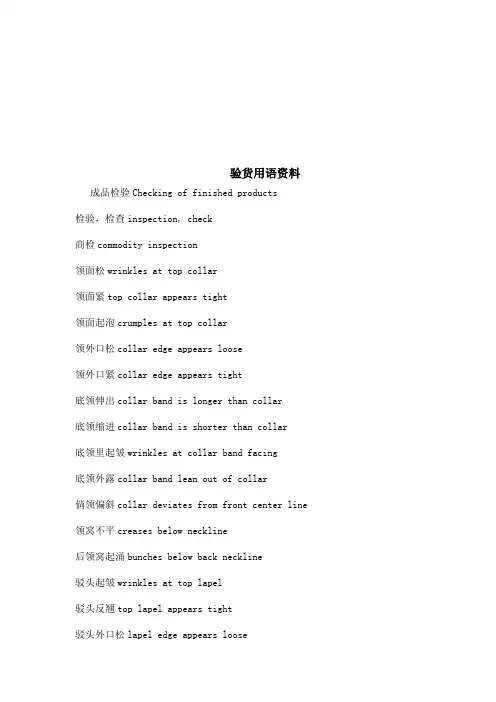
验货用语资料成品检验Checking of finished products检验,检查inspection, check商检commodity inspection领面松wrinkles at top collar领面紧top collar appears tight领面起泡crumples at top collar领外口松collar edge appears loose领外口紧collar edge appears tight底领伸出collar band is longer than collar底领缩进collar band is shorter than collar底领里起皱wrinkles at collar band facing底领外露collar band lean out of collar倘领偏斜collar deviates from front center line 领窝不平creases below neckline后领窝起涌bunches below back neckline驳头起皱wrinkles at top lapel驳头反翘top lapel appears tight驳头外口松lapel edge appears loose驳头外口紧lapel edge appears tight驳口不直lapel roll line is uneven串口不直gorge line is uneven领卡脖tight neckline领离脖collar stand away from neck小肩起皱puckers at shoulders塌肩wrinkles at shoulder袖隆起皱creases at underarm袖隆缝起皱puckers at underarm seam塌胸lack of fullness at chest省尖起泡crumples at dart point拉链起皱wrinkles at zip fly止口不直front edge is uneven止口缩角front edge is out of square止口反翘front edge is upturned止口反吐facing leans out of front edge 止口豁split at front edge止口下部搭叠过多crossing at front edge 底边起皱wrinkles at hem后身起吊back of coat rides up背衩豁开split at back vent背衩搭叠过多crossing at back vent绗棉起皱puckers at quilting絮棉不均padded cotton is uneven边缘缺棉empty hem绱袖不圆顺diagonal wrinkles at sleeve cap袖子偏前sleeve leans to front袖子偏后sleeve leans to back前袖缝外翻inseam leans to front袖口起皱wrinkles at sleeve opening袖里拧diagonal wrinkles at sleeve lining袋盖反翘top flap appears tight袋盖反吐flap lining leans out of edge袋盖不直flap edge is uneven袋口角起皱creases on two ends of pocket mouth 袋口裂split at pocket mouth腰头探出end of waistband is uneven腰缝起皱wrinkles at waistband facing里襟里起皱creases at right fly夹裆tight crotch短裆short seat后裆下垂slack seat前浪不平wrinkles at front rise裆缝断线bursting of crotch seam裤脚前后two legs are uneven脚口不齐leg opening is uneven吊脚pulling at outseam or inseam烫迹线外撇crease line leans to outside烫迹线内撇crease line leans to inside腰缝下口涌bunches below waistline seam裙裥豁开 split at lower part of skirt裙身吊split hem line rides up裙浪不匀skirt flare is uneven线路偏移stitch seam leans out line双轨接线 stitch seam is uneven跳针 skipping尺码不符 off size缝制不良stitching quality is not good洗水不良washing quality is not good熨烫不良pressing quality is not good极光iron-shine水渍water stain锈迹rust污渍spot色差color shade, off shade, color deviation 褪色fading, fugitive color线头thread residue毛头raw edge leans out of seam绣花不良embroidery design out line is uncovered BROKEN STITCHING 断线BROKEN HOLE 穿洞SKIPPED STITCHING 跳线RUN OFF STITCHING 落坑RAW EDGE 散口FULLNESS 衣面松紧OFF CENTER 不正中UPSIDE DOWN 上下倒转DROP STITCHING 漏针WAVY 波浪SEAM GRIN 哨牙SEAM ALLOWANCE 纸口FRAYED 散口OIL STAIN 油渍SOIL STAIN 泥污SHINNY 起镜DUSTY 灰尘BLEEDING 渗色OFF SHADE 褪色NEEDLE MARK 针痕TEETH MARK 靴痕MOIST 潮湿SMELL 气味TACK ON TACK 重枣POCKET LINING CAUGHT-IN TACK 枣黏袋布DAMAGED 破坏OPEN SEAM 爆口SEAM TORN 撕开SLANT 斜CROOKED 弯MIS MATCHED 不对称PUCKERING 绉起EXPOSED 外露FOREIGN MATTER 藏什物TWISTED LEG 扭脚LOOSE 松NOT PULLING OUT 不贴服POORLY 不良/不隹UNSTABLE 不稳定DENSITY 密度TIGHT THREAD TENSION 线太紧HI-LOW 高低BUBBLING 起泡GLUT ON INTERLINING-STRIKE THROUGH 朴胶水过面OUT OF TOLERANCE 超於规定SIDE SEAM TURNED WRONG-IN BAND 拨错骨INSECURE BACK STITCHES 反针线松UNEVEN 不平均THREAD END NOT TRIMMED 线尾未剪清MISALIGNEG SEAMS AT CROTCH 浪底骨不对HANDFEEL 手感SOFT/STIFF 软 / 硬IMPROPER 不正确DEFECTIVE 坏WRONG 错 MISS 欠 / 失去POSITION/PLACEMENT 位置DISTANCE 距离常见布料疵点SHADING 色差SLUBS 毛头NEPS 毛结CREASE MARK 折痕CHAFE MARK 灰路WATER SPOT 水点MISPICK/PULLOUT YARN 抽纱DIFFERENT COLOR LOT 不同色缸COLOR TONE 色光SELVEDGE 布边COLOR STRE**S 色条WEFT BAR 横档WARP BAR 直档COARSE YARN 粗纱UNEVEN DYE 染色不同FASTNESS 色牢度BIAS 斜纹FLOAT 浮纱LADDER 抽丝BOWING 弯TIWSTED LEG 扭脾OFF SHADE 褪色CHANGE IN SHADE OF FABRIC BY OVER-PASS 整熨过度令布色变色FLATTENED FABRIC SURFACE 布面被装平PIN TUCK 排褶DART 死褶PLEAT 生褶CREASE 折痕WATER SPOT 水渍NEEDLE MARK 针痕TEETH MARK 装靴痕PULL OUT BARE YARN 抽纱YARN END EXPOSES 毛尾未收HOLE/ CHALK MARK NOT COVERED 点位孔 / 粉笔痕外露FLAP NOT COVER POCKET OPENING 袋口露出袋盖外HIDDEN STITICHES JOIN SHOULDERS 暗线埋膊LINING TOO FULL/TIGHT/SHOWING BELOW BOTTOM 里布太松 / 太紧 / 露底SHADED GARMENT PARTS 衣服有色差GARMENTS WITH TWO COLOR TONES 衣服有两种色缸SIZES OUT OF TOLERENCE 尺码大差HANGTAGS NOT CORRECTLY POSITIONED 挂牌位置不确GARMENTS NOT FOLDED AS SPECIFICATI** 衣服褶法不依规格GARMENTS NOT CORRECTLY PACKED IN CART** 衣服装箱不依规格NOTCH 扼位GARMENTS NOT THOROUGHLY DRY 衣服未乾透MOIST GARMENTS 衣服潮湿ATTACH LABEL TWO SIDES 两边车口麦头ATTACH LABEL AROUND 四边车口麦头LABEL NOT SQAURE 口麦头歪斜LABEL SEWN IN TOO FAR INTO NECK 口麦头过份摄入领底STRAIGHT/BIAS/CROSS GRAIN LINE 直纹 / 斜纹 / 横纹SELVEDGE 布边RIGHT SIDE WRONG SIDE 正面 / 反面HANDFEEL STIFF 手感ABRASION MARK/ CHAFE MARK 起灰SLUBS 结头NEPS 毛结COLOR STRE**S 色条FOREIGN MATTER 飞花PILLING 起毛粒WEFT BAR 横档WARP BAR 直柳COARSE YARN 粗纱SKEWED WEFT 斜封NARROW WIDTH 窄边MISSING PICK 断纬SLACK END/PICK 现经 / 纬TIGHT END / PICK 出经 / 纬NEEDLE LINE 针痕BARRE 起横LADDING 线图脱落SKIP STITCHES 跳线BROKEN STITCHES 断线INSECURE BACK STITCHES 回针欠稳COVERING STITCHES 虾须线SMOCKING STITCHES 缩橡根线UN**HTLY JOINING STITCHES 驳线不良RUN OFF STITCHES 车线落坑SETTING STITCHES EXPOSED AT WAISTBAND 上裤头落坑线外露 BLINDSTITCHING SHOWING ON FACE SIDE 挑脚线露面BLINDSTITCHING NOT SECURELY CAUGHT ON INSIDE 挑脚漏针DROP STITCHES 漏针MISSING LINKING LOOPS 漏套眼OPEN SEAM 爆口LAP SEAM 包骨FRENCH SEAM 包边MISALIGNED SEAMS AT CROTCH/UNDERARM 裆底骨 / 底骨不合格TOO MUCH/INSUFFICIENT SEAM ALLOWANCE 太多 / 太少子口SEAM NOT FULLY PRESSED OPEN 开骨不良CHECK/STRIPES NOT MATCH AT SIDE SEAM 侧骨不对格 / 不对条CLEAN FINISH 横口EXCESSIVE LOOSE/TIGHT THREAD TENSION 车线太松 / 太紧NEEDLE THREAD 面线SCORCHED SEWING THREAD 底线CONCEALED LOOSE THREAD 藏线头LOOSE THREAD HANGING 松线头THREAD END NOT TRIMMED 线头未剪清UNEVEN TOP STITCHING 间面线不平均TWISTED HEM 扭脚PUCKERING 起绉INVISIBLE ZIPPER **拉鍊VELCRO(HOOK SIDE & LOOP SIDE) 魔术贴(钓面贴 / 圈面贴) RIVET 撞钉SHANK BUTTON工字钮。
(英)纺织验货用语中英文对照

验货用语资料成品检验Checking of finished products检验,检查inspection, check商检commodity inspection领面松wrinkles at top collar领面紧top collar appears tight领面起泡crumples at top collar领外口松collar edge appears loose领外口紧collar edge appears tight底领伸出collar band is longer than collar底领缩进collar band is shorter than collar底领里起皱wrinkles at collar band facing底领外露collar band lean out of collar倘领偏斜collar deviates from front center line 领窝不平creases below neckline后领窝起涌bunches below back neckline驳头起皱wrinkles at top lapel驳头反翘top lapel appears tight驳头外口松lapel edge appears loose驳头外口紧lapel edge appears tight驳口不直lapel roll line is uneven串口不直gorge line is uneven领卡脖tight neckline领离脖collar stand away from neck小肩起皱puckers at shoulders塌肩wrinkles at shoulder袖隆起皱creases at underarm袖隆缝起皱puckers at underarm seam塌胸lack of fullness at chest省尖起泡crumples at dart point拉链起皱wrinkles at zip fly止口不直front edge is uneven止口缩角front edge is out of square止口反翘front edge is upturned止口反吐facing leans out of front edge 止口豁split at front edge止口下部搭叠过多crossing at front edge 底边起皱wrinkles at hem后身起吊back of coat rides up背衩豁开split at back vent背衩搭叠过多crossing at back vent绗棉起皱puckers at quilting絮棉不均padded cotton is uneven边缘缺棉empty hem绱袖不圆顺diagonal wrinkles at sleeve cap袖子偏前sleeve leans to front袖子偏后sleeve leans to back前袖缝外翻inseam leans to front袖口起皱wrinkles at sleeve opening袖里拧diagonal wrinkles at sleeve lining袋盖反翘top flap appears tight袋盖反吐flap lining leans out of edge袋盖不直flap edge is uneven袋口角起皱creases on two ends of pocket mouth 袋口裂split at pocket mouth腰头探出end of waistband is uneven腰缝起皱wrinkles at waistband facing里襟里起皱creases at right fly夹裆tight crotch短裆short seat后裆下垂slack seat前浪不平wrinkles at front rise裆缝断线bursting of crotch seam裤脚前后two legs are uneven脚口不齐leg opening is uneven吊脚pulling at outseam or inseam烫迹线外撇crease line leans to outside烫迹线内撇crease line leans to inside腰缝下口涌bunches below waistline seam裙裥豁开 split at lower part of skirt裙身吊split hem line rides up裙浪不匀skirt flare is uneven线路偏移stitch seam leans out line双轨接线 stitch seam is uneven跳针 skipping尺码不符 off size缝制不良stitching quality is not good洗水不良washing quality is not good熨烫不良pressing quality is not good极光iron-shine水渍water stain锈迹rust污渍spot色差color shade, off shade, color deviation褪色fading, fugitive color线头thread residue毛头raw edge leans out of seam绣花不良embroidery design out line is uncoveredBROKEN STITCHING 断线BROKEN HOLE 穿洞SKIPPED STITCHING 跳线RUN OFF STITCHING 落坑RAW EDGE 散口FULLNESS 衣面松紧OFF CENTER 不正中UPSIDE DOWN 上下倒转DROP STITCHING 漏针WAVY 波浪SEAM GRIN 哨牙SEAM ALLOWANCE 纸口FRAYED 散口OIL STAIN 油渍SOIL STAIN 泥污SHINNY 起镜DUSTY 灰尘BLEEDING 渗色OFF SHADE 褪色NEEDLE MARK 针痕TEETH MARK 靴痕MOIST 潮湿SMELL 气味TACK ON TACK 重枣POCKET LINING CAUGHT-IN TACK 枣黏袋布DAMAGED 破坏OPEN SEAM 爆口SEAM TORN 撕开SLANT 斜CROOKED 弯MIS MATCHED 不对称PUCKERING 绉起EXPOSED 外露FOREIGN MATTER 藏什物TWISTED LEG 扭脚LOOSE 松NOT PULLING OUT 不贴服POORLY 不良/不隹UNSTABLE 不稳定DENSITY 密度TIGHT THREAD TENSION 线太紧HI-LOW 高低BUBBLING 起泡GLUT ON INTERLINING-STRIKE THROUGH 朴胶水过面OUT OF TOLERANCE 超於规定SIDE SEAM TURNED WRONG-IN BAND 拨错骨INSECURE BACK STITCHES 反针线松UNEVEN 不平均THREAD END NOT TRIMMED 线尾未剪清MISALIGNEG SEAMS AT CROTCH 浪底骨不对HANDFEEL 手感SOFT/STIFF 软 / 硬IMPROPER 不正确DEFECTIVE 坏WRONG 错 MISS 欠 / 失去POSITION/PLACEMENT 位置DISTANCE 距离常见布料疵点SHADING 色差SLUBS 毛头NEPS 毛结CREASE MARK 折痕CHAFE MARK 灰路WATER SPOT 水点MISPICK/PULLOUT YARN 抽纱DIFFERENT COLOR LOT 不同色缸COLOR TONE 色光SELVEDGE 布边COLOR STRE**S 色条WEFT BAR 横档WARP BAR 直档COARSE YARN 粗纱UNEVEN DYE 染色不同FASTNESS 色牢度BIAS 斜纹FLOAT 浮纱LADDER 抽丝BOWING 弯TIWSTED LEG 扭脾OFF SHADE 褪色CHANGE IN SHADE OF FABRIC BY OVER-PASS 整熨过度令布色变色FLATTENED FABRIC SURFACE 布面被装平PIN TUCK 排褶DART 死褶PLEAT 生褶CREASE 折痕WATER SPOT 水渍NEEDLE MARK 针痕TEETH MARK 装靴痕PULL OUT BARE YARN 抽纱YARN END EXPOSES 毛尾未收HOLE/ CHALK MARK NOT COVERED 点位孔 / 粉笔痕外露FLAP NOT COVER POCKET OPENING 袋口露出袋盖外HIDDEN STITICHES JOIN SHOULDERS 暗线埋膊LINING TOO FULL/TIGHT/SHOWING BELOW BOTTOM 里布太松 / 太紧 / 露底SHADED GARMENT PARTS 衣服有色差GARMENTS WITH TWO COLOR TONES 衣服有两种色缸SIZES OUT OF TOLERENCE 尺码大差HANGTAGS NOT CORRECTLY POSITIONED 挂牌位置不确GARMENTS NOT FOLDED AS SPECIFICATI** 衣服褶法不依规格GARMENTS NOT CORRECTLY PACKED IN CART** 衣服装箱不依规格NOTCH 扼位GARMENTS NOT THOROUGHLY DRY 衣服未乾透MOIST GARMENTS 衣服潮湿ATTACH LABEL TWO SIDES 两边车口麦头ATTACH LABEL AROUND 四边车口麦头LABEL NOT SQAURE 口麦头歪斜LABEL SEWN IN TOO FAR INTO NECK 口麦头过份摄入领底STRAIGHT/BIAS/CROSS GRAIN LINE 直纹 / 斜纹 / 横纹SELVEDGE 布边RIGHT SIDE WRONG SIDE 正面 / 反面HANDFEEL STIFF 手感ABRASION MARK/ CHAFE MARK 起灰SLUBS 结头NEPS 毛结COLOR STRE**S 色条FOREIGN MATTER 飞花PILLING 起毛粒WEFT BAR 横档WARP BAR 直柳COARSE YARN 粗纱SKEWED WEFT 斜封NARROW WIDTH 窄边MISSING PICK 断纬SLACK END/PICK 现经 / 纬TIGHT END / PICK 出经 / 纬NEEDLE LINE 针痕BARRE 起横LADDING 线图脱落SKIP STITCHES 跳线BROKEN STITCHES 断线INSECURE BACK STITCHES 回针欠稳COVERING STITCHES 虾须线SMOCKING STITCHES 缩橡根线UN**HTLY JOINING STITCHES 驳线不良RUN OFF STITCHES 车线落坑SETTING STITCHES EXPOSED AT WAISTBAND 上裤头落坑线外露 BLINDSTITCHING SHOWING ON FACE SIDE 挑脚线露面BLINDSTITCHING NOT SECURELY CAUGHT ON INSIDE 挑脚漏针DROP STITCHES 漏针MISSING LINKING LOOPS 漏套眼OPEN SEAM 爆口LAP SEAM 包骨FRENCH SEAM 包边MISALIGNED SEAMS AT CROTCH/UNDERARM 裆底骨 / 底骨不合格TOO MUCH/INSUFFICIENT SEAM ALLOWANCE 太多 / 太少子口SEAM NOT FULLY PRESSED OPEN 开骨不良CHECK/STRIPES NOT MATCH AT SIDE SEAM 侧骨不对格 / 不对条CLEAN FINISH 横口EXCESSIVE LOOSE/TIGHT THREAD TENSION 车线太松 / 太紧NEEDLE THREAD 面线SCORCHED SEWING THREAD 底线CONCEALED LOOSE THREAD 藏线头LOOSE THREAD HANGING 松线头THREAD END NOT TRIMMED 线头未剪清UNEVEN TOP STITCHING 间面线不平均TWISTED HEM 扭脚PUCKERING 起绉INVISIBLE ZIPPER **拉鍊VELCRO(HOOK SIDE & LOOP SIDE) 魔术贴(钓面贴 / 圈面贴) RIVET 撞钉SHANK BUTTON工字钮。
面料疵点及英语对译
面料疵点及英语对译弓纬布面纬向纹路弯曲呈弓形,称为弓纬。
Bowing荷叶边布边在拉幅时,布边未挂到针链而导致布边有凹型或者月牙型的疵点。
Scallops 门幅布的有效宽度。
Fabric Width门幅小实际布封比要求的布封小。
Narrow Width磨毛痕布面因坯布时已经有针路在磨毛时使针路更加明显。
Sand Mark 起毛织物在实际穿用与洗涤过程中,不断经受摩擦,使织物表面的纤维端露出于织物,在织物表面呈现许多令人讨厌的毛茸,即为起毛。
Hair起球若这些毛茸在继续穿用中不能及时,脱离互相纠缠在一起,被揉成许多球形小粒,称为起球。
Pilling 树脂印过树脂的布在过树脂时产生的印记。
Resin Mark停车痕定型工艺中停机造成,类似色档 Stop Mark纬斜布面纬向纹路与水平方向不一致,形成一定角度的倾斜。
Slanting 循环大循环比订单要求的数值大。
Repeat Bigger油污机器上的油或空中飘浮的灰尘污染布面所导致的黑色油点为油污 Oil 预缩痕由于预缩调节的张力太松,而导致布在进入橡胶辊之前打槢在经过辊压后形成的预缩痕。
Compact Mark抓毛痕抓毛时出现痕迹。
Brush Mark软油印工艺中用了柔软迹定型过程中泛于布面类似油污 Softener 纬斜布面纬向纹路与水平方向不一致,形成一定角度的倾斜。
Skewing 错花织布时穿错纱,造成织物花型错误的情况。
Pattern Error 错纱换纱时上错纱 Missing Yarn错组织调试过程中工艺错误,使得织出的坯布组织同要求的不一致 Wrong Construction 断拉架 LYCRA在生产过程中被拉断。
Broken Lycra 断纱生产过程中纱线被拉断,在布面上呈现为沿纬向纹路裂开。
Broken Yarn 断针在布面上呈现为沿经向纹路裂开一般在末端形成一个破洞。
Broken Needle 反拉架 lycra在编织过程中同棉纱的位置翻转,表面形成一段段的横纹效果 Reverse Lycra 飞花织布过程中不同颜色的纤维被织进织物中。
织物疵点专用术语名称及英语对照
书山有路勤为径;学海无涯苦作舟织物疵点专用术语名称及英语对照织物疵点专用术语名称及英语对照本贴所列织物疵点专用术语名称均来自南方纺织企业,尽管部分与书面语有所差别,但还是能够明白、理解。
另外名称也加注了英文,以方便纺织外贸企业使用。
1横裆疵(Barre) - 对针织织物而言,这种缺陷的特点是在织物横列或在织物横向上通常会出现一些不均匀的花纹图案。
纱线不均匀、纱线张力不均匀以及纱线具有不同的染料亲和力等都可能是出现这种情况的原因。
2坏地(Bad Place) - 对于那些难以用语言来描述的织物缺陷而言,这是一个十分方便的术语。
这个术语通常用来描述那些织物织造受到严重破坏的地方。
3斜纹疵(Bias) (参考纬斜) - 对梭织织物而言,这种缺陷指的是纬纱与经纱发生尺寸偏斜的地方;对针织织物而言,这种情况指的是织物横列与织物纵行发生尺寸偏斜的地方。
4、鸟眼花纹疵(BirdseyeDefect) - 对针织织物而言,这种情况指的是偶尔无规律出现的与织物设计相反的集圈组织。
5弓弧(Bow) - 对梭织织物而言,这种情况指的是纬纱以弧线方式位于织物的宽度方向上;对针织织物而言,这种情况指的是线圈横列以弧线方式位于织物的宽度方向上。
6、断头疵(Broken End) - 这种缺陷指的是经纱断裂后并经过修补的地方,它的常见特点是可以看见织到织物当中的断头。
7、花纹错色疵(Broken ColorPattern) - 对梭织织物而言,这种情况指的是花纹的不连续性,在用织布机通丝描绘彩色图案时产生错误或者在纬纱断裂时对织布机进行维修以后对图像填充链的重新设置不正确都可能会导致这种缺陷的产生;对针织织物而言,这种情况是由梭换筒错误而产生的。
8、断纬疵(Broken pick) - 这种情况指的是,由于纬纱断裂而导致在织物的部分宽度上缺少纬纱。
9、擦伤疵(Bruise) - (参考边撑疵)专注下一代成长,为了孩子。
服装检验疵点中英文对照
1 粗纱 Rough yarn2 染色不均 Uneven dye3 部件色差 Shaded parts4 裤腰跳线 Waistband stitch skipped5 腰头高低 High/how waistband ends6 裤腰与前门襟不贴合 Waistband end not close to front fly7 大身毛边 Raw edge at body8 裤袢尺寸不均 Uneven belt-loop size9 裤袢遗漏 Missing belt-loop10 套接缝在袋布上 Pocketing caught in bar-tacking11 袋布太短 Too short of pocket-bag12 内缝跳线 Inseam skipped stitch13 底层暴露 Under layer exposed14 口袋错位 Pocket setting misplaced15 口袋边不直 Pocket edge not straight16 袋缝头太大 Too much seam allowance in setting pocket17 后约克大小不均 Uneven size of back yoke18 不正确的布层外露 Improper layer shown out19 后约克十字缝不对称 Mismatched meet point of back yoke20 袋布未延伸至前门襟位 Pocket-bag not extend to front fly21 口袋缉线张力不均匀 Uneven tension at pkt. Topstitch22 工字纽扣不牢 Press stud insecure23 前门襟宽度不均匀 Uneven front fly width24 前门襟太长 Front fly length too long25 裤腰扭曲 Waistband twisted26 裤腰高度错误 Wrong waistband height27 每英寸针迹比标准少 Stitch per inch less than specified28 后袋形状不正确 Incorrect shape of back pocket29 下摆扭曲 Twisted bottom30 里襟边为散口 Fraying the end of catch facing31 钻孔外露 Exposed drill holes32 (右)左门襟缉线不均匀 Uneven topstitch at left fly(right)33 裤袢和样衣不一样 Belt-loop not as sample34 套结遗漏 Missing bartack35尺寸超出公差 Measurement out of tolerance36 洗水标错误 Wrong care lable37 裆底十字缝不对位 The under crotch meet point do not matched38 拉链没延伸至顶端 Zipper cannot reach at top39 外缝缉线高低不平(落坑) Outseam run off stitchEyelet 气眼Zipper pull 拉链头Thread 线1领边不对称 Collar edge asymmetric2领座不均匀 Uneven collar stand3领尖露齿(底)针迹 Collar tip grinning stitch4底层外露 Under layer exposed5领辑面线张力不均匀 Uneven tension of topstitch at collar6门襟起泡 Placket bubbling7领子由于熨烫不均匀而起泡 Collar bubbling by uneven pressing8门襟扭曲 Twisted placket9口袋尺寸不正确 Incorrect pocket size10领子辑面线后底层外露 Under collar appeared after collar topstitching11纽扣有疵点 Defective buttons12领子尺寸不正确 Collar size incorrect13袖头边断裂 Seam broken of cuff edge14领尖不均匀 Uneven of collar tip15前门襟长度不均匀 Uneven length of front placket16绱袖起褶 Pleated at sleeve joining17熨烫欠佳 Improperly pressed18领尖缝线断裂 Collar tip seam broken19止口错误 Wrong edge margin20袖头两边高度不均匀Uneven height in both sides of cuff21缝纫线粘进领子内 Thread fused into collar22口袋边位超出袋盖边位 Side edge of pkt.exposed heyond side of flap23扣眼线迹太窄 Buttonholes stitching too narrow24袖头辑线张力不均匀 Uneven tension of topstitch on cuff25上领形状不均 Uneven shape in collar fall handing26机织商标便离后中1.3CM(1/2英寸)或更大Woven label 1.3CM(1/2”)or more off center back 27袖子褶裥距离不均匀 Uneven distance of slv. pleat28绱袖头与袖子不贴合 Cuff assembling to slv.not closed29绱领子与衣身不贴合 Collar assembling to body not closed30下摆缝线滑移 Seam slippage at bottom hemming31由于处理不正确导致领子起泡 Collar budding due to incorrect handling32下领嘴缝线断裂 Seam broken at collar stand end33表面打褶或起皱严重影响外形 Pleats or puckers outside seriously affecting appearance 34纽扣缝制未穿过所有孔眼 Button sewn on face down35纽扣缝制时正面翻转 Buttonholes cut in opposite direction to specification 36扣眼开口方向与规格相反 One or both collar stays missing37 1个或2个领子插片遗漏 Wrong type of seam38 缝型错误 Wrong type of seam39口袋及袋盖有高低 High/Low pkts. & flaps40袖衩缝线断裂 Seam broken in sleeve placket41袖头下层 Fullness on the under ply of the cuff42折边不正确 Incorrect folded edge43袖头扭曲 Twisted cuff领子有点小了—请根据尺寸表修改,确保领型好、顺滑。
织物疵点专用术语名称及英语对照
织物疵点专用术语名称及英语对照本贴所列织物疵点专用术语名称均来自南方纺织企业,尽管部分与书面语有所差别,但还是能够明白、理解。
另外名称也加注了英文,以方便纺织外贸企业使用。
1横裆疵 (Barre) - 对针织织物而言,这种缺陷的特点是在织物横列或在织物横向上通常会出现一些不均匀的花纹图案。
纱线不均匀、纱线张力不均匀以及纱线具有不同的染料亲和力等都可能是出现这种情况的原因。
2坏地 (Bad Place) - 对于那些难以用语言来描述的织物缺陷而言,这是一个十分方便的术语。
这个术语通常用来描述那些织物织造受到严重破坏的地方。
3斜纹疵 (Bias) (参考纬斜) - 对梭织织物而言,这种缺陷指的是纬纱与经纱发生尺寸偏斜的地方;对针织织物而言,这种情况指的是织物横列与织物纵行发生尺寸偏斜的地方。
4、鸟眼花纹疵 (BirdseyeDefect) - 对针织织物而言,这种情况指的是偶尔无规律出现的与织物设计相反的集圈组织。
5弓弧 (Bow) - 对梭织织物而言,这种情况指的是纬纱以弧线方式位于织物的宽度方向上;对针织织物而言,这种情况指的是线圈横列以弧线方式位于织物的宽度方向上。
6、断头疵 (Broken End) - 这种缺陷指的是经纱断裂后并经过修补的地方,它的常见特点是可以看见织到织物当中的断头。
7、花纹错色疵 (Broken ColorPattern) - 对梭织织物而言,这种情况指的是花纹的不连续性,在用织布机通丝描绘彩色图案时产生错误或者在纬纱断裂时对织布机进行维修以后对图像填充链的重新设置不正确都可能会导致这种缺陷的产生;对针织织物而言,这种情况是由梭换筒错误而产生的。
8、断纬疵 (Broken pick) - 这种情况指的是,由于纬纱断裂而导致在织物的部分宽度上缺少纬纱。
9、擦伤疵 (Bruise) - (参考边撑疵) - 这种情况指的是:由于正在进行编织的纱线或者已经编织完毕的织物受到磨损,从而导致纤维失去方向感并导致织物外观失真。