
英语人教版八年级上册unit2 3c
Unit 2 How often do you exercise?Section A 2 (Grammar Focus-3c)一、教学目标:1. 语言知识目标:1) 复习运用频率词汇及询问活动频率。
2) 一般现在时态的熟练运用。
2. 情感态度价值观目标:通过本单元的学习,养成健康的饮食习惯,保证充足的睡眠时间,进行合理的运动锻炼,以保持健康的体魄。
培养学生的逻辑表述能力,激发学生的积极思维,并使学生互相了解,增进友谊,加强人际交往,以形成良好的人际关系。
二、教学重难点1. 教学重点:1) —How often do you /does he(she)….? —He usually…2)频度副词的用法:always; usually ; often ; sometimes; hardly ever; never 2. 教学难点:1) 第三人称单数谓语动词在此核心句型中的运用。
2) 能够谈论课余时间的各项活动,以及初步认识和使用频率副词。
三、教学过程Ⅰ. Warming- up and revision1. Ask and answer some oral questions on how often exercise.2. Check the homework.3. Ask Ss to role-play the conversation in 2d.Ⅱ. Grammar Focus1. 学生阅读Grammar Focus中的句子,然后做填空练习。
1) 你通常在周末做什么?______ ____ you _______ do on weekends?2) 我总是去运动。
I _______ _______.3) 他们总是在周未做什么事情?______ _____ they ________ on weekends?4) 他们经常帮助做家务。
They ________ _______ with housework.5) 她在周未做什么?What ______ she _______ on weekends?6) 她有时候去购物。
She _________ _______ _________.你多久去看电影一次?_____ _____ do you go to the _________?7) 我可能一个月去看一次。
I go to movies ______ _______ a ________.8) 他多久看一次电视?______ _______ does he watch TV9) 他几乎不看电视。
He ________ _______ watches TV.10) 他去购物吗? ______ ___ go shopping?11) 不,他从不去购物。
No, he _______ ______ shopping.3. 学生们完成填空试题后,可以打开课本检查答案,对错误的句子,单独进行强化记忆。
Ⅲ. Try to Find1. Tell Ss try to find the answers.A: how often 意为“__________”,是用于提问表示________的特殊疑问词组。
其答语应为表示________ 的副词或副词词组。
句子的时态一般是_____________,也可以是一般过去时。
多久一次,频率,频率,一般现在时翻译:你多久去游泳一次?一个星期三次。
__________________________________._________________________________.How often do you go swimming?Three times a week.频度副词•always意为“总是”,表示动作的重复或状态的延续。
•usually意为“通常”,表示很少有例外。
•often意为“经常”,表示动作的重复,但不如usually那么频繁,中间有间断。
•sometimes意为“有时”,表示动作偶尔发生。
•hardly意为“几乎不”,常和ever连用表示强调。
•never意为“从未”。
提示:频率副词在句中的位置是:实义动词之前,be动词,助动词或情态动词之后。
e.g. It’s always interesting to watch other people show their talents.Why do people usually make resolutions?When we watch movies about the future, we sometimes see robots.They hardly ever watch TV.Ⅳ. Practice1. Tell Ss to make questions.2. Then try to ask and answer questions about the questions.3. Ask some Ss to ask and answer with their partners in front of the class.方法指导:应通读所有词汇,掌握句子大意;然后,找出句子中的特殊疑问词。
最后,按“特殊疑问词+ 一般疑问句?” 的结构来构成句子。
其他类似。
学生们,按老师指导的方法进行阅读,并逐句推敲组成正确的特殊疑问句,并理解掌握特殊疑问句的句式结构,在实际的运用中提高自己的阅读能力、分析能力及综合运用能力。
Language points1. maybe意为“大概;或许;可能”,是副词,常位于句首或句中。
e.g. 或许他们将去海滩度假。
Maybe they are going to the beach for vacation.【辨析】maybe与may bemaybe是副词,在句子做状语。
may be 是情态动词may与动词原形be一起构成句子的谓语动词意为“可能是”,它们有时也可互换。
e.g. 或许它们在你的书包里。
_______ they are in your schoolbag. MaybeThey ____ ___ in your schoolbag. may be2. at least意为“至少,不少于;起码”,是副词词组,一般指在数量或程度上。
e.g. 你必须至少一周打扫你的房间一次。
You have to clean your house __ ____ once a week. at leastⅤ. Group work1. Let Ss work in groups of six or eight.2. Tell Ss discuss what activities they do to improve their English. Then write theactivities in the chart.3. Ask their group mates the questions and fill in the chart.4. Try to make a report about their partners.(最后,可以经学生们评议来推举最有能力的小组)Ⅵ. ExercisesIf time is enough, do some more exercises on big screen.1)I usually go shopping on weekends. (变为一般疑问句)______ you usually _____ shopping on weekends?2)She often helps with housework at home. (同上)_____ she often ______ with housework?3)They visit their grandparents once a month. (提问)______ ______ ____ they visit their grandparents?4)She always watch TV after dinner. (提问)_____ _____ _____ she ______ TV after dinner?5)Maybe your mother is in the kitchen. (改为同义句)Your mother _______ ______ in the kitchen.二、将下列句子或对话翻译成英语。
1. 这个饭店的食物总是很美味。
_____________________________________2. 我妹妹从来不打羽毛球。
_____________________________________3. 她有时晨跑。
_____________________________________4. —你多久去一次音乐俱乐部?—周两次。
—________________________________—________________________________ HomeworkDo a survey:What does he/she do on weekends?Name Activity How often Bob play computer games usually。
人教英语八年级上册Unit2 Section B 3a-3c (共17张PPT)

• 14、Thank you very much for taking me with you on that splendid outing to London. It was the first time that I had seen the Tower or any of the other famous sights. If I'd gone alone, I couldn't have seen nearly as much, because I wouldn't have known my way about.
Running Game:(From sentences to an article)
Health and habits Paragraph 1 (the beginning )
I am …..
Paragraph 2 (good habits ) I have some good habits…
Paragraph 3 (bad habits) However,I have some bad…
She _u__su_a_l_l_y__ watches TV for more than two hours a day, and she _s_o_m_e_t_i_m_e_s__ eats hamburgers. Her parents are not very happy because she _h_a_r_d_ly__e_v_er_ helps with housework and she _n_e_v_e_r_ goes to the dentist for teeth cleaning. She says she is afraid!
Drink coffee Exercise
人教版八年级英语上册教案Unit 2 第3课时
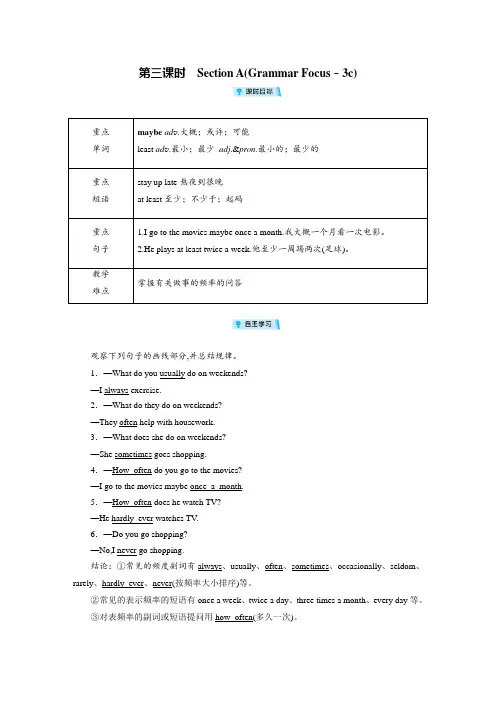
第三课时Section A(Grammar Focus-3c)重点单词maybe ad v.大概;或许;可能least ad v.最小;最少adj.&pron.最小的;最少的重点短语stay up late熬夜到很晚at least至少;不少于;起码重点句子1.I go to the movies maybe once a month.我大概一个月看一次电影。
2.He plays at least twice a week.他至少一周踢两次(足球)。
教学难点掌握有关做事的频率的问答观察下列句子的画线部分,并总结规律。
1.—What do you usually do on weekends?—I always exercise.2.—What do they do on weekends?—They often help with housework.3.—What does she do on weekends?—She sometimes goes shopping.4.—How_often do you go to the movies?—I go to the movies maybe once_a_month.5.—How_often does he watch TV?—He hardly_ever watches TV.6.—Do you go shopping?—No,I never go shopping.结论:①常见的频度副词有always、usually、often、sometimes、occasionally、seldom、rarely、hardly_ever、never(按频率大小排序)等。
②常见的表示频率的短语有once a week、twice a day、three times a month、every day等。
③对表频率的副词或短语提问用how_often(多久一次)。
2013秋人教版英语八年级上Unit2Section A 3a-3c
He ...
Then ask and answer them with a partner.
My partner’s answers:
1. I always help with housework. 2. I usually surf the Internet. 3. He does exercise everyday. 4. I usually do my homework after school.
---- How often do you go to the movies? ---- I go to the movies maybe once a month. ---- How often does he watch TV? ---- He hardly ever watches TV. ---- Does he go shopping? ---- No, he never goes shopping.
1. How often dose he play soccer? 2. Do you drink milk? 3. How often do they stay up late? 4. Dose Sue eat a healthy breakfast? 5. How often do you eat apples? 6. Do your parents play sports?
指导: 首先,通读所有答语句子理解大意。然 后,判断问句是一般疑问句还是特殊问 句,来先确定答案的范围。最后,根据 问答句在主语及句意上的联系来确定答 案。 答案:1. c 2. f 3. e 4. a 5. b 6. d
总结:how often“多久一次”询问动作的频率。 答语:(1)every+名词单数 everymorning/afternoon/evening/day/Sunday/weekend/ week/ month/term/year/… (2)次数+一段时间 once a day / twice a week / once or twice a year / two or three times (3)频度副词 always(100%)---usually(90%)---often =all the time =at times (60%)---sometimes(30%)---hardly ever(10-20%) ---never(0%) =seldom
人教英语八年级上册Unit2 Section B 3b3c (共13张PPT)
I have some good habits… I also have some bad habits...
第二步:正确运用表示频率的副词或词组。
I always…
I … twice a week.
第三步:加入however, also 等连词,让 句子和句子之间更连贯。
Unit 2 How often do you exercise? Section B 3b-3c
I always read in my free time.And sometimes I help with the housework.
However, I brush teeth only once a day .And I hardly ever go to the
于个人生活习惯的作文。
Game Time: Do your best!
要求:在最短的时间里面说出 尽可能多的表示日常活动的词 或词组。每次只能说出一个, 且不能重复他人的答案。回答 正确者可获印花一个同时为本 组积分。得分最多组为优胜组!
3b Complete the chart with your own
第四步:通读作文,改正错误。
3c Write a report about your good and
bad habits. Say how often you do things. Use the report in 3a as an example.
Show Time :作文展示
Homework
Finish off the writing and check each other’s writing between partners.
初中英语人教版八年级上册Unit 2Section B 3a-3c
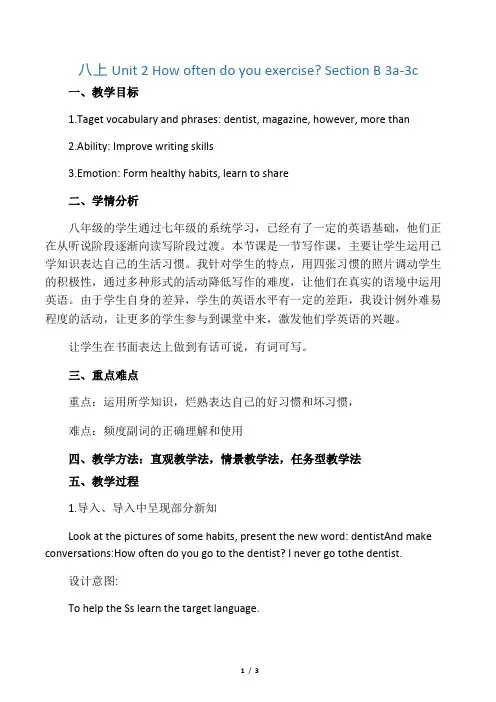
八上Unit 2 How often do you exercise? Section B 3a-3c一、教学目标1.Taget vocabulary and phrases: dentist, magazine, however, more than2.Ability: Improve writing skills3.Emotion: Form healthy habits, learn to share二、学情分析八年级的学生通过七年级的系统学习,已经有了一定的英语基础,他们正在从听说阶段逐渐向读写阶段过渡。
本节课是一节写作课,主要让学生运用已学知识表达自己的生活习惯。
我针对学生的特点,用四张习惯的照片调动学生的积极性,通过多种形式的活动降低写作的难度,让他们在真实的语境中运用英语。
由于学生自身的差异,学生的英语水平有一定的差距,我设计例外难易程度的活动,让更多的学生参与到课堂中来,激发他们学英语的兴趣。
让学生在书面表达上做到有话可说,有词可写。
三、重点难点重点:运用所学知识,烂熟表达自己的好习惯和坏习惯,难点:频度副词的正确理解和使用四、教学方法:直观教学法,情景教学法,任务型教学法五、教学过程1.导入、导入中呈现部分新知Look at the pictures of some habits, present the new word: dentistAnd make conversations:How often do you go to the dentist? I never go tothe dentist.设计意图:To help the Ss learn the target language.To arouse the Ss’interests and lead into“habits”.2.任务一、Show the chart in the books and ask the Ss to answer the questions:(1)What does the heading“Days a year”mean?(2)What good habits does the girl have?(3)Does the girl have any bad habits? What are they?Caculate the days and know the frequency.设计意图:To lead the Ss talk in English and get familiar with the content in thechart.To get ready for the next task.3.任务二、Fill in the blanks by themselves and check the answers.Then finish themindmapandretellthereport.Payattentiontothenewwords“however”and“more than”.设计意图:To lead the Ss understand the TV report better and set an example forwriting.4.任务三、Fillinthechartin3b.LeadtheSsaddmoregoodandbadhabitsaccording to their own situation.设计意图:To reduce the difficulty while writing and get ready for writingTo provide more words and phrases for writing.5.任务四、Write a report aboutyour good and bad habits. Say how often you dothings.设计意图:To use English to express.6.任务五、Share Ss’s reports and encourage them to learn from each other. Collectall the reports and find advantages and disadvantages, conclude next time.设计意图:To lead the Ss learn to share and discover the others’advantages.六、作业:Finish the exercise and preview next unit.设计意图:To lead the Ss gain new knowledge by reviewing old.。
人教版八年级上册英语Unit 2(Grammar-3c)练习(含答案)
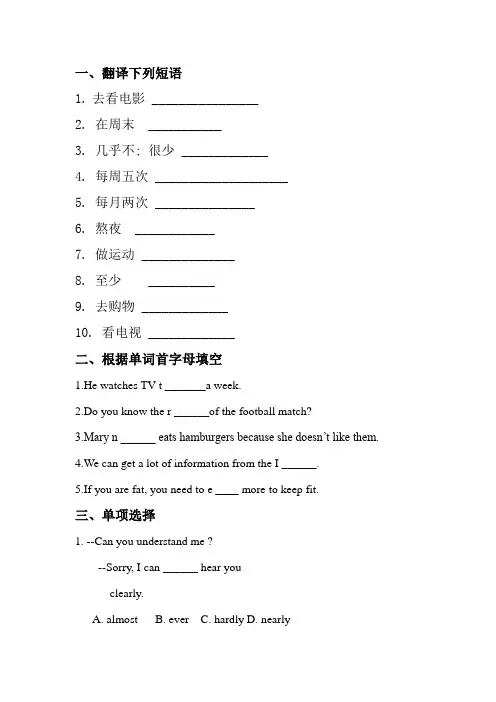
一、翻译下列短语1.去看电影 ________________2. 在周末 ___________3. 几乎不; 很少 _____________4. 每周五次 ____________________5. 每月两次 _______________6. 熬夜 ____________7. 做运动 ______________8. 至少 __________9. 去购物 _____________10. 看电视 _____________二、根据单词首字母填空1.He watches TV t _______a week.2.Do you know the r ______of the football match?3.Mary n ______ eats hamburgers because she doesn’t like them.4.We can get a lot of information from the I ______.5.If you are fat, you need to e ____ more to keep fit.三、单项选择1. --Can you understand me ?--Sorry, I can ______ hear youclearly.A. almostB. everC. hardlyD. nearly2. He tries ____ English.A. learnB. learningC. to learn3. An apple a day is good ___ your health.A. atB. withC. forD. in4. ---_____ do you go to the movies ?---Once a week.A. How longB. How soonC. How oftenD. How much5. _____ I’m not very healthy.A. MaybeB. May beC. MayD. Can6. I have a ______ habit.A. healthB. healthyC. healthilyD. healthily7. We watch TV ___ seven ___ Sundayevening.A. at, inB. at, onC. on, inD. on, on8. The students exercise every day andthey try _____ healthy.A. keepB. keepingC. keptD. to keep四、句型转换1. She goes to the movies three times a month.(对划线部分提问)____ _____ _____ she go to the movies?2. My mother wants me to play the guitar. (同义句转换)My mother______ _____ me to play the guitar.3. We eat meat twice a week. (同义句)We ____ meat two _____ a week.4. I always exercise after school.(变成完全否定句)I _____ exercise after school.5. I practice the piano every day.(对划线部分提问)_____ ____ do you practice the piano?参考答案一、翻译下列短语1.go to the movies2.on weekends3.hardly ever4.five times a week5.twice a month6.stay up late7.do sports 8.at least 9.go shopping 10.watch TV二、根据单词首字母填空1.twice2.result3.never4.Internet5.exercise三、单项选择1-5CCCCA 6-8BD四、句型转换1.How often does2.would like3.have times 4never.5.How often。
Unit2SectionAGrammarfocus3c教案人教版英语八年级上册
Unit 2Grammar focus3c一、教学内容:Grammar focus3c二、课型:语法课三、语篇研读What(主要内容):语法部分从询问某人从事某活动的问句和答句为主线,然后将对应的问句和答句匹配。
学生通过问句和答句的人称主语以及活动内容找到答案。
3c将学生从笔头训练转到口语训练,谈论自己和身边的同学关于学习英语的相关情况和频率。
Why(编写意图): 学生能通过谈论活动事项来强化对频率表达的学习和运用,让学生养成良好的生活习惯,保持积极阳光的心态学习和生活。
How(语篇特点):以表格形式列出本单元语法句型,总结语法点,对应练习的凸显出人称代词和谓语动词在做题中的重要性,同时巩固频率的语言表达。
四、教学目标通过本课时学习,学生能够:1.(学习理解)掌握本单元的语法和句型,正确使用How often引导的特殊疑问句询问从事活动的频率以及运用频度副词描述从事活动的频率。
2.(应用实践)采用学生资助观察、合作探究、发现总结的模式,引导学生掌握语法知识,注重独立思考能力和合作探究能力的培养。
3.(迁移创新)以练习、对话形式锻炼学生对频度副词的掌握情况;同时培养学生对英语的学习兴趣和语言运用能力,合作探讨英语学习方式,激发学生对英语学习的思考。
五、教学重难点1.常用频度副词及短语在句中的用法;3.一般现在时中谓语动词的第三人称单数形式;4.频度副词在句中的位置。
【核心词汇】maybe, once, never, early, exercise【核心短语】help with housework. go shopping, go to movies, stay up late.【核心句型】What do you usually do on weekends? I always exercise.What do they usually do on weekends? They often help with housework.Do you go shopping? No, I never go shopping五、教学过程六、板书设计Unit2 Grammar focus3cWhat do you usually do on weekends? I always exercise/ go to movies.What do they usually do on weekends? They often help with housework.Do you go shopping? No, I never go shopping/ stay up late.How often does he watch TV? He hardly ever watches TV.主谓一致。
人教英语八年级上册Unit2 Section A (2d3c)-课件
Unit 2
How often do you exercise ? Section A(2d---3c)
Tongjiang Middle School Qi Xiujuan
• Rush to answer (抢答) 1.看英语书 2.去看电影 3.帮忙做家务 4.上网 5.一周一次 6.一个月两次 7.一天三次 8.摇摆舞 9.几乎从不 10.至少
Report
Gao Hui reads English twice a week. Liu Tao goes to English club twice a week. Li Lei watches English movies once a month. Ma Li writes to a pen friend once a month. Liu Tao keeps an English diary. I think Liu Tao is the best English student.
2d . Listen and answer the question.
What does Claire do on Tuesday ?
2d Role-play the conversation.
Jack : Hi, Claire, are you free next week ? Claire: Hmm … next week is quite full for me, Jack. Jack : Really ? How come ? Claire: I have dance and piano lessons. Jack: W hat kind of dance are you learning ? Claire: Oh, swing dance. It’s fun !
2019年秋人教版八年级上册英语课件:Unit 2 Section A 3a-3c(共31张PPT)
如:I will never forget this lesson. 我将永远忘不 了这一课。
We often go there.我们常去那儿.
Sometimes we go to the cinema and at other times we go for a walk.有时候我们去看电影, 有时候我们去散步。
Do you __e_a_t/_h_a_v_e_a__h_e_a_lt_h_y__b_r_e_a_k_fa_s_t_______ every day?
三、语法专练
( D ) 1. --I want to be an artist, but it __________ a little hard.
--Work hard, and __________ you’ll succeed (成功) at
—He never _go_e_s_______ shopping.
二、 根据中文提示完成句子,词数不限。 1. 有时Linda走路去上学。 __S_o_m__e_ti_m_e_s_ Linda _w_a_l_k_s_ to school. 2.我妹妹一周至少看二至三次电视。
My sister watches TV ______a_t_l_e_a_st__tw__o_______- or three times a week. 3.跑步友谊与我们的身体健康。 Running ___i_s_g_o_o_d__fo_r_____________ our health.. 4.你多久散步一次? ____H__o_w__o_ft_e_n________ do you____ta_k_e__a_______walk? 5.你每天吃健康的早餐了吗?
考点3专练 (选词填空)
人教版英语八年级上册Unit2SectionA2dGrammarFocus3c说课稿
一、教材分析
(一)内容概述
本节课为人教版英语八年级上册Unit 2 Section A 2d Grammar Focus 3c的内容。本单元的主题是“保护环境”,本节课主要讲解一般将来时的用法。在课程体系中,本节课位于一般现在时和一般过去时之后,为学生对时态的进一步学习打下基础。通过本节课的学习,学生能够掌握一般将来时的基本结构和用法,并能在实际情景中运用。
3.情感态度与价值观:
(1)培养学生关注环境保护的意识;
(2)激发学生对英语学习的兴趣,提高自信心;
(3)教育学生珍惜时间,树立目标,为实现梦想而努力。
(三)教学重难点
根据对学生的了解和教学内容的分析,本节课的教学重点和难点如下:
1.教学重点:
(1)掌握一般将来时的基本结构和用法;
(2)能够运用一般将来时进行实际交流;
2.情境教学法:根据学生的认知特点,创设生动、具体的情境,让学生在情境中感知、体验和运用目标语法。这种方法的理论依据是情境认知理论,认为知识是在特定情境中建构的。
3.合作学习法:鼓励学生进行小组合作,共同完成学习任务,培养学生的合作精神和团队意识。这种方法的理论依据是社会建构主义,强调学习过程中的社会互动。
(二)学习障碍
学生在学习本节课之前,已经掌握了英语基本语法和一般现在时、一般过去时的用法。但在学习一般将来时时,可能会遇到以下障碍:
1.对一般将来时的概念理解不透,容易与一般现在时、一般过去时混淆;
2.动词形式的正确变化容易出错,特别是在进行时态转换时;
3.在实际语境中,学生可能难以把握一般将来时的运用,导致表达不准确。
(三)学习动机