
九年级英语下册 Module 2 Education Unit 3课件 外研版
A. both
B. either
C. neither
5. Hello, John! Come here, please. I have ____ to tell you. A. important something B. something important C. important anything
b. none 除指可数的人和物外, 还可以表示不可数的东西,
可以指与one, two, three一样的数字概念。例如:
I have a lot of money in my bag, but none is mine.
—How many postcards have you sent?
—None.
There are many people in the park. Some are dancing;
others are playing Taijiquan.
c. some 用于肯定句中, 而any 用于疑问句、否定句和条件 句中。
—I am thirsty. Can you give me some water?
1. There is ____ water left in the bottle. Would you go and
get some?
A. little C. few 2. We had ____ people this year than we had last year. B. a little
nice card on that special day.
—Which of the two shirts do you want?
—Either will do. 注意: either 表示一种选择, 如上面一例, 表示“哪个都可 以”, 说明购物者要买一件衬衣而不是两件都要。如表示 两件都要, 则用both。each 也可用于句末。例如: The old man gave the boys two apples each.
A. little
C. fewer
Hale Waihona Puke B. less3. You don’t like the same colours and I don’t like them, ____. A. too B. also C. either
4. I asked Kate and Mary to come for a talk, but ____ of
Bob: I’ve still got (5) a few / few weeks before I have to decide. I’m going to speak to (6) every / all my teachers and ask for their advice. Anna: The teachers say that we must decide for (7) themselves / ourselves , that (8) none / neither of them can tell us what to do.
Presentation
Grammar
代词是用来代替名词的词。它是英语语法结构中的一个 重要项目, 也是中考测试的重点内容之一。纵观历年中
考试题 , 出现频率最高的是不定代词,其次是 it 用法、
疑问代词、反身代词以及人称代词等。
类别 人称代词 指示代词
组成 主格: I, you, she, he, it,we, you, they 宾格: me, you, her, him, it, us, you, them this, these, that, those 形容词性: my, your, her, his, its, our, your, their 名词性: mine, yours, hers, his, its, ours, yours, theirs
Anna: I did really well in English. That’s (3) anything / something I’ve always enjoyed. My grades in history and art weren’t so good, because (4) none / neither of those is my favourite subject. What will you study next year?
Module 2 Education
Unit 3 Language in use
Lead in
Are you able to read through the sentences?
1. Did you do anything interesting? 2. Did you visit her school? 3. She took me there herself. 4. It isn’t as big as ours. 5. There are a few science laboratories.
He has many friends, but few are true friends/ but
only a few are true friends.
4) all和both a. all 表示“所有的, 全体, 一切”的 概念, both 表示“两 个都”, 而all指两者以上, 同时还可以指不可数的东西。例 如:
—Sorry, I don’t have any. If I have any, I will give you
some.
但在征求对方意见,并希望得到肯定回答时,要用 some
Eg: Would you like some tea ?
Can I have some bread ?
2) none和neither
a. none和neither 都表示否定的意思, 两者的区别在于,
neither 用于两者, 而none 用于两者以上。例如:Yes, I
saw two boys at the door, but neither (of them) is my
brother. None (of the students) in my class wants to take part in this trip.
1) some和any a. some和any 是单数还是复数, 要看其所代替的是什么。 some和any 都既可以指人, 也可以指物, 可以表示可数的事 物和人 , 也可以表示不可数的概念。 例如 : some (any) books, some (any) money, some people, some water b. 作为代词, 它们在句中可以作主语和宾语。例如:
3. They will help Kate, and Kate helps them with the homework. each other
4. Who owns that silver bike? Is it Mr Scott’s bike? Whose is
5. Yes, it is Mr Scott’s .
words and expressions in the box.
each other either his myself
of mine who is whose is
1. Meet John. He’s a friend I have .
of mine
2. You don’t need to help me. I can do it on my own . myself
ourselves she their themselves
1. Mr. Lee’s class put all _______ their things away at the end they have to tidy up of the lesson. _______ They know that ______
6. —Mum, Ann’s coming tonight. Let’s give her ____ to
eat.
—Good idea!
A. anything nice
B. nice anything
C. something nice
Complete the conversation with the correct words and expressions.
3) (a) little和(a) few a. a little和a few 表示肯定的概念, 而little和few 却表示 否定的概念。 b. (a) little 用于不可数名词,
而(a) few 用于可数名词。例如:
—Do you have any water? —Yes, but only a little. —Sorry, I have little myself. I can’t give you any.
his
who is
6. I know someone with the job as a dentist. 7. I don’t mind which apple you give me.
The red one or the green one will be fine.
Either
Complete the sentences with the correct form of the words in the box. he her him himself his they us we our
物主代词
续表 反身代词 疑问代词 myself, yourself, herself, himself, itself, ourselves, yourselves, themselves what, which, who, whom, whose
新九年级英语下册Module2EducationUnit3Languageinuse教案新版外研版
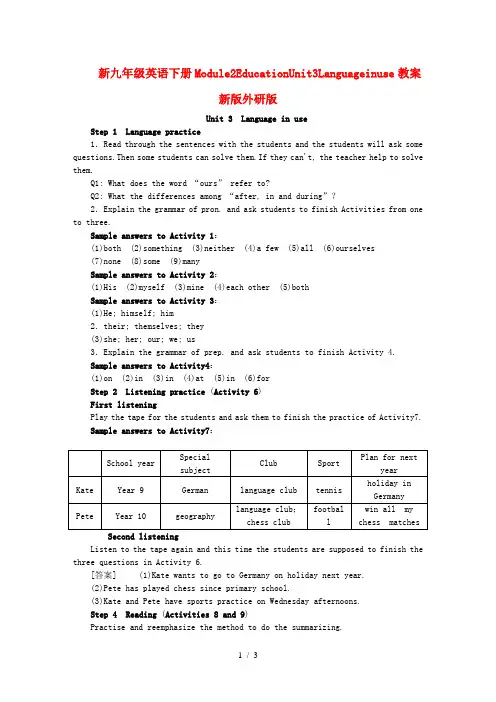
新九年级英语下册Module2EducationUnit3Languageinuse教案新版外研版Unit 3Language in useStep 1Language practice1.Read through the sentences with the students and the students will ask some questions.Then some students can solve them.If they can't, the teacher help to solve them.Q1: What does the word “ours” refer to?Q2: What the differences among “after, in and during”?2.Explain the grammar of pron. and ask students to finish Activities from one to three.Sample answers to Activity 1:(1)both (2)something (3)neither (4)a few (5)all (6)ourselves(7)none (8)some (9)manySample answers to Activity 2:(1)His (2)myself (3)mine (4)each other (5)bothSample answers to Activity 3:(1)He; himself; him2.their; themselves; they(3)she; her; our; we; us3.Explain the grammar of prep. and ask students to finish Activity 4.Sample answers to Activity4:(1)on (2)in (3)in (4)at (5)in (6)forStep 2Listening practice (Activity 6)First listeningPlay the tape for the students and ask them to finish the practice of Activity7.Sample answers to Activity7:Second listeningListen to the tape again and this time the students are supposed to finish the three questions in Activity 6.[答案] (1)Kate wants to go to Germany on holiday next year.(2)Pete has played chess since primary school.(3)Kate and Pete have sports practice on Wednesday afternoons.Step 4Reading (Activities 8 and 9)Practise and reemphasize the method to do the summarizing.First readingAsk the students to finish Activity 8.Ask some students to talk about their summarizing of each paragraph and then the teacher checks the answers.Sample answers to Activity 8:[答案] a) 3 b) 1 c) 4 d) 2Second readingRead the passage again and check the true sentences. (√)Sample answers to Activity 9:1.√ 4.√Step 5Around the worldor later. Let's look at the research studied by Professor Mitra.Step 6Homework1.Ask the students to think about their opinions on their present school lives and what they want in their school lives and so on.2.Finish the exercises of this module.Blackboard design寄宿学校的校规There are over 800 boarding(寄宿) schools in the UK with students from home and foreign countries. Boarding schools started hundreds of years ago in the country. But the earliest boarding schools were set up for white, rich boys only. Now bothboys and girls can go to boarding schools from the age of 7 to 18.In the UK, boarding schools have three terms in a school year, with about 13 weeks in each term. Students study and live together. They can't go outside if they are not allowed to. In some schools, each student has his or her subject plan. Besides the usual classrooms and labs, the boarding schools have lots of other facilities for their students, including music rooms, boats,swimming pools, cinemas and theaters. Most boarding schools have a “light out” time. So when it's time to go to bed, all the lights in the bedrooms are turned off. There are housemasters to take care of students all the time, especially afterschool hours.In the UK, boarding schools provide students with delicious food. They can choose to have a full English breakfast or simply bread. For lunch and supper, they can choose a meal with or without meat. And there is always selfservice for salad and dessert. Students can also make themselves something to eat at any time in a kitchen, or drink tea or have a snack between meals.。
九年级英语下册 Module 2 Education Unit 3 Language in use教案 (新版)外研版

Module 2 EducationUnit 3Language in useStep 1Language practice1.Read through the sentences with the students and the students will ask some questions.Then some students can solve them.If they can't, the teacher help to solve them.Q1: What does the word “ours” refer to?Q2: What the differences among “after, in and during”?2.Explain the grammar of pron. and ask students to finish Activities from one to three.Sample answers to Activity 1:(1)both (2)something (3)neither (4)a few (5)all (6)ourselves(7)none (8)some (9)manySample answers to Activity 2:(1)His (2)myself (3)mine (4)each other (5)bothSample answers to Activity 3:(1)He; himself; him2.their; themselves; they(3)she; her; our; we; us3.Explain the grammar of prep. and ask students to finish Activity 4.Sample answers to Activity4:(1)on (2)in (3)in (4)at (5)in (6)forStep 2Listening practice (Activity 6)First listeningPlay the tape for the students and ask them to finish the practice of Activity7.Second listeningListen to the tape again and this time the students are supposed to finish the three questions in Activity 6.[答案] (1)Kate wants to go to Germany on holiday next year.(2)Pete has played chess since primary school.(3)Kate and Pete have sports practice on Wednesday afternoons.Step 4Reading (Activities 8 and 9)Practise and reemphasize the method to do the summarizing.First readingAsk the students to finish Activity 8.Ask some students to talk about their summarizing of each paragraph and then the teacher checks the answers.Sample answers to Activity 8:[答案] a) 3 b) 1 c) 4 d) 2Second readingRead the passage again and check the true sentences. (√)Sample answers to Activity 9:1.√ 4.√Step 5Around the worldT: Can you imagine the schools without teachers in the future? Maybe it will come true sooner or later. Let's look at the research studied by Professor Mitra.Step 6Homework1.Ask the students to think about their opinions on their present school lives and what they want in their school lives and so on.2.Finish the exercises of this module.Blackboard design寄宿学校的校规There are over 800 boarding(寄宿) schools in the UK with students from home and foreign countries. Boarding schools started hundreds of years ago in the country. But the earliest boarding schools were set up for white, rich boys only. Now both boys and girls can go to boarding schools from the age of 7 to 18.In the UK, boarding schools have three terms in a school year, with about 13 weeks in each term. Students study and live together. They can't go outside if they are not allowed to. In some schools, each student has his or her subject plan. Besides the usual classrooms and labs, the boarding schools have lots of other facilities for their students, including music rooms, boats,swimming pools, cinemas and theaters. Most boarding schools have a “light out” time. So when it's time to go to bed, all the lights in the bedrooms are turned off. There are housemasters to take care of students all the time, especially afterschool hours.Nearly all students at boarding schools wear a school uniform. Boys usually wear a shirt and a tie, and girls wear a white blouse, sometimes also a tie and a skirt. As students get older, the rules become less strict.In the UK, boarding schools provide students with delicious food. They can choose to have a full English breakfast or simply bread. For lunch and supper, they can choose a meal with or without meat. And there is always selfservice for salad and dessert. Students can also make themselves something to eat at any time in a kitchen, or drink tea or have a snack between meals.。
外研版九年级下册Module2EducationUnit3Languageinuse课件
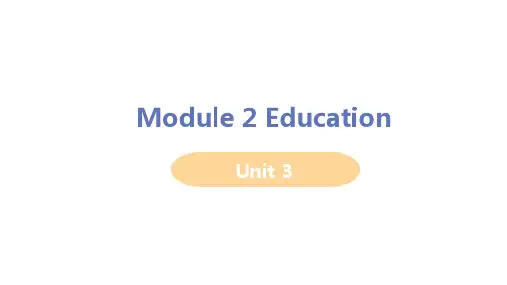
3) (a) little and (a) few a. a little and a few 表示肯定的概念, 而little and few 却表示否定的概念。 b. (a) little 用于不可数名词,
而(a) few 用于可数名词。如:
--Do you have any water? --Yes, but only a little. --Sorry, I have little myself. I can’t give you any. He has many friends, but few are true friends/ but only a few are true friends.
1) some and any a. some and any 是单数还是复数, 要看其所代替的是什么。some and any 都 既可以指人, 也可以指物, 可以表示可数的事物和人, 也可以表示不可数的概 念。如: some (any) books, some (any) money, some people, some water b. 作为代词, 它们在句中可以做主语和宾语。如:
另一方面 有时 顺便说一下 匆忙地 同时 坐飞机 名胜 在……几岁时
23. on show 24. at the beginning of 25. around your neighbourhood
展览 在……的开始 在你周围
与动词搭配
1. quarrel with 2. take care of 3. wait for 4. stop from 5. fall behind 6. make one’s way to 7. arrive at/in
但在征求对方意见,并希望得到肯定回答时,要用 some。 eg. Would you like some tea ?
外研版九年级下册英语M2U3ppt课件
true friends/but only a few are true
friends.
此外,(a) little用于不可数名词,
而(a) few用于可数名词。
可编辑版课件
13
4. both & and
both表示“两者都”,而all表示“全体, 一切”,指三者及以上,all还可以指不
可数的事物。
可编辑版课件
12
3. (a) little & (a) few
a little和a few表示肯定的概念,而little
和few表示否定的概念。
e.g. Little is known about these areas of
Mars.
He has many friends, but few are
每个人都穿夹克打领带!
可编辑版课件
7
4. We go to school every weekday _f_r_o_m__
8:45 am _to__ 3:15 pm.
周一到周王我们早上8:45上学,下午
3:15放学。
5. We have a large sports ground __f_o_r_
可数名词。可做主语和宾语。some多 用于肯定句,any多用于否定句、疑
问句和条件句。
e.g. Some of the students can speak
German.
可编辑版课件
11
2. neither & none 都表示否定意思,区别在于:neither 表示对两者的否定,而none表示对三 者及以上的否定。 e.g. I saw two boys at the door, but neither of them is my brother. None of the students in my class wants/want to take part in this trip.
2020英语外研版九年级下册Module2Education 课件
What are
like
2. ——在英国一个班级有多少个学生? ——大约三十个。 —_____ _____ ______ ___ _____ in a class in England? —_H__o_w__m_a_n__y_.pupils are there
6. 代替
___t_w_o__m__ore/another two
7. 8.
例如 首先;
尤其是_;_最__i重n_s_t要_ea的d 是of
________
such as
above all
Ⅱ. 根据汉语提示完成下列句子 1. 你认为苏茜的学校生活怎么样?
_____ do you ____ Susie’s school life?
Step 3考点·练 ①What’s your cousin like? (改为同义句)
What ____ your cousin ____ ____?
does
look like
②It’s rainy in my hometown in Summer. (对画线部 分提问) _______ the weather ____ in your hometown in S③Wu你mham能t’es想r?象十年后的你lik什e 么样子吗? Can you imagine _____ you will ___ ____ in ten years?
About twenty minutes away from her home by bike.
2. Now it’s 12: 30 pm on Friday. What might Susie be doing? _______________________ 3S.hHeomwigmhat nbye peaatrienngtsl’umncehe.tings are there every term at River School? _____
九年级英语下册外研版课件:Module 2 unit 3
Unit 3 Language in use
惊讶做某事 玩得开心 像…,…怎么样? 自己拍照 大一点 穿校服 成排地坐着 游泳池 运动场 一个很棒的游泳队 ……的数量
be surprised to do sth
enjoy oneself be like
take photos oneself
chess since primary Pete has played _________ school. 3 When do Kate and Pete have sports practice?
They have sports practice eveesday 学习目标:listening
学习目标:reading
Around the world No teachers needed?
1 The head teacher speaks to the whole √ school on Fridays. 2 The lunch break is less than one hour. 3 Students take exams in all the subjects they study. 4 Students can join more than one club. √
a bit bigger
wear school clothes
sit in rows a swimming pool a sports ground an excellent swimming team
the number of…
学习目标:phrases
1 通过考试 2 中学 3 小学 4 持续...... 5 休息 6 另外两节课 7 考试 8 例如 9 一组 10 家长会
外研版英语九年级下册Module 2《Education》(Unit 3)课件1
Maybe it's her book.
这不是我的书,上面有莉莉的名字, 或许是她的书。
old friend. 典例 The man over there is________ C He is a policeman. (重庆)
A.I
C.my
B.me
D.mine
【点拨】空格处需用形容词性物主代词修饰名词friend。
【点拨】help oneself to意为“随便吃……”。
考向三 反身代词作主语或宾语的同位语,起强调作用,
魔法 记忆
人称代词分主宾,只有八对要区分。you和it主 宾相同不用分;其他六对应记清。
考向一 考查主格。人称代词主格经常在句中作主语。
eg:She often walks to the park in the morning.
早晨她经常步行去公园。
looking young man?________is 典例 Do you see that goodA
yourself (玩得高兴) in London? 3. Did you enjoy __________
my (I) friend Susie. 4. _______ (I) went to see _______ I And ______ her school. I (I) visited _______ They (they) don’t sit in rows. 5. _______
第三人称 his, her, its his, hers, its
魔法 记忆
形容词性物主代词变为名词性物主代词口诀: 一变:my变mine;二留:his,its不变;三 s: 其他的在形容词性物主代词后加s。
外研版英语九年级下册Module 2《Education》(Unit 3)课件
Presentation
代词 ; 介词与介词短语
Presentation
Grammar 代词 代词的种类:
主格: I, you, she, he, it, we, they
1. 人称代词
宾格: me, you, her, him, it, us, them
形容词性: my, your, his, her, its,
Presentation
宾格代词(特别是me)可以作主语。 主格代词一般不单独使用, 也不用于带 not的简短回答中, 这些情况下往往用 宾格代词。 e.g. — Who wants a ride on my bike? 谁想骑我的自行车? — Me! / Not me! 我!/不是我!
Presentation
Presentation
④指距离: It’s 20 miles from here. ⑤作形式主语: It’s important for us to fight against pollution. It took me half an hour to finish the work. It’s kind of you to say so.
I
Presentation
1. 主、宾格的区分:人称代词可在句中 作主语、宾语和表语。作主语时, 人
称代词用主格形式, 作宾语和表语时
一般用宾格形式。
2. it 的用法:it 除用来代替上文中出现
的名词以外, 还可以用来表示时间、 天气、距离和重量等。
Presentation
(1) 人称代词有主格和宾格之分。人称代 词在句中作主语时用主格形式, 作宾语和 表语时一般用宾格形式。 e.g. They told us to get ready at once. 他们让我们马上准备好。 He bought very nice birthday presents for you and me. 他给你和我买了非常好的生日礼物。 — Who is it? — 是谁? — It’s me. — 是我。
九年级英语下册Module2Unit3Languageinuse课件新版外研版
5,不定代词
英语中不定代词很多, 用法也比较灵活, 这 里只介绍常用的几个。
(1)Some 和any
some 和any 都表示“一些”, 可以指人或其 他可数的东西, 也可以指不可数的东西, 可 用作主语、宾语, some 多用于肯定句, any 多用于疑问句、否定句和条件句。 例如:
__S_o_m_e_of the students can speak German .
形容词性: my your her his its our their
名词性:mine yours hers his ours
theirs
myself yourself herself himself itself ourselves yourselves themselves
some any both either neither all none each every many much few a few little a little other another one somebody nobody anybody everyone
eห้องสมุดไป่ตู้erything something anything nothing 等
what which who whom whose 等
1,人称代词 (1)主格与宾格的区分
人称代词在句中作主语时用主格形式, 作宾语和表语时 一般用宾格形式。如: _T_h_e_y_ told ___u_s_ to get ready at once . 他们让我们马上准备好。 __H_e_ bought very nice birthday presents for _y_o_u__ and _m__e__. 他给你和我买了非常好的生日礼物。 ----Who is__i_t _?是谁? -----It's____m_e_ 是我。 另外, 宾格代词(特别是me )可以作主语, 主格代词 一般不单独使用, 也不用于带not 的简短回答中, 这些情况下 往往用宾格代词。 如:
2023九年级英语下册Module2EducationUnit3教案(新版)外研版
-自主阅读预习资料:学生按照预习要求,观看视频,阅读相关资料,了解不同国家的教育体系。
-思考预习问题:学生尝试回答预习问题,记录自己的理解和新产生的疑问。
-提交预习成果:学生将自己的笔记、问题等提交至在线平台。
-教学方法/手段/资源:
-自主学习法:鼓励学生自主探索新知识,培养自主学习能力。
3.学生可能在学习过程中遇到的困难和挑战包括:对某些国家的教育体制了解不足,难以准确表达自己的观点;在讨论中可能存在词汇量不足、语法错误等问题;部分学生可能在学习过程中缺乏自信,不敢积极参与课堂活动。
针对以上分析,教师应采取适当的策略,如提供丰富的学习资源、创设互动情境、鼓励学生表达等,以帮助学生克服困难,提高学习效果。
3.观点表达题:
-题目:In your opinion, which country's education system is more effective, Finland or South Korea?
-答案:In my opinion, Finland's education system is more effective because it emphasizes student-centered learning and promotes equality.
学生学习效果
1.知识与技能:
-学生掌握了不同国家教育体系的基本特点,如课程设置、教学方法和评价标准等。
-学生能够运用所学词汇和表达方式,描述和比较不同国家的教育体系。
-学生在小组讨论和汇报中,提高了自己的口语表达能力和听力理解能力。
-学生通过完成课后作业,巩固了课堂所学知识,提升了写作能力。
2.过程与方法: