
2020中考英语第一轮复习七年级下册 Units 4-6
(二)短语
1. _a_n_y_o_t_h_e_r_n__ig_h_t__ 任何(一个)其他的夜晚 2. _a_r_r_iv_e__la_t_e_f_o_r_c_l_a_ss__ 上课迟到 3. _a_s_y_m__b_o_l_o_f_g_o_o_d__lu_c_k___ 好运的象征 4. _b_e_fo_r_e__d_in__n_e_r___ 晚餐前 5. _b_e_i_n_(_g_r_e_a_t_) _d_a_n_g_e_r 处于(极大)危险之中 6. _b_e_m__a_d_e_o_f__iv_o_r_y___ 由象牙制成 7. _b_e_o_n__ti_m_e__f_o_r_c_la_s_s_ 准时上课
→__sl_e_e_p_y______ adj. 欲睡的 →__as_l_e_e_p______ adj. 睡着的
adv. 睡着
29. __f_ri_e_n_d_l_y_____ adj. 友好的 →_k_i_n_d_______ 近义词
30. __s_h_y_________ adj. 羞怯的;腼腆的 31. __s_a_v_e________ v. 救;救助 32. __d_a_n_g_e_r______ n. 危险
9. What is / are ... doing? ……正在干什么?
10. We want to do ... 我们想做……
(四) 交际用语
一、原因和结果(Cause and effect) A. Why are you late?
How could you miss the interesting game? Why did Mary look a here with you?
→ _q_u_i_e_tl_y__ adv. 安静地 → _n_o_i_s_y___ adj. 吵闹的(反义词) 10. _p_r_a_c_t_ic_e___ v. &n. 练习
11. _b__ef_o_r_e_____ prep. & conj. 在……以前 adv. 以前
→ _a_f_t_e_r___ prep. & conj. 在……以后 12. __d_ir_t_y______ adj. 脏的
→ __c_le_a_n___ adj. 干净的 13. __r_e_la_x______ v. 放松;休息 14. __r_e_a_d______ v. 读;阅读 15. __t_e_r_ri_b_l_e___ adj. 非常讨厌的;可怕的 16. __f_e_e_l ______ v. 感觉;觉得
B. I’m late because I got up late this morning. Because of the bad weather, we went there late. Because we have been abroad, we asked her to help us. He has a lot of homework, so he will come a little late.
35. _t_a_lk__o_n__th_e__p_h_o_n_e___ 打电话;在通话 36. _u_s_e_t_h_e__co_m__p_u_t_e_r___ 使用电脑 37. _w__a_lk__o_n_t_w_o__l_eg_s____ 立着行走 38. _w__a_sh__t_h_e_c_l_o_th_e_s____ 洗衣服 39. _w__ea_r__a_h_a_t_________ 戴帽子 40. _w__ea_r__t_h_e_s_c_h_o_o_l_u_n_i_fo_r_m___ 穿校服
(三 )句型
1. Don’t do ... 不要做…… 2. —Can we ...?
—Yes, we can. / No, we can’t. —我们可以……吗? —是的,我们可以。/ 不,我们不可以。 3. Do / Does ... have to ...? …… 必须……吗?
4. ... don’t / doesn’t have to ... ……不必 ……
42. ___y_o_u_n_g_____ adj. 幼小的;年轻的 →___o_ld_______ adj. 老的(反义词)
43. ___m__is_s______ v. 怀念;司念;错过 44. ___w_is_h_______ v. 希望
→__h_o_p_e______ v. 希望 (近义词) 45. __d_e_l_ic_i_o_u_s____ adj. 可口的;美味的 46. __s_t_il_l ________ adv. 还;仍然
8. _b__e_s_tr_i_c_t_w_i_t_h_s_b_.__ 对某人要求严格 9. _b__ri_n_g__st_h_._t_o_s_o_m__e_p_l_a_c_e 把某物带到某地 10. c_u_t__d_o_w_n_________ 砍倒 11. _d_in_i_n_g__h_a_ll_______ 餐厅 12. d__o_t_h_e_d_i_s_h_e_s_____ 清洗餐具 13. d__ri_n_k__te_a_________ 喝茶 14. e_a_t__o_u_t__________ 出去吃饭 15. f_o_l_lo_w__t_h_e_r_u_l_e_s___ 遵守规则 16. g_e_t__lo_s_t__________ 迷路
The line is bad / busy. I couldn’t get through. Sorry. I’m afraid you have the wrong number.
(一)单词
1. arrive v. 到达
n. 饮料 39. ___a_n_y________ adj. 任何的;任一的
pron. 任何;任一 40. ___o_th__er_______ adj. 另外的;其他的
pron. 另外的人(或物) 41. __c_h_i_l_d______ n. 儿童
→_c_h_i_l_d_r_en____ 复数
17. __st_r_ic_t_______ adj. 严格的;严厉的 18. _r_e_m__em__b_e_r___ v. 记住;记起
→_f_o_r_g_et______ v. 忘记(反义词) 19. _f_o_l_lo_w_______ v. 遵循;跟随 20. __lu__ck_________ n. 幸运;运气
5. We / You must ... 我们 / 你(们)必须…… 6. What do / does ... have to do?
……不得不做什么? 7. —Why do you like ...?
—Because ... ——你(们)为什么喜欢……? ——因为……
8. Where is / are ... from? ……来自哪儿?
(一)单词
1. _a_r_r_i_ve___ v. 到达 2. _l_is_t_e_n____ v. 听;倾听 3. __fi_g_h_t___ v. & n. 打架;战斗 4. __s_o_rr_y_____ adj. 抱歉的;难过的;
惋惜的 5. __ou__ts_i_d_e___ adv. 在外面
→__l_u_c_k_y_____ adj. 幸运的 →__l_u_c_k_il_y____ adv. 幸运的 21. ___k_e_ep_________ v. 保持;保留 22. __l_e_a_r_n_______ v. 学习;学会 →__s_tu_d_y______ v. 同义词
23. __cu__te__________ adj. 可爱的;机灵的 24. __l_a_z_y_________ adj. 懒散的;懒惰的 25. __s_m_a_r_t________ adj. 聪明的 26. __b_e_a_u_t_if_u_l_____ adj. 美丽的;美好的 27. __s_ca_r_y_________ adj. 吓人的;恐怖的 28. __s_le_e_p_________ v. & n. 睡觉
→_d_a_n_g_e_r_o_u_s__ adj. 危险的 33. ___cu__t ________ v. 砍;切 34. ___k_i_ll_______ v. 杀死;弄死 35. ___u_s_e_______ v. 使用;运用
→__u_s_e_r______ n. 使用者
36. ___w_a_s_h______ v. 洗 37. ___j_u_s_t______ adv. 只是;恰好 38. ___d_ri_n_k______ v. 喝
二、打电话(Making telephone calls) A. Hello! May / Could I speak to David?
Hello! I’d like to speak to Mr. Depp. Is that Jenny speaking? Can I leave a message? I’ll call back later / again. I’ll ring him / her up again.
B. Hello! This is Lisa (speaking). Hello! Who’s that (speaking)? Hold the line, please. Just a moment, please. Hello! Who’s speaking? Sorry. He / She isn’t here right now. Can I take a message? Sorry. I can’t hear you.
17. _g_o__o_u_t__________ 外出(娱乐) 18. _g_o__to__th__e_m__o_v_ie_s__ 去电影院 19. _h_o_s_t_f_a_m__il_y______ 房东一家人 20. _i_n_t_h_e_h__a_ll_w_a_y_s___ 在走廊里 21. _j_o_in__m__e_f_o_r_d_i_n_n_e_r__ 跟我一起吃个饭 22. _k_e_e_p__o_n_e_’s__h_a_ir__sh_o_r_t_ 留短发 23. _k_i_n_d__o_f _in_t_e_r_e_st_i_n_g___ 有点趣味 24. _l_e_a_rn__t_o_p_l_a_y_t_h_e__p_ia_n_o___ 学弹钢琴 25. _l_is_t_e_n_t_o_m__u_s_ic_______ 听音乐
中考英语(人教新目标)一轮复习基础考点一遍过七年级(下)Units 1~4
35. according to
词形词块 拓展
补充词块
重点句式
语法
话题
1. brush my teeth; take a shower 2. does her homework and usually swims or takes a walk 3. practice the guitar; do the dishes 4. between their school and the village 5. lots of fruit and vegetables for lunch 6. it’s not good for ; tastes good 7. have to wear the school uniforms and be quiet
词形词块 拓展
补充词块
重点句式
语法
话题
1. 情态动词can表能力Ⅰ&Ⅱ(见本书P154) 2. 频度副词I(见本书P137) 3. how词组(见本书P164) 4. 祈使句(见本书P167) 5. 情态动词have to与must(见本书P154)
词形词块 拓展
补充词块
重点句式
语法
话题
Unit 1 Joining a club(加入社团/俱乐部) Unit 2 Daily routines(日常活动) Unit 3 Transportation(交通工具) Unit 4 Rules(规章制度)
28. either...or...
29. lots of/a lot of
30. between... and...
31. let’s do sth.
32. as many/much as
33. How about you?/What about you?
2024年河北中考英语复习人教版七年级下册 Units 4-6 基础知识练习(含答案)
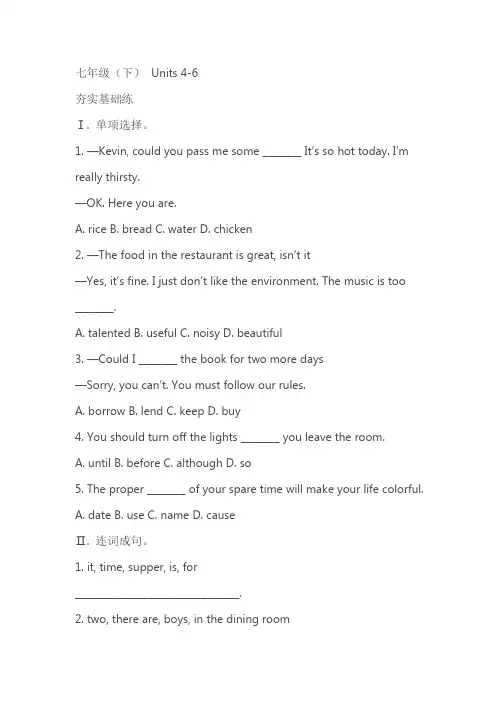
七年级(下)Units 4-6夯实基础练Ⅰ. 单项选择。
1. —Kevin, could you pass me some ________ It’s so hot today. I’m really thirsty.—OK. Here you are.A. riceB. breadC. waterD. chicken2. —The food in the restaurant is great, isn’t it—Yes, it’s fine. I just don’t like the environment. The music is too________.A. talentedB. usefulC. noisyD. beautiful3. —Could I ________ the book for two more days—Sorry, you can’t. You must follow our rules.A. borrowB. lendC. keepD. buy4. You should turn off the lights ________ you leave the room.A. untilB. beforeC. althoughD. so5. The proper ________ of your spare time will make your life colorful.A. dateB. useC. nameD. causeⅡ. 连词成句。
1. it, time, supper, is, for__________________________________.2. two, there are, boys, in the dining room__________________________________.3. eating, what, they, are_________________________________4. eating, and, chicken, are, dumplings, they__________________________________.5. carefully, they, how, washing the dishes, are__________________________________!Ⅲ. 词语运用。
2023年中考英语一轮培优试题+人教版七年级下册+Units+4-6
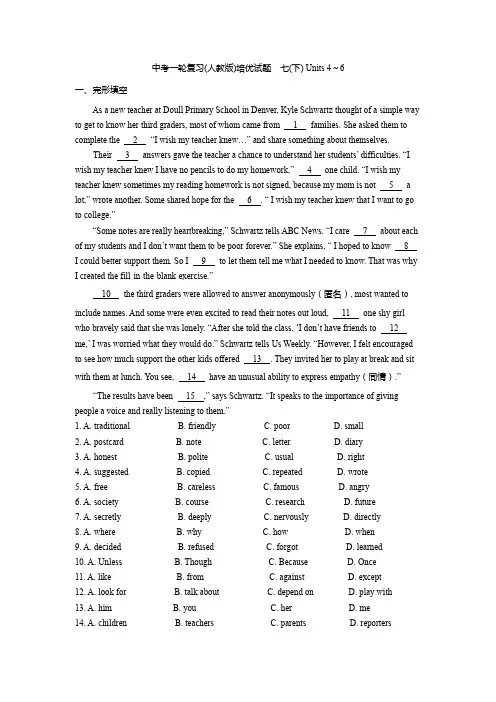
中考一轮复习(人教版)培优试题七(下) Units 4~6一、完形填空As a new teacher at Doull Primary School in Denver, Kyle Schwartz thought of a simple way to get to know her third graders, most of whom came from 1 families. She asked them to complete the 2 “I wish my teacher knew…” and share something about themselves.Their 3 answers gave the teacher a chance to understand her students’ difficulties. “I wish my teacher knew I have no pencils to do my homework,” 4 one child. “I wish my teacher knew sometimes my reading homework is not signed, because my mom is not 5 a lot,” wrote another. Some shared hope for the 6 . “ I wish my teacher knew that I want to go to college.”“Some notes are really heartbreaking,” Schwartz tells ABC News. “I care 7 about each of my students and I don’t want them to be poor forever.” She explains, “ I hoped to know 8I could better support them. So I 9 to let them tell me what I needed to know. That was whyI created the fill-in-the-blank exercise.”10 the third graders were allowed to answer anonymously(匿名), most wanted to include names. And some were even excited to read their notes out loud, 11 one shy girl who bravely said that she was lonely. “After she told the class, ‘I don’t have friends to 12 me,’ I was worried what they would do.” Schwartz tells Us Weekly. “However, I felt encouraged to see how much support the other kids offered 13 . They invited her to play at break and sit with them at lunch. You see, 14 have an unusual ability to express empathy(同情).”“The results have been 15 ,” says Schwartz. “It speaks to the importance of giving people a voice and really listening to them.”1. A. traditional B. friendly C. poor D. small2. A. postcard B. note C. letter D. diary3. A. honest B. polite C. usual D. right4. A. suggested B. copied C. repeated D. wrote5. A. free B. careless C. famous D. angry6. A. society B. course C. research D. future7. A. secretly B. deeply C. nervously D. directly8. A. where B. why C. how D. when9. A. decided B. refused C. forgot D. learned10. A. Unless B. Though C. Because D. Once11. A. like B. from C. against D. except12. A. look for B. talk about C. depend on D. play with13. A. him B. you C. her D. me14. A. children B. teachers C. parents D. reporters15. A. boring B. surprising C. worrying D. relaxing二、阅读理解AIt's 2050.The Earth is dying,and moving to Mars seems to be the only way out for humans.A team of American astronauts(宇航员)begin to searchon Mars.This is what the movie Red Planet begins with.Known as the RedPlanet,Mars is the favourite of writers and filmmakers.Mars is the fourth planet from the Sun and the next planet beyond the Earth.Mars is the only planet whose surface can be seen from the Earth.It is about half size of our planet.The surface of Mars is more like the Earth than any other planet.But it is further from the Sun than the Earth,so temperatures on Mars are much lower.Plants and animals can not live now on Mars.But many scientists still believe that such life may have been on Mars long ago.On 6th August,1996,scientists discovered a piece of rock from Mars,which fell to the Earth 13,000 years ago.10 years later,some scientists still didn't accept that there was life on Mars.P eople may not be sure about life on Mars until a sample(样本)of life is brought back.Some further researches are being done in many countries. If you want to know more, please click .16.Why is the movie Red Planet mentioned?A.To introduce the topic.B.To advise readers to go to Mars.C.To compare Mars with the Earth.D.To tell stories about American astronauts.17.What do we know about Mars?A.Mars is as big as the Earth in size.B.Mars is the fourth planet from the Earth.C.The surface of Mars is similar to that of the Earth.D.Mars is one of the planets whose surfaces can be seen from the Earth.18.No life exists on Mars because.A.it is too softB.it is too farC.it is too smallD.it is too cold19.What did scientists find from Mars in 1996?A.Some plants.B.Some animals.C.A piece of rock.D.Some water.20.The passage is most probably taken from.A.a noticeB.a websiteC.a diaryD.a tour guideBIt’s hard to find a person who doesn’t like traveling. The human’s hopes to explore(探索)new areas drive us to visit new countries and discover new places. It’s a pity that it is impossible toexplore every corner of the world even if you travel the whole life. So people search travel articles to learn more.If you want to become a travel writer who helps people to choose a trip, you should know how to create an article about traveling experience. Maybe the following can help you.Read different resources(资源). Do you want to improve your skills and do great writings? Start by exploring how experts do. Start following famous travel writers and discover how they engage readers. Also, it will help you to know about the latest news in the traveling.For sure, anyone can create a blog(博客)about traveling. But the top travel writers don’t create articles according to stories of other people. They make every trip by themselves and share their experience in their articles. If you want to become a successful writer, you should have a large background in traveling. So you can create original(原创)articles and share your traveling secrets with your readers.Don’t forget about your opinions when you discover how to write a travel article. If you want to copy someone’s story, you can rewrite it and collect a few points. But if you’re going to become a famous travel writer, you need to create original articles. Feel free to share your opinions and feelings.Being a travel writer is exciting. You have to travel, explore new areas and share your experience with readers.21. The Chinese meaning of the word “engage” is____________.A. 聘请B. 吸引C. 告诚D. 利用22. If you want to improve your writing skills, you should____________.A. explore how experts doB. visit new areasC. discover more readersD. report the latest news23. According to Paragraph 4, a top travel writer should____________.A. create a blog about readingB. write articles about others’ storiesC. become an experienced travelerD. share other people’s traveling secrets24. According to Paragraph 5, we know a famous travel writer____________.A. should often copy someone’s storyB. usually rewrites some body’s travel articlesC. only shares others’ experience and feelingsD. should always have their own opinions25. This passage mainly tells us____________.A. why people search travel articles to learn moreB. why people want to become a travel writerC. how to write a good article about your travelingD. how to travel, explore new areas and share your experienceCDr. Dolittle lived in a small town called Puddleby. Everyone in the town knew him. The dog and children ran after him.He lived in a small house, but he had a large garden. He kept many animals in his garden. His favorite animals were Dab-Dab, a duck; Jip, a dog; Gub-Gub, a baby pig and Polynesia, a parrot. He also kept some fish, rabbits, cats, a squirrel, a cow and a baby cow, a horse, chickens and so on.Dr. Dolittle didn't have many patients. Most people didn't like all of his animals, so when they were ill, they went to a doctor in another town."But you don’t have any money, "his sister told him. “You need patients.”“I have a patient, " Dr. Dolittle answered, “The cat's-meat-man. He's the man who sells me meat for the cat.”“He doesn’t pay you enough to live on, " his sister told him.“Then I’ll sell everything I have,” he said.And he did. He sold most of his furniture. He also sold most of his clothes. Then he had enough money to buy food for himself and his animals.One day, the cat's-meat-man said to him, " Why don't you stop being a doctor for people and become a doctor for animals instead? I’m sure that you know a lot about animals — more than most vets. You wrote a wonderful book about cats. I’d send all the people with sick dogs or cats to you.”When the cat’s-meat-man left, Polynesia, the parrot, flew onto the table. “He’s right, Doctor,” Polynesia said. “You should become an animal doctor.”“There are a lot of vets,” Dr, Dolittle said.“Perhaps there are a lot of vets. But you'd be the best vet of all. I'm not the only animal that can talk. All the animals can talk. Each kind of animal has its own language. I'll teach you mine if you like.”“Yes, please,” Dr. Dolittle said. He opened a drawer (抽屉) and took out a notebook and pencil. “Will you teach me the parrot's ABCs first?” he asked.Polynesia agreed to teach Dr. Dolittle parrot language. Later that day, Jip came into the room. Polynesia said, "He’s talking to you, Doctor."“I don't think he is,” Dr. Dolittle said. “He’s just cratching(挠) himself.”“Dogs talk with their ears, their noses, and their tails,” Polynesia told him. They don't always make a noise. Do you see how he is moving his nose now?”“Yes.”“He is telling us that it has stopped raining, and he wants to ask you a question.”Every day, Dr. Dolittle learned the languages of the animals. When people found out he was now an animal doctor, they brought their sick pets to him.One day, a horse said to him, " You’re a much better animal doctor than the vet. You knew Icouldn't see well, and you made glasses for me.”The horse was very pleased. He could see very well. He told all his friends how clever Dr. Dolittle was, and they told all their friends. Soon, many animals came to see him. He had a different door for each animal, and he wrote the name of each kind of animal above each door. HORSES, COWS,...Before long, every animal that lived in or near the town became the doctor’s patient. He was very happy, and he liked his life very much.(Adapted from The Story of Dr. Dolittle)26. What were Dr. Dolittle’s favourite animals?① a duck, cats ① a baby pig, a parrot ① a duck, a dog ① a parrot, rabbitsA. ①①B. ①①C. ①①D. ①①27. Why did most people go to a doctor in another town when they were ill?A. Because Dr Dolittle was impolite to them.B. Because they didn't like all of Dr. Dolittle's animals.C. Because the doctor in another town was very famous.D. Because Dr. Dolittle was busy looking after his animals.28. Which is the correct order of what happened to Dr. Dolittle in the story?a. Dr. Dolittle learned the languages of the animals.b. Dr. Dolittle sold most of his furniture and clothes.c. Animals in or near the town became Dr. Dolittle's patients.d. Polynesia flew onto the table and taught Dr. Dolittle parrot language.A. d-a-c-bB. b-d-a-cC. b-a-d-cD. d-c-b-a29. Who told all his friends that Dr. Dolittle was a clever animal doctor?A. A parrot.B. A cow.C. A horse.D. A duck.30. What can we learn from the passage?A. Dr. Dolittle only talked to his parrot.B. Dr. Dolittle had much money at first.C. Dr. Dolittle was very happy in the end.D. Dr. Dolittle was liked by everyone in the town.DChina gets greenerPresident Xi Jinping said "clear waters and lush mountains are invaluable assets(绿水青山就是金山银山)". With the efforts of China's government and its people, the rate of forest coverage(森林覆盖率)in China has reached 22. 96%, compared to 5. 05% forty years ago,according to a recent report from the State Forestry and Grassland Administration (SFGA).Over the past forty years, China planted billions of trees as part of its fight againstexpanding(延伸的)deserts, mostly in its north. Each year, people sow seedlings(播种)over an areanearly the size of Ireland, according to Nature.In 1978, China began a nationwide tree-planting programme known as the Three North Shelterbelt Forest Programme, also known as "the Great Green Wall". It has helped to plant more than 66 billion trees across 13 provinces in the country's north to act as windbreaks(防风林), according to China Daily.Since 2018, SFGA has made more efforts to build a greener country. Its purpose is to grow at least 6. 7 million hectares(公顷)of forest every year in the next 15 years. Besides planting more trees, China has tried to bring back grasslands. It has also used strict forest protection methods and banned(禁止)all commercial logging(商业伐木)since last August.The high-speed growth of forests cannot happen without public participation(参与). For example, Ant Forest, an Alipay mobile payment app, plants real tees for users who get "green energy" by taking part in low-carbon(低碳)activities. Since 2016, it has helped to plant about 122 million trees in China's driest areas.China was praised as "one of the most successful countries worldwide in greening the desert" by United Nations Environment Programme Executive Director Erik Solheim.31. What was the rate of forest coverage forty years ago?A. 5. 05%.B. 17. 91%.C. 22. 96%.D. 28. 01%.32. Over the past forty years, China has planted billions of trees to ________.A. turn deserts into green landB. create a green area in the desertC. stop deserts from expandingD. build an area nearly the size of Ireland33. Which of the following is TRUE according to the passage?A. Windbreaks have covered across all provinces of China.B. In 1978, China succeeded in building "the Great Green Wall.C. China has grown 6. 7 million hectares of forest since 2018.D. Since 1978, over 66 billion trees have been planted to act as windbreaks.34. What did China do to build a greener country?A. Tried to bring back grasslands.B. Made strict forest protection methods.C. Banned commercial logging.D. All of the above.35. What can we learn from the last two paragraphs?A. Ant Forest plants real trees for all Chinese people.B. Everybody can help build a greener country.C. China's forest coverage is the highest in the world.D. China was praised for no deserts in northern China.三、语法填空阅读下面短文, 在空白处填入适当的内容(不多于3个词)或括号内单词的正确形式。
七年级下册 Units 4~6-2023中考英语四轮总复习(人教新目标版)(学生版)

课时04七年级下册Units 4~6高频考点突破考点1 Don't arrive late for class. 上课不要迟到。
The singer arrived in (reached/got to) Sweden the day before yesterday.这位歌手前天到达瑞典。
考点2And we always have to wear the school uniform. 而且我们必须一直穿校服。
考点3Oh, and we also have to be quiet in the library. 哦,而且我们在图书馆也必须保持安静。
考点4Practice the guitar.练习吉他。
考点5There are too many rules! 太多规则了!考点6Parents and schools are sometimes strict, but remember, they make rules to help us. 父母和学校有时是严厉的,但是记住,他们制定规则是为了帮助我们。
Remember to buy a magazine when you come back. 当你回来的时候记得买本杂志。
Do you remember turning off the lights?你记得关灯了吗?She forgot calling me, so she called me again.她忘记给我打过电话了,所以她又给我打了一个。
She forgot to call me.她忘记了给我打电话。
后面可跟动名词,也可跟动词不定式,但意义上相差很大的动词还有stop, go on, need 等。
⎩⎪⎨⎪⎧stop doing sth. 停止做某事stop to do sth. 停下(正在做的事)去做另一件事 ⎩⎪⎨⎪⎧go on doing sth. 接着做某事go on to do sth. 接着做另一件事⎩⎪⎨⎪⎧need to do 需要做……(表示主动,主语为人)need doing =need to be done 需要被做(表示被动,主语为物)考点7At school, I have to wear a school uniform, and I must keep my hair short. 在学校,我不得不穿校服,而且我必须保持短发。
2023年中考英语一轮复习 第三课时 七年级下册(Unit 1_Unit 4)课件

A.neither
B.either
C.too
D.also
③(2021·凉山州)Without trees,many animals cannot live on the earth.It’s not easy
for man to live on the earth,e ither .
考点9 表示交通方式的常用句型 ①询问交通方式的常用句型: How do/does sb.go/get (to)...? 某人如何去……?
( B )①Either you or he
right.
A.are
B.is
C.was
D.were
( D )②(原创)He is good at basketball.He is
good at volleyball for he
has been in volleyball team for almost 2 years.
②如果你不知道事实,请保持沉默。 If you don’t know the truth,please keep silent .
考点5 辨析between与among
词条
用法
between 表示两者之间,也可表示三者或三者以上的人或物中的每两者之间。
among 表示三者或三者以上的人或物之间。 eg:She is sitting between Jane and Mary. 她正坐在Jane和Mary之间。 She is sitting among the children. 她正坐在孩子们之间。
—Yes,she always
her time with me whenever I need her.
2023年安徽省中考英语总复习第一轮复习:教材知识精讲:七年级(下) Units 1~4

(3)I’m afraid(that)…用来有礼貌地表达可能令人不愉快的消息。如: I’m afraid that he can’t come.恐怕他来不了了。
(4)用于一些固定句型中。如: I’m afraid so/not.恐怕是这样。/恐怕不行。
即时小练
23.Please hurry up! I’m afraid ___ we will be late for the
用于肯定句、疑 问句
用法 较正式,放于实义动词之前,系动词、 助动词、情态动词之后
too either
用于肯定句、疑 问句
用于否定句
较口语,放于句末,可用逗号隔开,也 可不用,不用时同as well 只能放于句末,可用逗号隔开,也可不 用。
as well 用于肯定句
放于句末,可与too互换,不用逗号
C.on
D.of
8.Tom has already learned how to ___ himself now.
A.test
√B.dress
C.keep
D.risk
9.As a teacher, I really feel worried to see so many students
___ glasses.
25.Phillips used to be a_f_r_a_id__(害怕的) to talk in public, but
now he can express his own thoughts to others.
考点7 remember的用法
Parents and schools are sometimes strict, but remember, they make rules to help us. 父母和学校有时很严厉, 但是要记住, 他们制定规则是为了帮助我们。 (Unit 4 P23)
初三一轮复习7下(4-6)
eg:Kobe is famous as a basketball player. 科比作为一名篮球运动员而著名。
5. be able to 能、会
6. free time 空闲时间
7. come true 实现
8. all year﹙around﹚整年
9. as well 也﹙肯定句句末,前面无逗号﹚
10. not… any more 不再…
11. by email 通过电子邮件
12. ask a question 问问题
4.辨析few与little a few 一些,几个(后跟可数名词)a little 一些,一点儿(不可数) eg:a few apples 一些苹果 a little water 一点儿水
5.辨析receive与accept
receive表示“收到,接到”指客观上被动的,强调动作,但并不意味着 同意接受
13. the change of weather 天气的变化
14. do light and easy work 做轻松简单的工作
三、重点句型
1. be able to +动词原形 能/会做...
2. not … any more 不再... Tony doesn′t play football any more.托尼不再踢球了。
把雨伞。 ③fetch意为“去取来某物”,它包括一个往返的过程。 eg:Will you go and fetch some water? 你去取一点水来,好吗? ④carry一般指“随身携带的细小物品”,此外还多用于汽车、火车等交通工具意为“运
Units 1— 4(七下) 词汇检测-中考英语人教版一轮复习
Units 1— 4(七下)词汇检测重点单词·Unit 11.n.吉他2.n.国际象棋3.v.参加;加入4.n.演出;节目v.给……看;展示5.n.小提琴6.n.人;人们7.n.家;活动本部adv.到家;在家8.adv.在今天9.n.钢琴10.n.周末·Unit 211.adv.通常地;一般地12.adv.从不;绝不13.v.& n.工作14.n.晚上;夜晚15.v.& n.锻炼;练习16.n.群;组17.n.一刻钟;四分之一18.n.家庭作业19.adv.有时20.v.有……的味道;品尝n.味道;滋味21.adj.&adv.早·Unit 322.火车23.n.地铁24.num.一百25.n.分钟26.v.居住;生活27.n.河;江28.prep.介于……之间29.n.桥30.n.小船31.n.梦想;睡梦v.做梦32.adj.新的·Unit 433.n.规则;规章34.v.到达35.n.大厅;礼堂36.v.听;倾听37.adv.在外面adj.外面的38.v.& n.练习39.prep.& conj.在……以前adv.以前40.adj.脏的41.v.读;阅读42.adj.严格的;严厉的43.v.记住;记起44.v.遵循;跟随45.n.厨房词汇拓展·名词1.story故事;小说→(复数)*tell stories/a story讲故事→(复数)3.tooth牙齿→(复数)*brush teeth 刷牙4.life生活;生命→(复数)*save/lose one’s life 拯救/丢掉某人的性命*live a(n)+adj.+life 过着……的生活*change one’s life 改变某人的生活5.village村庄;村镇→(n.)村民6.dish碟;盘→(复数)*do the dishes 洗餐具7.center中心;中央→(adj.)中心的8.luck幸运;运气→(adj.)幸运的→(adj.)不幸的→(adv.)幸运地→(adv.)不幸地9.half一半;半数→(复数)·动词10.sing唱歌→(过去式)→(过去分词)→(n.)歌手*sing a song/songs 唱歌11.swim游泳→(过去式)→(过去分词)→(n.)游泳者*go swimming 去游泳12.dance v.跳舞n.舞蹈→(n.)跳舞者13.draw画→(过去式)→(过去分词) *draw a picture/pictures 画画14.tell讲述;告诉→(过去式)→(过去分词) →(现在分词) *to tell the truth 说实话*tell sb. sth. 告诉某人某事*tell sb. (not) to do sth.告诉某人(不要)做某事15.write写作;写字→(过去式)→(过去分词) →(n.)作家*write down 写下;记下*write to sb. 给某人写信16.teach教;讲授→(过去式)→(过去分词) →(n.)老师*teach sb. to do sth. 教某人做某事*teach sb. a lesson 给某人一个教训*teach oneself 自学17.run跑;奔→(过去式)→(现在分词)→(n.)跑步者*run out (of) 用尽;用完*run away 跑开*run away from 逃离……18.clean v.打扫;弄干净adj.干净的→(n.)清洁工19.ride v.骑n.旅程→(过去式)→(过去分词) 20.drive开车→(过去式)→(过去分词)→(n.)司机*drive sb. mad 使人发狂21.leave离开;留下→(过去式)→(过去分词)*leave sb./sth. behind把某人/物抛在后面*leave a message 留言*leave for sp.动身去某地22.fight打架;战斗→(过去式)→(过去分词)→(n.)战士*fight for… 为……而战*fight against sb./sth. 奋力抵抗某人/物*fight with sb. 和某人打架23.wear穿;戴→(过去式)24.bring带来;取来→(过去式)→(过去分词)*bring up 抚养;养育*bring out 使显现25.feel感受;觉得→(过去式)→(过去分词)→(n.)感觉26.keep保持;保留→(过去式)→(过去分词)→(n.)饲养员*keep in mind 记住*keep away from sb./sth. 远离某人/物*keep up with 追上;赶上*keep (sb.) doing sth. (让某人)一直做某事27.learn学习;学会→(n.)学习者*learn from 向……学习*learn to do sth. 学习做某事28.cross横过;越过→(prep.)→(n.)十字路口29.relax放松;休息→(adj.)放松的→(adj.)令人放松的30.like喜欢;喜爱→(反义词)*look like看起来像*sound like听起来像·形容词、副词31.fun adj.有趣的;使人快乐的n.乐趣;快乐→(adj.)→(比较级)→(最高级)32.quick快的;迅速的;时间短暂的→(adv.)33.true真的;符合事实的→(n.)→(adv.)*come true 实现34.quiet安静的→(adv.)35.many许多→(比较级)→(最高级)36.good/well好的/好;令人满意地→(比较级)→(最高级)37.far远;远的→(比较级)→(最高级)38.terrible非常讨厌的;可怕的→(adv.)非常;极度地短语句型过关短语归纳·动词短语1.下国际象棋2.说英语3.弹吉他/钢琴4.5.拉小提琴6.敲鼓7.交朋友8.在某方面帮助某人9.加入俱乐部10.起床11.穿上衣服12.吃早餐13.洗淋浴14.去上学15.做作业16.上床睡觉17.散步18.做运动19.乘地铁20.骑自行车21.步行去上学22.实现;变成现实23.听音乐24.做早饭25.想起;认为26.制定规则27.遵守规则28.铺床29.外出(娱乐)30.去上班31.思考;思索·介词短语32.在周末33.按时34.放学后35.36.骑自行车37.及时38.在食堂·形容词短语39.擅长40.善于应付……的;对……有办法41.大量的;许多42.(对某人)要求严格43.对……有益/有好处44.害怕……写作积累·人物活动1.晚上,她做她的家庭作业,并且经常会游泳或者散步。
2020届中考英语总复习知识梳理七年级下Units 4-6
第4讲七年级下Units 4-6 1.重点单词(1)规则;规章: rule (2)到达: arrive(3)hall: 大厅;礼堂(4)听;倾听: listen(5)fight: 打架;战斗(6)sorry: 抱歉的;难过的;惋惜的(7) outside:adv.在外面adj.外面的(8)穿;戴: wear(9)重要的: important (10)带来;取来: bring(11)校服;制服: uniform (12)安静的: quiet(13)out: 外出(14)练习: practice(15)碟;盘: dish (16)before prep.: 在……以前adv.以前(17)脏的: dirty (18)厨房: kitchen(19)更多的: more (20)吵闹的: noisy(21)放松;休息: relax (22)读;阅读: read(23)非常讨厌的;可怕的: terrible (24)感受;觉得: feel(25)严格的;严厉的: strict (26)记住;记起: remember(27)遵循;跟随: follow (28)幸运;运气: luck(29)keep: 保持;保留(30)hair: 头发;毛发(31)学习;学会: learn (32)熊猫: panda(33)动物园: zoo (34)老虎: tiger(35)大象: elephant (36)狮子: lion(37)长颈鹿: giraffe (38)动物: animal(39)可爱的;机灵的: cute (40)懒散的;懒惰的: lazy(41)聪明的: smart (42)beautiful: 美丽的;美好的(43)kind: 种类(44)澳大利亚: Australia(45) south:adj.南方的n.南;南方(46)非洲: Africa(47)宠物: pet (48)腿: leg(49)猫: cat (50)睡觉: sleep(51)友好的: friendly (52)羞怯的;腼腆的: shy(53)救;救助: save (54)旗;旗帜: flag(55)忘记;遗忘: forget (56)地点;位置: place(57)水: water (58)危险: danger(59)砍;切: cut (60) down:(坐、躺、倒)下(61)tree: 树(62)杀死;弄死: kill(63) over:超过;多于;在……上方(64)报纸: newspaper(65)使用;运用: use (66)soup: 汤(67)洗: wash (68)电影: movie(69)just: 只是;恰好(70)house: 房子(71) drink:v.喝n.饮料(72)tea: 茶;茶叶(73) tomorrow:adv.在明天n.明天;未来(74)游泳池;水池: pool(75) shop:v.购物n.商店(76)超市: supermarket(77)man: 男人;人(78)race: 竞赛(79)学习;研究: study (80)洲: state(81) American:adj.美国的;美洲的n.美国人;美洲人(82) any:adj.任何的.任一的pron.任何;任一(83) other:adj.另外的;其他的pron.另外的人(或物)(84)幼小的;年轻的: young (85)儿童: child(86)怀念;思念: miss (87)希望: wish(88)可口的;美味的: delicious (89)still: 还;仍然2.重点短语(1)(be) on time: 准时(2)dining hall: 餐厅(3)listen to...: 听……(4)go out: 外出(娱乐)(5)do the dishes: 清洗餐具(6)make (one s) bed: 铺床(7)be strict (with sb): (对某人)要求严格(8)follow the rules: 遵守规则(9)kind of: 稍微;有点儿(10)South Africa: 南非(11)get lost: 迷路(12)be in (great) danger: 处于(极大)危险之中(13)cut down: 砍倒(14)(be) made of: 由……制成的(15)read a newspaper: 看报纸(16)make soup: 做汤(17)go to the movies: 去看电影(18)eat out: 出去吃饭(19)drink tea: 喝茶(20)the United States: 美国;美利坚合众国(21)Dragon Boat Festival: 端午节(22)living room: 客厅3.重点句子(1)Don t eat in the classroom.不准在教室里吃东西。
2020年中考英语分册复习七下Units4_6课件人教新目标版
23. __cu__te__________ adj. 可爱的;机灵的 24. __l_a_z_y_________ adj. 懒散的;懒惰的 25. __s_m_a_r_t________ adj. 聪明的 26. __b_e_a_u_t_if_u_l_____ adj. 美丽的;美好的 27. __s_ca_r_y_________ adj. 吓人的;恐怖的 28. __s_le_e_p_________ v. & n. 睡觉
(三 )句型
1. Don’t do ... 不要做…… 2. —Can we ...?
—Yes, we can. / No, we can’t. —我们可以……吗? —是的,我们可以。/ 不,我们不可以。 3. Do / Does ... have to ...? …… 必须……吗?
4. ... don’t / doesn’t have to ... ……不必 ……
(一)单词
1. _a_r_r_i_ve___ v. 到达 2. _l_is_t_e_n____ v. 听;倾听 3. __fi_g_h_t___ v. & n. 打架;战斗 4. __s_o_rr_y_____ adj. 抱歉的;难过的;
惋惜的 5. __ou__ts_i_d_e___ adv. 在外面
B. I’m late becauof the bad weather, we went there late. Because we have been abroad, we asked her to help us. He has a lot of homework, so he will come a little late.