
不定代词(the_indefinite_pronoun)用法
语法难点精析之非谓语动词(1)非谓语动词主要包括不定式、的动名词和现在分词。
为了区分这三种不同的非谓语动词的用法和含义,我们将分别从三种非谓语动词在句子中做主语、的宾语、的宾语补足语、的定语、的状语、的表语以及一些特殊结构句型等角度来区分其用法和细微含义。
1.不定式和动名词作主语的区别(1)动名词作主语通常表示抽象动作;而不定式作主语表示具体动作。
Smoking is prohibited(禁止)here.这里禁止抽烟。
(抽象)It is not very good for you to smoke so much.你抽这么多烟对你身体很不好。
(具体)(2)动名词作主语时,通常用以表示一件已知的事或经验。
不定式短语通常用来表示一件未完成的事或目的。
Climbing mountains is interesting.爬山很有趣。
(经验)Driving a car during the rush hour is tiring.在高峰时刻开车令人厌烦。
(经验)(3)不定式做主语,一般用it当形式主语,把作主语的不定式短语后置。
It took me only five minutes to finish the job.2.不定式、的动名词和分词作表语的区别(1)不定式作表语1)不定式作表语一般表示具体动作,特别是表示将来的动作。
To do two things at a time is to do neither.--次做两件事等于未做。
What I would suggest is to start work at once.我的建议是立刻开始干。
2)如果主语是不定式(表示条件),表语也是不定式(表示结果)。
To see is to believe.百闻不如一见。
To work means to earn a living.工作就是为了生活。
3)如果主语是以aim,duty,hope,idea,happiness,job,plan,problem,purpose,thing,wish等为中心的名词,或以what引导的名词性从句,不定式作表语是对主语起补充说明作用。
His wish is to buy a luxurious car in the near future.他的希望是在不远的将来买一辆豪华轿车。
The function of Lo uis Sullivan’s architecture was to provide large uninterrupted floor areas and to allow ample light into the interior.The most important thing is to negotiate with them about the future of the plant.语法难点精析之非谓语动词(2)(2)动名词作表语:动名词作表语,表示抽象的一般性的行为。
Our work is serving the people.我们的工作是为人民服务。
His hobby is collecting stamps.他的爱好是集邮。
(注)动名词作表语时与进行时态中的现在分词形式相同,但其所属结构迥异,进行时态说明动作是由主语完成的。
动名词做表语,说明主语的性质或情况。
People cannot but feel puzzled,for they simply cannot understand how he could have made such a stupid mistake.His victory in the final was no more convincing than I had expected.(3)分词作表语分词做表语有两种情况,一种是现在分词做表语,一种是过去分词做表语,这两者区别是考试中经常考到的地方。
一般来说,表示心理状态的动词如excite,interest等都是及物动词,汉语意思不是“激动”,“高兴”,而是“使激动”、的“使高兴”,因而现在分词应该是“令人激动的”、的“令人高兴的”,过去分词则是“感到激动的”和“感到高兴的”。
所以,凡表示“令人……的”都是-ing形式,凡是表示“感到……”都用-ed形式。
换句话说,若人对……感兴趣,就是somebody is interested in...,若人/物本身有兴趣时,就是说sb./sth. is interesting.这类词常见的有:interesting使人感到高兴--interested感到高兴的exciting令人激动的--excited感到激动的delighting令人高兴的--delighted感到高兴的disappointing令人失望的--disappointed感到失望的encouraging令人鼓舞的--encouraged感到鼓舞的pleasing令人愉快的--pleased感到愉快的puzzling令人费解的--puzzled感到费解的satisfying令人满意的---satisfied感到满意的surprising令人惊异的--surprised感到惊异的worrying令人担心的--worried感到担心的Traveling is interesting but tiring.旅行是有趣的,但是使人疲劳。
The pupils will get confused if they are made to learn too much.如果要学生学得太多,他们会感到糊涂的。
The argument is very convincing.他的论点很令人信服。
They were very excited at the news.听到这个消息,他们非常激动。
GCT英语非谓语动词练习1. in a simple style, the book clearly describes the author’s childhood experiences in a small town.A. WritingB. To be writtenC. Being writtenD. Written2. I really appreciate to help me, but I am sure that I can manage it myself.A.you to come B.that you come C.your coming D.how you come3. Australia the Asians have made their influence in businesses,large and small.A. feelingB. feelC. feltD. to be felt4. Susan will come to watch him ____ ___ at Wimbledon this week.A. playedB. playC. to playD. playing5. The issue _______ at the conference is very important and it will create a sensation nationwide.A. discussedB. being discussedC. is being discussedD. has been discussed6. Weather ,there will be an open air party with live music here this weekend.A.permits B.should permit C.will permit D.permitting7. If the work by the end of this month is delayed,the construction company will be heavily fined.A. is completedB. to be completedC. will have been completedD. will be completed8. The manager promised to keep me of how our business was going on.A. informedB. informingC. to be informedD. having informed9. Radios today seldom need _____ or the attention of a technician.A. to repairB. repairedC. repairingD. to have repaired10. Far too many owners of electric appliances have a hard time qualified repairmen to fix their machines.A.finding B.to find C.to finding D.having found答案:D C C B B D B A C A非谓语动词的用法小结(1)一、解析非谓动词作主语1.不定式作主语。
如:To say is easier than to do.it作形式主语而将其后置。
如上例可改为:It is easier to say than to do.2.动名词作主语。
如:Walking after supper is good for both young and old.二、解析非谓语动词作表语1.不定式作表语。
如:What I can do is to give you some reasonable advice.The library books are not allowed to be taken away.动式,与其最近的动词采用原形。
2.动名词作表语。
如:His job is teaching.The most famous writings in the world are worth reading.如上例可改为:Teaching is his job.3.分词作表语。
如:The film is interesting, and my sister gets interested in it.作主语,译为“某物怎么样”;过去分词作表语,表示主语所处的心理状态,主语和表语之间存在被动关系,并且常以人作主语,译为“某人感到怎么样”。
具有这一用法的有:surprise, interest, touch, move, puzzle, excite, tire, please, disappoint, satisfy, encourage等。
英语语法常用词汇
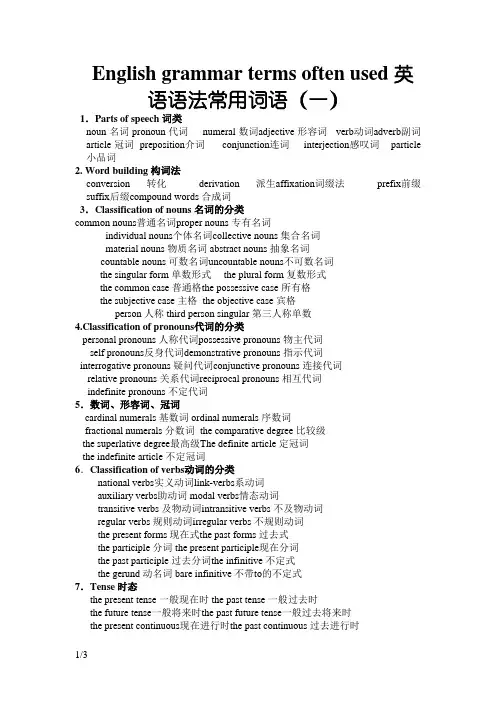
English grammar terms often used 英语语法常用词语(一)1.Parts of speech 词类noun 名词 pronoun 代词 numeral 数词adjective 形容词 verb动词adverb副词article 冠词 preposition介词 conjunction连词 interjection感叹词 particle 小品词2. Word building 构词法conversion 转化derivation 派生affixation词缀法prefix前缀suffix后缀compound words 合成词3.Classification of nouns 名词的分类common nouns普通名词proper nouns 专有名词individual nouns个体名词collective nouns 集合名词material nouns 物质名词 abstract nouns 抽象名词countable nouns 可数名词uncountable nouns不可数名词the singular form 单数形式 the plural form 复数形式the common case 普通格the possessive case 所有格the subjective case 主格 the objective case 宾格person 人称 third person singular 第三人称单数4.Classification of pronouns代词的分类personal pronouns 人称代词possessive pronouns 物主代词self pronouns反身代词demonstrative pronouns 指示代词interrogative pronouns 疑问代词conjunctive pronouns 连接代词relative pronouns 关系代词reciprocal pronouns 相互代词indefinite pronouns 不定代词5.数词、形容词、冠词cardinal numerals 基数词 ordinal numerals 序数词fractional numerals 分数词 the comparative degree 比较级the superlative degree最高级The definite article 定冠词the indefinite article 不定冠词6.Classification of verbs动词的分类national verbs实义动词link-verbs系动词auxiliary verbs助动词 modal verbs情态动词transitive verbs 及物动词intransitive verbs 不及物动词regular verbs 规则动词irregular verbs 不规则动词the present forms 现在式the past forms 过去式the participle 分词 the present participle现在分词the past participle 过去分词the infinitive 不定式the gerund 动名词 bare infinitive 不带to的不定式7.Tense 时态the present tense 一般现在时 the past tense 一般过去时the future tense一般将来时the past future tense一般过去将来时the present continuous现在进行时the past continuous 过去进行时the future continuous 将来进行时 the past future continuous过去将来进行时the present perfect 现在完成时the past perfect过去完成时the future perfect 将来完成时the past future perfect 过去将来完成时the present perfect continuous现在完成进行时the future perfect continuous 将来完成进行时the past future perfect continuous 过去将来完成进行时8.Voice 语态、Mood 语气the passive voice 被动语态the active voice 主动语态the indicative mood 陈述语气the imperative mood 祈使语气the subjunctive mood 虚拟语气9.Classification of adverbs副词的分类adverbs of place 地点副词adverbs of time 时间副词adverbs of degree程度副词adverbs of manner 方式副词adverbs of frequency频度副词relative adverbs 关系副词interrogative adverbs 疑问副词 conjunctive adverbs连接副词10. Members of the sentence 句子成分the subject 主语the predicate 谓语the predicative 表语the object 宾语the attribute 定语the adverbial 状语 the appositive 同位语independent elements 成分the direct object 直接宾语the indirect object 间接宾语 parenthesis 插入语the double possessive 双重所有格the formal subject/object 形式主语/宾语subject complement 主语补足语 object complement 宾语补足语11.Classification of sentences句子的分类declarative sentences 陈述句 imperative sentences 祈使句exclamatory sentences感叹句interrogative sentences 疑问句general questions 一般疑问句 special questions 特殊疑问句alternative questions选择疑问句 disjunctive questions 反意疑问句tap questions 附加疑问句 simple sentences 简单句compound sentences 复合句 complex sentences 并列句elliptical sentences 省略句 phrase 短语 preposition phrases 介词短语 infinitive phrases 不定式短语 the question word 疑问词12.Clauses 从句main clauses 主句subject clauses 主语从句object clauses宾语从句direct speech 直接引语indirect speech 间接引语predicate clauses 谓语从句predicative clauses 表语从句 attributive clauses定语从句restrictive attributive clauses 限定性定语从句theantecedent 先行词non-restrictive attributive clauses 非限定性定语从句appositive clauses同位语从句adverbial clauses状语从句adverbial clauses oftime/place/cause/condition/degree/result/concession/purpose/comparison /manner 时间/地点/原因/条件/程度/结果/让步/目的/比较/方式状语从句sentences of real condition真实条件句sentences of unreal condition 虚拟条件句natural word-order 自然语序inverted word-order 倒装语序full inversion 完全倒装partial inversion 部分倒装ellipsis 省略transformation of sentences 句型转换analysis of sentences 句子分析13. Punctuation 标点符号period/full stop 句号comma 逗号semicolon分号colon 冒号dash 破折号hyphen连字号brackets 括号question mark 问号quotation marks 引号apostrophe省略号14.The pronunciation of English 英语发音international phonetic国际音标 the sounds of English 英语语音vowels 元音pure vowels 单元音diphthongs 双元音semi-vowel 半元音consonants 辅音nasal 鼻音plosive 爆破音fricative磨擦音affricate 破擦音voiced sounds浊音 voiceless 清音length mark 长音符号stress 重读main stress 主重读音节secondary stress 次重读音节 unstressed 非重读音节rhythm 节奏 intonation 语调a level pitch 平调rising tune 升调falling tune 降调。
英语专四语法
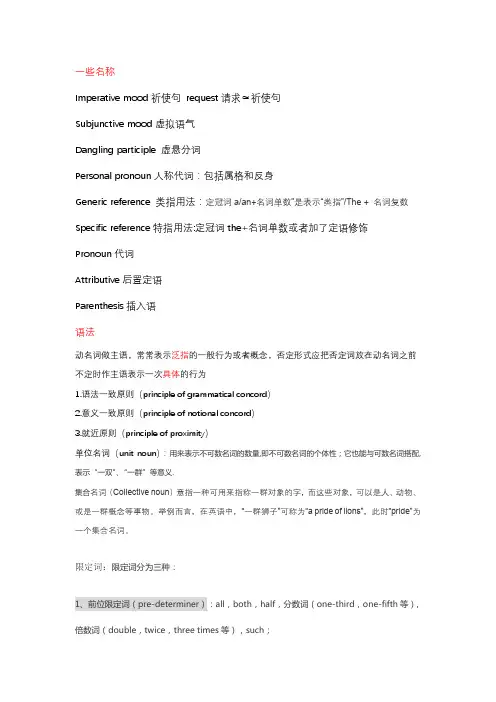
一些名称Imperative mood祈使句request请求≈祈使句Subjunctive mood虚拟语气Dangling participle 虚悬分词Personal pronoun人称代词:包括属格和反身Generic reference 类指用法:定冠词a/an+名词单数”是表示“类指”/The + 名词复数Specific reference特指用法:定冠词the+名词单数或者加了定语修饰Pronoun代词Attributive后置定语Parenthesis插入语语法动名词做主语,常常表示泛指的一般行为或者概念,否定形式应把否定词放在动名词之前不定时作主语表示一次具体的行为1.语法一致原则(principle of grammatical concord)2.意义一致原则(principle of notional concord)3.就近原则(principle of proximity)单位名词(unit noun):用来表示不可数名词的数量,即不可数名词的个体性;它也能与可数名词搭配,表示“一双”、“一群”等意义.集合名词(Collective noun)意指一种可用来指称一群对象的字,而这些对象,可以是人、动物、或是一群概念等事物。
举例而言,在英语中,“一群狮子”可称为“a pride of lions”,此时“pride”为一个集合名词。
限定词:限定词分为三种:1、前位限定词(pre-determiner):all,both,half,分数词(one-third,one-fifth等), 倍数词(double,twice,three times等),such;2、中位限定词(central-determiner):冠词(a,an,the),指示代词(this,that,these,those),不定代词(some,any,either),否定词(no,neither),全称限定词(every,each),所有格(my,your,John's);3、后位限定词(post-determiner):基数词(three,200),序数词(first,second,300th,last),数量词及短语(many,much,little,few,plenty of,a lot of,a large number of)等。
Pronouns

Pronouns (代词)Personal Pronoun(人称代词)1). 人称代词有人称、数、格、性之分,见下表:2). 人称代词连用时的次序:通常单数you放在第一位,I放在最后;复数we放在第一位,they放在最后:3). 人称代词要与其所指代的名词在性、数上一致,如:I take chemistry and biology because I need them for medicine.4). 人称代词she (her)也常用来指代国家、海洋、月亮、自由、和平等名词。
5).it可指事物、动物、未知的人;可表示天气、时间、距离等,也可作形式主语、形式宾语来代替不定式短语、动名词短语或从句,it还可用于构成强调句型,如:It's Sunday today.I found it necessary to go on with this experiment.It's Mary that we are talking about.Possessive Pronoun(物主代词)1). 英语中的物主代词有形容词型和名词型两种,见下表:2). 形容词型物主代词只能用作定语,而名词型物主代词可用作主语、宾语和表语,如:I can't find my pen. Can you lend me yours?3). 名词型物主代词可与of连用,构成双重所有格,如:She is a friend of mine.4).形容词型物主代词his, her, their等在人称、性、数上要和它们所指代的名词一致。
如果不能判断句中名词的属性,一般用his,如:Every girl is doing her best.Each teacher has his own teaching method.5). 集合名词作整体看待时用its(或his,her)指代,作个体看待时用their 取代,如:The Smiths could not agree on where to spend their vacation.The public expressed its concern about the flood.Reflexive Pronoun(反身代词)1).英语反身代词有:myself, yourself, himself, herself, itself, ourselves, yourselves, themselves。
不定代词

Indefinite pronouns 不定代词i. anything/ something/ nothing/ everything1. He is anything but a scholar. 他根本称不上学者。
She isn’t anything of a musician. 她没有音乐家的气质。
2. He is nothing if not optimistic. 他非常乐观。
He is nothing of a doctor, but much of a quack. 他不是什么医生,只是个江湖郎中。
3. He is a painter or something. 他是个画家或者其他职业。
It is something of a luck. 这也算是幸运吧。
He is something of a doctor. 他有点医术。
He is something in our city. 他是我们市的一个重要人物。
Mr. something went instead of him. (我忘了他的名字。
)He said sweet somethings to her. 他对她说了些好听的话。
Money is everything to the greedy man.对那个贪心的人来说,金钱就是他的命。
The news means everything to us. 这个消息对我们来说至关重要。
Her daughter is everything to her. 女儿就是她的命。
Speed is something but economic benefit is everything.速度是重要的,但经济效益更重要。
ii. somebody/ anybody/ everybody/ anyone/ nobody1. Is that man over there anybody?那边那个人是大人物吗?2. They think themselves somebodies, but in fact, they are nobodies.他们自以为自己了不起,但事实上他们什么也不是。
Pronoun代词
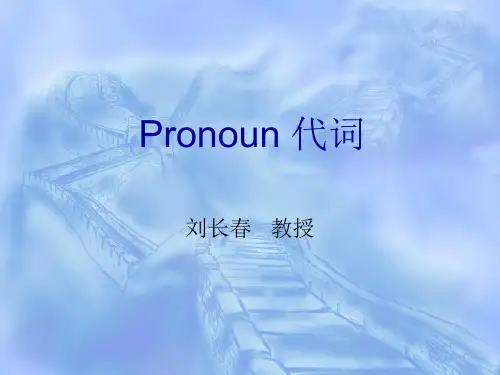
Did you know each other at that time? 你们那时候都互相认识吗? Do you often write to each other?你们常通信吗? We don’t often see each other now. 我们现在彼此不常见面了。 For years the two brothers looked after one another(each other). 多年来两兄弟都互相照顾。 ②所有格当定语,如: We are interested in one another’s work. 我们关心彼此的工作。 The students corrected each other’s mistakes in their homework. 学生们相互改正作业中的错误。 ③有时,each other和one another可以分开用(each other 分 开后,other前加定冠词the),如:
2
①
主格 nominative case I you he she it we you they
宾格 objective case me you him her it us you them
②用法: A、作主语 I am a cook.—— We are cooks. B、作表语(人称代词作表语时,一般用宾格) Who’s there?—— It’s I (he,she). (口语习惯说:It’s me(him,her).)
5
(c) 作宾语: Let’s clean their room first and ours later. 咱们先打扫他们的房间,再打扫我们的房间。 I didn’t borrow her dictionary, I borrowed his. 我没有借她的词典,我借的是他的。 I have lost my pen. Please lend me yours. 宾语 我把钢笔丢了,把你的笔借给我。(yours= your pen) (d)作介词宾语: Xiao Wang is a close friend of mine. 小王是我的一个亲密的朋友。(朋友中的一个) Xiao Wang is a close friend of my brother’s. 小王是我兄弟的一个亲密的朋友。(朋友中的一个) of + 名词性物主代词 完全一样 of + 名词所有格
完整版)不定代词用法总结
完整版)不定代词用法总结不定代词的用法一、不定代词some和any的用法区别一般来说,some用于肯定句中,而any用于否定句和疑问句中。
但是,在表示请求、邀请或征求意见的句子中,通常要用some而不用any,例如:Would you like some cake。
你想吃点蛋糕吗?Why not buy some bread。
为什么不买些面包呢?Shall I get some chalk for you。
要我帮你拿些粉笔来吗?需要说明的是,有时候any也用于肯定句中,此时表示“任何”,例如:Any colour will do。
任何颜色都可以。
Come any day you like。
你随便哪天来都可以。
二、不定代词many和much的用法以及区别不定代词many和much都表示“许多”,但many修饰或代替可数名词(复数),与few(少数)相对;而much用来修饰或代替不可数名词(单数),与little(少量)相对。
在口语中,两者主要用于非肯定句中,例如:Did you see many people there。
你在那儿看见许多人了吗?We don’t have much time。
我们没有许多时间。
XXX work has been done。
许多工作都已经做了。
You’ve given me too much。
你给我太多了。
Take as many (much) as you want。
你要多少拿多少。
I asked her a great many ns。
我问了她许多问题。
另外需要注意的是,too much可以作副词或代词,也可以用作形容词修饰不可数名词,例如:Is watching TV too much good or bad for your health。
看电视太多对你的健康有益还是有害?You’ve given me too much。
你给我的太多了。
We’ve had too much rain lately。
英语语法定语的种类
英语语法定语的种类定语是修饰名词或代词的词或短语,用以限定、说明或描述所修饰的名词或代词。
根据它们在句子中的作用和构成方式,定语可以分为以下几种种类。
1. 形容词定语(Adjective Modifier):形容词作为定语时,用来修饰名词或代词,表示名词的特征、性质、状态等。
例句:The beautiful flowers bloom in the garden.2. 物主代词定语(Possessive Pronoun Modifier):物主代词作为定语时,用来表示名词的所有关系,指示名词的所有者。
例句:My dog is very playful.3. 物主形容词定语(Possessive Adjective Modifier):物主形容词作为定语时,用来修饰名词,表示名词的所有关系,指示名词的所有者。
例句:Her book is on the shelf.4. 限定性定语从句(Restrictive Relative Clause):限定性定语从句是以关系词(如who, which, that)引导的从句,对先行词进行修饰,对先行词给予特定的限制,起到定语的作用,它不能被省略。
例句:The car that is parked outside is mine.5. 非限定性定语从句(Non-Restrictive Relative Clause):非限定性定语从句也是以关系词引导的从句,对先行词进行修饰,但它提供的信息是对先行词的补充说明,对先行词没有限制,它用逗号与主句隔开,可以省略。
6. 数词定语(Numeral Modifier):数词作为定语时,用来修饰名词,表示数量或顺序。
例句:She has three cats.7. 不定代词定语(Indefinite Pronoun Modifier):不定代词作为定语时,用来限定名词,并表示不确定或未指明的人或物。
例句:I bought some apples.8. 时间定语(Time Modifier):时间词或时间短语作为定语时,用来修饰名词,表示时间的概念。
英语中代词的分类和用法
英语中代词的分类和用法在英语中,代词是用来替代名词或名词短语的词语,常用于句子中以避免重复使用相同的名词。
根据其用法和所替代的对象不同,代词可以分为以下几类:1.人称代词(Personal Pronouns):用来表示人或物品与人相关的代词。
包括主格代词(subject pronouns)如I(我)、you(你)、he(他)、she(她)、it(它)、we(我们)、they(他们/她们/它们),以及宾格代词(object pronouns)如me(我)、you(你)、him(他)、her(她)、it(它)、us(我们)、them(他们/她们/它们)等。
2.物主代词(Possessive Pronouns):用来表示所属关系的代词。
包括形容词性物主代词(adjective possessive pronouns)如my(我的)、your(你的)、his(他的)、her(她的)、its(它的)、our(我们的)、their(他们的/她们的/它们的),以及名词性物主代词(pronoun possessive pronouns)如mine(我的)、yours(你的)、his(他的)、hers(她的)、its(它的)、ours(我们的)、theirs(他们的/她们的/它们的)等。
3.指示代词(Demonstrative Pronouns):用来指示特定人或物的代词。
包括this(这个/这些)、that(那个/那些)、these(这些)、those(那些)等。
4.相互代词(Reciprocal Pronouns):用来表示相互关系的代词。
包括each other(彼此)、one another (互相)。
5.不定代词(Indefinite Pronouns):用来表示不确定或泛指的代词。
包括someone(某人)、anyone (任何人)、everyone(每个人)、something(某物)、anything (任何物)、everything(每样东西)、nobody(没有人)、nothing (没有东西)等。
Pronoun练习+讲解
2. 名词性物主代词还是形容词性物主代词
1)Some of the stamps belong to me, while the rest are ______. B A.him and her B. his and hers C. his and her D. him and hers 2) Our home is finer than _______. D A.yours or him B. you’s or his C. you or his D. yours or his
1.人称代词的主格还是宾格 ? 2. 名词性物主代词还是形容词性物主代词 3.表示“两者”的 不定代词 4. 表示“其它”的不定代词 other, others, the other, the others, another , else, the rest 5. 复合不定代词 somebody, anybody, nobody, everybody, something, anything, nothing, everything (no one, none )
4. 表示“其它”的不定代 词 other, others, the other, the others,
another , else, the rest
1) Shanghai is really a fascinating city and we’ve A decided to stay for ______ two weeks. A. another B. other C. the other D. other’s 2) I have done most of the work. Could you please finish _______ in two days? A A.the rest B. the other C. another D. the others 3) I got the story from Tom and ______ people who C had worked with him. A.every other B. others C. other D. other than
代词Pronoun解读
ship:The sailors saw a ship in the distance.She was sailing toward the rocky island.又如人们常称 呼自己喜爱的汽车为she或her: A:How's your new car?B:Terrific.She's going like a bomb.汽车的 女主人也可能称汽车为he或 him:The car needs some petrol.Let's fill him up at the next station. • 如果先行项为动物名称,通常用中性代词来指代,但是若说话人带有感情色彩,或者把动物拟人化 ,可用阳性或阴性代词。 • 当先行项为表示天体名称或某些抽象概念的名词时,代词或相应的限定词用中性,但是若说话人带 有感情色彩或把这些无生命物拟人化,也可以用he she,依习惯而定。 • 当先行项为国家名词时,如果仅视为地理名词,代词或相应的限定词用中性,但若视为政治实体或 者说话人带感情色彩,代词或相应的限定词用阴性。China is in East Asia.It is one of the largest countries in the world. In the last decade of the 20th century,China began to assume her role as a world power.