
2018-2019学年六年级英语小升初课件:第5讲 句型看台 专题2 疑问句
3.选择疑问句 选择疑问句是提供两种或两种以上的情况供对方选择的疑问 句。选择疑问句的回答不用 Yes 或 No。要根据实际情况选择一种 情况作为回答。选择疑问句全句用 or 连接,朗读时 or 前面的部 分用升调, or 后面的部分用降调。 选择疑问句有以下三种结构: (1)一般疑问句+ or+可选择部分 如: Do you like tea or coffee? 你喜欢茶还是咖啡?
1.一般疑问句: ____________ 2.特殊疑问句: ____________ 3.选择疑问句: ____________ 4.反意疑问句: ____________ ☞ 思路点拨:本题考查学生对四种疑问句句式的掌握情况。 经过分析,可以很轻松地判断出来:句子③⑧属于一般疑问句; 句子②④属于特殊疑问句;句子①⑥属于选择疑问句;句子⑤⑦ 属于反意疑问句。 【答案】 1.③⑧ 2. ②④ 3.①⑥ 4.⑤⑦
巧学妙计: what 用途真广泛, 要问“什么”它当先。 问了“ 姓名”问“职 业”。 What's the time ?问时间。 how 开头来常“问安”, who 开头来常“问谁” 。“谁的”要由 whose 来承担。询问某地要用 where,询问原因要用 why, “哪个,哪些” which 就出现。
( 1)肯定陈述句+否定结构的附加问句 如: He is your friend, isn't he? 他是你的朋友,是吗? (2)否定陈述句+肯定结构的附加问句 如: Ann can't speak Chinese, can she? 安不会讲汉语,是吗?
【例 1】 单项选择。 ( )1. — Nhomakorabeaoes he like English?
(2)特殊疑问句+可选择部分+ or+可选择部分 如: Who runs faster, Jim or David? 谁跑得更快一些,吉姆还是戴维? (3)一般疑问句+ or not 如: Would you like to go or not? 你愿不愿意去?
【知识拓展】 反意疑问句 反意疑问句是在陈述句的后面附上简短问句,对陈述句所叙 述的事实或看法问对方是否同意的句子。朗读时陈述句部分用降 调,简短问句部分既可以用升调也可以用降调。反意疑问句的结 构是:
— ________. A. Yes, he is C. No, he isn't ( )2. —________does his father do? B. Yes, he does
— He's a doctor. A. What B. Who C. How
(
)3.Would you like coffee________tea? B. or C. of
☞思路点拨:本题考查学生对疑问句的掌握情况。第 1 题要 求改为一般疑问句,根据题意应借助助动词 do 构成一般疑问句, 由于主语为第三人称单数 he,应该用 does,第二空应用动词原形 do。第 2 题中 blue 是表示颜色的词,应该用 what colour 提问。 【答案】 1.Does; do 2.What colour
一般疑问句主要有以下几种句型: (1)句中谓语动词是系动词 be 时,则将 be 放在句首。 句型: be+主语+表语 如: Are you a student? 你是学生吗? (2)句中谓语含有情态动词或助动词时, 则将这类词放在句首。 句型:情态动词 (或助动词 )+主语+谓语动词+其他 如: Can you swim? 你会游泳吗?
【例 2】 按要求改写句子。 1. He usually does exercise on Sundays.(改为一般疑问句 ) __________ he usually __________ exercise on Sundays? 2. My bag is blue.(对画线部分提问) __________ __________ is your bag?
(3)句中谓语动词是行为动词 (或除 be 以外的系动词 ),并且其 前面没有情态动词或助动词时,则在句首加助动词 Do, Does 或 Did 提问。 如: Do you study English? 你学英语吗? 2.特殊疑问句 特殊疑问句是对句子中某一部分提问的疑问句。 通常以 what, who, whose, which, when, why, where,how 等词引导。特殊 疑问句不能用 Yes 或 No 来回答,朗读时用降调。特殊疑问句是由 “疑问词+一般疑问句”构成。
A. and (
)4.Dick has few friends , ________? B. doesn't he C. does he
A. is he
☞思路点拨:第 1 题考查一般疑问句的回答。对助动词 does 引导的一般疑问句的肯定回答为“ Yes,主语+ does.”,否定回答 为“ No,主语+ doesn't.”。第 2 题询问职业应用疑问词 what 提 问。第 3 题选择疑问句用 or 连接。第 4 题“ few”表示 “几乎没 有”,是否定的意思,附加问句部分要用肯定形式。 【答案】 1.B 2.A 3.B 4.C
专题二
疑问句
用来提问的句子叫做疑问句。通常以系动词、情态动词或助 动词开头,句末用问号。如: Are you a teacher? 你是老师吗?
考点
疑问句的分类及构成
疑问句共有四种,它们是一般疑问句、特殊疑问句、选择疑 问句和反意疑问句。 1.一般疑问句 一般疑问句通常是以系动词 be, have ,助动词或情态动词开 头。朗读时一般用升调。对一般疑问句作肯定回答时,通常是: Yes,主语+ be/助动词 /情态动词;作否定回答时,通常是: No, 主语+ be/助动词 /情态动词+ not, not 一般与前面的词构成缩略形 式。
【例 3】 根据所给的疑问句类别给下列句子分类。 ① Are you coming or not? ② Where does Mr Green live? ③ May I use your ruler? ④ What colour is the shirt? ⑤ You are busy, aren't you? ⑥ Is the answer right or wrong? ⑦ It isn't hot, is it? ⑧ Do they live there?
小升初英语语法复习课件:疑问句
5. Her sweater is red. (对划线部分提问) ___W__h_a_t _c_o_lo_u_r_i_s_y_o_u_r_s_w__e_a_te_r_?______________ 6. My pencils are in the pencil-box. (对划线部分提问) ______W__h_e_re__a_re__y_o_u_r_p_e_n_c_il_s_?_______________ 7. I get up at six every day. (对划线部分提问) ___W__h_e_n__d_o_y_o_u_r_g_e_t_u_p__e_v_e_ry__d_a_y_?___________ 8.There are fifty students in my class.(对划线部分提问) ____H__o_w_m__a_n_y_s_t_u_d_e_n_t_s_a_r_e_t_h_e_re__in__y_o_u_r_c_la_s_s_?_
-Autumn.秋天。
(3)选择疑问句:
选择疑问句表示提出两种或两种以上情况,要求对 方选择其一的问句。供对方选择的各项用 or 连接。朗 读时,or 前的部分用升调,or 后的部分用降调。
选择疑问句的结构:
一般疑问句 +or+ 可选择部分? 如:Is your hair long or short?
C.No
7.-Did you buy a dress or a skirt?-_C_____.
A.I like it
B.Yes
C.A skirt
8.-Will you come at 6:00 or 7:00? -_B_____.
A.Yes,I will
B.At 6:00
小升初句型专题复习一般疑问句(讲义)-人教PEP版英语六年级下册
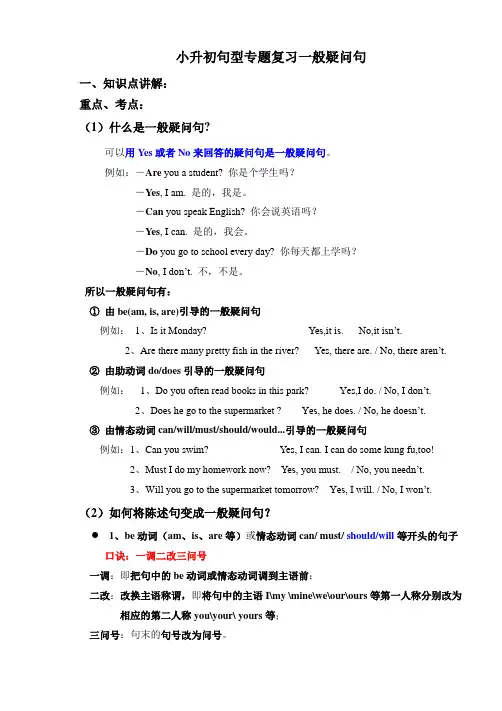
小升初句型专题复习一般疑问句一、知识点讲解:重点、考点:(1)什么是一般疑问句?可以用Yes或者No来回答的疑问句是一般疑问句。
例如:-Are you a student? 你是个学生吗?-Yes, I am. 是的,我是。
-Can you speak English? 你会说英语吗?-Yes, I can. 是的,我会。
-Do you go to school every day? 你每天都上学吗?-No, I don’t. 不,不是。
所以一般疑问句有:①由be(am, is, are)引导的一般疑问句例如:1、Is it Monday? Yes,it is. No,it isn’t.2、Are there many pretty fish in the river? Yes, there are. / No, there aren’t.②由助动词do/does引导的一般疑问句例如:1、Do you often read books in this park? Yes,I do. / No, I don’t.2、Does he go to the supermarket ? Yes, he does. / No, he doesn’t.③由情态动词can/will/must/should/would...引导的一般疑问句例如:1、Can you swim? Yes, I can. I can do some kung fu,too!2、Must I do my homework now? Yes, you must. / No, you needn’t.3、Will you go to the supermarket tomorrow? Yes, I will. / No, I won’t.(2)如何将陈述句变成一般疑问句?1、be动词(am、is、are等)或情态动词can/ must/ should/will等开头的句子口诀:一调二改三问号一调:即把句中的be动词或情态动词调到主语前;二改:改换主语称谓,即将句中的主语I\my \mine\we\our\ours等第一人称分别改为相应的第二人称you\your\ yours等;三问号:句末的句号改为问号。
六年级下册英语课件-小升初英语专题精讲 句子-疑问句(超全精编版) 全国通用

三、选择疑问句
Language points
(2)关于选择疑问句的答语,通常只在提供选择的答案中任选一个。例如:
-谁住得离学校更远,海伦还是杰克?-杰克。
一Who lives farther from school, Helen or Jack?
一Jack.
-你喜欢哪条短裙,蓝色的还是粉色的?-粉色的。
Language points
三、选择疑问句 (1)选择疑问句提出两个或两个以上可能的答案供对方选择。这类疑问句有两种形式: 一种是以一般疑问句结构为基础,只是在语调上有区别,提供选择的内容第一部分用 升调,第二部分用降调。 例如: 你是教师还是医生? Are you a teacher or a doctor?
Language points
一般疑间句通常用于询间一件事是否属实,其答语通常是yes或no,所以又叫“是非 问句”一般疑问句一般是把助动词或第一个助动词放在主语前面,句尾用升调。例 如:
你讲英语吗?
Do you speak English?
Language points
一、一般疑问句 一般疑间句通常用于询间一件事是否属实,其答语通常是yes或no,所以又叫“是非 问句”一般疑问句一般是把助动词或第一个助动词放在主语前面,句尾用升调。例 如: 我可以进来吗? May I come in?
Language points
一、一般疑问句 如果谓语动词只由be动词构成,则将be动词直接放在句首。例如:
他是一名老师吗? Is he a teacher? 你们是护土吗? Are you nurses?
一、一般疑问句
Language points
对于一般疑问句的回答通常用省略句,即"简短回答”。例如:
小学六年级下册英语小升初句型课件(通用版) 陈述句、感叹句、疑问句、祈使句的转换

二、疑问句
1.下周你打算做什么? What are you going to do next weekend? 2.你现在在哪里吃啊? Where are you eating now ? 3.你通常怎么去上学? How do you usually go to school?
There will be a building in our school after one year.
3. 她两年后将在学校工作。
翻译
She will work in school after two years.
改为否定句 改为一般疑问句
She won’t work in school after two years.
作否定和肯定回答 Will she work in school after two years?
小升初句型转换专题
陈述句、疑问句、感叹句、祈使句
一、陈述句
试翻译下列句子。 1.我是一名学生。
I am a student. 2.他不喜欢苹果。
He doesn't like apples.
什么是陈述句?
1.陈述一个客观事实; 2.分为肯定句和否定句; 3.句末通常用句号,并读降调。
3.他每天坐公交车去学校。
改为一般疑问句
Does she like her sister? Is she like her sister?
作肯定和否定回 答
Yes , she does. Yes , she is. No, she doesn’t. No, she isn’t.
小学英语小升初专题考点讲解课件之句型【含there be句型、陈述句、祈使句与感叹句、疑问句】
Exercise: 将下列陈述句转换为感叹句。
1. She swims wonderfully. 2. It is an interesting book. 3. They are cute pencil boxes. 4. The sunglasses are cool. 5. Her hair is short.
4.对指人名词或人称代词提问用who 例:Li Ping is my sister. —Who is Li Ping?
5.对物主代词和名词所有格提问用whose
例:Li Ping's coat—whose coat my father—whose father
6.对具体时间提出疑问,疑问词用when;对具体几点钟提问,用what time
3.Is this a teacher's desk? 这是一张讲台桌吗? Is it cold? 冷吗? Is her birthday in June? 她的生日在六月吗? Is this your T-shirt? 这是你的T恤衫吗? Yes,it is. 是的。/ No, it isn't. 不,不是的。
祈使句的肯定式
在祈使句的肯定式中,谓语动词要使用原形。 Look at the blackboard. Sit down, please! Open the door, please! Keep away from it!
祈使句的否定式
在祈使句的肯定式中,谓语动词用don't/never+原形。 Don't worry. Never mind. Don't turn off the light! Don't play football on the road!
广东小升初英语专题教案讲义第五讲句子(陈述句、疑问句、感叹句、祈使句)

第五讲陈述句、疑问句、感叹句、祈使句【陈述句】1.陈述句的概念(1)陈述句是用来叙述一个事实。
其特点是句末用句号"."。
(2)陈述句家族中有"两兄弟":老大是肯定句,老二是否定句。
2.陈述句的结构:主语+(+宾语):She is very happy today.:主语+谓语+not+其他成分:I don’t like swimming.老大肯定句,对人对事都持有肯定的态度,常说的三句话是:老二否定句,对人对事总是持有否定的态度,和大哥唱反调。
老二常把大哥的话加上"不"字。
3.肯定句变为否定句(1)肯定句:主语+be+其他否定句:主语+be+__________+其他(2)肯定句:主语+情态动词+其他否定句:主语+情态动词+__________+其他(3)肯定句:主语+实义动词+其他否定句:主语+__________+__________+动词原形+其他注:第一人称改为__________,some要改为__________,and改为__________。
口诀:有be用be,有情用情;无be无情,借助动词。
【疑问句】一、一般疑问句(1)---Is Mary a Japanese girl?---Yes,she is./No,she isn’t.(2)Can Lily speak Chinese?---No,she can’t./Sorry,I don’t know.(3)Do you like English?---Yes,I do./No,I don’t.1. 一般疑问句的概念:用yes/no(或相当于yes/no的词)回答,并怎么问怎么答(句首为情态动词,am/is/ are还是do/does)如:(1)---Is your father good at swimming?Yes,he__________./No,he__________.(2)Does your brother often play games?Yes,he__________./No,he__________.2.肯定句变一般疑问句肯定句变疑问句三种句型:注:第一人称改为__________,some要改为__________,and改为__________。
小学六年级英语专题小升初语法疑问句复习课件
专题10
特殊疑问句和选择疑问句
TYPES
• C.对划线部分提问。(每空一词)
• 1.There are forty students in our class.
students
• 2.She is making cakes.
she ?
• 3.This is Jim's bedroom. bedroom this?
• 4. The yellow coat is hers. what coat is hers?
• 5. This shirt is white. what
is this shirt?
in your class?
SENTENCE TRANSITION
• Step 2
• 提:将be动词或情态动词提到主语前。
SENTENCE TRANSITION
• Step 1
• 找:找动词。
• Step 2
• 提:将be动词或情态动词提到主语前。
•
没有be动词,主语是第三人称单数则将does到主语前;
•
其余人称则提do到主语前。
• Step 3
• 改:第一人称改第二人称 we-you i-you my-your our-your
• 他想要T恤衬衫吗?Does he want T-shirt? • 你拿她的鞋吗?Do you take her shoes? • 她买了2双鞋吗? • Does she take two pairs of shoes? • 你需要水吗?Do you need water?
EXERCISE 1
• B.将下列句子改为一般疑问句。(每空一词)
• 14. Lily and Lucy want some apples. Lily and Lucy want apples? • 15. They are buying a lot of things from the shop. ______ they ______ a lot of thongs
小升初英语第五讲句型看台专题二疑问句课件
B.How much is the fish C.How many do you want
D.Can I help you
( A )4.________ you ________ some washing last week?
A.Did; do
B.Did; did
C.Does; do
D.Do; do
(3)句中谓语动词是行为动词(或除 be 以外的系动词),并且其 前面没有情态动词或助动词时,则在句首加助动词 Do,Does 或 Did 提问。
如:Do you study English? 你学英语吗? 2.特殊疑问句 特殊疑问句是对句子中某一部分提问的疑问句。通常以 what, who,whose,which,when,why,where,how 等词引导。特殊 疑问句不能用 Yes 或 No 来回答,朗读时用降调。特殊疑问句是由 “疑问词+一般疑 问句”构成。
A.By bus
B.On bus
C.Take bus
D.In bus
( B )7.____ you ____ shopping this Sunday?
A.Will; go to
B.Are; going
C.Shall; go to
பைடு நூலகம்
D.Will; goes
( A )8.—________ are his socks? —They're under the bed. A.Where B.What C.When D.How
What is your hobby? 2.in, post office, of, front, the, is, you (?)
Is the post office in front of you? 3.go, you, yesterday, did, fishing (?)
小学六年级小升初英语语法课件
A.take photos
B.takes photos
C.taking photos D.take photo
( A )6.Listen, the students ____ an “ABC” song.
A.are singing
B.sing
C.are sing
D.singing
( A )7.—Can you help me do the housework?
(2)否定式的缩写形式
is not=isn't
are not=aren't
do not=don't
does not=doesn't
did not=didn't
will not=won't
were not=weren't was not=wasn't
【例 1】 按要求改写句子。 1. She does her homework every evening. (改为否定句 ) ____________________________________________________ 2.We don't have any lessons on Sundays.(改为肯定句) ____________________________________________________
②主语+助动词 (do/doe s /did)+ not+实义动词+其他 如:I don't like grapes.我不喜欢葡萄。 My father didn't go shopping last week. 我爸爸上周没有去购物。 ③主语+情态动词+not+实义动词+其他 如:I can't find Sarah.我找不到萨拉。
六年级下册英语-小升初英语专题精讲 代词-疑问代词 全国通用PPT精美版
Practice
真题演练:对下列句子的画线部分提问。 3. (苏州新区)Rubbish makes the park dirty and messy. _W__h_a__t_m__a__k_e_s__t_h__e__p_a_r_k__d__ir_t_y__a__n_d__m__e__s_s_y_?_____________________ 解析:句意:垃圾让城市变得又脏又乱。对表示东西的主语提问时,应 用疑问代词what,答案为“What makes the park dirty and messy?" 。
What time 真题演练:对下列句子的画线部分提问。 Whom/Who is the present from? 解析:句意:-你想要什么?-请给我一些咖啡。 解析:句意:-这些漂亮的话来自谁?-他们来自我的朋友们。 ________ is my mother? She is in the living room.
疑问代词的基本用法: 4.作表语 这顶帽子是准的? Whose is this cap?
Language points
Language points
疑问代词的基本用法: 解析:句意:-你正在写给谁?-我正在写给我的英国朋友汤姆。
句中的mine为名词性物主代词。 选择正确的单词填空 (who, where, when)
Language points
Language points
疑问代词的基本用法: 3.作定语 你喜欢什么学科? What subject do you like?
Language points
疑问代词的基本用法: 3.作定语 你喜欢哪件外套,红的还是蓝的? Which coat do you like, the red one or the blue one?