
2015年6月英语四级真题(第2套)和答案
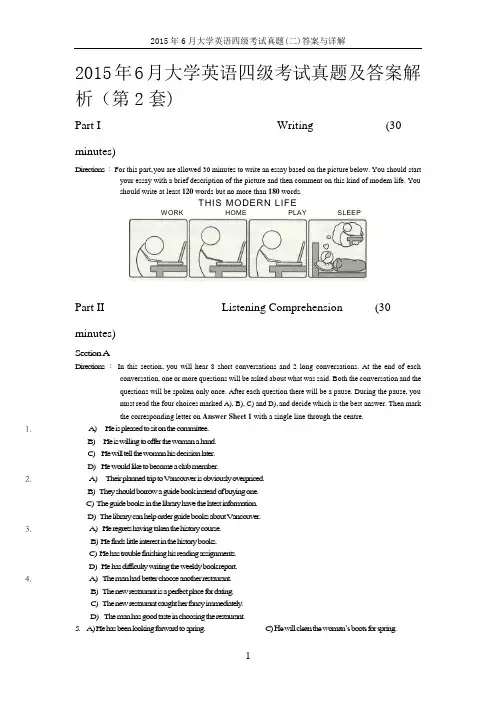
2015年6月英语四级真题(第2套)Part 1 Writing (30 minutes)(请于正式开考后半小时内完成该部分,之后将进行听力考试)Directions: For this part, you are allowed 30 minutes to write an essay based on the picture below. You should start your essay with a brief description of the picture and them comment on this kind of modern life. You should write at least 120 words but no more than 180 words.Part II Listening Comprehension (30minutes)Section ADirections: In this section, you will bear 8 short conversations and 2 long conversations. At the end of each conversation, one or more questions will be asked about what was said. Both the conversation and the questions will be spoken only once. After each questions there will be a pause. During the pause, you must read the four choices marked A), B),C) and D), and decide which is the best answer. Then mark the corresponding letter on Answer sheet 1 with a single line through the center.注意:此部分试题请在答题卡1上作答1. A) He is pleased to sit on the committeeB) He is willing to offer the woman a handC) He will tell the woman his decision laterD) He would like to become a club member2. A) Their planned trip to Vancouver is obviously overpricedB) They should borrow a guide book instead of buying oneC ) The guide books in the library have the latest informationD) The library can help order guide books about Vancouver3. A) He regrets having taken the history courseB) He finds little interests in history booksC) He has trouble finishing his reading assignmentsD) He has difficulty in writing the weekly book report4. A) The man had better choose another restaurantB) The new restaurant is a perfect place for datingC) The new restaurant caught her fancy immediatelyD) The man has good taste in choosing the restaurant5. A) He has been looking forward to springB)He will clean the woman’s boots for springC) He has been waiting for the winter saleD) He will help the woman put things away6. A) At a tailor’sB) At Bob’s homeC) In a cloth storeD) In a theatre7. A) His guests favors Tibetan drinksB) His water is quite extraordinaryC) Mineral water is good for healthD) Plain water will serve the purpose8. A) Report the result of a discussionB) Raise some environmental issuesC) Submit an important documentationD) Revise an environmental reportQuestions 9 to 12 are based on the conversation you just heard9. A) They pollute the soil used to cover themB) They are harmful to nearby neighborhoodsC) The rubbish in them takes long to dissolveD) The gas they emit is extremely poisonous10. A) Growing populationsB) Packaging materialsC) Changed eating habitsD) Lower production cost11. A) By saving energyB) By using less aluminumC) By reducing poisonous wastesD) By making the most of materials12. A) We are running out of natural resources soonB) Only combined efforts can make a differenceC) The waste problem will eventually hurt all of usD) All of us can actually benefit from recyclingQuestions 13 to 15 are based on the conversation you have just heard.13. A) MiamiB) VancouverC) BellinghamD) Boston14. A) To get information on one-way tickets to CanadaB) To inquire about the price of “Super saver ” seatsC) To get advice on how to fly as cheaply as possibleD) To inquire about the shortest route to drive home15. A) Join a tourist groupB) Choose a major airlineC) Avoid trips in public holidaysD) Book tickets as early as possibleSection BDirections: In this section, you will hear 3 short passages. At the end of each passage, you will hear some questions. Both the passage and the questions will be spokenonly once. After you hear a question, you must choose the best answer from the four choices marketed A), B),C) and D). Then marked the correspond letter on Answer sheet I with a single line through the centre.注意:此部分试题请在答题卡1上作答。
Passage oneQuestions 16 to 18 are based on the passage you have just heard.16. A) There are mysterious stories behind his worksB) There are many misunderstandings about himC) His works have no match worldwideD) His personal history is little known17. A) He moved to Stratford-on-Avon in his childhoodB) He failed to go beyond grammar schoolC) He was a member of the town councilD) He once worked in a well-know acting company18. A) Writers of his time had no means to protect their worksB) Possible sources of clues about him were lost in a fireC) His works were adapted beyond recognitionD) People of his time had little interest in himPassage TwoQuestions 19-21 are based on the passage you have just heard19. A) It shows you have been ignoring your healthB) It can seriously affect your thinking processC) It is an early warning of some illnessD) It is a symptom of two much pressure20. A) Reduce our workloadB) Control our temperC) Use painkillers for reliefD) Avoid masking symptom21. A) Lying down and having some sleepB) Rubbing and pressing one’s backC) Going out for a walkD) Listening to light musicPassage ThreeQuestions 22 to 25 are based on the passage you have just heard.22. A) Depending heavily on loansB) Having no budget plans at allC)Spending beyond one’s meansD) Leaving no room for large bills23. A) Many of them can be cutB) All of them have to be coveredC) Their payment cannot be delayedD) They eat up most of the family income24. A) Rent a house instead of buying oneB) Discuss the problem in the familyC) Make a conversation planD) Move to a cheaper place25. A) Financial issues plaguing a familyB) Difficulty in making both ends meetC) Family budget problems and solutionsD) New ways to boost family incomeSection CDirections: in this section, you will hear a passage three times. When the passage is read for the first time, you should listen carefully for its general idea. When the passage is read for the second time, you are required to fill in the blanks with the exact words you have just heard. Finally, when the passage is reaf for the third time, you should check what you have written.注意:此部分试题请在答题卡1上作答。
2015年6月大学英语四级真题及答案解析(二)
2015年6月大学英语四级考试真题及答案解析(第2套)Part I Writing (30minutes)Dire cti ons :For this part, you are allowed 30 minutes to write an essay based on the picture below. You should start your essay with a brief description of the picture and then comment on this kind of modem life. Youshould write at least 120 words but no more than 180 words.THIS MODERN LIFEWORK HOME PLAY SLEEPPart II Listening Comprehension (30minutes)Section ADire cti ons:In this section, you will hear 8 short conversations and 2 long conversations. At the end of each conversation, one or more questions will be asked about what was said. Both the conversation and thequestions will be spoken only once. After each question there will be a pause. During the pause, youmust read the four choices marked A), B), C) and D), and decide which is the best answer. Then markthe corresponding letter on Answer Sheet 1 with a single line through the centre.1.A) He is pl eas ed t o sit on th e co m mitt ee.B) He is w illi ng t o of fer t he w om an a ha nd.C) He wil l te ll the wo man h is d eci sion l at er.D) He wo uld like to b eco me a c lu b mem ber.2.A) Their planne d tri p to V an cou v er is o bvious ly ov erpriced.B) The y sho uld bor row a gui de b o ok ins te ad of buy ing o ne.C) The guid e bo oks i n th e lib rar y hav e the lat est inf orm ation.D) The libr ary c an h elp ord er g uide book s ab out Van cou ver.3.A) He re gr ets h avi ng t ake n the his t ory c our se.B) He fin ds li ttl e in ter est in th e hist ory b ook s.C) He has tro ubl e fi nish ing his read ing ass ign men ts.D) He ha s di ffi cul ty w rit ing t he w e ekly book rep ort.4.A) T he m an h ad be tte r ch oos e an o ther res tau ran t.B) The ne w res tau ra nt is a per fect pla ce f or d ating.C) The ne w res tau ra nt ca ugh t her f anc y imm ediately.D) The ma n ha s goo d taste in ch o osin g the restau ran t.5. A) H e ha s bee n lo oki ng fo rw ar d to sp rin g. C) He w ill cle an t he wo ma n’s b oots for sp rin g.B) He has be en w ait ing f or t he w in ter s ale.D) He will help th e wom an p ut th in gs aw ay.6. A) At a tai lor’s. C) In a cl oth es st ore.B) At Bob’s hom e. D) In a th eatre.7. A) His guest s fa vor Tib etan dri nks. C) Mineral wat er is goo d fo r hea lth.B) At Bob’s h ome.D) Plain water will serv e the purpose.8. A) Repor t th e res ult of a d isc us sion. C) Submit an im portant doc ume nt.B) Rais e so me en vir onm ent al i ssue s. D) Revise an en vi ronm ental repo rt.Questio ns 9 t o 12 a re b ase d on t he c onve rsa tio n yo u hav e ju st heard.9.A) Th ey po llute t he so il u sed t o co v er th em. C) The ru bbi sh in th em takes lon g to d issolv e.B) The y ar e ha rmf ul t o nea rby nei g hbor hoo ds. D) The g as th ey em it is extrem ely poi sono us.10.A) Gr owi ng po pul ati on. C) Changed eating hab it s.B) Pac kag ing mat eri als. D) Lower pro duction co st.11.A) By s avi ng e ner gy. C) By redu ci ng po iso nou s wast es.B) By us ing les s al umi num. D) By mak ing the m ost of ma te ria ls.12.A) We are run nin g out o f na tur al r es ourc es soon.B) On ly co mbi ned eff ort s ca n make a diff erence.C) Th e wa ste p rob lem wil l ev entu al ly hu rt all of u sD) Al l of u s ca n act ual ly b ene fit fro m rec ycling.Questio ns 13 to 15 are bas ed o n the conv ers ati on y ou have just h eard.13.A) Mi ami.B) Va nco uver.C) Bellin gh am.D) Bo sto n.14.A) To g et i nfo rma tio n on o ne-wa y ti cket s to C anada.B) To i nquire abo ut th e pr ice of “ S uper Sav er” seats.C) To g et a dvi ce o n how to fl y as ch eapl y as p ossible.D) To i nqu ire abo ut th e sh ort est rou t e to dr ive hom e.15.A) Jo in a t our ist g rou p.C) Av oid t rip s in p ubl ic h olid ays.B) Choos e a ma jor air lin e. D) Bo ok ti cke ts a s early a s po ssi ble.Section BDire cti ons:In this section, you will hear 3 short passages. At the end of each passage, you will hear some questions.Both the passage and the questions will be spoken only once. After you hear a question, you mustchoose the best answer from the four choices marked A),B),C),and D). Then mark the correspondingletter on Answer Sheet 1 with a single line through the centre.Pass age OneQuestions 16 to 18 are bas ed o n the pass age you h ave just heard.16.A) Th ere are mys ter iou s sto rie s be hi nd his works.B) Th ere are man y mis und ers tan din gs ab out h im.C) Hi s wor ks h ave no ma tch wor ld wide.D) Hi s pe rson al h ist ory i s li ttl e kno w n.17.A) He mov ed to S tr atf ord-on-Av on in his chi ldh ood.B) He f ai led t o go b eyo nd g ram mar scho ol.C) He w as a mem ber of th e to wn c ounc il.D) He o nc e wor ke d in a w ell-kn ow n act ing comp any.18.A) Wr ite rs o f his tim e ha d no m ean s to pro tect th eir works.B) Pos sib le s our ces of cl ues abo ut hi m wer e lost in a fire.C) Hi s wor ks w ere ada pte d be yon d reco gnitio n.D) Pe opl e of his ti me h ad li ttl e in ter e st in h im.Pass age TwoQuestio ns 19 to 21 are bas ed o n the pass age you h ave jus t heard.19.A) It s how s you hav e be en i gno rin g your health.B) It c an s eri ous ly a ffe ct y our t hin ki ng pr ocess.C) It i s an e ar ly wa rni ng o f so me il ln ess.D) It i s a sy mpt om o f to o muc h pr es sure.20. A) Redu ce ou r wo rkl oad. C) Use painkillers f or relief.B) Contro l ou r tem pe r. D) Avoid mas kin g sym pto ms.21. A) Lyi ng do wn a nd h avi ng so me sl eep. C) Goin g out for a wa lk.B) Rubbi ng an d pr ess ing one’s bac k. D) List ening to lig ht mu sic.Pass age Thr eeQuestio ns 22 to 25 are bas ed o n the pass age you have just heard.22. A) Depe ndi ng he avi ly o n loa ns. C) Spend ing beyond one’s m ean s.B) Havin g no b udg et p lan s at a ll. D) Leavi ng n o roo m for lar ge b ills.23. A) Ma ny of the m ca n be c ut. C) They eat up most of the fami ly i nco me.B) All of t hem hav e to b e co ver e d. D) They eat up mo st o f the fam ily inco me.24. A) Re nt a hous e ins tead of buy i ng on e. C) Make a con se rva tio n pla n.B) Discu ss th e pr obl em i n the fa mily. D) Move to a ch eap er p lac e.25. A) Fi nan cia l iss ues pla gui ng a f amil y. C) Family budg et p rob lem s an d sol utions.B) Diffi cul ty i n mak ing bot h end s mee t. D) New ways to bo ost fam ily i nco me.Section CDire cti ons :In this section, you will hear a passage three times. When the passage is read for the first time, you should listen carefully for its general idea. When the passage is read for the second time, you arerequired to fill in the blanks with the exact words you have just heard. Finally, when the passage isread for the third time, you should check what you have written.Perh aps bec aus e go ing t o co lle ge is so mu ch a p art o f th e Am eri can dre a m, many peo ple g o fo r no 26 r eas on. Some go be cause t hei r pa ren ts e xpect it, o the rs be cause ifs w hat their fr iends a re do ing. Then, the re’s th e bel ie f tha t a co llege degree w ill 27 ens ure a goo d job a nd hig h pa y.Some s tud ent s 28 th rou gh fo ur y e ars, at ten din g classes, or skipping (逃课) th em as the case ma y be, rea ding o nly what can’t b e avo ide d, loo kin g fo r le ss 29 cour ses, and n ever being to uche d or c ha nge d in any im por tan t way. Fo r a fewof these peop le, c oll ege p rov ides no 30 , yet be ca use o f paren tal or p eer pressure, th ey ca nno t vo lun tarily l eave. The y st op tryi ng in the hop e tha t th eir t ea che rs will mak e the decisi on f or th em b y 31 them.To put it b lun tly/(直截了当地),u nle ss you’re w illing to make you r colleg e yea rs cou nt, you mig ht be 32 doing some thi ng e lse. N ot e ver yon e sh ou ld at ten d col lege, no r sh ould every one w ho do es atte nd b egin ri ght a fter h igh scho ol. Many col leg e st ude nts 33 t akin g a yea r or so o ff. A year ou t in the w orld hel ps some peo ple to 34 their prioriti es a nd goal s. If you’r e re all y going to g et s omet hin g out of going to colleg e, you have to ma ke it mean som eth in g, and to do that you must h ave som e ide a wh y yo u’r e th ere, w hat you h ope to get ou t of it, and 35 even wha t yo u hop e to b ecom e.PartⅢReading Comprehension (40 minutes)Sect ion ADire cti ons:In this section, there is a passage with ten blanks. You are required to select one word for each blank from a list of choices given in a word bank following the passage. Read the passage through carefullybefore making your choices. Each choice in the bank is identified by a letter. Please mark thecorresponding letter for each item on Answer Sheet 2 with a single line through the centre. Youmay not use any of the words in the bank more than once.Questio ns 36 to 45 are bas ed o n the foll owi ng p assage.Ifs our g uil ty p lea sur e: W atchin g TV is the mos t co mmo n ev ery day a ctiv ity, aft er w ork and sle ep, in ma n y parts o f the w orl d. Ame ric ans vie w fiv e ho u rs of T V ea ch d ay, an d while w e kn ow th at sp end ing so mu ch time s itti ng 36 can l ea d to obesit y/(肥胖症)a nd ot her dis e ases, r es ear chers h ave n ow q uan tified just how 37 b ein g a co uch pot at o can b e.In a n a nal ysi s o f da ta fr om e igh t l arg e 38 .pu blished studies, a Harv ar d-le d g rou p r epo rte d in th e that fo r e very tw o hour s per day sp ent c han nel 39 , the ris k of dev elop ing Ty pe 2 diabetes Journal of the Am eri can M e dica l Aso c ia t ion (糖尿病)ro se 20% ov er 8. 5 ye ars, the ri sk o f heart d isease increased 15% ove r a 40 , and t he od ds o f dyin g pre maturely 41 13% d uri ng a s eve n-yea r f oll o w-up. Al l o f t hes e 42 are linked to a lac k o f p hysical exerci se. But com par ed wi thSection BDire cti ons :In this section, you are going to read a passage with ten statements attached to it. Each statement contains information given in one of the paragraphs. Identify the paragraph from which theinformation is derived. You may choose a paragraph more than once. Each paragraph is marked witha letter. Answer the questions by marking the corresponding letter on Answer Sheet 2.Essa y-G ra ding Sof tware Offers P ro fessors a BreakA)Imag ine t aki ng a col leg e exam, an d, inste ad of h andi ng in a blue bo o k and get tin g a gra de fro m a pro fe ssor a fewweeks lat er, cl ick ing t he “s end” but t on whe n you are do ne an d receivin g a grad e back instan tly, y our e ssa y scored by a soft war e pr ogr am. An d th en, ins tea d of bei ng do ne w ith that exam, ima g ine th at the sy ste m wo uld i mme dia t ely let yo u rewrit e the tes t to t ry to imp rov e you r grade.B)EdX, the no npr ofi t ente rpr is e foun ded by Harvard and th e Massach usetts Instit ute of T ech nol ogy (M IT) to offercour ses on the In ter net, h as j ust i ntr o duce d su ch a syst em and will make its a uto mat ed(自动的)so ftw are av aila ble fre e on the W eb t o an y in sti tut ion tha t want s to use it. The s oftware u ses a rtif ici al inte lligen ce to g rad e student essays and shor t wr itt en an sw ers, f ree ing pro fes sors for o ther tasks.C)The n ew s er vic e wi ll b rin g th e ed u cati onal consortium(联盟)int o a g rowin g co nfl ict ove r th e role of automation ineduc ati on. Alt hough auto ma ted gr a ding sy stems for mu lti ple-ch oice an d true-false te sts are n ow wid esp read, the use o f arti fic ial int ell ige nc e te chn olog y to g rade essay answers has not yet received w ide spread ac cep tan ce b y ed u cato rs a nd has m any c rit ics.D)Anan t Aga rw al, an e lectri cal e ngi ne er who is presiden t of Ed X, predicted that t he in sta nt-gradin g so ftw are would be ausef ul tea chi ng too l, enab lin g s tud ents to tak e t est s and write essays o ver and ov er and im prove th e q ual ity of the ir answ ers. H e said t he te chn olo gy wo uld of fer d isti nct advantages o ver t h e trad itiona l cla ssroom sy ste m, whe re stud ents ofte n wa it da ys or wee ks fo r gr ade s. “There is a hug e value in learning with ins tan t feedb ack,” Dr. Ag arwa l said.“Studen ts a re te lli ng u s the y learn m uch b ett er with instant feedback.”E)But skeptics (怀疑者) th e aut oma ted sy stem is n o match fo r live teac hers. O ne lo ngtime cri tic , Le s Per elman, h asdrawn nat ion al at ten tio n sev er al ti m es for p utting t ogether non sen se essa ys tha t hav e foo led s oft ware gradi ng programs into g ivi ng h igh m ark s. He h as a lso been hig hly critical of stu dies cla imi ng th at th e so ftw are com pares w ell t o hum a n graders.F)He is amon g a grou p of educato rs who last month beg an circulating a petition(呼吁) opp osing a utom ate dasse ssm ent s oft ware. The gr oup, whic h calls its elf P rofession als Ag ains t Mac hin e Scoring o f Stud ent Essay s in High-St ake s Ass ess men t, has co lle cted n ear ly 2,000 sig natures, inc lu ding some from f amo us pe ople li ke Noa m Chom sky.G)“Let’s f ac e the re ali tie s of aut oma ti c ess ay scoring,” th e gr oup’s s tate ment rea ds in part.“Com puters ca nnot ‘read’.They ca nnot me asu re t he ess ent ial s of e ffe ctive written co mmu nication:a ccu rac y, re aso nin g, ad equ acy of evid ence, good s ens e, ethical( 伦理的) po sit ion, co nvincing argu men t, meanin g ful o rga niz ation, an d clari ty, am ong othe rs. H)But EdX exp ect s its so ftw ar e to b e adop ted w idely by schoo ls an d univ ersities. It offe rs free onlin e classes fromHarvar d, MIT and the Uni ver sit y of Cali fornia-Berk eley; th is f all, it w ill add c lasses fro m W ell esl ey, G eorge town an d the Univ er sit y of Te xas. In a ll, 12 u nive rsi ties p artici pate in Ed X, wh ic h of fers ce rti ficates for cou rse co mp leti on a nd has s aid t hat it pl ans to co nti nue to ex pand nex t year, in clu ding add ing i nt erna tio nal sch ools.I)The E dX as ses sme nt to ol r equ ire s h uman t eachers, or g rad er s, to first g rade 100 essay s or essa y que stions. T he sys temthen us es a v ari ety of ma chi ne-le ar ning te chn iqu es to train itself to be able to gra de any nu mbe r o f e ssa ys or a nsw ers auto mat ica lly a nd al mos t inst ant ly. The so ftw are will assig n a grade depend ing on t he sc ori ng sys tem c re a ted by th e teac he r, whe the r it i s a le tte r gr ade or nume rical(数字的)ran k.J)EdX i s n ot t he f irs t t o us e th e auto m ated as sessment tech nol ogy, which date s to early com puter s in the 1960s. The re is now a range of c omp ani es of fer ing commercial pr ograms to g rad e wri tten test an swe rs, an d four stat es—Loui sia na, Nort h Dakota, U tah a nd We st Vi rgi nia—are u sin g some form of th e tec hnology in sec ond ary scho ols. A fifth, Indiana, has experi men ted wi th i t. In so m e c ases th e so ftware is used as a “seco n d re ader,” to c hec k the r eliabi lity o f t he h uman graders.K)But the gr owi ng inf luence of the Ed X conso rtium to set stan dar ds is lik el y to give the te ch nolo gy a boo st. On Tues day, Stanfor d a nno unc ed tha t i t w oul d work wi th EdX to develop a join t educ ationa l system tha t w ill ma ke use of th e auto mat ed a sse ssm ent tec hno log y.L)Two sta rt-ups, Co urs era an d U da cit y, re cen tly fo und ed by Stanfo rd fac ulty me mbe rs to create “massiv e o pen onlin e cour ses,” or MOO Cs, ar e also c om mitt e d to au tomated assessmen t sys tems b eca use o f the va lue o f inst ant feed ba ck.“It all ows st ude nts to get im med iat e fee dba ck on their work, so th at lean turn s into a gam e, wi th stu den ts nat ural ly(吸引) to war d res ubm itt ing th e wo rk unti l the y get it righ t,” said Dap hne Rolle r, a comp uter scient ist a nd a found er o f Courser a.M)Last y ear t he He wlett Fou nd atio n, a gran t-making organ izatio n set u p by one of the H ewlett- Pac kard fou nde rs and hi s wife, s pon sor ed tw o $100,000 p riz es aim ed at impr ovi ng so ftw are t ha t grad es essay s and s hor t ans wers. More t ha n 150 te ams ent ere d ea ch ca teg or y. A winne r of o ne o f the Hewlet t con tests, Vi k Par uch uri, w as h ired by Ed X to hel p desi gn it s as ses sme nt s oft war e.N)“One of our foc use s is to help ki ds l earn ho w to think critically,”said Victor Vu chic, a prog ram officer at th e Hewl ett Foun dat ion. “ I t’s p rob abl y imp oss i ble to d o that with mul tip le-cho ice t ests. T he ch alleng e is th at th is re qui res hum an graders, and s o th ey co st a l ot mo re and t hey take a lot mor e time. ”O)Mark D. Sherm is, a pro fe sso r at th e Univ ers ity o f Akron in Oh io, su perv ised the H ewlett Found at ion’s cont est o n automat ed ess ay s cor ing an d wr ote a paper ab out the exp er ime nt. In his vi ew, th e t ech nol ogy—tho ug h impe rfe ct—ha s a pl ace in ed uc atio n al se tti ngs.P)With in cr eas ingl y lar ge cla sse s, it is impos sib le for mo st teach ers to g ive stu den ts mea nin gfu l fee dback on writ in g assi gnm ent s, he said. Pl us, he not ed, criti cs of th e tech nology have tende d to come from th e nation’s best un iver sities, where th e le vel o f te ach ing is mu ch bett er t han at mo st schoo ls.Q)Ofte n the y come f rom v ery fa mou s instit uti ons wh ere, in fact, th ey do a much b ett er job o f prov iding fe edb a ck than a mach ine eve r cou ld,”Dr. Sh erm is s aid. “ Th er e seems to be a lack o f appre cia tio n of w hat i s actua lly g oin g on in the real wor ld.”46.Some p ro fes sio nal s in educ ati on a re coll ect ing sig natures to v oice th eir o pposition to automa ted essay gradin g.ing so ftw are t o gr ade stu den ts’ es says sav es teacher s tim e fo r other w ork.48.The H ewl ett con tes ts ai m at i mp rovi ng es say g rad ing sof tware.49.Thou gh th e aut om ate d gradin g sy stem i s wid ely used in mu lti ple-c hoic e tests, au tom ate d essay g rad i ng is stillcrit ici zed by m any e duc ato rs.50.Some p eo ple d on’t be lie ve th e so ft ware gra din g sy stem can do as goo d a job a s hum an g rad ers.51.Crit ics of autom ate d es say sco rin g d o not s eem to kn ow the tr ue realities in le ss famou s un ive rsitie s.52.Crit ics argue m any i mpo rta nt a spe ct s of ef fective writing cann ot b e me asured by co mpu te r rating pro gra ms.53.As cl ass s ize gro ws, mo st t eac her s a re un able to g ive stud ent s valuable c omme nts as to how t o im pro ve th eir writing.54.The a uto mat ed a sse ssm ent t ech nol o gy is s ometim es u sed to do uble chec k the w ork of hu ma n graders.55.Student s find in sta nt f eed bac k hel ps impr ove their lear nin g con sid er ably.Section CDire cti ons:There are 2 passages in this 'Section. Each passage is followed by some questions or unfinished statements. For each of them there are four choices marked A), B), C) and D). You should decide onthe best choice and mark the corresponding letter on Answer Sheet 2 with a single line through thecentre.Pass age OneQuestio ns 56 to 60 are bas ed o n the foll owi ng p assage.The e ndl ess de bat e ab out “wo rk-l ife b al ance ’’ often con tains a ho pefu l fo otn ote ab out stay-at- h om e dad s. If Amer ic an s oci ety and bu sin ess wo n5t m ake it eas ier on fut ure femal e leade rs who cho ose to hav e ch ild ren, there is st ill th eray of h ope tha t i ncr eas ing num be rs o f fu ll-tim e f ath ers wil l. Bu t bas ed on to d ay’s s ocioec ono mic tren ds, th is h ope is,unfo rtu nat ely, m isguid ed.I t’s t ru e tha t the num ber o f me n wh o hav e lef t wo rk to d o their thin g as full-ti me p are nts h as d oubled in a d ecad e, butifs s til l very sma ll: o nly0. 8% o f marr ied co upl es w here the s tay-at-h ome father was ou t of th e la bor fo rc e fo r a y ea r. Ev enthat perc ent ag e is li kel y inf lat ed by men th rus t int o their caretak er ro le by a dow nsi zin g. Thi s is sim ply n ot a large eno ughgrou p t o re duc e t he soc ial stigma(污名)an d f orce o ther adju stm ents nece ssa ry to sup porting men i n th is dec isi on, e ven ifonly for a rel ati vel y sh ort t ime.Even sho rt er t ime s aw ay fro m wo r k for working f ath ers are al ready difficu lt. A stu dy f oun d th at 85% of n e w fa the rs take some tim e off aft er th e bi rth o f a chil d—b ut fo r all b ut a f ew, i t’s a week o r two a t mo st. Mea nw hil e, the av erage forwome n wh o tak e le ave is mo re t han 10 wee ks.Such choi ce s imp act who mov es up in t he o rganization. Wh ile you’re aw ay, so meo ne e lse is do ing yo ur wo rk, maki ng your sal es, t aki ng car e of yo ur cu sto mers. Th at can’t h elp you at work. It c an o nly hu rt y ou. Wo men, of co ur se, fac ethe s ame iss ues of ret urn ing aft er a l ong a bse nce. But with many m ore wome n th an m en cho osin g to le av e the wor kforceenti rel y to rais e fa mil ies, ret urn ing f r om an e xte nded paren tal leave d oesn’t raise as m any eye bro ws a s it d oes for m en.Wome n wou ld ma ke mo re if t he y didn't break th eir earn ing trajectory (轨迹)by leavi ng th e workforce, o r if higher-pay ing pro fes sio ns w ere m ore f ami ly-fr ien dly. In th e fo res eeable futu re, st ay- at-ho me fath ers m ay ma ke a ll thediff erenc e fo r in div idu al f ami lies, b ut th eir pre sen ce w on’t redu ce t he n umbe rs o f hi gh-pot ential wom en w ho are fo rc ed t ochoose betw een fam ily a nd c are er.56.What giv es wo me n a ray of h ope to achi eve wor k-life balance?A)More men t aki ng a n ex ten ded p ar en tal leav e.B)Peop led cha ngi ng at tit udes to war ds fami ly.C)More wom en e nte rin g bus ine ss m anagemen t.D)The i mpr ove men t of t hei r so cio eco nomi c st atu s.57.Why d oes t he a uth or s ay th e ho pe f or mo re full-time fath ers is mi sgui de d?A)Wome n ar e be tte r at t aki ng c are of c hild ren.B)Many men v alu e wo rk m ore t han th eir family.C)Thei r number is t oo sm al l to m ake a diff erence.D)Not m any m en h ave the c han ce t o s tay at hom e.58.Why d o fe w men tak e a lo ng p are nt al le ave?A) A long lea ve w ill h av e a ne gat ive im pact on th eir car eer.B)They jus t hav e to o man y re spo nsi bil ities to f ulf ill at wo rk.C)The e conomi c los s wi ll b e too muc h for th eir fam ily to bear.D)They are lik ely t o ge t fir ed i f ab sen t f rom work for too long.59.What is th e mo st li kel y re act ion to men r etu rni ng f rom an ex ten ded parenta l le ave?A) Jea lou sy.C) Ad mirati on.B) Surpri se.D) Sy mpa thy.60.What doe s the aut hor say a bou t hi gh-pot ential wom en in the n ot-too-dist ant f utu re?A)They wil l ben efi t fr om t he tr en d of more fat hers stayi ng at hom e.B)They wil l fin d hi gh-pay ing p rof es si ons a b it m ore f amily-fr ien dly.C)They are unli ke ly to b re ak th ei r car e er tr ajecto ry to raise a fam ily.D)They wil l sti ll f ace the d iff icu lt c hoi c e bet ween career an d ch ild ren.Pass age TwoQuestio ns 61 to 65 are bas ed o n the foll owi ng p assage.Some of t he wor ld’s most s ign ifi cant prob lem s nev er hit h ead lin es. On e exam ple co mes f rom ag ric ulture. Food ri ots and hunge r make n ews. But t he tre nd lyin g behind th ese matters is rarely talk ed ab out. Th is is the d ecl ine i n the gro wth i nyiel ds of som e of t he wo rld’s m ajo r crop s. A ne w stu dy by the Univ ersity of Mi nnesot a and McG ill U niv ersity in Montre a llooks at w her e, and how far, t his dec line is occur rin g.The aut hor s t ake a vas t n umb er of d ata poi nts fo r the fou r m ost importa nt crop s :ric e, wh ea t, co m a nd soyabeans (大豆).The y find th at on b et wee n 24% an d 39% of all harvested areas, t he impr ove men t in y iel ds tha t t ook plac e b efo re th e1980s slowed dow n in t he 1990s an d 2000s.Ther e ar e tw o wo rry ing f ea tur es of t he sl owd own. One is that it h as b een particu larly sh arp in t he wo rld’s m o st(人口多的)c oun tri es, In dia and Ch in a. Thei r abi lit y to f eed them selves h as been an i mpo rtant so urc e of r ela ti ve sta bility b ot hwithin t he c ountri es a nd on wor ld f ood m ark ets. That self-sufficien cy canno t be tak en for g ran ted if yi eld s continu e to slo wdown or re ve rse.Seco nd, yie ld gr owt h has be en lo wer in w heat and rice th an in co m and soya be ans. Th is is probl ema tic beca use whea t a nd ric e a re m or e im por tan t as f ood s, ac cou nting for ar oun d half of a ll calories con sum ed. C om and soy abeans aremore im por tan t a s f ee d g rai ns. T h e au tho rs not e that “w e h ave pr ef erent ial ly focuse d o ur cro p i mprov e ment efforts onfeeding ani mal s an d car s ra the r th an on cr ops t hat feed people and are the basis of food secu rity in muc h of the world. ”, The r eport qu ali fi es th e mo re op tim i stic find ing s of another new p ap er whic h sug ge sts t hat the w orl d wil l n ot hav e to dig u p a lo t mo re l and for far min g i n ord er t o fe ed 9 b illion peo ple in 2050, as the Food and Agr icu ltu re O rgan isa tio n hasargued.Inst ead, i t says, tha nks t o slo win g po pula tio n gro wth, l and curr en tly p lou ghed u p fo r cro ps might b e ab le to r eve rt (回返)to for est or wi lde rne ss. Thi s co uld hap pen. The troub le is that the f orec ast as sum es con tin ued im pro ve ments i n y ields,whic h ma y not act ual ly h app en.61.What doe s the aut hor try t o dr aw att enti on to?A) Fo od ri ots and h ung er i n the wor l d. C) Th e de clin e of the g ra in yield gro wth.B) Ne ws headlin es in the l ead ing m edia.D) Th e fo od su ppl y in p opu lou s cou ntri es.62.Why d oes t he a uth or m ent ion I ndi a and C hin a in p articu lar?A)Thei r se lf-suf fic ien cy i s vit al t o th e st abil ity o f wo rld foo d marke ts.B)Thei r fo od yi eld s ha ve b egu n to d ec rease sh arp ly in recen t years.C)Thei r bi g pop ula tio ns are c aus ing w orld wid e co ncerns.D)Thei r fo od se lf-su ffi ciency has b een taken fo r gr anted.63.What doe s the new stu dy by the t w o univ ersities say abou t recen t cro p impro vem ent efforts?A)They fai l to p rod uce the s am e rem ar kable results as bef ore the 1980s.B)They con tri but e a lo t to t he i mpr ove ment of hu man foo d pr odu ctio n.C)They pla y a ma jor rol e in g uar ant eei ng th e foo d security o f th e wo rld.D)They foc us mo re o n th e inc rease o f animal feed than hum an f ood g rains.64.What doe s the Foo d and Agr icu ltu r e Org anisation s ay abou t wo rld food prod uct ion in th e com ing dec ade s? aA)The g row ing p opu lat ion wil l greatl y incr ease th e pressu re o n wo rld food supp lies.B)The o pti mis tic p red ict ion abo ut fo od prod uction shou ld b e viewed wit h c auti on.C)The "slo wdo wn o f th e gro wth in yi e lds o f major f ood cro ps will b e rev ersed.D)The w orl d wil l be abl e to f eed its p o pulatio n wit hou t in creasi ng f arm lan d.65.How d oes t he a uth or vi ew t he a rgu ment of th e Fo od an d Ag riculture O rgan isa tio n?A)It is b uil t on t he f ind ings of a n ew s tu dy.B)It is b ase d on a dou btf ul as sum pti on.C)It is b ack ed b y str ong evi den ce.D)It is o pen to fu rth er d isc uss ion.Part IV Translation (30minutes)Dire cti ons:For this part, you are allowed 30 minutes to translate a passage from Chinese into English. You should write your answer on Answer Sheet 2.据报道,今年中国快递服务(c ouri er s erv ices)将递送大约120亿件包裹。
2015年6月英语四级考试真题及答案(第2套)
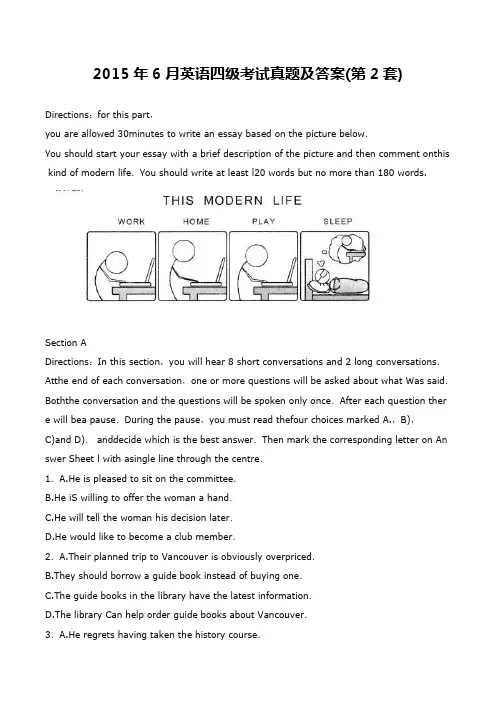
2015年6月英语四级考试真题及答案(第2套)Directions:for this part,you are allowed 30minutes to write an essay based on the picture below.You should start your essay with a brief description of the picture and then comment onthis kind of modern life.You should write at least l20 words but no more than 180 words.Section ADirections:In this section,you will hear 8 short conversations and 2 long conversations.Atthe end of each conversation,one or more questions will be asked about what Was said.Boththe conversation and the questions will be spoken only once.After each question ther e will bea pause.During the pause,you must read thefour choices marked A.,B),C)and D). anddecide which is the best answer.Then mark the corresponding letter on An swer Sheet l with asingle line through the centre.1.A.He is pleased to sit on the committee.B.He iS willing to offer the woman a hand.C.He will tell the woman his decision later.D.He would like to become a club member.2.A.Their planned trip to Vancouver is obviously overpriced.B.They should borrow a guide book instead of buying one.C.The guide books in the library have the latest information.D.The library Can help order guide books about Vancouver.3.A.He regrets having taken the history course.B.He finds little interest in the history books.C.He has trouble finishing his reading assignments.D.He has difficulty writing the weekly book report.4.A.The man had better choose another restaurant.B.The new restaurant is a perfect place for dating.C.The new restaurant caught her fancy immediately.D.The man has good taste in choosing the restaurant.5.A.He has been looking forward to spring.B.He has been waiting for the winter sale.C.He will clean the woman,s boots for spring.D.He will help the woman put things away.6.A.At a tailor’s.B.At Bob’s home.C.In a clothes store.D.In a theatre.7.A.His guests favor Tibetan drinks.B.His water is quite extraordinary.C.Mineral water is good for health.D.Plain water will serve the purpose.8.A.Report the result of a discussion.B.Raise some environmental issues.C.Submit an important document.D.Revise an environmental report.Questions 9 to 12 are based on the conversation you have just heard.9.A.They pollute the soil used to cover them.B.They are harmful to nearby neighborhoods.C.The rubbish in them takes long to dissolve.D.The gas they emit is extremely poisonous.10.A.Growing population.B.Packaging materials.C.Changed eating habits.D.Lower production cost.11.A.By saving energy.B.By using less aluminum.C.By reducing poisonous wastes.D.By making the most of materials.12.A.We are running out of natural resources soon.B.Only combined efforts can make a difference.C.The waste problem will eventually hurt all of us.D.All of us can actually benefit from recycling.Questions l3 to 15 are based on the conversation you have just heard.13.A.Miami.B.Vancouver.C.Belling ham.D.Boston.14.A.To get information on one—way tickets to Canada.B.To inquire about the price of“Super Saver”seats.C.To get advice on how to fly as cheaply as possible.D.To inquire about the shortest route to drive home.15.A.Join a tourist group.B.Choose a major airline.C.Avoid trips in public holidays.D.Book tickets as early as possible.Section BDirections:In this section,you will hear 3 short passages.At the end of each passage,youwill hear some questions.Both the passage and the questions will be spoken only once .Afteryou hear a question,you must choose the best answer from the four choices markedA.,B),C.and D).Then mark the corresponding letter on Answer Sheet l with a single linethrough t he centre.Passage OneQuestions l6 t0 18 are based on the passage you have just heard.16.A.There are mysterious stories behind his works.B.There are many misunderstandings about him.C.His works have no match worldwide.D.His personal history is little known.17.A.He moved to Strat ford—on—Avon in his childhood.B.He failed to go beyond grammar sch001.C.He was a member of the town council.D.He once worked in a well—known acting company.18.A.Writers of his time had no means to protect their works.B.Possible sources of clues about him were lost in a fire.C.His works were adapted beyond recognition.D.People of his time had little interest in him.Passage TwoQuestions l9 to 21 are based on the passage you have just heard19.A.It shows you have been ignoring your healthB. It can seriously affect your thinking processC.It is an early warning of some illness.D.It is a symptom of too much pressure.20.A.Reduce our workload.B.Control our temper.e painkillers for reliefD.Avoid masking syrup toms_21.A. Lying down and having some sleep.B.Rubbing and pressing one’s back.C.Going out for a walkD.Listening to light musicPassage ThreeQuestions 22 t0 25 are based on the passage you have just heard22.A.Depending heavily on loans.B.Having no budget plans at all.C.Spending beyond one's meansD.Leaving no room for large bills23.A.Many of them can be cut.B. All of them have to be covered.C.Their payment cannot be delayedD.They eat up most of the family income24.A.Rent a house instead of buying one.B. Discuss the problem in the family.C.Make a conservation planD.Move to a cheaper Place25.A.Financial issues plaguing a family.B.Difficulty in making both ends meet.C.Family budget problems and solutionsD.New ways to boost family incomeSection CDirections:In this section,you will hear a passage three times.When the passage is readfor the first time,you should listen carefully for its general idea.When the passage Its read forthe second time,you are required to fill in the blanks with the exact words you have justheard.Finally,when the passage is read for the third time,you should check what you havewritten.Perhaps because going to college is so much a part of the American dream,many people gofor no(26) reason. Some go because their parents expect it,others because it's what theirfriends are doing.Then,there,s the belief that a college degree will(27)ensure a good joband high pay.Some students(28) through four years,attending classes,or skipping(逃课)them as thecase may be,reading only what can’t be avoided,looking for less(29)courses,and neverbeing toucned or changed in any important way.For a few of these people,college providesno(30),yet.Because of parental or peer pressure,they cannot voluntarily leave.Theystop trying in the hope that their tea。
2016年6月大学英语四级第2套真题及答案

2016年6月大学英语四级真题(第2套)Part I WritingDirections:For this part, you are allowed 30 minutes to write a letter to express your thanks to one of your school teachers upon entering college. You should write at least 120 words but no more than 180 words.Part ⅡListening ComprehensionSection ADirections: In this section, you will hear three news reports. At the end of each news report, you will hear two or three questions. Both the news report and the questions will be spoken only once. After you hear a question, you must choose the best answer from the four choices marked A), B), C) and D). Then mark the corresponding letter on Answer Sheet 1 with a single line through the centre.Questions 1 and 2 are based on the news report you have just heard.1. A)How college students can improve their sleep habits.B)Why sufficient sleep is important for college students.C)Why college students are more likely to have stress problems.D)How college students can handle their psychological problems.2. A)It is not easy to improve one’s sleep habits.B)It is not good for students to play video games.C)Students who are better prepared generally get higher scores in examinations.D)Making last-minute preparations for tests may be less effective than sleeping.Questions 3 and 4 are based on the news report you have just heard.3. A)Whether more airports should be built around London.B)Whether adequate investment is being made to improve airport facilities.C)Whether the British Airports Authority should sell off some of its assets.D)Whether the Spanish company could offer better service.4. A)Inefficient management. B)Poor ownership structure.C)Lack of innovation and competition. D)Lack of runway and terminal capacity. Questions 5 to 7 are based on the news report you have just heard.5. A)Report the nicotine content of their cigarettes.B)Set a limit to the production of their cigarettes.C)Take steps to reduce nicotine in their products.D)Study the effects of nicotine on young smokers.6. A)The biggest increase in nicotine content tended to be in brands young smokers like.B)Big tobacco companies were frank with their customers about the hazards of smoking.C)Brands which contain higher nicotine content were found to be much more popular.D)Tobacco companies refused to discuss the detailed nicotine content of their products.7. A)They promised to reduce the nicotine content in cigarettes.B)They have not fully realized the harmful effect of nicotine.C)They were not prepared to comment on the cigarette study.D)They will pay more attention to the quality of their products.Section BDirections: In this section, you will hear two long conversations. At the end of each conversation, you will hear four questions. Both the conversation and the questions will be spoken only once. After you hear a question, you must choose the best answer from the four choices marked A), B), C)and D). Then mark the corresponding letter on Answer Sheet 1 with a single line through the centre.Questions 8 to 11 are based on the conversation you have just heard.8. A)Indonesia. B)Holland. C)Sweden. D)England.9.A)Getting a coach who can offer real help. B)Talking with her boyfriend in Dutch.C)Learning a language where it is not spoken . D)Acquiring the necessary ability to socialize .10. A)Listening language programs on the radio. B)Trying to speak it as much as one can.C)Making friends with native speakers. D)Practicing reading aloud as often as possible.11.A)It creates an environment for socializing.B)It offers various courses with credit points.C)It trains young people’s leadership abilities.D)It provides opportunities for language practice.Questions 12 to 15 are based on the conversation you have just heard.12. A)The impact of engine design on rode safety. B)The role policemen play in traffic safety.C)A sense of freedom driving gives. D)Rules and regulations for driving.13. A)Make cars with automatic control. B)Make cars that have better brakes.C)Make cars that are less powerful. D)Make cars with higher standards.14. A)They tend to drive responsibly. B)They like to go at high speed.C)They keep within speed limits. D)They follow traffic rules closely.15.A)It is a bad idea. B)It is not useful.C)It is as effective as speed bumps . D)It should be combined with education.Section CDirections: In this section, you will hear three passages. At the end of each passage, you will hear three or four questions. Both the passage and the questions will be spoken only once. After you hear a question, you must choose the best answer from the four choices marked A), B), C)and D).Then mark the corresponding letter on Answer Sheet 1 with a single line through the centre.Questions 16 to 18 are based on the passage you have just heard.16.A)The card got damaged . B)The card was found invalid.C)The card reader failed to do the scanning. D)The card reader broke down unexpectedly.17. A)By converting the credit card with a layer of plastic.B)By calling the credit card company for confirmation.C)By seeking help from the card reader maker Verifone.D)By typing the credit card number into the cash register.18.A)Affect the sales of high-tech appliances.B)Change the life style of many Americans.C)Give birth to many new technological inventions.D)Produce many low-tech fixes for high-tech failures.Questions 19 to 21 are based on the passage you have just heard.19. A)They are set by the dean of the graduate school.B)They are determined by the advising board.C)They leave much room for improvement.D)They vary among different departments.20. A)By consulting the examining committee . B)By reading the Bulletin of Information.C)By contacting the departmental office. D)By visiting the university’s website.21. A)They specify the number of credits students must earn.B)They are harder to meet than those for undergraduates.C)They have to be approved by the examining committee.D)They are the same among various divisions of the university.Questions 22 to 25 are based on the passage you have just heard.22. A)Students majoring in nutrition. B)Students in health classes.C)Ph.D. candidates in dieting. D)Middle and high school teachers.23. A)Its overestimate of the effect of dieting. B)Its mistaken conception of nutrition.C)Its changing criteria for beauty. D)Its overemphasis on thinness.24. A)To illustrate her point that beauty is but skin deep.B)To demonstrate the magic effect of dieting on women.C)To explain how computer images can be misleading.D)To prove that technology has impacted our culture.25. A)To persuade girls to stop dieting.B)To promote her own concept of beauty.C)To establish an emotional connection with students.D)To help students rid themselves of bad living habits.Section ADirections:In this section, there is a passage with ten blanks. You are required to select one word for each blank from a list of choices given in a word bank following the passage. Read the passage through carefully before making your choices. Each choice in the bank is identified by a letter. Please mark the corresponding letter for each item on Answer Sheet 2 with a single line through the centre. You may not use any of the words in the bank more than once.Contrary to popular belief, older people generally do not want to live with their children.Moreover, most adult children 26 every bit as much care and support to their aging parentsas was the case in the “good old days”, and most older people do not feel 27 .About 80% of people 65years and older have living children, and about 90% of them have 28 contact with their children. About 75% of elderly parents who don’t go to nursing homes live within 30 minutes of at least one of their children.However, 29 having contact with children does not guarantee happiness in old age. In fact, some research has found that people who are most involved with their families have the lowest spirits. This research may be 30 , however, as ill health often makes older people more 31 and thereby increases contact with family members. So it is more likely that poor health, not just family involvement, 32 spirits.Increasingly, researchers have begun to look at the quality of relationships, rather than at the frequency of contact, between the elderly and their children. If parents and children share interests and values and agree on childrearing practices and religious 33 , they are likely to enjoy each other’s company. Disagreements on such matters can 34 cause problems. If parents are agreed by their daughter’s d ivorce, dislike her new husband, and disapprove of how she is raising their grandchildren, 35 are that they are not going to enjoy her visits.Section BDirections: In this section, you are going to read a passage with ten statements attached to it. Each statement contains information given in one of the paragraphs. Identify the paragraph from which the information is derived. You may choose a paragraph more than once. Each paragraph is marked with a letter. Answer the questions by marking the corresponding letter on Answer Sheet 2.Could Food Shortages Bring Down Civilization?[A] For many years I have studied global agricultural, population, environmental and economictrends and their interactions. The combined effects of those trends and the political tensions they generate point to the breakdown of governments and societies. Yet I, too, have resisted the idea that food shortages could bring down not only individual governments but also our global civilization.[B] I can no longer ignore that risk. Our continuing failure to deal with the environmental declinesthat are undermining the world food economy forces me to conclude that such a collapse is possible.[C] As demand for food rises faster than supplies are growing, the resulting food-price inflationputs severe stress on the governments of many countries. Unable to buy grain or grow their own, hungry people take to the streets. Indeed, even before the steep climb in grain prices in 2008, the number of failing states was expanding. If the food situation continues to worsen, entire nations will break down at an ever increasing rate. In the 20th century the main threat to international security was superpower conflict; today it is failing states.[D] States fail when national governments can no longer provide personal security, food securityand basic social services such as education and health care. When governments lose theircontrol on power, law and order begin to disintegrate. After a point, countries can become so dangerous that food relief workers are no longer safe and their programs are halted. Failing states are of international concern because they are a source of terrorists, drugs, weapons and refugees(难民), threatening political stability everywhere.[E] The surge in world grain prices in 2007 and 2008—and the threat they pose to foodsecurity——has a different, more troubling quality than the increases of the past. During the second half of the 20th century, grain prices rose dramatically several times. In 1972, for instance, the Soviets, recognizing their poor harvest early, quietly cornered the world wheat market. As a result, wheat prices elsewhere more than doubled, pulling rice and corn prices up with them. But this and other price shocks were event-driven——drought in the Soviet Union, crop-shrinking heat in the U.S. Corn Belt. And the rises were short-lived: prices typically returned to normal with the next harvest.[F] In contrast, the recent surge in world grain prices is trend-driven, making it unlikely to reversewithout a reversal in the trends themselves. On the demand side, those trends include the ongoing addition of more than 70 million people a year, a growing number of people wanting to move up the food chain to consume highly grain-intensive meat products, and the massive diversion(转向) of U.S. grain to the production of bio-fuel.[G] As incomes rise among low-income consumers, the potential for further grain consumption ishuge. But that potential pales beside the never-ending demand for crop-based fuels. A fourth of this year’s U.S. grain harvest will go to fuel cars.[H] What about supply? The three environmental trends——the shortage of fresh water, the lossof topsoil and the rising temperatures——are making it increasingly hard to expand the world’s grain supply fast enough to keep up with demand. Of all those trends, however, the spread of water shortages poses the most immediate threat. The biggest challenge here is irrigation, which consumes 70% the world’s fresh water. Millions of irrigation wells in many countries are now pumping water out of underground sources faster than rainfall can refill them. The result is falling water tables(地下水位) in countries with half the world’s people, including the three big grain producers——China, India and the U.S.[I] As water tables have fallen and irrigation wells have gone dry, China’s wheat crop, the world’slargest, has declined by 8% since it peaked at 123 million tons in 1997. But water shortages are even more worrying in India. Millions of irrigation wells have significantly lowered water tables in almost every state.[J] As the world’s food security falls to pieces, individual countries acting in their own self-interest are actually worsening the troubles of many. The trend began in 2007, when leading wheat-exporting countries such as Russia and Argentina limited or banned their exports, in hopes of increasing local food supplies and thereby bringing down domestic food prices.Vietnam banned its exports for several months for the same reason. Such moves may eliminate the fears of those living in the exporting countries, but they are creating panic in importing countries that must rely on what is then left for export.[K] In response to those restrictions, grain-importing countries are trying to nail down long-term trade agreements that would lock up future grain supplies. Food-import anxiety is even leading to new efforts by food-importing countries to buy or lease farmland in other countries. In spite of such temporary measures, soaring food prices and spreading hunger in many other countries are beginning to break down the social order.[L] Since the current world food shortage is trend-driven, the environmental trends that cause it must be reversed. We must cut carbon emissions by 80% from their 2006 levels by 2020, stabilize the world’s population at eight billion by 2040, completely remove poverty, and restore forests and soils. There is nothing new about the four objectives. Indeed, we have made substantial progress in some parts of the world on at least one of these——the distribution of family-planning services and the associated shift to smaller families.[M]For many in the development community, the four objectives were seen as positive, promoting development as long as they did not cost too much. Others saw them as politically correct and morally appropriate. Now a third and far more significant motivation presents itself: meeting these goals may be necessary to prevent the collapse of our civilization. Yet the cost we project for saving civilization would amount to less than $200 billion a year, 1/6 of current global military spending. In effect, our plan is the new security budget.36.The more recent steep climb in grain prices partly results from the fact that more and morepeople want to consume meat products.37. Social order is breaking down in many countries because of food shortages.38. Rather than superpower conflict, countries unable to cope with food shortages now constitutethe main threat to world security.39. Some parts of the world have seen successful implementation of family planning.40. The author has come to agree that food shortages could ultimately lead to the collapse of worldcivilization.41. Increasing water shortages prove to be the biggest obstacle to boosting the world’s grainproduction.42. The cost for saving our civilization would be considerably less than the world’s currentmilitary spending.43. To lower domestic food prices, some countries limited or stopped their grain exports.44. Environmental problems must be solved to ease the current global food shortage.45. A quarter of this year’s American grain harvest will be used to produce bio-fuel for cars. Section CDirections: There are 2 passages in this section. Each passage is followed by some questions or unfinished statements. For each of them there are four choices marked A), B), C) and D). You should decide on the best choice and mark the corresponding letter on Answer Sheet 2 with a single line through the centre.Passage OneQuestions 46 to 50 are based on the following passage.Declining mental function is often seen as a problem of old age, but certain aspects of brain function actually begin their decline in young adulthood, a new study suggests.The study, which followed more than 2,000 healthy adults between the ages of 18 and 60, found that certain mental functions—including measures of abstract reasoning, mental speed and puzzle-solving—started to dull as early as age 27.Dips in memory, meanwhile, generally became apparent around age 37.On the other hand, indicators of a person’s accumulated knowledge—like performance on tests of vocabulary and general knowledge—kept improving with age, according to findings published in the journal Neurobiology of Aging.The results do not mean that young adults need to start worrying about their memories. Mostpeople’s minds function at a high level even in their later years, according to researcher Timothy Salthouse.“These patterns suggest that some type s of mental flexibility decrease relatively early in adulthood, but that the amount of knowledge one has, and the effectiveness of integrating it with one’s abilities, may increase throughout all of adulthood if there are no dise ases,” Salthouse said in a news release.The study included healthy, educated adults who took standard tests of memory, reasoning and perception at the outset and at some point over the next seven years.The tests are designed to detect subtle (细微的) changes in mental function, and involve solving puzzles, recalling words and details from stories, and identifying patterns in collections of letters and symbols.In general, Salthouse and his colleagues found, certain aspects of cognition (认知能力) generally started to decline in the late 20s to 30s.The findings shed light on normal age-related changes in mental function, which could aid in understanding the process of dementia (痴呆), according to the researchers.“By following individuals over time,” Salthouse said, “we gain insig ht in cognition changes, and may possibly discover ways to slow the rate of decline.”The researchers are currently analyzing the study participants’ health and lifestyle to see which factors might influence age-related cognitive changes.46. What is the common view of mental function?A)It varies from person to person. B)It weakens in one’s later years.C)It gradually expands with age. D)It indicates one’s health condition.47. What does the new study find about mental functions?A)Some diseases inevitably lead to their decline.B)They reach a peak at the age of 20 for most people.C)They are closely related to physical and mental exercise.D)Some of them begin to decline when people are still young.48. What does Timothy Salthouse say abo ut people’s minds in most cases?A)They tend to decline in people’s later years.B)Their flexibility determines one’s abilities.C)They function quite well even in old age.D)Their functioning is still a puzzle to be solved.49. Although people’s minds may function less flexibly as they age, they _____.A)may be better at solving puzzlesB)can memorize things with more easeC)may have greater facility in abstract reasoningD)can put what they have learnt into more effective use50. According to Salthouse, their study may help us_____.A)find ways to slow down our mental declineB)find ways to boost our memoriesC)understand the complex process of mental functioningD)understand the relation between physical and mental healthPassage TwoQuestions 51 to 55 are based on the following passage.The most important thing in the news last week was the rising discussion in Nashville about the educational needs of children. The shorthand(简写)educators use for this is “pre-K”—meaning instruction before kindergarten—and the big idea is to prepare 4-year-olds and even younger kids to be ready to succeed on their K-12 journey.But it gets complicated. The concept has multiple forms, and scholars and policymakers argue about the shape, scope and cost of the ideal program.The federal Head Start program, launched 50 years ago, has served more than 30 million children. It was based on concepts developed at Vanderbilt University’s Peabody College by Susan Gray, the legendary pioneer in early childhood education research.A new Peabody study of the Tennessee V oluntary Pre-K program reports that pre-K works, but the gains are not sustained through the third grade. It seems to me this highlights quality issues in elementary schools more than pre-K, and indicates longer-term success must connect pre-K with all the other issues related to educating a child.Pre-K is controversial. Some critics say it is a luxury and shouldn’t be free to families able to pay. Pre-K advocates insist it is proven and will succeed if int egrated with the rest of the child’s schooling. I lean toward the latter view.This is, in any case, the right conversation to be having now as Mayor Megan Barry takes office. She was the first candidate to speak out for strong pre-K programming. The important thing is for all of us to keep in mind the real goal and the longer, bigger picture.The weight of the evidence is on the side of pre-K that early intervention (干预)works. What government has not yet found is the political will to put that understanding into full practice with a sequence of smart schooling that provides the early foundation.For this purpose, our schools need both the talent and the organization to educate each child who arrives at the schoolhouse door. Some show up ready, but many do not at this critical time when young brains are developing rapidly.51.What does the author say about pre-kindergarten education?A)It should cater to the needs of individual children.B)It is essential to a person’s future academic success.C)Scholars and policymakers have different opinions about it.D)Parents regard it as the first phase of children’s development.52.What does the new Peabody study find?A)Pre-K achievements usually do not last long.B)The third grade marks a new phase of learning.C)The third grade is critical to children’s development.D)Quality has not been the top concern of pre-K programs.53.When does the author think pre-K works the best?A)When it is accessible to kids of all families.B)When it is made part of kids’ education.C)When it is no longer considered a luxury.D)When it is made fun and enjoyable to kids.54.What do we learn about Mayor Megan Barry?A)She knows the real goal of education. B)She is a mayor of insight and vision.C)She has once run a pre-K program. D)She is a firm supporter of pre-K.55.What does the author think is critical to kids’ education?A)Teaching method. B)Kids’ interest.C)Early intervention. D)Parents’ involvement.Part IV Translation Directions:For this part, you are allowed 30 minutes to translate a passage from Chinese into English. You should write your answer on Answer Sheet 2.在山东省潍坊市,风筝不仅仅是玩具,而且还是这座城市文化的标志。
2015年6月英语四级考试真题与答案(第2套)
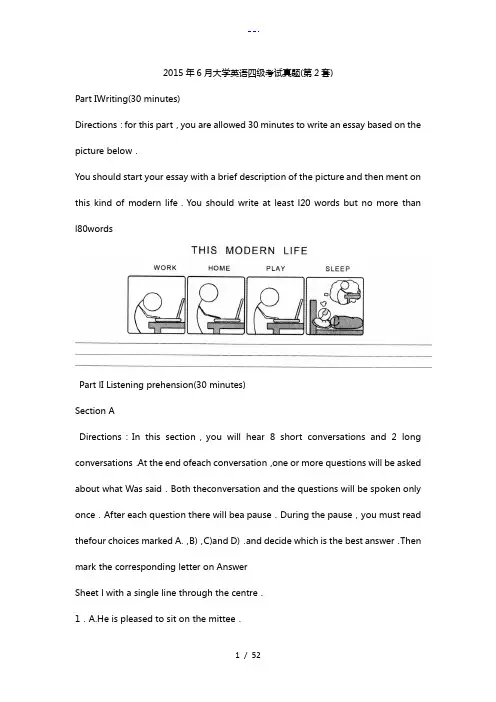
2015年6月大学英语四级考试真题(第2套)Part IWriting(30 minutes)Directions:for this part,you are allowed 30 minutes to write an essay based on the picture below.You should start your essay with a brief description of the picture and then ment on this kind of modern life.You should write at least l20 words but no more than l80wordsPart lI Listening prehension(30 minutes)Section ADirections:In this section,you will hear 8 short conversations and 2 long conversations.At the end ofeach conversation,one or more questions will be asked about what Was said.Both theconversation and the questions will be spoken only once.After each question there will bea pause.During the pause,you must read thefour choices marked A.,B),C)and D).and decide which is the best answer.Then mark the corresponding letter on AnswerSheet l with a single line through the centre.1.A.He is pleased to sit on the mittee.B.He iS willing to offer the woman a hand.C.He will tell the woman his decision later.D.He would like to bee a club member.2.A.Their planned trip to Vancouver is obviously overpriced.B.They should borrow a guide book instead of buying one.C.The guide books in the library have the latest information.D.The library Can help order guide books about Vancouver.3.A.He regrets having taken the history course.B.He finds little interest in the history books.C.He has trouble finishing his reading assignments.D.He has difficulty writing the weekly book report.4.A.The man had better choose another restaurant.B.The new restaurant is a perfect place for dating.C.The new restaurant caught her fancy immediately.D.The man has good taste in choosing the restaurant.5.A.He has been looking forward to spring.B.He has been waiting for the winter sale.C.He will clean the woman,s boots for spring.D.He will help the woman put things away.6.A.At a tailor’s.B.At Bob’s home.C.In a clothes store.D.In a theatre.7.A.His guests favor Tibetan drinks.B.His water is quite extraordinary.C.Mineral water is good for health.D.Plain water will serve the purpose.8.A.Report the result of a discussion.B.Raise some environmental issues.C.Submit an important document.D.Revise an environmental report.Questions 9 t0 12 are based on the conversation you have just heard.9.A.They pollute the soil used to cover them.B.They are harmful to nearby neighborhoods.C.The rubbish in them takes long to dissolve.D.The gas they emit is extremely poisonous.10.A.Growing population.B.Packaging materials.C.Changed eating habits.D.Lower production cost.11.A.By saving energy.B.By using less aluminum.C.By reducing poisonous wastes.D.By making the most of materials.12.A.We are running out of natural resources soon.B.Only bined efforts can make a difference.C.The waste problem will eventually hurt all of us.D.All of us can actually benefit from recyclin9.Questions l3 to 15 are based on the conversation you have just heard.13.A.Miami.B.Vancouver.C.Bellingham.D.Boston.14.A.T o get information on one—way tickets to Canada.B.To inquire about the price of“Super Saver〞seats.C.To get advice on how to fly as cheaply as possible.D.T o inquire about the shortest route to drive home.15.A.Join a tourist group.B.Choose a major airline.C.Avoid trips in public holidays.D.Book tickets as early as possible.Section BDirections:/n this section,you will hear 3 short passages.At the end of each passage,you will hearsome questions.Both the passage and the questions will be spoken only once.After youhear a question,you must choose the best answer fromthe four choices marked A.,B),C.and D).Then mark the corresponding letter on Answer Sheet l with a single linethrough the centre.Passage OneQuestions l6 t0 18 are based on the passage you have just heard.16.A.There are mysterious stories behind his works.B.There are many misunderstandings about him.C.His works have no match worldwide.D.His personal history is little known.17.A.He moved to Stratford—on—Avon in his childhood.B.He failed to go beyond grammar sch001.C.He was a member of the town council.D.He once worked in a well—known acting pany.18.A.Writers of his time had no means to protect their works.B.Possible sources of clues about him were lost in a fire.C.His works were adapted beyond recognition.D.People of his time had little interest in him.Passage TwoQuestions l9 to 21 are based on the passage you have just heard19.A.It shows you have been ignoring your healthB. It can seriously affect your thinking processC.It is an early warning of some illness.D.It is a symptom of too much pressure.20.A.Reduce our workload.B.Control our temper.e painkillers for reliefD.Avoid masking syruptoms_21.A. Lying down and having some sleep.B.Rubbing and pressing one’s back.C.Going out for a walkD.Listening to light musicPassage ThreeQuestions 22 t0 25 are based on the passage you have just heard 22.A.Depending heavily on loans.B.Having no budget plans at all.C.Spending beyond one's meansD.Leaving no room for large bills23.A.Many of them can be cut.B. All of them have to be covered.C.Their payment cannot be delayedD.They eat up most of the familyine24.A.Rent a house instead of buying one.B. Discuss the problem in the family.C.Make a conservation planD.Move to a cheaper Place25.A.Financial issues plaguing a family.B.Difficulty in making both ends meet.C.Family budget problems and solutionsD.New ways to boost familyineSection CDirections:In this section,you will hear a passage three times.When the passage is read for the firsttime,you should listen carefully for its general idea.When the passage Its read for thesecond time,you are required to fill in the blanks with the exact words you have justheard.Finally,when the passage is read for the third time,you should check what youhave written.Perhaps because going to college is so much a part of the American dream,many people go for no26 reason.Some go because their parents expect it,others because it's what their friends aredoing.Then,there,s the belief that a college degree will27 ensure a good job and high pay.Some students 28 through four years,attending classes,or skipping(逃课)them as the case may be,reading only what can’t be avoided,looking for less 29courses,and never being touedor changed in any important way.For a few of these people,college provides no 30,yet.Becauseof parental or peer pressure,they cannot voluntarily leave.They stop trying in the hope that theirtea。
2024年6月全国大学英语CET四级真题和答案解析(第二套)

2024年06月大学英语四级考试真题(第2套)Part I Writing (30 minutes) Directions: Suppose your university is seeking students’ opinions on whether university sports facilities should be open to the public. You are now to write an essay to express your view. You will have 30 minutes for the task. You should write at least 120 words but no more than 180 words.PartⅡListening Comprehension (25 minutes) Section ADirections: In this section, you will hear three news reports. At the end of each news report, you will hear two or three questions. Both the news report and the questions will be spoken only once. After you hear a question, you must choose the best answer from the four choices marked A), B), C) and D).Then mark the corresponding letter on Answer Sheet 1 with a single line through the centre.Questions 1 and 2 are based on the news report you have just heard.1. A) It hit a bird shortly after takeoff.B) Its crew members went on strike.C) It narrowly escaped a plane crash when turning around.D) Its captain got slightly injured during the forced landing.2. A) Panic. C) Relieved.B) Nervous. D) Contented.Questions 3 and 4 are based on the news report you have just heard.3. A) He is now kept in a secure area.B) He has escaped the zoo once again.C) He has been caught a second time.D) He finally disappeared six days ago.4. A) Squeezed.B) Threatened.C) Disappointed.D) Frustrated.Questions 5 to 7 are based on the news report you have just heard.5. A) It is condemned as a crazy idea.B) It is enriching the city’s night life.C) It is questioned by local residents.D) It is giving rise to safety concerns.6. A) Avoid entering one-way streets.B) Ensure the safety of pedestrians.C) Follow all the traffic rules drivers do.D) Give way to automobiles at all times.7. A) To ease the city’s busy traffic.B) To bring new life into the city.C) To add a new means of transport.D) To reduce the city’s air pollution.Section BDirections: In this section, you will hear two long conversations. At the end of each conversation, you will hear four questions. Both the conversation and the questions will be spoken only once. After you hear a question, you must choose the best answer from the four choices marked A),B),C)and D). Then mark the corresponding letter on Answer Sheet 1 with a single line through the centre.Questions 8 to 11 are based on the conversation you have just heard.8. A) Take it seriously. C) Make it sound scary.B) Discuss it regularly. D) Talk about it openly.9. A) By shopping around for the best deals. C) By citing concrete examples.B) By making abstract sums relevant. D) By visiting discount stores.10. A) Paying their kids to help with housework.B) Setting kids a good example by sharing chores.C) Giving kids pocket money according to their needs.D) Urging kids to deposit some of their gift money.11. A) The importance of cutting down family expenses.B) The need to learn important lessons from her elders.C) The delight in seeing their savings grow.D) The necessity of saving into a pension.Questions 12 to 15 are based on the conversation you have just heard.12. A) He is a successful businessman.B) He reviews books on political affairs.C) He has published a new bestseller.D) He has worked in several banks.13. A) The man’s ideas about education.B) The man’s academic background.C) The man’s attempts at drawing public attention.D) The man’s proposals to solve economic problems.14. A) To reduce students’ financial burden.B) To motivate all students to be successful.C) To give students incentive to excel in economics.D) To provide remedies for students’ poor performance.15. A) Improving school budgeting. C) Seeking donations.B) Increasing tuition fees. D) Raising taxes.Section CDirections:In this section, you will hear three passages. At the end of each passage, you will hear three or four questions. Both the passage and the questions will be spoken only once. Afteryou hear a question, you must choose the best answer from the four choices marked A), B), C) and D). Then mark the corresponding letter on Answer Sheet 1 with a single line through the centre.Questions 16 to 18 are based on the passage you have just heard.16. A) To show his sympathy towards people always being busy.B) To prevent people from complaining about being “busy”.C) To call on busy people to take care of themselves.D) To help busy people to sort out their priorities.17. A) Avoid saying we are busy. C) Describe our schedule in detail.B) Reflect on their true purpose. D) Respond as most busy people do.18. A) To show their achievements resulted from great efforts.B) To prove they stand out as accomplished professionals.C) To cover up their failure to achieve some purpose.D) To tell others a complete lie about their inability.Questions 19 to 21 are based on the passage you have just heard.19. A) They will help one reduce fear. C) They will be less challenging after a time.B) They should become so popular. D) They should cover so many different types.20. A) To break one’s ultimate limits. C) To avoid dangerous mistakes.B) To stop being extremely afraid. D) To enjoy the sports to the full.21. A) By allowing our motivation to be at an all-time high.B) By stopping us hurting the same muscles repeatedly.C) By burning as many as 300 calories per hour.D) By enabling us to get an all-over workout.Questions 22 to 25 are based on the passage you have just heard.22. A) It is natural.B) It is instrumental.C) It is personal.D) It is vital.23. A) To guard against being perceived negatively. C) To conceal personality preferences.B) To prevent themselves from being isolated. D) To maintain workplace harmony.24. A) It helps to enhance team spirit.B) It stimulates innovative ideas.C) It helps to resolve problems.D) It facilitates policy-making.25. A) An innovative mind.B) Corporate culture.C) Mutual trust.D) A healthy mentality.Part III Reading Comprehension (40 minutes) Section ADirections: In this section, there is a passage with ten blanks. You are required to select one word for each blank from a list of choices given in a word bank following the passage. Read the passage through carefully before making your choices. Each choice in the bank is identifiedby a letter. Please mark the corresponding letter for each item on Answer Sheet 2 with a single line through the centre. You may not use any of the words in the bank more than once.A team of researchers led by Priyanka Joshi examined the degree to which men and women relied on “communicative abstraction” to verbally convey their ideas and emotions. Communicative abstraction, according to the researchers, reflects the tendency of people to use “abstract speech that focuses on the broader pi cture and 26 purpose of action rather than concrete speech focusing on details and the means of 27 action.” Interestingly, they found that men were far more likely to speak in the abstract than were women.To arrive at this 28 , the researchers examined the linguistic (语言的) patterns of men and women in over 600,000 blog posts written on websites. To do this, the researchers computed abstractness ratings for 29 40,000 commonly used words in the English language. Words conside red to be concrete could be easily visualized, such as “table” or “chair”. Words that were more 30 to visualize, for example, “justice” or “morality” were considered to be more abstract. They found that men used 31 more abstract language in their blog posts.What is the 32 of this effect? The researchers suggest that power differences between the genders— that is, men having more power in society—might be a key determinant (决定因素). For instance, in a follow-up study conducted with a sample of 300 students, the researchers 33 power dynamics in an interpersonal setting to see if this would influence communicative abstraction. They found that participants in a high-power interviewer role were more likely to give abstract descriptions of behaviors than were participants in a low-power interviewee role. This suggests that communicating more abstractly does not reflect a 34 tendency of men or women but rather 35 within specific contexts.Section BDirections:In this section, you are going to read a passage with ten statements attached to it. Each statement contains information given in one of the paragraphs. Identify the paragraph from which the information is derived. You may choose a paragraph more than once. Each paragraph is marked with a letter. Answer the questions by marking the corresponding letter on Answer Sheet 2.How to better work towards long-term goalsA)Hal Hershfield, a psychologist at the UCLA Anderson School of Management, wanted toknow why people weren’t saving for retirement. Across the board, people are living longer.Logically, they’ll need more money to live comfortably in their post-work years. And yet, savings rates in the U.S. have gone down in recent decades, not up.B)To help explain this seemingly irrational behavior, Hershfield and his team scanned thebrains of study participants while asking them to what degree various traits (特征)—like “honorable”or “funny”—applied to their current self, their future self, a current other, or a future other. As participants answered, Hershfield’s team recorded which parts of their brains lit up. Unsurprisingly, people’s brains were most active when thinking about their current selves and least active when thinking about a current other. But the team found that participants’ brain activity while considering their future selves more closely resembled their brain activity while thinking about a current other rather than the current self.C)Put in practical terms, when thinking of yourself in a month or a year or a decade, yourbrain registers that person in ways similar to how it would register Taylor Swift or the mailman. Understood in that way, saving for retirement is the equivalent of giving money away to someone else entirely.D)In light of Hershfield’s study, one simple question arises: Is it possible to make our presentselves give a damn about our future selves? The answers are anything but simple.E)Seen through the lens of the present self versus the future self, our self-defeating actions—like choosing to watch television rather than go to the gym—suddenly make perfect sense.We get to enjoy the very concrete, immediate benefits of our actions while someone else (namely, our future selves) suffers the hypothetical(假设的), far-off consequences. As a result, the decisions we make for our present selves often look very different from our decisions for our future selves. We believe that tomorrow will be different. We believe that we will be different tomorrow; but in doing so, we prioritize our current mood over the consequences of our inaction for the future self.F)Understanding our procrastination (拖延) through the lens of the present and future selves,we’re left with three possible solutions: The first is to force your future self to do whatever your present self doesn’t want to do. The second is to convince your present self that your future self is, in fact, still you. If the central problem is that we think of our future selves as other people, it follows that trying to identify more closely with our future selves will encourage us to make better long-term decisions.G)In a follow-up study, Hershfield wanted to explore ways to bridge the disconnect betweenthe present and future selves and encourage people to save more for retirement. He and his team took photos of study participants, and then used image processing to visually age their faces. Participants were then placed in a virtual reality setting where they could look into a mirror and see their aged selves looking back at them. Participants who saw their aged selves said they would save 30% more of their salary for retirement than the control group.H)Whatever your long-term goals may be—getting in better shape, launching your ownbusiness, writing a book—thinking about your deadline in terms of days rather than months or years can help you wrap your mind around how close the future really is.I)The third solution is to forget about your future self and use your present self’s love ofinstant gratification (满足感) to your advantage. While the two tactics (手段) above can be effective in making better long-term choices, in the end, you’re still struggling againsthuman nature. Our brains are hard-wired for instant gratification. Instead of fighting your present self’s need for immediate rewards, why not use it to your advantage? When most of us set goals, we focus on long-term results we want to see—e.g., losing weight, gettinga promotion, retiring in comfort, etc. While those visions of our future selves can beinspiring, when it comes to actually doing the day-to-day work, it may be more effective to reframe activities in terms of their immediate, or at least very near-term, rewards.J)Take writing this article, for instance. It’s easy for me to imagine how amazing it will feel at the end of the workday to have this article done. This isn’t just my opinion. Research partners Kaitlin Woolley of Cornell University and Ayelet Fishbach of the University of Chicago have made a career out of studying the differences between the goals that people achieve and the ones that fall to the wayside.K)“In one study, we asked people online about the goals they set at the beginning of the year.Most people set goals to achieve delayed, long-term benefits, such as career advancement, debt repayment, or improved health. We asked these individuals how enjoyable it was to pursue their goal, as well as how important their goal was. We also asked whether they were still working on their goals two months after setting them. We found that enjoyment predicted people’s goal persistence two months after setting the goal far more than how important they rated their goal to be,” Woolley said.L)This pattern held true across a wide variety of goals from exercising to studying to eating healthier foods. For example, people ate 50% more of a healthy food when directed to focus on the good taste rather than the long-term health benefits. Other studies have shown a greater uptake of exercise in people who were told to think of the enjoyment of doing the exercise now rather than future health gains.M)These findings suggest that when it comes to achieving your goals, enjoying the process itself is more important than wanting the long-term benefits. In other words, present self trumps (战胜) future self. Who says instant gratification has to be a bad thing? By all means, set ambitious long-term goals for your future self, but when it comes to actually following through day-to-day, make sure your present self knows what’s in it for her too.36. Our brains are genetically determined to satisfy immediate desires.37. Taken in a practical way, saving for post-work years is like giving money away to others.38. Research found that, as regards achievement of one’s goals, it is important to focus more on enjoying the process than the long-term benefits.39. Regarding our future selves as still being ourselves will help us make better long-term decisions.40. Savings rates in America have dropped in recent decades even though people’s life expectancy has increased.41. Researchers found that enjoyment rather than importance enabled people to persist in their goals.42. When making decisions, we give priority to our current frame of mind without thinking much of the consequences.43. People ate more of a healthy food when they focused on its good taste instead of its long-term benefits.44. As was expected, when people thought of their present selves, their brains were observed to become more active.45. Researchers found that participants who saw the images of their aged selves would save more for their later years than those who didn’t.Section CDirections:There are 2 passages in this section. Each passage is followed by some questions or unfinished statements. For each of them there are four choices marked A), B), C) and D). You should decide on the best choice and mark the corresponding letter on Answer Sheet 2 with a single line through the centre.Passage OneQuestions 46 to 50 are based on the following passage.People often wonder why some entrepreneurs have greater success than others. Is it habits, connections, luck, work ethic or any other behavior? I believe the key to success is willpower. Willpower is the ability to control yourself. It is a strong determination that allows you to do something difficult. It is a behavior we are born with more than one we learn; however, it is possible to not only learn it, but also strengthen it with constant exercise.Willpower is just like a muscle; to keep it strong you need to constantly exercise it. People with a great amount of willpower have the discipline to develop positive, successful habits. Even with an incredible amount of talent, without the discipline and motivation to create positive habits, it can be difficult to achieve success.Willpower and habits go hand in hand. It is critical to create good habits and take the actions necessary to stick to those habits day in and day out for greater success. Almost half of our daily actions are part of our habits and not decisions, so once the correct habits are in place, you will automatically perform those tasks on a day-today basis.The best way to create and stick to a habit is to have strong motivation. It’s easier to change your habits to lose weight if you have a health issue and you want to be around longer for your kids, or if your business is somethin g you’re passionate about. Having a valuable outcome associated with a habit will help you stick to that habit permanently.The art of self-control is one that most successful individuals have mastered. Self-control enables you to avoid behaviors that don’t contribute to your success and adopt those that do.Because there is a delayed satisfaction associated with self-control, it can be easy to get off track. However, if you work on sticking to those small positive habits one day at a time, it becomes easier to stay strong and achieve that delayed reward. Once a reward is achieved, it is much easier to continue sticking to your habits.46. What does the author say we need to do to strengthen our willpower?A) Keep it under control. C) Learn from entrepreneurs.B) Apply it continuously. D) Aim at success determinedly.47. How are almost half of our daily actions performed according to the passage?A) Out of habit. C) Like muscle building.B) With determination. D) By self-discipline.48. What will help people stick to doing something constructive automatically?A) Practising it on a day-to-day basis. C) Possessing a reasonable amount of talent.B) Associating it with improving health. D) Foreseeing the desired outcome it will yield.49. How does the art of self-control help us succeed?A) By allowing us to remain clear-headed permanently.B) By enabling us to alter our behaviors constantly.C) By enabling us to take positive actions.D) By allowing us to avoid taking risks.50. Why can it be difficult for us to maintain self-control?A) Most of us are not in the habit of exercising self-control.B) We may not get immediate rewards from self-control.C) Self-control tends to be associated with pains.D) Self-control only brings about small benefits.Passage TwoQuestions 51 to 55 are based on the following passage.Today, most scientific research is funded by government grants, companies doing research and development, and non-profit foundations. As a society, we reap the rewards from this science, but we also help pay for it. You indirectly support science through taxes you pay, products and services you purchase, and donations you make.Funding for science has changed with the times. Historically, science has been largely supported through private patronage(资助), church sponsorship, or simply paying for the research yourself. Today, researchers are likely to be funded by a mix of grants from various government agencies, institutions, and foundations. Other research is funded by private companies. Such corporate sponsorship is widespread in some fields. Almost 75% of U.S. clinical trials in medicine are paid for by private companies. And, of course, some researchers today still fund small-scale studies out of their own pockets. Most of us can’t afford to do nuclear research as a private hobby, but birdwatchers, rock collectors, and others can do real research on a limited budget.In a perfect world, money wouldn’t matter—all scientific studies would be completely objective. But in the real world, funding may introduce biases. Drug research sponsored by the pharmaceutical (制药的) industry is more likely to end up favoring the drug under consideration than studies sponsored by government grants or charitable organizations. Similarly, nutrition research sponsored by the food industry is more likely to end up favoring the food under consideration than independently funded research.So what should we make of all this? Should we ignore any research funded by companies or special interest groups? Certainly not. These groups provide invaluable funding for scientific research. Furthermore, science has many safeguards in place to catch instances of bias that affect research outcomes. Ultimately, misleading results will be corrected as science proceeds; however, this process takes time. Meanwhile, it pays to examine studies funded by industry or special interest groups with extra care. Are the results consistent with other independently funded studies? What do other scientists have to say about this research? A little examination can go a long way towards identifying bias associated with the funding source.51. What does the passage mainly discuss regarding scientific research?A) Its foundation.B) Its rewards.C) Its prospect.D) Its funding.52. What do we learn from the passage about researchers like birdwatchers and rock collectors?A) They have little access to government funding.B) They can do research with limited resources.C) They can do amateur work in their own fields.D) They have no means for large-scale research.53. What would scientific studies look like in a perfect world according to the author?A) They would be totally unbiased.B) They would be independently funded.C) They would be responsibly conducted.D) They would be strictly supervised.54. What does the author say about companies and special interest groups?A) They try hard to pull down the safeguards for research.B) They make extra efforts to research their own products.C) They provide valuable resources for scientific research.D) They reap the most benefits from scientific research.55. What does the author think of research funded by industry or special interest groups?A) Its recommendations should be examined for feasibility.B) Its misleading results should be corrected in time.C) Its validity should be checked with additional care.D) Its hidden biases should be identified independently.Part ⅣTranslation (30 minutes) Directions: For this part, you are allowed 30 minutes to translate a passage from Chinese into English. You should write your answer on Answer Sheet 2.农历(the lunar calendar)起源于数千年前的中国,根据太阳和月亮的运行规律制定。
2015年6月大学英语四级考试真题及解析第二套
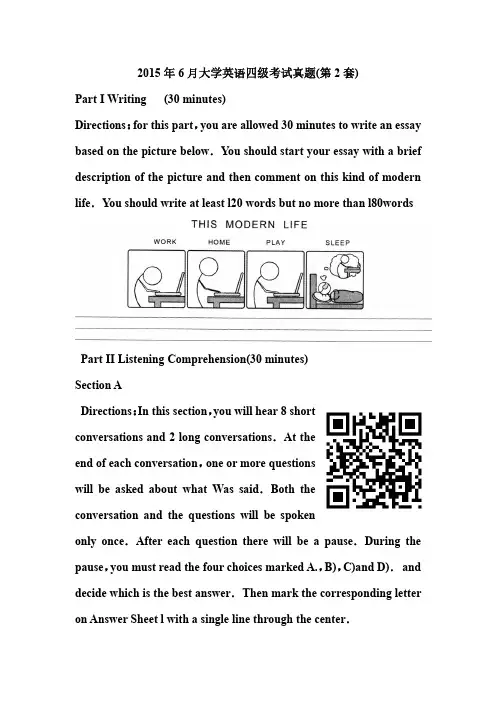
2015年6月大学英语四级考试真题(第2套)Part I Writing (30 minutes)Directions:for this part,you are allowed 30 minutes to write an essay based on the picture below.You should start your essay with a brief description of the picture and then comment on this kind of modern life.Y ou should write at least l20 words but no more than l80wordsPart II Listening Comprehension(30 minutes)Section ADirections:In this section,you will hear 8 shortconversations and 2 long conversations.At theend of each conversation,one or more questionswill be asked about what Was said.Both theconversation and the questions will be spokenonly once.After each question there will be a pause.During the pause,you must read the four choices marked A.,B),C)and D).and decide which is the best answer.Then mark the corresponding letter on Answer Sheet l with a single line through the center.1.A.He is pleased to sit on the committee.B.He is willing to offer the woman a hand.C.He will tell the woman his decision later.D.He would like to become a club member.2.A.Their planned trip to Vancouver is obviously overpriced.B.They should borrow a guide book instead of buying one.C.The guide books in the library have the latest information.D.The library Can help order guide books about V ancouver.3.A.He regrets having taken the history course.B.He finds little interest in the history books.C.He has trouble finishing his reading assignments.D.He has difficulty writing the weekly book report.4.A.The man had better choose another restaurant.B.The new restaurant is a perfect place for dating.C.The new restaurant caught her fancy immediately.D.The man has good taste in choosing the restaurant.5.A.He has been looking forward to spring.B.He has been waiting for the winter sale.C.He will clean the woman,s boots for spring.D.He will help the woman put things away.6.A.At a tailor’s.B.At Bob’s home.C.In a clothes store.D.In a theatre.7.A.His guests favor Tibetan drinks.B.His water is quite extraordinary.C.Mineral water is good for health.D.Plain water will serve the purpose.8.A.Report the result of a discussion.B.Raise some environmental issues.C.Submit an important document.D.Revise an environmental report.Questions 9 t0 12 are based on the conversation you have just heard.9.A.They pollute the soil used to cover them.B.They are harmful to nearby neighborhoods.C.The rubbish in them takes long to dissolve.D.The gas they emit is extremely poisonous.10.A.Growing population.B.Packaging materials.C.Changed eating habits.D.Lower production cost.11.A.By saving energy.B.By using less aluminum.C.By reducing poisonous wastes.D.By making the most of materials.12.A.We are running out of natural resources soon.B.Only combined efforts can make a difference.C.The waste problem will eventually hurt all of us.D.All of us can actually benefit from recyclin9.Questions l3 to 15 are based on the conversation you have just heard.13.A.Miami.B.V ancouver.C.Belling ham.D.Boston.14.A.To get information on one—way tickets to Canada.B.To inquire about the price of“Super Saver”seats.C.To get advice on how to fly as cheaply as possible.D.To inquire about the shortest route to drive home.15.A.Join a tourist group.B.Choose a major airline.C.Avoid trips in public holidays.D.Book tickets as early as possible.Section BDirections:in this section,you will hear 3 short passages.At the end of each passage,you will hear some questions.Both the passage and the questions will be spoken only once After you hear a question,youmust choose the best answer from the four choices marked A.,B),C.and D).Then mark the corresponding letter on Answer Sheet l with a single line through the center.Passage OneQuestions l6 t0 18 are based on the passage you have just heard.16.A.There are mysterious stories behind his works.B.There are many misunderstandings about him.C.His works have no match worldwide.D.His personal history is little known.17.A.He moved to Strat ford—on—Avon in his childhood.B.He failed to go beyond grammar sch001.C.He was a member of the town council.D.He once worked in a well—known acting company.18.A.Writers of his time had no means to protect their works.B.Possible sources of clues about him were lost in a fire.C.His works were adapted beyond recognition.D.People of his time had little interest in him.Passage TwoQuestions l9 to 21 are based on the passage you have just heard 19.A.It shows you have been ignoring your healthB. It can seriously affect your thinking processC.It is an early warning of some illness.D.It is a symptom of too much pressure.20.A.Reduce our workload.B.Control our temper.e painkillers for reliefD.Avoid masking syrup toms_21.A. Lying down and having some sleep.B.Rubbing and pressing one’s back.C.Going out for a walkD.Listening to light musicPassage ThreeQuestions 22 t0 25 are based on the passage you have just heard 22.A.Depending heavily on loans.B.Having no budget plans at all.C.Spending beyond one's meansD.Leaving no room for large bills23.A.Many of them can be cut.B. All of them have to be covered.C.Their payment cannot be delayedD.They eat up most of the family income24.A.Rent a house instead of buying one.B. Discuss the problem in the family.C.Make a conservation planD.Move to a cheaper Place25.A.Financial issues plaguing a family.B.Difficulty in making both ends meet.C.Family budget problems and solutionsD.New ways to boost family incomeSection CDirections:In this section,you will hear a passage three times.When the passage is read for the first time,you should listen carefully for its general idea.When the passage Its read for the second time,you are required to fill in the blanks with the exact words you have just heard.Finally,when the passage is read for the third time,you should check what you have written.Perhaps because going to college is so much a part of the American dream,many people go for no 26 reason.Some go because their parents expect it,others because it's what their friends are doing.Then,there,s the belief that a college degree will27 ensure a good job and high pay.Some students 28 through four years,attending classes,or skipping(逃课)them as the case may be,reading only what can’t be avoided,looking for less 29courses,and never being touched or changed in any important way.For a few of these people,college provides no 30,y et because of parental or peer pressure, they cannot voluntarily leave. They stop tryingin the hope that their teachers will make the decision for them by31_them.To put it bluntly (直截了当地),unless you’re willing to make your college years count,You might be32 doing something else.Not everyone should attend college,nor should everyone who does.attend begin right after high school.Many college students 33 taking a year or so off.A year out m the world helps some people to 34 their priorities and goals.If you’re really going to get something out of going to college,you have to make it mean something,and to do that you must have some idea why you're there,what you hope to get out of it,and35 even what you hope to become.Part HI Reading Comprehension(40 minutes)Section ADirections:in this section,there is a passage with ten blanks.You are required to select one word for each blank from a list of choices given in a word bank following the passage. Read the passage through carefully before making your choices.Each choice in the bank is identified by a letter.Please mark the corresponding letter for each item on Answer Sheet 2 with a single line through the center.You may not use any of the words in the bank more than once.Questions 36 t0 45 are based on the following passage.It’s our guilty pleasure:Watching TV is the most comtion everyday activity,after work and sleep,in many parts of the world.Americans view five hours of TV each day,and while we know that spending so much time sitting36 can lead to obesity(肥胖症)and other diseases,researchers have now quantified just how 37 being a couch potato can be.In an analysis of data from eight large 38 published studies,a Harvard—led group reported in the that for every two hours per day spent channel 39 ,the risk of developing Type 2 diabetes Journal of the American Medical Association(糖尿病)rose 20%over 8.5 years,the risk of heart disease increased l5%over a 40 ,and the odds of dying prematurely 41 13%during a seven— year follow—up.All of these 42 are linked to a lack of physical exercise.But compared with other sedentary(久坐的)activities,like knitting,viewing TV may be especially 43 at promoting unhealthy habits.For one,the sheer number of hours we pass watching TV dwarfs the time we spend on anything else.And other studies have found that watching ads for beer and popcorn may make you more likely to 44 them.Even so.the authors admit that they didn’t compare different sedentary activities to 45 whether TV watching was linked to a greater risk of diabetes,heart disease or early death compared with,say,reading.A.climbedB.consumeC.decadeD.determineE.effectiveF.harmfulG.outcomesH.passivelyI.previouslyJ.resumeK.sufferedL.surfingM.termN.terminals0.twistingSection BDirections:in this section,you are going to read a passage with ten statements attached to it.Each statement contains information given in one of the paragraphs.Identify the paragraph from which the information is derived.Y ou may choose a paragraph more than once.Each paragraph is marked with a letter.Answer the questions by marking the corresponding letter on Answer Sheet 2.Essay.Grading Software Offers Professors a BreakA.Imagine taking a college exam,and,instead of handing in a blue book and getting a grade from a professor a few weeks later,clickingthe“send”button when you are done and receiving a grade back instantly,your essay scored by a software program.And then,instead of being done with that exam,imagine that the system would immediately let you rewrite the test to try to improve your grade.B.EDX,the nonprofit enterprise founded by Harvard and the Massachusetts Institute of Technology(MIT)to offer courses on the Internet,has just introduced such a system and will make its automated(自动的)software available free on the Web to any institution that wants to use it.The software uses artificial intelligence to grade student essays and short written answers,freeing professors for other tasks.C.The new service will bring the educational consortium(联盟)into a growing conflict over the role of automation in education.Although automated grading systems for multiple—choice and true—false tests are now widespread,the use of artificial intelligence technology to grade essay answers has not yet received widespread acceptance by educators and has many critics.D.Anant Agarwal,an electrical engineer who is president of EDX,predicted that the instant—grading software would be a useful teaching tool enabling students to take tests and write essays over and over andimprove the quality of their answers.He said the technology would offer distinct advantages over the traditional classroom system,where students often wait days or weeks for grades.“There is a huge value in learning with instant feedback,”Dr.Agarwal said.“Students are telling us they learn much better with instant feedback.”E.But skeptics(怀疑者)say the automated system is no match for live teachers.One longtime critic,Les Perelman,has drawn national attention several times for putting together nonsense essays that have fooled software grading programs into giving high marks.He has also been highly critical of studies claiming that the software compares well to human graders.F.He is among a group of educators who last month began circulating a petition(呼吁)opposing automated assessment software.The group.which calls itself Professionals Against Machine Scoring of Student Essays in High—Stakes Assessment,has collected nearly 2,000 signatures,including some from famous people like Noanl Chomsky.G.“Let’s face the realities of automatic essay scorin9,”the group’s statement reads in part. “Computers cannot‘read.’They cannot measure the essentials of effective written communication:accuracy.reasonin9,adequacy of evidence,good sense,ethical(伦理的)position,convincing argument,meaningful organization,and clarity,among others.”H)But EdX expects its software to be adopted widely by schools and universities.It offers free online classes from Harvard.MIT and the University of California—Berkeley;this fall,it will add classes from Well else.Georgetown and the University of Texas.In all,12 universities participate in EDX,which offers certificates for course completion and has said that it plans to continue to expand next year,including adding international schools.I.The EDX assessment tool requires human teachers,or graders,to first grade l00 essays or essay questions.The system then uses a variety of machine—learning techniques to train itself to be able to grade any number of essays or answers automatically and almost instantly.The software will assign a grade depending on the scoring system created by the teacher,whether it is a letter grade or numerical(数字的)rank.J . EDX is not the first to use the automated assessment technology,which dates to early computers in the l960s.There is now a range of companies offering commercial programs to grade written test answers,and four states--Louisiana,North Dakota,Utah and West Virginia--are using some formof the technology in secondary schools.A fifth,Indiana,has experimented with it.In some cases the software is used as a“second reader.”to check the reliability of the human graders.K.But the growing influence of the EDx consortium to set standards is likely to give the technology a boost.On Tuesday,Stanford announced that it would work with EDX to develop a joint educational system that will make use of the automated assessment technology.L.Two start.ups.Coursera and Udacity,recently founded by Stanford faculty members to create“massive open online courses,”or MOOCs,are also committed to automated assessment systems because of the value of instant feedback.‘‘It allows students to get immediate feedback on their work.so that learning turns into a game,with students naturally gravitating(吸引)toward resubmitting the work until they get it right,”said Daphne Koller,a computer scientist and a founder of Coursera.M.Last year the Hewlett Foundation, a grant—malting organization set up by one of the Hewlett Packard founders and his wife.sponsored two$100,000 prizes aimed at improving software that grades essays and short answers.More than l50 teams entered each category.A winner of one of the Hewlett contests.Vik Paruchuri,was hired by E(Ⅸto help design its assessment software.N.“One of our focuses is to help Mds learn how to think critically,”said Victor Vuchic,a program officer at the Hewlett Foundation.“It’s probably impossible to do that with multiple—choice tests The challenge is that this requires human graders,and so they cost a lot more and they take a lot more time.“O.Mark D.Shermis,a professor at the University of Akron inOhi0.supervised the Hewlett Foundation’s contest on automated essay scoring and wrote a paper about the experiment.In his view,the technology--though imperfect--has a place in educational settings.P.With increasingly large classes,it is impossible for most teachers to give students meaningful feedback on writing assignments,he said.Plus,he noted,critics of the technology have tended to come from the nation’s best universities,where the level of teaching is much better than at n lost schools.Q)“Often they come from very famous institutions where,in fact,they do a much better.job of providing feedback than a machine ever could,”Dr.Shermis said.“There seems to be a lack of appreciation of what is actually going on in the real world.”46.Some professionals in education are collecting signatures to voice their opposition to an to mated essay grading.47.Using software to grade students’ essays saves teachers time for other work.48.The Hewlett contests aim at improving essay grading software.49.Though the automated grading system is widely used in multiple—choice tests.automated essay grading is still criticized by many educators.50.Some people don’t believe the software grading system can do as good a job as human graders.51.Critics of automated essay scoring do not seem to know the true realities in less famous universities.52.Critics argue many important aspects of effective writing cannot be measured by computer rating programs.53.As class size grows,most teachers are unable to give students valuable comments as to how to improve their writin9.54.The automated assessment technology is sometimes used to double check the work of human graders.55.Students find instant feedback helps improve their learning considerably.Section CDirections:There are 2 passages in this section.Each passage is followed by some questions or unfinished statements.For each of them there are four choices marked A.,B),C)and D.Y ou should decide on the best choice and mark the corresponding letter on Sheet 2 with a single line through the center.Passage On eQuestions 56 t0 60 are based on the following passage.The endless debate about“work—life balance”often contains a hopeful footnote about stay at home dads.If American society and business won’tmake it easier on future female leaders who choose to have children,there is still the ray of hope that increasing numbers of full—time fathers will.But based on today’s socioeconomic trends,this hope is,unfortunately,misguided.It’s true that the number of men who have left work to do their thing as full—time parents has doubled in a decade,but it’s still very small:only 0.8%of married couples where the stay—at—hone father was out of the labor force for a year.Even that percentage is likely inflated by men thrust into their caretaker role by a downsizing.This is simply not a large enough group to reduce the social stigma(污名)and force other adjustments necessary to supporting men in this decision.even if only work more than their family.Even shorter times away from work for working fathers are already difficult.A study found that 85%of new fathers take some time off after the birth of a child—but for all but a few.it’s a week or two at most.Meanwhile,the average for women who take leave is more than lo weeks.Such choices impact who moves up in the organization.While you’re away,someone else is doing your work,making your sales,taking care of your customers.That can’t help you at work.It can only hurt you.Women,of course,face the same issues of returning after a long absence.But with many more women than men choosing to leave theworkforce entirely to raise families,returning from an extended parental leave doesn’t raise as many eyebrows as it does for men.Women would make more if they didn’t break their earning trajectory(轨迹)by leaving the workforce,or if higher-paying professions were more family friendly.In the foreseeable future,Stay at home fathers may make all the difference for individual families.but their presence won’t reduce the numbers of high potential women who are forced to choose between family and career.56.What gives women a ray of hope to achieve work life balance?A.More men taking an extended parental leave.B.People’s changing attitudes towards family.C.More women entering business management.D.The improvement of their socioeconomic status.57.Why does the author say the hope for more full—time fathers is misguided?A.Women are better at taking care of children.B.Many men value work more than their family.C.Their number is too small to make a difference.D.Not many men have the chance to stay at home.58.Why do few men take a long parental leave?A.A long leave will have a negative impact on their career.B.They just have too many responsibilities to fulfill at work.C.The economic loss will be too much for their family to bear.D.They are likely to get fired if absent from work for too lon9.59.What is the most likely reaction to men returning from an extended parental leave?A.Jealousy.B.SurpriseC.AdmirationD.Sympathy.60.What does the author say about high-potential women in the not—too-distant future?A.They will benefit from the trend of more fathers staying at home.B.They will find high—paying professions a bit more family—friendly.C.They are unlikely to break their career trajectory to raise a family.D.They will still face the difficult choice between career and children.Passage TwoQuestions 61 to65 are based on the following passage.Some of the world’s most significant problems never hit headlines.One example comes from agriculture.Food riots and hunger make news.But the trend lying behind these matters is rarely talked about.This is the decline in the growth in yields of some of the world’s major crops.A new study by the University of Minnesota and McGill University in Montreal looks at where.and how far.this decline is occurring.The authors take a vast number of data points for the four most important crops:rice,wheat,corn and soyabeans(大豆).They find that on between 24%and 39%of all harvested areas,the improvement in yields that took place before the l980s slowed down in the l990s and 2000s.There are two worrying features of the slowdown.One is that it has been particularly sharp in the world’s most populous(人口多的)countries,India and China.Their ability to feed themselves has been an important source of relative stability both within the countries and on world food markets.That self-sufficiency cannot be taken for granted if yields continue to slow down or reverse.Second,yield growth has been lower in wheat and rice than in coll and soyabeans.This is problematic because wheat and rice are more important as foods,accounting for around half of all calories consumed.Corn and soyabeans are more important as feed grains.The authors note that“we have preferentially focused our crop improvement efforts on feeding animals and cars rather than on crops that feed people and are the basis of food security in much of the world.” The report qualifies the more optimistic findings of another new paper which suggests that the world will not have to dig up a lot more land for farming in order to feed 9 billion people in 2050,as the Food and Agriculture Organisation has argued.Instead,it says,thanks to slowing population growth,land currently ploughed up for crops might be able torevert(回返)to forest or wilderness.This could happen.The trouble is that the forecast assumes continued improvements in yields which may not actually happen61.What does the author try to draw attention to?A.Food riots and hunger in the world.B.News headlines in the leading media.C.The decline of the grain yield growth.D.The food supply in populous countries.62.Why does the author mention India and China in particular?A.Their self-sufficiency is vital to the stability of world food markets.B.Their food yields have begun to decrease sharply in recent years.C.Their big populations are causing worldwide concerns.D 1 Their food self-sufficiency has been taken for granted.63.What does the new study by the two universities say about recent crop improvement efforts?A. They fail to produce the same remarkable results as before the l980s.B.They contribute a lot to the improvement of human food production.C.They play a major role in guaranteeing the food security of the world.D.They focus more on the increase of animal feed than human food grains.64.What does the Food and Agriculture Organisation say about world food production in the coming decades?A.The growing population will greatly increase the pressure on world food supplies.B.The optimistic prediction about food production should be viewed with caution.C. The slowdown of the growth in yields of major food crops will be"reversed.D.The world will be able to feed its population without increasing farmland.65.How does the author view the argument of the Food and Agriculture Organisation?A.It is built on the findings of a new study.B.It is based on a doubtful assumption.C.It is backed by strong evidence.D. It is open to further discussion.Part IV Translation(30 minutes)Directions:For this part,you are allowed 30 minutes to translate a passage from Chinese into English.Y ou should write your answer on Answer Sheet 2.据报道,今年中国快递服务(courier services)将递送大约120亿件包裹。
英语四级第2套真题及解析(2023年6月份)
英语四级第2套真题及解析(2023年6月份)题目说明本文档为2023年6月份的英语四级第2套真题及解析,总结了各部分的题目及解析。
希望对正在准备四级考试的同学们有所帮助。
听力部分Section A题目1.What does the man suggest the woman do?2.What is the probable relationship between thespeakers?3.What was the woman’s decision?4.What does the man mean?5.What will the speakers do next?解析1.答案:B) Registered at the hotel. 解析:根据对话内容,男士建议女士到酒店登记,所以正确选项是B。
2.答案:D) Guide and tourist. 解析:男士希望女士给他建议,说明他是游客,女士是导游,故选D。
3.答案:C) Miss the tour. 解析:对话中提到已经十点多了,而导游要求游客在准时九点前到达,所以没有时间再去参观了,故选C。
4.答案:A) He agrees with the w oman’s decision. 解析:对话最后男士说,It’s probably for the best,说明他同意女士的决定,故选A。
5.答案:B) Continue the tour. 解析:对话中提到女士给男士参观时间表,所以下一个行动是继续参观旅游景点,故选B。
Section B题目11.What was the woman doing?12.What did Mary do?13.What does the woman mean?14.What is the woman going to do next?15.What is the probable relationship between the speakers?解析11.答案:A) Looking for a book. 解析:根据对话内容,女士要找一本书,所以正确选项是A。
2015年6月英语四级答案及解析(第二套)
2015年6月大学英语四级考试真题答案与详解(第2套)Part I Writing这是一篇四级考试中常见的议论文。
此次通过漫画所呈现出的话题computer(电脑)是考生日常生活中耳熟能详的话题,因此写起来并不难。
行文中,考生应将重点放在第二段阐述电脑与日常生活的关系上。
联系实际分析可知,二者关系为:电脑为日常生活提供了便利,但不能完全占据人们的日常生活。
一、提出观点:电脑在日常生活中虽然重要但并非必不可少(an important but not indispensable role)现代生活漫画中是一个人,一天当中他无时无刻不在使用电脑,不论是在工作时、在家时、玩游戏时,还是在睡眠中。
这幅漫画生动地描述了一种普遍现象:电脑现在深深地渗透到我们的日常生活中,我们甚至一分钟都不能没有它。
尽管如此,在我看来,电脑在现代生活中虽然重要但并非必不可少。
诚然,电脑使我们的生活方便,并提供及时帮助。
但它并非生活必需品。
首先,过度沉迷于电脑对我们的健康不利。
我们可能着迷于电脑上五花八门的内容而忽略了在业余时间锻炼身体。
此外,过度使用电脑会将我们隔离在社交圈之外。
因为我们可以通过电脑与虚拟世界中的朋友交谈,所以我们可能不会费心去与身边的亲朋好友交流。
总之,作为高科技的产物,电脑确实改善了我们的生活。
但是我们不应该在电脑上花费过多的时间而舍弃享受美好的生活.Part II Listening Comprehension1.W:Tom.would you be interested in serving on the membership committee this year? M:Can I get back to you on that in a few days?0:What does the man mean?C.2.W:We should buy a good guide book and study it before our trip to Vancouver. M:We could.But they are overprice—d.What about the library?Q:What does the man mean?B.3.W:You took a history course this term.didn’t you?What can you say about it?M:Well,the trouble is that I never get through the weekly r—eadin—g list,though some books are quite interesting.Q:What does the man mean?C.assignments,difficulty和book report等,由此可推测对话内容与男士在历史课上所碰到的问题相关。
6月大学英语四级听力题目答案及原文第2套
Part II Listening ComprehensionSection ANews Report One【话题预测】由college students,sleep,problem,stress,psychological 等词可推断,本则新闻与大学生睡眠或心理健康有关。
【正确答案】1—2 B D听力原文You probably think college students are experts at sleeping, but parties, preparations for tests, personal problems and general stress can wreck a student’s sleep habits, which can be bad for the body and the mind. Texas Tech University is even offering a class called “Improving Your Sleep Habits”. People suffering from sleep loss are at an increased risk from obesity, psychological problems and car crashes. Students who don’t get enough sleep have poor attendance and lower grades. On top of all that, a new study published in the journal Learning and Memory finds you are probably better off sleeping than making last-minute preparations for a test. 200 college kids were taught to play some unfamiliar video games. Subjects who learned the games in the morning lost some skills when they played again 12 hours later, but they did much better after getting a good night’s sleep. So if you really want to do your job well, don’t forget to get some sleep. Questions 1 and 2 are based on the news report you have just heard.1. What is the news report mainly about?2. What is the finding of the new study published in the journal Learning and Memory?试题解析【话题分类】时事新闻【新闻大意】大学生睡眠不好会严重影响学习效率和身心健康;Texas Tech 大学甚至开设课程教授学生改善睡眠习惯,提高睡眠质量;新的一项研究也证明了提高睡眠质量的重要性。
英语四级真题2016年6月(第二套)试卷及答案解析
2016年6月大学英语四级真题(第2套)Part I Writing (30 minutes) Directions:For this part, you are allowed 30 minutes to write a letter to express your thanks to one of your school teachers upon entering college. You should write at least 120 words but no more than 180 words.Part ⅡListening Comprehension (25 minutes) Section ADirections: In this section, you will hear three news reports. At the end of each news report, youwill hear two or three questions. Both the news report and the questions will be spoken only once. After you hear a question, you must choose the best answer from the four choices marked A), B), C) and D). Then mark the corresponding letter on Answer Sheet 1 with a single line through the centre.Questions 1 and 2 are based on the news report you have just heard.1. A)How college students can improve their sleep habits.B)Why sufficient sleep is important for college students.C)Why college students are more likely to have stress problems.D)How college students can handle their psychological problems.2. A)It is not easy to improve one’s sleep habits.B)It is not good for students to play video games.C)Students who are better prepared generally get higher scores in examinations.D)Making last-minute preparations for tests may be less effective than sleeping.Questions 3 and 4 are based on the news report you have just heard.3. A)Whether more airports should be built around London.B)Whether adequate investment is being made to improve airport facilities.C)Whether the British Airports Authority should sell off some of its assets.D)Whether the Spanish company could offer better service.4. A)Inefficient management. B)Poor ownership structure.C)Lack of innovation and competition. D)Lack of runway and terminal capacity. Questions 5 to 7 are based on the news report you have just heard.5. A)Report the nicotine content of their cigarettes.B)Set a limit to the production of their cigarettes.C)Take steps to reduce nicotine in their products.D)Study the effects of nicotine on young smokers.6. A)The biggest increase in nicotine content tended to be in brands young smokers like.B)Big tobacco companies were frank with their customers about the hazards of smoking.C)Brands which contain higher nicotine content were found to be much more popular.D)Tobacco companies refused to discuss the detailed nicotine content of their products.7. A)They promised to reduce the nicotine content in cigarettes.B)They have not fully realized the harmful effect of nicotine.C)They were not prepared to comment on the cigarette study.D)They will pay more attention to the quality of their products.Section BDirections: In this section, you will hear two long conversations. At the end of each conversation, you will hear four questions. Both the conversation and the questions will be spoken only once. After you hear a question, you must choose the best answer from the four choices marked A), B), C)and D). Then mark the corresponding letter on Answer Sheet 1 with a single line through the centre.Questions 8 to 11 are based on the conversation you have just heard.8. A)Indonesia. B)Holland. C)Sweden. D)England.9.A)Getting a coach who can offer real help. B)Talking with her boyfriend in Dutch.C)Learning a language where it is not spoken . D)Acquiring the necessary ability to socialize .10. A)Listening language programs on the radio. B)Trying to speak it as much as one can.C)Making friends with native speakers. D)Practicing reading aloud as often as possible.11.A)It creates an environment for socializing.B)It offers various courses with credit points.C)It trains young people’s leadership abilities.D)It provides opportunities for language practice.Questions 12 to 15 are based on the conversation you have just heard.12. A)The impact of engine design on rode safety. B)The role policemen play in traffic safety.C)A sense of freedom driving gives. D)Rules and regulations for driving.13. A)Make cars with automatic control. B)Make cars that have better brakes.C)Make cars that are less powerful. D)Make cars with higher standards.14. A)They tend to drive responsibly. B)They like to go at high speed.C)They keep within speed limits. D)They follow traffic rules closely.15.A)It is a bad idea. B)It is not useful.C)It is as effective as speed bumps . D)It should be combined with education.Section CDirections: In this section, you will hear three passages. At the end of each passage, you will hear three or four questions. Both the passage and the questions will be spoken only once. After you hear a question, you must choose the best answer from the four choices marked A), B), C)and D).Then mark the corresponding letter on Answer Sheet 1 with a single line through the centre.Questions 16 to 18 are based on the passage you have just heard.16.A)The card got damaged . B)The card was found invalid.C)The card reader failed to do the scanning. D)The card reader broke down unexpectedly.17. A)By converting the credit card with a layer of plastic.B)By calling the credit card company for confirmation.C)By seeking help from the card reader maker Verifone.D)By typing the credit card number into the cash register.18.A)Affect the sales of high-tech appliances.B)Change the life style of many Americans.C)Give birth to many new technological inventions.D)Produce many low-tech fixes for high-tech failures.Questions 19 to 21 are based on the passage you have just heard.19. A)They are set by the dean of the graduate school.B)They are determined by the advising board.C)They leave much room for improvement.D)They vary among different departments.20. A)By consulting the examining committee . B)By reading the Bulletin of Information.C)By contacting the departmental office. D)By visiting the university’s website.21. A)They specify the number of credits students must earn.B)They are harder to meet than those for undergraduates.C)They have to be approved by the examining committee.D)They are the same among various divisions of the university.Questions 22 to 25 are based on the passage you have just heard.22. A)Students majoring in nutrition. B)Students in health classes.C)Ph.D. candidates in dieting. D)Middle and high school teachers.23. A)Its overestimate of the effect of dieting. B)Its mistaken conception of nutrition.C)Its changing criteria for beauty. D)Its overemphasis on thinness.24. A)To illustrate her point that beauty is but skin deep.B)To demonstrate the magic effect of dieting on women.C)To explain how computer images can be misleading.D)To prove that technology has impacted our culture.25. A)To persuade girls to stop dieting.B)To promote her own concept of beauty.C)To establish an emotional connection with students.D)To help students rid themselves of bad living habits.Part III Reading Comprehension (40 minutes) Section ADirections:In this section, there is a passage with ten blanks. You are required to select one word for each blank from a list of choices given in a word bank following the passage. Read the passage through carefully before making your choices. Each choice in the bank is identified by a letter. Please mark the corresponding letter for each item on Answer Sheet 2 with a single line through the centre. You may not use any of the words in the bank more than once.Contrary to popular belief, older people generally do not want to live with their children. Moreover, most adult children 26 every bit as much care and support to their aging parents as was the case in the “good old days”, and most older people do not feel 27 .About 80% of people 65years and older have living children, and about 90% of them have 28 contact with their children. About 75% of elderly parents who don’t go to nursing homeslive within 30 minutes of at least one of their children.However, 29 having contact with children does not guarantee happiness in old age. In fact, some research has found that people who are most involved with their families have the lowest spirits. This research may be 30 , however, as ill health often makes older people more 31 and thereby increases contact with family members. So it is more likely that poor health, not just family involvement, 32 spirits.Increasingly, researchers have begun to look at the quality of relationships, rather than at the frequency of contact, between the elderly and their children. If parents and children share interests and values and agree on childrearing practices and religious 33 , they are likely to enjoy each other’s company. Disagreements on such matters can 34 cause problems. If parents are agreed by their daughter’s divorce, dislike her new husband, and disapprove of how she is raising their grandchildren, 35 are that they are not going to enjoy her visits.A) abandoned E)commitment I)frequent M)provideB)advanced F)dampens J)fulfillment N)understandablyC)biased G)dependent K)grant O)unrealisticallyD)chances H)distant L)merelySection BDirections: In this section, you are going to read a passage with ten statements attached to it. Each statement contains information given in one of the paragraphs. Identify the paragraph from which the information is derived. You may choose a paragraph more than once. Each paragraph is marked with a letter. Answer the questions by marking the corresponding letter on Answer Sheet 2.Could Food Shortages Bring Down Civilization?[A] For many years I have studied global agricultural, population, environmental and economictrends and their interactions. The combined effects of those trends and the political tensions they generate point to the breakdown of governments and societies. Yet I, too, have resisted the idea that food shortages could bring down not only individual governments but also our global civilization.[B] I can no longer ignore that risk. Our continuing failure to deal with the environmental declinesthat are undermining the world food economy forces me to conclude that such a collapse is possible.[C] As demand for food rises faster than supplies are growing, the resulting food-price inflationputs severe stress on the governments of many countries. Unable to buy grain or grow their own, hungry people take to the streets. Indeed, even before the steep climb in grain prices in 2008, the number of failing states was expanding. If the food situation continues to worsen, entire nations will break down at an ever increasing rate. In the 20th century the main threat to international security was superpower conflict; today it is failing states.[D] States fail when national governments can no longer provide personal security, food securityand basic social services such as education and health care. When governments lose their control on power, law and order begin to disintegrate. After a point, countries can become so dangerous that food relief workers are no longer safe and their programs are halted. Failingstates are of international concern because they are a source of terrorists, drugs, weapons and refugees(难民), threatening political stability everywhere.[E] The surge in world grain prices in 2007 and 2008—and the threat they pose to foodsecurity——has a different, more troubling quality than the increases of the past. During the second half of the 20th century, grain prices rose dramatically several times. In 1972, for instance, the Soviets, recognizing their poor harvest early, quietly cornered the world wheat market. As a result, wheat prices elsewhere more than doubled, pulling rice and corn prices up with them. But this and other price shocks were event-driven——drought in the Soviet Union, crop-shrinking heat in the U.S. Corn Belt. And the rises were short-lived: prices typically returned to normal with the next harvest.[F] In contrast, the recent surge in world grain prices is trend-driven, making it unlikely to reversewithout a reversal in the trends themselves. On the demand side, those trends include the ongoing addition of more than 70 million people a year, a growing number of people wanting to move up the food chain to consume highly grain-intensive meat products, and the massive diversion(转向) of U.S. grain to the production of bio-fuel.[G] As incomes rise among low-income consumers, the potential for further grain consumption ishuge. But that potential pales beside the never-ending demand for crop-based fuels. A fourth of this year’s U.S. grain harvest will go to fuel cars.[H] What about supply? The three environmental trends——the shortage of fresh water, the lossof topsoil and the rising temperatures——are making it increasingly hard to expand the world’s grain supply fast enough to keep up with demand. Of all those trends, however, the spread of water shortages poses the most immediate threat. The biggest challenge here is irrigation, which consumes 70% the world’s fresh water. Millions of irrigation wells in many countries are now pumping water out of underground sources faster than rainfall can refill them. The result is falling water tables(地下水位) in countries with half the world’s people, including the three big grain producers——China, India and the U.S.[I] As water tables have fallen and irrigation wells have gone dry, China’s wheat crop, the world’slargest, has declined by 8% since it peaked at 123 million tons in 1997. But water shortages are even more worrying in India. Millions of irrigation wells have significantly lowered water tables in almost every state.[J] As the world’s food security falls to pieces, individual countries acting in their own self-interest are actually worsening the troubles of many. The trend began in 2007, when leading wheat-exporting countries such as Russia and Argentina limited or banned their exports, in hopes of increasing local food supplies and thereby bringing down domestic food prices. Vietnam banned its exports for several months for the same reason. Such moves may eliminate the fears of those living in the exporting countries, but they are creating panic in importing countries that must rely on what is then left for export.[K] In response to those restrictions, grain-importing countries are trying to nail down long-term trade agreements that would lock up future grain supplies. Food-import anxiety is even leading to new efforts by food-importing countries to buy or lease farmland in other countries. In spite of such temporary measures, soaring food prices and spreading hunger in many other countries are beginning to break down the social order.[L] Since the current world food shortage is trend-driven, the environmental trends that cause it must be reversed. We must cut carbon emissions by 80% from their 2006 levels by 2020,stabilize the world’s population at eight billion by 2040, completely remove poverty, and restore forests and soils. There is nothing new about the four objectives. Indeed, we have made substantial progress in some parts of the world on at least one of these——the distribution of family-planning services and the associated shift to smaller families.[M]For many in the development community, the four objectives were seen as positive, promoting development as long as they did not cost too much. Others saw them as politically correct and morally appropriate. Now a third and far more significant motivation presents itself: meeting these goals may be necessary to prevent the collapse of our civilization. Yet the cost we project for saving civilization would amount to less than $200 billion a year, 1/6 of current global military spending. In effect, our plan is the new security budget.36.The more recent steep climb in grain prices partly results from the fact that more and morepeople want to consume meat products.37. Social order is breaking down in many countries because of food shortages.38. Rather than superpower conflict, countries unable to cope with food shortages now constitutethe main threat to world security.39. Some parts of the world have seen successful implementation of family planning.40. The author has come to agree that food shortages could ultimately lead to the collapse of worldcivilization.41. Increasing water shortages prove to be the biggest obstacle to boosting the world’s grainproduction.42. The cost for saving our civilization would be considerably less than the world’s currentmilitary spending.43. To lower domestic food prices, some countries limited or stopped their grain exports.44. Environmental problems must be solved to ease the current global food shortage.45. A quarter of this year’s American grain harvest will be used to produce bio-fuel for cars. Section CDirections: There are 2 passages in this section. Each passage is followed by some questions or unfinished statements. For each of them there are four choices marked A), B), C) and D). You should decide on the best choice and mark the corresponding letter on Answer Sheet 2 with a single line through the centre.Passage OneQuestions 46 to 50 are based on the following passage.Declining mental function is often seen as a problem of old age, but certain aspects of brain function actually begin their decline in young adulthood, a new study suggests. The study, which followed more than 2,000 healthy adults between the ages of 18 and 60, found that certain mental functions—including measures of abstract reasoning, mental speed and puzzle-solving—started to dull as early as age 27. Dips in memory, meanwhile, generally became apparent around age 37. On the other hand, indicators of a person’s accumulated knowledge—like performance on tests of vocabulary and general knowledge—kept improving with age, according to findings published in the journal Neurobiology of Aging. The results do not mean that young adults need to start worrying about their memories. Most people’s minds function at a high level even in their later years, according to researcher TimothySalthouse. “These patterns suggest that some types of mental flexibility decrease relatively early in adulthood, but that the amount of knowledge one has, and the effectiveness of integrating it with one’s abilities, may increase throughout all of adulthood if there are no diseases,” Salthouse said in a news release. The study included healthy, educated adults who took standard tests of memory, reasoning and perception at the outset and at some point over the next seven years. The tests are designed to detect subtle (细微的) changes in mental function, and involve solving puzzles, recalling words and details from stories, and identifying patterns in collections of letters and symbols. In general, Salthouse and his colleagues found, certain aspects of cognition (认知能力) generally started to decline in the late 20s to 30s. The findings shed light on normal age-related changes in mental function, which could aid in understanding the process of dementia (痴呆), according to the researchers. “By following individuals over time,” Salthouse said, “we gain insight in cognition changes, and may possibly discover ways to slow the rate of decline.” The researchers are currently analyzing the study participants’ health and lifestyle to see which factors might influence age-related cognitive changes.46. What is the common view of mental function?A)It varies from person to person. B)It weakens in one’s later years. C)It gradually expands with age. D)It indicates one’s health condition.47. What does the new study find about mental functions?A)Some diseases inevitably lead to their decline.B)They reach a peak at the age of 20 for most people.C)They are closely related to physical and mental exercise.D)Some of them begin to decline when people are still young.48. What does Timothy Salthouse say about people’s minds in most cases? A)They tend to decline in people’s later years.B)Their flexibility determines one’s abilities.C)They function quite well even in old age. D)Their functioning is still a puzzle to be solved.49. Although people’s minds may function less flexibly as they age, they _____.A)may be better at solving puzzles B)can memorize things with more ease C)may have greater facility in abstract reasoningD)can put what they have learnt into more effective use50. According to Salthouse, their study may help us_____. A)find ways to slow down our mental declineB)find ways to boost our memoriesC)understand the complex process of mental functioningD)understand the relation between physical and mental healthPassage TwoQuestions 51 to 55 are based on the following passage.The most important thing in the news last week was the rising discussion in Nashville about the educational needs of children. The shorthand(简写)educators use for this is “pre-K”—meaning instruction before kindergarten—and the big idea is to prepare 4-year-olds and even younger kids to be ready to succeed on their K-12 journey. But it gets complicated. The concept has multiple forms, and scholars and policymakers argue about the shape, scope and cost of the ideal program. The federal Head Start program, launched 50 years ago, has served more than 30 million children. It was based on concepts developed at Vanderbilt University’s Peabody College by Susan Gray, the legendary pioneer in early childhood education research. A new Peabody study of the Tennessee Voluntary Pre-K program reports that pre-K works, but the gains are not sustained through the third grade. It seems to me this highlights quality issues in elementary schools more than pre-K, and indicates longer-term success must connect pre-K with all the other issues related to educating a child. Pre-K is controversial. Some critics say it is a luxury and shouldn’t be free to families able to pay. Pre-K advocates insist it is proven and will succeed if integrated with the rest of the child’s schooling. I lean toward the latter view. This is, in any case, the right conversation to be having now as Mayor Megan Barry takes office. She was the first candidate to speak out for strong pre-K programming. The important thing is for all of us to keep in mind the real goal and the longer, bigger picture. The weight of the evidence is on the side of pre-K that early intervention (干预)works. What government has not yet found is the political will to put that understanding into full practice with a sequence of smart schooling that provides the early foundation. For this purpose, our schools need both the talent and the organization to educate each child who arrives at the schoolhouse door. Some show up ready, but many do not at this critical time when young brains are developing rapidly.51.What does the author say about pre-kindergarten education? A)It should cater to the needs of individual children. B)It is essential to a person’s future academic success. C)Scholars and policymakers have different opinions about it.D)Parents regard it as the first phase of children’s development.52.What does the new Peabody study find? A)Pre-K achievements usually do not last long. B)The third grade marks a new phase of learning. C)The third grade is critical to children’s development. D)Quality has not been the top concern of pre-K programs.53.When does the author think pre-K works the best? A)When it is accessible to kids of all families. B)When it is made part of kids’ education. C)When it is no longer considered a luxury. D)When it is made fun and enjoyable to kids.54.What do we learn about Mayor Megan Barry? A)She knows the real goal of education. B)She is a mayor of insight and vision. C)She has once run a pre-K program. D)She is a firm supporter of pre-K.55.What does the author think is critical to kids’ education? A)Teaching method. B)Kids’ interest. C)Early intervention. D)Parents’ involvement.Part IV TranslationDirections:For this part, you are allowed 30 minutes to translate a passage from Chinese into English. You should write your answer on Answer Sheet 2.在山东省潍坊市,风筝不仅仅是玩具,而且还是这座城市文化的标志。