
ArrivinginBeijing
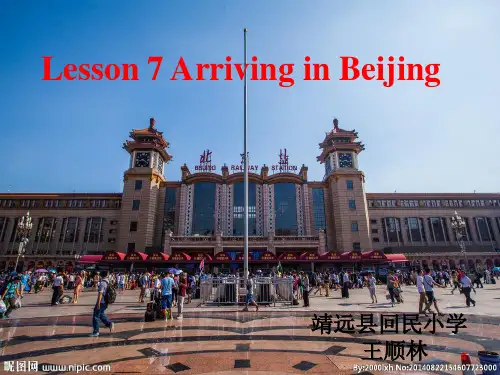
Beijing Train Station
This is a / one man .
These are men . Many men.
This is a / one woman .
These are women . Many women .
This is a boy.
A boy is a child.
This is a girl.
A girl is a child, too.
These are boys and girls. Boys and girls are children.
Man , man ,this is a man 。 Men , men ,these are men。 Woman , woman,this is a woman。 Women , women, these are women。 Boys and girls are children 。 Men 和 women 爱 children。 People , people 是人民。 人民人民真伟大。
5.不规则名词: foot→feet, tooth→teeth,
child→children,man→men,woman→women, people→people.
Everyone is tired and hungry. ( 提示:Everyone作主语时,动词用 第三人称单数.即be 动词用is,实意动 词后面加s或es)
1.一般名词复数是在名词后面加上“s”,如 map→maps等.
2.以s, x ,ch, sh等结尾的词加“es”,bus→buses, watch→watches 等. 3.以辅音字母+y结尾的词,变y为i加es,如baby→babies等. 4.以f或fe结尾的名词,多数变f为v加es,如leaf →leaves等.
Lesson9: Arriving in Beijing
抚宁县骊城学区第一小学
徐艳红
What can I see a What can I see a What can I see a What can I see a What can I see a
you see ? goat . you see ? tree . you see ? car . you see ? school . you see ? cow .
2.What is she / he doing?(What are they doing?)
1
2
3
4
Words:man , men, woman , women,
children, people, many, everyone. Sentences: This is a man / woman / child . These are men / women / children.
men people
boys
man people
child
woman boy
women children
1.
C
are women. A.This B. There C.These
2.There are many
B A
in the train station.
A. man B. people C.woman 3.These children are football.
Homework(家庭作业)
1.Repeat the text to your family in English .
2.Make up some other dialogues, use the words they have learned today.
.
A. playing B. plays C. play 4.Boys and girls are B
A. child B. children C. men
5.
C
is tired and hungry.
A. everyone B. Some C. Everyone
Talk about: 1.What can you see in this picture?
Just do it:
1.Everyone likes fruit . (e)
2.Everyone
is
happy . (be)
3. Everyone
goes
to school . (go)
Li Ming , Danny, Jenny and Mrs. Li arrive in Beijing. Everyone is tired and hungry.There are many people in the Beijing Train Station.These women are buying tickets. Some children are crying.Thesemen are talking. Some children are playing cards. Word List: (children ,Everyone, people, women, men)
Lesson-7-Arriving-in-Beijing-教学课件
靖远县回民小学 王顺林
Teaching Aims
1.听,说,认,读,写本课的单词和短语。 (people, men,women,child,many,arrive in, on their
way to,playfootball,in the park)
a young woman
She is singing.
some old women The old women are dancing.
Man , man ,this is a man .
Men , men ,these are men. Woman , woman,this is a woman. Women , women, these are women. Boys ,girls are children . Men ,women love children.
Retell the text.
Make sentences
1. hotel on way to their are they the. __T_h_e_y__a_re__o_n_t_h_e_ir_w__a_y_t_o_t_h_e_h_o_t_e_l.___
2.many are people there park in the. __T_h_e_r_e_a_r_e_m__a_n_y_p_e_o_p_l_e_in__t_h_e_p_a_rk_.____
the Winter Palace
in the park
a child A child is flying a kite.
some children
Some children are playing football.
五年级下册英语教学设计-Lesson7 Arriving in Beijing|冀教版
五年级下册英语教学设计-Lesson7 Arriving in Beijing|冀教版一、教学目标1.学习新单词:arrive, airport, luggage, taxi, subway, bike, walk;2.能够掌握新课文中的语音、语法,听懂、会说、会读本课文内容;3.能够流利地表达自己在旅行中所需要的信息;4.培养学生的合作意识和自学能力。
二、教学重难点1.教学重点:单词和课文的听、说、读、写训练;2.教学难点:掌握新单词及其应用场景,以及语法知识。
三、教学准备1.课本:《冀教版》五年级下册英语教材;2.教学PPT;3.单词卡片;4.习题练习册。
四、教学步骤Step 1:引入课文1.教师介绍本课时的课程内容;2.学生回忆在旅行中可能会使用到哪些英语单词;3.教师出示单词卡片并让学生快速朗读。
Step 2:听读课文1.教师播放课文录音,学生跟读;2.教师重复播放停顿较大的部分,让学生重复跟读;3.教师让学生自主读课文,并关注正确的语音和语调。
Step 3:合作练习1.教师将学生分成小组,让他们自己分配任务;2.小组内互相练习和交流,帮助对方提高听、说、读、写的能力;3.教师巡视各小组并积极给予指导。
Step 4:语法讲解教师对语法进行讲解,重点讲解以下知识点:1.arrive的用法:表示到达,常用的搭配有arrive in / at,如:“I arrived in Beijing yesterday.”2.名词性物主代词的用法:如my, your, his, her, its, our和their。
Step 5:练习巩固1.教师出示习题练习册,让学生认真完成;2.学生自行讲解练习中的难点,教师适时给予指导;3.教师对学生完成情况进行点评和总结。
五、教学反思本节课是英语第七课,主要内容是介绍到达北京的方式和工具。
本节课的教学重点在于让学生学会新单词的应用和语法知识的理解,同时鼓励学生合作和自主学习。
小学英语冀教版(一起)五年级上册unit2 In Beijing lesson7第一课时教案

小学英语冀教版(一起)五年级上册Lesson7 《Arriving in Beijing》教案第一课时教学目标1. 知识目标:掌握单词:man,woman,child以及复数形式men, women, children, 了解people的单复数一致,知道some, great, hotel的汉语意思,能运用所学知识用英语表达看到的、听到的事情。
2. 能力目标:能熟练掌握和识记本课单词:men, women, children, people, many,能灵活运用本课所学内容,对身边的人物进行描述。
教学重难点教学重点:掌握单词men, women, children, people, some。
教学难点:能利用本课所学知识结合实际活动情况进行情感交际练习。
教学方法情景交际教学法,合作学习教学法。
教学媒体准备教学卡片cards、tape-recorder、多媒体课件PPT.课时安排1课时教学过程Step 1: Warm-up1. Greeting: Hello! Boys and girls! How are you? I’m happy. Are you hap py? How’s the weather today? It’s a lovely day! Let’s go on a trip, Ok?2. Show the picture of “Tian’anmen Square” to the students.What’s this? Where is it? Who can say something about Beijing? So, Beijing is great! Let’s go on a trip to Beijing by trai n.3. Show the train on PPT. Now we’re on the train. Do you want to have a chant? (this that chant)4. Can we jump on the train? Can we look out the window on the train? Ok. What can you see?Sept 2: Presentation(一)part 11. Oh, We arrive in Beijin g. I’m very tired. Mrs. Li, Danny, Jenny and Li Ming arrive in Beijing too. They are on their way to the hotel. What can they see?2. Read and answer.a. There are many ______, ________and __________ on the street.b. There are many _________, too.(二)part 21. 出示man图, What can you see? 板书This is a man. / This is one man.2. 出示men图, Is this a man? 板书These are men. / These are many men.拼读men. 从音形区别man 与men.3. 出示woman图, Who is this? 板书This is a woman./ This is one woman. I am a woman, too.4. 出示women图, How many women? 5 women. 板书These are women.拼读women. 从音形区别woman 与women.5. 出示boy and girl图, This is a boy and a girl. Who is a boy? Stand up, please. Who is a girl? Stand up, please. Who is a child? The boy is a child. The girl is a child, too. Boys and girls are children. 板书,拼读children= child+ ren. 区别child 与children.6. 出示课本插图,Teacher asks students try to describe them in pairs. Show the question of “Fill in the blanks”, ask one student to read.A child is_______________.Some children are ______________.A man is_______________.Some old men are ______________.A young woman is_______________.Some old women are ______________.Step3 文本学习(Reading)1. Listen to the tape, and point to the sentences.2. Read the text with the tape. 使用‘学乐师生’APP录音,分享给全班同学。
新冀教版五年级英语下册《Unit 2 In Beijing Lesson 7 Arriving in Beijing》教案_9

Lesson 7 Arriving in Beijing【教学目标】1.语言能力:(1)学生能听懂、会说、认读并书写下列词汇:people, many, child, women, men(2)学生能认读,理解并运用下列基本句型结构:They are on their way to _____. There are many _____.(3)学生能够理解并掌握下列单词的单复数形式:child/children ,man/men,woman/women2.学习能力:通过课堂展示,提高学生的英语表达能力。
3.思维品质:通过细节性和发散性问题,培养学生的独创性。
4.文化品格:通过学习人们在公园所做的事情,让学生知道要遵守社会公共秩序。
【教学重、难点】1.学生能听懂、会说、认读并书写下列词汇:people, many, child, women, men2.学生能认读,理解并运用下列基本句型结构:They are on their way to _____. There are many _____.【教学准备】智慧英语教学系统【教学课时】一课时【教学过程】Step1:Warm up1.Greeting:How do you feel?2.Free talk:Three minutes before class.一名学生进行课前三分钟演讲,出示一个谜语,然后介绍北京。
(设计意图:课前三分钟锻炼学生的口语表达能力。
通过谜语导入,吸引学生注意力,然后介绍北京与新课联系起来。
)Step2:New Concept1.They arrive in Beijing. When do they arrive?火车声音导入,师问:What’s voice?生答:Train.师介绍:Li Ming,Danny,Jenny and Mrs. Li are in the train. Now they are arriving in Beijing.Let’s watch videos and answer questions.看视频,回答问题。
Lesson7 Arriving in Beijing课文要点

Lesson7ArrivinginBeijing课文重点及作业一,可数名词变复数的规则1、可数名词单数变为复数形式的规则变化名词单数变复数,直接加-s占多数;s,x,ch,sh来结尾,直接加上-es;词尾是-f或-fe,加-s之前先变ve;辅音加y在词尾,把y变i再加-es;词尾字母若是o,常用三个已足够,要加-es请记好,hero,tomato,potato.2、有些名词的复数形式是不规则的。
1)改变单词内部的元音字母man--men男人woman--women 女人foot--feet脚tooth--teeth牙齿2)特殊的复数词尾child--children 孩子ox--oxen 公牛3)单复数同形sheep--sheep 绵羊Chinese--Chinese 中国人fish--fish 鱼肉deer--deer 鹿二,本课重点单词或短语:a man--men, a woman--women, a child-children, people人;人们;民族是集体名词,无复数形式,但表示复数意思many people 许多人;some people 一些人一个人one person,one people 一个民族arrive in… 意为到达(大的地方)a rrive at… 意为到达(小的地方)LiMingarrivesinBeijing.李明到达北京。
Dannyarrives at school. Danny 到达学校。
3,on one’s way to 在某人去……的路上on my way to school 在我上学的路上on his way to school在他上学的路上on their way to school 在他们上学的路上4,do Tai Chi 打太极。
冀教版五年级下册英语Arriving in Beijing知识点汇总
冀教版五年级下册英语Arriving in Beijing知识点汇总1.They arrive Beijing 1:17 the afternoon. (介词填空)in的用法:后+年/月/季节/早、中、晚2021、March,winter/spring/summer/autumnmorning/afternoon/eveningon的用法:后+具体某天/(具体某天的)早中晚/星期/节日May 1st、 a Sunday morning、Wednesday、Teachers' Dayat的用法:后+时间点、特定时刻、在几岁8:00、noon、night、that time在那时、the age of 10 在10岁时2.They are their way to the hotel. 他们在去往旅馆的路上on one’s way to+ 某地(one’s 指形容词性物主代词/人名's)在某人去往……的路上Eg. He is on way to the park. 他在去往公园的路上。
注:当后面跟home,there ,here 等地点副词时需要省略toEg . I met (遇见) my teacher ____________ ____(在我回家的路上) yesterday.3.There be 句型表示“有”,其确切含义是“存在”。
肯定句:There a book on the desk. There many people on the bus.There some water in the cup. There a teacher and some pupils in the classroom.否定句:There a book on the desk. (没有)There water in the cup. (没有一些)一般疑问句:—there water in the cup?杯子里有水吗?—Yes, is.是的,有。
lesson7arrivinginbeijing说课稿
l e s s o n7A r r i v i n g i nB e i j i n g说课稿(总2页) -CAL-FENGHAI.-(YICAI)-Company One1-CAL-本页仅作为文档封面,使用请直接删除lesson 7 Arriving in Beijing说课稿广宗县广宗镇中心小学卫冠琼一、说教材。
本课是冀教版教材book6, lesson 7 Arriving in Beijing.分为两个部分。
第一部分,主要介绍形形色色的人,在第一单元学习单数的基础上学习复数形式。
第二部分主要讲述的是李明、Mrs. Li 、Danny、 Jenny 一行人来到北京车站的所见所闻, 话题较集中,本课的配图能帮助学生理解课文所描述的内容.本课涉及到了一些复杂的可数名词单数变复数的词汇,在教学中应该注意帮助学生进行归类总结,形成比较清晰的概念。
本课主要内容是结合men, women, children等名词,让学生学会“There be”句型的用法,说出自己在北京车站的所见,体会This is 与 There be 的不同,同时结合第一单元学过的现在进行时句型的用法,把两者结合起来。
二、说教学目标1.知识目标:学生可以听、说、读、写词汇men, women, children, people, many, everyone。
2.能力目标:学生能用英语表达在火车站的所见所闻。
3.情感目标:培养学生较好的文化意识与英语语感。
小组与小组间相互合作,互相帮助。
爱北京和爱祖国教育。
三、说教学重、难点:学习复数名词的不规则变化,巩固和扩充学生的词汇,复习现在进行时。
正确使用主语是复数的现在进行时。
复数名词不规则变化的应用。
四、说教法和学法。
1. 说教法。
为了顺利完成教学目标,更好地突出重点,突破难点,按照学生的认识规律,我采用情景假设法、直观演示法、交际法、比赛法相结合的方法。
兴趣是学生最好的老师,小学英语更注重趣味教学,在课堂上通过演示图片,吸引学生的注意力,通过比赛和抢答激发学生学习英语的兴趣,进而促使学生由兴趣发展到产生要学好它的志趣。
2024年冀教版五年级英语下册Lesson7 Arriving in Beijing-课件
Practice
Read and say
Practice
Read Part1. Answer the questions.
When do they arrive in Beijing? What do they see on their way to the hotel? What do you know about Beijing?
五年级下册
Lesson 7 Arriving in Beijing
(单击图片可播放动画)
Presentation
a man
men
Presentation
a woman women
Presentation
people
Presentation
children
Presentation
Answer these questions
都二
能分
运浇
用灌
好,
“八
二分
八等
定待
律;
”二
,分
我管
们教
一,
起八
,分
静放
待手Leabharlann 花;开二。分成
➢ Pure of heart, life is full of sweet and joy!
绩 ,
八
分
方
法
。
愿
全
天
下
所
有
父
母
我们,还在路上……
When does Jenny arrive in Beijing? She arrives in Beijing at 1:17 in the afternoon.
Arriving-in-Beijing-教学设计
Lesson 7 Arriving in Beijing一、教学目标:1. 知识目标(1)、使学生掌握(包括正确地说、读、写、用)单词:men, women, children, people, hotel.(2)、使学生通过练习句子: This is a ___. These are ___.复习所学过的一些单词 that, those 及名词的复数。
2.能力目标(1)能熟练掌握和识记本课单词:men, women, children, people, hotel,短语:on their way to.../do TaiChi/in the park(2)能灵活运用现在进行时,对身边的人物进行描述3.情感目标培养学生良好的文化意识和英语语感二、教材分析教学内容:本课是冀教版(三年级起始版)五年级下册第七课。
内容分析:本课涉及到了一些复杂的可数名词单数变复数的词汇,在教学中应该注意帮助学生进行归类总结,形成比较清晰的概念。
教学重点:掌握单词men, women, children, people, hotel.短语:on their way to.../do TaiChi/in the park教学难点:能利用本课所学知识结合实际活动情况进行情感交际练习三、教学准备:多媒体, 卡片,词卡,风筝,足球,扇子,话筒,报纸,篮球,纸牌五、教学过程Step 1:Class opening and review1. Greeting:T: Hello! Boys and girls! How are you? Ss: Fine, thanks. and you? T:l'm fine, too. Nice to meet you!Ss: Nice to meet you!(设计意图:上课伊始,教师与学生自然的问候可以使学生快速融入英语学习氛围,同时为下一步教学做铺垫。
)2.T:Do you like sing songs? Ss:Yes.T:OK,Follow me ,sing a song together.(播放英文歌曲BINGO,教师和学生一起唱,并做动作)(设计意图:利用歌曲激发学生的学习兴趣,激活学生原有的知识为学习新知识做必要的准备)Review some phrases: play cards, read a book, draw a picture, jump, play basketball, fly a kite叫学生看卡片猜短语,为下面的学习做铺垫。
礼县二小五年级英语下册Unit2InBeijingLesson7ArrivinginBeijing课
a.重点词汇
a.④him /hɪm/(人称代词) (宾格) 他
a.【单词巧记]hi(你好) + m = him(宾格形式)他 b.【例句]Do you know him?你认识他吗? c.【主格形式]he d.【対应词]her(宾格形式)她
a.⑤give 【gɪv](动词) 给
a.【第三人称单数]gives
Lesson 7
Arriving in Beijing
1 : 写出以下单词
的动名词形式。
1. fly sleep cook do listen walk 2. dance give use move ride 3. run swim put cut stop get
总结
1.一般情况下直接在动词 后面+ ing(例:sleep+ing 变sleeping)
A. he B. him C. his
g.(a.C )4. Here
.
h.
A. is it
B. it’s
C. it is
i.( a.A )5. Help me
the door, please.
j.
A. clean
B. cleans C. clean to
C. I’m
a.(二)看图片 , 写单词 , 补全句子。 a.1. I’d like some k . b.2. Would you like some a.beef ? c.3. Would you please pass me thea.fork ? d.4. Would you please pass me thea.chopsticks ?
left. 3.
1. A: Is there a pet shop? 2. B: No, there isn’t. 3. A: Where’s it? 4. B: It’s on the third floor. 5. Turn right and go straight.