
2017外研版英语八年级上册Module 4《Planes, Ships and trains》主题阅读+综合能力提升
Module 4主题阅读Ⅰ、完形填空How do you usually get to school?Buy bus? On foot?Roby Burch, 16,a US student,gets to school a little ___1__—he goes by horse (马)、Burch has been riding his white horse 4 miles to and 2 school since(自……以来)the beginning of the semester(学期)、“Every morning, wearing my blue jacket and jeans,I’m on my way at 6 am、" Burch says,“The streets are mostly ___3___ at this time of morning、It’s a nice way to start the day、”The idea was his ___4___、His family were enjoying their vacation on their farm this summer, “My dad just said, ‘Burch, you ___5___ ride your horse to school every day、” says Burch、When they got back home,Burch asked for permission from the headmaster (校长),Joe Cox,and surprisingly,he got the green light、Cox even ___6___ Burch to keep the horse next to the headmaster’s house、Then his dad helped Burch find the best route to school、It is along back streets and has ___7___cars than the others、Every afternoon, Burch leaves school at 5:45 pm、Now as the days grow ___8___ and colder,he contuines to ride his horse、“ I will ride my horse even in the coldest weather、” he says、Burch says the first time he sat on a horse as a four—year-old boy,he was afraid、___9___ now,“it’s what I do best、" It's no surprise that he wants to be a cowboy (牛仔) when he grows up、“I love riding horse s more than __10__ else、" He says,“It’s really a guy thing、”()1、A、normally B、casuallyC、differentlyD、actually( )2、A、for B、fromC、onD、after( )3、A、empty B、crowdedC、busyD、awful( )4、A、sister's B、brother’sC、mom’sD、dad’s()5、A、will B、won’tC、shouldD、shouldn't()6、A、invited B、allowedC、taughtD、urged()7、A、fewer B、fewC、moreD、many( )8、A、short B、longC、shorterD、longer()9、A、So B、OrC、AndD、But()10、A、anything B、nothingC、everybodyD、somebodyⅡ、从方框中选择合适的单词,并用其适当形式填空.But next month he is taking a long 1、_________ He is going to China withhis family、They are going to the Great Wall and the Palace Museum、They are 2、_________there for two weeks、They have some Chinese 3、_________ there,and they are also 4、_________ them、Then they are going 5、_________ and enjoying the beautiful parks there、They are 6、_________ to stay there for a week、Next they are going to Mount Emei in Sichuan、They are going 7、_________ in the mountains、They will 8、_________ their friends somepostcards during the vocation、Then they are going 9、_________ to New York、After thevacation they will have to go on 10、_________ the busy work、综合提升训练Ⅰ、单项选择()1、—Which city is your favorite?—Hangzhou,of course、It’s the ________ place that I want to visit、A、worseB、worstC、better D 、best()2、This dress is ready ________ the buttons、A、exceptB、except forC、besidesD、but()3、—It's so cold today、—Yes,it’s ________colder than it was yesterday、A、 someB、 moreC、 veryD、 much()4、The more you smile,the _______ you will feel、A、happyB、happierC、happilyD、more happily()5、—Which city has _____ population, Shanghai, Hong Kong or Qingdao?—Shanghai,of course、A、the smallestB、the leastC、the mostD、the largest( )6、He was late this morning,because the bus was too ________ for him to get on、A、quietB、tidyC、crowdedD、noisy()7、【2011温州】After practicing for several months,I can swim much________now、A、slowerB、slowestC、fasterD、fastest( )8、【2011广东】—Steve is good at writing short stories、—So he is、But he writes _______ than us、So he can’t get good grades in writing、A、most carefullyB、more carefullyC、less carefullyD、least carefully( )9、Nanjing isn't so large _______ Shanghai, however,it's the second ________ city in east China、A、like; largestB、as; largestC、like;largeD、as;large( )10、Funtawild Adventure is very popula r and ______ tourists visit it year by year、A、more and moreB、fewer and fewerC、less and lessD、more or lessⅡ、完形填空Jim Green has been in China for more than two years、He has been to many interesting 1 in Beijing, but he has not yet been to many other parts of China、Last week he went to Mount Emei in Sichuan with his 2 、Many people like to travel by train, but the Greens think that travelling by train is the best、It is much 3 and far more enjoyable than a rushed journey by air、They had a wonderful train ride to Chengdu 4 they went on to Mount Emei by bus、The train was quite nice and tidy,and there weren't too many people in their sleeping car、The Greens could stand up and 5 around、It was a long journey, 6 none of them felt tired、They kept 7 the beautiful things out of the window、They talked, laughed and played cards、The conductor kept coming to give them hot water and 8 them newspapers、People nearby 9 with each other、A young man tried to speak English with Mr and Mrs Green、Jim thought the train was like a big moving party、He went to sleep quite 10 、He enjoyed listening to the sound of the running train and then fell asleep、( )1、A、schools B、 places C、 villages D、 cities( )2、A、friends B、 classmatesC、fatherD、 family()3、A、cheaper B、 dearer C、 dirtier D、 quicker()4、A、before B、 when C、 after D、 while( )5、A、sit B、 walk C、 run D、dance()6、A、and B、 so C、 also D、 but()7、A、looking B、 drawing C、 watching D、 getting ( )8、A、reading B、 buying C、 selling D、 writing( )9、A、talked B、 spoke C、 told D、 said()10、A、early B、 lateC、 easilyD、hardⅢ、阅读理解“Visitors to the 2010 World Expo(世博会)in Shanghai will be able to go sightseeing in super cool cars with no drivers,” Shanghai city government speaker said recently(近期)、When the six-seat car was shown to the public(公众), it interested many people、“The car will help visitors feel what high technology(技术)is and help them enjoy the tour of the World Expo site,” said a teacher from Tongji University、The car,4、5 meters long,1、7 meters wide(宽), and 1、6 meters tall, runs along a white line、The car costs around 300,000 yuan to build and can reach a top speed of 50 kilometers per hour、According to the researches(调查),visitors will be able to drive the car anywhere in the World Expo site by pressing a button(按钮)、If they want to get off or stop the car, all they need to do is just to press the button again、“People can rent (租赁)one of these cars for a whole day or just take a ride in it from oneplace to another,” the teacher said、About 400 to 500 of these cars will be made for the Expo in 2010、the cars will have a radar(雷达)to help them get around、They will mainly use solar(太阳能)batteries、And they have no need of drivers and oil(汽油),these cars will help save energy and human work, and cause no pollution to the environment、( )1、The new type of car has _____ seats、A、sevenB、sixC、five()2、According to this passage,which of the following is TRUE?A、The car can reach a top speedof 50 kilometers per hour、B、The car costs about 30,000yuan to build、C、The car is 4、5 meters long and1、7 meters tall、()3、Which of the follow ing is notmentioned in this passage?A、People can buy this type of car and drive it in the World Expo site、B、This type of car can save energy and human work, and cause no pollution、C、People can press the button themselves when they want to get off or stop the car、()4、The title(标题)of the passage is probably “_____”、A、Radar First Used in CarsB、Cool Cars with No DriverC、Tour the 2010 World ExpoⅣ、根据对话内容,从方框中选择4个恰当的句子完成对话。
外研版英语八年级上册 Module4 知识点及练习题(含答案)
外研版英语八年级上册Module 4 Planes, ships and trains知识点单词和短语:except除……之外far away远离;far away from远离(某地、某人等)crowded拥挤的book预订all the time一直,总是sometimes有时some times几次sometime在某时;多指在将来或过去的某一时刻= some time也可表示一段时间重要句型:1. But nobody was late, except me. 但是除了我之外没人迟到。
except 除……之外,除去;用于表示同类事物之间的关系。
(1) except 后面可接名词、代词、动词、副词、介词短语和从句等。
We have an English lesson every day except Sunday. 除星期天之外,我们每天都有一节英语课。
(2) except 常用在all, whole, any, every, no等词,及anything, anybody, anyone, everything, everybody, everyone等不定代词之后。
She ate everything on the plate except the carrot. 除了胡萝卜外,她把盘子里的东西都吃了。
(3) except for 除了……之外;用于表示理由或者细节,修正或补充前面说的情况。
Mr. Smith is a good man, except for his bad temper. 史密斯先生除了脾气不好外,是个好人。
The movie was good except for the ending.这部电影除了结尾之外都很好。
2. He lives the farthest from school, so he takes the underground. 他住的离学校最远,所以他坐地铁。
初中八年级英语上册外研版Module 4 Planes ships trains 教学设计 (2)
Module 4 Planes, ships and trains
一、教学内容:Unit 2 What is the best way to travel?
二、课型:Reading and writing
三、教学目标:
1、能够正确使用下列单词:journey, book, outside, choice, however, cost
2、能够读懂有关旅游和交通工具的文章,并抓住文章细节。
3、能够运用形容词、副词的最高级形式对几种交通方式进行对比。
4、了解英语国家有关旅游和交通等方面的信息,并密切联系自己的日常生
活,从而拓展视野、激发学习英语的兴趣;
四、教学重难点:
1、能够理解有关旅游和交通工具的文章。
(重点)
2、能够正确运用形容词、副词的比较级和最高级,写一篇旅游日志,比较
各种交通工具的便捷和不便之处。
(难点)
五、教学准备:
课堂整体运用任务型教学模式以及阅读课“四个阶段”教学模式。
本课指导学生通过阅读获取信息,培养学生阅读技能。
在教学过程中,采用多媒体手段辅助教学,利用各种图片和习题任务贯穿整个教学过程。
因此,本节课需准备:PPT课件。
六、教学过程:。
英语外研八年级上册Module4Planes,shipsandtra
_b_y_ bike
_r_id_e_ _a_ bike
_b_y_ bus
_ta_k__e t_h_e_ bus
_b_y_ train
_t_a_k_e _th_e_ train
Fill in the blanks.
_b_y_ plane/air _t_a_k_e _th_e_ plane
_b_y_ ship
_t_a_k_e _th_e_ ship
_b_y_ taxi
_t_a_k_e _a_ taxi
_b_y_ underground t_a_k_e_ _t_h_e underground
--How do you go to school? --I go to school _b_y_ _b_u__s_. --I _t_a_k_e _t_h_e_b_u__s to school.
time. 这封信一直在我的口袋里。
1. Match the words in the box with the pictures.
bus ship taxi train underground
train
ship
taxi
underground
bus
2. Listen and match the words in the box with the pictures in Activity 1. You need to use one word more than once.
1. To ask and answer questions about transportation and travel
2. To understand the conversation and pay attention to the sentences with superlative adjectives and adverbs
外研版八年级上册英语课件 Module 4 Planes, Ships and trains
The third choice is by coach. This is usually the cheapest, but in summer, the coaches sometimes6g.变et得c拥ro挤wded! And it takes you about twelve hours to get there. 7.花费了某人多少时间做某事 However / haʊ‘evə/然而, it will not co8.s某t 事/kɒ/某st物/ 花花费费a某s 人m多uc少h钱a/s时g间oing9.b和y…一样多 train.
North Sea
London
Amsterdam
Skimming(略读) Number the ways of travelling from the most expensive to the least expensive.
3
4
1
2
Scanning(快读) Read the passage and answer the question:
You can go by car and by shi4p.越a过cr北o海ss the North Sea. This is the most comfortable way to travel but also the most expensive. Book /bʊk /预订 your ticket before you book your hotel. Remember that parking /pɑːk/停车 in Amsterdam is ver5y.呆ex在p城en外sive, so stay outside /‘aʊt’saId/ 在外面the city centre and travel in by bus or train.
外研版英语八年级上册Module4单词速记法
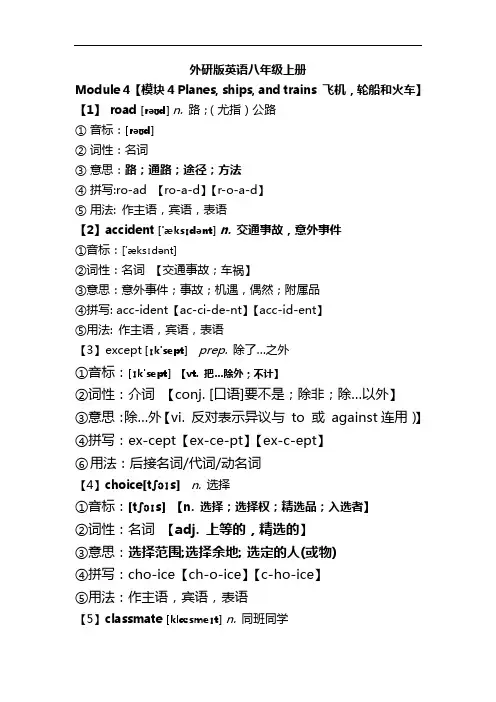
外研版英语八年级上册Module 4【模块4 Planes, ships, and trains 飞机,轮船和火车】【1】road [rəʊd]n.路;(尤指)公路①音标:[rəʊd]②词性:名词③意思:路;通路;途径;方法④拼写:ro-ad 【ro-a-d】【r-o-a-d】⑤用法: 作主语,宾语,表语【2】accident['æksɪdənt]n.交通事故,意外事件①音标:['æksɪdənt]②词性:名词【交通事故;车祸】③意思:意外事件;事故;机遇,偶然;附属品④拼写: acc-ident【ac-ci-de-nt】【acc-id-ent】⑤用法: 作主语,宾语,表语【3】except[ɪk'sept]prep.除了…之外①音标:[ɪk'sept] 【vt. 把…除外;不计】②词性:介词【conj. [口语]要不是;除非;除…以外】③意思:除…外【vi. 反对表示异议与to 或against连用)】④拼写:ex-cept【ex-ce-pt】【ex-c-ept】⑥用法:后接名词/代词/动名词【4】choice[tʃɔɪs]n.选择①音标:[tʃɔɪs] 【n. 选择;选择权;精选品;入选者】②词性:名词【adj. 上等的,精选的】③意思:选择范围;选择余地;选定的人(或物)④拼写:cho-ice【ch-o-ice】【c-ho-ice】⑤用法:作主语,宾语,表语【5】classmate [klɑ:smeɪt]n.同班同学①音标:[klɑ:smeɪt]②词性:名词③意思:同班)同学;级友;同班同学④拼写:class-mate【cl-ass-m-ate】【c-lass-m-ate】⑤用法:作主语,宾语,表语【6】far [fɑ:(r)]adv. 远,遥远;adj.远的,遥远的①音标:[fɑ:(r)]②词性:副词/形容词③意思:远;遥远地/ 远的;遥远的;(某方向的)最远的;远端的④拼写: f-ar【fa-r】【f-a-r】⑤用法: 作定语,状语,做表语【7】far from [fɑ: frɔm] 远离①音标:[fɑ: frɔm]①词性:形容词短语②意思:远离;远非,不但不③拼写:far-from【fa-r-fr-om】④用法:作状语,表语【8】close [kləʊz] adj.(距离上)近的,接近的; adv.(距离上) 接近地①音标:[kləʊz]②词性:形容词/副词③意思:紧密的;亲密的;亲近的;紧密地;接近地④拼写:c-lose【cl-o-se】【c-lo-se】⑤用法: 作定语,作表语,作状语,定语【9】crowded [kraʊdɪd]adj. 拥挤的;人数过多的①音标:[kraʊdɪd]②词性:形容词【人多的;拥挤的】③意思:水泄不通的;拥挤的;肩摩踵接④拼写: c-row-d-ed【crowd-ed】【crow-ded】⑤用法: 作定语,表语,补语【10】all the time [ɔ:l ðə taim] 一直;不断地①音标:[ɔ:l ðə taim]②词性:副词短语③意思:在该段时间内)一直;向来,一向;时时刻刻;每时每刻④拼写:all the time⑤用法: 作状语【11】journey['dʒɜ:nɪ] 旅行,旅程①音标:['dʒɜ:nɪ]②词性:名词③意思:旅行,旅程行期;历程,过程④拼写: j-our-ney【j-our-n-ey】⑤用法: 作主语,表语,宾语【12】book [bʊk]v.预订①音标:[bʊk] 【n. 书;卷;课本;账簿】②词性:动词【预订;登记;(向旅馆、饭店、戏院等)预约;立案(控告某人);订立演出契约】③意思:预订④拼写:b-oo-k【bo-ok】【b-ook】⑤用法:作谓语①现在分词:booking(用于进行时态)②一般过去式:booked(用于一般过去时态)③过去分词:booked(用于完成时态)④动词三人称单数:books(一般现在时态)⑤动名词:booking(作主语,作动词和介词宾语)【13】park[pɑ:k] v.停放车;泊车①音标:[pɑ:k] 【公园;停车场】②词性:动词/名词③意思:将…放置在某处;停车④拼写: p-ark【pa-rk】【p-ar-k】①用法: 作谓语(主语,宾语,表语)①现在分词:parking(用于进行时态)②一般过去式:parked(用于一般过去时态)③过去分词:parked(用于完成时态)④动词三人称单数:parks(一般现在时态)⑤动名词:parking(作主语,作动词和介词宾语)【14】outside [aʊtsaɪd]prep.在….之外;adv.在外面,朝户外n.外面,外部; adj. 外部的;外表的①音标:[aʊtsaɪd]②词性:介词/副词/名词/形容词③意思:【prep(表示位置)在[向]…的外面;(表示范围)超出…的范围;(表示排斥)除了(某人)】【adv. 在外面;向外面;在户外;露天】【n.外面;(弯曲路面或轨道的)外道;(靠近路中央的)外侧;(建筑物等的)周围】【adj. 外部的;集团外的;(选择余地、可能性等)非常小;可能性最大的】④拼写: out-side 【out-si-de】⑤用法: 后面接名词/代词或者动名词构成介宾短语;作定语,状语,主语,宾语,表语【15】however [haʊevə(r)] adv.然而,但是①音标:[haʊevə(r)] 【不管怎样】②词性:副词【然而;不过;仍然】③意思:不管到什么程度;无论如何;然而;可是④拼写:how-ever【ho-we-ver】【how-eve-r】⑤用法: 作状语【16】cost [kɒst] v.价钱为;花费n.价钱;成本;代价①音标:[kɒst] 【价钱,代价;花费,费用;牺牲;[用复数][法律]诉讼费】②词性:动词【sth cost sb +金钱某物花费某人金钱】③意思:【花费,付出代价;估价;使丧失;使付出努力;】④拼写:c-o-s-t【co-st】【co-s-t】⑦用法: 作谓语,主语,宾语,表语。
外研版英语八年级上册 Module 4 Planes, ships and trains

A. 书本 B. 购买 √C. 预定
2. Remember that parking in Amsterdam
is very expensive.
A. 公园 B√. 停车 C. 乘车
3. …it will not cost as much as going by train.
A. cost more than… B√. cost less than…
by bus
by taxi by car
by ship
by train by bicycle by plane walk /on foot
Presentation
Words
/rəʊd/
路;(尤指) 公路 n.
road
/'æksIdənt/ 交通事故;意外事件 n. accident
/Ik'sept/
Shanghai airport train. 3 I saw a(n) accident on my way to school yesterday. 4 I do not take the bus to school because it is usually
very crowded.
L1ine.tRg’rosoleusppeslea; ywthhe iccohnvegrrsoatuiopn 2. Rodleopelsaytthhee cboensvetr.sation
Daming
by bus/take the bus
What can we learn from the answers?
Consolidation
Complete the sentences with the correct form of the words in the box.
外研版-英语-八上-外研八上Module4 Planes, ships and知识讲解及练习
Module 4 Planes, ships and trains词汇精讲1. maybemaybe作副词,意为“也许;大概”。
例如:Maybe he is a teacher. 也许他是个老师。
【拓展】辨析:maybe与may be(1)maybe是副词,主要用于非正式场合,口语中常用。
意为“也许,大概”。
它通常放在句子的开头,在句子中作状语。
例如:Maybe they won’t come here tonight. 他们大概今晚不会来这儿。
Maybe she is happy. 也许她是幸福的。
(2)may be是“情态动词may+动词原形be”构成的,在句中做谓语,意为“可能是、大概是”。
例如:She may be at home. 她可能在家。
(也可以说:Maybe she is at home.)You may be right. 你可能是对的。
(也可以说:Maybe you are right.)2. take the bustake在此为及物动词,意为“乘,坐”,其后接交通工具。
例如:take a train乘火车take a bus乘公共汽车take a ship乘船take a plane乘飞机【拓展】其他表示“乘……”的表达方式:(1)用介词短语来表示交通方式,介词短语在句中作状语:1) 用“by + 交通工具名词”表示交通方式。
例如:by bike骑自行车by car乘小汽车by bus乘公共汽车by taxi乘出租车2) 用“by + 交通路线的位置”来表示交通方式。
例如:by water由水路by land从陆路by sea从海路by air乘飞机3) 用“in/on + 冠词/形容词性物主代词/指示代词+ 交通工具名词”表示交通方式。
其中,in多用在car等交通工具之前,而on多用在bike/horse/bus/train/ship等交通工具之前,它们的用法与“by + 交通工具名词”的用法相同。
外研版八年级上册英语Module 4 Planes ships and trains知识点复习总结
初二英语上册(外研版)Module 4 Planes, ships and trains知识点总结一、重点词汇·原文再现There was a road accident…路上出了交通事故…·基本用法accident n. 交通事故;意外事件。
如:The accident is so terrible.这起交通事故真可怕。
·知识拓展--相关短语by accident 意为“偶然”。
如:I only found it by accident.我只是碰巧找到的。
·原文再现But nobody was late, except me.但除了我,没有别人迟到。
·基本用法except prep. 除…之外,可用于句首。
Everyone went to the movies except me.除我以外,大家都去看了电影。
·知识拓展--词义辨析:besides/except/except for这三个介词或者短语都可以表示“除了…”的意思,区别如下:1. except仅表示“除了…”,排除在外。
She can do everything except cook.除了做饭之外她什么都会。
He had considered everything except the weather.他什么都想过,唯独没考虑到天气。
2. besides表示“除了…还有…”的意思,表示包含在内。
Besides milk and cheese, we need vegetables.除了牛奶和干酪外,我们还需要蔬菜。
Besides football, I like playing basketball and table tennis.除了足球以外,我还喜欢打篮球和乒乓球。
3. except for表示“除了…”,except for后接的词同句子中的整体词(主语)不是同类的,指从整体中除去一个细节,一个方面;而except后接的词同整体词(主语)一般是同类,指在同类的整体中除去一个部分。
外研版八年级英语上册_Module_4_Planes__Ships_and_trains_Unit_2
Words: journey, book, park, outside, however, cost Phrases: plan to… because of outside the city centre Patterns: The more information, the better. What’s the cheapest way to get there? Have a great trip.
5 Work in pairs. Ask and answer about the ways of travelling. Use the information in the table. -What’s the cheapest way to travel from London to Paris? -The cheapest way is by coach.
2 Read the passage and number the ways of travelling from the most expensive to the least expensive.
4
3
1
2
3 Complete the table.
Ways of travelling Train Good points Bad points
n. 旅行;旅程 v. 预订 v. 停放(车);泊(车) prep. 在……之外 adv. 在外面;朝户外 n. 外面;外部 adj. 外部的;外表的 however adv. 然而;但是 cost v. 价钱为;花费 n. 价钱;成本;代价 journey book park outside
Do you know Holland?
Ways of Cost travellin g
外研版英语(新标准)八年级上册Module 4 Planes, ships and trains Unit 1 教案
Module 4 Planes, ships and trains一、学习目标:A.单词和短语:road, accident, except, far, far away, crowded, choice, classmate, all the time, journey, book, outside, close, park, however, costB.交际用语:1. What happened?2. Don’t worry.3. —Who lives the closest to school?— Lingling lives closest.4. — What is the most comfortable way to go to school for Betty?— By taxi.5. —What’s the most expensive way to go to school?— Going by taxi is the most expensive.6. How do you get there?7. What’s the cheapest way?8. What’s the best way to get there?9. —What’s the cheapest way to travel from London to Paris?— The cheapest way is by coach.10. It’s the most comfortable way, but it’s the most expensive.11. He lives farthest from school.12. It is the fastest and the second cheapest.13. The more information, the better.二. 教学目标1. Function: Describing and comparing modes of transportation.2. Structure: Superlative adjectives and adverbs (-est, most); irregular superlatives.3. Skills: 1) Listening and understanding familiar topics (transportation)2) Comparing modes of transportation.3) Reading and finding specific transportation4) Writing a short passage comparing modes of transportation.4. Around the world: The longest railway5. Task: Making a holiday plan for a family trip to a city in China.三、重点及难点:Superlative adjectives and adverbs (-est, most); irregular superlatives.四、教学设计:Unit 1 He lives the farthest from school.ⅠTeaching modelListening and speakingⅡTeaching methodPWP approachⅢTeaching aims1. Key vocabulary: road, accident, except, far, far away, crowded, choice,classmate, close, all the time2. Key structures: superlative adjectives and adverbs (-est, most); irregularsuperlatives.3. Key sentences:1) What happened?2) Don’t worry.3) — Who lives the closest to school?— Lingling lives closest.4) — What is the most comfortable way to go to school for Betty?— By taxi.5) —What’s the most expensive way to go to school?— Going by taxi is the most expensive.ⅣTeaching aidsTape recorder, OHP, videoⅤTeaching StepsStep 1 Warming-up1. Work in pairs. Show some pictures and ask “How do you often go to school?”2. Look and say something about the pictures.3. Introduce the new words.4. Learn the new words.5. Read the new words.Step 2 Look and match.1. Ask the students to read the words in Activity 1.2. Look at the pictures in Activity 1 carefully.3. Now match the words with the pictures.5. Check the answers with the students.Keys: 1. train 2. ship 3. taxi 4. underground 5. busStep 3 Look, listen and match.1. Ask the students to read the words in Activity2.2. Play the recording and ask the students to listen to the recording carefully. T: Listen and match the words in the box with the pictures in Activity 1. You need to use one word more than once.3. Check the answers with the students.Step 4 Listen and read.1. Show some pictures, and ask the students to talk about them.2. Ask the students to read the conversation silently.3. Play the recording and ask the students to listen the conversation, and then answer the questions.1) How does Lingling go to school? Why?2) How do you think Betty will go to school?4. Read the conversation.5. Act it out.Step 5 Complete the table.1. Ask the students to read the conversation again.2. Now complete the table.3. Check the answers.Keys: by bus (by bike) by underground walks / on foot by bus Step 6 Complete the sentences.1. Ask the students to read the words in the box in Activity 4.2. Read the sentences.1) The _________________ way to go to school is by taxi.2) Tony lives the __________ from school.3) Lingling’s home is the _________ to school, so she always walks.4) For Betty, going to school by bike is the ______ choice.3. Complete the sentences with the correct words from the box.4. Check the answers:Keys: 1. most comfortable 2. farthest 3. closest 4. bestStep 7 Complete the sentences.1. Ask the students to read the words or expression in the box in Activity 5.2. Read through the sentences.1) All the students take the bus to school ___________ Sam.2) The ___________ train in the world is the Shanghai airport train.3) I saw a(n) __________ on the way to school yesterday.4) I do not take the bus to school because it is usually very ___________.3. Complete the sentences with the correct words from the box.4. Check the answers:Keys: 1. except 2. most modern 3. accident 4. crowdedStep 8 Pronunciation and speaking.1. Play the recording once without stopping.2. Play the recording again and ask the whole class to repeat.1) —Who lives the closest to school?— Lingling lives closest.2) — What is the most comfortable way to go to school for Betty?— By taxi.3. Ask the students to listen and mark the intonation.4. Now listen again and repeat.Step 9 Work in pairs.1. Ask the students to read the words or expression in the box in Activity 7.2. Read the example with the class.—What’s the most expensive way to go to school?— Going by taxi is the most expensive.3. Work in pairs.Step 10 Language points1. Maybe I should go to school by taxi. 或许我应该坐出租车去上学。