
人教版英语七年级下册unit5+6核心考点归纳(语法+词汇+短语+重点句子)
人教版七年级下册unit5+6核心考点及语法归纳【unit 5语法】一、特殊疑问句概述特殊疑问句(special questions),也可称为“wh”-questions,因为它们多数都以who,where,when,which,whose,why这类词开头,如:Who is it on the phone?谁来的电话?What can you see in the picture?你能在图画上看到什么?Where did you see that?你在哪儿看到那个的?What did you eat this morning?你今早吃了些什么?How do you usually go to work?你通常是怎么去上班呢?二、特殊疑问句构成及用法(1)它的结构一般为:特殊疑问词+一般疑问句,即:特殊疑问词+be/助动词/情态动词+主语+谓语/表语+(其他),如:What can be done about it?对此能做些什么呢?Which are yours?哪些是你的?Who would like to come for a game of football?谁愿意来踢场足球呀?What did you say?你说什么?Why didn’t you tell me?你为什么没有告诉我?(2)特殊疑问句有时可有一个以上的疑问词,如:When and where did you meet?你们何时在何地相遇的?(3)特殊疑问句有时须以介词开首,如:By whom is the book written?此书是谁写的?Since when have you lived here?你从什么时候起住在这里的?(4) 疑问词作主语或主语的定语时,与陈述句的语序相同,如:Who is in the room?谁在房间里?(5)“why+一般疑问句否定式”这种结构一般表示劲告、建议、责备等,而不能归为特殊问句,Why not do...?=Why don’t you/we do...?为什么不...呢?如:Why don’t you come earlier?你为什么不早些来呢?Why not go skiing?为何不去滑雪呢?三、特殊疑问词特殊疑问词可分为两类:疑问代词和疑问副词(1)疑问代词:who,whom,which,what,whose。
五个疑问代词除了who外都没有格的变化。
who谁,作主语, 用来指人Who is the girl under the tree?Who is not here?Whom 谁, 作宾语,用来指人Whom are you writing to?Whom do you want to see?Whose 谁的, 用来指所属关系,如果作定语,一般后接名词Whose pen is this?Whose are those shoes?Which 哪个,哪些用来指对人或物在一定范围之内进行选择Which girls will be in the sports meeting?Which hat is lily’s ?What 通常指物,偶尔也可指人,一般用在没有指出范围的情况下What can you see in the picture?What is in the teacher’s room?(2) 疑问副词:when,where,why,how及how与其他副词和形容词组成的疑问词。
when何时, 询问时间When will she return?Where, 何地, 询问地点Where do you come from?Why 为什么, 询问原因Why are you late for school?How如何, 询问手段、方式、工具以及程度等How do you usually go to school?How old 多大, 询问年龄How old is Jim’s little brother?How much/many多少, 询问数量How many friends do you have?How far多远, 询问距离How far is it from your home to school?How long多长、多久, 询问时间的长度或距离How long will you stay in Beijing?How often多长时间一次, 询问频率How often do you go to see your grandparents?How soon 多久, 询问时间How soon will you come back?(3) 特殊疑问句的答语特殊疑问句的答语的重点是对疑问词的回答非所问,因此,无需用yes或no。
在回答时,可以用一个词或词组,也可以用一个较为完整的句子。
—Who has borrowed my bike?谁借了我的自行车?—Jack. 杰克。
/Jack has borrowed your bike.—When did he borrow my bike?他什么时候借了我的自行车?—This morning. 今天早晨。
/He borrowed your bike this morning.—Where is he?他现在在何处?—At the office. 在办公室。
/He is at the office.—What is he doing there?他在那儿干什么呢?—Working. 工作/He is working.—Whose bike is this?这辆自行车是谁的?—Mr. Smith’s. 史密斯先生的。
/It’s Mr. Smith’s bike.【unit 5重点句子】But elephants are in great danger.但是大象正处于极大的危险之中。
Does your family have a pet? 你家有宠物吗?Why do you like pandas? 你为什么喜欢熊猫?Why don't you like the cat? 你为什么不喜欢那只猫呢?Well,because she's kind of boring. She sleeps all day, and her name is Lazy.嗯,因为她有点儿无聊。
她整天睡觉,她的名字叫“懒妞”。
What animals do you like? 你喜欢什么动物?We must save the trees and not buy things made of ivory.我们必须拯救树木,拒绝买象牙制品。
He can walk on two legs. He can dance, too.他会用两条腿走路。
他还会跳舞。
I like dogs because they're friendly and smart.我喜欢狗因为它们既友好又聪明。
Let's see the pandas first.我们先看熊猫吧。
My mom has a big cat, but I don't like her.我妈妈有一只很大的猫,但我不喜欢她。
People cut down many trees so elephants are losing their homes.由于人类大量砍伐树木,所以大象正在失去它们的家园。
People also kill elephants for their ivory.人们还为了象牙猎杀大象。
The elephant is one of Thailand's symbols.大象是泰国的象征之一。
This helps them to live.这帮助它们生存。
【unit 5重点短语】a symbol of good luck 好运的象征a long time 很长一段时间black and white 黑白相间be in (great) danger 处于(极大)危险之中(be) made of 由....制成的be/come from China 来自中国cut down 砍倒get lost 迷路kind of interesting 有点意思like...a lot 非常喜欢....lose one's home 失去家园one of... ......之一places with food and water 有食物和水的地方really scary 真的很吓人South Africa 南非sleep all day 整天睡觉things made of ivory 象牙制品【unit 6重点句子】But there isn't a Dragon Boat Festival in the US, so it's like any other night for Zhu Hui and his host family.但是美国没有端午节,所以对于朱辉和他的寄宿家庭来说,它就和其他任何一个平常的夜晚一样。
Not much. I'm just washing my clothes.没做什么。
我只是在洗衣服。
That sounds good.那听起来不错。
The mother is reading a story to her young children.母亲在给幼小的孩子们读故事。
What are you doing? 你在干什么?Zhu Hui misses his family and wishes to have his mom's delicious zongzi.朱辉想念他的家人并渴望吃到他母亲包的美味粽子。
Do you want to join me for dinner? 你想跟我一起吃晚饭吗?Hello? This is Jenny.喂? 我是妮。
Hi,Jenny.It's Laura here.嗨,珍妮,我是劳拉。
He's now studying in the United States.他目前在美国学习。
His dad and uncle are watching the boat races on TV.他的爸爸和叔叔正在看电视上的龙舟比赛。
Let's meet at my home first. Come at half past six.我们先在我家见面。
六点半来吧。
【unit 6重点短语】any other night 其他任何一个晚上drink tea 喝茶Dragon Boat Festival 端午节eat out 出去吃饭go to the movies 看电影read a newspaper 看报纸talk on the phone 通过电话交谈tomorrow evening 明天晚上usethe computer 使用电脑watch TV 看电视wash the dishes 清洗餐具watch the boat races on TV 看电视上的龙舟比赛host family 寄宿家庭in a pool 在(游泳)池里in the United States 在美国listen to a CD 听CDliving room 客厅make soup 做汤make dinner 做晚饭make zongzi 包粽子no place like home 没有像家一样的地方。
人教版七年级下册第五单元第六单元unit5unit6重点短语语法
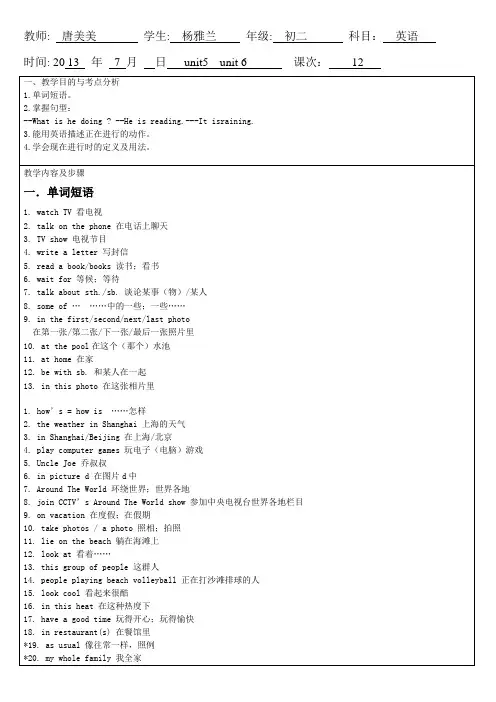
教师: 唐美美学生: 杨雅兰年级: 初二科目:英语时间: 20 13 年7 月日unit5 unit 6 课次:12
5. It’s winter in France. (这时)在法国是冬天。
6. What do you do when it’s raining?
当天下雨时你做些什么?
*7. What is the weather like? 天气怎么样?
*8. Happy New Year! 新年好!
1.What’s he doing? 他在干嘛?
He’s reading. 他正在阅读。
2.That sounds good. 那听起来不错。
3.What’s he taking? 他正在拿什么?
4.What’s he waiting for? 他在等什么?
5.What’s he reading? 他在读什么?
6.Who are Ben and Tim talking to? 本和蒂姆在和谁说话?
7.What are they talking about? 他们正谈论什么?
8.Where are they all going? 他们将要去哪儿?
9. Where is he swimming? 他正在哪儿游泳?
10. Is Tina there? 蒂娜在那儿吗?
No, she isn’t. 不,她没在。
11. Here are some …这儿有一些……
12. Are you surfing? 你在冲浪吗?
No, I’m not. 不,我没有。
三、本次课后作业:
四、学生对于本次课的评价:
○特别满意○满意○一般○差
学生签字:
起航教育教务处。
七年级下册U5-U6各个话题知识要点

七年级下册U5-U6各个话题知识要点(重点句型必须背下来)Unit 5 Topic1重点语法一般现在时(常与频度副词never, seldom, sometimes, often, usually, always等连用)重点句型1.How do you usually come to school? 你通常是怎样来上学的?2.I usually come to school by subway. 我通常是乘地铁来上学。
3.How often do you go to the library? 你多久去一次图书馆?4.Once/Twice/Three times a week/Very often/Every day/Sedom5.一周一次/两次/三次经常/每天/很少。
6.Happy New Year! 新年快乐!7.The same to you. 你也一样。
8.The early bird catches the worm. 早起的鸟儿有虫吃。
9.Nice talking to you. 和你交谈很愉快!10.Work must come first! 工作必须放在第一位!11.She goes to bed at about a quarter to ten. 她大约在9点45睡觉。
重点详解1I always go to school by bus.by+交通工具名称,表示使用某种交通方式,中间不加限定词,如果交通工具前有a, the, my 等限定词,就不能用by,而是用in或是on.on the train=by train on his bike=by bike in my car=by car.巧辩异同on foot 与walk on foot “走路”,是介词短语,不能作谓语,只作方式状语,位于句末。
walk “走路”,是动词,可以作谓语。
go to…on foot= walk to I often go to school on foot. =I often walk to school.同样,go to….by bike = ride a bike to go to…. by car = drive a car to go t o … by plane = fly to go to… by bus = take a bus to2 Come on! It’s time for class. come on “快点,加油,来吧”。
七年级英语下册 第五六单元知识点归纳 人教新目标版

七年级英语第五单元知识点归纳1、wait for sb/sth:等待某人/物2、have a good trip:旅途愉快=have a nice trip=have a great trip3、one hour’s driving:一小时的驾驶(“hour’s”是名词所有格,表示时间、距离等无生命的名词,也可以用’s表所有格。
)4、以here、there等方向性副词开头的句子,并且句子的主语是名词时,句子完全倒装。
如果主语是代词(he, she, it, they, I, we, you),则不用倒装。
The bus comes here.→Here comes the bus.He is there. →There he is.(there直接提前,其他顺序不变)5、what time “几点了”,在具体几点用介词at:at 6:30 在6:30It is 8:15 now. (划线部分提问)→What time is it now?6、cook①动词:煮;烹调②名词:厨师cooker 名词:厨具do some cooking 做饭do some washing 洗衣服do some shopping买东西7、would like “想要……”①would like+名词;would like+ to do sth.②一般疑问句:would直接提前。
8、把某物传给某人pass sb. sth. = pass sth. to sb.人物物to 人9、该做……的时候了:①Time to do sth. ②Time for sth.10、the same age 同龄,年龄相同11、What’s the name of sth:....叫什么?12、说某种语言用动词:speak :speak English 说英语13、How old“几岁了”,用于问年龄How many “多少”,用于提问可数名词数量How long ①“多长”用于问长度;②“多久”,用于提问一段时间How far “多远”,用于问距离How tall “多高”,用于提问高度14、get to work=begin our class:开始上课15、minus fifteen degrees:零下15℃(degree的复数形式degrees)提问多少度?What is the temperature?16、What shape is/are sth:某物是什么形状?17、look like 看起来像18、a piece of 一块,一张,一片,其复数形式:pieces ofa piece of pizza 一块比萨饼four pieces of pizza 四块比萨饼pieces of pizza 几块比萨饼19、make a chart:制图20、put...for...:用...代表...21、dry the dishes:擦干碗盘22、always(总是、一直),usually(通常),sometimes(有时),never(从不),这些词一般放在行为动词之前,系动词(be)和助动词之后。
人教版七年级英语下册第五、六单元知识点、短语归纳总结
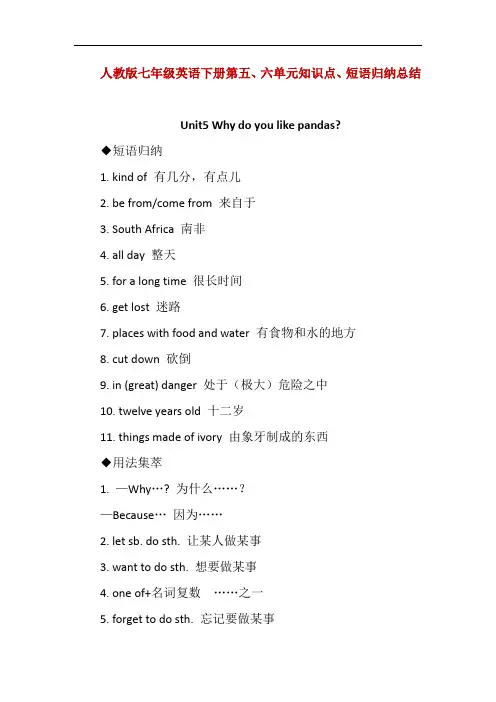
人教版七年级英语下册第五、六单元知识点、短语归纳总结Unit5 Why do you like pandas?◆短语归纳1. kind of 有几分,有点儿2. be from/come from 来自于3. South Africa 南非4. all day 整天5. for a long time 很长时间6. get lost 迷路7. places with food and water 有食物和水的地方8. cut down 砍倒9. in (great) danger 处于(极大)危险之中10. twelve years old 十二岁11. things made of ivory 由象牙制成的东西◆用法集萃1. —Why…? 为什么……?—Because…因为……2. let sb. do sth. 让某人做某事3. want to do sth. 想要做某事4. one of+名词复数……之一5. forget to do sth. 忘记要做某事6. forget doing sth. 忘记做过某事7. help sb. (to) do sth. 帮助某人做某事8. be friendly to sb. 对某人友好◆典句必背1. —Why do you like pandas? 你为什么喜欢熊猫?—Because they’re kind of interesting. 因为它们有点儿有趣。
2. —Why does John like koalas? 约翰为什么喜欢树袋熊?—Because they’re very cute. 因为它们非常可爱。
3. —Why don’t you like tigers? 你为什么不喜欢老虎?—Because they’re really scary. 因为它们真的吓人。
4. —Where are lions from? 狮子来自哪里?—They’re from South Africa. 它们来自南非。
人教版七年级英语下第五六单元知识重点
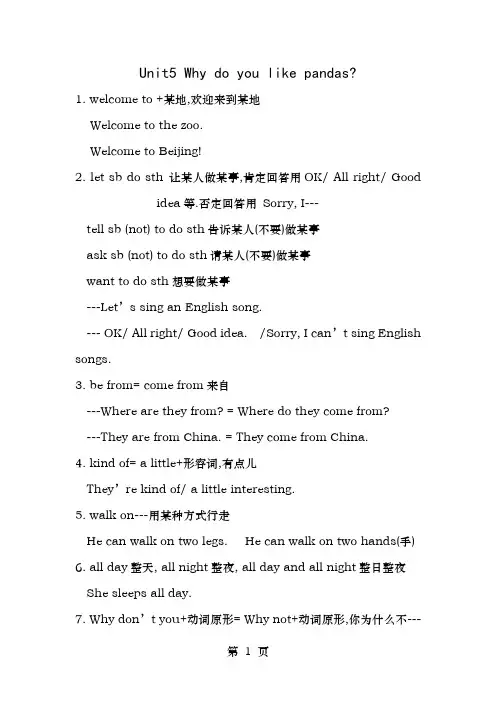
Unit5 Why do you like pandas?1. welcome to +某地,欢迎来到某地Welcome to the zoo.Welcome to Beijing!2. let sb do sth 让某人做某事,肯定回答用OK/ All right/ Goodidea等.否定回答用Sorry, I---tell sb (not) to do sth告诉某人(不要)做某事ask sb (not) to do sth请某人(不要)做某事want to do sth想要做某事---Let’s sing an English song.--- OK/ All right/ Good idea. /Sorry, I can’t sing English songs.3. be from= come from来自---Where are they from? = Where do they come from?---They are from China. = They come from China.4. kind of= a little+形容词,有点儿They’re kind of/ a little interesting.5. walk on---用某种方式行走He can walk on two legs. He can walk on two hands(手) 6. all day整天, all night整夜, all day and all night整日整夜She sleeps all day.7. Why don’t you+动词原形= Why not+动词原形,你为什么不---Why don’t you like tigers? =Why not like tigers?8. be friendly to sb对某人友好My English teacher is friendly to me.9. one of+(限定词)+可数名词复数/代词宾格,作主语时,谓语动词用单数.One of the boys likes tigers.One of them is good at English.10. forget to do sth忘记要做某事(事情还没有做)forget doing sth忘记做过了某事(事情已经做了)Don’t forget to do your homework.不要忘记做作业.(还没有做作业)I forget closing the door.我忘记已经关上门了.(门已经关了)11. lost形容词,丢失的,迷路的,可以直接+名词get lost= be lost丢失,迷路a lost watch, a lost childMy keys are lost again.Elephants never get lost.12. be in (great) danger处于(极大)危险之中be out of danger脱离危险Elephants are in great danger.The doctors say he is out of danger.13. made of--- ,由---制成,作定语时,放在被修饰的名词之后be made of---,用---制成,从制成品能看出原材料made of paper由纸制成, a boat made of paper一条纸叠的小船We can’t buy things made of ivory.The kite is made of paper.这个风筝是用纸制成的.14. 否定句的一般疑问句:Isn’t she beautiful?难道她不美丽吗?如果事实她美丽用Yes, she is.不,她美丽.如果事实她不美丽用No, she isn’t.是的,她不美丽.Unit6 I’m watching TV.1.动词—ing形式的构成(1)一般直接+ing, 如go—going, look—looking, play—playing(2)以辅音字母+e结尾,去e, 再+ing, 如write—writing, make—making(3)以重读闭音节结尾,末尾只有一个辅音字母(除w, y),先双写这个辅音字母,再+ing, 如get—getting, run—running, begin—beginning2.现在进行时(1)表示现在或现阶段正在进行的动作.句中常见now现在, look看,listen听.(2):现在进行时谓语构成:be( am, is, are) +动词—ing形式.否定句在be的后面加not,疑问句把be提到主语的前面.---What are you doing? ---I’m watching TV.---Are you reading a newspaper?---Yes, I am. / No, I’m not. I’m cleaning my room.She isn’t listening to a CD.Jenny is cleaning the house now.Look! She is washing the dishes.Listen! She is singing.3.on+电器,在---上,通过on the phone通过,on the radio通过收音机, on TV在电视上They are talking on the phone.Jenny is listening to music on the radio.I often watch games on TV.4. wash the dishes= do the dishes洗餐具I often help my mother wash/ do the dishes.She is washing/ doing the dishes.5. This is Jenny.= This is Jenny speaking. = Jenny speaking.= It’s Jenny (speaking).我是珍妮.打我用this,你用that.---Who’s that (speaking)? 你是谁? ---This is Jim (speaking).我是吉姆.May I speak to Gina, please? 请问,我可以与吉娜通话吗?Is that Gina (speaking)? 你是吉娜吗?6. not much= nothing much没什么事---What are you doing?---Not much.7. just只是,仅仅(=only),恰好I’m just(只是)washing my clothes.I t’s just(恰好) two o’clock.8. join sb for sth参加到某人的行列中一起做某事Do you want to join me for dinner?9. I’d love to = I’d like to我很乐意,但前者比后者语气强---Would you like to eat out with me? 你愿意与我一起出去吃饭吗?---肯定回答: Yes, I’d like to . 否定回答:Sorry, I’m afraid I can’t because ( I have lots of homework to do ).或I’d love to, but---10.any other+可数名词单数,其他任何一个Tom runs faster than any other boy in his class.汤姆比他班上的其他任何一个男孩都跑得快.11.wish to do sth希望做某事He wishes to have his mom’s delicious zongzi.12.study for a test为考试而学习, study for the English test为英语考试而学习He’s studying for a test.。
七年级下册五六单元重点短语和句型归纳

七年级下册五六单元重点短语和句型归纳Unit 5 Our School LifeTopic1 I usually come to school by subway.⼀、重点单词和短语:1.On foot=walk to +地点2.By +交通⼯具名词单数3.By bike=ride a bike4.By subway/underground=take the subway5.On the weekdays On the weekend6.Take a bus=by bus7. A short time Go fishing8.Listen to music9.Play soccer Meet friends10.Once a week Twice a week11.Three times a week Very often⼆、重点句型1.-Happy New Year! -The same to you.2.The early bird catches the worm.3.How often do you come to thelibrary?4.She goes to bed at about a quarter toten.5.I never come to school by subway.6.I seldom walk to school.7.Maria sometimes takes the subwayhome.8.We usually go to the park on foot.9.They always go to the zoo by bus.10.Li Xiang often rides a bike to school.11.We’d like to know about the schoollife of American students.12.What do they do in their free time?15.It’s time for class.16.It’s time to go to school.17.How do you usually come to school?Topic 2 A few students are running around the play ground.⼀、重点单词和短语1.Make a card=make cards2.On the telephone3.Play a card =play cards4.On the playground5.Look for On time6.Have a soccer game7.Over there Look at8.Have lessons Write a letter9.Clean the blackboard10.Show sb. around⼆、重点句型1.What are you doing?2.Is Tom reading in the library, too?3.-What are Jane and Maria doing?-They’re talking.4.Excuse me, may I borrow someEnglish workbooks?5.-How long can I keep them?-Two weeks.6.-You must return them on time.-Sure, I will.7. What day is it today?Topic3My school life is very interesting.⼀、重点短语和单词1.Learn about the past2.Outdoor activities3.Form …to…At the back of4.Do some cleaning Go to bedclassmates. 2.He usually plays soccer, but hedoesn’t play basketball.3.They sometimes have lunch at school.4.-What class are they having?-They are having a music class.5.–What time does the next class begin?-At ten to nine.6. How many English lessons does hehave every week?7. I don’t like it. It’s a little difficult.8. My school life is very interesting.9. My teachers and classmates are verykind to me.10. I can learn a lot form reading.11. Thank you for your hard work.12. Thanks for helping me with myEnglish.13. The boy is drawing pictures. He isn’t cleaning the blackboard.14. –Which subject do you like best?- I like history best.Unit 6 Our local AreaTopic 1 There is a study next to my bedroom.⼀、重点单词和短语1.On the second floor2.Next to3.And so on4.Go upstairs5.Have a look(at)6.Living room7. dining room8. in front of9. in the front of10. on the shelves14. in the center of15. on the right/left of16. at the back of⼆、重点句型1.Welcome to my new home!2.There is a sofa, a desk, some booksand so on.3.Why not go upstairs and have a look?4.-What’s on your desk?–There are some keys.5.-How many model planes are there?-There are three.6.–How much water is there? – Only a little.7.–Is there a computer in your study?-Yes, there is./No, there isn’t.8.–Are there two students in the front ofthe classroom?-Yes, there are./No, there aren’t.9.Don’t put it/them there.10.Put it/them away, please.11.You must look after your things.12.I’m writing this letter to tell you aboutmy new home.13.Write to me about you home.Topic 2 My home is in an apartment building.⼀、重点单词和短语1.Live with2. a kind of3.all/many kinds of4.different kinds of5.for rent9.post office10.at the end of11.a lot of=lots of12.close to13.be far from…14.call….for help15.do sports16.fresh air17.such as⼆、重点句型1.There+ be +sb./sth/+ doing+介词短语。
人教新目标七年级下册英语五,六单元语法点-
Unit5 I am watching TV一.重点单词及词组单词:clean V. 打扫;清除toy N. 玩具activity N. 活动shop V. 买东西,购物camera N. 照相机词组:1.do one’s homework 做某人的作业do housework 做家务2.talk on the phone 在电话里交谈,talk about……谈论……talk to(with)sb 和某人交谈3.write a letter 写信write a letter to sb 给某人写信4.play with……和……一起玩5.watch TV看电视TV show 电视节目6.wait for sb/sth 等待某人/某物7.some of…………中的一些8.in the first photo 在第一张照片里(介词用in,序数词前面有the)in the last photo 在最后一张照片里a photo of one’s family 某人的家照片9.at the mall 在购物街at/in the library 在图书室at/in the pool 在游泳池10.read a book = read books = do some reading看书\阅读11.thanks for = thank you for为某事而感谢(后接动词要用v-ing)二.课文重难点释义1., I am watching TV.Look & see& wach & reada.look 通常为不及物动词,强调看的动作,指认真看,在强调看某人某物时,其后必须接介词at才能带宾语,即look at.Look at the map.b.see是及物动词,侧重于看的结果,意味看见看到,see无进行时态Can you see the dog over there.c.Watch作动词,意为“观看,注视”,多指观看运动着的事物,如电视,比赛,表演等。
人教版七年级英语下册5-6单元知识点
pretty good play computer game take photos look cool
play beach volleyball 玩沙滩排球 on vacation 在度假中 躺在沙滩上
lie on the beach
look at
have a good time be surprised at sth look for
看一看
玩的开心 对某事很惊奇 寻找
in this heat 在这样的热度里
a group of 一群
in order to
为了……
one … the other … some … others … • 交际用语
一个… … 另一个… … 一些… …另一些… …
---How’s the weather? ---It’s raining/ snowing. ---What’s the weather like? --- It’s sunny/ windy/ cloudy. ---It’s cold/ hot/ cool/ warm. ---What’s Uncle Joe doing? --- He’s playing basketball.
我在看电视。
他在干什么? 他正在写作业。 她在干什么? 她在读书。 你想去看电影吗? 好的,这个碟片太无聊了。 你什么时候想去? 我们6点去吧。
四 1. 2. 3.
时间前加介词 在一天中的早晨,上/下午、晚上或者年份、月份、季节前用介词 in。 in summer 在夏季 in the morning 具体到某一天或者某一天的早晨、上午/下午、晚上用on on Saturday 在周六 on the evening of Friday 星期五晚上 在几点钟(具体时间)前用at at six in the morning 早上6点钟 at three in the afternoon 在下午3点钟 辨析in, on 表示方位时的区别
初中英语课堂笔记七年级下册 知识点复习Unit 5 Unit6
初中英语:【课堂笔记】七年级下册Unit 5一、重点短语1.a symbol of good luck 好运的象征be friendly to sb.对某人友好2.be in great danger 处于危险中can also draw well 也能画得好e from South Africa 来自南非cut down many trees 砍伐许多树4.forget to do sth.忘记去做某事forget doing sth.忘记做过某事5.get lost 迷路kill the elephants for their ivory为获取象牙捕杀大象kind of shy有点害羞13.let sb.do sth.让某人做某事make sb. do sth.14.like ... a lotlose one's home(s)失去某人的家园15.my favorite animals我最喜欢的动物on the flag 在国旗上16.one of Thailand's symbols泰国的象征之一他现在在美国学习。
8.It's like any other night for Zhu Hui.对朱辉而言就像其他任何一个晚上一样。
9.Zhu Hui misses his family and wishes to have his mom's delicious zongzi.朱辉非常想家并盼望着能吃到妈妈包的美味粽子。
10.There's still “no place like home” .仍然“没有哪个地方像家一样”。
三、词法精选reading a newspaper 看报纸newspaper是可数名词,意为“报纸”,它是由news 和paper■构成的复合名词。
如:I like reading newspapers every day.我喜欢每天看报纸。
期末复习参照--人教版七年级下册unit 5单元考点归纳
期末复习参考--人教版七年级下册unit 5重点内容归纳【重点短语】a symbol of good luck 好运的象征a long time 很长一段时间black and white 黑白相间be in (great) danger 处于(极大)危险之中(be) made of 由....制成的be/come from China 来自中国cut down 砍倒get lost 迷路kind of interesting 有点意思like...a lot 非常喜欢....lose one's home 失去家园one of... ......之一places with food and water 有食物和水的地方really scary 真的很吓人South Africa 南非sleep all day 整天睡觉things made of ivory 象牙制品【重点句子】But elephants are in great danger.但是大象正处于极大的危险之中。
Does your family have a pet? 你家有宠物吗?He can walk on two legs. He can dance, too.他会用两条腿走路。
他还会跳舞。
I like dogs because they're friendly and smart.我喜欢狗因为它们既友好又聪明。
Let's see the pandas first.我们先看熊猫吧。
My mom has a big cat, but I don't like her.我妈妈有一只很大的猫,但我不喜欢她。
People cut down many trees so elephants are losing their homes.由于人类大量砍伐树木,所以大象正在失去它们的家园。
People also kill elephants for their ivory.人们还为了象牙猎杀大象。