
2017年12月大学英语六级考试真题试卷(第2套)
2017年12月英语六级试题真题及答案解析
2017年12月英语六级试题真题及答案解析2017年12月的大学英语六级考试已经结束了,考生最想知道的就是考试的答案了。
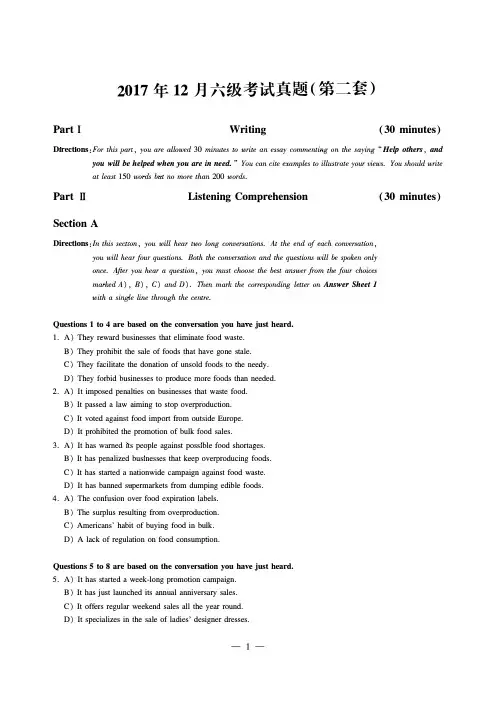
下面店铺整理了2017年12月英语六级试题真题及答案解析,供大家参考!2017年12月英语六级试题真题及答案解析Part Ⅰ Writing (30 minutes)Directions: For this part, you are allowed 30 minutes to write a short essay on invention. Your essay should include the importance of invention and measures to be taken to encourage invention. You are required to write at least 150 words but no more than 200 words.参考范文My View on InventionDrawing a comparison between modern life and ancient life, we cannot imagine what life will be like now without invention. Invention must be attached great importance to, as it is invention that contributes to the advancement of our society. There are several examples which can be cited to illustrate this concept. I can think of no better illustration than the following one. If Edison hadn't invented the light bulb, we would have lived a life as the blind in the night.Given that invention plays such an essential role in our life, what can we do to cultivate this precious spirit? For one thing, it is advisable for the social media and publicity department to vigorously inform the public of the importance of invention. For another, the relevant authority should set up favorable regulations to encourage invention. For example, they can set up the practice of giving premiums or issuing patent certificate toinventors.Finally, I want to use the following saying as our mutual encouragement, “Invention is the spirit of human being’s progress.”At no time should we underestimate the power of invention. Therefore, when an idea comes to your mind next time, just make your own invention.Part Ⅱ Listening ComprehensionSection A1. C) It links the science of climate change to economic and policy issues.2. B) It would be more costly to deal with its consequences than to avoid it.3. A) The transition to low-carbon energy systems.4. C) Plan well in advance.5. B) What determines success.6. D) It means being good at seizing opportunities.7. D) Practice is essential to becoming good at something.8. C) Being passionate about work can make one wealthy.Section B9. A) The stump of a giant tree.10. B) Wind and water.11. D) It was created by supernatural powers.12. C) By lifting them well above the ground.13. A) They will buy something from the convenience stores.14. A) They can bring only temporary pleasures.15. D) Small daily savings can make a big difference in one’s life.Section C16. B) They are necessary in our lives.18. B) They feel too overwhelmed to deal with life’sproblems.18. A) They expand our mind.19. B) It came from a 3D printer.20. C) When she was studying at a fashion design school.21. C) It was hard and breakable.22. D) It marks a breakthrough in printing material.23. A) They arise from the advances in technology.24. D) It is intensely competitive.25. D) Sharing of costs with each other.Part Ⅲ Reading Comprehension选词填空26. G) hypotheses 假设27. B) contextual 上下文的,情境的,前后关联的28. A) arena 舞台,竞技场29. C) convincing 有说服力的,使人信服的30. I) incorporate 合并,使并入31 .D) devoted献身于,把…专用于32 .N) reaping 收获33 .E) digits 数字34 .M) pride 以...自豪35 .F) hasten 加速长篇阅读36. D) For instance, new technologies that are building upon existing technology have not found their footing well enough to appeal to a mass audience…37. K)That, too, explains the heavy Washington presence at this year’s show, as these new technologies intrude upon heavily regulated areas.38. B) In some ways, the answer is yes. For years, smartphones, televisions, tablets, laptops and desktops…39. L) Curran, the Accenture analyst, said that increased government interest in the show makes sense as technology becomes a larger part of our lives.40. F) “So much of what CES has been about is the cool. It is about the flashiness and the gadgets,”…41. A) Scan the highlights of this year’s Consumer Electronics Show (CES), and you may get a slight feeling of having seen them before.42. H) And when it comes to the hyper-connected super-smart world that technology firms are painting for us…43. E) Companies are promoting their own standards, and the marker has not had time to choose a winner yet as this is still very new.44. I) Companies have already won part of the battle, having driving tech into every part of our lives…45. C) Basically the tech industry seems to be in an awkward period now.篇章阅读Passage One46. A) it is unfair to those climate-vulnerable nations47. C) They hardly pay anything for the problems they have caused.48. C) They have to bear consequences they are not responsible for.49. B) There is no final agreement on where it will come from.50. D) Putting in effect the policies in the agreement at once.Passage Two51. C) Teenagers’mental problems are often too conspicuous not to be observed.52. D) Many hitherto unobserved youngsters may havepsychological problems.53. B) Their behaviors do not constitute a warning signal.54. A) They are almost as liable to depression as the high-risk group.55. B) It provides new early-warning signals for identifying teens in trouble.Part Ⅳ Translation(30 minutes)参考译文With the improvement of living standards, holiday is occupying a more and more prominent position in Chinese people’s life. In the past, making a living takes most of Chinese people’s time, which gives them rare chance to go off on a trip. However, tourism has undergone rapid growth in China for the past few years. The prosperity of economy and the emergence of the affluent middle class trigger an unprecedented tourism boom. Not only does domestic traveling become common, but traveling abroad is also enjoying an increasing popularity among Chinese people. During the National Day holidays in 2016, tourism consumption amounts to more than 400 billion yuan. According to the statistical data by the World Trade Organization, China will have become the world's largest tourism country by 2020, and she will also see the fastest growth in overseas traveling expenditure in the next few years.。
2017年12月大学英语六级考试真题答案(第二套)

2017年12月英语六级考试真题答案(第二套)Part I Writing范文"Seek to understand others,and you will be understood"The enlightenment of this saying is not lost in our era but unwilling to understand others seems prevalent. The implication of this message is that people can understand each other as long as they try to do this first;there are,in fact,many who get understood by others because they manage to understand others first.There are several factors to be taken into account when we agree on“seek to understand others,and will be understood”:One reason is that trying to understand others can show your kindness to others.Other people would be thankful,so it is easier for them to accept your ideas.On the other hand,it will let you think what other people think so that you can get to know them better.Therefore,your ideas would have a greater chance to be understood.When we seek to understand others,we elevate the goodwill and team-work spirit.There is a stimulative effect that kicks in when people share this spirit.By seeking to understand others,we boost opportunity for fulfilling understanding between each other.Part II Listening ComprehensionSection ALong Conversation11.【答案】C.They facilitate the donation of unsold food to the needy.2.【答案】B.It passed a law aiming to stop overproduction.3.【答案】D.It has banned supermarkets from dumping edible food.4.【答案】A.the confusion over food expiration labels.Long Conversation25.【答案】B.It has just launched its annual anniversary sales.6.【答案】D.Price adjustment within seven days of purchase.7.【答案】C.Credit it to her account.8.【答案】plimentary tailoring.Section BPassage19.【答案】A.They are thin,tall,and unlike real human beings.10.【答案】D.Their body shapes have not changed much.11.【答案】C.On the Internet.Passage212.【答案】A.Moveable metal type began to be used in printing.13.【答案】B.It was the biggest printer in the16th century.14.【答案】B.It boosted the circulation of popular works.15.【答案】D.It promoted the growth of national languages.Section CRecording116.【答案】D)They choose a job without thinking it through.17.【答案】B)Find out what job choices are available.18.【答案】A)The qualifications you have.Recording219.【答案】B)It is a cultural festival founded for African-Americans.20.【答案】C)To help African-Americans to realize their goals.21.【答案】B)The first fruits of the harvest.22.【答案】A)They recite a principle.Recording323.【答案】A)It is one of the world’s most healthy diets.24.【答案】C)It is regarded as one of the greatest researchers of its kind.25.【答案】D)They have lower mortality rates.Part III Reading ComprehensionSection A26.i)permitThe new marine reserve,now the largest in the Pacific,will no fishing or mining.该空考察will之后的动词原形,因此,结合上下句语境,不难得出该空为permit(允许零捕鱼区);27.o)territoryThe tiny island nation has set aside500,000square kilometers-80percent-of its maritime.该空考察maritime后的搭配,考虑到形容词后的搭配,不难得出该空考察maritime后的名词为territory(小岛领土);28.f)exclusiveThat’s the highest percentage of an economic zone devoted to marine conservation by any country in the world.该空考察不定冠词an后的搭配,同时考虑空后的economic,可以得出exclusive(专属经济区);29.c)commercialby individuals and small-scale fishing businesses with limited exports该空考察individuals及small-scale后的搭配,根据上下文语境可以得出,该空答案为commercial(商业捕鱼区);30.d)communitiesIsland have been among the hardest hit by the threats facing the ocean.此处考察从句的主语部分,考虑前后文,可以得出“Island communities”(小岛社区);31.e)essentialThe people of Palau recognise as to our survival.Recognise as后接该空出所问的“这个大胆的一步”所处的地位,“essential”一词为正确答案(Palau地区居民认为的必需品);32.g)independentPalau has only been an nation for twenty years and has a strong history of environmental protection.此处考察搭配“an independent nation”(独立的国家),故根据前后搭配,答案很容易得出;33.m)sponsorSenator Hokkons Baules,lead of the Palau National Marine Sanctuary Act,said....该提出现在句中的同位语处,因此,考虑到这个人的身份,不难得出答案为sponsor(主要赞助商);34.j)secureHelp build a future...该空考察搭配,“帮助建立...的未来”,因此,“安全的未来”符合语境,故选secure;35.n)stocksCall a temporary stop to fishing for key species in order to give fish an opportunity to replenish.此处考察搭配fish后的搭配,因此,“给...一个补充的机会”,因此,该空答案为fish stocks(鱼类);section B36M)Astronomer David Hogg doesn't think scooping is as serious a problem as generally thought.37.G)some researchers are hesitant to make their dada public for fear that others might publish something similar before them.38.D)some psychology journals have offered incentives to encourage authors to hare their data.39.A)there is a growing demand in the sience community that research data be open the public.40.P)sharing data offers early-career resarchers the chance to build a certain level of reputation.41.C)Data sharing enables scientists to publish each step of their research work. thus leading to more citations.42.B)scientists hold different opinions about the extent and timing of data sharing.43.O)Potential problems related to data sharing should be made known to and discussed by all participants at the beginning of a joint research project.44.F)sharing data and handling data-reated issues can be time-consuming45.F)junior researc hers may have no say when it comes to sharing data.Section c46.A47.D48.B49.A50.B51.D52.B53.B54.A55.APart IV TranslationDongting lake is a large,shallow lake in northeastern hunan province,china.it is a flood basin of the yangtze River.Hence the lake's size depends on the season.the provinces of hubei and hunan are named after their location relative to the lake:Hubei means"north of the lake and Hunan means"south of the lake.dongting lake enjoys a good reputation in chinese culture as the place of origin of dragon boat racing.dragon boat racing is said to have begun on the eastern shores of Dongtinglake as a search for the body of Qu Yuan,the Chu patriotic poet.Dragon Boat racing and the beauty of Dongting Lake and the surrounding area attract thousands of tourists at home and abroad each year.。
201712月大学英语四级真题与答案解析第二套
2016年12月大学英语四级考试真题(第2套)Part IWriting(30 minutes)Directions: For this part, you are allowed 30 minutes to write an essay. Suppose you have twooptions upon graduation: one is to take a job in a company and the other to go to agraduate school. You are to make a choice between the two. Write an essay to explain thereasons for your choice. You should write at least 120 words but no more than 180words.Part ⅢReading Comprehension(40 minutes)Section ADirections: In this section, there is a passage with ten blanks. You are required to select one wordfor each blank from a list of choices given in a word bank following the passage. Read thepassage through carefully before making your choices.Each choice in the bank isidentified by a letter. Please mark the corresponding letter for each item on AnswerSheet 2with a single line through the centre. You may not use any of the words in thebank more than once.Questions 26 to 35 are based on the following passage.The ocean is heating up. That's the conclusion of a new study that finds that Earth's oceans now26heat at twice the rate they did 18 years ago. Around half of ocean heat intake since 1865 hastaken place since 1997, researchers report online in Nature Climate Change.Warming waters are known to27 to coral bleaching (珊瑚白化) and they take up more spacethan cooler waters, raising sea28While the top of the ocean is well studied, its depths are moredifficult to 29The researchers gathered 150 years of ocean temperature data in order to get abetter30 of heat absorption from surface to seabed. They gathered together temperature readingscollected by everything from a 19th century31 of British naval ships to modem automated oceanprobes. The extensive data sources,32 with computer simulations ( 计算机模拟), created atimeline of ocean temperature changes, including cooling from volcanic outbreaks and warming fromfossil fuel33About 35 percent of the heat taken in by the oceans during the industrial era now resides at a34 of more than 700 meters, the researchers found. They say they're35whether the deep-seawarming canceled out warming at the sea's surface.A. absorbB. CombinedC. ContributeD. depthE. emissionsF. excursionG. exploreH. floorI. heightsJ. indifferentK. levelsL. mixedM. pictureN. unsureO. voyageSection BDirections: In this section, you are going to read a passage with ten statements attached to it. Eachstatement contains information given in one of the paragraphs. Identify the paragraphfrom which the information is derived. You may choose a paragraph more than once.Each paragraph is marked with a letter.Answer the questions by marking thecorresponding letter on Answer Sheet 2.The Secret to Raising Smart KidsA) I first began to investigate the basis of human motivation--and how people persevere aftersetbacks--as a psychology graduate student at Yale University in the 1960s. Animal experiments bypsychologists at the University of Pennsylvania had shown that after repeated failures, most animalsconclude that a situation is hopeless and beyond their control. After such an experience an animaloften remains passive even when it can effect change--a state they called learned helplessness.B) People can learn to be helpless, too. Why do some students give up when they encounter difficulty,whereas others who are no more skilled continue to strive and learn? One answer, I soondiscovered, lay in people's beliefs about why they had failed.C) In particular, attributing poor performance to a lack of ability depresses motivation more than doesthe belief that lack of effort is to blame. When I told a group of school children who displayedhelpless behavior that a lack of effort led to their mistakes in math, they learned to keep tryingwhen the problems got tough. Another group of helpless children who were simply rewarded fortheir success on easier problems did not improve their ability to solve hard math problems. Theseexperiments indicated that a focus on effort can help resolve helplessness and generate success.D) Later, I developed a broader theory of what separates the two general classes of learners--helplessversus mastery-oriented. I realized these different types of students not only explain their failuresdifferently, but they also hold different "theories" of intelligence.The helpless ones believeintelligence is a fixed characteristic: you have only a certain amount, and that's that. I call this a"fixed mind-set (思维模式). "Mistakes crack their self-confidence because they attribute errors toa lack of ability, which they feel powerless to change. They avoid challenges because challengesmake mistakes more likely. The mastery-oriented children, on the other hand, think intelligence isnot fixed and can be developed through education and hard work. Such children believe challengesare energizing rather than intimidating (令人生畏); they offer opportunities to learn. Studentswith such a growth mind-set were destined (注定) for greater academic success and were quitelikely to outperform their counterparts.E) We validated these expectations in a study in which two other psychologists and I monitored 373students for two years during the transition to junior high school, when the work gets more difficultand the grading more strict, to determine how their mind-sets might affect their math grades. At thebeginning of seventh grade, we assessed the students' mind-sets by asking them to agree or disagreewith statements such as "Your intelligence is something very basic about you that you can't reallychange. " We then assessed their beliefs about other aspects of learning and looked to see whathappened to their grades.F) As predicted, the students with a growth mind-set felt that learning was a more important goal thangetting good grades. In addition, they held hard work in high regard. They understood that evengeniuses have to work hard. Confronted by a setback such as a disappointing test grade, studentswith a growth mind-set said they would study harder or try a different strategy. The students whoheld a fixed mind-set, however, were concerned about looking smart with less regard for learning.They had negative views of effort, believing that having to work hard was a sign of low ability.They thought that a person with talent or intelligence did not need to work hard to do well.Attributing a bad grade to their own lack of ability, those with a fixed mind-set said that they wouldstudy less in the future, try never to take that subject again and consider cheating on future tests.G) Such different outlooks had a dramatic impact on performance. At the start of junior high, the mathachievement test scores of the students with a growth mind-set were comparable to those ofstudents who displayed a fixed mind-set. But as the work became more difficult, the students witha growth mind-set showed greater persistence. As a result, their math grades overtook those of theother students by the end of the first semester--and the gap between the two groups continued towiden during the two years we followed them.H) A fixed mind-set can also hinder communication and progress in the workplace and discourage orignore constructive criticism and advice. Research shows that managers who have a fixed mind-setare less likely to seek or welcome feedback from their employees than are managers with a growthmind-set.I) How do we transmit a growth mind-set to our children? One way is by telling stories aboutachievements that result from hard work. For instance, talking about mathematical geniuses whowere more or less born that way puts students in a fixed mind-set, but descriptions of greatmathematicians who fell in love with math and developed amazing skills produce a growth mind-set.J) In addition, parents and teachers can help children by providing explicit instruction regarding themind as a learning machine. I designed an eight-session workshop for 91 students whose mathgrades were declining in their first year of junior high.Forty-eight of the students receivedinstruction in study skills only, whereas the others attended a combination of study skills sessionsand classes in which they learned about the growth mind-set and how to apply it to schoolwork. Inthe growth mind-set classes, students read and discussed an article entitled "You Can Grow YourBrain. " They were taught that the brain is like a muscle that gets stronger with use and thatlearning prompts the brain to grow new connections. From such instruction, many students beganto see themselves as agents of their own brain development. Despite being unaware that there weretwo types of instruction, teachers reported significant motivational changes in 27% of the childrenin the growth mind-set workshop as compared with only 9% of students in the control group.K) Research is converging (汇聚) on the conclusion that great accomplishment and even genius istypically the result of years of passion and dedication and not something that flows naturally from agift. 36. The author's experiment shows that students with a fixed mind-set believe having to work hard is an indication of low ability.37. Focusing on effort is effective in helping children overcome frustration and achieve success.38. We can cultivate a growth mind-set in children by telling success stories that emphasize hard work and love of learning.39. Students' belief about the cause of their failure explains their attitude toward setbacks.40. In the author's experiment, students with a growth mind-set showed greater perseverance in solving difficult math problems.41. The author conducted an experiment to find out about the influence of students' mind-sets on math learning.42. After failing again and again, most animals give up hope.43. Informing students about the brain as a learning machine is a good strategy to enhance their motivation for learning.44. People with a fixed mind-set believe that one's intelligence is unchangeable.45. In the workplace, feedback may not be so welcome to managers with a fixed mind-set.Section CDirections:There are 2 passages in this section. Each passage is followed by some questions orunfinished statements. For each of them there are four choices marked A., B., C. AndD . You should decide on the best choice and mark the corresponding letter on AnswerSheet 2 with a single line through the centre.Passage OneQuestions 46 to 50 are based on the following passage."Sugar, alcohol and tobacco," economist Adam Smith once wrote," are commodities which arenowhere necessaries of life, which have become objects of almost universal consumption, and whichare, therefore, extremely popular subjects of taxation. "Two and a haft centuries on, most countries impose some sort of tax on alcohol and tobacco. Withsurging obesity levels putting increasing strain on public health systems, governments around the worldhave begun to toy with the idea of taxing sugar as well.Whether such taxes work is a matter of debate. A preliminary review of Mexico's taxation found afall in purchases of taxed drinks as well as a rise in sales of untaxed and healthier drinks. By contrast,a Danish tax on foods high in fats was abandoned a year after its introduction, amid claims thatconsumers were avoiding it by crossing the border to Germany to satisfy their desire for cheaper, fattierfare.The food industry has, in general, been firmly opposed to such direct government action.Nonetheless, the renewed focus on waistlines means that industry groups are under pressure todemonstrate their products are healthy as well as tasty.Over the past three decades, the industry has made some efforts to improve the quality of itsofferings. For example, some drink manufacturers have cut the amount of sugar in their beverages.Many of the reductions over the past 30 years have been achieved either by reducing the amount ofsugar, salt or fat in a product, or by finding an alternative ingredient. More recently, however, somecompanies have been investing money in a more ambitious undertaking: learning how to adjust thefundamental make-up of the food they sell. For example, having salt on the outside, but none on theinside, reduces the salt content without changing the taste.While reformulating recipes ( 配方) is one way to improve public health, it should be part of amulti-sided approach. The key is to remember that there is not just one solution. To deal with obesity,a mixture of approaches--including reformulation, taxation and adjusting portion sizes--will beneeded. There is no silver bullet.46. What did Adam Smith say about sugar, alcohol and .tobacco?A. They were profitable to manufacture.B. They were in ever-increasing demand.C. They were subject to taxation almost everywhere.D. They were no longer considered necessities of life.47. Why have many countries started to consider taxing sugar?A. They are under growing pressure to balance their national budgets.B. They find it ever harder to cope with sugar-induced health problems.C. The practice of taxing alcohol and tobacco has proved both popular and profitable.D. The sugar industry is overtaking alcohol and tobacco business in generating profits.48. What do we learn about Danish taxation on fat-rich foods?A. It did not work out as well as was expected.B. It gave rise to a lot of problems on the border.C. It could not succeed without German cooperation.D. It met with firm opposition from the food industry.49. What is the more recent effort by food companies to make foods and drinks both healthy and tasty?A. Replacing sugar or salt with alternative ingredients.B. Setting a limit on the amount of sugar or salt in their products.C. Investing in research to find ways to adapt to consumers' needs.D. Adjusting the physical composition of their products.50. What does the author mean by saying, at the end of the passage, "There is no silver bullet" ( Line 4, Para.7)?A. There is no single easy quick solution to the problem.B. There is no hope of success without public cooperation.C. There is no hurry in finding ways to solve the obesity problem.D. There is no effective way to reduce people's sugar consumption.Passage TwoQuestions 51 to 55 are based on the following passage.You may have heard some of the fashion industry horror stories: models eating tissues or cottonballs to hold off hunger, and models collapsing from hunger-induced heart attacks just seconds afterthey step off the runway.Excessively skinny models have been a point of controversy for decades, and two researchers saya model's body mass should be a workplace health and safety issue. In an editorial released Monday inthe American Journal of Public Health, Katherine Record and Bryn Austin made their case forgovernment regulation of the fashion industry.The average international runway model has a body mass index (BMI) under 16--low enough toindicate starvation by the World Health Organization's standard. And Record and Austin are worried notjust about the models themselves, but about the vast number of girls and women their images influence."Especially girls and teens," says Record. "Seventy percent of girls aged 10 to 18 report that theydefine perfect body image based on what they see in magazines. " That's especially worrying, she says,given that anorexia(厌食症) results in more deaths than does any other mental illness, according tothe National Institute of Mental Health.It's commonly known that certain diseases are linked with occupations like lung disease in coalminers. Professional fashion models are particularly vulnerable to eating disorders resulting fromoccupational demands to maintain extreme thinness.Record's suggestion is to prohibit agents from hiring models with a BMI below 18.In April, France passed a law setting lower limits for a model's weight. Agents and fashion houseswho hire models with a BMI under 18 could pay $ 82,000 in fines and spend up to 6 months in jail.Regulating the fashion industry in the United States won't be easy, Record says. But with the new rulesin France, U.S. support could make a difference. "A designer can't survive without participating inParis Fashion Week", she says, adding," Our argument is that the same would be true of New YorkFashion Week. "51. What do Record and Austin say about fashion models' body mass?A. It has caused needless controversy.B. It is but a matter of personal taste.C. It is the focus of the modeling business.D. It affects models' health and safety.52. What are Record and Austin advocating in the Monday editorial?A. A change in the public's view of female beauty.B. Government legislation about models' weight.C. Elimination of forced weight loss by models.D. Prohibition of models eating non-food stuff.53. Why are Record and Austin especially worried about the low body mass index of models?A. It contributes to many mental illnesses.B. It defines the future of the fashion industry.C. It has great influence on numerous girls and women.D. It keeps many otherwise qualified women off the runway.54. What do we learn about France's fashion industry?A. It has difficulty hiring models.B. It has now a new law to follow.C. It allows girls under 18 on the runway.D. It has overtaken that of the United States.55. What does Record expect of New York Fashion Week?A. It will create a completely new set of rules.B. It will do better than Paris Fashion Week.C. It will differ from Paris Fashion Week.D. It will have models with a higher BMI.Part ⅣTranslation( 30 minutes )Directions: For this part, you are allowed 30 minutes to translate a passage from Chinese intoEnglish. You should write your answer on Answer Sheet 2.在中国文化中,黄颜色是一种很重要的颜色,因为它具有独特的象征意义。
2017年12月大学英语六级真题试卷(二)(题后含答案及解析)
2017年12月大学英语六级真题试卷(二)(题后含答案及解析)题型有:1. Writing 2. Listening Comprehension 3. Reading Comprehension 4. TranslationPart I Writing1.For this part, you are allowed 30 minutes to write an essay commenting on the saying “Seek to understand others, and you will be understood. “You can cite examples to illustrate your views. You should write at least 150 words but no more than 200 words.正确答案:The Power of Mutual Understanding A host of facts in our daily life have proved that lack of understanding is a critical factor leading to disagreement among people, which makes it difficult for people to be on friendly terms with others. That’s why the phrase “mutual understanding” is emphasized. Just as the remark goes, “Seek to understand others, and you will be understood. “The significance of mutual understanding cannot be underestimated. On the one hand, mutual understanding serves as a prerequisite for learning progress, career success and happy life. If we understand each other and are willing to reach agreement, we can be empowered to summon multi-forces to grease the wheels of everything. On the other hand, mutual understanding is the lubricant of human relations. For those who wish to build lasting relationships and achieve civilized intercourse, mutual understanding is a foolproof strategy. To sum up, mutual understanding is the basis of our relationships with others and we would be socially idiotic without it. To avoid this, all we need is our utmost effort to seek to understand others.解析:这是一篇一句话点评类作文,要求针对引言“试着理解他人,你就会被理解”给出自己的观点。
2017年12月大学英语六级考试真题含答案解析(三套全)
2017年12月英语六级考试真题及答案(第一套)“考试采取“多题多卷”模式,试题顺序不统一,请依据试题进行核对。
”Part I Writing (30 minutes)Directions: for this part, you are allowed 30 minutes to write an essay commenting on the saying " Respect others, and you will be respected." you can cite examples to ilustrate your views. you should write at least 150 words but no more than 200 。
Part IIListening comprehension(30miutes)Section aDirections: in this section, you will hear two long conversations at the end of each comversation you will hear four questions. both the comversation and the questions will be spoken only once. afier you hear a question, you must choose the best answer from the four choices marked a, b) cand d). then mark the corresponding letter on answer Sheet i with a single line through the centre.Questions1 to 4 are based on the conversation you have just heard1. a)they reward businesses that eliminate food wastb) they prohibit the sale of foods that have gone stalec) they facilitate the donation of unsold foods to the needyd) they forbid businesses to produce more foods than needed2. a)it imposed penalties on businesses that waste foodb) it passed a law aiming to stop overproductionC)it voted gainst food import from outside europed) it prohibited the promotion of bulk food sales.3. a) it has warmed its people against possible food shortage.b) it has penalized businesses that keep overproducing foodsc) it has started a nationwide campaign against food waste.d) it has banned supermarkets from dumping edible foods.4 .a)the confusion over food expiration labels.b) the surplus resulting from overproductionc) americans' habit of buying food in bulkd) a lack of regulation on food consumptionQuestions 5 to 8 are based on the conversation you have just heard.5. a) it has started a week-long promotion campaign.b) it has just launched its annual anniversary salesc) it offers regular weekend sales all the year roundd) it specializes in the sale of ladies designer dresses6. a)price reductions for its frequent customers.b) coupons for customers with bulk purchases.c) free delivery of purchases for senior customers.d) price adjustments within seven days of purchase.7. a)mail a gift card to her.b) allow her to buy on credic) credit it to her accountd) give her some coupons.8. a) refunding for goods returnedb) free installing of appliances.c) prolonged goods warranty.d) complimentary tailoringSection bDirections: in this section, you will hear two passages. at the end of each passage, you will hear Iree or four questions. both the passage and the questions will be spoken only once After you hear aquestion, you must choose the best answer from the four choices marked a, b, cand d). then mark the corresponding letter on answer Sheet 1 with a single line through the centre.Questions 9 to 11 are based on the passage you have just heard9. a)they are thin, tall, and unlike real human beings.b) they have more than twenty different hair texturesc) they have twenty-four different body shapes in totald) they represent people from virtually all walks of life.10. a)they do not reflect young girls aspirationsb) they are not sold together with the originalc) their flat feet do not appeal to adolescentsd) their body shapes have not changed much11. a)in toy storesb) in shopping malls.c) on the internetd) at barbie shopsQuestions 12 to 15 are based on the passage you have just heard.12. a )moveable metal type began to be used in printingb) chinese printing technology was first introducec) the earliest known book was publishedd) metal type was imported from korea13. a) it had more than a hundred printing presses.b) it was the biggest printer in the 16th century.c) it helped the german people become literate.d) it produced some 20 million volumes in total14. a)it pushed handwritten books out of circulation.b) it boosted the circulation of popular works.c) it made writing a very profitable career.d) it provided readers with more choices.15. a) it accelerated the extinction of the latin language.b) it standardized the publication of grammar books.c) turned translation into a welcome profession.d) it promoted the growth of national languagesSection cDirections: in this section, you will hear three recordings of lectures or talks followed by three or four questions. the recordings will be played only once. after you hear a question,you must choose the best answer from the four choices marked a, b, c and d)Then mark the corresponding letter on answer sheet 1 with a single line through centre.Questions 16 to 18 are based on the recording you have just heard.16. a) they get bored after working for a period of time.b) they spend an average of one year finding a job.c) they become stuck in the same job for decades.d) they choose a job without thinking it through.17. a)see if there will be chances for promotion.b) find out what job choices are available.c) watch a film about ways of job hunting.d) decide which job is most attractive to you.18. a)the qualifications you have.b) the pay you are going to get.c) the culture of your target company.d) the work environment you will be in.19. a) it is as important as christmas for african-americans.b) it is a cultural festival founded for african-americans.c) it is an ancient festival celebrated by african-americans.d) it is a religious festival celebrated by african-americans20. a)to urge african-americans to do more for society.b) to call on african-americans to worship their godsc) to help african-americans to realize their goals.d) to remind african-americans of their sufferings.21. a)faith in self-determinationb) the first fruits of the harvestc) unity and cooperative economicsd creative work and achievement.22. a)they recite a principleb) they take a solemn oathc) they drink wine from the unity cupd) they call out their ancestors' names.Questions 23 to 25 are based on the recording you have just heard23. a) it is one of the world's most healthy diets.b) it contains large amounts of dairy products.c) it began to impact the world in recent years.d) it consists mainly of various kinds of seafood.4. a) it in volved 13, 000 researchers from asia, europe and america.b) it was con ducted in seve n mid-easter n coun tries in the 1950sc) it is regarded as one of the greatest researches of its kind.d) it has drawn the attention of medical doctors the world over.25. a) they care much about their health.b) they eat foods with little fat.c) they use little oil in cook ingd) they have lower mortality ratesPart III Read ing Comprehe nsion(40 mi nutes)Section ADirections: In this secti on, there is a passage with ten bla nks. You are required to select one word for each blank from a list of choices given in a word bank following the passage. Read the passage through carefully before making your choices. Each choice in the bank is identified by a letter. Please mark the corresponding letter for each item on Answer Sheet 2 with a single line through the cen tre. You may not use any of the words in the bank more tha n once.In the past 12 months,Nigeria has suffered from a shrinking economy, a sliding currency, and a proIonged fuel shortage. Now, Africa ' s largest in facing a food crisis as major tomato fields have bee n destroyed by an in sect,leadi ng to a n ati on wide shortage and escalat ing prices.The in sect, Tutaabsoluta, has destroyed 80% of farms in Kaduna, Nigeria's largest tomato produci ng state, leadi ng the gover nment there to declare a state of26 .The in sect, also known as the tomato leaf miner, devastates crops by 27 on fruits and diggi ng into and moving through stalks .It 28 in credibly quickly,breeding up to 12 generations per year if conditions are favorable. it is believed to have 29 in South America in the early 1900s, and later spread to Europe before cross ing over to sub-Sahara n Africa.In Nigeria, where tomatoes are a staple of local diets,the in sect's effects are devastat ing. Retail prices for a 30 of tomatoes at local markets have rise n from $0. 50 to $2.50. Farmers are report ing steep losses and a new $20 millio n tomato-paste factory has 31 producti on due to the shortages.Given the moth's ability also to attack crops like pepper and potatoes, Audu Ogbeh, Nigeria's mi nister of agriculture, has warned that the pest may"create serious problems for food 32 "in the coun try.Ogbeh says e xpertss damage are in vestigati ng how to con trol the pest and preve nt its spread, which has gone largely 33 un til now.Despite being the con ti nen t's sec on d-largest producer of tomatoes, Nigeria is 34 on $1 billi on worth oftomato-paste imports every year.as around 75% of the local harvest goes to waste thanks to a lack of properstorage facilities. A further 35 in local supplies is yet ano ther un welcome setback to the in dustry.A)dependent I) originatedB) Embark ing J) reducti onC) emerge nc K) reproducesD) feedi ng L) securityE) grazes M ) terrorF) halted N) uncheckedG) han dful O) uncheckedH) multitudeSectio n BDirections: In this secti on, you are going to read a passage with ten stateme nts attached to it. Each statement contains in formatio n give n in one of the paragraphs. Ide ntify the paragraph from which the information is derived. You may choose a paragraph more than once. Each paragraph is marked with a letter. An swer the questions by mark ing the corresp onding letter on An swer Sheet 2.who's really addicting you to Technology?A. "Nearly every one i know is addicted in some measure to the intern et, "wrote tony Schwartz in The New York Times. it's a com mon compla int these days. A steady stream of similar headli nes accuse the net and its offspring apps, social media sites and online games of addicting us to distractio nB. There's little doubt that n early every one who comes in con tact with the net has difficulty concentration than it takes to post a status update. as one person ironically put it in the comments sect ion of Schwartz's on li ne article, "As I was readi ng this very excelle nt article .I stopped at least half a doze n times to cheek my email.C. There'ssomething different about this technology: it is both invasive and persuasive. but who's at fault for its overuse ?Tofind solutions, it's important to understand what we ' re dealingwith.There are four parties conspiring to keep you connected the tech, your boss, your friends and you.D. The technologies themselves and their makers, are the easiest suspects to blame for our diminishing attention spans. Nicholas Carr,author of The Shallows :what the internet is doing Our brains, wrote, The net is designedto be an interruption system, a machine geared to dividing attention.E. Online services like Facebook, twitter and the like, are called out of manipula-tion--making ,products so goodthat people can't stop using them. after studying these products for several years, I wrote a book about how theydo it. I learned it all starts with the business model. since these services rely on advertising revenue, The mores no frequently you use money they make.It winder these companies employ teams of people focused on engineeringtheir services to be as engaging as possible. these products aren't habit-forming by chance; it's by design. theyhave an incentive to keep us hooked.F. However, as good as these services are, there are simple steps we can take to keep them at bay.For example,we can change how often we receive the distracting notifications that trigger our urge to check.According to adam marchick, ceo of mobile marketing company kahuna, less than 15 percent of smartphone users ever bother toadjust their notification setlings--meaning the remaining 85 percent of us default to the app makers' every presettrigger.Google and Apple have made it far too difficult to adjust these settings so it's up to us to take steps ensurewe set these triggers to suit our own needs, not the needs of the app makers.G. While companies like Facebook harvest attention to generate revenue from advertisers, other technologieshave no such agenda. take email, for example. this system couldn't care less how often you use it. Yet to many,email is the most habit-forming medium of all.We check email at all hours of the day--we're obsessed, but why?Because that's what the boss wants.For almost all white-collar jobs, A slowResponse to a message could hurt not only your reputation but also your livelihood.H. Your friends are also responsible.Think about this familiar scene.People gathered around a table, enjoying foodand each others company. there's laughter and a bit of kidding. Then, during an interval in the conversation,someone takes out their phone to check who knows what.Barely anyone notices and no one says a thing.I. Now imagine thesame dinner,but instead of checking their phone, the person belches(打嗝)-loudly.Everyone notices. unless the meal takes place in a beer house, this is considered bad manners. Theimpolite act violates the basic rules of etiquette. one has to wonder why don apply the same social norms tochecking phones during meals, meetings and conversations as we do to other antisocial behaviors somehow, weaccept it and say nothing when someone offends.J. The reality is taking one's phone out at the wrong time is worse than belching because, unlike other minoroffense, checking tech is contagious. once one person looks at their phone,other people feel compelled to do thesame, starting a chain reaction. the more people are on their phones, the fewer people are talking until finally youare the only one left not reading email or checking twitter. from a societal perspective, phone checking is less like belching in public and more like another bad habit. our phones are like cigarettes-something to do when werebored or when our fingers need something to toy with seeing others enjoy a smoke,or sneak a quick glance, is too tempting to resist and soon everyone is doing it.K. The technology, your boss, and your friends, all influence how often you find yourself using (or overusing )these gadgets. but there's still someone who deserves scrutiny--the person holding the phone.L. I have a confession. even though i study habit-forming technology for a living, disconnecting is not easy for me.I'm online far more than I'd like like Schwartz and so many others, I often find myself distracted and off tack.I wanted to know why so i began self-monitoring to try to understand my behavior. that's when i discovered an uncomfortable truth. i use technology as an escape. when I'm doing something I'd rather not do, or when I'm someplace I'd rather not attention was often a good thing, like when passing time on public transportation, but frequently my tech use was not so benign. when i faced difficult work, like thinking through an article idea or editing the same draft for the hundredth time, for example, a more sinister screen would draw me in. i could easily escape discomfort.temporarlly.by answering email or browsing ing the web under the pretense of so-called"research. "though I desperately wanted to lay blame elsewhere, i finally had to admit that my bad habits had less to do with new-age.technology and more to do with old-fashioned procrastination( 拖延)M. it's easy to blame technology for being so distracting, but distraction is nothing new. Aristotle and Socrates dehated nature of “ akrasia--o”ur tendency to do things agninst our interests. If we're honest with ourselves, tech is just another way to occupy our time and minds,if we weren devices. We' d likely do similarly unproductive.N. personal technology is indeed more engaging than ever, and there's no doubt companies are engineering their products and services to be more compelling and attractive but would want it any other way the intended result of making something better is that people use it more. that's not necessarily a problem, that's progress.O. These improvements don't mean we shouldn't attempt to control our use of technology. In order to make sure it doesn't control us, we should come to terms with the fact that it's more than the technology itself that 'ressponsible for our habits. our workplace culture, social norns and individual behaviors all play a part to put technology in its place, we must be conscious not only of how technology is changing, but also of how it is changing us.36.Online services are so designed that the more they are used, the more profit they generate.37. The author admits using technology as an escape from the task at hand.38. Checking phones at dinners is now accepted as normal but not belching39. To make proper use of technology, we should not only increase our awareness of how it is changing but also how it is impacting us.40. Most of us find it hard to focus on our immediate tasks because of internet distractions41. when one person starts checking their phone, the others will follow suit.42. T he great majority of smartphone users don' t take the trouble to adjust their settings to suit their own purposes.43. T he internet is regarded by some as designed to distract our attention.44. The author attributes his tech addiction chiefly to his habit of putting off doing what he should45. W hite-collar workers check email round the clock because it is required by their employersSection BDirections: In this section, you are going to read a passage with ten statements attached to it. Each statement contains information given in one of the paragraphs. Identify the paragraph from which the information is derived. You may choose a paragraph more than once. Each paragraph is marked with a letter. Answer the questions by marking the corresponding letter on Answer Sheet2.who's really addicting you to Technology?A. "Nearly everyone i know is addicted in some measure to the internet, "wrote tony Schwartz in The New York Times. it's a common complaint these days. A steady stream of similar headlines accuse the net and its offspring apps, social media sites and online games of addicting us to distractionB. There's little doubt that nearly everyone who comes in contact with the net has difficulty concentration than it takes to post a status update. as one person ironically put it in the comments section of Schwartz's online article, "As I was reading this very excellent article.I stopped at least half a dozen times to cheek my email.C. There's something different about this technology: it is both invasive and persuasive. but who's at fault for its overuse ?To find solutions, it's important to understand what we with.There are four partiesre dealing conspiring to keep you connected the tech, your boss, your friends and you.D. The technologies themselves and their makers, are the easiest suspects to blame for our diminishing attention spans. Nicholas Carr,author of The Shallows :what the internet is doingOur brains, wrote, The net is designed to be an interruption system, a machine geared to dividing attention.E. Online services like Facebook, twitter and the like, are called out of manipula-tion--making ,products so good that people can't stop using them. after studying these products for several years, I wrote a book about how theydo it. I learned it all starts with the business model. since these services rely on advertising revenue, The mores no frequently you use money they make.It winder these companies employ teams of people focused onengineering their services to be as engaging as possible. these products aren't habit-forming by chance; it's by design. they have an incentive to keep us hooked.F. However, as good as these services are, there are simple steps we can take to keep them at bay.For example,we can change how often we receive the distracting notifications that trigger our urge to check.According to adam marchick, ceo of mobile marketing company kahuna, less than 15 percent of smartphone users ever bother toadjust their notification setlings--meaning the remaining 85 percent of us default to the app makers' every preset trigger.Google and Apple have made it far too difficult to adjust these settings so it's up to us to take steps ensurewe set these triggers to suit our own needs, not the needs of the app makers.G. While companies like Facebook harvest attention to generate revenue from advertisers, other technologieshave no such agenda. take email, for example. this system couldn't care less how often you use it. Yet to many, email is the most habit-forming medium of all.We check email at all hours of the day--we're obsessed, but why? Because that's what the boss wants.For almost all white-collar jobs, A slowResponse to a message could hurt not only your reputation but also your livelihood.H. Your friends are also responsible.Think about this familiar scene.People gathered around a table, enjoying food and each others company. there's laughter and a bit of kidding. Then, during an interval in the conversation, someone takes out their phone to check who knows what.Barely anyone notices and no one says a thing.I. Now imagine thesame dinner,but instead of checking their phone, the person belches(打嗝)-loudly.Everyone notices. unless the meal takes place in a beer house, this is considered bad manners. Theimpolite act violates the basic rules of etiquette. one has to wonder why don apply the same social norms to checking phones during meals, meetings and conversations as we do to other antisocial behaviors somehow, we accept it and say nothing when someone offends.J. The reality is taking one's phone out at the wrong time is worse than belching because, unlike other minor offense, checking tech is contagious. once one person looks at their phone,other people feel compelled to do the same, starting a chain reaction. the more people are on their phones, the fewer people are talking until finally youare the only one left not reading email or checking twitter. from a societal perspective, phone checking is less like belching in public and more like another bad habit. our phones are like cigarettes-something to do when werebored or when our fingers need something to toy with seeing others enjoy a smoke,or sneak a quick glance, is too tempting to resist and soon everyone is doing it.K. The technology, your boss, and your friends, all influence how often you find yourself using (or overusing )these gadgets. but there's still someone who deserves scrutiny--the person holding the phone.L. I have a confession. even though i study habit-forming technology for a living, disconnecting is not easy forme.I'm online far more than I'd like like Schwartz and so many others, I often find myself distracted and off tack.I wanted to know why so i began self-monitoring to try to understand my behavior. that's when i discovered an uncomfortable truth. i use technology as an escape. when I'm doing something I'd rather not do, or when I'm someplace I'd rather not attention was often a good thing, like when passing time on public transportation, but frequently my tech use was not so benign. when i faced difficult work, like thinking through an article idea or editing the same draft for the hundredth time, for example, a more sinister screen would draw me in. i could easily escape discomfort.temporarlly.by answering email or browsing ing the web under the pretense of so-called"research. "though I desperately wanted to lay blame elsewhere, i finally had to admit that my bad habits had less to do with new-age.technology and more to do with old-fashioned procrastination( 拖延)M. it's easy to blame technology for being so distracting, but distraction is nothing new. Aristotle and Socrates dehated nature of “ akrasia--o”ur tendency to do things agninst our interests. If we're honest with ourselves, tech is just another way to occupy our time and minds,if we weren devices. We' d likely do similarly unproductive.N. personal technology is indeed more engaging than ever, and there's no doubt companies are engineering their products and services to be more compelling and attractive but would want it any other way the intended result of making something better is that people use it more. that's not necessarily a problem, that's progress.O. These improvements don't mean we shouldn't attempt to control our use of technology. In order to make sure it doesn't control us, we should come to terms with the fact that it's more than the technology itself that 'ressponsible for our habits. our workplace culture, social norns and individual behaviors all play a part to put technology in its place, we must be conscious not only of how technology is changing, but also of how it is changing us.36.Online services are so designed that the more they are used, the more profit they generate.37. The author admits using technology as an escape from the task at hand.38. Checking phones at dinners is now accepted as normal but not belching39. To make proper use of technology, we should not only increase our awareness of how it is changing but also how it is impacting us.40. Most of us find it hard to focus on our immediate tasks because of internet distractions41. when one person starts checking their phone, the others will follow suit.42. T he great majority of smartphone users don' t take the trouble to adjust their settings to suit their own purposes.43. T he internet is regarded by some as designed to distract our attention.44. The author attributes his tech addiction chiefly to his habit of putting off doing what he should45. W hite-collar workers check email round the clock because it is required by their employersPart IVTranslation (30 minutes)Directions: for this part, you are allowed 30 minutes to translate a passage from chinese into English. you should write your answer on answer sheet 2.太湖是中国东部的一个淡水湖,占地面积2250平方公里,是中国第三大淡水湖,仅次于鄱阳和洞庭。
六级英语真题2017年12月(第二套)试卷及答案详解
C) They become stuck in the same job for decades.
D) They choose a job without thinking it through.
17. A) See if there will be chances for promotion.
B) Find out what job choices are available.
you will hear four questions. Both the conversation and the questions will be spoken only once. After you hear a question, you must choose the best answer from the four choices marked A), B), C) and D). Then mark the corresponding letter on Answer Sheet I with a single line through the centre.
Part II
Listening Comprehension
(30 minutes)
Section A
Direct.ions: In thi·s section, you will hear two long conversations. At the end of each conversation,
B) In shopping malls.
C) On the Internet.
D) At Barbie shops.
Questions 12 to 15 are based on the passage you have just heard. 12. A) Moveable metal type began to be used in printing.
2017年12月英语四级真题答案及解析(卷二)
Part I Writing
审题思路:
此次话题师生关系贴近学生生活,因此写起来并不难。简单开篇之后,考生应该将重点放在第二段,给出处理
好师生关系的一些建议。当然,这个话题还可以从不同的角度入手,比如老师应该如何做,或者师生共同努力,等
可知,It 指某个动物,因此本篇新闻内容与动物有关;再结合第 2 题选项中出现的 spotted、television、videos 和 social
media 等词可知,该动物因某种原因引起了媒体关注。
1.What is the probable reason the bear walks upright on its back legs?
答案:D
详解:新闻中提到,根据专家的说法,Pedals 明显有一条腿或者爪子受伤,这导致它无法舒服地四肢着地行走,
因此答案为D。
2.How is the bear first known to the public?
答案:C
详解:新闻中提到,这头熊首次出名是因为它在居民区附近闲逛被人发现并且拍了视频上传到社交网站上,又在
was doing and what he was asking for, I said he was my hero.” (7) “Chauncy is a top student who is doing his best to make
moved to a shelter, but New Jersey officials have said they won’t allow the bear to be captured and transferred to the facility
CET全国大学生英语2017年12月六级真题
2017年12月大学英语六级考试真题(第1套)Part I Writing (30 minutes)请于正式开考后半小时内完成该部分,之后将进行听力考试Directions: For this part, you are allowed 30 minutes to write an essay commenting on the saying “Respect others, and you will be respected.”You can cite examples to illustrate your views. You should write at least 150 words but no more than 200 words.Part II Listening Comprehension (30 minutes)Section ADirections:In this section, you will hear two long conversations At the end of each conversation, you will hear four questions. Both the conversation and the questions will be spoken only once. After you hear a question, you must choose the best answer from the four choices marked A), B), C) and D). Then mark the corresponding letter on Answer Sheet 1 with a single line through the centre.Questions1 to 4 are based on the conversation you have just heard.1.A)They reward businesses that eliminate food waste.B)They prohibit the sale of foods that have gone stale.C)They facilitate the donation of unsold foods to the needy.D)They forbid businesses to produce more foods than needed.2.A)It imposed penalties on businesses that waste food.B)It passed a law aiming to stop overproduction .C)It voted against food import from outside Europe.D)It prohibited the promotion of bulk food sales.3.A) It has warmed its people against possible food shortage.B)It has penalized businesses that keep overproducing foods.C)It has started a nationwide campaign against food waste.D)It has banned supermarkets from dumping edible foods.4 .A)The confusion over food expiration labels.B)The surplus resulting from overproduction.C)Americans' habit of buying food in bulk.D)A lack of regulation on food consumption.Questions 5 to 8 are based on the conversation you have just heard.5.A) It has started a week-long promotion campaign.B)It has just launched its annual anniversary sales.C)It offers regular weekend sales all the year round.D)It specializes in the sale of ladies designer dresses.6.A)Price reductions for its frequent customers.B)Coupons for customers with bulk purchases.C)Free delivery of purchases for senior customers.D)Price adjustments within seven days of purchase.7.A)Mail a gift card to her.B)Allow her to buy on credit.C)Credit it to her account.D)Give her some coupons.8.A) Refunding for goods returned.B)Free installing of appliances.C)Prolonged goods warranty.D)Complimentary tailoring.Section BDirections: In this section, you will hear two passages. At the end of each passage, you will hear three or four questions. Both the passage and the questions will be spoken only once. After you hear a question, you must choose the best answer from the four choices marked A), B), C)and D). Then mark the corresponding letter on Answer Sheet 1 with a single linethrough the centre.Questions 9 to 11 are based on the passage you have just heard.9.A)They are thin, tall, and unlike real human beings.B)They have more than twenty different hair textures.C)They have twenty-four different body shapes in total.D)They represent people from virtually all walks of life.10.A)They do not reflect young girls’ aspirations.B)They are not sold together with the original.C)Their flat feet do not appeal to adolescents.D)Their body shapes have not changed much.11.A)In toy stores.B)In shopping malls.C)On the Internet.D)At Barbie shops.Questions 12 to 15 are based on the passage you have just heard.12.A )Moveable metal type began to be used in printing.B)Chinese printing technology was first introduce.C)The earliest known book was published.D)Metal type was imported from Korea.13.A) It had more than a hundred printing presses.B)It was the biggest printer in the 16th century.C)It helped the German people become literate.D)It produced some 20 million volumes in total.14.A)It pushed handwritten books out of circulation.B)It boosted the circulation of popular works.C)It made writing a very profitable career.D)It provided readers with more choices.15.A) It accelerated the extinction of the Latin language.B)It standardized the publication of grammar books.C)It turned translation into a welcome profession.D)It promoted the growth of national languages.Section CDirections: In this section, you will hear three recordings of lectures or talks followed by three or four questions. The recordings will be played only once. After you hear a question, you must choose the best answer from the four choices marked A), B), C)and D).Then mark the corresponding letter on Answer Sheet 1 with a single line through the centre. Questions 16 to 18 are based on the recording you have just heard.16.A) They get bored after working for a period of time.B)They spend an average of one year finding a job.C)They become stuck in the same job for decades.D)They choose a job without thinking it through.17.A)See if there will be chances for promotion.B)Find out what job choices are available.C)Watch a film about ways of job hunting.D)Decide which job is most attractive to you.18.A)The qualifications you have.B)The pay you are going to get.C)The culture of your target company.D)The work environment you will be in.Questions 19 to 22 are based on the recording you have just heard.19.A) It is as important as Christmas for African-Americans.B)It is a cultural festival founded for African-Americans.C)It is an ancient festival celebrated by African-Americans.D)It is a religious festival celebrated by African-Americans.20.A)To urge African-Americans to do more for society.B)To call on African-Americans to worship their gods.C)To help African-Americans to realize their goals.D)To remind African-Americans of their sufferings.21.A)Faith in self-determination.B)The first fruits of the harvest.C)Unity and cooperative economics.D)Creative work and achievement.22.A)They recite a principle.B)They take a solemn oath.C)They drink wine from the unity cup.D)T hey call out their ancestors’ names.Questions 23 to 25 are based on the recording you have just heard.23.A) It is one of the world’s most healthy diets.B)It contains large amounts of dairy products.C)It began to impact the world in recent years.D)It consists mainly of various kinds of seafood.24.A) It involved 13, 000 researchers from Asia, Europe and America.B)It was conducted in seven Mid-Eastern countries in the 1950s.C)It is regarded as one of the greatest researches of its kind.D)It has drawn the attention of medical doctors the world over.25.A) They care much about their health.B)They eat foods with little fat.C)They use little oil in cooking.D)They have lower mortality rates.Part III Reading Comprehension (40 minutes)Section ADirections: In this section, there is a passage with ten blanks. You are required to select one word for each blank from a list of choices given in a word bank following the passage. Read the passage through carefully before making your choices. Each choice in the bank is identified by a letter. Please mark the corresponding letter for each item on Answer Sheet 2 with a single line through the centre. You may not use any of the words in the bank more than once.Questions 26 to 35 are based on the following passage.In the past 12 months, Nigeria has suffered from a shrinking economy, a sliding currency, and a prolonged fuel shortage. Now, Africa’s largest economy is facing a food crisis as major tomato fields have been destroyed by an insect, leading to a nationwide shortage and escalating prices.The insect, Tutaabsoluta, has destroyed 80% of farms in Kaduna, Nigeria's largest tomato producing state, leading the government there to declare a state of 26 .The insect, also known as the tomato leaf miner, devastates crops by 27 on fruits and digging into and moving through stalks. It 28 incredibly quickly, breeding up to 12 generations per year if conditions are favorable. It is believed to have 29 in South America in the early 1900s, and later spread to Europe before crossing over to sub-Saharan Africa.In Nigeria, where tomatoes are a staple of local diets, the insect's effects are devastating. Retail prices for a 30 of tomatoes at local markets have risen from $0. 50 to $2.50. Farmers are reporting steep losses and a new $20 million tomato-paste factory has 31 production due to the shortages.Given the moth's ability also to attack crops like pepper and potatoes, Audu Ogbeh, Nigeria's minister of agriculture, has warned that the pest may “create serious problems for food 32 ” in the country. Ogbeh says experts are investigating how to control the pest’s damage and prevent its spread, which has gone largely 33 until now.Despite being the continent's second-largest producer of tomatoes, Nigeria is 34 on $1 billion worth of tomato-paste imports every year. as around 75% of the local harvest goes to waste thanks to a lack of proper storage facilities. A in local supplies is yet another unwelcome setback to the industry.further 35Section BDirections: In this section, you are going to read a passage with ten statements attached to it. Each statement contains information given in one of the paragraphs. Identify the paragraph from which the information is derived. You may choose a paragraph more than once. Each paragraph is marked with a letter. Answer the questions by marking the corresponding letter on Answer Sheet 2.Who’s Really Addicting You to T echnology?A.“Nearly everyone I know is addicted in some measure to the I nternet,” wrote Tony Schwartz in The New York Times. It’s a common complaint these days. A steady stream of similar headlines accuse the Net and its offspring apps, social media sites and online games of addicting us to distractionB.There’s little doubt that nearly everyone who comes in contact with the Net has difficulty disconnecting. Many of us, like Schwartz, struggle to stay focused on tasks that require more concentration than it takes to post a status update. As one person ironically put it in the comments section of Schwartz's online article, “As I was reading this very excellent article. I stopped at least half a dozen times to cheek my email.”C.There's something different about this technology: it is both invasive and persuasive. But who's at fault for its overuse?To find solutions, it's important to understand what we’re dealing with.There are four parties conspiring to keep you connected: the tech, your boss, your friends and you.D.The technologies themselves, and their makers, are the easiest suspects to blame for our diminishing attention spans. Nicholas Carr, author of The Shallows:What the Internet Is Doing to Our Brains, wrote, “The net is designed to be an interruption system, a machine geared to dividing attention.”E.Online services like Facebook, Twitter and the like, are called out of manipula-tion—making products so good that people can’t stop using them. After studying these products for several years, I wrote a book about how they do it. I learned it all starts with the business model. Since these services rely on advertising revenue, the more frequently you use them, the more money they make. It’s no winder these companies employ teams of people focused on engineering their services to be as engaging as possible. These products aren't habit-forming by chance; it's by design. They have an incentive to keep us hooked.F.However, as good as these services are, there are simple steps we can take to keep them at bay. For example, we can change how often we receive the distracting notifications that trigger our urge to check. According to Adam Marchick, CEO of mobile marketing company Kahuna, less than 15 percent of smartphone users ever bother to adjust their notification settlings--meaning the remaining 85 percent of us default to the app makers' every preset trigger. Google and Apple have made it far too difficult to adjust these settings so it's up to us to take steps ensure we set these triggers to suit our own needs, not the needs of the app makers’.G.While companies like Facebook harvest attention to generate revenue from advertisers, other technologies have no such agenda. Take email, for example. This system couldn’t care less how often you use it. Yet to many, email is the most habit-forming medium of all. We check email at all hours of the day—we’re obsessed, But why? Because that’s what the boss wants. For almost all white-collar jobs, email is the primary tool of corporate communication, A slow response to a message could hurt not only your reputation but also your livelihood.H.Your friends are also responsible. Think about this familiar scene. People gathered around a table, enjoying food and each other’s company. There’s laughter and a bit of kidding. Then, during an interval in the conversation, someone takes out their phone to check who knows what. Barely anyone notices and no one says a thing.I.Now imagine the same dinner, but instead of checking their phone, the person belches(打嗝)-loudly. Everyone notices. Unless the meal takes place in a beer house, this is considered bad manners. The impolite act violates the basic rules of etiquette. One has to wonder: why don’t we apply the same social norms to checking phones during meals, meetings and conversations as we do to other antisocial behaviors? Somehow, we accept it and say nothing when someone offends.J.The reality is taking one’s phone out at the wrong time is worse than belching because, unlike other minor offense, checking tech is contagious. Once one person looks at their phone, other people feel compelled to do the same, starting a chain reaction. The more people are on their phones, the fewer people are talking until finally you are the only one left not reading email or checking Twitter. From a societal perspective, phone checking is less like belching in public and more like another bad habit. Our phones are like cigarettes-something to do when we’re anxious, bored or when our fingers need something to toy with Seeing others enjoy a smoke, or sneak a quick glance, is too tempting to resist and soon everyone is doing it.K.The technology, your boss, and your friends, all influence how often you find yourself using (or overusing )these gadgets. But there’s still someone who deserves scrutiny--the person holding the phone.L.I have a confession. Even though I study habit-forming technology for a living, disconnecting is not easy for me. I'm online far more than I'd like. Like Schwartz and so many others, I often find myself distracted and off tack. I wanted to know why so I began self-monitoring to try to understand my behavior. That's when I discovered an uncomfortable truth. I use technology as an escape. When I'm doing something I'd rather not do, or when I'm someplace I'd rather not be, I use my phone to port myself elsewhere. I found that this ability to instantly shift my attention was often a good thing, like when passing time on public transportation, But frequently my tech use was not so benign. When I faced difficult work, like thinking through an article idea or editing the same draft for the hundredth time, for example, a more sinister screen would draw me in. I could easily escape discomfort. temporarily. by answering email or browsing the web under the pretense of so-called “research.” Though I desperately wanted to lay blame elsewhere, I finally had to admit that my bad habits had less to do with new-age. technology and more to do with old-fashioned procrastination(拖延)M.It's easy to blame technology for being so distracting, but distraction is nothing new. Aristotle and Socrates debated the nature of “akrasia”--our tendency to do things against our interests. If we're honest with ourselves, tech is just another way to occupy our time and minds, I f we weren’t on our devices.We’d likely do similarly unproductive.N.Personal technology is indeed more engaging than ever, and there's no doubt companies are engineering their products and services to be more compelling and attractive. But would we want it any other way? The intended result of making something better is that people use it more. That's not necessarily a problem, that's progress.O.These improvements don't mean we shouldn't attempt to control our use of technology. In order to make sure it doesn't control us, we should come to terms with the fact that it's more than the technology itself that’s responsible for our habits. Our workplace culture, social norms and individual behaviors all play a part. To put technology in its place, we must be conscious not only of how technology is changing, but also of how it is changing us.36.Online services are so designed that the more they are used, the more profit they generate.37.The author admits using technology as an escape from the task at hand.38.Checking phones at dinners is now accepted as normal but not belching.39.To make proper use of technology, we should not only increase our awareness of how it is changing but also how it isimpacting us.40.Most of us find it hard to focus on our immediate tasks because of Internet distractions.41.When one person starts checking their phone, the others will follow suit.42.The great majority of smartphone users don' t take the trouble to adjust their settings to suit their own purposes.43.The Internet is regarded by some as designed to distract our attention.44.The author attributes his tech addiction chiefly to his habit of putting off doing what he should do right away.45.White-collar workers check email round the clock because it is required by their employers.Section CDirections: T here are 2 passages in this section. Each passage is followed by some question or unfinished statements. For each of them there are four choices marked A), B), C)and D). You should decide on the best choice and mark the corresponding letter on Answer Sheet 2 with a single line through the centre.Passage OneQuestions 46 to 50 are based on the following passage.You may have heard that Coca-Cola once contained an ingredient capable of sparking particular devotion in consumers: cocaine. The cocaine. The “coca” in the name referred to the extracts of coca leaf that the drink's originator, chemist John Pemberton, mixed with his sugary syrup( 浆汁). At the time, coca leaf extract mixed with wine was a common tonic( 滋补品), and Pemberton's sweet brew was a way to get around local laws prohibiting the sale of alcohol. But the other half of the name represents another ingredient, less infamous(名声不好的), perhaps, but also strangely potent: the kola nut.In West Africa, people have long chewed kola nuts as stimulants, because they contain caffeine that also occurs naturally in tea, coffee ,and chocolate .They also have heart stimulants .Historian Paul Lovejoy relates that the cultivation of kola nuts in West Africa is hundreds of years old. The leafy, spreading trees were planted on graves and as part of traditional rituals. Even though the nuts, which need to stay moist, can be somewhat delicate to transport, traders carried them hundreds of miles throughout the forests and grasslands.Europeans did not know of them until the 1500s when Portuguese ships arrived on the coast of what is now Sierra Leone. And while the Portuguese took part in the trade, ferrying nuts down the coast along with other goods, by 1620, when English explorer Richard Jobson made his way up the Gambia, the nuts were still peculiar to his eyes.By the late 19th century, kola nuts were being shipped by the tonne to Europe and the US. Many made their way into medicines, intended as a kind of energy boost. One such popular medicinal drink was Vin Mariani, a French product consisting of coca extract mixed with red wine. It was created by a French chemist, Angelo Mariani, in 1863. So when Pemberton created his drink, it represented an ongoing trend. When cocaine eventually fell from grace as a beverage ingredient, kola-extract colas became popular.The first year it was available, Coca-Cola averaged nine servings a day across all the Atlanta soda fountains where it was sold. As it grew more popular, the company sold rights to bottle the soda, so it could travel easily. Today about 1. 9 billion Cokes are purchased daily. It's become so iconic that attempts to change its taste in 1985- sweetening it in a move projected to boost sales proved disastrous, with widespread anger from consumers. "Coca-Cola Classic" returned to store shelves just three months after the "New Coke" was released.These days, the Coca-Cola recipe is a closely guarded secret. But it's said to no longer contain kola nut extract, relying instead on artificial imitations to achieve the flavour.46.What do we learn about chemist John Pemberton?A)He used a strangely potent ingredient in a food supplementB)He created a drink containing alcohol without breaking lawC)He became notorious because of the coca drink he developed.D)He risked breaking local law to make a drink with coca leaves.47.What does the passage say about kola nuts?A)Their commercial value was first discovered by Portuguese settler.B)They contain some kind of energy boost not found in any other food.C)Many were shipped to Europe in the late 19th century for medicinal use.D)They were strange to the Europeans when first imported from West Africa.48.How come kola-extract colas became popular?A)Cocaine had become notorious.C)Fountains were set up to sell them.B)Alcoholic drinks were prohibited.D)Rights were sold to bottle the soda.49.What is known about the taste of Coca-Cola?A)It was so designed as to create addiction in consumers.B)It still relies on traditional kola nut extract.C)It has become more popular among the old.D)It has remained virtually unchanged since its creation.50.What is the passage mainly about?A)The evolution of Coca-Cola.B)The medicinal value of Coca-Cola.C)The success story of Coca-Cola.D)The business strategy of Coca-Cola.Passage TwoQuestions 51 to 55 are based on the following passageTwenty years ago, the Urban Land Institute defined the two types of cities that dominated the US landscape: smaller cities that operated around standard 9-5 business hours and large metropolitan areas that ran all 24 hours of the day. Analyzing and comparing cities using the lens of this basic divide gives interesting context to how investment capital flows and housing prices have shifted.In recent years, many mid-sized cities have begun to adopt a middle-of-the-road approach incorporating the excitement and opportunity of large cities with small cities’ quiet after midnight.These18-hour cities are beginning to make waves in real estate rankings and attract more real estate investment. What is underlying this new movement in real estate, and why do these cities have so much appeal?18-hour cities combine the best of 24-hour and 9-5 cities, which contributes to downtown revitalization. For decades, many downtown cores in small to mid-sized cities were abandoned after work hours by workers who lived in the suburbs. Movement out of city centers was widespread, and downtown tenants were predominantly made up of the working poor. This generated little commerce for downtown businesses in the evenings, which made business and generating tax revenue for municipal upkeep difficult. With the rise of a new concept in urban planning that aims to make life easier and more convenient, increasing popularity for urban areas that caused the real estate pushes, in major cities like San Francisco or New York, has inspired a type of forward thinking urbanity and in smaller citiesTransforming downtown areas so that they incorporate modern housing and improved walkability to local restaurants, retail, and entertainment -especially when combined with improved infrastructure for cyclists and public transit-makes them appeal to a more affluent demographic. These adjustments encourage employers in the knowledge and talent industries to keep their offices downtown. Access to foot traffic and proximity to transit allow the type of entertainment-oriented businesses such as bars and restaurants to stay open later, which attracts both younger, creative workers and baby boomers nearing retirement alike. Because of their smaller size, most keep hours that allow people to enjoy themselves, then have some quiet after midnight, as opposed to large major cities like New York, where the buzz of activity is ongoing.These 18-hour cities are rapidly on the rise and offer great opportunities for homeowner investment. In many of these cities such as Denver, a diverse and vigorous economy attracted to the urban core has offered stable employment for residents. The right urban mix has propped up home occupancy, increased property values, and attracted significant investment capital.51.What do we learn about American cities twenty years ago?A)They were divided into residential and business areas.B)Their housing prices were linked with their prosperity.C)There was a clear divide between large and small citiesD)They were places where large investment capital flowed.52.What can be inferred from the passage about 18-hour cities?A)They especially appeal to small businesses.B)They have seen a rise in property prices.C)They have replaced quiet with excitement.D)They have changed America's landscape.53 Years ago, many downtown cores in small to mid-sized cities().A)had hardly any business activity.C)exhibited no signs of prosperity.B)were crowded in business hours.D)looked deserted in the evenings.54.What characterizes the new downtown areas in 18-hour cities?A)A sudden emergence of the knowledge industry.B)Flooding in of large crowds of migrant workers.C)Modernized housing and improved infrastructure.D)More comfortable life and greater upward mobility.55.What have 18-hour cities brought to the local residents?A)More chances for promotion.C)Greater cultural diversity.B)Healthier living environment.D)Better job opportunities.Part IV T ranslation (30 minutes)Directions: For this part, you are allowed 30 minutes to translate a passage from Chinese into English. You should write your answer on Answer Sheet 2.太湖是中国东部的一个淡水湖,占地面积2250平方公里,是中国第三大淡水湖,仅次于鄱阳和洞庭。
2017年12月英语六级听力真题原文(第二套)
2017年12月英语六级听力原文(第二套)Conversation-1W: You are going to give a short speech of thanks for the speaker this evening, aren’t you, Bill?M: Yes.W: You don’t sound very enthusiastic. It’s not that bad, is it?get the first speech of thanks I did.M: No, I don’t mind, really. But I can never forW: Why? What happened?M: Well, I was in my early twenties. I joined the local history society.W: Yes?M: Anyway, I went along to a lecture by a Miss Bligh.W: Oh. Do go on.M: She was going to talk with slides about our town in the mid-18th century. She had just published a book on thesubject which was reckoned to be quite good. So I went along. When I arrived, the secretary asked me if I could give thespeech of thanks. Rather stupidly, I said yes.W: We’ve all don e it.M: Anyway, from that point on, I was scared. What should I say? I decided to make notes during the lecture and referto interesting parts and thank her on behalf of the society. In fact, by the time Miss Bligh stood up to talk, I was feelingmuch better. But she was so nervous that she kept forgetting what to say, and she spoke almost in a whisper. People at theback kept calling out “We can’t hear.” It was embarrassing.W: I can imagine it.M: At least the slides were good, that is, until the bulb in the projector blew. And she had to finish her talk with no illustrations.W: So what did you say in your speech of thanks?M: What can you say? You have be polite. I mentioned the interesting facts, referred to the excellent slides, and thefinished by sa ying “We’d all like to thank Miss Bligh for blowing out her slides.” W: Oh, no.M: I felt terrible. I tried to apologize, not very successfully.W: And the speech of thanks this evening?M: I’ll write down exactly what I’m going to say and read it carefully.1. What is the man asked to do this evening?2. What do we learn about the man?3. What does the man say about Miss Bligh?4. What does the man say about the first time he gave a speech of thanks?Conversation-2W: Another cup of tea, Paul?M: No, than ks. Well, what’s new, Laurie?W: Nothing dramatic. But there is something you should know about.M: What’s that?W: Well, our rivals are offering extended credit terms to some of the retailers in the area.M: Oh? Which rival is this? We only have two.W: Barratts Company.M: Oh, them. Well, they are hardly a threat.W: I know they are smaller than us, but we can’t afford to ignore them.M: Yes, you are right, Laurie. But I don’t like extended credit. It ties up cash we could put to better use elsewhere,I’ll look into it on Monday.W: Yes. And there is something else.M: Don’t tell me! The letter from the tax revenue office?W: Right. How did you know?M: Tara told me. What’s the problem?W: Well. Tome got this letter late yesterday and then went franti c trying to find copies of last year’s accounts.M: Did he find them?W: No. And he was away before I could get hold of the letter.M: How about a drive down to the office now? And we’ll see if everything’s all right. There’s wanted a chat with you before Monday.W: I thought as much. Well, go on. Surprise me.M: How about selling that new motorcycle of yours in Indonesia?W: What? You mean export? Paul, I think you’ve been away too long. This is Jayal Motors. We’ve abroad.M: Don’t worry, Laurie. I’m not crazy. I’ve been studying the possibility and I think we should give it a go.W: It’s not as easy as that, though, is it? We’ll have to reorganize the whole company.M: Don’t be silly. I don’t intend starting next week. We’d h ave to plan it properly. Of course, there will be a few problems.W: A few problems? I can see hundreds. For one thing, transport. I have enough trouble delivering bikes to shops only40 miles away, never mind 5,000 miles!g agents are for.M: That’s what forwardin5. What does the woman think the man should know?6. What does the woman think of Barrats Company.7. What did the woman say about the letter from the tax revenue office?8. What is the man think of doing?Passage 1A report on sleep and nutrition released this month found that people who consistently went to bed earlier than 11 p.m.took in fewer calories and ate more healthy food. In contrast, “night owls” who go to bed between 11 p.m to consume more coffee, alcohol, refined sugars and processed meats than early risers. This report corresponds with theexisting scientific literature on bedtime and wellness. The relationship between geeing more sleep and making better foodchoices is well-documented. A study published last year in The American Journal of Clinical Nutrition found that peoplewho sleep more tend to eat less unhealthy food than their peers who don’t get much rest. And a 2015 study from the University of California, Berkeley, found that teens who go to bed late are more likely to gain weight over a five-year period.neAs a group, “night owls” types tend to eat less healthy food and take in more calories overall than early risers. The later o goes to bed, the more calories one records the next day. As yet a challenge to explain the cause-and-effect relationship between sleep and nutrition, there may be a third factor that impacts both of them. Or the relationship could be reversed,that is, people who eat less fall asleep earlier. Still, if late sleepers want to lose a few pounds, they can go to bed earlier thanthey usually do, thereby, reducing their chance of taking snacks before bedtime.9.What do we learn about the report released this month?10. What does the study from the University of California, Berkeley, find about teens who go to bed late?11. What should “night owls” do to reduce their consumption of unhealthy food?Passage 2Researchers have found not just a diversity problem in Hollywood but actually an inclusion crisis. With less than aweek before an Oscars ceremony that has already been criticized for an all-whit list of acting nominees, a study shows thefilm industry does worse than television. Just 3.4 percent of film directors were female, and only 7 percent of films has castwhose balance of race and ethnicity reflected the country’s diversity. When researches looked at all TV shows, they a found that women of color over 40 were regarded as “largely invisible” and just 22 percent of TV series creators were female. Overall, the study found half the films and TV shows had no Asian speaking characters and more than one-fifth ofthem had no black characters with dialogue. The film industry still functions as a straight, whit, boy thow women are depicted, the study found female characters were four times more likely to be shown in sexy clothing andnearly four times as likely to be referred to as physically attractive. But their results also indicated films and TV shows withwomen or people of color in the important jobs behind the scenes—director, producer or writer—tended to have better diversity numbers. Across TV and film, the underrepresentation of non-white characters falls mostly on Hispanics. Amongmore than 10,000 characters, proportions of white, black and Asian characters came close to U.S. population figures. ButHispanics were just 5.8 percent of characters, despite being about 17 percent of the U.S. population.12. Why has the Oscars ceremony been criticized?13. What do we learn from the research?14. Who are regarded as “largely invisible” on TV shows?15. What does the speaker say about Hispanic?Lecture 1When purchasing life insurance, there are many important factors to consider. One should buy the policies that give themost protection at the least cost, e nsure the right family members, and consider the family’s financial needs. It is to buy the insurance from companies that are financially sound and that are represented by honest, well-trained agents. Atnt kinds of life insurance are needed for particular situations. Jerry is single and hasvarious stages in a person’s life, differeno dependents. Probable the only life insurance he needs is enough to cover his debts and burial expenses. Insurance can be purchased at a lower rate during the young years, but by buying while young, the premiums are paid in for a longer periodof time. In the end, the amount paid for premium is about the same. A person shouldn’t buy insurance pr, who is a college graduate and is working. Perhaps enough insuranceisn’t necessary. Suppose that Jerry marries Jeannettewould be needed to cover their debts and burial expenses. Now, Jeanette has quit work and their first child is on the way.They have purchased a home with a small down payment and a 30-year mortgage. The situation regarding life insurancetakes on a different look. There are dependents who need financial protection. How much insurance is needed? As thefamily increase in size, it is essential to add more insurance on the breadwinner to protect the dependents. When the children are young and depend upon the family for financial need, families with modest incomes have difficulty providingenough life insurance to protect the mother and the children. Families with modest incomes should insure the breadwinneror breadwinners first. When considering the amount of insurance for the mother with dependent children, substitute childcare is a need that should be planned for until the children can care for themselves. The death of a small child would haveno effect upon the income of the family. Perhaps a policy to meet funeral expenses would sufficient for the young child,although most people do not take out insurance on their young children. As the children become financially independent ofthe family, the emphasis on family financial security will shift from protection to saving for the retirement years. Everyfamily situation is different, but it is important that each family give adequate thought to planning its financial future.16. What life insurance should a singe person buy, according to the speaker?17. What should people do as their family increases in size?18. When should one change their life insurance?Lecture 2“Stereotype” may sound like a bad word, but there’s nothing bad about it.For one thing, stereotypes are often accurate.When you ask people about their concept of stereotypes, they get it pretty much right. Also, stereotypes are often positive,particularly of groups that we ourselves belong to. Some of the statistical generalizations may be positive as some groupshave reputations for being smart, for being loyal, for being brave, for all sorts of things that are not at all negative. And sothere’s nothing inherently wrong abut stereotypes.But there are problems with stereoty pes. For one thing, they’re reliable insofar as they’re based on unbia But a lot of the information we get about human groups is through biased sources like how they’re re And if these sources don’t give you an accurate depiction, your stereotype won’t be accurate.For example, many Jews have been troubled by Shakespeare’sdepiction of Shylock. If the only Jew you know ise we are good at Shakespeare’s Shylock, it’s going to be a very bad impression. So one problem with stereotypes is whildrawing conclusions from them, often our information isn’t reliable.A second problem is that stereotypes, regardless of whether or not they’re accurate, can have a negati people that they apply to. And this is what psychologist, Claude Steele, described as stereotype threat. He has a vivid-Americans do worse on a math test. You have the test and you put on the testexample of this. Here’s how to make Africanthat they have to identify their race. The very act of acknowledging that they are African-Americans when given a testignites in them thoughts of their own stereotype which is negative regarding academics and that makes them do worse. Wantto know how to make a woman do worse on a math test? Same thing, get her to write down her sex.One recent study found a sort of clever twist on this. When Asian-American women are given a test and they’re as to mark down their race, they do better than they would otherwise do. They’re reminded of a positive stereo their morale. You ask them, on the other hand, to mark down their sex, they do worse because they are reminded of a negative stereotype. That’s an example of how stereotypes have a potentially damaging effect on people.19. What does the speaker say about stereotype?20. What lead to the bias of stereotype?21. What does the speaker say is a problem with stereotypes?22. What did one recent study find about stereotype?Lecture 3Sometimes when you take a common drug, you may have a side effect. That is, the drug may cause some effect otherthan its intended one. When these side effects occur, they are called adverse reactions. Whenever you have an adverse reaction, you should stop taking the drug right away. Ask your pharmacist whether he can suggest a drug that will relievethe symptoms but that will not cause the adverse reaction. If an adverse reaction to a drug is serious, consult your doctor for advice at once.Drugs that are safe in the dosage stated on the label may be very dangerous in large dose. For example, aspirin is seldom thought of as dangerous, but there are many reports of accidental poisoning of young children who take too manyaspirin pills as well as the possible development of Reye syndrome in children with flu. In adults, excessive used of somepain-killing drugs may cause serve kidney damage. Some drugs for relief of stomach upsets, when taken in excess, can perhaps cause serious digestive problems. You should never use any over-the-counter drug on a regular, continued basis, orin large q uantities, except on your doctor’s advice. You could be suffering from a serious illness that needs a doctor Each drug you take not only acts on the body but may also alter the effect of any other drug you are taking. Sometimes,this can cause dangerous or even fatal reactions. For example, aspirin increases the blood-thinning effects of drugs given to patients with heart disease. Therefore, a patient who has been taking such a drug may risk bleeding if her or she uses aspirinfor a headache. Before using several drugs together you should ask your doctor and follow his advice. Your pharmacist cantell you whether certain drugs can safely be taken together.Alcohol may increase the effect of a drug—sleeping pills combine with alcohol to produce a sleepy feeling. When taking any drug, you should ask your doctor whether drinking alcohol could be dangerous in combination with the medicine.Experts believe there is a relationship between adult abuse of legitimate medicines and the drug culture has swept our country. You can do your shar to reduce the chances that your children will become part of the drug culture by treating all medicines with respect. Always let your children know that medicines and drugs should not be used carelessly.23. What does the speaker say you should do when you have an adverse reaction?24. What does the speaker say about alcohol drinking?25. What does the speaker call on parents to do at the end of the talk?。
(完整word版)2017年12月英语四级真题和答案解析(第二套).docx
2017 年 12 月大学英语四级考试真题(第 2 套)Part I Writing(30 minutes)Directions: For this part, you are allowed 30 minutes to write a short essay on how to best handle the relationship between teachers and students. You should write at least 120 words but no more than 180 words.Part II Listening Comprehension(25 minutes) Section ADirections: In this section, you will hear three news reports. At the end of each news report, you will hear two or three questions. Both the news report and the questions will be spoken only once. After you hear a question, you must choose the best answer from the four choices marked A), B), C) and D). Then mark the corresponding letter on Answer Sheet 1 with a single line through the centre. Questions 1 and 2 are based on the news report you have just heard.1. A) It tries to entertain its audience.C) It wants to catch people’ s attention.B) It tries to look into the distance.D) It has got one of its limbs injured.2.A) It was spotted by animal protection officials.B) It was filmed by a local television reporter.C) Its videos were posted on social media.D) Its picture won a photography prize.Questions 3 and 4 are based on the news report you have just heard.3.A) The distance travelled C) The spending on gas.B) The incidence of road accidents.D) The number of people travelling.4.A) Fewer people are commuting.C) Job growth is slowing down.B) Gas consumption is soaring.D) Rush-hour traffic is worsening.Questions 5 to 7 are based on the news report you have just heard.5. A) He told a stranger the sad story about himself.B)He helped a stranger to carry groceries to his car.C)He went up to a stranger and pulled at his sleeves.D)He washed a stranger’ s car in return for some food.6.A) He ordered a lot of food for his family.B) He gave him a job at his own company.7.A) He works hard to support his family.B) He is an excellent student at school. Section B C)He raised a large sum of money for him.D)He offered him a scholarship for college.C)He is very good at making up stories.D)He has been disabled since boyhood.Directions: In this section, you will hear two long conversations. At the end of each conversation, you will hear four questions. Both the conversation and the questions will be spoken only once. After you hear a question, you must choose the best answer from the four choices marked A), B), C) and D). Then mark the corresponding letter on Answer Sheet 1 with a single line through the centre. Questions 8 to 11 are based on the conversation you have just heard.8.A) Attended an economics lecture.C) Had a drink at Queen Victoria.B) Taken a walk on Charles Street.D) Had dinner at a new restaurant.9.A) Treat a college friend to dinner.C) Attend his brother’ s birthday party.B) Make preparations for a seminar.D) Visit some of his high school friends.10.A) Gather statistics for his lecture.B) Throw a surprise birthday party.C) Meet with Jonathan’ s friends on the weekend.D) Join him in his brother’ s birthday celebration.11. A) By car.B) By train.C) By taxi.D) By bus.Questions 12 to 15 are based on the conversation you have just heard.12. A) Taking a vacation abroad.C) Saving enough money for a rainy day.B) Reviewing for his last exam.13.A) Preparing for his final exams. B) Negotiating with his boss for a raise.14.A) Finish her term paper.B) Save enough money.15.A) He has rich sailing experience.B) He speaks Spanish fluently. Section C D)Finding a better way to earn money.C)Working part time as a waiter.D)Helping the woman with her courses.C)Learn a little bit of Spanish.D) Ask her parent’ s permission.C)He is also eager to go to Spain.D)He is easy to get along with.Directions: In this section, you will hear three passages. At the end of each passage, you will hear three or four questions. Both the passage and the questions will be spoken only once. After you hear a question, you mast choose the best answer from the four choices marked A), B), C) and D). Then mark the corresponding letter on Answer Sheet 1 with a single line through the centre. Questions 16 to 18 are based on the passage you have just heard.16.A) She went to the same university as her mother.B) She worked as a nurse in the First World War.C) She won the Nobel Prize two times.D) She was also a Nobel Prize winner.17.A) She fought bravely in a series of military operations.B) She developed X-ray facilities for military hospitals.C) She helped to set up several military hospitals. D)She made donations to save wounded soldiers.18. A) Both died of blood cancer.C) Both won military medals.B) Both fought in World War I.D) Both married their assistants.Questions 19 to 21 are based on the passage you have just heard.19. A) They were the first settlers in Europe.B)They were the conquerors of Norway.C)They discovered Iceland in the ninth century.D)They settled on a small island north of England. 20.A) It was some five hundred miles west of Norway.B)It was covered with green most time of the year.C)It was the Vikings’ most important discovery.D)It was a rocky mass of land covered with ice.21.A) The Vikings, ocean explorations.C) The Vikings’ everyday life.B) The making of European nations.D) The Europeans’ Arctic discoveries. Questions 22 to 25 are based on the passage you have just heard.22.A) Work hard for a better life.C) Dream about the future.B) Make mistakes now and then.D) Save against a rainy day.23.A) Teach foreign languages for the rest of his life. B)Change what he has for his past imaginary world. C)Exchange his two-story house for a beach cottage. D)Dwell on the dreams he had dreamed when young.24.A) Criminal law.C) Oriental architecture.B) City planning.D) International business.25.A) Dream and make plans.C) Be content with what you have.B) Take things easy in life,D) Enjoy whatever you are doing.Part III Reading Comprehension(40 minutes) Section ADirections: In this section, there is a passage with ten blanks. You are required to select one word for each blank from a list of choices given in a word bank following the passage. Read the passage through carefully before making your choices. Each choice in the bank is identified by a letter. 4Please mark the corresponding letter for each item on Answer Sheet 2 with a single line throughthe centre. You may not use any of the words in the bank more than once.Questions 26 to 35 are based on the following passage.Technological changes brought dramatic new options to Americans living in the 1990s. During this decade new forms of entertainment, commerce, research, and communication became commonplace in the U. S. The driving force behind much of this change was a (n) 26 popularly known as the Internet.The Internet was developed during the 1970s by the Department of Defense. In the case of an attack, military advisers suggested the27of being able to operate one computer from another terminal. In the early days, the Internet was used mainly by scientists to communicate with other scientists. The Internet28under government control until 1984.One early problem faced by Internet users was speed. Phone lines could only transmit information at a29rate. The development of fiber-optic ( 光纤 )cables allowed for billions of bits of information to be received every minute. Companies like Intel developed faster microprocessors, so personal computers could process the30signals at a more rapid rate.In the early 1990s, the World Wide Web was developed, in large part, for31purposes. Corporations created home pages where they could place text and graphics to sell products. Soon airline tickets, hotel32, and even cars and homes could be purchased online. Universities33research data on the Internet, so students could find34information without leaving their dormitories. Companies soon discovered that work could be done at home and35online, so a whole new class of telecommuters began to earn a living from home offices unshaven and wearing pajamas (睡衣 ).A) advantage I) maintainedB) commercial J) occupationsC) conservation K) postedD) equipped L) remainedE) incoming M) reservationsF) innovation N) submittedG) limited O) valuableH) localSection BDirections: In this section, you are going to read a passage with ten statements attached to it. Eachstatement contains information given in one of the paragraphs. Identify the paragraph from whichthe information is derived. You may choose a paragraph more than once. Each paragraph ismarked with a letter. Answer the questions by marking the corresponding letter on Answer Sheet 2.The Health Benefits of KnittingA)About 15 years ago, I was invited to join a knitting group. I agreed to give it a try.B)My mother had taught me to knit at 15, and I knitted in class throughout college and for afew years thereafter. Then decades passed without my touching a knitting needle. But within twoMondays in the group, I was hooked, not only on knitting but also on crocheting ( 钩织 ), and I wason my way to becoming a highly productive crafter.C)I ’ vemade countless baby blankets, sweaters, scarves, hats, caps for newborns. I take aknitting project with me everywhere, especially when I have to sit still and listen. As I discoveredin college, when my hands are busy, my mind stays focused on the here and now.D) It seems, too, that I’ m part of a national renewal of interest in needle and other handicrafts(手工艺 ).The Craft Yam Council reports that a third of women ages 25-35 now knit or crochet.Even men and schoolchildren are swelling the ranks, among them my Mend’ s three small grandsons Last April, the council created a Stitch Away Stress”campaign in honor of National StressAwareness Month. Dr. Herbert Benson, a pioneer in mind/body medicine and author of TheRelaxation Response, says that the repetitive action of needlework can induce a relaxed state likethat associated with meditation ( 沉思 ) and yoga. Once you get beyond the initial learning curve,knitting and crocheting can lower heart rate and blood pressure.E)But unlike meditation, craft activities result in tangible and often useful products that canenhance self-esteem. I keep photos of my singular accomplishments on my cellphone to boostmy spirits when needed.F)Since the 1990s, the council has surveyed hundreds of thousands of knitters and crocheters,who routinely list stress relief and creative fulfillment as the activities’ main benefits. A is the father of a prematurely born daughter who reported that during the baby’ s five weeks intensive care unit,“ learning how to knit infant hats gave me a sense of purpose during a time thatI felt very helpless. It’ s a hobby that I’ ve stuck with, and it continues to help me cope with stress at work, provide a sense of order in hectic ( 忙乱的 ) days, and allow my brain time to solve problems.”G) A recent email from the yam ( 纺纱 ) company Red Heart titled“ HealthBenefits ofCrocheting and Knitting ” prompted me to explore what else might be known about the health value ofactivities like knitting. My research revealed that the rewards go well beyond replacing stress and anxietywith the satisfaction of creation.H)For example, Karen Hayes, a life coach in Toronto, conducts knitting therapy programs,including Knit to Quit to help smokers give up the habit, and Knit to Heal for people coping with healthcrises, like a cancer diagnosis or serious illness of a family member. Schools and prisons with craftprograms report that they have a calming effect and enhance social skills. And having to followinstructions on complex craft projects can improve children’ s math skills.I) Some people find that craftwork helps them control their weight. Just as it’ s challe smoke while knitting, when hands are holding needles and hooks, there’ s less snacking and mind eating out of boredom.J) I ’ ve found that my handiwork with yam has helped my arthritic患(关节炎的 )fingers remainmore dexterous ( 灵巧的) as I age. A woman encouraged to try knitting and crocheting afterdeveloping an autoimmune disease that caused a lot of hand pain reported on the Craft Yam Councilsite that her hands are now less stiff and painful.K) A 2009 University of British Columbia study of 38 women with an eating disorder whowere taught to knit found that learning the craft led to significant improvements. Seventy-fourpercent of the women said the activity lessened their fears and kept them from thinking about theirproblem.L)Betsan Corkhill, a wellness coach in Bath, England, and author of the book Knit for Health&Wellness, established a website, Stitchlinks, to explore the value of what she calls therapeuticknitting. Among her respondents, 54 percent of those who were clinically depressed said thatknitting made them feel happy or very happy. In a study of 60 self-selected people with persistentpain, Ms. Corkhill and colleagues reported that knitting enabled them to redirect their focus,reducing their awareness of pain. She suggested that the brain can process just so much at once, andthat activities like knitting and crocheting make it harder for the brain to register pain signals.Perhaps most exciting is research that suggests that crafts like knitting and crocheting may help tokeep off a decline in brain function with age. In a 2011 study, researchers led by Dr. Yonas Geda atthe Mayo Clinic in Rochester interviewed a random ( 随机的 ) sample of 1,321 people ages 70-89,most of whom were cognitively ( 在认知方面 ) normal, about the cognitive activities they engaged inlate in life. The study, published in the Journal of Neuropsychiatry & Clinical Neurosciences, foundthat those who engaged in crafts like knitting and crocheting had a diminished chance of developingmild cognitive disorder and memory loss.M)Although it is possible that only people who are cognitively healthy would pursue suchactivities, those who read newspapers or magazines or played music did not show similar benefits.The researchers speculate that craft activities promote the development of nerve pathways in thebrain that help to maintain cognitive health.N)In support of that suggestion, a 2014 study by Denise C. Park of the University of Texas atDallas and colleagues demonstrated that learning to knit or do digital photography enhancedmemory function in older adults. Those who engaged in activities that were not intellectuallychallenging, either in a social group or alone, did not show such improvements.O)Given that sustained social contacts have been shown to support health and a long life, thosewishing to maximize the health value of crafts might consider joining a group of like-minded folks.I for one try not to miss a single weekly meeting of my knitting group.36.When the author was a college student, she found that knitting helped her concentrate.37.Knitting can help people stay away from tobacco.38.Even men and children are now joining the army of knitters.39.Being a member of a crafts group enhances one’ s health and prolongs one’ s life.40.Knitting diverts people’ s attention from their pain.41.The author learnt to knit as a teenager, but it was not until she was much older that shebecame keenly interested.42.When people are knitting, they tend to eat fewer snacks.43.Survey findings show that knitting can help people relieve stress.44.According to a study, knitters and crocheters are less likely to suffer mild cognitive damage.45. The products of knitting can increase one’ s sense of self-respect.Section CDirections: There are 2 passages in this section. Each passage is followed by some questions orunfinished statements. For each of them there are four choices marked A), B), C) and D). Youshould decide on the best choice and mark the corresponding letter on Answer Sheet 2 with a singleline through the centre.Passage OneQuestions 46 to 50 are based on the following passage.Nobody really knows how big Lagos is. What’ s indisputable is that it’ s growing very quick Between now and 2050, the urban population of Africa could triple. Yet cities in sub-SaharanAfrica are not getting richer the way cities in the rest of the world have. Most urban Africans live inslums (贫民窟 ); migrants are often not much better off than they were in the countryside. Why?The immediate problem is poverty. Most of Africa is urbanising at a lower level of income thanother regions of the world did. That means there ’ s little money around for investment that would make citiesliveable and more productive. Without upgrades and new capacity, bridges, roads andpower systems are unable to cope with expanding populations. With the exception of South Africa,the only light rail metro system in sub-Saharan Africa is in Addis Ababa, Ethiopia. Traffic jam leadsto expense and unpredictability, things that keep investors away.In other parts of the world, increasing agricultural productivity and industrialization wenttogether. More productive farmers meant there was a surplus that could feed cities; in turn, thatcreated a pool of labour for factories. But African cities are different. They are too often built aroundconsuming natural resources. Government is concentrated in capitals, so is the money. Most urbanAfricans work for a small minority of the rich, who tend to be involved in either cronyish (有裙带关系的 )businesses or politics. Since African agriculture is still broadly unproductive,food isimported, consuming a portion of revenue.So what can be done? Though African countries are poor, not all African cities are. In Lagos,foreign oil workers can pay as much as $65,000 per year in rent for a modest apartment in a safepart of town. If that income were better taxed, it might provide the revenue for better infrastructure.If city leaders were more accountable to their residents, they might favour projects designed to helpthem more. Yet even as new roads are built, new people arrive. When a city ’ s population grow 5% a year, it is difficult to keep up.46.What do we learn from the passage about cities in sub-Saharan Africa?A) They have more slums than other cities in the world.B) They are growing fast without becoming richer.C) They are as modernised as many cities elsewhere.D) They attract migrants who want to be better off.47.What does the author imply about urbanisation in other parts of the world?A) It benefited from the contribution of immigrants.B) It started when people’ s income was relatively high.C)It benefited from the accelerated rise in productivity.D) It started with the improvement of people’ s livelihood.48.Why is sub-Saharan Africa unappealing to investors?A) It lacks adequate transport facilities.B) The living expenses there are too high.C) It is on the whole too densely populated.D) The local governments are corrupted.49.In what way does the author say African cities are different?A) They have attracted huge numbers of farm labourers.B) They still rely heavily on agricultural productivity.C) They have developed at the expense of nature. D)They depend far more on foreign investment.50.What might be a solution to the problems facing African cities?A) Lowering of apartment rent.C) More rational overall planning.B) Better education for residents.D) A more responsible government.Passage TwoQuestions 51 to 55 are based on the following passage.For the past several decades, it seems there’ s been a general consensus on how to get ahead in America: Get a college education, find a reliable job, and buy your own home. But do Americansstill believe in that path, and if they do, is it attainable?The most recent National Journal poll asked respondents about the American dream, what ittakes to achieve their goals, and whether or not they felt a significant amount of control over theirability to be successful. Overwhelmingly, the results show that today, the idea of the Americandream — and what it takes to achieve it—looks quite different than it did in the late 20th century.By and large, people felt that their actions and hard work — not outside forces — werethedeciding factor in how their lives turned out. But respondents had decidedly mixed feelings aboutwhat actions make for a better life in the current economy.In the last seven years, Americans have grown more pessimistic about the power of education tolead to success. Even though they see going to college as a fairly achievable goal, a majority52 percent — thinkthat young people do not need a four-year college education in order to besuccessful.Miguel Maeda, 42, who has a master’ s degree and works in public health, was the first in his family to go to college, which has allowed him to achieve a sense of financial stability hisparents and grandparents never did.While some, like Maeda, emphasized the value of the degree rather than the education itself,others still see college as a way to gain new perspectives and life experiences.Sixty-year-old Will Fendley, who had a successful career in the military and never earned acollege degree, thinks “ personal drive ” is far more important than just going to college. To Fendley, a sense of drive and purpose, as well as an effective high-school education, and basic life skills, like balancing a checkbook, are the necessary ingredients for a successful life in America.51. It used to be commonly acknowledged that to succeed in America, one had to have ______.A) an advanced academic degree C) a firm belief in their dreamB) an ambition to get ahead D) a sense of drive and purpose52.What is the finding of the latest National Journal poll concerning the American dream?A) More and more Americans are finding it hard to realize.B) It remains alive among the majority of American people.C) Americans ’ idea of it has changed over the past few decades. D)An increasing number of young Americans are abandoning it.53.What do Americans now think of the role of college education in achieving success?A) It still remains open to debate.B) It has proved to be beyond doubt.C) It is no longer as important as it used to be.D) It is much better understood now than ever.54.How do some people view college education these days?A) It promotes gender equality.C) It adds to cultural diversity.B) It needs to be strengthened.D) It helps broaden their minds.55. What is one factor essential to success in America, according to Will Fendley?A)A desire to learn and to adapt.B)A strong sense of responsibility. C)A willingness to commit oneself.D)A clear aim and high motivation.Part IV Translation(30 minutes) Directions: For this part, you are allowed SO minutes to translate a passage from Chinese into English. You should write your answer on Answer Sheet 2.华山位于华阴市,距西安120 公里。