
【精校版】八年级英语上册Unit1PlayingSports句式精讲精练
人教版精品英语资料(精校版)Unit1 Playing Sports句式精讲精练【句式精讲】1. Which sport do you prefer, swimming or rowing?(1)prefer 作动词,意为“更喜爱,更喜欢”。
相当于like…better。
例如:Of the two cars,I prefer that red one.两辆车中,我更喜欢红色的那辆。
Which do you prefer,coffee or tea?你更喜欢咖啡还是茶?(2) prefer to do sth. 意为“宁愿做某事”。
例如:I prefer to go home now. 现在我宁愿回家。
(3) prefer sth to sth. 意为“与……相比更喜欢……”。
后接名词、代词或动词-ing形式。
例如:She usually prefers vegetables to meat.她通常喜欢蔬菜而不喜欢肉。
2. Are you going to join the school rowing team?(1)join 意为“参加,加入”,可以指加入某种社团或者组织,成为其中的成员。
例如:Yao Ming joined the NBA. 姚明加入了NBA。
(2)“join + 指人的名词或代词”,意为“加入……之中”。
例如:Will you join us for lunch? 和我们一起吃午饭好吗?(3)“join + in + 活动类名词”意为“参加……(活动)。
”例如:Can you join in the game? 你能参加这个游戏吗?3. Because it makes him stro ng and it’s popular all over the world.because意为“因为”,表示直接原因。
它所指的原因通常是听话人所不知道的,其语气最强。
常用来回答why的提问,一般放于主句之后,也可以单独存在。
例如:I stayed at home because it rained. 因为下雨我待在家里。
Because Lingling was ill, she didn’t come to school. 玲玲因病没有上学。
He kept working all day, because he wanted to finish the work on time.他整天都在不停地工作,因为他想准时完成工作。
— Why is she absent? 她为什么缺席?— Because she is sick. 因为她病了。
【拓展】because和because of的辨析:because 是连词,其后接句子;because of 是复合介词,其后接名词、代词、动名词、what 从句等。
例如:I didn’t buy it because it was too expensive. 我没有买是因为它太贵了。
He lost his job because of his age. 由于年龄关系他失去了工作。
He knew she was crying because of what he had said. 他知道她哭是因为他说的话。
4. They are leaving for Japan the day after tomorrow for a game …leave作动词,意为“离开(某处)”,常与for连用,后接要去的地方。
leave的过去式和过去分词都是left。
例如:He is leaving for Beijing next week. 他下周打算离开去北京。
Mr. Smith left the room at two o’clock. 史密斯先生两点离开房间。
【拓展1】(1)leave还意为“离开(某人)的身边;离弃”。
例如:Her husband has left her. 她的丈夫把她遗弃了。
(2)动词短语leave sth. at/in +表示地点的名词,意为“把某物忘在某地”。
例如:I left my key at home. 我把钥匙忘在家里了。
Tom left his English book at school, so he didn’t do his homework.汤姆把英语书落在学校了,所以没有做英语作业。
(3)leave还意为“听任,使处于某种状态”。
例如:He left the windows open. 他让窗子开着。
【拓展2】leave与forgetleave与forget两者都是动词,都含有“忘记”的意思。
表示把某物“落在某地方”用leave,如果无具体地点,则用forget。
例如:He said that he had left his book in the classroom. 他说他把书落在教室里了。
I never forget her. 我永远也忘不了她。
5. You are sure to have more fun.sure常用于口语中,为说话人较有把握的肯定回答,意为“当然可以,愿意”,相当于certainly 或yes。
例如:— May I use your pen? 我能用一下你的钢笔吗?— Sure. 当然可以。
【拓展】sure的其他用法:(1) 祈使句“Be sure + 不定式”表达说话人向对方所提出的要求,意为“务必,千万”。
例如:Be sure to give it back in time. 务必要及时归还。
(2) “be sure + 不定式”还可意为“一定,肯定”,往往表示说话人的一种推测或判断,主语可以是人,也可以是物。
例如:It’s sure to rain tomorrow. 明天一定会下雨。
(3) be sure of/about表示主语“相信”或“对……有把握”,后接名词、代词或动词-ing 形式,主语必须是人。
例如:He is sure of success. = He is sure that he will succeed. 他自信会取得成功。
(4) “be sure + 从句”表示“肯定,有把握”,主句的主语必须是人。
例如:I’m sure who he is. 我知道他是谁。
6. Basketball is one of the most popular sports …one of +the +形容词最高级+复数名词/代词,意为“最……之一”,当其作主语时,谓语动词用单数形式。
例如:His brother is one of the tallest boys in the class.他弟弟是这个班最高的男生之一。
The song is one of the most popular songs.这首歌是最流行的歌之一。
One of us has nothing for breakfast.我们中有一个人没吃早饭。
【句式精练】I. 句型转换,按要求完成下列句子。
1. Could you please follow me?(改为否定句)Could you please _______ _______ me?2.—Would you mind waiting for a little while?(作出回答)—_______ _______ not.3. This term he is not going to learn French. He’ll learn Japanese instead.(同义句转换)He is going to learn Japanese _______ _______ French this term.4. They are doing some shopping.(改为一般将来时)They _______ _______ some shopping next weekend.5. I’m sorry for being late for school.(就划线部分提问)_______are you sorry_______?6. Li Ping doesn’t run as far as Wang Lin. (改为同义句)Li Ping ________ ________ ________ Wang Lin.7. The Yellow river is 5.464 kilometers long. (对划线部分提问)_______ _______is the Yellow River?8. It took me fifteen minutes to finish the e-mail. (改为同义句)_______ spent ______ quarter in _______ the e-mail.9. I don’t like Coke. My sister doesn’t like Coke, either.(合并为一句)______ I ______ my sister likes Coke.10. Betty likes taking a bus to work. She likes taking an underground to work better. (合并为一句)Betty ______ taking an underground ______ taking a bus to work.II. 根据汉语提示,完成句子。
1.老师认为和学生在一起将获得极大的乐趣。
Teachers think they will_______much_______with the students.2.越来越多的外国人将在中国生活。
_______ and _______ foreigners will live in China.3.有多少国家参加了2008年北京奥运会?How many countries _______ _______ _______ the 2008 Beijing Olympics?4.我们的城市将有更多更宽阔的道路。
There _______ _______ more and more wide roads in our city.5.CBA代表什么?What does CBA _______ _______?6. 我相信他会按时到这的。
I _______ _______ he will be here on time.7. 他们没有机会打败湖人队。
They have ______ _____ to beat Lakers.8. 我以前经常梦见坐火车,梦见去首都。
I often ________ _________ the train, about going to the capital.9. 我宁愿自己做饭也不愿出去吃。
【仁爱版】2019年春八年级英语上册Unit1PlayingSports句式精讲精练卷附答案
【博爱版】 2019 年秋八年级英语上册Unit1 Playing Sports句式精讲精练卷【句式精讲】1. Which sport do you prefer, swimming or rowing?(1)prefer作动词,意为“更喜爱,更喜爱”。
相当于like better 。
比如:Of the two cars,I prefer that red one.两辆车中,我更喜爱红色的那辆。
Which do you prefer,coffee or tea?你更喜爱咖啡仍是茶?(2) prefer to do sth.意为“情愿做某事”。
比如:I prefer to go home now.此刻我情愿回家。
(3) prefer sth to sth.意为“与对比更喜爱”。
后接名词、代词或动词-ing形式。
比如:She usually prefers vegetables to meat.她往常喜爱蔬菜而不喜爱肉。
2. Are you going to join the school rowing team?(1) join 意为“参加,加入”,能够指加入某种社团或许组织,成为此中的成员。
比如:Yao Ming joined the NBA.姚明加入了NBA。
(2)“ join +指人的名词或代词”,意为“加入之中”。
比如:Will you join us for lunch?和我们一同吃午餐好吗?(3)“ join + in +活动类名词”意为“参加(活动)。
”比如:Can you join in the game?你能参加这个游戏吗?3. Because it makes him strong and it’s popular all over the world.because 意为“因为”,表示直接原由。
它所指的原由往常是听话人所不知道的,其语气最强。
常用来回答 why 的发问,一般放于主句以后,也能够独自存在。
八年级英语上册Unit1PlayingSports词汇知识精讲新版仁爱版
Unit1 Playing Sports【词汇精讲】1. duringduring是介词,意为“在……期间”。
例如:I went to see my uncle during my stay in Beijing. 我在北京逗留期间去北京看我叔叔了。
【辨析】(1) during指“在……时间内,在……的期间”,一般有明确的时间长度和起止时间。
谓语动词常为持续性的动作或状态,时间段前常有限定词(the; 物主代词等),表特指。
例如: He asked many questions during the three meetings. 在这三次会议期间,他问了许多问题。
(2) in意为“在……时间内”,一般情况下可以和during互换,用in时往往强调某一动作发生在某一时间段中的某一时间点;during既可用在“在整个时间段期间”,也可用在“某时间段内的某个时间点”。
例如:Mike put his hand up three times during/in the class. 在这节课内,Mike举了三次手。
(3) for意为“(时间)长达……”,强调时间由始至终,动作也贯穿这段时间的始终,可以和完成时连用。
强调持续时间的长短,回答how long的问题;而during则是指动作所发生的时间,回答when的问题。
例如:He stayed in Beijing for two years. 他在北京住了两年。
He swims every day during the summer. 夏天他每天去游泳。
2. againstagainst是介词,其用法如下:(1) 反对,违反。
对应的反义词为for,常用于be against sb. / sth.反对某人/某事。
例如:Are most people against having a part-time job? 大多数人反对做兼职工作吗?(2) 和……交战(指竞争、比赛等)。
八年级英语上册 Unit 1 Playing Sports词汇知识精讲 (新版)仁爱版
Unit1 Playing Sports【词汇精讲】1. duringduring是介词,意为“在……期间”。
例如:I went to see my uncle during my stay in Beijing. 我在北京逗留期间去北京看我叔叔了。
【辨析】(1) during指“在……时间内,在……的期间”,一般有明确的时间长度和起止时间。
谓语动词常为持续性的动作或状态,时间段前常有限定词(the; 物主代词等),表特指。
例如: He asked many questions during the three meetings. 在这三次会议期间,他问了许多问题。
(2) in意为“在……时间内”,一般情况下可以和during互换,用in时往往强调某一动作发生在某一时间段中的某一时间点;during既可用在“在整个时间段期间”,也可用在“某时间段内的某个时间点”。
例如:Mike put his hand up three times during/in the class. 在这节课内,Mike举了三次手。
(3) for意为“(时间)长达……”,强调时间由始至终,动作也贯穿这段时间的始终,可以和完成时连用。
强调持续时间的长短,回答how long的问题;而during则是指动作所发生的时间,回答when的问题。
例如:He stayed in Beijing for two years. 他在北京住了两年。
He swims every day during the summer. 夏天他每天去游泳。
2. againstagainst是介词,其用法如下:(1) 反对,违反。
对应的反义词为for,常用于be against sb. / sth.反对某人/某事。
例如:Are most people against having a part-time job? 大多数人反对做兼职工作吗?(2) 和……交战(指竞争、比赛等)。
部编版2020八年级英语上册 Unit 1 Playing Sports句式精讲精练 (新版)仁爱版
Unit1 Playing Sports句式精讲精练【句式精讲】1. Which sport do you prefer, swimming or rowing?(1)prefer 作动词,意为“更喜爱,更喜欢”。
相当于like…better。
例如:Of the two cars,I prefer that red one.两辆车中,我更喜欢红色的那辆。
Which do you prefer,coffee or tea?你更喜欢咖啡还是茶?(2) prefer to do sth. 意为“宁愿做某事”。
例如:I prefer to go home now. 现在我宁愿回家。
(3) prefer sth to sth. 意为“与……相比更喜欢……”。
后接名词、代词或动词-ing形式。
例如:She usually prefers vegetables to meat.她通常喜欢蔬菜而不喜欢肉。
2. Are you going to join the school rowing team?(1)join 意为“参加,加入”,可以指加入某种社团或者组织,成为其中的成员。
例如:Yao Ming joined the NBA. 姚明加入了NBA。
(2)“join + 指人的名词或代词”,意为“加入……之中”。
例如:Will you join us for lunch? 和我们一起吃午饭好吗?(3)“join + in + 活动类名词”意为“参加……(活动)。
”例如:Can you join in the game? 你能参加这个游戏吗?3. Because it makes him strong and it’s pop ular all over the world.because意为“因为”,表示直接原因。
它所指的原因通常是听话人所不知道的,其语气最强。
常用来回答why的提问,一般放于主句之后,也可以单独存在。
八年级英语上册 Unit 1 Playing Sports Topic 1 I’m going to
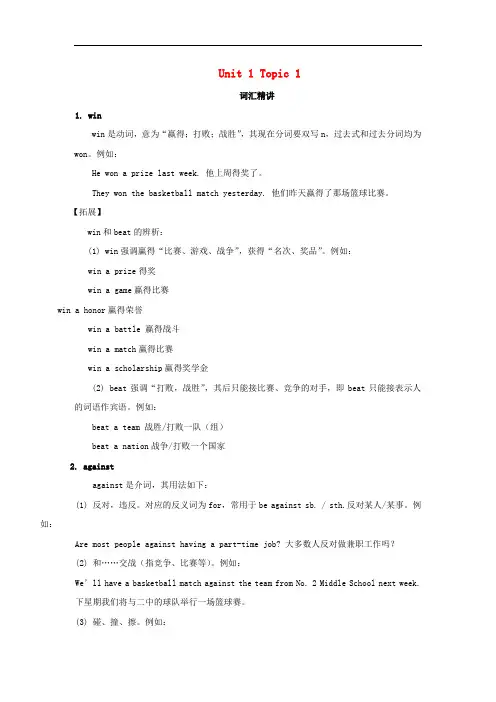
Unit 1 Topic 1词汇精讲1. winwin是动词,意为“赢得;打败;战胜”,其现在分词要双写n,过去式和过去分词均为won。
例如:He won a prize last week. 他上周得奖了。
They won the basketball match yesterday. 他们昨天赢得了那场篮球比赛。
【拓展】win和beat的辨析:(1) win强调赢得“比赛、游戏、战争”,获得“名次、奖品”。
例如:win a prize得奖win a game赢得比赛win a honor赢得荣誉win a battle 赢得战斗win a match赢得比赛win a scholarship赢得奖学金(2) beat强调“打败,战胜”,其后只能接比赛、竞争的对手,即beat只能接表示人的词语作宾语。
例如:beat a team 战胜/打败一队(组)beat a nation战争/打败一个国家2. againstagainst是介词,其用法如下:(1) 反对,违反。
对应的反义词为for,常用于be against sb. / sth.反对某人/某事。
例如:Are most people against having a part-time job? 大多数人反对做兼职工作吗?(2) 和……交战(指竞争、比赛等)。
例如:We’ll have a basketball match against the team from No. 2 Middle School next week.下星期我们将与二中的球队举行一场篮球赛。
(3) 碰、撞、擦。
例如:Rain beats against the window. 雨打在窗户上。
(4) 倚着、靠着。
例如:There was a ladder propped up(支撑) against the wall.一把梯子靠着墙。
(5) 防备,抗……。
例如:She saved money against old age. 她攒钱防老。
八年级英语上册Unit1PlayingSports句式精讲练习新版仁爱版
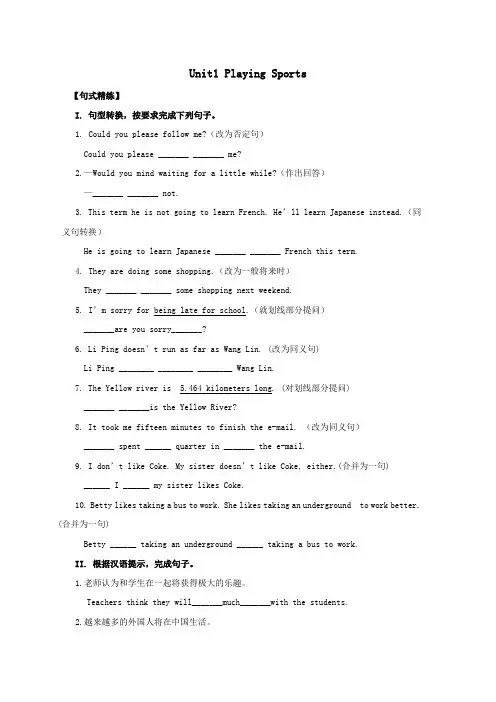
Unit1 Playing Sports【句式精练】I. 句型转换,按要求完成下列句子。
1. Could you please follow me?(改为否定句)Could you please _______ _______ me?2.—Would you mind waiting for a little while?(作出回答)—_______ _______ not.3. This term he is not going to learn French. He’ll learn Japanese instead.(同义句转换)He is going to learn Japanese _______ _______ French this term.4. They are doing some shopping.(改为一般将来时)They _______ _______ some shopping next weekend.5. I’m sorry for being late for school.(就划线部分提问)_______are you sorry_______?6. Li Ping doesn’t run as far as Wang Lin. (改为同义句)Li Ping ________ ________ ________ Wang Lin._______ _______is the Yellow River?8. It took me fifteen minutes to finish the e-mail. (改为同义句)_______ spent ______ quarter in _______ the e-mail.9. I don’t like Coke. My sister doesn’t like Coke, either.(合并为一句)______ I ______ my sister likes Coke.10. Betty likes taking a bus to work. She likes taking an underground to work better. (合并为一句)Betty ______ taking an underground ______ taking a bus to work.II. 根据汉语提示,完成句子。
【配套K12】[学习]八年级英语上册 Unit 1 Playing Sports词汇知识精讲 (新版
Unit1 Playing Sports【词汇精讲】1. duringduring是介词,意为“在……期间”。
例如:I went to see my uncle during my stay in Beijing. 我在北京逗留期间去北京看我叔叔了。
【辨析】(1) during指“在……时间内,在……的期间”,一般有明确的时间长度和起止时间。
谓语动词常为持续性的动作或状态,时间段前常有限定词(the; 物主代词等),表特指。
例如: He asked many questions during the three meetings. 在这三次会议期间,他问了许多问题。
(2) in意为“在……时间内”,一般情况下可以和during互换,用in时往往强调某一动作发生在某一时间段中的某一时间点;during既可用在“在整个时间段期间”,也可用在“某时间段内的某个时间点”。
例如:Mike put his hand up three times during/in the class. 在这节课内,Mike举了三次手。
(3) for意为“(时间)长达……”,强调时间由始至终,动作也贯穿这段时间的始终,可以和完成时连用。
强调持续时间的长短,回答how long的问题;而during则是指动作所发生的时间,回答when的问题。
例如:He stayed in Beijing for two years. 他在北京住了两年。
He swims every day during the summer. 夏天他每天去游泳。
2. againstagainst是介词,其用法如下:(1) 反对,违反。
对应的反义词为for,常用于be against sb. / sth.反对某人/某事。
例如:Are most people against having a part-time job? 大多数人反对做兼职工作吗?(2) 和……交战(指竞争、比赛等)。
八年级上Units1—2重点句型归纳、仿写与演练(含答案)
八年级上重点句型归纳、仿写与演练Unit 1 Playing SportsTopic 1 I am going to play basketball.1.What’s your favorite sport? = What sport do you like best? 你最喜爱运动是什么?My favorite sport is basketball. = I like basketball best.我最喜欢的运动是篮球。
仿句:你妹妹最喜欢的科目是什么?_____________________________________________________________2. Which sport do you prefer? = Which sport do you like better? 你更喜欢什么运动?I prefer skating. = I like skating better. 我更喜欢滑雪.仿句:游泳和滑冰,你比较喜欢什么运动?_____________________________________________________________ 3.Who is your favorite player? My favorite player is YaoMing.你最喜欢运动员是谁? 我最喜欢的运动员是姚明。
4.What are you going to be when you grow up? 你长大后要做什么?I am going to be a scientist.我想要成为一名科学家。
仿句:当他长大后他想要成为一名舞蹈家。
_____________________________________________________________ 5.She spends half an hour doing exercise in the gym every day. 每天她花半小时在体育馆锻炼.仿句:他去年花了半年时间学游泳。
八年级英语上册 Unit 1 Playing Sports Topic 2 I'll kick you the ball again重点句子讲解 (新版)
Unit1 Topic2 重点句子讲解Section A【1】—Will you join us?你愿意加入我们吗?(教材P9)—I’d be glad to.我很乐意。
(1) will在这里表示意愿,劳烦别人做事或请求别人做事,还可用would表达委婉的语气。
(2) I’d be glad to 中的 I’d 是 I would 的缩写,to 后的动词可省略,但to不能省略。
be glad to ...乐意于……。
如:I’m glad to help you.我很乐意帮助你。
【2】Would you mind leaching me?你介意教我吗?(教材P9)(1) Would you mind ...? 表示“你介意……吗?”1) 用法:是英语中委婉请求的表述方式之一,语气委婉、客气、礼貌,易于被对方接受。
此种表达也可用Do you mind…?但语气没有Would you mind…?委婉。
2) 结构:Would you mind doing sth. ? 做……好吗?否定式:Would you mind not doing sth. ? 别做……好吗?如:Would you mind closing the door? 你介意把门关上吗?Would you mind not wearing those old jeans? 别穿那些旧牛仔裤可以吗?3) 句中动名词前可加一个逻辑主语,一般用形容词性物主代词或名词所有格,用于不用意义不同。
如:Do you mind smoking? 你介意抽支烟吗?(你抽烟)Do you mind my smoking?你介意我抽支烟吗?(我抽烟)4)后可接由if引导的从句。
如:Would you mind if I smoke here?如果我在这抽烟你介意吗?(2)Would you mind ...?用来提问,表达的语气较客气。
回答的方式有:1)听从对方提议,表示一点也不介意。
人教pep版八年级英语上册 Unit1PlayingSports词汇知识精讲
Unit1 Playing Sports【词汇精讲】1. duringduring是介词,意为“在……期间”。
例如:I went to see my uncle during my stay in Beijing. 我在北京逗留期间去北京看我叔叔了。
【辨析】(1) during指“在……时间内,在……的期间”,一般有明确的时间长度和起止时间。
谓语动词常为持续性的动作或状态,时间段前常有限定词(the; 物主代词等),表特指。
例如:He asked many questions during the three meetings. 在这三次会议期间,他问了许多问题。
(2) in意为“在……时间内”,一般情况下可以和during互换,用in时往往强调某一动作发生在某一时间段中的某一时间点;during既可用在“在整个时间段期间”,也可用在“某时间段内的某个时间点”。
例如:Mike put his hand up three times during/in the class. 在这节课内,Mike举了三次手。
(3) for意为“(时间)长达……”,强调时间由始至终,动作也贯穿这段时间的始终,可以和完成时连用。
强调持续时间的长短,回答how long的问题;而during则是指动作所发生的时间,回答when的问题。
例如:He stayed in Beijing for two years. 他在北京住了两年。
He swims every day during the summer. 夏天他每天去游泳。
2. againstagainst是介词,其用法如下:(1) 反对,违反。
对应的反义词为for,常用于be against sb. / sth.反对某人/某事。
例如:Are most people against having a part-time job? 大多数人反对做兼职工作吗?(2) 和……交战(指竞争、比赛等)。