
2016年6月大学英语四级真题第二套
2016年6月大学英语四级真题(第2套)Part I WritingDirections:For this part, you are allowed 30 minutes to write a letterto express your thanks to one of your school teachers upon entering college. You should write at least 120 words but no more than 180 words.Section ADirections:In this section, there is a passage with ten blanks. You are required to select one word for each blank from a list of choices given in a word bank following the passage. Read the passage through carefully before making your choices. Each choice in the bank is identified by a letter. Please mark the corresponding letter for each item on Answer Sheet 2 with a single line through the centre. You may not use any of the words in the bank more than once.Contrary to popular belief, older people generally do not want to live with their children. Moreover, most adult children 26 every bit as much care and support to their aging parents as was the case in the “good old days”, and most older people do not feel 27.About 80% of people 65years and older have living children, and about 90% of themhave 28contact with their children. About 75% of elderly parents who don’t go to nursing homes live within 30 minutes of at least one of their children.However, 29 having contact with children does not guarantee happiness in old age. In fact, some research has found that people who are most involved with their families have the lowest spirits. This research may be 30 ,however, as ill health often makes older people more 31 and thereby increases contact with family members. So it is more likely that poor health, not just family involvement, 32 spirits.Increasingly, researchers have begun to look at the quality of relationships, rather than at the frequency of contact, between the elderly and their children. If parents and children share interests and values and agree on childrearing practices and religious 33 , they are likely to enjoy each other’s company. Disagreements on such matters can 34 cause problems. If parents are agreed by their daughter’s divorce, dislike her new husband, and disapprove of how she is raisingtheir grandchildren, 35 are that they are not going to enjoy her visits.Section BDirections: In this section, you are going to read a passage with ten statements attached to it. Each statement contains information given in one of the paragraphs. Identify the paragraph from which the information is derived. You may choose a paragraph more than once. Each paragraph ismarkedwith a letter. Answer the questions by marking the corresponding letter on Answer Sheet 2.Could Food Shortages Bring Down Civilization?[A] For many years I have studied global agricultural, population, environmental and economictrends and their interactions. The combined effects of those trends and the political tensions they generate point to the breakdown of governments and societies. Yet I, too, have resisted the idea that food shortages could bring down not only individual governments but also our global civilization.[B] I can no longer ignore that risk. Our continuing failure to deal with the environmental declinesthat are undermining the world food economy forces me to conclude that such a collapse is possible.[C] As demand for food rises faster than supplies are growing, the resulting food-price inflationputs severe stress on the governments of many countries. Unable to buy grain or grow their own, hungry people take to the streets. Indeed, even before the steep climb in grain prices in 2008, the number of failing states was expanding. If the food situation continues to worsen, entire nations will break down at an ever increasing rate. In the 20th century the main threat to international security was superpower conflict; today it is failing states.[D] States fail when national governments can no longer provide personal security, food securityand basic social services such as education and health care. When governments lose their control on power, law and order begin to disintegrate. After a point, countries can become so dangerous that food relief workers are no longer safe and their programs are halted. Failing states are of international concern because they are a source of terrorists, drugs, weapons and refugees(难民), threatening political stability everywhere.[E]The surge in world grain prices in 2007 and 2008—and the threat they pose to foodsecurity——has a different, more troubling quality than the increases of the past. During the second half of the 20th century, grain prices rose dramatically several times. In 1972, for instance, the Soviets, recognizing their poor harvest early, quietly cornered the world wheat market. As a result, wheat prices elsewhere more than doubled, pulling rice and corn prices up with them. But this and other price shocks were event-driven——drought in the Soviet Union, crop-shrinking heat in the U.S. Corn Belt. And the rises were short-lived: prices typically returned to normal with the next harvest.[F]In contrast, the recent surge in world grain prices is trend-driven, making it unlikely to reversewithout a reversal in the trends themselves. On the demand side, those trends include the ongoing addition of more than 70 million people a year, a growing number of people wanting to move up the food chain to consume highly grain-intensive meat products, and the massive diversion(转向)of U.S. grain to the production of bio-fuel.[G]As incomes rise among low-income consumers, the potential for further grain consumption ishuge. But that potential pales beside the never-ending demand for crop-based fuels. A fourth of this year’s U.S. grain harvest will go to fuel cars.[H]What about supply? The three environmental trends——the shortage of fresh water, the loss oftopsoil and the rising temperatures——are making it increasingly hard to expand the w orld’s grain supply fast enough to keep up with demand. Of all those trends, however, the spread of water shortages poses the most immediate threat. The biggest challenge here is irrigation, which consumes 70% the world’s fresh water. Millions of irrigatio n wells in many countries are now pumping water out of underground sources faster than rainfall can refill them. Theresult is falling water tables(地下水位)in countries with half the world’s people, including the three big grain producers——China, India and the U.S.[I]As water tables have fallen and irrigation wells have gone dry, China’s wheat crop, the world’slargest, has declined by 8% since it peaked at 123 million tons in 1997. But water shortages are even more worrying in India. Millions of irrigation wells have significantly lowered water tables in almost every state.[J]As the world’s food security falls to pieces, individual countries acting in their own self-interest are actually worsening the troubles of many. The trend began in 2007, when leading wheat-exporting countries such as Russia and Argentina limited or banned their exports, in hopes of increasing local food supplies and thereby bringing down domestic food prices.Vietnam banned its exports for several months for the same reason. Such moves may eliminate the fears of those living in the exporting countries, but they are creating panic in importing countries that must rely on what is then left for export.[K]In response to those restrictions, grain-importing countries are trying to nail down long-term trade agreements that would lock up future grain supplies. Food-import anxiety is even leading to new efforts by food-importing countries to buy or lease farmland in other countries. In spite of such temporary measures, soaring food prices and spreading hunger in many other countries are beginning to break down the social order.[L]Since the current world food shortage is trend-driven, the environmental trends that cause it must be reversed. We must cut carbon emissions by 80% from their 2006 levels by 2020, stabilize the world’s population at eight billion by 2040, completely remove poverty, and restore forests and soils. There is nothing new about the four objectives. Indeed, we have made substantial progress in some parts of the world on at least one of these——the distribution of family-planning services and the associated shift to smaller families.[M]For many in the development community, the four objectives were seen as positive, promoting development as long as they did not cost too much. Others saw them as politically correct and morally appropriate. Now a third and far more significant motivation presents itself: meeting these goals may be necessary to prevent the collapse of our civilization. Yet the cost we project for saving civilization would amount to less than $200 billion a year, 1/6 of current global military spending. In effect, our plan is the new security budget.36.The more recent steep climb in grain prices partly results from the fact that more and morepeople want to consume meat products.37. Social order is breaking down in many countries because of food shortages.38. Rather than superpower conflict, countries unable to cope with food shortages now constitutethe main threat to world security.39. Some parts of the world have seen successful implementation of family planning.40. The author has come to agree that food shortages could ultimately lead to the collapse of worldcivilization.41. Increasing water shortages prove to be the biggest obstacle to boosting the world’s gra inproduction.42. The cost for saving our civilization would be considerably less than the world’s currentmilitary spending.43. To lower domestic food prices, some countries limited or stopped their grain exports.44. Environmental problems must be solved to ease the current global food shortage.45. A quarter of this year’s American grain harvest will be used to produce bio-fuel for cars. Section CDirections:There are 2 passages in this section. Each passage is followed by some questions or unfinished statements. For each of them there are four choices marked A), B), C) and D).You should decide on the best choice and mark the corresponding letter on Answer Sheet 2 with a single line through the centre.Passage OneQuestions 46 to 50 are based on the following passage.Declining mental function is often seen as a problem of old age,but certain aspects of brain function actually begin their decline in young adulthood, a new study suggests.The study, which followed more than 2,000 healthy adults between the ages of 18 and 60, found that certain mental functions—including measures of abstract reasoning, mental speed and puzzle-solving—started to dull as early as age 27.Dips in memory, meanwhile, generally became apparent around age 37.On the other hand, indicators of a person’s accumulated knowledge—like performance on tests of vocabulary and general knowledge—kept improving with age, according to findings published in the journal Neurobiology of Aging.The results do not mean that young adults need to start worrying about their memories. Most people’s minds function at a high level even in their later years, according to researcher Timothy Salthouse.“These patterns suggest that some types of mental flexibi lity decrease relatively early in adulthood, but that the amount of knowledge one has, and the effectiveness of integrating it with one’s abilities,may increase throughout all of adulthood if there are no dis e ases,” Salthouse said in a news release.The study included healthy, educated adults who took standard tests of memory, reasoning and perception at the outset and at some point over the next seven years.The tests are designed to detect subtle (细微的)changes in mental function, and involve solving puzzles, recalling words and details from stories, and identifying patterns in collections of letters and symbols.In general, Salthouse and his colleagues found, certain aspects of cognition (认知能力)generally started to decline in the late 20s to 30s.The findings shed light on normal age-related changes in mental function, which could aid in understanding the process of dementia(痴呆),according to the researchers.“By following individuals over time,” Salthouse said, “we gain insight in cognition changes, and may possibly discover ways to slow the rate of decline.”The researchers are currently analyzing the study participants’ health and lifestyle to see which factors might influence age-related cognitive changes.46. What is the common view of mental function?A)It varies from person to person. B)It weakens in one’s later years.C)It gradually expands with age. D)It indicates one’s health condition.47. What does the new study find about mental functions?A)Some diseases inevitably lead to their decline.B)They reach a peak at the age of 20 for most people.C)They are closely related to physicaland mental exercise.D)Some of them begin to decline when people are still young.48. What does Timothy Salthouse say about people’s minds in most cases?A)They tend to decline in people’s later years.B)Their flexibility determines one’s abilities.C)They function quite well even in old age.D)Their functioning is still a puzzle to be solved.49. Although people’s minds may function less flexibly as they ag e, they_____.A)may be better at solving puzzlesB)can memorize things with more easeC)may have greater facility in abstract reasoningD)can put what they have learnt into more effective use50. According to Salthouse, their study may help us_____.A)find ways to slow down our mental declineB)find ways to boost our memoriesC)understand the complex process of mental functioningD)understand the relation between physical and mental healthPassage TwoQuestions 51 to 55 are based on the following passage.The most important thing in the news last week was the rising discussion in Nashville about the educational needs of children. The shorthand(简写)educators use for this is “pre-K”—meaning instruction before kindergarten—and the big idea is to prepare 4-year-olds and even younger kids to be ready to succeed on their K-12 journey.But it gets complicated. The concept has multiple forms, and scholars and policymakers argue about the shape, scope and cost of the ideal program.The federal Head Start program, launched 50 years ago, has served more than 30 million children. It was based on concepts developed at Vanderbilt University’s Peabody College by Susan Gray, the legendary pioneer in early childhood education research.A new Peabody study of the Tennessee V oluntary Pre-K program reports that pre-K works, but the gains are not sustained through the third grade. It seems to me this highlights quality issues in elementary schools more than pre-K, and indicates longer-term success must connect pre-K with all the other issues related to educating a child.Pre-K is controversial. Some critics say it is a luxury and shouldn’t be free to families able to pay. Pre-K advocates insist it is proven and will succeed if integrated with the rest of the child’s schooling. I lean toward the latter view.This is, in any case, the right conversation to be having now as Mayor Megan Barry takes office. She was the first candidate to speak out for strong pre-K programming. The important thing is for all of us to keep in mind the real goal and the longer, bigger picture.The weight of the evidence is on the side of pre-K that early intervention (干预)works. What government has not yet found is the political will to put that understanding into full practice with a sequence of smart schooling that provides the early foundation.For this purpose, our schools need both the talent and the organization to educate each child who arrives at the schoolhouse door. Some show up ready, but many do not at this critical time when young brains are developing rapidly.51.What does the author say about pre-kindergarten education?A)It should cater to the needs of individual children.B)It is essential to a person’s future academic success.C)Scholars and policymakers have different opinions about it.D)Parents regard it as the first phase of children’s development.52.What does the new Peabody study find?A)Pre-K achievements usually do not last long.B)The third grade marks a new phase of learning.C)The third grade is cr itical to children’s development.D)Quality has not been the top concern of pre-K programs.53.When does the author think pre-K works the best?A)When it is accessible to kids of all families.B)When it is made part of kids’ education.C)When it is no longer considered a luxury.D)When it is made fun and enjoyable to kids.54.What do we learn about Mayor Megan Barry?A)She knows the real goal of education. B)She is a mayor of insight and vision.C)She has once run a pre-K program. D)She is a firm supporter of pre-K.55.What does the author think is critical to kids’ education?A)Teaching method. B)Kids’ interest.C)Early intervention. D)Parents’ involvement.Directions:For this part, you are allowed 30 minutes to translate a passage from Chinese into English. You should write your answer on Answer Sheet 2.在山东省潍坊市,风筝不仅仅是玩具,而且还是这座城市文化的标志。
2016年6大学英语四级第2套真题及答案
2016年6月大学英语四级真题(第2套)Part I WritingDirections:For this part, you are allowed 30 minutes to write a letter to expressyour thanks to one of your school teachers upon entering college. You should writeat least 120 words but no more than 180 words.ComprehensionSection ADirections: In this section, you will hear three news reports. At the end of eachnews report, you will hear two or three questions. Both the news report and thequestions will be spoken only once. After you hear a question, you must choose thebest answer from the four choices marked A), B), C) and D). Then mark thecorresponding letter on Answer Sheet 1 with a single line through the centre. Questions 1 and 2 are based on the news report you have just heard.1. A)How college students can improve their sleep habits.B)Why sufficient sleep is important for college students.C)Why college students are more likely to have stress problems.D)How college students can handle their psychological problems.2. A)It is not easy to improve one’s sleep habits.B)It is not good for students to play video games.C)Students who are better prepared generally get higher scores in examinations.D)Making last-minute preparations for tests may be less effective than sleeping. Questions 3 and 4 are based on the news report you have just heard.3. A)Whether more airports should be built around London.B)Whether adequate investment is being made to improve airport facilities.C)Whether the British Airports Authority should sell off some of its assets.D)Whether the Spanish company could offer better service.4. A)Inefficient management. B)Poor ownership structure.C)Lack of innovation and competition. D)Lack of runway and terminal capacity.Questions 5 to 7 are based on the news report you have just heard.5. A)Report the nicotine content of their cigarettes.B)Set a limit to the production of their cigarettes.C)Take steps to reduce nicotine in their products.D)Study the effects of nicotine on young smokers.6. A)The biggest increase in nicotine content tended to be in brands young smokers like.B)Big tobacco companies were frank with their customers about the hazards of smoking.C)Brands which contain higher nicotine content were found to be much more popular.D)Tobacco companies refused to discuss the detailed nicotine content of their products.7. A)They promised to reduce the nicotine content in cigarettes.B)They have not fully realized the harmful effect of nicotine.C)They were not prepared to comment on the cigarette study.D)They will pay more attention to the quality of their products.Section BDirections: In this section, you will hear two long conversations. At the end ofeach conversation, you will hear four questions. Both the conversation and the questions will be spoken only once. After you hear a question, you must choose the best answer from the four choices marked A), B), C)and D). Then mark the corresponding letter on Answer Sheet 1 with a single line through the centre.Questions 8 to 11 are based on the conversation you have just heard.8. A)Indonesia. B)Holland. C)Sweden. D)England.Getting a coach who can offer real help. B)Talking with her boyfriend in Dutch.C)Learning a language where it is not spoken . D)Acquiring the necessary ability to socialize .10. A)Listening language programs on the radio. B)Trying to speak it as much as one can.C)Making friends with native speakers. D)Practicing reading aloud as often as possible.It creates an environment for socializing.B)It offers various courses with credit points.C)It trains young people’s leadership abilities.D)It provides opportunities for language practice.Questions 12 to 15 are based on the conversation you have just heard.12. A)The impact of engine design on rode safety. B)The role policemen play in traffic safety.C)A sense of freedom driving gives. D)Rules and regulations for driving.13. A)Make cars with automatic control. B)Make cars that have better brakes.C)Make cars that are less powerful. D)Make cars with higher standards.14. A)They tend to drive responsibly. B)They like to go at high speed.C)They keep within speed limits. D)They follow traffic rules closely. It is a bad idea. B)It is not useful.C)It is as effective as speed bumps . D)It should be combined with education.Section CDirections:In this section, you will hear three passages. At the end of each passage, you will hear three or four questions. Both the passage and the questions will be spoken only once. After you hear a question, you must choose the best answer from the four choices marked A), B), C)and D).Then mark the corresponding letter on Answer Sheet 1 with a single line through the centre.Questions 16 to 18 are based on the passage you have just heard.The card got damaged . B)The card was found invalid.C)The card reader failed to do the scanning. D)The card reader broke down unexpectedly.17. A)By converting the credit card with a layer of plastic.B)By calling the credit card company for confirmation.C)By seeking help from the card reader maker Verifone.D)By typing the credit card number into the cash register.Affect the sales of high-tech appliances.B)Change the life style of many Americans.C)Give birth to many new technological inventions.D)Produce many low-tech fixes for high-tech failures.Questions 19 to 21 are based on the passage you have just heard.19. A)They are set by the dean of the graduate school.B)They are determined by the advising board.C)They leave much room for improvement.D)They vary among different departments.20. A)By consulting the examining committee . B)By reading the Bulletin of Information.C)By contacting the departmental office. D)By visiting the university’s website.21. A)They specify the number of credits students must earn.B)They are harder to meet than those for undergraduates.C)They have to be approved by the examining committee.D)They are the same among various divisions of the university.Questions 22 to 25 are based on the passage you have just heard.22. A)Students majoring in nutrition. B)Students in health classes.C). candidates in dieting. D)Middle and high school teachers.23. A)Its overestimate of the effect of dieting. B)Its mistaken conception of nutrition.C)Its changing criteria for beauty. D)Its overemphasis on thinness.24. A)To illustrate her point that beauty is but skin deep.B)To demonstrate the magic effect of dieting on women.C)To explain how computer images can be misleading.D)To prove that technology has impacted our culture.25. A)To persuade girls to stop dieting.B)To promote her own concept of beauty.C)To establish an emotional connection with students.D)To help students rid themselves of bad living habits.Part III Reading ComprehensionSection ADirections:In this section, there is a passage with ten blanks. You are requiredto select one word for each blank from a list of choices given in a word bank following the passage. Read the passage through carefully before making your choices. Each choice in the bank is identified by a letter. Please mark the corresponding letter for each item on Answer Sheet 2 with a single line through the centre. You may not use any of the words in the bank more than once.Contrary to popular belief, older people generally do not want to live with their children. Moreover, most adult children 26 every bit as much care and support to their aging parents as was the case in the “good old days”, and most older people do not feel 27 .About 80% of people 65years and older have living children, and about 90% of them have 28 contact with their children. About 75% of elderly parents who don’t go to nursing homes live within 30 minutes of at least one of their children.However, 29 having contact with children does not guarantee happiness in old age. In fact, some research has found that people who are most involved with their families have the lowest spirits. This research may be 30 , however, as ill health often makes older people more 31 and thereby increases contact with family members. So it is more likely that poor health, not just family involvement, 32 spirits.Increasingly, researchers have begun to look at the quality of relationships, rather than at the frequency of contact, between the elderly and their children. If parents and children share interests and values and agree on childrearing practices and religious 33 , they are likely to enjoy each other’s company. Disagreements on such matters can 34 cause problems. If parents are agreed by their daughter’s divorce, dislike her new husb and, and disapprove of how she is raising their grandchildren, 35 are that they are not going to enjoy her visits.Section BDirections: In this section, you are going to read a passage with ten statements attached to it. Each statement contains information given in one of the paragraphs. Identify the paragraph from which the information is derived. You may choose a paragraph more than once. Each paragraph is marked with a letter. Answer the questions by marking the corresponding letter on Answer Sheet 2.Could Food Shortages Bring Down Civilization?[A] For many years I have studied global agricultural, population, environmentaland economic trends and their interactions. The combined effects of those trends and the political tensions they generate point to the breakdown of governments and societies. Yet I, too, have resisted the idea that food shortages could bring down not only individual governments but also our global civilization.[B] I can no longer ignore that risk. Our continuing failure to deal with theenvironmental declines that are undermining the world food economy forces me to conclude that such a collapse is possible.[C] As demand for food rises faster than supplies are growing, the resultingfood-price inflation puts severe stress on the governments of many countries.Unable to buy grain or grow their own, hungry people take to the streets. Indeed, even before the steep climb in grain prices in 2008, the number of failing stateswas expanding. If the food situation continues to worsen, entire nations will break down at an ever increasing rate. In the 20th century the main threat to international security was superpower conflict; today it is failing states. [D] States fail when national governments can no longer provide personal security,food security and basic social services such as education and health care. When governments lose their control on power, law and order begin to disintegrate.After a point, countries can become so dangerous that food relief workers are no longer safe and their programs are halted. Failing states are of international concern because they are a source of terrorists, drugs, weapons and refugees(难民), threatening political stability everywhere.[E] The surge in world grain prices in 2007 and 2008—and the threat they pose tofood security——has a different, more troubling quality than the increases of the past. During the second half of the 20th century, grain prices rose dramatically several times. In 1972, for instance, the Soviets, recognizing their poor harvest early, quietly cornered the world wheat market. As a result, wheat prices elsewhere more than doubled, pulling rice and corn prices up with them. But this and other price shocks were event-driven——drought in the Soviet Union, crop-shrinking heat in the . Corn Belt. And the rises were short-lived: prices typically returned to normal with the next harvest.[F] In contrast, the recent surge in world grain prices is trend-driven, making itunlikely to reverse without a reversal in the trends themselves. On the demand side, those trends include the ongoing addition of more than 70 million peoplea year, a growing number of people wanting to move up the food chain to consumehighly grain-intensive meat products, and the massive diversion(转向) of . grain to the production of bio-fuel.[G] As incomes rise among low-income consumers, the potential for further grainconsumption is huge. But that potential pales beside the never-ending demand forcrop-based fuels. A fourth of this year’s . grain harvest will go to fuel cars.[H] What about supply? The three environmental trends——the shortage of fresh water,the loss of topsoil and the rising temperatures——are making it increasingly hard to expand the world’s grain supply fast enough to keep up with demand. Of all those trends, however, the spread of water shortages poses the most immediate threat. The biggest challenge here is irrigation, which consumes 70% the world’s fresh water. Millions of irrigation wells in many countries are now pumping water out of underground sources faster than rainfall can refill them. The result is falling water tables(地下水位) in countries with half the world’s people, including the three big grain producers——China, India and the .[I] As water tables have fallen and irrigation wells have gone dry, China’s wheatcrop, the world’s largest, has declined by 8% since it peaked at 123 million tons in 1997. But water shortages are even more worrying in India. Millions of irrigation wells have significantly lowered water tables in almost every state. [J] As the world’s food security falls to pieces, individual countries acting in their own self-interest are actually worsening the troubles of many. The trend began in 2007, when leading wheat-exporting countries such as Russia and Argentina limited or banned their exports, in hopes of increasing local food supplies and thereby bringing down domestic food prices. Vietnam banned its exports for several months for the same reason. Such moves may eliminate the fears of those living in the exporting countries, but they are creating panic in importing countries that must rely on what is then left for export.[K] In response to those restrictions, grain-importing countries are trying to nail down long-term trade agreements that would lock up future grain supplies.Food-import anxiety is even leading to new efforts by food-importing countries to buy or lease farmland in other countries. In spite of such temporary measures, soaring food prices and spreading hunger in many other countries are beginningto break down the social order.[L] Since the current world food shortage is trend-driven, the environmental trends that cause it must be reversed. We must cut carbon emissions by 80% from their 2006 levels by 2020, stabilize the world’s population at eight billion by 2040, completely remove poverty, and restore forests and soils. There is nothing new about the four objectives. Indeed, we have made substantial progress in some parts of the world on at least one of these——the distribution of family-planning services and the associated shift to smaller families.[M]For many in the development community, the four objectives were seen as positive, promoting development as long as they did not cost too much. Others saw them as politically correct and morally appropriate. Now a third and far more significant motivation presents itself: meeting these goals may be necessary to prevent the collapse of our civilization. Yet the cost we project for saving civilization would amount to less than $200 billion a year, 1/6 of current global military spending. In effect, our plan is the new security budget.more recent steep climb in grain prices partly results from the fact that more and more people want to consume meat products.37. Social order is breaking down in many countries because of food shortages.38. Rather than superpower conflict, countries unable to cope with food shortagesnow constitute the main threat to world security.39. Some parts of the world have seen successful implementation of family planning.40. The author has come to agree that food shortages could ultimately lead to thecollapse of world civilization.41. Increasing water shortages prove to be the biggest obstacle to boosting thewo rld’s grain production.42. The cost for saving our civilization would be considerably less than the world’scurrent military spending.43. To lower domestic food prices, some countries limited or stopped their grain exports.44. Environmental problems must be solved to ease the current global food shortage.45. A quarter of this year’s American grain harvest will be used to produce bio-fuel for cars.Section CDirections: There are 2 passages in this section. Each passage is followed by some questions or unfinished statements. For each of them there are four choices marked A), B), C) and D). You should decide on the best choice and mark the corresponding letter on Answer Sheet 2 with a single line through the centre.Passage OneQuestions 46 to 50 are based on the following passage.Declining mental function is often seen as a problem of old age, but certain aspects of brain function actually begin their decline in young adulthood, a new study suggests.The study, which followed more than 2,000 healthy adults between the ages of 18 and 60, found that certain mental functions—including measures of abstract reasoning, mental speed and puzzle-solving—started to dull as early as age 27.Dips in memory, meanwhile, generally became apparent around age 37.O n the other hand, indicators of a person’s accumulated knowledge—like performance on tests of vocabulary and general knowledge—kept improving with age, according to findings published in the journal Neurobiology of Aging.The results do not mean that young adults need to start worrying about their memories. Most people’s minds function at a high level even in their later years, according to researcher Timothy Salthouse.“These patterns suggest that some types of mental flexibility decreaserelatively early in adulthood, but that the amount of knowledge one has, and the effectiveness of integrating it with one’s abilities,may increase throughout all of adulthood if there are no dise ases,” Salthouse said in a news release.The study included healthy, educated adults who took standard tests of memory, reasoning and perception at the outset and at some point over the next seven years.The tests are designed to detect subtle (细微的) changes in mental function, and involve solving puzzles, recalling words and details from stories, and identifying patterns in collections of letters and symbols.In general, Salthouse and his colleagues found, certain aspects of cognition (认知能力) generally started to decline in the late 20s to 30s.The findings shed light on normal age-related changes in mental function, which could aid in understanding the process of dementia (痴呆), according to the researchers.“By following individuals over time,” Salthouse said, “we gain insight in cognition changes, and may possibly disc over ways to slow the rate of decline.”The researchers are currently analyzing the study participants’ health and lifestyle to see which factors might influence age-related cognitive changes.46. What is the common view of mental function?A)It varies from person to person. B)It weakens in one’s later years.C)It gradually expands with age. D)It indicates one’s health condition.47. What does the new study find about mental functions?A)Some diseases inevitably lead to their decline.B)They reach a peak at the age of 20 for most people.C)They are closely related to physical and mental exercise.D)Some of them begin to decline when people are still young.48. What does Timothy Salthouse say about people’s minds in most cases?A)They tend to decline in people’s later years.B)Their flexibility determines one’s abilities.C)They function quite well even in old age.D)Their functioning is still a puzzle to be solved.49. Although people’s minds may function less flexibly as they age, they _____.A)may be better at solving puzzlesB)can memorize things with more easeC)may have greater facility in abstract reasoningD)can put what they have learnt into more effective use50. According to Salthouse, their study may help us_____.A)find ways to slow down our mental declineB)find ways to boost our memoriesC)understand the complex process of mental functioningD)understand the relation between physical and mental healthPassage TwoQuestions 51 to 55 are based on the following passage.The most important thing in the news last week was the rising discussion in Nashville about the educational needs of children. The shorthand(简写)educators use for this is “pre-K”—meaning instruction before kindergarten—and the big idea is to prepare 4-year-olds and even younger kids to be ready to succeed on their K-12 journey.But it gets complicated. The concept has multiple forms, and scholars and policymakers argue about the shape, scope and cost of the ideal program.The federal Head Start program, launched 50 years ago, has served more than 30 million children. It was based on concepts developed at Vanderbilt University’sPeabody College by Susan Gray, the legendary pioneer in early childhood education research.A new Peabody study of the Tennessee Voluntary Pre-K program reports that pre-K works, but the gains are not sustained through the third grade. It seems to me this highlights quality issues in elementary schools more than pre-K, and indicates longer-term success must connect pre-K with all the other issues related to educating a child.Pre-K is controversial. Some critics say it is a luxury and shouldn’t be free to families able to pay. Pre-K advocates insist it is proven and will succeed if integrated with the rest of the child’s schooling. I lean toward the latter view.This is, in any case, the right conversation to be having now as Mayor Megan Barry takes office. She was the first candidate to speak out for strong pre-K programming. The important thing is for all of us to keep in mind the real goal and the longer, bigger picture.The weight of the evidence is on the side of pre-K that early intervention (干预)works. What government has not yet found is the political will to put that understanding into full practice with a sequence of smart schooling that provides the early foundation.For this purpose, our schools need both the talent and the organization to educate each child who arrives at the schoolhouse door. Some show up ready, but many do not at this critical time when young brains are developing rapidly.does the author say about pre-kindergarten education?A)It should cater to the needs of individual children.B)It is essential to a person’s future academic success.C)Scholars and policymakers have different opinions about it.D)Parents regard it as the first phase of children’s development.does the new Peabody study find?A)Pre-K achievements usually do not last long.B)The third grade marks a new phase of learning.C)The third grade is critical to children’s deve lopment.D)Quality has not been the top concern of pre-K programs.does the author think pre-K works the best?A)When it is accessible to kids of all families.B)When it is made part of kids’ education.C)When it is no longer considered a luxury.D)When it is made fun and enjoyable to kids.do we learn about Mayor Megan Barry?A)She knows the real goal of education. B)She is a mayor of insight and vision.C)She has once run a pre-K program. D)She is a firm supporter of pre-K.does the author think is critical to kids’ education?A)Teaching method. B)Kids’ interest.C)Early intervention. D)Parents’ involvement.Directions:For this part, you are allowed 30 minutesto translate a passage from Chinese into English. You should write your answer on Answer Sheet 2.在山东省潍坊市,风筝不仅仅是玩具,而且还是这座城市文化的标志。
2016年六月大学英语四级考试真题二
2016年六月大学英语四级考试真题二全文共3篇示例,供读者参考篇12016年六月大学英语四级考试真题二Part Ⅰ Writing (30 minutes)Directions: For this part, you are allowed 30 minutes to write an essay on the importance of reading classic literature. You should write at least 150 words, but no more than 200 words.Importance of Reading Classic LiteratureReading classic literature is often viewed as a daunting task by many young students. However, the importance of reading classic literature should not be underestimated. Classic literature has stood the test of time and continues to be relevant and influential in today’s s ociety.Firstly, reading classic literature exposes readers to new ideas, cultures, and perspectives. By delving into the works of authors such as Shakespeare, Dickens, and Austen, readers can gain insights into different time periods and societies. Thisbroadens their horizons and helps them develop empathy and understanding for people from diverse backgrounds.Secondly, classic literature provides readers with a deeper understanding of human nature. Through the complex characters and intricate plots found in classic novels, readers can explore universal themes such as love, loss, and morality. This allows readers to reflect on their own lives and learn valuable lessons about ethics and relationships.Furthermore, reading classic literature can improve readers’ language skills. Classic novels are often written in a more complex and formal style than contemporary literature, which can challenge readers to expand their vocabulary and improve their comprehension skills. This can be especially beneficial for students studying English as a second language.In conclusion, reading classic literature is not just a task for scholars or literary enthusiasts. It is a valuable and enriching experience that can broaden readers’ minds, deepen their understanding of human nature, and improve their language skills. Therefore, all students should make an effort to engage with classic literature and reap the benefits it has to offer.Part Ⅱ Listening Comprehension (30 minutes)Section ADirections: In this section, you will hear three news reports. At the end of each news report, you will hear two or three questions. Both the news report and the questions will be spoken only once. After you hear a question, you must choose the best answer from the four choices marked A), B), C) and D). Then mark the corresponding letter on Answer Sheet 1 with a single line through the centre.Questions 1 and 2 are based on the news report you have just heard.1. A) Most people disapprove of nuclear power.B) There is widespread skepticism about nuclear power.C) The survey shows a growing distrust of nuclear power.D) Public opinion on nuclear power is divided.2. A) It invests one billion dollars in nuclear power.B) It is planning to phase out nuclear power plants.C) It commissions a public opinion survey on nuclear power.D) It announces a policy shift concerning nuclear power.Questions 3 and 4 are based on the news report you have just heard.3. A) People have been evacuated from a nearby village.B) A forest fire has destroyed many houses in the area.C) The fire has spread due to the strong wind.D) The firefighters have managed to bring the fire under control.4. A) A chemical leak from a factory.B) A careless camper.C) A lightning strike.D) A forest clearing operation.Questions 5 to 7 are based on the news report you have just heard.5. A) They marked the reopening of the museum for the public.B) They featured works by famous contemporary artists.C) They were organized as part of an exhibition on Tibetan culture.D) They emphasized the importance of ancient cultural relics.6. A) The museum plans to expand its collection.B) The museum is planning more exhibitions in the future.C) The museum has joined a nationwide campaign to restore relics.D) The museum has recently acquired a valuable Tibetan relic.7. A) They will be publicly shown for a limited time.B) They will be permanently housed in a new museum.C) They will be returned to Tibet once the exhibition ends.D) They will eventually be kept in the museum's storeroom.Section BDirections: In this section, you will hear two long conversations. At the end of each conversation, you will hear four questions. Both the conversation and the questions will be spoken only once. After you hear a question, you must choose the best answer from the four choices marked A), B), C) and D).Then mark the corresponding letter on Answer Sheet 1 with a single line through the centre.Questions 8 to 11 are based on the conversation you have just heard.8. A) The man lost his hat.B) The woman lost her key.C) The woman lost her notebook.D) The man lost his wallet.9. A) Check the information missing in the man's address book.B) Call the man back later if she gets any information.C) Forward some of the calls to the man's cell phone.D) Tell the man all four messages were for him.10. A) The possibility of a meeting with Professor Richards.B) The likelihood of a job offer at the university.C) The location of the Humanities Department office.D) The man's schedule for the day.11. A) She can't meet the caller on Thursday.B) She is surprised she wasn't invited to the meeting.C) She doesn't know what time the meeting is.D) She doesn't want to go to the meeting.Questions 12 to 15 are based on the conversation you have just heard.12. A) Her friend's plan to go to the library to study will change.B) She has to find another way to print her essay.C) She does not have any paper to hand in the assignment.D) Her essay must be printed and turned in on time.13. A) They have to change their plan to study together.B) The dorm printer cannot print her assignment.C) The man's printer is broken as well.D) The man will print out a copy for her.14. A) Borrow paper from the library and write a new essay.B) Ask their friend from the fifth floor to help with printing.C) Borrow a printer from another dorm resident.D) Go to the library for copies.15. A) Going to bed.B) Studying for their finals.C) Listening to music.D) Printing out their assignments.Part Ⅲ Reading Comprehension (40 minutes)Section ADirections: In this section, there is a passage with ten blanks. You are required to select one word for each blank from a list of choices given in a word bank following the passage. Read the passage through carefully before making your choices. Each choice in the bank is identified by a letter. Please mark the corresponding letter for each item on Answer Sheet 2 with a single line through the centre. You may not use any of the words in the bank more than once.Global warming is one of the most serious environmental issues facing us today. The average temperature on Earth has increased by about 1°F(arou nd 0.5°C)over the past century. A change of this 16 is a big deal. For example, during the last Ice Age, when much of North America. Europe, and Asia were covered with 17. average global temperatures were only about 5°F(2.8°C)cooler than they are today.The term global warming is a bit misleading because it is 18 more than an increase in temperature. Changes to local weather patterns as a result of the global increase in temperature are just as worrying. In some cases this can lead to 19 intense and prolonged heat waves, while in others it can lead to intense rainfall and widespread flooding. This can be a result of the 20 jet stream, a swift, high-altitude wind. The jet stream can cause weather systems to become 21 in one area and remain there for extended periods of time.Global warming is a result of greenhouse gases. These are gases that are in the atmosphere. Carbon dioxide is the primary greenhouse gas. This gas is released in several ways, including through human 22. For example, humans burn fossil fuels like coal, oil, and natural gas to make electricity, and to heat, cool, and power 23 homes and cars. Another important greenhouse gas is methane, which is a result of microbial decomposition in the world's 24.A) activitiesB) primarilyC) increasesD) glaciersE) sourcesF) changesG) machinesH) trappedI) impactJ) strengthensK) frozenL) gasesM) wildlifeN) concentratedO) remoteSection BDirections: In this section, you are going to read a passage with ten statements attached to it. Each statement contains information given in one of the paragraphs. Identify the paragraph from which the information is derived. You may choose a paragraph more than once. Each paragraph is marked with a letter. Answer the question by marking the corresponding letter on Answer Sheet 2.Imagine this scene: a man and a woman sit in an open field, surrounded by colorful flowers swaying in the breeze. They are 26, talking and laughing as they enjoy the vibrant beauty of nature. Suddenly, the man turns to the woman and declares his love for her. The woman is touched by his gesture and shyly returns his affections. This romantic scene could be straight out of a Hollywood movie, but it is actually a common theme in Persian literature.Persian literature, one of the world's oldest literary traditions, has a rich history that dates back over a thousand years. It encompasses a variety of genres, including poetry, novels, and short stories, and has been influenced by a range of cultural and religious traditions. One of the most famous works of Persian literature is the Rubaiyat of Omar Khayyam, a collection of quatrains that explore themes of love, nature, and the passage of time. The Rubaiyat has been translated into many languages and continues to be celebrated for its beauty and wisdom.In Persian culture, literature holds a special place. Poets and writers are revered for their ability to craft powerful and evocative prose, and works of literature are often seen as sources of inspiration and guidance. Persian literature has played a keyrole in shaping the cultural identity of the region and continues to be a source of pride for many Iranians.Reading Persian literature provides insight into the rich cultural heritage of Iran and allows readers to explore universal themes such as love, loss, and redemption. By delving into the works of Persian poets and writers, readers can gain a greater understanding of the complexities of human emotion and experience a deep connection to the beauty of language and storytelling.26. Persian literature features a romantic scene that could be from a Hollywood movie.27. The Rubaiyat of Omar Khayyam explores themes of love and nature.28. Persian writers are highly respected for their ability to craft powerful and evocative prose.29. Persian literature has played a significant role in shaping the cultural identity of Iran.30. Reading Persian literature allows readers to explore universal themes and gain understanding of human emotions.篇22016年六月大学英语四级考试真题二Part I Writing (30 minutes)Directions: For this part, you are allowed 30 minutes to write a short essay discussing whether parents should send their children to kindergarten before the age of 3. You should write at least 150 words but no more than 200 words.In recent years, the debate over whether parents should send their children to kindergarten before the age of 3 has been a controversial topic. Some people believe that early education is crucial for a child's development, while others argue that children at such a young age should stay at home with their parents.On the one hand, sending children to kindergarten at an early age can help them develop social skills and independence. They will learn how to interact with other children and adults, follow instructions, and adapt to a structured environment. This can give them a head start in their academic and social development. Additionally, kindergarten provides a safe and stimulating environment for children to explore and learn new things, which can enhance their overall growth and development.On the other hand, some argue that children under the age of 3 are too young to be separated from their parents for long periods of time. They believe that young children need the love and care of their parents to feel secure and develop a strong emotional bond with them. Sending them to kindergarten at such a young age may cause stress and anxiety, leading to negative effects on their emotional well-being.In conclusion, while early education can be beneficial for a child's development, parents should consider their child's individual needs and circumstances before making the decision to send them to kindergarten before the age of 3. It is important to strike a balance between early education and the emotional well-being of the child.篇3In June 2016, the English language proficiency exam for Chinese university students, also known as the College English Test Band 4 (CET-4), was administered. This exam is a crucial assessment for students seeking to demonstrate their English language skills and obtain their undergraduate degree. The exam consists of listening, reading, writing, and translation sections, testing students' abilities in different aspects of the English language.The listening section of the exam typically includes a variety of listening tasks, such as listening to conversations, lectures, and news reports. Students are required to answermultiple-choice questions based on the information they hear. This section tests their listening comprehension skills and ability to extract important details from spoken English.The reading section presents students with a series of passages on various topics, including academic articles, news reports, and opinion pieces. Students must answer comprehension questions to demonstrate their understanding of the content. This section tests their reading comprehension skills, vocabulary, and ability to interpret written English.The writing section requires students to write essays on given topics, expressing their opinions and ideas clearly and cohesively. This section tests their ability to organize their thoughts, use proper grammar and vocabulary, and develop coherent arguments in English.The translation section tests students' ability to translate Chinese passages into English and vice versa. This section evaluates their understanding of both languages, as well as their proficiency in translating between the two.Overall, the CET-4 exam in June 2016 was challenging but manageable for most students. It provided an opportunity for students to showcase their English language skills and demonstrate their readiness for academic study inEnglish-speaking countries or international environments.In conclusion, the CET-4 exam is an important milestone for Chinese university students, marking their progress in English language proficiency and preparing them for future academic and professional endeavors. Students who successfully pass the exam can be proud of their accomplishments and confident in their ability to communicate effectively in English.。
2016年6月四级考试真题(第二套)及解析

2016年6月四级考试真题(第二套)PartⅠWriting(30minutes)Directions:For this part,you are allowed30minutes to write a letter to express your thanks to your parents or any other family member upon making a memorable achievement.You should write at least120words but no more than180words.PartⅡListening Comprehension(25minutes)Section ADirections:In this section,you will hear three news reports.At the end of each news report,you will hear two or three questions.Both the news report and the questions will be spoken only once.After you hear a question,you must choose the best answer from the four choices marked A,B,C and D.Then mark the corresponding letter on Answer Sheet l with a single line through the centre.Questions1and2are based on the news report you have just heard.1.A.The International Labour Organization’s key objective.B.The basic social protection for the most vulnerable.C.Rising unemployment worldwide.D.Global economic recovery.2.A.Many countries have not taken measures to create enough jobs.B.Few countries know how to address the current economic crisis.C.Few countries have realised the seriousness of the current crisis.D.Many countries need support to improve their people’s livelihood.Questions3and4are based on the news report you have just heard.3.A.Serve standardised food nationwide.B.Put calorie information on the menu.C.Increase protein content in the food.D.Offer convenient food to customers.4.A.They will be fined.B.They will be closed.C.They will get a warning.D.They will lose customers.Questions5to7are based on the news report you have just heard.5.A.Inability to implement their business plans.B.Inability to keep turning out novel products.C.Lack of a successful business model of their own.D.Failure to integrate innovation into their business.6.A.It is the secret to business success.B.It is the creation of something newC.It is a magic tool to bring big rewards.D.It is an essential part of business culture7.A.Its hardworking employees.B.Its flexible promotion strategy.C.Its innovation culture.D.Its willingness to make investments.Section BDirections:In this section,you will hear two long conversations.At the end of each conversation,you will hear four questions.Both the conversation and the questions will be spoken only once.After you hear a question,you must choose the best answer from the four choices marked A,B,C and D.Then mark the corresponding letter on Answer Sheet1with a single line through the centre.Questions8to11are based on the conversation you have just heard.8.A.He’s got addicted to technology.B.He is not very good at socializingC.He is crazy about text—messaging.D.He does not talk long on the phone.9.A.Talk big.B.Talk at length.C.Gossip a lot.D.Forget herself.10.A.He thought it was cool.B.He needed the practice.C.He wanted to stay connected with them,D.He had an urgent message to send.11.A.It poses a challenge to seniors.B.It saves both time and money.C.It is childish and unprofessional.D.It is cool and convenient.Questions l2to15are based on the conversation you have just heard.12.A.He wants to change his job assignment.B.He is unhappy with his department managerC.He thinks he deserves extra pay for overtime.D.He is often singled out for criticism by his boss13.A.His workload was much too heavy.B.His immediate boss did not trust himC.His colleagues often refused to cooperate.D.His salary was too low for his responsibility14.A.He never knows how to refuse.B.He is always ready to help othersC.His boss has a lot of trust in him.D.His boss has no sense of fairness.15.A.Put all his complaints in writing.B.Wait and see what happens next.C.Learn to say no when necessary.D.Talk to his boss in person first.Section CDirections:In this section,you will hear three passages.At the end of each passage,you will hear three or four questions。
2016年6月英语四级真题 (第二套)
2016年6月英语四级真题(第二套)Part I Writing (30 minutes)Directions:For this part, you are allowed 30 minutes to write a letter to express your thanks to one of your school teachers upon entering college. You should write at least 120 words but no more than 180 words.Part III Reading Comprehension (40 minutes)Section ADirections: In this section, there is a passage with ten blanks. You are required to select one word for each blank from a list of choices given in a word bank following the passage.Contrary to popular belief, older people generally do not want to live with their children. Moreover, most adult children _____(26)every bit as much care and support to their aging parents as was the case in the "good old days", and roost older people do not feel _____(27).About 80% of people 65 years and older have living children, and about 90% of them have _____(28)contact with their children. About 75% of elderly parents who don't go to nursing homes live within 30 minutes of at least one of their children.However, _____(29)having contact with children does not guarantee happiness in old age. In fact, some research has found that people who are most involved with their families have the lowest spirits. This research may be _____(30), however, as ill health often makes older people more _____(31)and thereby increases contact with family members. So it is more likely that poor health, not just family involvement, _____(32)spirits.Increasingly, researchers have begun to look at the quality of relationships, rather than at the frequency of contact, between the elderly and their children. If parents and children share interests and values and agree on childrearing practices and religious _____(33)they are likely to enjoy each other's company. Disagreements on such matters can _____(34)cause problems. If parents are angered by their daughter's divorce, dislike her new husband, and disapprove of how she is raising their grandchildren, _____(35)are that they are not going to enjoy her visits.A.abandonedB.advancedC.biasedD.chancesmitmentF.dampensG.dependentH.distantI.frequentJ.fulfillmentK.grantL.merelyM.provideN.understandablyO.unrealisticallySection BDirections: In this section, you are going to read a passage with ten statements attached to it. Each statement contains information given in one of the paragraphs. Identify the paragraph from which the information is derived. You may choose a paragraph more than once. Each paragraph is marked with a letter. Answer the questions by marking the corresponding letter on Answer Sheet 2.Could Food Shortages Bring Down Civilization?[A] For many years I have studied global agricultural, population, environmental and economic trends and their interactions. The combined effects of those trends and the political tensions they generate point to the breakdown of governments and societies. Yet I, too, have resisted the idea that food shortages could bring down not only individual governments but also our global civilization.[B] I can no longer ignore that risk. Our continuing failure to deal with the environmental declines that are undermining the world food economy forces me to conclude that such a collapse is possible.[C] As demand for food rises faster than supplies are growing, the resulting food-price inflation puts severe stress on the governments of many countries. Unable to buy grain or grow their own, hungry people take to the streets. Indeed, even before the steep climb in grain prices in 2008, the number of failing states was expanding. If the food situation continues to worsen, entire nations will break down at an ever increasing rate. In the 20th century the main threat to international security was superpower conflict; today it is failing states.[D] States fail when national governments can no longer provide personal security, food security and basic social services such as education and health care. When governments lose their control on power, law and order begin to disintegrate. After a point, countries can become so dangerous that food relief workers are no longer safe and their programs are halted. Failing states are of international concern because they are a source of terrorists, drugs, weapons and refugees(难民), threatening political stability everywhere.[E] The surge in world grain prices in 2007 and 2008—and the threat they pose to food security——has a different, more troubling quality than the increases of the past. During the second of the 20th century, grain prices rose dramatically several times. In 1972, for instance, the Soviets. I recognizing their poor harvest early, quietly cornered the world wheat market. As a result, wheat prices elsewhere more than doubled, pulling rice and com prices up with them. But this and other price shocks were event-driven——drought in the Soviet Union, crop-shrinking heat in the U.S. Corn Belt. And the rises were short-lived: prices typically returned to normal with the next harvest.[F]In contrast, recent surge in world grain prices is trend-driven, making it unlikely to reverse without a reversal in the trends themselves. On the demand side, those trends include the ongoing addition of more than 70 million people a year, a growing number of people wanting to move up the food chain to consume highly grain-intensive meat products, and the massive diversion(转向)of U.S. grain to the production of bio-fuel.[G]As incomes rise among low-income consumers, the potential for further grain consumption is huge. But that potential pales beside the never-ending demand for crop-based fuels. A fourth of this year's U.S. grain harvest will go to fuel cars.[H]What about supply? The three environmental trends——the shortage of fresh water, the loss of topsoil and the rising temperatures——are making it increasingly hard to expand the world's grain supply fast enough to keep up with demand. Of all those trends, however, the spread of water shortages poses the most immediate threat. The biggest challenge here is irrigation, which consumes 70% the world's fresh water. Millions of irrigation wells in many countries are now pumping water out of underground sources faster than rainfall can refill them. The result is falling water tables(地下水位)in countries with half the world's people, including the three big grain producers——China, India and the U.S.[I]As water tables have fallen and irrigation wells have gone dry, China's wheat crop, the world's largest, has declined by 8% since it peaked at 123 million tons in 1997. But water shortages are even more worrying in India. Millions of irrigation wells have significantly lowered water tables in almost every state.[J]As the world's food security falls to pieces, individual countries acting in their own self-interest are actually worsening the troubles of many. The trend began in 2007, when leading wheat-exporting countries such as Russia and Argentina limited or banned their exports, in hopes of increasing local food supplies and thereby bringing down domestic food prices. Vietnam banned its exports for several months for the same reason. Such moves may eliminate the fears of those living in the exporting countries, but they are creating panic in importing countries that must rely on what is then left for export.[K]In response to those restrictions, grain-importing countries are trying to nail down long-term trade agreements that would lock up future grain supplies. Food-import anxiety is even leading to new efforts by food-importing countries to buy or lease farmland in other countries. In spite of such temporary measures, soaring food prices and spreading hunger in many other countries are beginning to break down the social order.[L]Since the current world food shortage is trend-driven, the environmental trends that cause it must be reversed. We must cut carbon emissions by 80% from their 2006 levels by 2020, stabilize the world's population at eight billion by 2040, completely remove poverty, and restore forests and soils. There is nothing new about the four objectives. Indeed, we have made substantial progress in some parts of the world on at least one of these——the distribution of family-planning services and the associated shift to smaller families.[M]For many in the development community, the four objectives were seen aspositive, promoting development as long as they did not cost too much. Others saw them as politically correct and morally appropriate. Now a third and far more significant motivation presents itself: meeting these goals may necessary to prevent the collapse of our civilization. Yet the cost we project for saving civilization would amount to less than $200 billion a year, 1/6 of current global military spending. In effect, our plan is the new security budget.36.The more recent steep climb in grain prices partly results from the fact that more and more people want to consume meat products.37.Social order is breaking down in many countries because of food shortages.38.Rather than superpower conflict, countries unable to cope with food shortages now constitute the main threat to world security.39.Some parts of the world have seen successful implementation of family planning.40.The author has come to agree that food shortages could ultimately lead to the collapse of world civilization.41.Increasing water shortages prove to be the biggest obstante to boosting the world's grain production.42.The cost for saving our civilization would be considerably less than the world's current military spending.43.To lower domestic food prices, some countries limited or stopped their grain exports.44.Environmental problems must be solved to case the current global food shortage.45.A quarter of this year's American grain harvest will be used to produce bio-fuel for cars.Section CPassage OneQuestions 46 to 50 are based on the following passage.Declining mental function is often seen as a problem of old age,but certain aspects of brain function actually begin their decline in young adulthood, a new study suggests.The study, which followed more than 2,000 healthy adults between the ages of 18 and 60, found that certain mental functions—including measures of abstract reasoning, mental speed and puzzle-solving—started to dull as early as age 27.Dips in memory, meanwhile, generally became apparent around age 37.On the other hand, indicators of a person’s accumulated knowledge—like performance on tests of vocabulary and general knowledge—kept improving with age, according to findings published in the journal Neurobiology of Aging.The results do not mean that young adults need to start worrying about their memories. Most people’s minds function at a high level even in their later years, according to researcher Timothy Salthouse."These patterns suggest that some types of mental flexibility decrease relatively early in adulthood, but that the amount of knowledge one has, and the effectiveness of integrating it with one’s abilities,may increase throughoutall of adulthood if there are no dispases," Salthouse said in a news release.The study included healthy, educated adults who took standard tests of memory, reasoning and perception at the outset and at some point over the next seven years.The tests are designed to detect subtle (细微的)changes in mental function, and involve solving Puzzles, recalling words and details from stories, and identifying patterns in collections of letters and symbols.In general, Salthouse and his colleagues found, certain aspects of cognition (认知能力)generally started to decline in the late 20s to 30s.The findings shed light on normal age-related changes in mental function, which could aid in understanding the process of dementia(痴呆),according to the researchers.“By following individuals over time,” Salthouse said, "we gain insight in cognition changes, and may possibly discover ways to slow the rate of decline.”The researchers are currently analyzing, the study participants' health and lifestyle to see which factors might influence age-related cognitive changes.46.What is the common view of mental function?A.It varies from person to person.C.It gradually expands with age.B.It weakens in one’s later years.D.It indicates one’s health condition.47.What does the new study find about mental functions?A.Some diseases inevitably lead to their decline.B.They reach a peak at the age of 20 for most people.C.They are closely related to physical' and mental exercise.D.Some of them begin to decline when people are still young.48.What does Timothy Salthouse say about people's minds in most cases?A.They tend to decline in people’s later years.B.Their flexibility determines one’s abilities.C.They function quite well even in old age.D.Their functioning is still a puzzle to be solved.49.Although people’s minds may function less flexibly as they age, they_____.A.may be better at solving puzzlesB.can memorize things with more easeC.may have greater facility in abstract reasoningD.can put what they have learnt into more effective use50.According to Salthouse, their study may help us_____.A.find ways to slow down our mental decline6.find ways to boost our memoriesC.understand the complex process of mental functioningD.understand the relation between physical and mental healthPassage TwoQuestions 51 to 55 are based on the following passage.The most important thing in the news last week was the rising discussion inNashville about the educational needs of children. The shorthand(简写)educators use for this is "pre-K"—meaning instruction before kindergarten—and the big idea is to prepare 4-year-olds and even younger kids to be ready to succeed on their K-12 journey.But it gets complicated. The concept has multiple forms, and scholars and policymakers argue about the shape, scope and cost of the ideal program.The federal Head Start program, launched 50 years ago, has served more than 30 million children. It was based on concepts developed at Vanderbilt University's Peabody College by Susan Gray, the legendary pioneer in early childhood education research.A new Peabody study of the Tennessee Voluntary Pre-K program reports that pre-K works, but the gains are not sustained through the third grade. It seems to me this highlights quality issues in elementary schools more than pre-K, and indicates longer-term success must connect pre-K with all the other issues, related to educating a child.Pre-K is controversial. Some critics say it is a luxury and shouldn't be free to families able to pay. Pre-K advocates insist it is proven and will succeed if integrated with the rest of the child's schooling. I lean toward the latter view.This is, in any case, the right conversation to be having now as Mayor Megan Barry takes office. She was the first candidate to speak out for strong pre-K programming. The important thing is for all of us to keep in mind the real goal and the longer, bigger picture.The weight of the evidence is on the side of pre-K that early intervention (干预)works. What government has not yet found is the political will to put that understanding into full practice with a sequence of smart schooling that provides the early foundation.For this purpose, our schools need both the talent and the organization to educate each child who arrives at the schoolhouse door. Some show up ready, but many do not at this critical time when young brains are developing rapidly.51.What does the author say about pre-kindergarten education?A.It should cater to the needs of individual children.B.It is essential to a person's future academic success.C.Scholars and policymakers have different opinions about it.D.Parents regard it as the first phase of children's development.52.What does the new Peabody study find?A.Pre-K achievements usually do not last long.B.The third grade marks a new phase of learning.C.The third grade is critical to children's development.D.Quality has not been the top concern of pre-K programs.53.When does the author think pre-K works the best?A.When it is accessible to kids of all families.B.When it is made part of kids' education.C.When it is no longer considered a luxury.D.When it is made fun and enjoyable to kids.54.What do we learn about Mayor Megan Barry?A.She knows the real goal of education.B.She is a mayor of insight and vision.C.She has once run a pre-K program.D.She is a firm supporter of pre-K.55.What does the author think is critical to kids' education?A.Teaching method.B.Kids' interest.C.Early intervention.D.Parents' involvement.Part IV Translation (30 minutes)Directions: For this part, you are allowed 30 minutes to translate a passage from Chinese into English。
2016年6月大学英语四级第2套答案解析
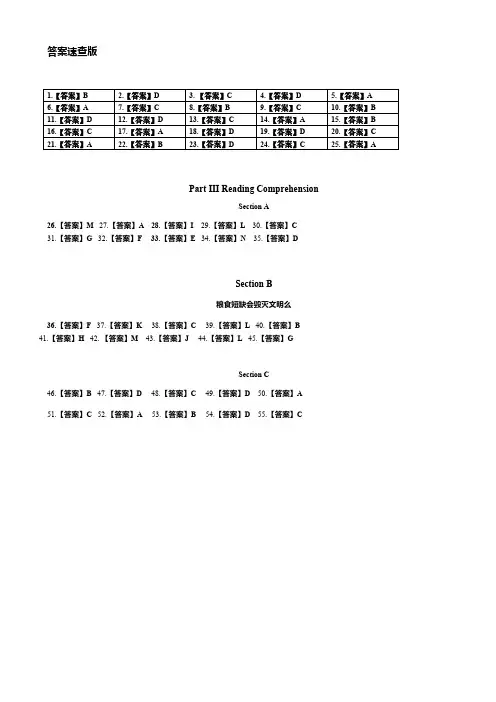
答案速查版Part III Reading ComprehensionSection A26.【答案】M 27.【答案】A 28.【答案】I 29.【答案】L 30.【答案】C31.【答案】G 32.【答案】F 33.【答案】E 34.【答案】N 35.【答案】DSection B粮食短缺会毁灭文明么36.【答案】F 37.【答案】K 38.【答案】C 39.【答案】L 40.【答案】B41.【答案】H 42.【答案】M 43.【答案】J 44.【答案】L 45.【答案】GSection C46.【答案】B 47.【答案】D 48.【答案】C 49.【答案】D 50.【答案】A51.【答案】C 52.【答案】A 53.【答案】B 54.【答案】D 55.【答案】CPart II Listening ComprehensionSection ANews Report One【话题预测】由college students,sleep,problem,stress,psychological等词可推断,本则新闻与大学生睡眠或心理健康有关。
【正确答案】1—2B D听力原文You probably think college students are experts at sleeping,but parties,preparations for tests, personal problems and general stress can wreck a student’s sleep habits,which can be bad for the body and the mind.Texas Tech University is even offering a class called“Improving Your Sleep Habits”.People suffering from sleep loss are at an increased risk from obesity,psychological problems and car crashes.Students who don’t get enough sleep have poor attendance and lower grades.On top of all that,a new study published in the journal Learning and Memory finds you are probably better off sleeping than making last-minute preparations for a test.200college kids were taught to play some unfamiliar video games.Subjects who learned the games in the morning lost some skills when they played again12hours later,but they did much better after getting a good night’s sleep.So if you really want to do your job well,don’t forget to get some sleep. Questions1and2are based on the news report you have just heard.1.What is the news report mainly about?2.What is the finding of the new study published in the journal Learning and Memory?试题解析【话题分类】时事新闻【新闻大意】大学生睡眠不好会严重影响学习效率和身心健康;Texas Tech大学甚至开设课程教授学生改善睡眠习惯,提高睡眠质量;新的一项研究也证明了提高睡眠质量的重要性。
2016年6月大学英语四级考试.真题_第2套.答案解析+听力文本

2016年6月英语四级考试真题(第2套)答案、解析、听力Section A News ReportDirections:In this section,you will hear three news reports. At the end of each news report,you will hear two or three questions. Both the news report and the questions will be spoken only once. After you hear a question,youmust choose the best answer from the four choices marked A),B),C)and D). Then mark the corresponding letter on Answer Sheet 1 with a single line through the centre.Directions: Questions 1 and 2 are based on the news report you have just heard.Question 1A) How college students can improve their sleep habits.B) Why sufficient sleep is important for college students.C) Why college students are more likely to have stress problems.D) How college students can handle their psychological problems.Question 2A) It is not easy to improve one's sleep habits.B) It is not good for students to play video games.C) Students who are better prepared generally get higher scores in examinations.D) Making last-minute preparations for tests may be less effective than sleeping.Directions: Questions 3 and 4 are based on the news report you have just heard.Question 3A) Whether more airports should be built around London.B) Whether adequate investment is being made to improve airport facilities.C) Whether the British Airports Authority should sell off some of its assets.D) Whether the Spanish company could offer better service.Question 4A) Inefficient management.B) Poor ownership structure.C) Lack of innovation and competition.D) Lack of runway and terminal capacity.Directions: Questions 5 to 7 are based on the news report you have just heard.Question 5A) Report the nicotine content of their cigarettes.B) Set a limit to the production of their cigarettes.C) Take steps to reduce nicotine in their products.D) Study the effects of nicotine on young smokers.Question 6A) The biggest increase in nicotine content tended to be in brands young smokers like.B) Big tobacco companies were frank with their customers about the hazards of smoking.C) Brands which contain higher nicotine content were found to be much more popular.D) Tobacco companies refused to discuss the detailed nicotine content of their products. Question 7A) They promised to reduce the nicotine content in cigarettes.B) They have not fully realized the harmful effect of nicotine.C) They were not prepared to comment on the cigarette study.D) They will pay more attention to the quality of their products.Section B ConversationDirections:In this section,you will hear two long conversations. At the end of each conversations you will hear four questions. Both the conversations and the question-s will be spoken only once. After you hear a question. Youmust choose the best answer from the four choices marked A),B),C)and D). Then mark the corresponding letter on Answer Sheet 1 with a single line through the centre.Question 8A) Indonesia.B) Holland.C) Sweden.D) England.Question 9A) Getting a coach who can offer real help.B) Talking with her boyfriend in Dutch.C) Learning a language where it is not spoken.D) Acquiring the necessary ability to socialize.Question 10A) Listening to language programs on the radio.B) Trying to speak it as much as one can.C) Making friends with native speakers.D) Practicing reading aloud as often as possible.Question 11A) It creates an environment for socializing.B) It offers various courses with credit points.C) It trains young people's leadership abilities.D) It provides opportunities for language practice.Directions: Questions 12 to 15 are based on the conversation you have just heard.Question 12A) The impact of engine design on road safety.B) The role policemen play in traffic safety.C) A sense of freedom driving gives.D) Rules and regulations for driving.Question 13A) Make cars with automatic control.B) Make cars that have better brakes.C) Make cars that are less powerful.D) Make cars with higher standards.Question 14A) They tend to drive responsibly.B) They like to go at high speed.C) They keep within speed limits.D) They follow traffic rules closely.Question 15A) It is a bad idea.B) It is not useful.C) It is as effective as speed bumps.D) It should be combined with education.Section C PassagesDirections:In this section,you will hear three passages. At the end of each passage,you will hear three or four questions. Both the passage and the questions will be spoken only once. After you hear a question,you must choosethe best answer from the four choices marked A),B),C)and D).Then mark the corresponding letter on Answer Sheet 1 with a single line through the centre.Directions:Questions 16 to 18 are based on the passage you have just heard.Question 16A) The card got damaged.B) The card was found invalid.C) The card reader failed to do the scanning.D) The card reader broke down unexpectedly.Question 17A) By covering the credit card with a layer of plastic.B) By calling the credit card company for confirmation.C) By seeking help from the card reader maker Verifone.D) By typing the credit card number into the cash register.Question 18A) Affect the sales of high-tech appliances.B) Change the lifestyle of many Americans.C) Give birth to many new technological inventions.D) Produce many low-tech fixes for high-tech failures.Directions: Questions 19 to 21 are based on the passage you have just heard.Question 19A) They are set by the dean of the graduate school.B) They are determined by the advising board.C) They leave much room for improvement.D) They vary among different departments.Question 20A) By consulting the examining committee.B) By reading the Bulletin of Information.C) By contacting the departmental office.D) By visiting the university's website.Question 21A) They specify the number of credits students must earn.B) They are harder to meet than those for undergraduates.C) They have to be approved by the examining committee.D) They are the same among various divisions of the university.Directions: Questions 22 to 25 are based on the passage you have just heard. Question 22A) Students majoring in nutrition.B) Students in health classes.C) Ph.D. candidates in dieting.D) Middle and high school teachers.Question 23A) Its overestimate of the effect of dieting.B) Its mistaken conception of nutrition.C) Its changing criteria for beauty.D) Its overemphasis on thinness.Question 24A) To illustrate her point that beauty is but skin deep.B) To demonstrate the magic effect of dieting on women.C) To explain how computer images can be misleading.D) To prove that technology has impacted our culture.Question 25A) To persuade girls to stop dieting.B) To promote her own concept of beauty.C) To establish an emotional connection with students.D) To help students rid themselves of bad living habits.Keys:参考答案1. B)Why sufficient sleep is important for college students.2. D)Making last-minute preparations for tests may be less effective than sleeping.3. C)Whether the British Airports Authority should sell off some of its assets.4. D)Lack of runway and terminal capacity.5. A)Report the nicotine content of their cigarettes.6. A)The biggest increase in nicotine content tended to be in brands young smokers like.7. C)They were not prepared to comment on the cigarette study.8. B)Holland.9. C)Learning a language where it is not spoken.10. B)Trying to speak it as much as one can.11. D)It provides opportunities for language practice.12. D)Rules and regulations for driving.13. C)Make cars that are less powerful.14. A)They tend to drive responsibly.15. B)It is not useful.16 C)The card reader failed to do the scanning.17 A)By covering the credit card with a layer of plastic.18 D)Produce many low-tech fixes for high-tech failures.19. D)They vary among different departments.20. C)By contacting the departmental office.21. A)They specify the number of credits students must earn.22 B)Students in health classes.23 D)Its overemphasis on thinness.24 C)To explain how computer images can be misleading.25 A)To persuade girls to stop dieting.大学英语四级考试2016年6月第二套真题听力原文及解析Section ANews Item 1You probably think college students are experts at sleeping, but parties, preparations for tests, personal problems and general stress can rack a student's sleep habits, which can be bad for the body and the mind. Texas Tech University is even offering a class called Improving Your Sleep Habits. People suffering from sleep loss are at an increased risk from obesity, psychological problems and car crashes. Students who don't get enough sleep have poor attendance and lower grades. On top of all that, (2)a new study published in the journal Learning and Memory finds you are probably better off sleeping than making last-minute preparations for a test. Two hundred college kids were taught to play some unfamiliar video games. Subjects who learned the games in the morning lost some skills when they played again 12 hours later, (1)but they did much better after getting a good night's sleep. So if you really want to do your job well, don't forget to get some sleep.Questions 1 and 2 are based on the news report you have just heard.What is the news report mainly about?解析:主旨大意题。
2016年6月英语四级真题及答案解析(第二套)
2016年6月英语四级真题第二套(文字版整理)Part I Writing (30 minutes)Directions:For this part, you are allowed 30 minutes to write a letter to express your thanks to one of your school teachers upon entering college. You should write at least 120 words but no more than 180 words.Part III Reading Comprehension (40 minutes)Section ADirections: In this section, there is a passage with ten blanks. You are required to select one word for each blank from a list of choices given in a word bank following the passage.Contrary to popular belief, older people generally do not want to live with their children. Moreover, most adult children _____(26)every bit as much care and support to their aging parents as was the case in the "good old days", and roost older people do not feel _____(27).About 80% of people 65 years and older have living children, and about 90% of them have _____(28)contact with their children. About 75% of elderly parents who don't go to nursing homes live within 30 minutes of at least one of their children.However, _____(29)having contact with children does not guarantee happiness in old age. In fact, some research has found that people who are most involved with their families have the lowest spirits. This research may be _____(30), however, as ill health often makes older people more _____(31)and thereby increases contact with family members. So it is more likely that poor health, not just family involvement, _____(32)spirits.Increasingly, researchers have begun to look at the quality of relationships, rather than at the frequency of contact, between the elderly and their children. If parents and children share interests and values and agree on childrearing practices and religious _____(33)they are likely to enjoy each other's company. Disagreements on such matters can _____(34)cause problems. If parents are angered by their daughter's divorce, dislike her new husband, and disapprove of how she is raising their grandchildren, _____(35)are that they are not going to enjoy her visits.A.abandonedB.advancedC.biasedD.chancesmitmentF.dampensG.dependentH.distantI.frequentJ.fulfillmentK.grantL.merelyM.provideN.understandablyO.unrealisticallySection BDirections: In this section, you are going to read a passage with ten statements attached to it. Each statement contains information given in one of the paragraphs. Identify the paragraph from which the information is derived. You may choose a paragraph more than once. Each paragraph is marked with a letter. Answer the questions by marking the corresponding letter on Answer Sheet 2.Could Food Shortages Bring Down Civilization?[A] For many years I have studied global agricultural, population, environmental and economic trends and their interactions. The combined effects of those trends and the political tensions they generate point to the breakdown of governments and societies. Yet I, too, have resisted the idea that food shortages could bring down not only individual governments but also our global civilization.[B] I can no longer ignore that risk. Our continuing failure to deal with the environmental declines that are undermining the world food economy forces me to conclude that such a collapse is possible.[C] As demand for food rises faster than supplies are growing, the resulting food-price inflation puts severe stress on the governments of many countries. Unable to buy grain or grow their own, hungry people take to the streets. Indeed, even before the steep climb in grain prices in 2008, the number of failing states was expanding. If the food situation continues to worsen, entire nations will break down at an ever increasing rate. In the 20th century the main threat to international security was superpower conflict; today it is failing states.[D] States fail when national governments can no longer provide personal security, food security and basic social services such as education and health care. When governments lose their control on power, law and order begin to disintegrate. After a point, countries can become so dangerous that food relief workers are no longer safe and their programs are halted. Failing states are of international concern because they are a source of terrorists, drugs, weapons and refugees(难民), threatening political stability everywhere.[E] The surge in world grain prices in 2007 and 2008—and the threat they pose to food security——has a different, more troubling quality than the increases of the past. During the second of the 20th century, grain prices rose dramatically several times. In 1972, for instance, the Soviets. I recognizing their poor harvest early, quietly cornered the world wheat market. As a result, wheat prices elsewhere more than doubled, pulling rice and com prices up with them. But this and other price shocks were event-driven——drought in the Soviet Union, crop-shrinking heat in the U.S. Corn Belt. And the rises were short-lived: prices typically returned to normal with the next harvest.[F]In contrast, recent surge in world grain prices is trend-driven, making it unlikely to reverse without a reversal in the trends themselves. On the demand side, those trends include the ongoing addition of more than 70 million people a year, a growing number of people wanting to move up the food chain to consume highlygrain-intensive meat products, and the massive diversion(转向)of U.S. grain to the production of bio-fuel.[G]As incomes rise among low-income consumers, the potential for further grain consumption is huge. But that potential pales beside the never-ending demand for crop-based fuels. A fourth of this year's U.S. grain harvest will go to fuel cars.[H]What about supply? The three environmental trends——the shortage of fresh water, the loss of topsoil and the rising temperatures——are making it increasingly hard to expand the world's grain supply fast enough to keep up with demand. Of all those trends, however, the spread of water shortages poses the most immediate threat. The biggest challenge here is irrigation, which consumes 70% the world's fresh water. Millions of irrigation wells in many countries are now pumping water out of underground sources faster than rainfall can refill them. The result is falling water tables(地下水位)in countries with half the world's people, including the three big grain producers——China, India and the U.S.[I]As water tables have fallen and irrigation wells have gone dry, China's wheat crop, the world's largest, has declined by 8% since it peaked at 123 million tons in 1997. But water shortages are even more worrying in India. Millions of irrigation wells have significantly lowered water tables in almost every state.[J]As the world's food security falls to pieces, individual countries acting in their own self-interest are actually worsening the troubles of many. The trend began in 2007, when leading wheat-exporting countries such as Russia and Argentina limited or banned their exports, in hopes of increasing local food supplies and thereby bringing down domestic food prices. Vietnam banned its exports for several months for the same reason. Such moves may eliminate the fears of those living in the exporting countries, but they are creating panic in importing countries that must rely on what is then left for export.[K]In response to those restrictions, grain-importing countries are trying to nail down long-term trade agreements that would lock up future grain supplies. Food-import anxiety is even leading to new efforts by food-importing countries to buy or lease farmland in other countries. In spite of such temporary measures, soaring food prices and spreading hunger in many other countries are beginning to break down the social order.[L]Since the current world food shortage is trend-driven, the environmental trends that cause it must be reversed. We must cut carbon emissions by 80% from their 2006 levels by 2020, stabilize the world's population at eight billion by 2040, completely remove poverty, and restore forests and soils. There is nothing new about the four objectives. Indeed, we have made substantial progress in some parts of the world on at least one of these——the distribution of family-planning services and the associated shift to smaller families.[M]For many in the development community, the four objectives were seen as positive, promoting development as long as they did not cost too much. Others saw them as politically correct and morally appropriate. Now a third and far more significant motivation presents itself: meeting these goals may necessary to prevent the collapse of our civilization. Yet the cost we project for saving civilizationwould amount to less than $200 billion a year, 1/6 of current global military spending. In effect, our plan is the new security budget.36.The more recent steep climb in grain prices partly results from the fact that more and more people want to consume meat products.37.Social order is breaking down in many countries because of food shortages.38.Rather than superpower conflict, countries unable to cope with food shortages now constitute the main threat to world security.39.Some parts of the world have seen successful implementation of family planning.40.The author has come to agree that food shortages could ultimately lead to the collapse of world civilization.41.Increasing water shortages prove to be the biggest obstante to boosting the world's grain production.42.The cost for saving our civilization would be considerably less than the world's current military spending.43.To lower domestic food prices, some countries limited or stopped their grain exports.44.Environmental problems must be solved to case the current global food shortage.45.A quarter of this year's American grain harvest will be used to produce bio-fuel for cars.Section CPassage OneQuestions 46 to 50 are based on the following passage.Declining mental function is often seen as a problem of old age,but certain aspects of brain function actually begin their decline in young adulthood, a new study suggests.The study, which followed more than 2,000 healthy adults between the ages of 18 and 60, found that certain mental functions—including measures of abstract reasoning, mental speed and puzzle-solving—started to dull as early as age 27.Dips in memory, meanwhile, generally became apparent around age 37.On the other hand, indicators of a person’s accumulated knowledge—like performance on tests of vocabulary and general knowledge—kept improving with age, according to findings published in the journal Neurobiology of Aging.The results do not mean that young adults need to start worrying about their memories. Most people’s minds function at a high level even in their later years, according to researcher Timothy Salthouse."These patterns suggest that some types of mental flexibility decrease relatively early in adulthood, but that the amount of knowledge one has, and the effectiveness of integrating it with one’s abilities,may increase throughout all of adulthood if there are no dispases," Salthouse said in a news release.The study included healthy, educated adults who took standard tests of memory, reasoning and perception at the outset and at some point over the next seven years.The tests are designed to detect subtle (细微的)changes in mental function, and involve solving Puzzles, recalling words and details from stories, and identifying patterns in collections of letters and symbols.In general, Salthouse and his colleagues found, certain aspects of cognition (认知能力)generally started to decline in the late 20s to 30s.The findings shed light on normal age-related changes in mental function, which could aid in understanding the process of dementia(痴呆),according to the researchers.“By following individuals over time,” Salthouse said, "we gain insight in cognition changes, and may possibly discover ways to slow the rate of decline.”The researchers are currently analyzing, the study participants' health and lifestyle to see which factors might influence age-related cognitive changes.46.What is the common view of mental function?A.It varies from person to person.C.It gradually expands with age.B.It weakens in one’s later years.D.It indicates one’s health condition.47.What does the new study find about mental functions?A.Some diseases inevitably lead to their decline.B.They reach a peak at the age of 20 for most people.C.They are closely related to physical' and mental exercise.D.Some of them begin to decline when people are still young.48.What does Timothy Salthouse say about people's minds in most cases?A.They tend to decline in people’s later years.B.Their flexibility determines one’s abilities.C.They function quite well even in old age.D.Their functioning is still a puzzle to be solved.49.Although people’s minds may function less flexibly as they age, they_____.A.may be better at solving puzzlesB.can memorize things with more easeC.may have greater facility in abstract reasoningD.can put what they have learnt into more effective use50.According to Salthouse, their study may help us_____.A.find ways to slow down our mental decline6.find ways to boost our memoriesC.understand the complex process of mental functioningD.understand the relation between physical and mental healthPassage TwoQuestions 51 to 55 are based on the following passage.The most important thing in the news last week was the rising discussion in Nashville about the educational needs of children. The shorthand(简写)educators use for this is "pre-K"—meaning instruction before kindergarten—and the big idea is to prepare 4-year-olds and even younger kids to be ready to succeed on their K-12 journey.But it gets complicated. The concept has multiple forms, and scholars and policymakers argue about the shape, scope and cost of the ideal program.The federal Head Start program, launched 50 years ago, has served more than 30million children. It was based on concepts developed at Vanderbilt University's Peabody College by Susan Gray, the legendary pioneer in early childhood education research.A new Peabody study of the Tennessee Voluntary Pre-K program reports that pre-K works, but the gains are not sustained through the third grade. It seems to me this highlights quality issues in elementary schools more than pre-K, and indicates longer-term success must connect pre-K with all the other issues, related to educating a child.Pre-K is controversial. Some critics say it is a luxury and shouldn't be free to families able to pay. Pre-K advocates insist it is proven and will succeed if integrated with the rest of the child's schooling. I lean toward the latter view.This is, in any case, the right conversation to be having now as Mayor Megan Barry takes office. She was the first candidate to speak out for strong pre-K programming. The important thing is for all of us to keep in mind the real goal and the longer, bigger picture.The weight of the evidence is on the side of pre-K that early intervention (干预)works. What government has not yet found is the political will to put that understanding into full practice with a sequence of smart schooling that provides the early foundation.For this purpose, our schools need both the talent and the organization to educate each child who arrives at the schoolhouse door. Some show up ready, but many do not at this critical time when young brains are developing rapidly.51.What does the author say about pre-kindergarten education?A.It should cater to the needs of individual children.B.It is essential to a person's future academic success.C.Scholars and policymakers have different opinions about it.D.Parents regard it as the first phase of children's development.52.What does the new Peabody study find?A.Pre-K achievements usually do not last long.B.The third grade marks a new phase of learning.C.The third grade is critical to children's development.D.Quality has not been the top concern of pre-K programs.53.When does the author think pre-K works the best?A.When it is accessible to kids of all families.B.When it is made part of kids' education.C.When it is no longer considered a luxury.D.When it is made fun and enjoyable to kids.54.What do we learn about Mayor Megan Barry?A.She knows the real goal of education.B.She is a mayor of insight and vision.C.She has once run a pre-K program.D.She is a firm supporter of pre-K.55.What does the author think is critical to kids' education?A.Teaching method.B.Kids' interest.C.Early intervention.D.Parents' involvement.Part IV Translation (30 minutes)Directions: For this part, you are allowed 30 minutes to translate a passage from Chinese into English。
2016年6月大学英语四级考试真题、听力原文及参考答案(第2套)
2016年6月大学英语四级考试真题(第2套)Part I Writing (30 minutes)Directions:For this part, you are allowed 30 minutes to write a letter to express your thanks to your parents or any other family member upon making a memorable achievement. You should write at least 120 words but no more than 180 words.Part II Listening Comprehension (25 minutes)Section ADirections:In this section, you will hear three news reports. At the end of each news report, you will hear two or three questions. Both the news report and the questions will be spoken only once. After you hear a question, you must choose the best answer from the four choices marked A), B), C) and D). Then mark the corresponding letter on Answer Sheet 1 with a single line through the centre.Questions 1 and 2 are based on the news report you have just heard.1. A) The International Labour Organization's key objective.B) The basic social protection for the most vulnerable.C) Rising unemployment worldwide.D) Global economic recovery.2. A) Many countries have not taken measures to create enough jobs.B) Few countries know how to address the current economic crisis.C) Few countries have realised the seriousness of the current crisis.D) Many countries need support to improve their people's livelihood.Questions 3 and 4 are based on the news report you have just heard.3. A) Serve standardised food nationwide.C) Increase protein content in the food.B) Put calorie information on the menu.D) Offer convenient food to customers.4. A) They will be fined. C) They will get a warning.B) They will be closed.D) They will lose customers.Questions 5 to 7 are based on the news report you have just heard.5. A) Inability to implement their business plans.B) Inability to keep turning out novel products.C) Lack of a successful business model of their own.D) Failure to integrate innovation into their business.6. A) It is the secret to business success. C) It is a magic tool to bring big rewards.B) It is the creation of something new.D) It is an essential part of business culture.7. A) Its hardworking employees. C) Its innovation culture.B) Its flexible promotion strategy. D) Its willingness to make investments.Section BDirections:In this section, you will hear two long conversations. At the end of each conversation, you will hear four questions. Both the conversation and the questions will be spoken only once. After you hear a question, you must choose the best answer from the four choices marked A), B), C) and D). Then mark the corresponding letter on Answer Sheet 1 with a single line through the centre.Questions 8 to 11 are based on the conversation you have just heard.8. A) He's got addicted to technology. C) He is crazy about text-messaging.B) He is not very good at socializing.D) He does not talk long on the phone.9. A) Talk big.C) Gossip a lot.B) Talk at length. D) Forget herself.10. A) He thought it was cool. C) He wanted to stay connected with them.B) He needed the practice.D) He had an urgent message to send.11. A) It poses a challenge to seniors. C) It is childish and unprofessional.B) It saves both time and money. D) It is cool and convenient.Questions 12 to 15 are based on the conversation you have just heard.12. A) He wants to change his job assignment.B) He is unhappy with his department manager.C) He thinks he deserves extra pay for overtime.D) He is often singled out for criticism by his boss.13. A) His workload was much too heavy. C) His colleagues often refused to cooperate.B) His immediate boss did not trust him. D) His salary was too low for his responsibility.14. A) He never knows how to refuse.C) His boss has a lot of trust in him.B) He is always ready to help others.D) His boss has no sense of fairness.15. A) Put all his complaints in writing. C) Learn to say no when necessary.B) Wait and see what happens next.D) Talk to his boss in person first.Section CDirections: In this section, you will hear three passages. At the end of each passage, you will hear three or four questions. Both the passage and the questions will be spoken only once. After you hear a question, you must choose the best answer from the four choices marked A), B), C) and D). Then mark the corresponding letter on Answer Sheet 1 with a single line through the centre.Questions 16 to 18 are based on the passage you have just heard.16. A) The importance of sleep to a healthy life.B) Reasons for Americans' decline in sleep.C) Some tips to improve the quality of sleep.D) Diseases associated with lack of sleep.17. A) They are more health-conscious. C) They get less and less sleep.B) They are changing their living habits. D) They know the dangers of lack of sleep.18. A) Their weight will go down. C) Their work efficiency will decrease.B) Their mind function will deteriorate.D) Their blood pressure will rise.Questions 19 to 21 are based on the passage you have just heard.19. A) How much you can afford to pay.B) What course you are going to choose.C) Which university you are going to apply to.D) When you are going to submit your application.20. A) The list of courses studied.C) The references from teachers.B) The full record of scores. D) The personal statement.21. A) Specify what they would like to do after graduation.B) Describe in detail how much they would enjoy studying.C) Indicate they have reflected and thought about the subject.D) Emphasize that they admire the professors in the university.Questions 22 to 25 are based on the passage you have just heard.22. A) It was equipped with rubber tyres.C) It was purchased by the Royal family.B) It was built in the late 19th century.D) It was designed by an English engineer.23. A) They consumed lots of petrol. C) They were difficult to drive.B) They took two passengers only.D) They often broke down.24. A) They were produced on the assembly line. C) They were modeled after British cars.B) They were built with less costly materials. D) They were made for ordinary use.25. A) It made news all over the world. C) It marked a new era in motor travel.B) It was built for the Royal family. D) It attracted large numbers of motorists.Part III Reading Comprehension (40 minutes)Section ADirections:In this section, there is a passage with ten blanks. You are required to select one word for each blank from a list of choices given in a word bank following the passage. Read the passage through carefully before making your choices. Each choice in the bank is identified by a letter Please mark the corresponding letter for each item on Answer Sheet 2 with a single line through the centre. You may not use any of the words in the bank more than once.Contrary to popular belief, older people generally do not want to live with their children. Moreover, most adult children 26 every bit as much care and support to their aging parents as was the case in the "good old days", and most older people do not feel 27 .About 80% of people 65 years and older have living children, and about 90% of them have28 contact with their children. About 75% of elderly parents who don't go to nursing homes live within 30 minutes of at least one of their children.However, 29 having contact with children does not guarantee happiness in old age. In fact, some research has found that people who are most involved with their families have the lowest spirits. This research may be 30 , however, as ill health often makes older people more 31 and thereby increases contact with family members. So it is more likely that poor health, not just family involvement, 32 spirits.Increasingly, researchers have begun to look at the quality of relationships, rather than at the frequency of contact, between the elderly and their children. If parents and children share interests and values and agree on childrearing practices and religious 33 , they are likely to enjoy each other's company. Disagreements on such matters can 34 cause problems. If parents are angered by their daughter's divorce, dislike her new husband, and disapprove of how she is raisingSection BDirections:In this section, you are going to read a passage with ten statements attached to it. Each statement contains information given in one of the paragraphs. Identify the paragraph from which the information is derived. You may choose a paragraph more than once. Each paragraph is marked with a letter Answer the questions by marking the corresponding letter on Answer Sheet 2.Could Food Shortages Bring Down Civilization?A) For many years I have studied global agricultural, population, environmental and economic trends and their interactions. The combined effects of those trends and the political tensions they generate point to the breakdown of governments and societies. Yet I, too, have resisted the idea that food shortages could bring down not only individual governments but also our global civilization.B) I can no longer ignore that risk. Our continuing failure to deal with the environmental declines that are undermining the world food economy forces me to conclude that such a collapse is possible.C) As demand for food rises faster than supplies are growing, the resulting food-price inflation puts severe stress on the governments of many countries. Unable to buy grain or grow their own, hungry people take to the streets. Indeed, even before the steep climb in grain prices in 2008, the number of failing states was expanding. If the food situation continues to worsen, entire nations will break down at an ever increasing rate. In the 20th century the main threat to international security was superpower conflict; today it is failing states.D) States fail when national governments can no longer provide personal security, food security and basic social services such as education and health care. When governments lose their control on power, law and order begin to disintegrate. After a point, countries can become so dangerous that food relief workers are no longer safe and their programs are halted. Failing states are of international concern because they are a source of terrorists, drugs, weapons and refugees (难民) threatening political stability everywhere.E) The surge in world grain prices in 2007 and 2008 --and the threat they pose to food security -- has a different, more troubling quality than the increases of the past. During the second half of the 20th century, grain prices rose dramatically several times. In 1972, for instance, the Soviets, recognizing their poor harvest early, quietly cornered the world wheat market. As a result, wheat prices elsewhere more than doubled, pulling rice and corn prices up with them. But this and other price shocks were event-driven -- drought in the Soviet Union, crop-shrinking heat in the U.S. Corn Belt. And the rises were short-lived: prices typically returned to normal with the next harvest.F) In contrast, the recent surge in world grain prices is trend-driven, making it unlikely to reverse without a reversal in the trends themselves. On the demand side, those trends include the ongoing addition of more than 70 million people a year, a growing number of people wanting to move up the food chain to consume highly grain-intensive meat products, and the massive diversion (转向) of U.S. grain to the production of bio-fuel.G) As incomes rise among low-income consumers, the potential for further grain consumption is huge. But that potential pales beside the never-ending demand for crop-based fuels.A fourth of this year's U.S. grain harvest will go to fuel cars.H) What about supply? The three environmental trends -- the shortage of fresh water, the loss of topsoil and the rising temperatures -- are making it increasingly hard to expand the world's grain supply fast enough to keep up with demand. Of all those trends, however, the spread of water shortages poses the most immediate threat. The biggest challenge here is irrigation, which consumes 70% of the world's fresh water. Millions of irrigation wells in many countries are now pumping water out of underground sources faster than rainfall can refill them. The result is falling water tables (地下水位) in countries with half the world's people, including the three big grain producers -- China, India and the U.S.I) As water tables have fallen and irrigation wells have gone dry, China's wheat crop, the world's largest, has declined by 8% since it peaked at 123 million tons in 1997. But water shortages are even more worrying in India. Millions of irrigation wells have significantly lowered water tables in almost every state.J) As the world's food security falls to pieces, individual countries acting in their own self-interest are actually worsening the troubles of many. The trend began in 2007, when leading wheat-exporting countries such as Russia and Argentina limited or banned their exports, in hopes of increasing local food supplies and thereby bringing down domestic food prices. Vietnam banned its exports for several months for the same reason. Such moves may eliminate the fears of those living in the exporting countries, but they are creating panic in importing countries that must rely on what is then left for export.K) In response to those restrictions, grain-importing countries are trying to nail down long-term trade agreements that would lock up future grain supplies. Food-import anxiety is evenleading to new efforts by food-importing countries to buy or lease farmland in other countries. In spite of such temporary measures, soaring food prices and spreading hunger in many other countries are beginning to break down the social order.L) Since the current world food shortage is trend-driven, the environmental trends that cause it must be reversed. We must cut carbon emissions by 80% from their 2006 levels by 2020, stabilize the world's population at eight billion by 2040, completely remove poverty, and restore forests and soils. There is nothing new about the four objectives. Indeed, we have made substantial progress in some parts of the world on at least one of these -- the distribution of family-planning services and the associated shift to smaller families.M) For many in the development community, the four objectives were seen as positive, promoting development as long as they did not cost too much. Others saw them as politically correct and morally appropriate. Now a third and far more significant motivation presents itself: meeting these goals may be necessary to prevent the collapse of our civilization. Yet the cost we project for saving civilization would amount to less than $200 billion a year, 1/6 of current global military spending. In effect, our plan is the new security budget.36. The more recent steep climb in grain prices partly results from the fact that more and more people want to consume meat products.37. Social order is breaking down in many countries because of food shortages.38. Rather than superpower conflict, countries unable to cope with food shortages now constitute the main threat to world security.39. Some parts of the world have seen successful implementation of family planning.40. The author has come to agree that food shortages could ultimately lead to the collapse of world civilization.41. Increasing water shortages prove to be the biggest obstacle to boosting the world's grain production.42. The cost for saving our civilization would be considerably less than the world's current military spending.43. To lower domestic food prices, some countries limited or stopped their grain exports.44. Environmental problems must be solved to ease the current global food shortage.45. A quarter of this year's American grain harvest will be used to produce bio-fuel for cars.Section CDirections:There are 2 passages in this section. Each passage is followed by some questions or unfinished statements. For each of them there are four choices marked A), B), C) and D). You should decide on the best choice and mark the corresponding letter on Answer Sheet 2with a single line through the centre.Passage OneQuestions 46 to 50 are based on the following passage.Declining mental function is often seen as a problem of old age, but certain aspects of brain function actually begin their decline in young adulthood, a new study suggests.The study, which followed more than 2,000 healthy adults between the ages of 18 and 60, found that certain mental functions -- including measures of abstract reasoning, mental speed and puzzle-solving -- started to dull as early as age 27.Dips in memory, meanwhile, generally became apparent around age 37.On the other hand, indicators of a person's accumulated knowledge -- like performance on tests of vocabulary and general knowledge --kept improving with age, according to findings published in the journal Neurobiology of Aging.The results do not mean that young adults need to start worrying about their memories. Most people's minds function at a high level even in their later years, according to researcher Timothy Salthouse."These patterns suggest that some types of mental flexibility decrease relatively early in adulthood, but that the amount of knowledge one has, and the effectiveness of integrating it with one's abilities, may increase throughout all of adulthood if there are no diseases," Salthouse said in a news release.The study included healthy, educated adults who took standard tests of memory, reasoning and perception at the outset and at some point over the next seven years.The tests are designed to detect subtle(细微的) changes in mental function, and involve solving puzzles, recalling words and details from stories, and identifying patterns in collections of letters and symbols.In general, Salthouse and his colleagues found, certain aspects of cognition(认知能力) generally started to decline in the late 20s to 30s.The findings shed light on normal age-related changes in mental function, which could aid in understanding the process of dementia (痴呆), according to the researchers."By following individuals over time," Salthouse said, "we gain insight in cognition changes, and may possibly discover ways to slow the rate of decline."The researchers are currently analyzing the study participants' health and lifestyle to see which factors might influence age-related cognitive changes.46. What is the common view of mental function?A) It varies from person to person.C) It gradually expands with age.B) It weakens in one's later years.D) It indicates one's health condition.47. What does the new study find about mental functions?A) Some diseases inevitably lead to their decline.B) They reach a peak at the age of 20 for most people.C) They are closely related to physical and mental exercise.D) Some of them begin to decline when people are still young.48. What does Timothy Salthouse say about people's minds in most cases?A) They tend to decline in people's later years.B) Their flexibility determines one's abilities.C) They function quite well even in old age.D) Their functioning is still a puzzle to be solved.49. Although people's minds may function less flexibly as they age, theyA) may be better at solving puzzlesB) can memorize things with more easeC) may have greater facility in abstract reasoningD) can put what they have learnt into more effective use50. According to Salthouse, their study may help us ________.A) find ways to slow down our mental declineB) find ways to boost our memoriesC) understand the complex process of mental functioningD) understand the relation between physical and mental healthPassage TwoQuestions 51 to 55 are based on the following passage.The most important thing in the news last week was the rising discussion in Nashville about the educational needs of children. The shorthand(简写) educators use for this is "pre-K" --meaning instruction before kindergarten --and the big idea is to prepare 4-year-olds and even younger kids to be ready to succeed on their K-12 journey.But it gets complicated. The concept has multiple forms, and scholars and policymakers argue about the shape, scope and cost of the ideal program.The federal Head Start program, launched 50 years ago, has served more than 30 million children. It was based on concepts developed at Vanderbilt University's Peabody College by Susan Gray, the legendary pioneer in early childhood education research.A new Peabody study of the Tennessee V oluntary Pre-K program reports that pre-K works, but the gains are not sustained through the third grade. It seems to me this highlights quality issues in elementary schools more than pre-K, and indicates longer-term success must connect pre-K with all the other issues related to educating a child.Pre-K is controversial. Some critics say it is a luxury and shouldn't be free to families able to pay. Pre-K advocates insist it is proven and will succeed if integrated with the rest of the child's schooling. I lean toward the latter view.This is, in any case, the right conversation to be having now as Mayor Megan Barry takes office. She was the first candidate to speak out for strong pre-K programming. The important thing is for all of us to keep in mind the real goal and the longer, bigger picture.The weight of the evidence is on the side of pre-K that early intervention (干预) works. What government has not yet found is the political will to put that understanding into full practice with a sequence of smart schooling that provides the early foundation.For this purpose, our schools need both the talent and the organization to educate each child who arrives at the schoolhouse door. Some show up ready, but many do not at this critical time when young brains are developing rapidly.51. What does the author say about pre-kindergarten education?A) It should cater to the needs of individual children.B) It is essential to a person's future academic success.C) Scholars and policymakers have different opinions about it.D) Parents regard it as the first phase of children's development.52. What does the new Peabody study find?A) Pre-K achievements usually do not last long.B) The third grade marks a new phase of learning.C) The third grade is critical to children's development.D) Quality has not been the top concern of pre-K programs,53. When does the author think pre-K works the best?A) When it is accessible to kids of all families.B) When it is made part of kids' education.C) When it is no longer considered a luxury.D) When it is made fun and enjoyable to kids.54. What do we learn about Mayor Megan Barry?A) She knows the real goal of education.C) She has once run a pre-K program.B) She is a mayor of insight and vision. D) She is a firm supporter of pre-K.55. What does the author think is critical to kids' education?A) Teaching method. C) Early intervention.B) Kids' interest. D) Parents' involvement.Part IV Translation (30 minutes)Directions: For this part you are allowed 30 minutes to translate a passage from Chinese into English. You should write your answer on Answer Sheet 2.功夫(Kung Fu)是中国武术(martial arts)的俗称。
2016年6月大学英语四级考试真题第二套
2016年6月大学英语四级考试真题第二套全文共3篇示例,供读者参考篇12016年6月大学英语四级考试真题第二套Part I Writing (30 minutes)Directions: For this part, you are allowed 30 minutes to write a composition on the topic: The Importance of Education. You should write at least 120 words following the outline given below in Chinese:1. 教育的重要性;2. 你对教育的态度;3. 你的看法。
The Importance of EducationEducation plays a crucial role in shaping individuals as well as societies. It is widely acknowledged that education is the key to success and personal growth. With the rapid development of technology and globalization, the importance of education has become more prominent than ever.In my opinion, education is not only about acquiring knowledge but also about developing critical thinking, problem-solving skills, and the ability to adapt to new situations.A well-rounded education helps individuals to become better citizens and contribute positively to their communities. Education also opens doors to new opportunities and improves one's chances of professional success.I believe that everyone should have access to quality education regardless of their background or socioeconomic status. Education should be seen as a fundamental human right and governments should invest more resources in improving educational systems and making education more accessible to all. Only by providing equal educational opportunities to everyone can we ensure a more just and prosperous society.In conclusion, education is essential for individual growth, societal progress, and global development. It is the foundation of a successful and fulfilling life. We should all recognize the importance of education and strive to promote education for all.篇22016年6月大学英语四级考试真题第二套Part I Writing (30 minutes)Directions: For this part, you are allowed 30 minutes to write a short essay on the topic of Due to increasing popularity of online shopping, many stores have closed and many people will be out of work. Some people think the trend has brought negative impacts on the society, while others consider it positive. You are supposed to write at least 150 words but no more than 200 words.Online Shopping: Negative or Positive Impact on Society?The rise of online shopping has revolutionized the way we shop and has brought about both positive and negative impacts on society. While some believe that online shopping has resulted in many stores closing down and people losing their jobs, others argue that it has created new job opportunities and made shopping more convenient for consumers.On the negative side, the increasing popularity of online shopping has led to the closure of many brick-and-mortar stores, especially small businesses. This has resulted in job losses for many people who worked in these stores, contributing to unemployment rates in certain areas. Additionally, the lack of face-to-face interaction in online shopping may lead to a decline in social connections and community bonds.However, on the positive side, online shopping has created new job opportunities in e-commerce, logistics, and customer service. The convenience of shopping online has also made it easier for consumers to compare prices, read reviews, and make purchases from the comfort of their own homes. This has benefited many people, especially those with busy schedules or limited access to physical stores.In conclusion, while online shopping has brought about some negative impacts on society, such as store closures and job losses, it has also had many positive effects, such as creating new job opportunities and making shopping more convenient for consumers. It is important for society to adapt to these changes and find ways to minimize the negative impacts while maximizing the benefits of online shopping.篇3In June 2016, the second set of the College English Test Level 4 (CET-4) was administered to students across China. This exam is a crucial milestone for Chinese students as it assesses their proficiency in English and is a requirement for graduation from many universities. As such, the CET-4 exam is a source of stress and anxiety for many students who spend months preparing for it.The second set of the exam in June 2016 consisted of four sections: listening, reading, writing, and translation. The listening section tested students' ability to understand spoken English, while the reading section evaluated their comprehension of written English. The writing section required students to write a short essay on a given topic, and the translation section tested their ability to translate English sentences into Chinese.One of the most challenging aspects of the CET-4 exam is the time constraint. Students must answer a large number of questions within a limited amount of time, which can be difficult for those who struggle with time management. Additionally, the exam covers a wide range of topics, from science and technology to arts and culture, which requires students to have a broad knowledge base.Overall, the CET-4 exam is a rigorous test that requires students to demonstrate their English skills in a variety of areas. It is a challenging but important milestone for Chinese students as they strive to improve their English proficiency and expand their academic and career opportunities.。
2016年6月大学英语四级考试真题(第2套)
2016年6月大学英语四级考试真题(第2套)2016年6月大学英语四级考试真题(第2套)Part I WritingDirections:For this part,you are allowed30minutes to write a letter to express your thanks to one of your school teachers upon entering college.You should write at least120words but no more than180words.PartⅡListening ComprehensionSection ADirections:In this section,you will hear three news reports. At the end of each news report,you will hear two or three questions.Both the news report and the questions will be spoken only once.After you hear a question,you must choose the best answer from the four choices marked A),B),C)and D).Then mark the corresponding letter on Answer Sheet1with a single line through the centre.Questions1and2are based on the news report you have just heard.1.A)How college students can improve their sleep habits.B)Why sufficient sleep is important for college students.C)Why college students are more likely to have stress problems.D)How college students can handle their psychological problems.2.A)It is not easy to improve one’s sleep habits.B)It is not good for students to play video games.C)Students who are better prepared generally get higher scores in examinations.D)Making last-minute preparations for tests may be lesseffective than sleeping.Questions3and4are based on the news report you have just heard.3.A)Whether more airports should be built around London.B)Whether adequate investment is being made to improve airport facilities.C)Whether the British Airports Authority should sell off some of its assets.D)Whether the Spanish company could offer better service.4.A)Inefficient management.B)Poor ownership structure.C)Lack of innovation and competition.D)Lack of runway and terminal capacity.Questions5to7are based on the news report you have just heard.5.A)Report the nicotine content of their cigarettes.B)Set a limit to the production of their cigarettes.C)Take steps to reduce nicotine in their products.D)Study the effects of nicotine on young smokers.6.A)The biggest increase in nicotine content tended to be in brands young smokers like.B)Big tobacco companies were frank with their customers about the hazards of smoking.C)Brands which contain higher nicotine content were found to be much more popular.D)Tobacco companies refused to discuss the detailed nicotine content of their products.7.A)They promised to reduce the nicotine content in cigarettes.B)They have not fully realized the harmful effect of nicotine.C)They were not prepared to comment on the cigarette study.D)They will pay more attention to the quality of their products.Section BDirections:In this section,you will hear two long conversations.At the end of each conversation,you will hear four questions.Both the conversation and the questions will be spoken only once.After you hear a question,you must choose the best answer from the four choices marked A),B),C)and D). Then mark the corresponding letter on Answer Sheet1with a single line through the centre.Questions8to11are based on the conversation you have just heard.8.A)Indonesia.B)Holland.C)Sweden.D)England.9.A)Getting a coach who can offer real help.B)Talking with her boyfriend in Dutch.C)Learning a language where it is not spoken.D)Acquiring the necessary ability to socialize.10.A)Listening language programs on the radio.B)Trying to speak it as much as one can.C)Making friends with native speakers.D)Practicingreading aloud as often as possible.11.A)It creates an environment for socializing.B)It offers various courses with credit points.C)It trains young people’s leadership abilities.D)It provides opportunities for language practice. Questions12to15are based on the conversation you have just heard.12.A)The impact of engine design on rode safety.B)The role policemen play in traffic safety.C)A sense of freedom driving gives.D)Rules and regulations for driving.13.A)Make cars with automatic control.B)Make cars that have better brakes.C)Make cars that are less powerful.D)Make cars with higher standards.14.A)They tend to drive responsibly.B)They like to go at high speed.C)They keep within speed limits.D)They follow traffic rules closely.15.A)It is a bad idea.B)It is not useful.C)It is as effective as speed bumps.D)It should be combined with education.Section CDirections:In this section,you will hear three passages.At the end of each passage,you will hear three or four questions. Both the passage and the questions will be spoken only once. After you hear a question,you must choose the best answer from the four choices marked A),B),C)and D).Then mark the corresponding letter on Answer Sheet1with a single line through the centre.Questions16to18are based on the passage you have just heard.16.A)The card got damaged.B)The card was found invalid.C)The card reader failed to do the scanning.D)The card reader broke down unexpectedly.17.A)By converting the credit card with a layer of plastic.B)By calling the credit card company for confirmation.C)By seeking help from the card reader maker Verifone.D)By typing the credit card number into the cash register.18.A)Affect the sales of high-tech appliances.B)Change the life style of many Americans.C)Give birth to many new technological inventions.D)Produce many low-tech fixes for high-tech failures. Questions19to21are based on the passage you have just heard.19.A)They are set by the dean of the graduate school.B)They are determined by the advising board.C)They leave much room for improvement.D)They vary among different departments.20.A)By consulting the examining committee.B)By reading the Bulletin of Information.C)By contacting the departmental office.D)By visiting the university’s website.21.A)They specify the number of credits students must earn.B)They are harder to meet than those for undergraduates.C)They have to be approved by the examining committee.D)They are the same among various divisions of the university.Questions22to25are based on the passage you have just heard.22.A)Students majoring in nutrition.B)Students in health classes.C)Ph.D.candidates in dieting.D)Middle and high school teachers.23.A)Its overestimate of the effect of dieting.B)Its mistaken conception of nutrition.C)Its changing criteria for beauty.D)Its overemphasis on thinness.24.A)T o illustrate her point that beauty is but skin deep.B)To demonstrate the magic effect of dieting on women.C)To explain how computer images can be misleading.D)To prove that technology has impacted our culture.25.A)T o persuade girls to stop dieting.B)To promote her own concept of beauty.C)To establish an emotional connection with students.D)To help students rid themselves of bad living habits.Part III Reading ComprehensionSection ADirections:In this section,there is a passage with ten blanks. You are required to select one word for each blank from a list of choices given in a word bank following the passage.Read the passage through carefully before making your choices.Each choice in the bank is identified by a letter.Please mark the corresponding letter for each item on Answer Sheet2with a single line through the centre.You may not use any of the words in the bank more than once.Contrary to popular belief,older people generally do not want to live with their children.Moreover,most adult children 26every bit as much care and support to their aging parents as was the case in the“good old days”,and most older people do not feel27.About80%of people65years and older have living children, and about90%of them have28contact with their children. About75%of elderly parents who don’t go to nursing homes live within30minutes of at least one of their children.However,29having contact with children does not guarantee happiness in old age.In fact,some research has found that people who are most involved with their families have the lowest spirits.This research may be30,however,as ill health often makes older people more31and thereby increases contact with family members.So it is more likely that poor health,not just familyinvolvement,32spirits.Increasingly,researchers have begun to look at the quality of relationships,rather than at the frequency of contact, between the elderly and their children.If parents and children share interests and values and agree on childrearing practices and religious33,they are likely to enjoy each other’s company.Disagreements on such matters can34cause problems.If parents are agreed by their daughter’s divorce, dislike her new husband,and disapprove of how she is raising their grandchildren,35are that they are not going to enjoy her visits.A)abandoned E)commitment I)frequent M)provideB)advanced F)dampens J)fulfillmentN)understandablyC)biasedG)dependent K)grant O)unrealisticallyD)chancesH)distantL)merelySection BDirections:In this section,you are going to read a passage with ten statements attached to it.Each statement contains information given in one of the paragraphs.Identify the paragraph from which the information is derived.You may choose a paragraph more than once.Each paragraph is marked with a letter.Answer the questions by marking the corresponding letter on Answer Sheet2.Could Food Shortages Bring Down Civilization?[A]For many years I have studied global agricultural,population,environmental and economic trends and theirinteractions.The combined effects of those trends and the political tensions they generate point to the breakdown of governments and societies.Yet I,too,have resisted the idea that food shortages could bring down not only individual governments but also our global civilization.[B]I can no longer ignore that risk.Our continuing failureto deal with the environmental declines that are undermining the world food economy forces me to conclude that such a collapse is possible.[C]As demand for food rises faster than supplies are growing,the resulting food-price inflation puts severe stress on the governments of many countries.Unable to buy grain or grow their own,hungry people take to the streets.Indeed,even before the steep climb in grain prices in2008,the number of failing states was expanding.If the food situation continues to worsen,entire nations will break down at an ever increasing rate.In the20th century the main threat to international security was superpower conflict;today it is failing states.[D]States fail when national governments can no longer providepersonal security,food security and basic social servicessuch as education and health care.When governments lose their control on power,law and order begin to disintegrate.After a point,countries can become so dangerous that food relief workers are no longer safe and their programs are halted.Failing states are of international concern because they are a source of terrorists,drugs,weapons and refugees(难民),threatening political stability everywhere.[E]The surge in world grain prices in2007and2008—and thethreat they pose to food security——has a different,moretroubling quality than the increases of the past.During the second half of the20th century,grain prices rose dramatically several times.In1972,for instance,the Soviets,recognizing their poor harvest early,quietly cornered the world wheat market.As a result,wheat prices elsewhere more than doubled,pulling rice and corn prices up with them.But this and other price shocks were event-driven——drought in the Soviet Union, crop-shrinking heat in the U.S.Corn Belt.And the rises were short-lived:prices typically returned to normal with the next harvest.[F]In contrast,the recent surge in world grain prices istrend-driven,making it unlikely to reverse without a reversal in the trends themselves.On the demand side, those trends include the ongoing addition of more than70 million people a year,a growing number of people wanting to move up the food chain to consume highly grain-intensive meat products,and the massive diversion(转向)of U.S.grain to the production of bio-fuel.[G]As incomes rise among low-income consumers,the potentialfor further grain consumption is huge.But that potential pales beside the never-ending demand for crop-based fuels.A fourth of this year’s U.S.grain harvest will go to fuelcars.[H]What about supply?The three environmental trends——theshortage of fresh water,the loss of topsoil and the rising temperatures——are making it increasingly hard to expand the world’s grain supply fast enough to keep up with demand.Of all those trends,however,the spread of water shortages poses the most immediate threat.The biggest challenge here isirrigation,which consumes70%the world’s fresh water.Millions of irrigation wells in many countries are now pumping water out of underground sources faster than rainfall can refill them.The result is falling watertables(地下水位)in countries with half the world’s people, including the three big grain producers——China,India and the U.S.[I]As water tables have fallen and irrigation wells have gonedry,China’s wheat crop,the world’s largest,has declined by8%since it peaked at123million tons in1997.But water shortages are even more worrying in /doc/d415900333.html,lions of irrigation wells have significantly lowered water tables in almost every state.[J]As the world’s food security falls to piec es,individual countries acting in their own self-interest are actually worsening the troubles of many.The trend began in2007,when leading wheat-exporting countries such as Russia and Argentina limited or banned their exports,in hopes of increasing local food supplies and thereby bringing down domestic food prices.Vietnam banned its exports for several months for the same reason.Such moves may eliminate the fears of those living in the exporting countries,but they are creating panic in importing countries that must rely on what is then left for export.[K]In response to those restrictions,grain-importing countries are trying to nail down long-term trade agreements that would lock up future grain supplies.Food-import anxiety is even leading to new efforts by food-importing countries to buy or lease farmland in other countries.In spite of such temporary measures,soaring food prices and spreading hunger in many other countries are beginning to break down the social order.[L]Since the current world food shortage is trend-driven,the environmental trends that cause it must be reversed.We must cut carbon emissions by80%from their2006levels by2020, stabilize the world’s population at eight billion by2040, completely remove poverty,and restore forests and soils.There is nothing new about the four objectives.Indeed,we have made substantial progress in some parts of the world on at least one of these——the distribution of family-planning services and the associated shift to smaller families.[M]For many in the development community,the four objectives were seen as positive,promoting development as long as they did not cost too much.Others saw them as politically correct and morally appropriate.Now a third and far more significant motivation presents itself:meeting these goals may be necessary to prevent the collapse of our civilization.Yet the cost we project for saving civilization would amount to less than$200billion a year,1/6of current global military spending.In effect,our plan is the new security budget.36.The more recent steep climb in grain prices partly resultsfrom the fact that more and more people want to consume meat products.37.Social order is breaking down in many countries because of food shortages.38.Rather than superpower conflict,countries unable to copewith food shortages now constitute the main threat to world security.39.Some parts of the world have seen successful implementation of family planning.40.The author has come to agree that food shortages couldultimately lead to the collapse of world civilization.41.Increasing water shortages prove to be the biggest obstacleto boosting the world’s grain production.42.The cost for saving our civilization would be considerablyless than the world’s current military spending.43.To lower domestic food prices,some countries limited or stopped their grain exports.44.Environmental problems must be solved to ease the current global food shortage.45.A quarter of this year’s American grain harvest will be used to produce bio-fuel for cars.Section CDirections:There are2passages in this section.Each passage is followed by some questions or unfinished statements.For each of them there are four choices marked A),B),C)and D). You should decide on the best choice and mark the corresponding letter on Answer Sheet2with a single line through the centre.Passage OneQuestions46to50are based on the following passage.Declining mental function is often seen as a problem of old age,but certain aspects of brain function actually begin their decline in young adulthood,a new study suggests.The study,which followed more than2,000healthy adults between the ages of18and60,found that certain mental functions—including measures of abstract reasoning,mental speed and puzzle-solving—started to dull as early as age27.Dips in memory,meanwhile,generally became apparent around age37.On the other hand,indicators of a person’s accumulated knowledge—like performance on tests of vocabulary and general knowledge—kept improving with age,according to findingspublished in the journal Neurobiology of Aging.The results do not mean that young adults need to start worrying about their memories.Most people’s minds function at a high level even in their later years,according to researcher Timothy Salthouse.“These patterns suggest that some types of mental flexibility decrease relatively early in adulthood,but that the amount of knowledge one has,and the effectiveness of integrating it with one’s abilities,may increase throughout all of adulthood if there are no diseases,”Salthouse said in a news release.The study included healthy,educated adults who took standard tests of memory,reasoning and perception at the outset and at some point over the next seven years.The tests are designed to detect subtle(细微的)changes in mental function,and involve solving puzzles,recalling words and details from stories,and identifying patterns in collections of letters and symbols.In general,Salthouse and his colleagues found,certainaspects of cognition(认知能力)generally started to decline in the late20s to30s.The findings shed light on normal age-related changes in mental function,which could aid in understanding the process of dementia(痴呆),according to the researchers.“By following individuals over time,”Salthouse said,“we gain insight in cognition changes,and may possibly discover ways to slow the rate of decline.”The researchers are currently analyzing the study participants’health and lifestyle to see which factors might influence age-related cognitive changes.46.What is the common view of mental function?A)It varies from person to person.B)It weakens in one’s later years.C)It gradually expands with age.D)It indicates one’s health condition.47.What does the new study find about mental functions?A)Some diseases inevitably lead to their decline.B)They reach a peak at the age of20for most people.C)They are closely related to physical and mental exercise.D)Some of them begin to decline when people are still young.48.What does Timothy Salthouse say about people’s minds in。