
译林版八年级英语下册Unit 7 Task 教案
主备人用案人授课时间总第_ 课时
课题Unit 7 International charities
Task
课型新授课
教学目标1.To order ideas following a logical sequence
2.Describe specific details about the work of ORBIS as shown in a series of pictures
anize language and descriptions to write a story about a girl in India
重点1.Describe specific details about the work of
ORBIS as shown in a series of pictures
难点
1.To order ideas following a
logical sequence
教法及教具Some pictures and a tape recorder.
学过程
教学内容个案调整
教师主导活动学生主体活动
Step 1 New words
secretary n. 秘书, India n. 印度, officer n. 官员
Step2 Leading in
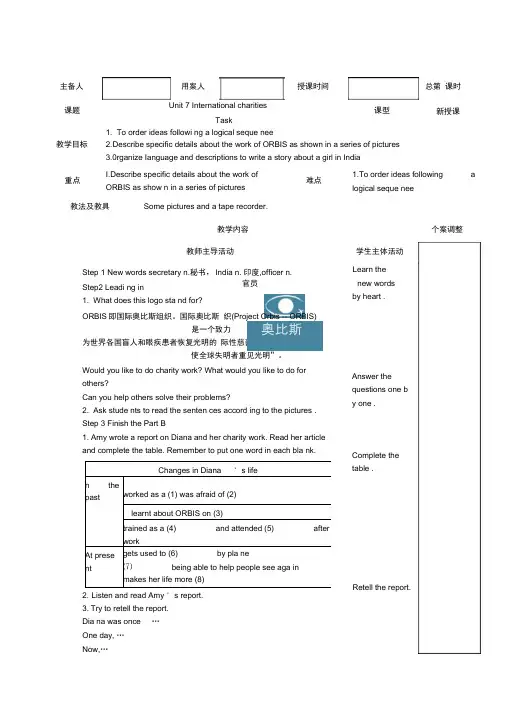
1.What does this logo stand for?
ORBIS即国际奥比斯组织。
国际奥比斯组
织(Project Orbis -- ORBIS) 是一个致力于
为世界各国盲人和眼疾患者恢复光明的国
际性慈善机构,它的宗旨是“使全球失明者重见光明”。
Would you like to do charity work?
What would you like to do for others?
Can you help others solve their problems?
2.Ask students to read the sentences according to the pictures .
Step 3 Finish the Part B
1. Amy wrote a report on Diana and her charity work. Read her article
and complete the table. Remember to put one word in each blank.
Changes in Diana’s life
In the
past
worked as a (1) _______
was afraid of (2) ________
learnt about ORBIS on (3) ________
trained as a (4) ______ and attended (5) ______ after
work
At
present
gets used to (6) ________ by plane
(7) ________ being able to help people see again
makes her life more (8) ________
2. Listen and read Amy’s report.
3. Try to retell the report.
Diana was once …
One day, …
Now, …
Learn the
new words
by heart .
Answer the
questions one b
y one .
Complete the
table .
Retell the report.。
译林版八年级英语下册Unit7Task教案
2.She is getti ng used to travelli ng by pla ne.
短语be/get used to someth in g/do ing someth ing意思是习惯于,适应”。如:
Learn the
官员
奧比斯
Changes in Diana's life
nthe
past
worked as a (1) was afraid of (2)
learnt about ORBIS on (3)
trained as a (4)and attended (5)after
work
At prese nt
难点
1.To order ideas followinga
logical seque nee
教法及教具
Some pictures and a tape recorder.
教学内容
教师主导活动
学生主体活动
个案调整
Step 1 New words secretary n.秘书,India n.印度,officer n.
Step2 Leadi ng in
1.What does this logo sta nd for?
ORBIS即国际奥比斯组织。国际奥比斯 织(Project Orbis -- ORBIS)是一个致力
为世界各国盲人和眼疾患者恢复光明的 际性慈善机构,它的宗旨是使全球失明者重见光明”。
Would you like to do charity work? What would you like to do for others?
译林版英语八年级下册_Unit7_Study_skills名师教案

Unit7 Study skills名师教案I. Teaching aims and learning objectivesBy the end of the lesson, students should be able to:1. know the name of five common punctuation marks;2. know the usage of comma, full stop, question mark, exclamation mark and quotation marks;3. use comma, full stop, question mark, exclamation mark and quotation marks correctly.II. Focus of the lesson and predicted area of difficultyLearn how to use comma, full stop, question mark, exclamation mark and quotation marks correctly.III. Teaching proceduresStep 1 Lead in1. Enjoy two picturesShow two pictures made of different symbols and ask “What’re the pictures made of?”.Let the students pay attention to the circled symbols. They are punctuation marks.2. Try to punctuate sentencesShow two sentences without punctuation marks: “woman without her man is nothing” and “Do you know her dad”. Ask the students to add punctuation marks. Let the students realize the importance of punctuation marks.【设计意图:首先通过图片引出标点符号,接着让学生给句子加标点,在趣味中点明标点符号的重要性。
Unit 7 Task 学案-2021-2022学年八年级英语牛津译林版下册

八年级下册Unit7 Task学案主备:审核:日期:2022-1-23学校:___________ 班级:___________ 姓名:___________ 家长签字:__________【板块要点】一、教学目标1. To grasp important vocabulary, phrases and sentences in this unit.2. To learn about the daily work and study of an ORBIS nurse.3. To learn to write a report on an Indian girl who was helped.教学重点、难点1.To learn to write a report on an Indian girl who was helped.2. To help the students set up the consciousness to help vulnerable groups.二、词汇、短语1. secretary n. 秘书secretaries(pl.)make up one’s mind to do sth 决定= decide to do sth=make a decision (n.)to do sth2.make made(simple past) made (past participle)3. India n. 印度adj. Indian Canada n. Canadian adj.4 officer n. 官员off ice n. 办公室5 get /be used to doing used to do be used to do三、句型1.She is afraid of flying.2.She made up her mind to train as a nurse and attended courses after work .3.She is get used to traveling by air.4.She is glad to help people see again.四、知识点1. make up one’s mind决定,下定决心mind (1) (vi.) mind 介意mind doing stheg:Do you mind me opening the door? ----- Of course not./ You’d better not.(2)(n.) mind 思维,头脑,决心2. She is getting used to travelling by plane.短语be/get used to something/doing something意思是“习惯于,适应”。
牛津译林版八年级下册英语教案Unit7InternationalcharitiesTask
牛津译林版八年级下册英语教案Unit7InternationalcharitiesTask英语(八年级下册)Unit 7 International charitiesTask冷雪I. Teaching aims and learning objectivesBy the end of the lesson, students should be able to:1. learn about an ORBIS volunteer called Diana;2. write a report about an Indian girl helped by UNICEF;3. learn the five steps of writing (prewrite—write—revise—edit—publish).II. Teaching contents1. New words and phrases: secretary, India, officer, make up one's mind +Z+X+X+K]科来源学+[2. New structures: She wanted to help poor people with eye problems see again, so she made upher mind to train as a nurse and attended courses after work.She is getting used to travelling by plane.III. Focus of the lesson and predicted area of difficulty1. To write a report about an Indian girl helped by UNICEF.2. To learn the five steps of writing (prewrite—write—revise—edit—publish).|]科来源[:学IV. Teaching proceduresStep 1 Lead-inDescribe the pictures in your own wordsT: Amy wants to write about the work of an ORBIS nurse called Diana for her class presentation. And she found some pictures of Diana.T: Look at these two pictures. Can you guess Diana's job in the past? As you see, she was anoffice lady, a secretary of a pany. Did she look happy? Look at the second one. What does shedo now? Does she look happy? Why does she change the job and what happened? Try todescribe the pictures in your own words.,]科来源[学Step 2 Reading prehension1. Discuss the picturesStudents read the six pictures carefully. They can ask any question about the story, and invitethe other students to answer. They can get the answer from the report or use their imagination toget reasonable answers.The teacher gives six questions. Students read and underline the answers in the report.(1) What was her life like?(2) Which does she like better, travelling by car or by plane?(3) In which way did she learn about ORBIS?(4) After learning about it, how did she feel and what did she do?(5) What is her life like now?(6) How does she feel about the changes?2. Analyze the structure of the articleT: Now please find the topic sentences of each paragraph, and get the main idea of each paragraph. [来源:]3. pare the lives in the past and at presentT: The first paragraph and the third paragraph tell Diana's work, lifestyle and way of travelling. They have similar structures.Step 3 Writing practice1. How to writeShow the five steps of writing; indicate that we should write step-by-step.2. Prewriting—choose a topic/collect details(1) Ask students to write about an Indian girl helped by UNICEF and show the pictures and the information. Show the subject, form, purpose and audience.(2) Ask students to plete a 5 W's chart.Writing tips: An experience includes the basic details, sensory details and dialogues.(3) Ask students to put things in order.Ask students to use the time line to organize things in time order.3. Writing—write a first draft: a beginning + a middle + an ending :ZXXK]来源[Show the structure of the report.(1) The beginning should get the readers' attention and introduce the experience. Show threeways to begin:a. Start with dialogues;b. Begin with a fact or an interesting statement;c. Put yourself in the middle of the action.Give three examples and encourage students to write their own.(2) The middle part tells story in time order. It may include sensory details, use dialogues, and share the feelings people experienced.Give a model middle and guide the students to pay attention to the transition words andsensory details.(3) The ending should bring the story to a close. Show three possible ways:a. Tell what you learnt from the experience;b. Explain how the experience changed you;c. Tell how you felt about the experience.Give three examples and encourage students to write their own.4. Revising—improve your writing(1) Show the steps to revise.Read—review—ask—change(2) Add and move parts.Use the model passage to show how to add and move parts and explains why.5. Editing—check for errorsInvite the students to check the article for punctuation, capitalization, grammar error and spelling.6. Publishing—share your writingShow the final copy.Give two tips:a. Use blue or black ink and write neatly;b. Indent every paragraph and leave a one-inch margin of all sides.7. Assessing the final copyShow how to assess the final copy.8. Reflecting on your writingReflect by answering four questions.9. The advantages of writingShow the advantages of writing:bee a better student, understand your experience, connect with others, enjoy life ... Encourage the students to write more.10. Write your articleV. Homework1. Make your article better.2. Put the best articles onto the wall and enjoy together. 附件1:律师事务所反盗版维权声明附件2:独家资源交换签约学校名录(放大查看)学校名录参见:://.。
牛津译林版英语八上Unit 7《Seasons》(task)教学设计1

牛津译林版英语八上Unit 7《Seasons》(task)教学设计1一. 教材分析牛津译林版英语八上Unit 7《Seasons》主要介绍了四季的变化,以及不同季节的特点和活动。
本单元话题贴近学生的生活,易于激发学生的学习兴趣。
通过学习本单元,学生能够掌握季节相关的词汇和表达方式,描述不同季节的特点和活动,提高学生的语言运用能力。
二. 学情分析八年级的学生已经具备一定的英语基础,对于日常生活话题有一定的了解。
然而,学生在语言表达方面仍存在一定的困难,如季节特点的描述、天气变化的表达等。
因此,在教学过程中,教师需要关注学生的个体差异,针对不同学生的学习需求进行有针对性的教学。
三. 教学目标1.知识目标:学生能够掌握季节相关的词汇和表达方式,如spring,summer, autumn, winter, warm, cold, sunny, rny等;2.能力目标:学生能够用英语描述不同季节的特点和活动,提高学生的语言运用能力;3.情感目标:培养学生热爱生活、珍惜时间的积极情感。
四. 教学重难点1.重点:季节相关的词汇和表达方式;2.难点:描述季节特点和活动的语言表达。
五. 教学方法1.任务型教学法:通过完成具体任务,让学生在实践中学习和运用语言;2.情境教学法:创设真实的生活情境,激发学生的学习兴趣;3.合作学习法:鼓励学生分组讨论,培养学生的团队协作能力。
六. 教学准备1.教材:牛津译林版英语八上Unit 7《Seasons》;2.多媒体设备:电脑、投影仪、音响等;3.教学素材:图片、视频、PPT等;4.课堂活动用品:卡片、贴纸等。
七. 教学过程1.导入(5分钟)教师通过展示四季变化的图片,引导学生谈论各自喜欢的季节,激发学生的学习兴趣。
2.呈现(10分钟)教师利用PPT展示本节课的主要内容,包括季节词汇和描述季节特点的句子。
同时,教师引导学生跟读,注意发音和语调。
3.操练(15分钟)教师学生进行小组活动,用所学的词汇和句子描述各自喜欢的季节。
牛津译林版八年级英语下册unit7 task教案(无答案)

牛津译林版八年级英语下册8B Unit 7 International charitiestask主备:课型:新授审核:八年级英语组班级______________ 姓名______________ 学号______________【教学目标】1、按逻辑顺序理解思路。
2、用从图片中获取的信息,写一篇关于一个印度女孩的报告。
3、评价学生对used to、be used to、so…that…以及such…that…等句型的掌握情况。
4、复习本单元的话题及重要的单词和短语。
5、培养学生为慈善事业出力的意识。
【教学内容】四会内容词汇:research n.词组:do a lot of research on【旧知回顾】一、根据所给中文完成句子。
1、房价还在上涨。
The prices of flats________ _______ _________ .房价又被抬高了。
The prices of flats ________ _______ _________ already.2、UNICEF给贫困国家的儿童提供干净的水、食品和教育。
UNICEF_______ clean water, food and education ______ the children in many countries.3、在喧闹的车站里谈话时很困难的。
It’s _________ _________ _________ in the noisy station.4、这部电影如此有趣,我还想再看一遍。
It’s _________ _________ _________ film _________ I want to watch it again.5、ORBIS要建立一个新的培训中心。
ORBIS wants to _________ _________ a new _________ _________.6、她年龄太大,走不了那么远。
牛津译林版英语7AUnit7Task教学设计
4.写作指导法:通过范文分析,引导学生掌握写作技巧,培养学生的写作能力。
(三)情感态度与价值观
在本章节的教学中,学生将培养以下情感态度与价值观:
1.培养学生对英语学习的兴趣和积极性,激发学生的学习动力。
-培养学生的跨文化交际意识,让学生学会尊重和欣赏不同国家和地区的文化。
四、教学内容与过程
(一)导入新课
1.教学活动设计:
-利用多媒体展示世界各地著名建筑的图片,如长城、埃菲尔铁塔、自由女神像等,引导学生欣赏并猜测建筑名称。
-以提问方式引导学生回顾已学的相关知识,为新课的学习做好铺垫。
2.教学过程:
-教师与学生互动,讨论不同建筑的特色及所在国家,激发学生对新课的兴趣。
-句型:It is known for..., It has a history of..., It is famous for...等。
2.难点:
-时态的运用:一般现在时和一般过去时的正确运用,特别是在描述建筑的历史和现状时的切换。
-写作能力:如何将所学知识运用到写作中,编写一篇关于著名建筑的短文。
-设计合理的评价标准,对学生进行全面的评价,包括知识掌握、口语表达、写作能力等方面。
-定期进行测试,了解学生的学习进展,针对学生的薄弱环节给予指导和帮助。
4.教学拓展:
-鼓励学生在课后通过网络、书籍等渠道了解更多关于著名建筑的知识,拓展学生的文化视野。
-组织课外活动,如参观当地的著名建筑,让学生亲身感受建筑的魅力,提高学生的实践能力。
2.培养学生的跨文化交际意识,让学生了解和尊重不同国家和地区的文化。
3.培养学生的合作精神,让学生在小组活动中学会倾听、交流、互助。
译林版初二英语书unit7task作文
译林版初二英语书unit7task作文Learning a new language can be an exciting and rewarding experience. It opens up a world of opportunities and allows us to connect with people from different cultures and backgrounds. One of the most important aspects of language learning is the ability to effectively communicate through writing. In the context of English language education, the unit 7 task in the translation version of the junior high school English textbook provides a valuable opportunity for students to practice their writing skills.The unit 7 task focuses on the theme of travel and tourism, a topic that is both interesting and relevant to many learners. Students are asked to write an essay about their dream vacation destination, describing the location, activities, and experiences they would like to have. This task not only allows students to showcase their English language proficiency but also encourages them to explore their own interests and aspirations.When approaching this task, it is important for students to carefully plan and organize their essay. They should begin by brainstormingideas and creating an outline to structure their thoughts. This will help them to develop a clear and coherent argument, ensuring that their essay flows logically from one point to the next.In the introduction, students should provide some background information on their chosen destination, explaining why they are interested in it and what they hope to experience there. This could include details about the location, such as its geography, climate, and cultural heritage, as well as any specific attractions or activities that appeal to the student.The body of the essay should then delve deeper into the student's dream vacation, describing in detail the sights, sounds, and experiences they would like to encounter. This could include exploring historical landmarks, indulging in local cuisine, participating in cultural festivals, or engaging in outdoor activities such as hiking, swimming, or wildlife viewing. By providing vivid and descriptive language, students can transport the reader to their dream destination and convey the excitement and anticipation they feel about their potential trip.Throughout the essay, students should also consider the practical aspects of their dream vacation, such as the logistics of travel, accommodation, and budgeting. They may want to discuss how they would plan and prepare for their trip, including any research or pre-booking they would need to do. This demonstrates their understanding of the practical considerations involved in travel and tourism, as well as their ability to think critically and problem-solve.In the conclusion, students should reflect on the overall significance of their dream vacation, highlighting the personal growth, cultural enrichment, or memories they hope to gain from the experience. They may also want to discuss how this trip aligns with their broader goals or aspirations, such as a desire to explore new cultures, broaden their horizons, or create lasting memories with loved ones.Overall, the unit 7 task in the translation version of the junior high school English textbook presents an excellent opportunity for students to showcase their writing skills and explore their personal interests in the context of travel and tourism. By crafting a well-organized and compelling essay, students can not only demonstrate their English language proficiency but also engage in a meaningful and enjoyable learning experience.。
初中英语八下第七单元教案
初中英语八下第七单元教案一、教学目标:1. 知识目标:(1)能够熟练运用本单元核心单词和短语进行日常交流。
(2)能够理解并在适当的情境中运用本单元所学的语法知识。
(3)能够理解课文内容,掌握课文中的关键信息。
2. 能力目标:(1)能够提高听说读写的能力,尤其是听力和口语表达能力。
(2)能够通过阅读和听力,获取和处理信息。
3. 情感目标:(1)培养学生的团队协作精神,提高他们的交际能力。
(2)培养学生的跨文化交际意识,增强他们的文化素养。
二、教学重难点:1. 重点:本单元的核心单词、短语和句型。
2. 难点:本单元的语法知识和跨文化交际。
三、教学过程:1. 导入:(1)利用图片或实物引导学生回顾本单元的主题。
(2)通过提问,激发学生的学习兴趣,引导学生进入学习状态。
2. 课堂学习:(1)单词和短语的学习:通过例句和练习,让学生熟练掌握本单元的核心单词和短语。
(2)语法知识的学习:通过例句和练习,让学生理解和掌握本单元的语法知识。
(3)课文学习:通过阅读课文,让学生理解课文内容,掌握课文中的关键信息。
3. 课堂练习:(1)听力练习:通过听录音,让学生获取和处理信息,提高他们的听力能力。
(2)口语练习:通过角色扮演或小组讨论,让学生运用本单元的知识进行日常交流,提高他们的口语表达能力。
(3)阅读练习:通过阅读练习,让学生理解和运用本单元的知识,提高他们的阅读能力。
4. 课堂小结:(1)对本单元的知识进行总结,让学生巩固所学。
(2)布置作业,让学生课后巩固所学知识。
5. 课后作业:(1)抄写本单元的核心单词和短语。
(2)完成本单元的练习题。
(3)预习下一单元的内容。
四、教学反思:通过本节课的教学,学生是否掌握了本单元的核心单词和短语?是否理解并掌握了本单元的语法知识?学生的听说读写能力是否有所提高?这些都是我在课后需要反思的问题。
同时,我还需要关注学生的学习情况,针对不同学生的特点,调整教学方法,以提高教学效果。
译林版英语八年级下册_Unit7_精品教案
Unit 7International charitiesReading设计说明教学反思首先通过复习上一课时的内容来导入新课,然后学习有关生词,为学习本课节扫清语言障碍。
接下来由浅入深对这篇文章进行阅读,同时处理一些课后的练习,进而掌握文章中出现的一些重要知识点,并围绕这些知识点展开一系列的练习进行巩固。
教学目标通过本课节的教学,让学生达成以下目标:1.知识目标掌握词汇:interviewer, blindness, medical, patient, afford, proud, reader, medicine, develop, treat, go to hospital, on board, carry on2.能力目标(1)通过上下文猜测生词词义;读懂文章,了解ORBIS医护人员的基本工作情况;(2)学会用正确的语言介绍ORBIS医生的工作;理解采访中使用的开放性问题。
3.情感目标培养学生积极参加社会慈善活动,尽自己所能帮助他人的意识。
重点难点1.重点:通过上下文猜测生词词义;读懂文章,了解ORBIS医护人员的基本工作情况。
2.难点:学会用正确的语言介绍ORBIS医生的工作;理解采访中使用的开放性问题。
教学准备PPT课件;有关A部分的音频;有关弱势群体的图片。
授课时数2课时教学过程Step 1 Lead-inShow four charities (ORBIS, Oxfam,UNICEF, WWF) and ask: Which charitycan help them?1.Children in poor areas2. Poor people in the disaster3. Elephants killed by hunters4. Blind people with eye problems Answers: 1. UNICEF 2. Oxfam 3. WWF 4. ORBISStep 2 Pre-reading1. Task 1: Look and learn.Show pictures of ORBIS and answer questions.(1)What does the logo (图标) look like?(2)Why is there a plane in the logo?(3)Why does ORBIS fly to help people?(4)What do ORBIS doctors and nurses do on board?(5)What happened after the operation?Answers: (1) It looks like an eye.(2) It is a Flying Eye Hospital.(3) Because many patients cannot afford to go to hospital.(=Because many patients don’t have enough money to see a doctor.) (4) They operate on patients.(= They do an operation on patients. )(5) Some eye problems and diseases can be treated or cured.2. Task 2: Match the words in B1 (P96). Then check the answer.(1) blindness (line 1 ) ________(2) cure (line 5 ) ________(3) patient (line 12 ) ________(4) afford (line 12 ) ________Answers: (1)—f, (2)—c, (3)—e, (4)—d, (5)—b, (6)—aAmy is interested in the work that ORBIS doctors and nurses do. She found an interview with an ORBIS doctor. Let’s read the interview with an ORBIS doctor in Part A and know more about ORBIS.How many questions does the interviewer ask? What are they?Answers: Five questions. They are:Question1: Dr Ma, please tell us something about blindness.Question 2: How does OBRIS help?Question 3: Why don’t you work in a hospital?Question 4: How many operations do you do during a visit?Question 5: Is there anything else you’d like to say to our readers?Step 3 While-reading1. Task 1: Scan and answer.(1) What is the Flying Eye Hospital used as?(2) What does Dr Ma hope?Answers: (1) It is used as a training centre.(2) He hopes more people will support ORBIS.2. Task 2: Read and choose.(1) What are local doctors and nurses invited to learn on board?A. Eye operations.B. New planes.C. New skills.D. Useful books.(2) How many people did he operate on during his last visit?A. 285 patients.B. 150 patients.C. 80 patients.D. 200 patients.Answers: (1) AC (2)B3. Task 3: Skim and choose the main idea.Part 1 (Lines1-6) : ________________Part 2 (Lines7-15) : ________________Part 3 (Lines16-20) : ________________Part 4 (Lines21-26): ________________A. Something about blindnessB. Dr Ma’s hopeC. The work of ORBISD. Dr Ma’s work and his feelingAnswers:Part 1 (Lines1-6) : APart 2 (Lines7-15) : CPart 3 (Lines16-20) : DPart 4 (Lines21-26): B4. Task 4: Read Part 1 and complete the table.Guess and match the meaningmostly a person or a problem that a doctor deals withcase in large part or mainlytreatment related to medicine and illnessmedical what a sick or injured person getAnswers:mostly a person or a problem that a doctor deals withcase in large part or mainlytreatment related to medicine and illnessmedical what a sick or injured person get5. Task 5: Read Part 2 and fill in the blanks (B2).(1) The work of ORBIS.Answers: Flying Eye Hospital, eye problems, eye operations, doctors and nurses, see again, new skills[Tips] Use verbs to describe (描述) things.(2) Complete the following sentences to describe their work.Many of our patients ________ to hospital.The Flying Eye Hospital ________ to visit ________.Local doctors and nurses ________ about ________ and ________ by training.Volunteer doctors ________ on ________.Answers: can’t afford to go; is used, poor areas; learn, eye operations, new skills; do operations, board6. Task 6: Read Part 3 and fill in the blanks.Dr Ma’s work and his feeling(1) 150 patients ________ ________ ________ by him during his last visit.(2) Although (尽管) his work is tiring, he still feels ________ of it.(3) It’s an ________ job for him to help his patients ________ again and maketheir lives________.Answers:(1) were operated on (2) proud (3) important, see, better7. Task 7: Read Part 4 and tell T or F.Dr Ma’s hope(1) Dr Ma would like to say other things to readers.________(2) Eye problems and diseases can be treated and cured because moderntechnology is developing quickly.(3) But more time is needed to continue the work. ________(4) More people are also needed to support ORBIS doctors. ________ Answers: (1) T (2) F (3) F (4) T8. Task 8 Write the correct letters in the blanks (B3).(1) Many more people in poor areas ________.(2) Dr Ma thinks that most eye problems and diseases ________.(3) Many blind people do not get any treatment ________.(4) The ORBIS plane is used as ________.(5) One hundred and fifty patients ________.(6) More money is needed ________.a.were operated on during Dr Ma’s last visitb.a hospital and a training centrec.because they have no money to go to hospitald.to carry on with the worke.have eye problemsf.can be prevented or curedAnswers: e, f, c, b, a, dThe ORBIS plane travels all around the world and helps people with eye problems in poor areas. Most of the people there cannot (1)________ to go to hospital, so ORBIS doctors go to them. Operations are done to help people with eye problems see again. The (2) ________ do not have to pay because ORBIS is a charity. Local doctors and nurses are also invited on (3) ________ to learn new skills. By (4) ________ them, ORBIS doctors hope to help more people.Dr Ma is a doctor on the ORBIS plane. He feels (5) ________ to help people see again. Dr Ma thinks that modern (6) ________ is developing quickly and now most eye problems can be treated and (7) ________, but more money is needed to (8) ________ their work.Answers: (1) afford (2) patients (3) board (4) training (5) proud(6) medicine (7) cured (8) supportStep 4 Post-readingTask: Discuss in groups.(1) What can we learn from ORBIS doctors?(2) How can we help ORBIS?Step 5 Post-taskTask 1: Feedback.What have we learned today?Answers: Learn something about ORBIS.Introduce the work of ORBIS.ORBIS uses its Flying Eye Hospital to help people in need.6. enough7. skills8. proud9. diseases 10. continueStep 6 Language points1. …and about 80 per cent of these cases can be prevented or cured.……这些病例中大约80%是能预防或治愈的。