
湖北省八校第二次联考英语试题
绝密★启用前鄂南高中华师一附中黄冈中学黄石二中荆州中学孝感高中襄阳四中襄阳五中2018届高三第二次联考英语试题命题学校:华师一附中命题人:雷运波审题人:杨晓斌审题学校:襄阳四中审定人:万耿李晋华本试卷共10页,72题。
全卷满分150分。
考试用时120分钟。
★祝考试顺利★注意事项:1.答题前,先将自己的姓名、准考证号填写在试卷和答题卡上,并将准考证号条形码粘贴在答题卡上的指定位置。
2.选择题的作答:每小题选出答案后,用2B铅笔把答题卡上对应题目的答案标号涂黑。
写在试卷、草稿纸和答题卡上的非答题区域均无效。
3.非选择题的作答:用黑色签字笔直接答在答题卡上对应的答题区域内。
写在试卷、草稿纸和答题卡上的非答题区域均无效。
4.考试结束后,请将本试卷和答题卡一并上交。
第一部分听力(共两节,满分30分)做题时,先将答案标在试卷上。
录音内容结束后,你将有两分钟的时间将试卷上的答案转涂到答题卡上。
第一节(共5小题;每小题1.5分,满分7.5分)听下面5段对话。
每段对话后有一个小题,从题中所给的A、B、C三个选项中选出最佳选项。
听完每段对话后,你都有10秒钟的时间来回答有关小题和阅读下一小题。
每段对话仅读一遍。
1. What does the woman think of the car journey?A. It’s too long.B. It’s very exciting.C. It’s rath er dangerous.2. Why is John late for school?A. He was stuck in traffic.B. He hurt his head.C. He did a good deed.3. What are the speakers talking about?A. A farm.B. Some houses.C. A corn field. 4. What does the man say about the movie?A. It’s horrible.B. It’s amusing.C. It’s not good.5. What is the probable relationship between the speakers?A. Acquaintances.B. Classmates.C. A couple.第二节(共15小题;每小题1.5分,满分22.5分)听下面5段对话或独白。
每段对话或独白后有几个小题,从题中所给的A、B、C三个选项中选出最佳选项。
听每段对话或独白前,你将有时间阅读各个小题,每小题5秒钟;听完后,各小题将给出5秒钟的作答时间。
每段对话或独白读两遍。
听第6段材料,回答第6、7题。
6. What do we know from the conversation?A. The woman will be free tomorrow.B. The man will help the woman tomorrow.C. The woman will have workers to do the job.7. What does the woman probably think of the man?A. Considerate.B. Annoying.C. Stubborn.听第7段材料,回答第8、9题。
8. Who plans to get more people for the team?A. Sue.B. Ben.C. Karen.9. What are going to take place in the near future?A. Tennis matches.B. Football matches.C. Softball matches.听第8段材料,回答第10至12题。
10. What will the woman do?A. Sell new game products.B. Make a presentation.C. Give away luggage carts.11. What is the probable relationship between the speakers?A. Friends.B. Strangers.C. Colleagues.12. Where are the speakers?A. In the company.B. In the hotel.C. In the lecture hall.听第9段材料,回答第13至16题。
13. What is Tina doing?A. Doing some reading.B. Having a holiday.C. Surfing the Internet.14. What does the man ask the woman to do?A. To buy a cake and ice cream.B. To help Sandy.C. To attend the birthday party.15. Who can’t eat chocolate?A. Tina.B. Sandy.C. The man.16. Which place will the woman go to next?A. The store on Abbey Road.B. The store on Olive Avenue.C. The supermarket on Downing Street.听第10段材料,回答第17至20题。
17. What do we know about the travel destination, Costa Rica?A. It’s suitable for newly-married couples.B. It’s suitable for old people.C. It’s family-friendly.18. What language do Costa Rican people probably speak?A. English.B. Spanish.C. French.19. What can travelers see in Costa Rica?A. Sand beaches.B. Dead volcanoes.C. Fish farms.20. How much will it cost a family to travel in Costa Rica?A. 80 dollars.B. 185 dollars.C. Half the cost of a trip to Disneyland.第二部分阅读理解(共两节,满分40分)第一节(共15小题;每小题2分,满分30分)阅读下列短文,从每题所给的A、B、C和D四个选项中,选出最佳选项。
AChoosing where to live may be one of the biggest decisions you’ll make when you move to Sydney, but you’ll have plenty of help.Temporary arrival accommodationBefore you move to Sydney, we recommend that you book a temporary place to stay. Once you get here, you can look for longer-term accommodation..au/accommodation/short-termOn-campus-residential colleges (fully catered饮食全包的)The University has eight residential colleges on the Camperdown/Darlington Campus, including International House, a residential community of global scholars. Colleges provide comfortable, fully furnished single rooms and daily meals, along with sporting, cultural, leadership and social programs. They also include on-site tutorials(辅导课) in addition to campus-based classes..au/collegesOn-campus residences (self-catered饮食自理的)The University has two self-run residences—Queen Mary Building (QMB) and Abercrombie Student Accommodation—on the Camperdown/Darlington Campus. Both just under a year old, they house up to 1000 students. These residences provide modern single-study rooms with large common living, learning and study spaces, shared kitchens, a theatre, gyms, soundproofed music rooms, art studios, sky lounges and rooftop gardens..au/campus-life/accommodation/live-on-campus.html Off-campus livingMore than 90 percent of our students live off campus. The University is close to many dynamic and multicultural suburbs such as Annandale, Newtown, Chippendale and Glebe. A great place to search is our large online database of properties..au/campus-life/accommodation/live-off-campus.html21.Where can you find a place to live temporarily?A.On “.au/colleges”.B.On “.au/accommodation/short-term”.C.On “.au/campus-life/accommodation/live-on-campus.html”.D.On “.au/campus-life/accommodation/live-off-campus.h tml”.22.What do students living in QMB have access to?A.Their own kitchens.B.On-site tutorials.C.Daily meals.D.Gyms.23. What is the most popular choice among students?A. Living off campus.B. Living in host families.C. Living in self-catered flats on campus.D. Living in fully catered houses on campus.BEveryone should be so lucky as to have a friend like Francia Raisa. On Thursday, singer and actress Selena Gomez, 25, used Instagram to explain why she was “laying low” this summer. She posted a photo of herself in a hospital bed with her friend Francia Raisa holding hands. She said she recently received a kidney transplant from her best friend because of complications(并发症) from lupus(狼疮), an autoimmune disease, which means it is the result of the immune system attacking normal tissue, including the kidneys, brain, heart and lungs.People with lupus may first experience tiredness, joint pain or a little bit of rash(皮疹) on their bodies and can go for a long time before their doctors realize it is more serious. Many people see two or four doctors before the real problem is picked up. According to Dr. Kyriakos Kirou, roughly a third to one-half of people with lupus develop kidney disease, and up to one in five of them will eventually need a transplant, sometimes because they weren’t treated with effective drugs to prevent the immune system from attacking the kidneys. Though Gomez said that she was “very well now,” she warned about the dangers of not taking medical diagnoses seriously, like she initially did.Her Instagram post also called attention to two major health topics: the need for living organ donators and the fact that Gomez represents three groups more likely to be diagnosed with lupus and lupus-related kidney disease. Nine out of 10 people diagnosed with lupus are women, and most develop the disease between the ages of 15 to 44. And lupus is two to three times more common among women of color, including Hispanic women, according to the Lupus Foundation.Raisa is Latina, and Gomez’s father is of Mexican origin. While it’s not essential that the organ donator and receiver be of the same ethnicity, people who share a similar background sometimes are better matched, according to data from the United Network for Organ Sharing.24. What can we learn about Francia Raisa?A. She is lucky.B. She is selfless.C. She is optimistic.D. She is encouraging.25. What is lupus like at its early stage?A. It is deadly.B. It is hard to recognize.C. Its symptoms are psychological.D. It reminds you of a kidney disease.26.What does the underlined word “them” in Paragraph 2 refer to?A. People with lupus.B. Colored women lupus patients.C. Lupus patients with kidney disease.D. Women between the ages of 15 to 44.27.What does the last paragraph mainly tell us?A. Raisa and Gomez have a similar background.B. Gomez has fully recovered thanks to the kidney from Raisa.C. It is vital for the donator and receiver to be of the same race.D. The organ from the donator of the same race matches the receiver better.CA few weeks ago, I called an Uber to take me to the Boston airport for a flight home for the holidays. As I slid into the back seat of the car, the warm intonations(语调) of the driver’s accent washed over me in a familiar way.I learned that he was a recent West African immigrant with a few young children, working hard to provide for his family. I could relate: I am the daughter of two Ethiopian immigrants who made their share of sacrifices to ensure my success. I told him I was on a college break and headed home to visit my parents. That’s how he found out I go to Harvard. An approving eye glinted at me in the rearview window, and quickly, we crossed the boundaries of rider and driver. I became his daughter, all grown up — the product of his sacrifice.And then came the fateful question: “What do you study?”I answered “history and literature” and the pride in his voice faded, as I knew it might. I didn’t even get to add “and African-American studies” before he cut in, his voice thick with disappointment, “All that work to get into Harvard, and you study history?”Here I was, his daughter, squandering the biggest opportunity of her life. He went on to deliver the age-old lecture that all immigrant kids know. We are to become doctors (or lawyers, if our parents are being generous) — to make money and send money back home. The unspoken demand, made across generations, which my Uber driver laid out plainly, is simple: Fulfill your role in the narrative(故事) of upward mobility so your children can do the same.I used to feel anxious and backed into a corner by the questioning, but now as a junior in college, I’m grateful for their support more than anything. This holiday season, I’ve promised myself I won’t huff and get annoyed at their inquiries. I won’t defensively respond with “but I plan to go to law school!” when I get unrequested advice. I’ll just smile and nod, and enjoy the warmth of the occasion.28.What disappointed the driver?A. The author’s attitude towards him.B. The school that the author is attending.C. The author’s majors in history and literature.D. The author’s interests in African American s tudies.29. Which of the following can replace the underlined word “squandering” in Paragraph 4?A. wastingB. creatingC. valuingD. seizing30. Why are immigrant kids expected to be doctors or lawyers?A. Their parents want them to move upward in society.B. Their parents are high achieving as well.C. They have more opportunities.D. They are very smart in general.31. How did the author react to the driver’s questioning?A. Getting upset.B. Feeling satisfied.C. Defending herself.D. Appreciating his concern.DWhat’s small, buzzes here and there and visits flowers? If you said bees or hummingbirds, you got it. You wouldn’t be the first if you mixed the two up. Now a group of researchers even say we should embrace our history of considering the two together in the same group. The way scientists study bees could help them study hummingbird behavior, too.Scientists first compared the two back in the 1970s when studying how animals search for food. The idea is that animals use a kind of math to make choices in order to minimize the work it takes to earn maximum rewards. Researchers at the time focused on movement rules, like the order in which they visited flowers, and where flowers were located relative to others. It was “almost like an algorithm(算法)” for efficient searching, said David Pritchard, a biologist at the University of St. Andrews in Scotland. Hummingbirds and bees had similar solutions.As the field of animal cognition(认知) appeared, hummingbird and bee research parted. Neuroscientists and behavioral ecologists developed ways to study bee behavior in naturalistic settings. Hummingbird researchers compared hummingbirds to other birds and borrowed methods from psychology to study theirability to learn in the lab. To be fair, hummingbirds and bees differ. For example, hummingbirds have more advanced eyes and brains than bees. Honeybees and bumblebees are social; hummingbirds typically aren’t.But however they perceive(感知) or process information, they both experience similar information, Dr. Pritchard said. In day-to-day searching for food, for example, hummingbirds may rely on more of a bee’s-eye view than a bird’s-eye view. Like other birds, they rely on landmarks, distances and directions to make maps when travelling long distances, but they don’t use these cues to find flowers. Move a flower just an inch or so away from where a hummingbird thought it was and it will hover over the flower’s or iginal location. Dr. Pritchard is investigating if, like bees, hummingbirds engage in view matching — hovering, scanning snapshots of a place to its memory and using those as references later.32.What is the center of research on hummingbirds and bees in the 1970s?A. Memory.B. Movement rules.C. Reward calculating.D. Information processing.33.Which subject’s research methods were adopted to study the learning ability of Hummingbirds?A. Math.B. Biology.C. Ecology.D. Psychology.34.How do researchers find out that hummingbirds are not like birds?A. By setting them free.B. By moving flowers.C. By matching view.D. By making maps.35.Which of the following can be the best title for the text?A. Hummingbirds and BeesB. Hummingbirds in the LabC. New Trends in Studying BeesD. Thinking of Hummingbirds as Bees第二节(共5小题;每小题2分,满分10分)根据短文内容,从短文后的选项中选出能填入空白处的最佳选项。
2024届高三八省八校第二次学业质量评价(T8联考)英语试卷(高频考点)
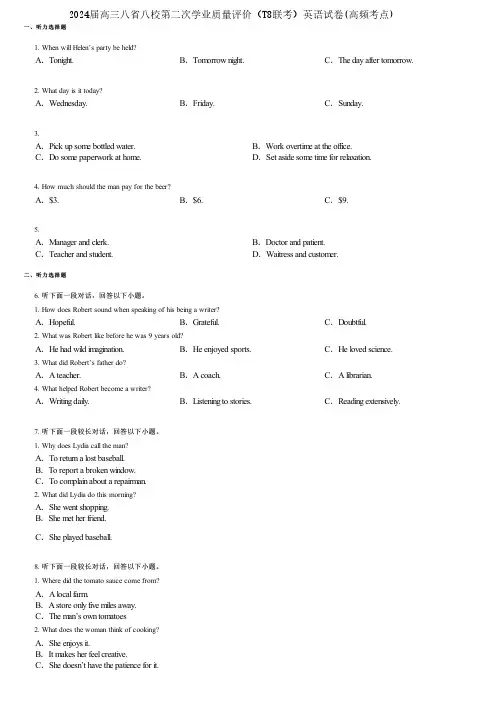
2024届高三八省八校第二次学业质量评价(T8联考)英语试卷(高频考点)一、听力选择题1. When will Helen’s party be held?A.Tonight.B.Tomorrow night.C.The day after tomorrow.2. What day is it today?A.Wednesday.B.Friday.C.Sunday.3.A.Pick up some bottled water.B.Work overtime at the office.C.Do some paperwork at home.D.Set aside some time for relaxation.4. How much should the man pay for the beer?A.$3.B.$6.C.$9.5.A.Manager and clerk.B.Doctor and patient.C.Teacher and student.D.Waitress and customer.二、听力选择题6. 听下面一段对话,回答以下小题。
1. How does Robert sound when speaking of his being a writer?A.Hopeful.B.Grateful.C.Doubtful.2. What was Robert like before he was 9 years old?A.He had wild imagination.B.He enjoyed sports.C.He loved science.3. What did Robert’s father do?A.A teacher.B.A coach.C.A librarian.4. What helped Robert become a writer?A.Writing daily.B.Listening to stories.C.Reading extensively.7. 听下面一段较长对话,回答以下小题。
2024届八省八校(T8)第二次联考英语试卷(含答案)

2024届八省八校(T8)第二次联考英语试卷学校:___________姓名:___________班级:___________考号:___________一、阅读理解Books That Celebrate Diverse Holidays and Traditions It’s important to remember there are a diverse set of holidays available to explore. Below are a few books that help introduce children to different holiday cultures and traditions.Too Many Tamales by Gary Soto, illustrated by Ed MartinezWhile helping her mother with Christmas celebration, Maria is tempted to try on her mother’s diamond ring. After getting caught up in the joy of the holiday and playing with her cousins, Maria realizes the ring is missing! That’s when she and her cousins come up with a plan to eat all of the tamales, in hopes of finding the ring.Together for Kwanzaa by Juwanda G. Ford, illustrated by Shelly HehenbergerThis is a story about a little girl named Kayla who wants to see her older brother Khari come home so they can celebrate Kwanzaa together as a family. Khari is stuck at college when a snowstorm hits and his car breaks down. Will he make it home in time for Kwanzaa?A Child’s Christmas in Wales by Dylan Thomas, illustrated by Trina Schart HymanThis book is a funny, nostalgic tale of Christmas Eve afternoon through Christmas night in Wales, and is full of unique imagery and poetic prose. It will arouse a sense of familiarity for some young readers while introducing them to different aspects of Christmas traditions.We Are Grateful: Otsaliheliga by Traci Sorell, illustrated by Frane LessacThe word otsaliheliga is used by members of the Cherokee Nation to express gratitude. This is an amazing story that describes a journey through the seasons with a modern-day Cherokee family. Cherokee history and traditions are also woven into the story in a very kid-friendly way.1.What makes it difficult for Khari to return home in time for Kwanzaa?A.A car crash.B.Delayed flights.C.Extreme weather.D.Academic pressure.2.Who provides pictures for A Child’s Christmas in Wales?A.Traci Sorell.B.Ed Martinez.C.Dylan Thomas.D.Trina Schart Hyman. 3.The four books all inform readers of ______.A.how to find hidden treasures at homeB.how to strengthen bonds with friendsC.the lifestyles of different ethnic groupsD.different holiday celebrations and customsKristin Schell is the founder of The Turquoise Table, a movement of ordinary people who want to create community right in their own front yards. Ten years ago, she and her family moved to a new home in Austin, Texas.One day, Kristin tried to connect with her new neighbors by hosting a party. She bought a few picnic tables but the delivery driver set one table down in her front yard by mistake. “After the party, I painted the table turquoise—my favorite color—and put it in the front yard, just a few feet from the sidewalk,” she says.That turquoise table became the place where Kristin and her kids hung out. They played games, did crafts and ate snacks. “We got intentional about where we spent our time,” Kristin says. “We became ‘front yard people’.”Neighbors began to stop by to introduce themselves and sit down for a chat. Kristin invited people to join her at the table for coffee or iced tea. Then neighbors asked Kristin if their family could put a picnic table in their front yard too. A movement was born. “It was a simple way to slow down and connect with others,” she says. The turquoise table was inviting and had a shared feel.People often hesitate to invite others into their homes. They think their house is too messy, it’s not big enough or they don’t have enough time. “Our perfectionism ca n cause us to miss out on the joy of connecting with others,” Kristin says. Her picnic table takes away the excuses—and the pressure.She likes how it enables her to take a small step toward easing loneliness and building relationships in her community. “People’s greatest need is to know that they are loved and that they belong,” she says.A decade after their Texas beginnings, thousands of Turquoise Tables exist in all 50states and in 13 countries around the world. Not all of them are actually turquoise. “No matter what color it is, it’s a friendship table,” Kristin says.4.Why did Kristin Schell start the movement?A.To host more parties in her front yard.B.To entertain her friends and neighbors.C.To engage with people in the neighbourhood.D.To create harmonious communities worldwide.5.Which of the following words best describe Kristin Schell according to the text?A.Creative and sociable.B.Friendly and humorous.C.Generous and ambitious.D.Cautious and responsible.6.What can be inferred from the text?A.People don’t like others to step into their houses.B.The campaign has a big impact at home and abroad.C.Kristin Schell bought the turquoise table to host a party.D.People feel unwilling to join in the front ya rd chat at first.7.Which of the following is a suitable title for the text?A.Love Your NeighborsB.An Amazing WomanC.Happy Front Yard TimeD.Tables Where All Are WelcomeIf you live in a region where winter weather is a regular risk, you are likely used to pouring salt on your sidewalks. But how does it work? And how much salt do humans pour onto our planet’s surface? The second question is easier to answer: a lot.Salt doesn’t directly melt ice, nor does it make snow simply disappear. Instead it makes water less likely to freeze in a phenomenon called freezing point depression. In the case of simple rock salt, which is a rawer, less pure version of table salt, each molecule (分子) splits into smaller elements. Normally, when water freezes into ice, its molecules line up to form a stable, orderly structure. Salt interrupts the process, however, and temperatures must drop lower to overcome that interruption and for freezing to occur.But if salt needs to interact with liquid water, how does it do anything when temperatures are stubbornly below freezing, and water should already be in the form of ice? That’s where cars help clear their own way by creating friction and, in turn, heat. The friction allows for the ice that has already frozen to melt a little bit, making it unlikely to freeze.Beyond rock salt’s ability to clear icy streets, it can also be destructive. Chloride ions (North American lakes could begin to upset local ecology and degrade sources of drinking water.Many local governments are looking for alternatives to rock salt. Other salts such as magnesium chloride and calcium chloride work in the same way as rock salt, and they’re perhaps even more efficient. Some experiments are testing other ice-preventing solutions, including those that contain sugars instead of or in addition to salts. Another approach relies more heavily on sand, which can mechanically make roads safer. All of this experimentation is aimed at ensuring people can travel in any weather condition—a Herculean task when winter brings its worst.8.What’s the purpose of the first sentence in Paragraph 2?A.To introduce the topic.B.To give some evidence.C.To define the phenomenon.D.To reveal the misconception.9.How does salt work to disturb the process of freezing?A.By lowering the temperature.B.By melting and splitting itself.C.By lining up to form a solid structure.D.By stopping the formation of the structure. 10.What does the underlined word “densities” in Paragraph 4 mean?A.Concentrations.B.Weights.C.Qualities.D.Salts.11.What’s the last paragraph mainly talking about?A.Other salts won’t disturb local ecology.B.Efforts are being made to guarantee safe travels.C.Many alternatives are available to solve the problem.D.Bitter winter make it impossible to secure road safety.About ten years ago, logging into Facebook, Twitter, or Instagram would mostly show posts from friends and family in the order they were posted. Today, these platforms present a mix of content, tailored by algorithms (算法) to match users’ interests, whether it’s plants, sports, cats, or politics.Kyle Chayka, a writer for The New Yorker, discusses this topic in his book, Filterworld. He explains that algorithms analyze user data to predict and influence what they will likely engage with. This means that instead of a simple, chronological feed, users encounter a dynamic stream, constantly adapting to their preferences. Chayka examines how these algorithmic recommendations control what we consume, from music and movies to food and travel destinations. He argues that this machine-driven selection process has turned us into passive consumers, making our preferences and tastes more similar.Chayka points out that algorithms make us passive by always showing us content that we’re unlikely to click away from but won’t find too unexpected or challenging. This constant stream of recommendations reduces our exposure to diverse or challenging content, subtly shaping our preferences and behaviors.Moreover, Chayka points out that algorithms also pressure content creators, like musicians and artists, to tailor their work to fit these digital platforms. For instance, musicians on Spotify or TikTok might focus on creating catchy hooks at the beginning of their so ngs to grab the listener’s attention.Despite the strong presence of these algorithms, Chayka believes that regulation couldreduce their influence. He suggests that if Meta, the parent company of Facebook, were required to separate its various services, like Instagram or WhatsApp, and make them compete with each other, it could give users more control and choice over their digital consumption.In summary, the change from simple, time-ordered social, media posts to algorithm-driven content has a big impact on both the viewers and the creators, influencing what we see, hear, and even think. Chayka’s insights highlight the need for greater awareness and potentially more regulation in our increasingly digital world.12.According to the text, how have social media platforms changed in the past ten years?A.They show posts in a time-based order.B.They prioritize posts from friends and family.C.They make adjustments to satisfy users’ needs.D.They provide more content to meet different needs.13.What does Kyle Chayka think of algorithmic recommendations?A.They make users more active consumers.B.They shape users’ preferences and behaviors.C.They reduce the influence of content creators.D.They expose users to diverse and challenging content.14.How do algorith ms influence musicians’ work on digital platforms?A.By encouraging musicians to create longer songs.B.By discouraging musicians from using catchy hooks.C.By giving musicians more control and choice over their music.D.By requiring musicians to create their work to fit the platforms.15.What can be concluded from the text?A.Tech companies should have more departments.B.Social media algorithms give content creators less opportunities.C.Social media algorithms flatten our culture by making decision s for us.work platforms have increased the common recommendations for 10 years.二、七选五16.How to Protect Against Undue Influence Online The potential for undue influence has become increasingly significant in this era of digital interconnectivity. Undue influence can affect our perceptions and influence our decisions. It may even end anger our autonomy (自主) and mental health.①______Understand what undue influence isThe first step to protecting yourself is understanding what undue influence is. Undue influence refers to a situation in which an individual or group employs unreasonable control over another person’s behavior information, thoughts, and emotions. ②______Disinformation campaigns, persuasive advertising, and even content designed to cause fear, uncertainty, or dependency may often appear online.Develop media literacy skillsIn an age of fake news, it is crucial to develop media literacy skills. ③______Become a consumer who can tell the quality of information, identify the source, check for credibility, and look for your unconscious assumptions and preferences.④______Delete as much data as you can about yourself. Be mindful of what information you share online, and always ensure that your online activities are secured through reliable sources. R eview all policies on platforms, especially “free” ones. If you aren’t paying, then you are the product, as in many cases, they are selling your data.By including these steps into your digital life, you can protect yourself from undue influence in the online world, ensuring that you can think and act independently, free from ill control.⑤______It is your mind. Only you should control it!A.Prioritize privacyB.Be mindful of free onesC.It’s vital to have a health y Internet and real-life balance.D.In the digital world, undue influence can take many forms.E.Everyone deserves the right to live free from undue influence.F.They involve analyzing, evaluating, and creating media in various forms.G.Here are some essential strategies for you to protect yourself online from undue influence.三、完形填空(15空)Smith brought his three-month-old son out for breakfast one day. He was playing withThe Masons.”touched by the generosity and noted that he didn’t have a father figure growing up, so17.A.unusual B.rare C.big D.regular18.A.stranger B.woman C.couple D.waiter19.A.embarrassed B.confused C.worried D.scared20.A.shouting B.aiming C.smiling D.getting21.A.turns out B.turns on C.strikes out D.goes on22.A.relationship B.appreciation C.friendship D.instruction23.A.bill B.note C.excuse D.notice24.A.credit B.cash C.change D.fortune25.A.Enjoy B.Share C.Protect D.Cheer26.A.lost B.exposed C.wronged D.seen27.A.significant B.occasional C.grateful D.influential28.A.idea B.breakfast C.joy D.story29.A.feeling fort C.power D.consequence30.A.carrying it through B.paying it forwardC.making it upD.putting it down31.A.approach B.address C.bless D.watch四、短文填空32.The Chinese zodiac, also known as Sheng Xiao or Shu Xiang , is a①_______ (repeat) circle of 12 years. Each year ②_______ (represent) by an animal. Chinese New Year 2024 is a year of the Loong.Chinese Zodiac Loong is the ③_______ (five) of the 12 zodiac animals, following theRot, Ox, Tiger and Rabbit. People born in the year of the Loong—an animal no one knows if it existed in real world—are enveloped in mystery, and very charming.Back in the pre-Qin period over 2, 200 years ago, there was already the Chinese zodiac signs theory. So it is ④_______ (reason) that Chinese Zodiac years are in agreement with the beginning of Chinese Lunar New Year. If you have an idea of Lunar Calendar, you will know ⑤_______Chinese zodiac year often start s from late January and ends in middle February of the next year.Therefore, to see what your Chinese zodiac animal is, ⑥_______to confirm whether you are a Loong, you need to change your Gregorian calendar birthday to Lunar Calendar of the year you were born. For example, if you were born ⑦_______February 16, 1988 (a year of the Loong), the Lunar New Year’s Eve, which was very close to Loong year, but you are a Rabbit.⑧_______is also worth mentioning is that if two people were born in the different Loong years, they may have very different ⑨_______ (personality), and horoscope, due to the Five Elements, which are Gold, Wood, Water, Fire, and Earth. Each element ⑩_______(come) in a 60-year cycle.五、书面表达33.假定你是李华,毕业在即,你校英文报举办了以“An Unforgettable Activity in High School”为主题的征文活动。
湖北省八校2020届高三英语第二次联考试题

湖北省八校2020届高三第二次联考试题(英语)全卷满分150分。
考试用时120分钟。
第一部分:听力(共两节,满分30分)第一节(共5小题;每小题1.5分,满分7.5分)听下面5段对话。
每段对话后有一个小题,从题中所给的A、B、C三个选项中选出最佳选项,并标在试卷的相应位置。
听完每段对话后,你都有10秒钟的时间来回答有关小题和阅读下一小题。
每段对话仅读一遍。
1.Why does the woman want to change her job?A.To get more money.B.To have more challenges.C.To have more chances.2.What will the woman have to do?A.Borrow a tape tomorrow.B.Keep the tape for another week.C.Return the tape to the man right now.3.Why will the man go to Edingburg?A.To drive the woman there.B.To have a meeting in Glasgow.C.To meet some important people.4.What will the woman probably do then?A.Go on washing the clothes.B.Stop washing the clothes.C.Let the man wash the clothes.5.How was the man doing at the job interview yesterday?A.He was well prepared.B.He did a good job.C.He did a poor job.第二节(共15小题;每题1.5分,满分22.5分)听下面5段对话或独白。
湖北省八校高三英语第二次联考试卷 人教版

湖北省八校高三英语第二次联考试卷人教版本试卷分第Ⅰ卷(选择题)、第Ⅱ卷(非选择题)两部分。
满分150分,考试用时120分钟。
第Ⅰ卷(选择题,共125分)第一部分:听力 (共两节,满分30分)第一节(共5小题;每小题1.5分,满分7.5分)听下面5段对话。
每段对话后有一个小题,从题中所给的A、B、C三个选项中选出最佳选项,并标在试卷的相应位置。
听完每段对话后,你都有10秒钟的时间来回答有关小题和阅读下一小题。
每段对话仅读一遍。
1.What are they talking about?A.The radio. B.The weather. C.The weekend.2.How does the man prefer to go to work?A.Driving. B.Taking a bus. C.Walking.3.Where did the conversation possibly take place?A.In a bedroom. B.In a living room. C.In a bathroom.4.To whom is the woman speaking?A.Her boss. B.Her husband. C.A policeman.5.What does the man mean?A.Only one seat was empty.B.One of the students was absent from the lecture.C.The lecture was so interesting that the lecture-room was full of people.第二节(共15小题;每小题1.5分,满分22.5分)听下面5段对话或独白。
每段对话或独白后有几个小题,从题中所给的A、B、C三个选项中选出最佳选项,并标在试卷的相应位置。
听每段对话或独白前,你将有时间阅读各个小题,每小题5秒钟;听完后,各小题将给出5秒钟的作答时间。
2020届湖北八校第二次联考英语试卷含解析 答案

+% )F-7/=B<3>>67C=75E'
)%R-07' F?:Ilm[&?!!n!&"
*%6'
+% Q6>'
!!% ;2E<-64526.-/=>B--JC=B6
)%V2634C7-D=DBE431J'
*%V26F66B4D-76<.352267.-7J'
+%V26.-7J45--2=7<.352267>6.450<6>54'
*% ,6=</=4567=><56=1267'
+% Q6=1267=><450<6>5'
!K% ;2=5<-64526.-/=>1=BB526FB=5/=>=A67F-7
)% )D7-J6>.3><-.'
*% )B-45123B<'
+% )F=BB6>5766'
!"% ;2=5L4526.-/=>L46H3<6>16
+% )4J526/=>F-726BC'
)% ,6.=>545-D6=D=DE435567' *% ,634A-3>A5-D6=D7-5267' +% ,34.3F634A-3>A5-2=H6=D=DE' K% ;2=5L4526.-/=>A-3>A5-<-
)% ?-5265EC3>A'
*% M6=<526C=C67=B-0<'
湖北省八校XX届高三第二次联考英语试题(扫描版)

XX八校第二次联考英语试题参考解析:1~20 BBABC ACACA BCCBC ABCAA31~50 CDADB ABCCD ACBBC DABDC31.“事实上”作者并不知道他叫“Vit”还是“Wit”。
32.“refer to…as…”把他称作。
33.根据下文“walked…”这一句,所以选择“acted”。
34.本段最后一句这几个孩子的所作所为表明他们“捉弄”Wit。
35.我也是捉弄他的同学之一,注意下一句的“we”。
36.把他的东西“藏”在某些地方。
37.根据下文的描述,他很“害怕”虫子。
38.不敢用手取下来,只好到处跑、跳,把虫子“抖”下来。
39. 这句话中的many beetles,提示是“主要的”。
40.蝴蝶不易被“捕获”。
41.当他没有防备的时候,我们就抓住机会(把虫子放在他身上)。
42.Once,“一…就…”43.touch and pull, 呼应上文提到的不敢碰虫子。
44.被校方“请去”。
45.注意看完全句“silently”,家长们要解决的是孩子被捉弄的事,气氛严肃。
46.“击打”沙袋发泄。
47.“几乎”每天如此。
48.根据下文Wit家长连续发问She asked many things,,给了我们“压力”,我觉得好笑但不敢笑。
49. She asked many things, 对“many things”举例。
50.上下文逻辑关系:转折。
51-54 DACB 55-58 DCAA 59-62 ABDC 63-66 CBAD 67-70 BDCAA 【语篇导读】本文是一篇记叙文。
评论员Melody Cramer曾是社交网站Facebook的忠实追随者,近日却毅然选择了退出。
究竟是什么原因让她做出如此的决定呢?51. 答案D 推理判断题。
根据第三、四段内容可知,Melody Cramer经常在网上就已经知道了她朋友的一切,当他们真正碰面时却又无话可说,所以她觉得Facebook使她的真实世界的生活很无趣,故D项正确。
湖北省2020届第二次八大名校联考试题(英语)
+%W6-CB61=>->BEH34353/C-75=>5135364' !9%X>.2312135E-F)0457=B3=1=>E-045=75043>A526C=44
)%VE<>6E' $#% ;26761=>E-0A-<3H3>A
*% )>E135E'
+% N6BD-07>6'
)%X>)B316VC73>A4'
)BB6H6>54/=>=A6/6>5450<6>5H-B0>56674>66<5-D6=556>53H6=><26BCF0B'X>76507>$526EA6552612=>165-
/6654-/6=/=Y3>A$176=53H6C6-CB6$=><6TC6736>16526<=3BE70>>3>A-F=F=45U/-H3>A3>567>=53->=BF6453H=B$.2676 53/6UJ66C3>A343/C-75=>5=><$=D-H6=BB$C67F-7/674=><=0<36>16B6=H6 2=H3>A 2=<=52-7-0A2BE6>I-E=DB6$
FDIJKefgi4%5#:^_jLC"DC""Y8FW3jC"%PT"Y89k&#:DI JKefg_6a
F?PIlm[&?P("
P% ;2E34526.-/=>4-2=CCE
湖北省八校(黄冈中学、华师一附中、襄阳四中、襄阳五中、荆州中学等)2020届高三第二次联考英语试题含答案
华师一附中 黄冈中学 黄石二中 荆州中学孝感高中 襄阳四中 襄阳五中 鄂南高中2020届高三八校第二次联考英语试题考试时间:2020年3月25日下午 试卷满分:150分注意事项:1. 答卷前,考生务必将自己的姓名、考生号等填写在答题卡和试卷指定位置上。
2. 回答选择题时,选出每小题答案后,用铅笔把答题卡上对应题目的答案标号涂黑。
如需改动,用橡皮擦干净后,再选涂其他答案标号。
回答非选择题时,将答案写在答题卡上,写在本试卷上无效。
3. 考试结束后,将本试卷和答题卡一并交回。
第一部分听力(共两节,满分30分)做题时,先将答案标在试卷上。
录音内容结束后,你将有两分钟的时间将试卷上的答案转涂到答题纸上。
第一节(共5小题;每小题1.5分,满分7.5分)听下面5段对话。
每段对话后有一个小题,从题中所给的A、B、C三个选项中选出最佳选项。
听完每段对话后,你都有10秒钟的时间来回答有关小题和阅读下一小题。
每段对话仅读一遍。
例: How much is the shirt?A. £19.15.B. £9.18.C. £9.15.答案是C。
1.Who does the man want to see?A. Dr. Edmunds.B. Dr. Edgar.C. Dr. Brown.2.What will the woman probably do this afternoon?A. Give the man some advice.B. Go for a job interview.C. Ask the man for help.3.Why does the man want to know how to take care of babies?A. He wants to be a baby sitter.B. He is going to be a brother.C. His wife is going to have a baby.4.What's the woman going to do?A. Do the typing.B. Read the paper aloud.C. Check for typing errors.5.What does the man advise Mary to do?A. Go out to work.B. Listen carefully to Henry.C. Be calm and patient.第二节(共15小题;每小题1.5分,满分22.5分)听下面5段对话或独白。
湖北八校高三第二次联考英语worddoc下载
英语试题注意事项:1.答题前,考生务必将自己的姓名、准考证号填写在试题卷和答题卡上,并将准考证号条形码粘贴 在答题卡上的指定位置。
2.每小题选出答案后,用2B 铅笔把答题卡上对应题目的答案标号涂黑,如需改动,用橡皮擦干净后,再选涂其他答案标号,在试题卷上作答无效。
..第一部分:听力(共两节,满分 30 分) 做题时,先将答案划在试卷上,录音内容结束后,你将有两分钟的时间将试卷上的答案转涂到答题卡 上。
第一节(共 5小题;每小题 1.5分,满分 7.5 分)听下面5段对话。
每段对话后有一个小题,从题中所给的 A 、B 、C 三个选项中选出最佳选项,并标在试卷的相应位置,听完每段对话后.你都有 10 秒钟的时间来回答有关小题和阅读下一小题,每段对话仅 读一遍。
1 . What 'sthe most probable relationship between them?A . Teacher and student.B . Classmates.2 . What can we learn from the dialogue?A . There is something wrong with the wonton.B . There is something wrong with the woman 's car.C . The woman wants to have enough money to buy a new car. 3 . What is the man talking shout with the woman?A . Her lecture topic.B . Her find test.C .Her absence from class. 4 . What does the woman mean?A . The man ahould stop smoking.B . The man should join the fitness center.C .The man is too fat. 5 . How does the man like the meeting?A . Funny.B . Shameful.C . Awful.第二节 (共 15 小题;每题 1.5 分,满分 22.5 分)听下面5段对话或独白。
【联合命题】2020届湖北省八校高三第二次联考英语试题(解析版)
2020届高三八校第二次联考英语试题注意事项:1. 答卷前,考生务必将自己的姓名、考生号等填写在答题卡和试卷指定位置上。
2. 回答选择题时,选出每小题答案后,用铅笔把答题卡上对应题目的答案标号涂黑。
如需改动,用橡皮擦干净后,再选涂其他答案标号。
回答非选择题时,将答案写在答题卡上,写在本试卷上无效。
3. 考试结束后,将本试卷和答题卡一并交回。
第一部分听力(共两节,满分30分)做题时,先将答案标在试卷上。
录音内容结束后,你将有两分钟的时间将试卷上的答案转涂到答题纸上。
第一节(共5小题;每小题1.5分,满分7.5分)听下面5段对话。
每段对话后有一个小题,从题中所给的A、B、C三个选项中选出最佳选项。
听完每段对话后,你都有10秒钟的时间来回答有关小题和阅读下一小题。
每段对话仅读一遍。
例:How much is the shirt?A. £19.15.B. £9.18.C. £9.15.答案是C。
1. Who does the man want to see?A. Dr. Edmunds.B. Dr. Edgar.C. Dr. Brown.2. What will the woman probably do this afternoon?A. Give the man some advice.B. Go for a job interview.C. Ask the man for help.3. Why does the man want to know how to take care of babies?A. He wants to be a baby sitter.B. He is going to be a brother.C. His wife is going to have a baby.4. What’s the woman going to do?A. Do the typing.B. Read the paper aloud.C. Check for typing errors.5. What does the man advise Mary to do?A. Go out to work.B. Listen carefully to Henry.C. Be calm and patient.第二节(共15小题;每小题1.5分,满分22.5分)听下面5段对话或独白。