
外研版九年级英语上module7unit1课件
外研版九年级英语Module7Unit1
学而时习之,不亦乐乎?
学而不思那么罔;
思而不学那么殆。
Lun Yu
敏而好学,不耻下问。 — Confucius
Do you know who wrote Romeo and Juliet? William Shakespeare
Do you know his four great tragedies?
e) People are still influenced by
his ideas. v. 影响;作用于
True or False
1. Both Betty and Mr Jackson think that Confucius and Shakespeare are great writers.
discuss influence
review (n. 评论)
sense (n. 道理;意义;合理)
thinker (n. 思想家) wise
Mr Jackson and Betty are (1) _d_is_c_u_s_s_in_g_ great writers. Betty explains that in her Internet group, each person reads a favourite
Listen again and fill in the blanks.
Presenter: Hello, today our guests will each introduce an important person from their countries, and we’ll discuss why they are famous. Chinese person: Confucius was a great _te_a_c_h_e_r_a_n_d__t_h_in__k_e_r in ancient China. He lived over 2,000 years ago and he is
外研版九年级上册英语Module 7 Unit 1
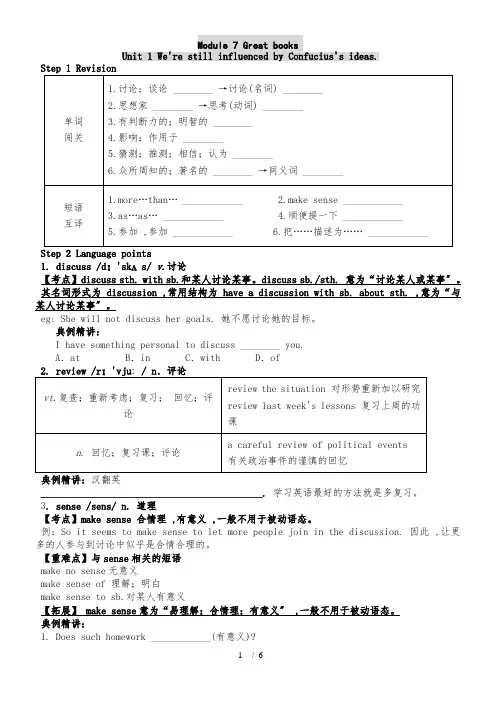
Module 7 Great booksUnit 1 We're still influenced by Confucius's ideas.1. discuss /dɪ'skʌs/ v.讨论【考点】discuss sth. with sb.和某人讨论某事。
discuss sb./sth. 意为“讨论某人或某事〞。
其名词形式为discussion ,常用结构为 have a discussion with sb. about sth. ,意为“与某人讨论某事〞。
eg: She will not discuss her goals. 她不愿讨论她的目标。
典例精讲:I have something personal to discuss ________ you..with D.ofA.at B.in C____________________________________________. 学习英语最好的方法就是多复习。
3. sense /sens/ n. 道理【考点】make sense 合情理 ,有意义 ,一般不用于被动语态。
例:So it seems to make sense to let more people join in the discussion. 因此 ,让更多的人参与到讨论中似乎是合情合理的。
【重难点】与sense相关的短语make no sense无意义make sense of 理解;明白make sense to sb.对某人有意义【拓展】 make sense意为“易理解;合情理;有意义〞 ,一般不用于被动语态。
典例精讲:1. Does such homework ____________(有意义)?2. It doesn't make ______ to memorize lots of words if you don't know how to use them in daily life.A. effortB. differenceC. senseD. choiceYou're supposed ________ something happy and lucky to others on New Year's Day. (湖南湘潭)A.to say B.saying C.say4.You are ________ to type quickly when talking to each other on QQ so the other person doesn't get bored.A.suggested B.supported C.taught D.supposed5. influence v.影响;作用于例:We're still influenced by Confucius's thoughts. 我们仍然被孔子的思想影响着。
外研版初中英语九年级上册精品Module Unit 课件
外研版初中英语九年级上册精品Module Unit
noon
/si:t /
/feə/ /kɪk/ /mæd/
座椅;座位 n.
seat
绝不;不可能 公平的;合理的
no way fare
踢 v. 生气的;恼火的 adj.
kick mad
外研版初中英语九年级上册精品Module Unit
stand for是…的缩写
Didn’t they beat you last time? Tony: Yes, they did. But... Lingling: What was the score?
外研版初中英语九年级上册精品Module Unit
Betty: If my memory is correct, HAS 98 points to BIG 52.
Now listen again and repeat.
外研版初中英语九年级上册精品Module Unit
外研版九年级英语上Module7Great books unit 1We're still influenced by Confucius's ideas.
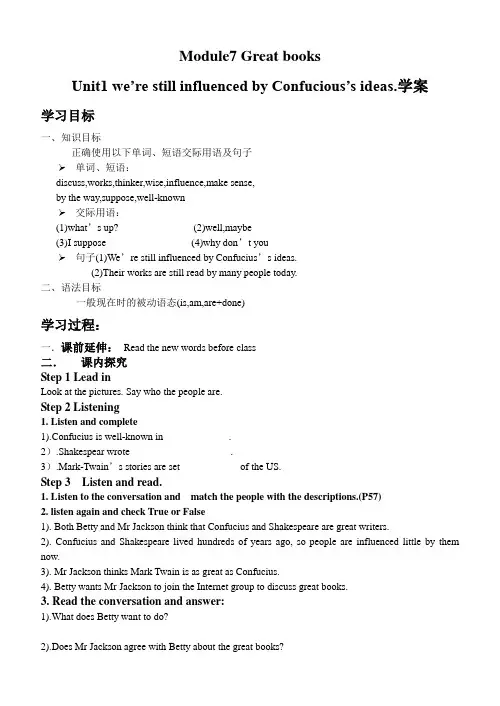
Module7 Great booksUnit1 we’re still influenced by Confucious’s ideas.学案学习目标一、知识目标正确使用以下单词、短语交际用语及句子单词、短语:discuss,works,thinker,wise,influence,make sense,by the way,suppose,well-known交际用语:(1)what’s up? (2)well,maybe(3)I suppose (4)why don’t you句子(1)We’re still influenced by Confucius’s ideas.(2)Their works are still read by many people today.二、语法目标一般现在时的被动语态(is,am,are+done)学习过程:一.课前延伸:Read the new words before class二.课内探究Step 1 Lead inLook at the pictures. Say who the people are.Step 2 Listening1. Listen and complete1).Confucius is well-known in_____________.2).Shakespear wrote____________________.3).Mark-Twain’s stories are set____________of the US.Step 3 Listen and read.1. Listen to the conversation and match the people with the descriptions.(P57)2. listen again and check True or False1). Both Betty and Mr Jackson think that Confucius and Shakespeare are great writers.2). Confucius and Shakespeare lived hundreds of years ago, so people are influenced little by them now.3). Mr Jackson thinks Mark Twain is as great as Confucius.4). Betty wants Mr Jackson to join the Internet group to discuss great books.3. Read the conversation and answer:1).What does Betty want to do?2).Does Mr Jackson agree with Betty about the great books?3).Why does Mr Jackson think Confucius and Shakespeareare great?4).What does Betty think of Mark-Twain?5).Who wrote The Adventures of Tom Sawyer?6).Are Mark-Twain’s books still popul ar?4. Read again and complete:1).what’s up?中文是____________,表达同样的意思还可以_____________________表达。
外研版九年级英语上 Module 7 Great books Unit 1 We’re still
read great books.
By the way, what do you think of Mark Twain, the great American writer in the nineteenth century? Betty: He was important, but I suppose he isn’t as well-known as Confucius or Shakespeare.
•A can be given to the team who have the correct answer.
•If you know the answer, please stand up and shout it out!
1. Lu Xun was a great thinker and writer in China.
There are 6 tasks in this part. Your can find out your tasks of your group in the envelope. Make a discussion after you finish the task, then show your answers to the class.
Guess
• When three people are walking together, I am sure to find teachers among them.
• 三人行必有我师焉
Confucius’s ideas
Confucius
He was a wise man in China. He is thought more as a teacher and thinker than a writer. Lun Yu describes his thoughts. And we are influenced by him.
Module7Unit1外研版英语九年级上册教案详解

二、核心素养目标
1.提高学生的语言素养:通过学习新词汇和语法,使学生能够熟练运用英语描述旅行经历,增强口语表达和书面表达能力;
2.培养学生的文化意识:通过了解不同城市的旅游景点和风土人情,拓展学生的国际视野,增进对多元文化的理解和尊重;
1.加强对基础薄弱学生的关注,给予个别指导和鼓励,提高他们的学习信心。
2.使用简洁明了的语言讲解语法知识,注重实际应用,让学生更容易理解。
3.在实践活动和小组讨论中,加强对学生的引导,确保讨论围绕主题进行。
4.培养学生的独立思考能力,让他们在学习中更加自信。
5Байду номын сангаас及时关注学生的疑问,确保他们能够跟上教学进度。
3.发展学生的思维品质:通过分析课文中的描述性语言和写作技巧,提高学生的思维逻辑性和创新性,培养批判性思维;
4.增强学生的学习能力:引导学生自主探究、合作交流,培养其解决问题的能力和团队协作精神,提高学习效率;
5.塑造学生的人格素养:借助旅行主题,教育学生关爱自然、尊重历史,培养积极向上的生活态度和价值观。
举例:解析课文中的句子,如“During the trip, we saw many interesting sights.”,让学生学会如何描述旅行中的见闻。
(4)写作:根据课文模板,编写一篇关于自己旅行经历的英文短文。教师应指导学生运用所学词汇和语法,提高写作能力。
举例:给出写作框架,如“Introduction-Body-Conclusion”,并指导学生如何将自己的旅行经历填充到框架中。
(2)语法:一般过去时的运用是本节课的重点语法。教师应通过实例讲解,让学生掌握一般过去时的结构,并在实际情境中运用。
2022年外研版九年级上《Module 7 Unit 1 》公开课教案
Module 7 Great booksUnit 1 We’re still influenced by Confucius’s ideas.教学目标【知识目标】1、能够正确使用以下单词和词组: crocodile, shark, hand, have a look at, alongside,2、能够初步了解that引导的限定性定语从句.【能力目标】3、能够听懂有关介绍澳大利亚的对话;能够询问他人的旅游经历.4、能够用本单元学到的词汇、短语、句型介绍参观过的某个地点.【情感态度目标】了解不同国家的风景, 自然与文化, 同时能够介绍中国的文化景点, 增强民族意识;培养学生对自然和生活的热爱之情.教学重难点【教学重点】1、能够掌握本单元重点单词和固定表达2、能够用本单元学到的词汇、短语、句型介绍参观过的某个地点.【教学难点】一般现在时的被动语态的用法教学过程Step 1 Lead-in标题导入:“Recently I’ve read a great book called Romeo and Juliet. I’m deeply moved by it. Have you ever read some great books? 〞随即将“Great books〞呈现在黑板上, 鼓励学生说出他们读过的名著. 这里用学生们熟悉的话题导入新课, 能够激发学生学习的兴趣, 活泼课堂气氛, 更重要的是通过老师的表述, 如运用重读、稍慢的语速等方式强调被动语态的句子, 让学生们在真实的语境中感知被动语态. Step 2 Listening听activity1, 展示三幅图片, 问“Who are they? Do you know something about them? Try to use the words in the table to help you.〞,学生们两人一组描述图片, 之后, 听磁带看学生们的匹配是否与所听到的一致.1. Ask the students to Look at the pictures.2. Say who they are and why they are famous.3. Play the recording and ask the students to listen carefully.4. Now listen and check your answers.5. Ask the students to check their answer with a partner.6. Call back the answers from the whole class and check the answers.Step 3 Listening carefully1. Ask the students to read through answer the sentences.1) Confucius is well-known in _______________.2) Shakespeare wrote ______________________.3) Mark Twain’s stories are set __________________ of the US.2. Play the recording and ask the students to listen carefully.3. Listen and complete the sentences.4. Ask the students to check their answer with a partner.5. Call back the answers from the whole class and check the answers.6. Now listen and check.Step 4 Listen and read〔一〕学生自主学习, 理解activity 3的意思, 找出不懂的地方.〔二〕小组内合作解决不懂的地方, 再有疑难, 小组间共同解决, 教师适时点拨.1. Show some pictures, and ask the students to talk about them.2. Ask the students to read the conversation silently.3. Play the recording and ask the students to listen and read the conversation.4. Read the conversation.5. Act it out.6. Match the people with the descriptions.〔1〕Ask the students to read the conversation again.〔2〕Read the information in Activity 3.1) Confucius 2) Shakespeare 3)Mark Twaina) He was a very wise man.b) He is not as well-known as the other two people, but his works are still popular.c) His plays are read by millions of people.d) He was more a teacher and thinker than a writer.e) People are still influenced by his ideas.3. Now match the people with the descriptions.4. Ask the students to check their answer with a partner.5. Call back the answer from the whole class and check the answer.Keys: 1.a), d), e) 2. c) 3. b)Step 5 Finish the activity 4.1. Ask the students to the words in the box in Activity 4.accept discuss influence review sense thinker wise2. Ask the students to read through the passage in Activity 4.3. Complete the passage with the correct form of the words in the box.4. Check with a partner.5. Call back the answers from the whole class.Keys: 1. discussing 2. review 3. accepted 4. thinker 5. wise6. influenced7. senseStep 6 Everyday English让学生们说说这些句子在文中的意思.What’s up? Well, maybe…I suppose… Why don’t you…?Step 7 Pronunciation1〕跟读录音朗读文章, 模仿语音语调2〕读熟文章3〕画出重读的句子1. Play the recording once without stopping.2. Play the recording again and ask the whole class to repeat.1) We’re still influenced by Confucius’s ideas.2) Shakespeare’s plays also make a lot of sense to us today.3) He was important, but I suppose he isn’t as well-known as Confucius or Shakespeare.3. Ask the students to listen and underline the words the speaker stresses.4. Now listen again and repeat.Step 8 Group work and speaking1. Work in groups. Do you agree with the following opinions? Give your reasons.1) Teahouse is one of the greatest plays in China.2) Everyone should learn some Tang poems.3) We should only read books by great writers.I accept… I agree / don’t agree with…I suppose… I think…2. Now report the ideas of your group to the whole class.Most of us think…We think we learn…3. Work in groups.Step 9 Language points1. What’s up?What’s up? 是一种非正式的用法, 意思是“怎么了/出什么事了?〞例如:What’s up? You look very worried? 怎么了?你看上去很焦虑.2. But I think I’d describe Confucius more as a teacher and thinker than a writer.这里的Confucius指孔子, 为“孔夫子〞的英语译名, 是长期以来约定俗成的译法. more…than…在本句中表示“与其说是…不如说是…〞. 例如:Success is more hard work than good luck. 成功来自努力, 而非好运.3. … and Shakespeare’s plays also make a lot of sense to us today. …make sense的意思是“合情理;明智;有意义〞. 例如:No wonder how I tried to read it, the sentence still did not make any sense to me. 不管我们怎么努力地读, 我还是不懂这个句子的意思.Why did she do such a thing? It does not seem to make sense. 她为什么做这样的事?似乎没有道理.4. I want to join an Internet group to discuss great books by great writers.discuss v.讨论;谈论discuss的过去分词是discussed, 现在分词是discussing,discuss sth. (with sb.)和某人谈论某事e.g. We will discuss the plans with them at the meeting.我们将和他们在会议上讨论这个方案.5. We’re still influenced by Confucius’s ideas.influence v.影响;作用于influence用作动词时, 后面直接跟宾语, 常可用于influence sb. to do sth.结构.e.g. What influenced you to take the job? 什么影响你接受这份工作?6. By the way, what do you think of Mark Twain, …by the way用于转入新的话题, 意为“顺便说;附带说〞.e.g. By the way, has everybody arrived? 顺便问一句, 大家都到了吗?7. He was important, but I suppose he isn’t as well-known as Confucius or Shakespeare.suppose v.猜想;推测;相信;认为后面可以带动词不定式的复合结构或从句, 也常用于be supposed to结构.e.g. I suppose him to be on duty. 我想他在值班.We are not supposed to smoke here. 我们不应该在这儿吸烟.well-known adj.众所周知的;著名的be well-known as意为“作为……而著名〞, 相当于be famous as .e.g. Norman Bethune was well-known as a great doctor.白求恩作为一个伟大的医生而著名.拓展:be well-known for意为“因为……而著名〞, 相当于be famous for. 除v-ing形式外, for后还可跟名词.e.g. Yuan Longping is well-known for hybrid rice. 袁隆平因杂交水稻而著名.8. 小组自我补充9. 学生自主完成这些重点与难点.自主完成后, 小组合作, 交流学习成果, 共同释疑.让学生朗读以上重点知识.Step 10 中考链接A. 单项选择:1. Experts ________ to make suggestions to help him develop.A. will inviteB. are invitedC. have invited2. Han Han’s books are popular. They ________ by many teenagers.A. are readingB. are readC. were read3. —At present, one of the best ways to study is working in groups.—More chances _______ to students to learn from each other.A. offerB. are offeredC. have offered4.—Don’t you see the sign “No Parking!〞on the right?—Sorry, I didn’t. But now I know parking______ here.A. wasn’t allowedB. isn’t allowedC. won’t allowD. doesn’t allow Keys: 1. B 2.B 3. B 4. BB. 完成句子:1. 我试图让每首歌都表达出它自己的意义.I try to make each song ____________for itself.2. 顺便问一下, 你认为这个队的水平如何?_____________, what do you think about this Team?3. 今天很多人仍然看孔子的作品.Confucius’ works ______________ by many people today.4. 学校鼓励学生大声地讲英语.All the students ______________ speak English loudly.5. 我们受到孔子思想的影响.We _____________ by Confucius’s thoughts.Keys: 1. make sense 2. By the way 3. are still read 4. are encouraged to5. are influenced课堂作业Remember the words of Unit 1 and prepare the text of Unit 2.教学反思Unit 3 Language in use教学目标【知识目标】让学生能够使用在本模块所学的单词和短语.【能力目标】总结和理解if条件状语从句.【情感态度目标】在日常生活中能听懂他人的问题和给出建议, 做一个老实的人.教学重难点【教学重点】【教学难点】教学过程Step 1 Revision and lead-inLet Ss look at the pictures and answer the questions to review what they have learnt. Step 2 Language practice and grammarTo master the tense of the adverbial clause of condition.用所给单词的适当形式补全对话1. If I ______(start) the dinner, I ________ (finish) it before I go to bed.2. If you _____(do) these other things instead of your homework, you _______(not have) time to study.3. He thinks something _______(go) wrong if I play games on it.Grammar: If从句(2)一、引导条件状语从句最常用的连词是if, 常见的if条件状语从句表示在某条件下, 某事很可能发生.e.g. If you ask him, he will help you.如果你请他帮助, 他会帮你的.If he does not work hard, he will fail his exams.如果他不努力, 考试就要不及格了.二、If从句的时态1. if从句用一般现在时, 主句用一般将来时.e.g. If he runs, he’ll get there in time.如果他跑着去, 他就会及时赶到那儿.2. if从句用一般现在时, 主句用情态动词+动词原形.e.g. She may come with us if she arrives in time.如果她来得及时, 就可以和我们一道去.三、if 引导的条件状语从句位置灵活, 可直接放在主句后面, 也可以放在句首. 放在句首时, 从句后面要用逗号和主句隔开.e.g. I’ll go to see you if I have time. 如果有时间, 我就去看你.If it rains tomorrow, we’ll stay at home. 如果明天下雨, 我们就待在家里.四、同义句转换用“祈使句+and / or +一般将来时的句子〞转换.e.g. If you work hard, you’ll pass the exam easily.→ Work hard, and you’ll pass the exam easily. 努力学习, 你将很容易通过考试. If you don’t hurry up, you’ll miss the train. → Hurry up, or you’ll miss the train.快点儿, 否那么你就赶不上火车了.Exercises1.If you ____ to the party, you’ll have a great time.A. will goB. wentC. goD. going2. I ______ her the answer if she _______me.A. can tell, will askB. will tell, will askC. would tell, askD. will tell, asks3. -What are you going to do tomorrow?-We’ll go to the library tomorrow if it ______.A. isn’t rainB. rainC. won’t rainD. doesn’t rain4. I’ll give the book to him if he _____ here next Sunday.A. will comeB. comesC. is comingD. cameStep 3 Join the sentences with if●The teacher show Ss how to join the sentences with if.Listen in class, or you will not understand what to do.If you do not listen in class, you will not understand what to do.1. Eat your breakfast, or you will get hungry at school.If you do not eat your breakfast, you will get hungry at school.2. Hurry up! You will be late.If you do not hurry up, you will be late.3. Read the book carefully. Then you will not make mistakes.If you read the book carefully, you will not make mistakes.4. Don’t watch too much TV, or your eyes will hurt.If you watch too much TV, your eyes will hurt.5. Work harder! You will get higher marks.If you work harder, you will get higher marks.●Let Ss write new sentences with if.Step 4 Make a survey1.Think of three problems you have in your schoolwork.2.Make notes about them in the Problem boxes.Now work in pairs. Talk about your problems and give advice to each other. Complete the table.-I can’t speak English well.-If you practise more outside the classroom, you will make progress.Step 5 Complete the sentences so that they are true for you1. Read the sentences carefully.2. Use the correct words to fill in the blanks1 I will be really happy if________________.2 I will do well in English if______________________________.3 My parents will be angry if____________________.4 If it rains next Saturday, I_____________________.Step 6 Complete the conversation with the correct form of the words and expressions in the box1.Read the conversation carefully.2.Now complete the conversation with the words or expressions in the box.Step 7 Complete the passages with the correct form of the expressions in the box1. Read the passages carefully.2. Now complete the passages with the words or expressions in the box.Step 8 Read the problems and give your adviceStep 9 ListeningListen to the conversation and answer the questions.1. What is the girl’s problem?2. Is it a common problem among teenagers?3. What does the doctor advise the girl to do?4. What does the doctor advise the girl not to do?Step 10 Around the worldLearn about the advice columns.Read the passage and fill the blanks.1. Advice columns have been used since ___________________.2. In the past, advice columns could mainly be found in _______________________.3. Nowadays, _______________________are much more popular.Step 11 Writing1. Work in pairs. Write a letter about a problem.2. Decide on advice for the problems in groups.3. Make a problem page.Step 12 PracticeDo some exercises from the entrance exam to senior high schools.1. -Would you like to go shopping with me, Carmen?-I’d love to, ____ you don’t want to go alone.A. untilB. beforeC. if2. You will be late for school ____ you don’t get up early.A. butB. ifC. andD. or3. -Please give Alice the story book ____ you see her.-All right.A. unlessB. orC. butD. if4. If the weather ____ fine, we ___ have a sports meeting this weekend.A. will be; willB. is; willC. was; would5. He will go to the mountains with his parents if it _____ next Sunday.A. won’t rainB. doesn’t rainC. isn’t rainD. will rain6. If she _____ tomorrow, I’ll call you.A. comeB. comesC. will comeD. came课堂作业假设你是Lucy, 你的笔友Mary给你写了一封信, 告诉你她现在的问题, 请你给她写一封回信, 并给她提出你的一些建议.Dear Lucy,I am a good girl but I am not good at studying. I like watching TV so much that I can’t stop myself from watching it. My parents have tried their best to stop me watching TV too much. They argued〔争吵〕with me about it. I was so angry with them that I left home. The problem makes me very sad and I don't know what to do. Can you help me?Yours,Mary教学反思。
新外研版九年级英语上册module7Great Books
Do you know his four great comedies? What are their titles? As you like it 《皆大欢喜》 Twelfth Night 《第十二夜》 His great A Midsummer Night’s comedies Dream 喜剧 《仲夏夜之梦》 The Merchant of Venice 《威尼斯商人》
many countries
Shakespear wrote ______
plays and poems
Mark Twain's stories are set ____________of the US.
in the south
Listen and answer the questions.
Confucius 1.Whose ideas are we still influenced by today?
Practice 1. Match the people with the descriptions
1. Confucius a)He was a very wise man . b)He is not as well-known as the other two people, but his works are still popular. c)His plays are read by millions of people. d)He was more a teacher and thinker than a writer. e)People are still influenced by his ideas.
1.What does Mr Jackson think of Confucius?
初中英语外研版九年级上册《Module 7 Unit 1 We’re still influence
外研(新标准)版-九年级上册
3. make sense 讲得通,成心义,通情达理的。 Can you make sense out of what this book says? 你能理解这本书的内容吗? It would make sense to leave early.还是早点走好。
4. by the way 顺便说一下 Not bad. By the way, how is your mother? 还好。顺便问一下,你母亲怎么样?
(3) 作动词,意为“运转;运行”。如: My watch doesn’t work. 我的表不走了。
外研(新标准)版-九年级上册
2. But I think I’d describe Confucius more as a teacher and thinker than a writer. 我更愿意把孔子描写为教师兼思想家,而非作家。 more…than… 在本文中指“与其说……不如说……”
Shaksespeare wrote _p_l_a_y_s_a_n_d__p_o_e_m_s__.
Mark Twain’s stories are set _in__t_h_e_s_o_u_t_h_ of the US.
外研(新标准)版-九年级上册
Listen and answer the questions.
结构: 主(动作接受者)+am/is/are+ v.过去分词+(by+动作履行者)
The boy is called Tony (by us). These songs are loved (by children).
外研(新标准)版-九年级上册
Complete the passage with the correct form of the words in the box.
外研版九年级上册Module7unit1
【精品学案】Module 7 AustraliaUnit1 I am looking for the photos that you took in Australia[课前朗读]shark, hand, have a look at , alongside,crocodile, detail[学习目标]知识与技能: 1. To understand the conversation of talking about Australia.2. To learn how to introduce a famous place.3. To learn Instructive Attributive Clauses with that过程与方法:1、以听促说,听后说与说后听相结合,增加语言知识的输入。
2、调动学生的自主学习,体现展示欲望,创设语言输出的平台。
3、教师有效指导,加强小组合作学习。
情感目标:交谈经历时能注意他人的情感,不因别人不能周游世界各地而蔑视,要表现关怀与平等。
[学习重难点] 1. To make up the conversation involving the use of restrictive attributive Clause.2. Attributive Clause with “that”[学习过程]Step 1导入新课1.Talk about the pictures:There are three pictures in unit 1. Let the students to talk about them “Where are they?”Then the teacher show the answers. Then lead to the new point.Step 2听力训练(课本第2 部分)1.Listen and answer the questions in Activity 1.(Play the tape for the students. The Ss listen to it carefully and then try to find out the answer to these questions. Then talk about their answers with their partners. At last , the teacher shows theanswers to the students.)2. Listen to it again, and answers the questions.1). What’s the largest English-speaking country in the southern part of the world?2). What famous things can you see there?3) What animals can you see there?Step 3对话处理(课本第3部分)2. Listen to the dialogue again and answer the questions1.Why does Tony want his dad’s photos of Australia?2.Does he know where to find them?3.What does Tony think of the photos?4.Why does Tony want to borrow the camera?5.Is Tony’s dad surprised that Tony wants to win the photo competition?6.Does Tony’s dad lend him the camera at once?3. Listen and repeat .Step 4 听后说1.Work in groups , read the dialogue then act it out.(分角色朗读并展示)2. Complete the sentences in your own words.1). Tony is looking for the photos that his dad took in Australia in order to_____________________.2). Tony is going to write a letter to his mum and dad that describes _______________.3). He likes the photo that shows _____________________.4) .The kangaroo that Tony’s dad saw were _____________________.Step 5释难解惑Let students read the dialogue, find out the difficulties, talk about them in their groups, then go through in the class. (启发学生通过自己阅读对话找出问题,然后在组内讨论,最后全班在教师指导下,解决难题,并通过练习加以巩固)______________________________________________________________________________ _Step 6知识点拨1、b e surprised at 对~~感到惊讶。