
Module4-Unit1 W0Lo
7. Project Hope
9. all over China
8. in fact
10. sound interesting
专项练习
结合本文知识点自主完成,然后在组内交流答案 1.火车到站了。The train has arrived at the station. 2. 他是前天到那儿的。 He arrived there the day before yesterday. 3. --How are you getting on with your classmates? --I’m getting on well with them.(相处得好) 4. 她的头发和她妈妈的一样。 Her hair is the same as her mother’s. 5. 对一些外国人来说学习汉语很难。 It’s difficult for some foreigners to learn Chinese. 6. 戴娜的近况你听说了吗? Have ______ you heard _________ Danna? ______ about/of
Have a check
1、同桌间进行词汇的英汉互译和拼写。
2、小组内检查以下年份的读法:
1995
1998 2003
2001 2006
Module 4 Education
Unit 1 How long have you studied English?
新安街道关王学校 王振志
学习目标
• 知识目标:识记本单元词汇 • 能力目标:能听懂有关学习经历描述, 用现在 完成时描述行为持续的时间 • 情感目标:关心社会事宜,增加社会责 任感
No,she hasn’t.
(3)Does Ms James still know the head teacher?
Yes,she does.
(4)How many years has Ms James taught English?
She has taught English for 7 years.
For two years.
(2) Does she still know her?
Yes,she does.
(3) How long has Sally studied Chinese?
For a year.
(4) Is she still studying it?
Yes,she is.
Listen to activity 3 and answer the questions
Listen again and fill in the chart.
Time since two years ago 2) since 2004 4) Character Action 1) has known Sally has lived in Beijing
Limgling
Betty
3) since 1989
Listen and match the years with the activities.
1995 1998 2001 2003 2004 2006
d
a
e
c
b
f
a be a teacher b live in China c know our head teacher
d study Chinese English f
Read aloud before class(课前朗读)
study 学习;研究 teach (taught taught) 教 since 从……以来 head teacher 校长 same 相同的 get on (well) with 与……相处 poor 贫穷
90 80 70 60 50 40 30 20 10 0 第一季度 第二季度 第三季度 第四季度 东部 西部 北部
I hope we can get on well with each other.
Practice
Ask and answer in pairs according to the model
(可参考下列提示词进行扩展:learn English, study Chinese, be a student, live in Weifang, know my best friend… ) Model : A: How long have you lived in Weifang? B : I have lived in Weifang since 1998/for 12 years.
Speaking
Ask and answer the questions about Ms James according to the model Model: A: How long has Ms James been a teacher? B: Since 1998.
Listen to activity 3 and answer the questions
(7) How long has Project Hope built schools all
over China? (8) Are they still building them?
Listen to activity 3 and answer the questions
(1) How long has Lingling known Sally?
has built the Project Hope Hope Schools
The important phrases
1. arrive in /at 2. get on well with
3. a foreign language 4. school orchestra
5. hear about 6. Hope School
Finish the testormation about Project Hope.
Thank
ou
oodbye
(1) How long has Lingling known Sally?
(2) Does she still know her?
(3) How long has Sally studied Chinese?
(4) Is she still studying it? (5) How long has Betty lived in China? (6) Is she still living there?
(5) How long has Betty lived in China?
Since 2004.
(6) Is she still living there?
Yes,she is.
(7) How long has Project Hope built
schools all over China? Since 1989. (8) Are they still building them? Yes,they are.
Can you say something about Sally? Please discuss in groups.
eg. Sally will arrive in Beijing
next month because her school orchestra has some concerts. ……
e
teach
work at Beijing International
Listen again and answer the questions.
(1)Has Ms James lived in China since 2004?
Yes ,she has .
(2)Has Ms James studied Chinese for 17 years?
Introduce myself
Have you heard about me? I have lived here since 1964. I have taught English since 1984. I have been an English teacher for 26 years.
【教学设计新部编版】Module 4 Unit 1(英语外研四上)
精品教学教案设计| Excellent teaching plan教师学科教案[ 20 – 20 学年度第__学期]任教学科:_____________任教年级:_____________任教老师:_____________xx市实验学校精品教学教案设计| Excellent teaching planModule 4 Unit 1Chinese people invented paper.教学设计本课时编写:合肥永和学校段文哲教材分析:本模块的学习主要依然围绕着过去式的应用,复习了动词过去式的用法,以及过去式的否定形式。
在Unit 1里,老师通过讲述中国人发明了哪些东西,学习了invent这个动词的过去式用法,以及invent过去式的否定形式,同时也培养孩子们对民族文化的自信心和自豪感。
教学目标:1.Students learn some words, the past tense and its negative form.Words: important, paper, newspaper, invented, printing, printedSentences:Chinese people invented …….Chinese people didn’t invent …….2.Help the students use these words and sentences in activities and daily life.3.Inspire the students’ interest, and Inspire the students to love our homeland .教学重难点:1.To master the basic sentence “Chinese people invented…….”2.To master the past indefinite tense “invent-invented , print-printed”3.To talk about what Chinese people invented.4.To talk about what Chinese people didn’t invent.5.To use these words and sentences in the past indefinite tense correctly.教学准备:Multimedia, cards, ppt, and CD-ROM.教学过程:1.Warm-up1) Sing a song: Children from China are Chinese.2) Free talk:T: Which country is it? (point to the Chinese national flag)Ss: It’s China.T: The people from China are (Chinese).T: Are the Chinese people very clever?Ss: Yes. Chinese people are very clever.T: There is a clever cat. He invented something. Let’s go and see.3) Activity1:listen, point and sayPlay the CD-ROM.T: what did the cat invent?Ss: the cat invented a boat.T: is it like a bike?Ss: yes, it is. It’s a bike boat.【设计意图】The song will draw students’ attention, make them ready for the class, and have a review on some verbal phrases. Especially, the word “invented”. The activity1 will let students have a primary knowledge of the word “invent”.2.Presentation1)Activity2. Listen and say.T: boys and girls, the cat invented many things. Chinese people are also very clever.T: Chinese people invented many things.T: what did Chinese people invent?S1: …S2: …S3: …T: the teacher is talking about this with students. Let’s listen and find the answer.Play the CD-ROM.T: boys and girls, what did Chinese people invent?Ss: paper and printing.T: great! But what did we do with these important inventions? Let’s listen to the tape again.2)Listen again for detailed information.Play the CD-ROM again.Discuss and check the answer.Chinese people invented important things.Chinese people invented paper.Chinese people invented printing.Sam printed his newspaper.Learn “important”, ”paper”, ”printing”, “printing” and the sentence pattern.3)Listen again and read.Play the CD-ROM again, and read after it.T: boys and girls, now we will listen to the tape again. This time, please try to imitate the pronunciation and intonation.【设计意图】This procedure is to learn the new text. The Task-based method is used to lead students to read the letter carefully and get information from the text. Imitation and repeat will improve students’ pronunciation.3.Practice1)Role-play.Students will read the letter by group, or by role.2) Practice activity3 on page22.3) Practice activity4 on page22.4) Play a game: quick response (ppt)【设计意图】The new knowledge they have learned will be consolidated, and they will practice their skill of communication and expression.4.SummaryStudents sum up the knowledge they have learned.【设计意图】The summary is another kind of consolidation.5.Homework1) Listen to the text and try to recite.2) Copy the sentences and words3 times:Words: important, paper, newspaper, invented, printing, printedSentences:Chinese people invented paper.Chinese people didn’t invent bicycle.【设计意图】Let students do some exercises after class to consolidate the knowledge they have learned.教学反思:。
Module 4 Unit 1(课件) -九年级英语上册(外研版)

3 Listen again and complete the sentences.
1 Will you be OK at home _o_n_y_o_u__r_o_w_n___? 2 I’ll _m__is_s_ you too, and I’ll call you every day. 3 I’ll keep it tidy so that you’ll __b_e_p_r_o_u_d__o_f_ me
is about to leave.)
Betty: That’s your train! Goodbye Mum, goodbye Dad.
Mum: I know! I haven’t given you our address in
Lhasa!
短信
地址
Betty: Send me a text message. Have a good trip!
when you get home.
4 Listen and read.
Mum: Now, wh拉at萨’s our train number?月台;站台 Dad: T27 to Lhasa. It’s leaving from Platform 2.
Mum: The meeting in Lhasa is very important for us, but I’m sorry yomu icsasn未’t出co席me;w未ith出u现s, Betty.
2.Make sure you eat plenty of fresh _f_r_u_i_t _ and _v_e_g_et_a_b_l_e_s. And I’ve left lots of your favorite _b_i_s_c_u_it_s__.
Module4Unit1课件九年级英语上册
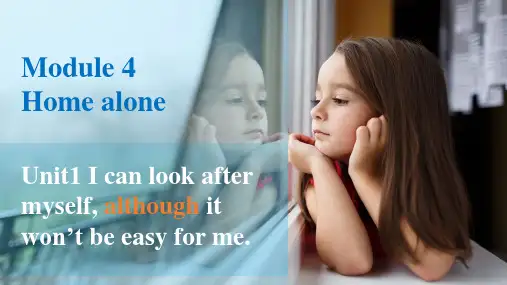
Betty will be home alone. Why? How long? Can she look after herself?
Listening Task2: Listen and choose the correct answer.
Reading Task3: Read and complete the table.
1.---Ms He can swim. --- So _____c_a_n_I_________. (我也会)
3. ---Ms He lives in Guangzhou. --- So _d_o_e_s_h_e_r__m_o_t_h_e_r___. (她妈妈也是)
4. --- Ms He has been to Beijing. --- So ____h_a_v_e__I________. (我也去了)
8. 留下很多饼干 9. 煮些简餐 10.叫醒某人 11.建议某人做某事 12.马上去… 13.马上将… 14.我们在拉萨的地址 15.发条短信给我 16.几个星期
leave lots of biscuits cook simple meals wake sb up advise sb to do sth go immediately to … be about to do sth our address in Lhasa send me a text message a couple of weeks
Think over:
Group work: Do and Don’t
Discuss what you can do and what you can’t do about living alone. And then choose one to make a report.
Module4Unit1课件初中英语九年级上册
6. text message 短信 Please send me a text message as soon as you get home. 你一到家就给我发个短信。
22
Discussion & Consolidation
Choose the correct answer.
address lock meeting passenger ring shut text message
1. “I haven’t given you our address in Lhasa!” This means you do not know where we are staying / what we are doing.
lock
15
Practice & Listening
Make a list of things that Betty can do and talk about why her parents don’t trust her to stay home alone.
Things that Betty can do: look after herself cook simple meals Why her parents don’t trust her to stay home alone: Because it won’t be easy for her to look after herself.
3. Have a good trip! 祝你旅行愉快! 祝福用语。
Module4_Unit1_课件

everyone will have lots of (8)_______ free time.
Read and choose the best answer to each question. 1. Will students go to school in the future? Yes, they will./No, they won’t. 2. Will they study at home? Yes, they will./ No, they won’t. 3. Will everyone send their homework by email? Yes, they will./ No, they won’t.
Then listen and read again.
Ms Li: Will schools be different in the future, Daming?
Daming: Yes, they will! In twenty years’ time, maybe
there won’t be any schools!
4. Will there be teachers? Yes, there will./ No, there won’t. 5. Will there be computers in school? Yes, there will./ No, there won’t. 6. Will we read books in the future? Yes, we will./ No, we won’t.
Listen and check the true sentences for Daming and Betty.
Betty Daming 1. Everyone will study at home in the future. 2. Everyone will send their homework to the teacher by email. 3. There will be computer on everyone’s desk in the future. 4. Everyone will use paper, pens and pencils.
Module4Unit1外研版英语九年级上册教案详解
举例:教师可提供一些表达观点的句型模板,如"I think...because...",帮助学生更好地参与讨论。
四、教学流程
(一)导入新课(用时5分钟)
同学们,今天我们将要学习的是《Module 4 Unit 1外研版英语九年级上册》中的"Healthy eating"。在开始之前,我想先问大家一个问题:“你们在日常生活中是否注意过自己的饮食习惯?”这个问题与我们将要学习的内容密切相关。通过这个问题,我希望能够引起大家的兴趣和好奇心,让我们一同探索健康饮食的奥秘。
4.学习能力:指导学生运用阅读策略,提高阅读效率,培养学生自主、合作、探究的学习能力,激发学习兴趣。
三、教学难点与重点
1.教学重点
(1)词汇:学生需要掌握的关键词汇,如balanced diet, nutrition, calorie, obese, slender等,并能运用这些词汇描述饮食习惯。
2.学习一般现在时态,了解其用法,并能在实际情境中运用;
3.学习阅读策略,如预测、扫描、略读等,提高阅读理解能力;
4.学习关于健康饮食的对话和文章,分析饮食习惯对身体的影响;
5.通过小组讨论,培养学生运用英语进行讨论和表达观点的能力;
6.完成与本单元相关的写作任务,描述自己的饮食习惯,并提出改进措施。
五、教学反思
在今天的教学过程中,我发现学生们对健康饮食这个话题非常感兴趣,这让我感到很高兴。在导入新课环节,通过提问学生们日常生活中的饮食习惯,成功引起了他们的好奇心,为接下来的学习打下了良好的基础。
在新课讲授环节,我尝试用简单明了的语言解释健康饮食的基本概念和重要性,并通过案例分析让学生们更直观地理解。同时,针对一般现在时态和健康饮食相关词汇这两个重点,我尽量用丰富的实例进行讲解,希望学生们能够更好地掌握。
Module4Unit1微课课件
Internet paper pen radio ruler satellite TV
Which group can make the most sentence in one minutes?
Name Group1 Group2 Group3 Group4
Score
Prize
What will our school be like in the future?
√
4.Everyone will use paper, pens and pencils.
Daming
√ √
1.Listen and answer:
Will there be schools in the future? Yes ,there will be.
2.Choose the best answer to each questions.
2.Will there be a radio and a TV in this room?
__Y_e__s_,_t__h_e_r_e__w__il_l.___________________
3.What will Mr. Johnson do this Sunday?
__H__e__w_i_ll__b_e__i_n__t_h_e___b_a_t_h_r_o_o__m__a_l_l__ the morning.
How will you go to school in the future?
The school bag will…
We will go to school…
What will your life be like in the future?
The shaver will … The machine will…
Module4Unit1知识点课件英语九年级上册
讲 表示即将发生的动作,在时间上指最近的将来。▶The new school year is about to begin. 新学年开学在即。▶I was about to ask you the same thing at that time.那时候我正要问你相同的事情。
特别提醒be about to do sth.不可与表示将来的具体时间连用,但可与when引导的时间状语从句连用。▶I was about to make chocolate pudding when my children got up.我的孩子们起床时,我正准备做巧克力布丁。
教材原句 See you in a couple of weeks! 两周之后见!(教材P26)
couple/ˈkʌpl/ n. 一对;两个
讲 couple作名词,在此意为"一对;两个",它还可意为"几个;夫妻"。a couple of意为"两个;几个"。▶A couple of boys were playing chess.两个男孩正在下国际象棋。▶I've got a couple of questions to ask my teacher. 我有几个问题想问我的老师。▶The couple have been married for thirty years.这对夫妇已经结婚30年了。