
2011级人教版八年级下册英语 Unit2 第二单元笔记+练习
八年级下册Unit 2 What should I do? 单元笔记一丶重点短语1.argue v.争论;争吵 argue with sb.与某人吵架I argued with my best friend.我和我的好朋友吵架了。
2.① either adv.(用于否定句)也He doesn’t have any money, and I don’t, either.他没有钱,我也没有。
I can’t play chess. She can’t, either.我不会下国际象棋,她也不会。
② too 也(用于肯定或疑问句)I’m a teacher.He is a teacher, too.我是老师,他也是老师。
3.ask (sb.)for sth.向某人寻求某物;要……Don't ask for food every day.Go and find some work.别天天要饭,找点儿工作做。
I don’t think you should ask your parents for some money.我想你不应向父母要钱。
4.the same as... 与……相同(注意前后两个比较对象的属性保持一致)The clothes are the same as my friends'.这些衣服与我朋友的一样。
Tom is the same age as Anna.= Tom is as old as Anna.汤姆和安娜一样大。
Her backpack is the same as mine. 她的背包与我的一样。
5.except 除……以外;(不包括……在内)My class has been invited except me.除我以外,我的同学都被邀请了。
All the students went to the park except him.除了他之外,全体同学都去过公园了。
They all traveled America except her. 除了她以外,所有的学生都去美国旅行过。
注意区别:besides 除……以外,还有...(包括在内)We all went there besides him.除他去以外,我们也都去了。
(= He went there.We went there, too.) 他也去了,我们也去了!/大家都去了!There are five more visitors besides me.除了我之外还有5名访客(加上我是6个)6.wrong adj.错误的;有毛病的;不合适的─ What's wrong with you? 你怎么了?(你哪里不舒服?)─ I've got a headache.我头痛。
What’s wrong with your watch? It doesn't work.你的手表怎么了?它不走了。
注意:What’s the matter with you?= What’s wrong with you ?=What’s the trouble with you? 你怎么了?/你出什么事了?7.get on(well) with sb.与某人相处(融洽)get on ( well ) with sth 某事进展地好The students will get on well with the teacher.学生会和老师相处得非常好。
How are you going on with your new friends? 你和你的新朋友相片如何?These days ,Mr Green gets on well with his new job.这些天,格林先生的工作进展很顺利8.have a fight with sb.= fight with sb.与某人打架I don‘t want to have a fight with my cousin.我不想和我的堂兄打架。
They never fight with each other.They are really goodfriends.他们从不打架,他们的确是好朋友。
二、主要句型(Key Sentences Structures)What should I do? You could write him a letter.What should he do? Maybe he should say sorry to himWhat should they do? They shouldn't argue.三、词语辨析1. borrow sth. from sb. 从某人处借进某物(借回来)lend sth. to sb. = lend sb. sth 把某物借给某人(借出去)注: borrow sth. from sb. 是指该句的主语从别人处(往里)借进某物例:He borrowed the dictionary from Lucy yesterday. 他昨天从露西处借了那本字典.lend sth. to sb. = lend sb. sth.是指该句的主语把某物(往外)借给别人用例如:Could you lend me your car?=Could you lend your car to me?请你借给我你的车用一下好吗?2. ①get sb. to do…使……做(以人为对象时,有“说服……使做……”的含义)He could get a tutor to come to his home. 他可以请一位家庭教师来他家。
You’ll never get her to agree.你决不可能使她同意。
②ask sb. to do…邀请(人)做……We asked her to come to our party.我们请她来参加聚会③ tell sb. to do…让某人做某事例如:The teacher told him to finish the work that day. 老师那天让他完成那项工作。
3、be in style 时髦的,流行的be out of style 过时的,不时髦的例: Look! Her new dress is in style.她的新裙子很时髦。
Those clothes are out of style. 那些衣服过时了。
四、课文解释1、I don’t want to surprise him. 我不想让他感到意外。
此处surprise是及物动词 surprise sb. 使某人感到吃惊eg. My friend always surprises me.2、talk about it on the phone 用电话就此事进行交流On the phone 在电话里。
不能使用 in the phone、eg. They talk about a lot on the phone yesterday.他们昨天在电话里谈了很多3、call sb. (up) =give sb. a call 给某人打电话4、write sb. a letter = write a letter to sb. 给某人写信5、give him a ticket to a ball game.给他一张观看球赛的入场券 (注意to 译为:...的)eg. They got two ticket s to tonight’s show.他们搞了两张今晚表演的入场券。
6、She has the same haircut as I do. 她和我有相同的发型。
eg. Tim has the same clothes as his brother does.提姆和他的弟弟有相同的衣服。
7、find out (经过某人的研究、努力)发现,查出,找出You should find out the answer for yourself.你应该自己去找答案。
8、Everyone else in my class was invited except me.除了我以外,我们班其他别的人都接到了邀请(信)此句中else一词不能单独使用,它必须跟在不定代词像“someone, anyone nobody”等词的后面,或跟在特殊疑问词像“what, where”等词的后面使用意思是“别的”eg. What else 别的什么, Who else 其他谁 someone else 其他人9、I can’t think what I did wrong.我真想不出我做错了什么。
此句中 what I did wrong是宾语从句,应用陈述语序(即:主语+动词)10、I’m very upset and don’t know what to do.我很沮丧,不知该干什么。
此句中 what to do是不定式作know的宾语,可用宾语从句来代替。
可以说成“I don’t know what I should do.”请大家背熟以下两个常见结构: I don’t know what to do .我不知道该做什么。
I don’t know how to do it. 我不知道该怎么去做它。
11、There are a lot of things you could do. 有许多你能做的事。
此句中 you could do是定语从句,修饰前面的名词“things”12、You left your homework at home.你把你的作业落在家里了。
leave sth. +介词短语,是“把……忘在,落在(某处)的意思。
eg. He left his umbrella on the bus.他把伞忘在公交车上。
注:千万不能根据汉语的说法写为:forget sth ,只能用leave sth.’表示“落下”13、You should try to be funny. 你应该试着幽默一些。
Try to do…努力做,试着做,尽量做而try not to do 是尽量不做……eg. Please try not to be late again. 请尽量不要再迟到。
14、Their school days are busy enough. 他们的学校生活是够忙的。
enough必须放在形容词/副词的后面,表示“足够……的”(后置)eg. He is tall enough to reach that apple. 他足够高的可以够着那个苹果。
15、be under too much pressure. 在太多的压力下16、see other children doing a lot of things 看别的孩子在做许多事see sb. doing 看见某人正在干某事(强调动作正在进行)See sb do sth 看见某人做过某事(强调动作已结束)eg. We saw them playing basketball at that time.那时我们看见他们在打篮球17、find it hard to do sth. 发现做……(事)很难He found it hard to learn math well. 他发现学好数学很难注:it 初中阶段常作:形式主语 /形式宾语,而句子真正的主语/宾语则由to do 来担当.八年级下册Unit 2 What should I do ? 练习题一丶单项选择1.I’m not good at math. I really don’t know________.A. what should I doB.how should doC.what to do2. My best friend is the same________. We are both 12 years old.A. as my ageB.age as meC.as me age3. Can you________ what time the meeting starts?A.find outB.look afterC.find4. My mother knows little about fashion. Her clothes are always________A.in styleB. Out of styleC.new and smart5. Dad, I don’t have enough money to buy a CD. Could you________me some?A.borrowB.lendC.keep6. Don’t argue________ your parents. It’s not polite.A.toB.forC.with7. “What should I do ?”“________ you could get________part-time job.”A.Maybe ,aB.May be ,/C.Really, a8.-You’d better not go out now. It’s raining.- It doesn’t matter. My new coat can keep________ the rain.A.inB.ofC.out9. It’s a beautiful coat. But he ________ only 30 dollars for it.A. paidB.boughtC.spent10.The weather is________ for us to go swiming.A.enough warmB.warm enoughC.too warm11.He________ his homework at home yesterday.A. leftB.leavesC.forgot12. Could you give me________ to eat? I’’m hungry.A.anythingB.somethingC.some thing13. If you are wrong, you should ________sorry ________others.A. talk, toB.say, toC.speak, about14. –I was told to be here before seven.- Oh, you________ .I’m sorry for not telling you that we have changed the plan.A. mustB.can’tC.needn’t15. – What’s wrong ________ your radio?- It doesn’t work.A. toB.withC.for二丶根据首字母及句意完成单词。
八年级下册英语笔记unit2

八年级下册英语笔记unit2Studying English in the eighth grade can be both challenging and rewarding. Learning a new language opens up opportunities for communication and understanding across borders. It may seem difficult at times to grasp new grammar rules and vocabulary, but perseverance is key. In the end, the ability to communicate in English can greatly benefit one's future, whether in education, career, or personal relationships.在八年级学习英语可能既具有挑战性又具有回报性。
学习一门新语言可以打开跨越国界的沟通和理解的机会。
有时候掌握新的语法规则和词汇似乎很困难,但坚持不懈是关键。
最终,用英语进行沟通的能力可能会极大地有益于个人的未来,无论是在教育、职业还是个人关系方面。
Unit 2 of the eighth grade English textbook covers a variety of topics, from daily routines to hobbies and interests. This unit allows students to practice using English in everyday scenarios, which can be both helpful and practical. By engaging with the material in Unit 2, students can improve their listening, speaking, reading, and writing skills in English. Additionally, learning about different cultures andcustoms through the unit can broaden one's worldview and enhance cultural awareness.八年级英语教科书的第二单元涵盖了各种主题,从日常生活到爱好和兴趣。
八年级下册英语_Unit2_第二单元笔记+练习 (1)

八年级下册Unit 2 What should I do? 单元笔记一丶重点短语1.argue v.争论;争吵argue with sb.与某人吵架I argued with my best friend.我和我的好朋友吵架了。
2.① either adv.(用于否定句)也He doesn’t have any money, and I don’t, either.他没有钱,我也没有。
I can’t play chess. She can’t, either.我不会下国际象棋,她也不会。
② too 也(用于肯定或疑问句)I’m a teacher.He is a teacher, too.我是老师,他也是老师。
3.ask (sb.)for sth.向某人寻求某物;要……Don't ask for food every day.Go and find some work.别天天要饭,找点儿工作做。
I don’t think you should ask your parents for some money.我想你不应向父母要钱。
4.the same as... 与……相同(注意前后两个比较对象的属性保持一致)The clothes are the same as my friends'.这些衣服与我朋友的一样。
Tom is the same age as Anna.= Tom is as old as Anna.汤姆和安娜一样大。
Her backpack is the same as mine. 她的背包与我的一样。
5.except 除……以外;(不包括……在内)My class has been invited except me.除我以外,我的同学都被邀请了。
All the students went to the park except him.除了他之外,全体同学都去过公园了。
八年级下册人教版英语笔记

八年级下册人教版英语笔记一、Unit 1 What's the matter?1. 重点单词。
- matter:n. 问题;事情。
常用搭配:What's the matter (with sb.)? = What's wrong (with sb.)? = What's the trouble (with sb.)?(某人)怎么了?- sore:adj. 疼痛的;酸痛的。
例如:a sore throat喉咙痛。
- stomachache:n. 胃痛;腹痛。
- foot:n. 脚;足。
复数形式是feet。
- neck:n. 脖子;颈部。
- fever:n. 发烧。
have a fever发烧。
- lie:v. (lay - lain)躺;平躺。
lie down躺下。
- rest:v. & n. 放松;休息。
take breaks/take a break = have a rest休息。
- cough:v. & n. 咳嗽。
have a cough咳嗽。
- toothache:n. 牙痛。
2. 重点短语。
- have a cold:感冒。
- have a stomachache:胃痛。
- lie down and rest:躺下休息。
- drink some hot tea with honey:喝些加蜂蜜的热茶。
- see a dentist:看牙医。
- get an X - ray:拍X光片。
- take one's temperature:量体温。
3. 重点句型。
- What should I do? 我应该做什么?- You should see a dentist and get an X - ray. 你应该去看牙医并拍X光片。
- Should I put some medicine on it? 我应该在上面敷些药吗?- Yes, you should. / No, you shouldn't. 是的,你应该。
八年级下册2单元笔记英语
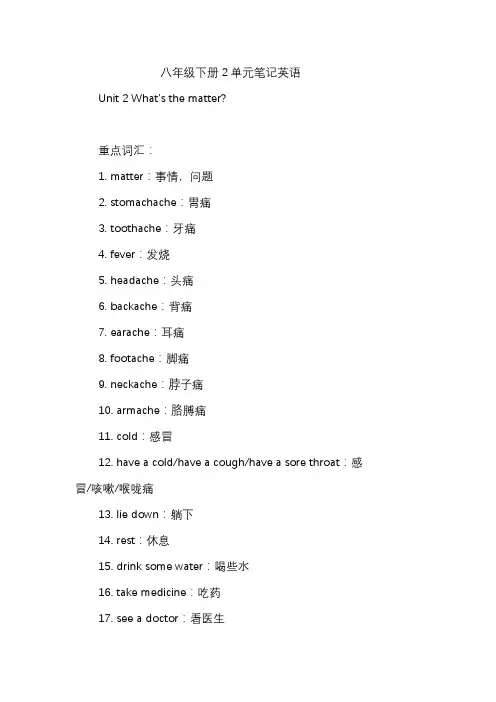
八年级下册2单元笔记英语Unit 2 What's the matter?重点词汇:1. matter:事情,问题2. stomachache:胃痛3. toothache:牙痛4. fever:发烧5. headache:头痛6. backache:背痛7. earache:耳痛8. footache:脚痛9. neckache:脖子痛10. armache:胳膊痛11. cold:感冒12. have a cold/have a cough/have a sore throat:感冒/咳嗽/喉咙痛13. lie down:躺下14. rest:休息15. drink some water:喝些水16. take medicine:吃药17. see a doctor:看医生18. go to bed early:早睡19. eat healthy food:吃健康的食物20. exercise:锻炼重点句型:1. What's the matter?:怎么了?2. I have a … 我有一个……(如toothache、fever等)3. I have a … and … 我有一个……和……(如 a toothache and a headache等)4. I have a …,a … and a … 我有一个……,一个……和一个……(如a stomachache, a cold and a sore throat等)5. I feel … 我感觉到……(如tired, hot等)6. I need to … 我需要……(如lie down, rest等)7. You should … 你应该……(如drink some water, take medicine等)8. You should go to bed early. 你应该早睡。
9. You should eat healthy food. 你应该吃健康的食物。
八年级下册人教版英语书unit2笔记
八年级下册人教版英语书unit2笔记English:In Unit 2 of the 8th grade People's Education Press English book, the main focus is on the theme of “School Life”. The unit covers topics such as school subjects, school rules, school facilities, and extracurricular activities. Students will learn vocabulary related to different subjects, rules and regulations in school, and the names of various facilities in a school. They will also be introduced to different extracurricular activities that students can participate in, such as sports, music, and art. The unit includes reading passages, dialogues, and grammar points related to the theme of school life, allowing students to practice their reading and listening skills while also understanding the proper usage of grammar in context.中文翻译:人教版八年级下册英语书第二单元的重点主题是“学校生活”。
该单元涵盖了课程科目、校规、校设施和课外活动等主题。
人教部编版八年级英语下册第二单元笔记重点汇总(可直接打印)

人教部编版八年级英语下册第二单元笔记重点汇总(可直接打印)Unit2笔记11.分发食物give out food/hand out food2.打扫干净clean up3.使…更高兴cheer sb. up4.想出,提出come up with5.推迟put off6.打电话给某人call up7.曾经/过去used to8.照顾care for9.帮忙做… help out with10.Offer help(提供帮助):I hope to work outside.I’d like to help homeless people.I want to cheer up sick people.11.give suggestion(给出建议):You could…12.动词不定式的用法:①作状语(表目的)You could visit sick children in hospital to cheer them up. You could give out food at the food bank to help feed them. You could help to clean up the city parks.②做宾语(用在动词之后)I hope to work hard.I’d like to help homeless people.I want to cheer up sick people.Unit2 21.希望去外面工作hope to work outside2.帮助摆脱饥饿help stop hunger(名词)3.食物赈济处food bank4.课后学习活动an after-school study program5.想出/提出一个计划come up with a plan6.推迟制定计划put off making a plan7.张贴标语put up signs8.写一些公告make some notices9.需要做某事need to do …10.在敬老院in an old people’s home11.让某人做某事ask sb. to do …12.帮助解决某事help out with sth.13.给我讲过去的故事tell me stories about past14.是孤独的/感觉孤独be lonely / feel lonely15.听/倾听listen to16.照顾他们care for themSection A 3a 笔记1.students who volunteer 做志愿服务的学生2.give up several hours to do sth.花费几个小时去做某事(动词不定式表目的)spend several hours doing sth. 花费几个小时做某事3.give up doing sth. 放弃做某事4.get such a strong feeling of satisfaction/joy 产生如此强烈的满足感/喜悦感get a feeling of happiness / joy / being helpful / satisfaction 产生幸福/快乐/助人/满足感5.the look of joy 快乐的表情6.on their owners’ faces 在他们主人们的脸上7.at the age of 4 在四岁的时候8.try out for…参加…的选拔9.go on a different journey 进行一次不一样的旅行10.a dream come true 梦想成真… is a dream come true for me.↓(名词/动名词)例:Volunteering here is a dream come true for me.Going on vacation in Yunnan is a dream come true for me.11.at the same time 同时Grammar Focus动词不定式的用法:(必须掌握三种基本用法)一、动词不定式作宾语:(用于动词之后)①want to do sth.②hope to do sth.③try/decide等等之后跟to do sth.二、作宾补(用于宾语之后)①would like sb. to do sth.②tell sb. to do sth.③ask / want / allow等等三、作状语1.We make some signs to put up around the school. (表目的)2.be+adj.(表示心情)+to do(作原因状语)I am sorry to trouble you. 补充其他用法:四、作主语:To be an engineer is my dream.五、作表语(用在be动词之后)His aim is to win the first prize.六、作定语:I’d like something to drink.(喝的东西)七、特殊疑问词+to do sthI don’t know how to plant a tree.Section B (1a-1e) 笔记1、take after=be similar to 与……像,相似(外貌、行为方面)look after 看起来像(多指外貌)2、修理:fix up fix it up (代词放中间)修理:repair修补:mend3、give away sth. to sb. 把某物赠送给某人give away 赠送,泄露give up 放弃give in (to) 屈服,投降give out 分发,用完耗尽4、broken bicycle parts 损坏的自行车部分My bike is broken. 我的自行车坏了。
人教版八年级下册英语Unit2笔记+练习(精心制作很实用!)
八年级下册Unit 2 What should I do? 单元笔记一丶重点短语1.① either adv.(用于否定句)也He doesn’t have any money, and I don’t, either.他没有钱,我也没有。
I can’t play chess. She can’t, either.我不会下国际象棋,她也不会。
② too 也(用于肯定或疑问句)I’m a teacher.He is a teacher, too.我是老师,他也是老师。
2.argue v.争论;争吵 argue with sb.与某人吵架I argued with my best friend.我和我的好朋友吵架了。
3.the same as... 与……相同(注意前后两个比较对象的属性保持一致)The clothes are the same as my friends'.这些衣服与我朋友的一样。
Tom is the same age as Anna.= Tom is as old as Anna.汤姆和安娜一样大。
Her backpack is the same as mine. 她的背包与我的一样。
4.ask (sb.)for sth.向某人寻求某物;要……Don't ask for food every day.Go and find some work.别天天要饭,找点儿工作做。
I don’t think you should ask your parents for some money.我想你不应向父母要钱。
5.wrong adj.错误的;有毛病的;不合适的─ What's wrong with you? 你怎么了?(你哪里不舒服?)─ I've got a headache.我头痛。
What’s wrong with your watch? It doesn't work.你的手表怎么了?它不走了。
八年级下册英语书笔记第二单元
八年级下册英语书笔记第二单元English:In the second unit of the eighth-grade English textbook, students will be learning about different cultures and traditions around the world. They will study various customs, foods, holidays, and clothing from countries such as China, Mexico, India, and Kenya. Through readings, videos, and discussions, students will broaden their understanding of diversity and tolerance. They will also have the opportunity to compare and contrast their own culture with those of others, fostering a sense of empathy and respect for people from all backgrounds. In addition, this unit will emphasize the importance of cultural awareness and sensitivity in our interconnected world, encouraging students to be open-minded and accepting of differences. By the end of the unit, students will have a more global perspective and a greater appreciation for the richness of human culture and heritage.中文翻译:在八年级英语教材的第二单元中,学生将学习世界各地不同的文化和传统。
八年级下册英语第2单元笔记
八年级下册英语第2单元笔记English: In Unit 2 of the eighth grade English textbook, students will learn about the topic of challenges. This unit covers various aspectsof facing and overcoming challenges, such as setting goals, making plans, seeking help, and staying positive. Students will also focus on vocabulary related to challenges, as well as different strategies for dealing with difficult situations. Through reading passages, listening exercises, and interactive activities, students will not only improve their language skills but also develop a growth mindset that will help them navigate challenges both in and out of the classroom. By the end of the unit, students will have a better understanding of how to approach obstacles with determination and resilience, ultimately building their confidence and ability to succeed in the face of adversity.中文翻译: 在八年级英语教科书的第二单元中,学生将学习关于挑战的主题。
英语八下第二单元笔记
英语八下第二单元笔记The second unit of English class in eighth grade covers various topics such as wildlife conservation, environmental protection, and the importance of biodiversity. 这门英语课八年级第二单元涵盖了各种主题,如野生动物保护、环境保护以及生物多样性的重要性。
One of the key lessons in this unit is the impact of human activities on the environment, specifically how deforestation, pollution, and habitat destruction affect ecosystems and wildlife. 这个单元的一个关键教训是人类活动对环境的影响,特别是森林砍伐、污染和栖息地破坏对生态系统和野生动物的影响。
Through studying this unit, students can gain a better understanding of the interconnectedness of all living things and the importance of preserving natural habitats for future generations. 通过学习这个单元,学生们可以更好地理解所有生物之间的相互联系,以及为了子孙后代保存自然栖息地的重要性。
Moreover, students will also learn about the role of national parks and wildlife reserves in protecting endangered species andpromoting biodiversity. 此外,学生们还将了解国家公园和野生动物保护区在保护濒危物种和促进生物多样性方面的作用。