
英语形容词翻译小技巧
英语和汉语语言结构和表达习惯有很多差异之处,翻译时往往能死扣原文逐词逐句译出。
本文拟谈谈形容词的翻译问题:
一、一些原义并无否定意思的形容词和别的词搭配,有时可译成否定句。
1. These goods are in short supply.
这些货物供应不足。
2. This equation is far from being complicated.
这个方程一定也不复杂。
二、为了使译文自然流畅,读起来顺口,在一些形容词前可根据上下文内容加上副词“很”、“最”等字。
1. It was as pleasant a day as I have ever spent.
这是我度过最愉快的一天。
2. It is easy to compress a gas.
气体很容易压缩。
三、有时可将英语的“形容词+名词短语”译成汉语的主谓结构。
1. She spoke in a high voice.
她讲话声音很尖。
2. This engine develops a high torque.
这台发动机产生的转矩很大。
四、如果一个名词前有几个形容词修饰,英译时应根据汉语习惯决定其顺序。
1. a large brick conference hall
一个用砖砌的大会议厅
2. a plastic garden chair
一把在花园里用的塑料椅子
五、英语中一些表示知觉、情感、欲望等心理状态的形容词,同连系动词构成复合谓语时,翻译时可将形容词译成动词。
1. You are ignorant of the duties you undertake in marrying.
你完全不懂你在婚姻方面承担的责任。
2. Such criticisms have become familiar in his later commentaries on America.
类似的批评在他后来写的评论美国的文章中屡见不鲜。
3. He is truly sorry for his past, and he has undertaken to give up motorcars entirely and for ever.
他诚恳地忏悔过去,并保证永远不再玩汽车。
六、由于语言习惯不同,英语里的形容词有时译成汉语副词。
1. I am going to be good and sweet and kind to every body.
我要对每一个人都亲切、温柔、甜蜜。
2. He asked me for a full account of myself and family.
他详尽地问起我自己和我家里的情况。
3. Another war will be the absolute end of our country.
再来一次战争将彻底毁灭我们这个国家。
从以上几个方面可以看出,译好形容词是使译文通顺、流畅的一个环节。
初中英语语法形容词副词
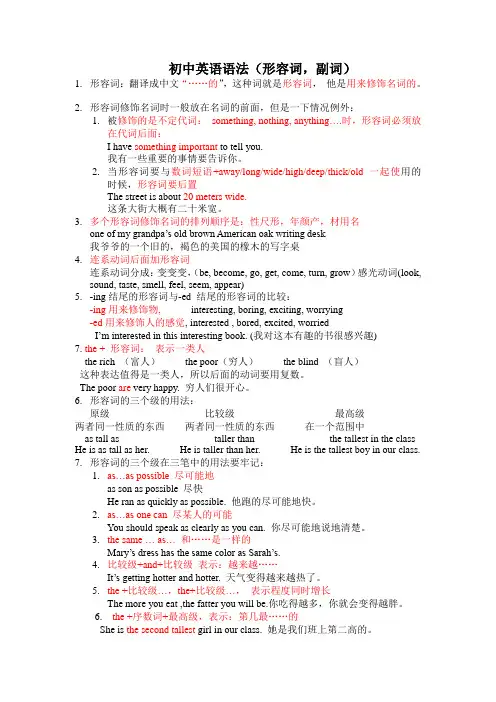
初中英语语法(形容词,副词)1.形容词:翻译成中文“……的”,这种词就是形容词,他是用来修饰名词的。
2.形容词修饰名词时一般放在名词的前面,但是一下情况例外:1.被修饰的是不定代词:something, nothing, anything….时,形容词必须放在代词后面:I have something important to tell you.我有一些重要的事情要告诉你。
2.当形容词要与数词短语+away/long/wide/high/deep/thick/old 一起使用的时候,形容词要后置The street is about 20 meters wide.这条大街大概有二十米宽。
3.多个形容词修饰名词的排列顺序是:性尺形,年颜产,材用名one of my grandpa’s old brown American oak writing desk我爷爷的一个旧的,褐色的美国的橡木的写字桌4.连系动词后面加形容词连系动词分成:变变变,(be, become, go, get, come, turn, grow)感光动词(look, sound, taste, smell, feel, seem, appear)5.-ing结尾的形容词与-ed 结尾的形容词的比较:-ing用来修饰物,interesting, boring, exciting, worrying-ed用来修饰人的感觉, interested , bored, excited, worriedI’m interested in this interesting book. (我对这本有趣的书很感兴趣)7. the + 形容词:表示一类人the rich (富人)the poor(穷人)the blind (盲人)这种表达值得是一类人,所以后面的动词要用复数。
The poor are very happy. 穷人们很开心。
6.形容词的三个级的用法:原级比较级最高级两者同一性质的东西两者同一性质的东西在一个范围中as tall as taller than the tallest in the class He is as tall as her. He is taller than her. He is the tallest boy in our class.7.形容词的三个级在三笔中的用法要牢记:1.as…as possible 尽可能地as son as possible 尽快He ran as quickly as possible. 他跑的尽可能地快。
英语介词和形容词的翻译
英语介词的翻译英语中大多数介词含义灵活,一词多义多用。
除了一些常用短语已有译法外,大量介词需要从其基本意义出发,联系上下文加以灵活处理。
下面简明地介绍几种基本译法。
(1)转译:英语中常用介词来表达动作意义。
汉译时,可将介词转译成动词。
①在作表语的介词短语中,介词常转译为动词,而连系动词则省略不译。
如:This machine is out of repair.这台机器失修了。
②在作目的或原因状语的介词短语中,介词有时转译成动词。
如:The plane crushed out of control.这架飞机失去控制而坠毁。
The letter E is commonly used for electromotive force.通常用E 这个字母表示电动势。
③在作条件、方式或方法状语的介词短语中,介词有时转译成动词。
如:But even the larger molecules with several hundred atoms are too small to be seen with the best optical microscope.但是,即使有几百个原子的分子也是太小了,用最好的光学显微镜也看不见它们。
④介词短语作补足语时,其中介词常转译成动词。
如:Heat sets these particles in random motion.热量使这些粒子作随机运动。
(2)增译:增词不是无中生有,而是要根据上下文特别是与介词搭配的动词或形容词的含义加得恰当。
有不少情况,句中与介词搭配的动词或形容词不出现,如照原文结构无法把意思表达清楚,甚至易于误解时,这就需要增词。
如:That's all there is to it.那就是与此有关的全部内容。
(原句中 to=related to)The engineer was taken ill with consumption. It was flour on the lungs, the doctor told him at the time.这个工程师得了肺一病、那是由于面粉对肺部的影响,当时医生这样对他说的。
英语翻译技巧

例22:Most novelists and historians writing in the early to mid-twentieth century who considered women in the West, when they considered women at all, fell under Turner’s spell.
译文:不间断的移民浪潮也起了作用 —— 而且 随着昔日在 “ 生育高峰期 ” 出生的一代人达到 生育年龄,婴儿的出生数量增加了,这同样起 了作用。
例19: Only when you have acquired a good knowledge of grammar can you write correctly.
译文:油箱里装满优质汽油倒是好事,但是驾驶 室里坐着横冲直撞的司机那就完全是另一回事了。
2、抽象化
例6:Every life has its roses and thorns.
译文:每个人的人生中都有酸甜苦辣。
3、具体化
例7:he is somebody in his home town but nobody here.
译文:油箱里装满优质汽油倒是好事,但是驾驶 室里坐着横冲直撞的司机那就完全是另一回事了。
2、抽象化
例6:Every life has its roses and thorns.
译文:每个人的人生中都有酸甜苦辣。
3、具体化
例7:he is somebody in his home town but nobody here.
例12:All the wounded were sent to the hospital right away.
英语翻译形容词翻译六大技巧

riesonAmerica.类似的批评在他后来写的评论美国的 文 章 中 屡 见 不 鲜 。
3.Heistrulysorryforhispast,andhehasundertakent ogiveupmotorcarsentirelyandforever.他诚恳地忏
尽地问起我自己和我家里的情况。从以上六点可以看 出,英语翻译中翻译好形容词是使译文通顺、流畅的一 个重要环节。
1.alargebrickconferencehall 一个用砖砌的大
会议厅。
2.aplasticgardenchair 一把在花园里用的塑料 椅子。
四、为了使译文自然流畅,读起来顺口,在一些形
容词前可根据上下文内容加上副词“很”、“最”等字。
1.ItwasaspleasantadayasIhaveeverspent.这是我度
个方程一定也不复杂。
二、有时可将英语的“形容词+名词短语”译成汉
语的主谓结构 1.Shespokeinahighvoice.她讲话声音 很尖。2.Thisenginedevelopsahightorque.这台发动
机产生的转矩很大。
三、如果一个名词前有几个形容词修饰,英译时应 根据汉语习惯决定其顺序。
悔过去,并保证永远不再玩汽车。 六、由于语言习惯不同,英语里的形容词有时译成
汉
语
副
词
。
1.Iamgoingtobegoodandsweetandkindtoeverybody.
我要对 每一 个人 都亲 切、 温顺 、和 善。
2.Heaskedmeforafullaountofmyselfandfamily.他详
形容词与副词的翻译

湖北师范大学外国语学院大学英语部
第四讲 英语形容词和副词的
翻译
英语形容词的翻译
1.英语形容词,转换成汉语副词 2.英语中be+形容词,转换成汉语谓语动词 3.英语中同源形容词,转换成汉语动词 4.英语形容词,转换成汉语名词
1.英语形容词,转换成汉语副词
• The modern world is experiencing rapid development of science and technology.
• 我第一次离开家这么长时间,所以有些想家了。
• It is the first time for me to be away from home so long, so I am homesick now.
• 考前我对自己很有信心,但现在我说不准自己是否 考得很好。
• Before the exam, I was confident of myself. But now I’m not sure whether I did well in the exam.
• 他为人宽容、富有爱心,朋友们都很喜欢 他。
4.英语形容词,转换成汉语名词
• the needy 穷人 • the unemployed 失业者 • the handicapped 残疾人 • the rich are not always happy. • 富人未必总是幸福的。 • Nylon is nearly twice as strong as natural silk. • 尼龙的强度几乎是天然丝的两倍。
• 校方很支持我们的计划. • The school authority is very supportive of our plan. • 不要总是批评别人的工作. • Don’t always be critical of others’ work all the time. • 一种文化及其语言就像大脑与身体一样不可分割. • A culture and its language are as inseparable as brain and
论英语形容词的中文翻译
论英语形容词的中文翻译摘要:讨论了英语形容词中译过程理解与表达两个重要环节,以达到把准确生动表达出原文修饰词与被修饰对象的关系,创造出生动,鲜明,充满美感的译文。
关键词:准确理解充分表达忠实流畅形容词在英语的数量仅次于名词和动词,它是用来描述人物,事物或地点的性质,因此形容词的翻译十分重要。
准确,生动的译文会令被修饰词生动的呈现在读者面前。
翻译包括理解和表达两个步骤,而准确度理解是表达的基础。
理解方面谈到理解形容词应该注意的三点:一,根据上下文的语境来确定词义;二,要注意区别主观和客观形容词;三,要注意区分形容词作定语和表语意义的不同。
这就要求在翻译过程中要勤查字典,品味词义。
由于英语和汉语是在不同的文化背景下形成的两种截然不同的语言,在表达过程中为保证词义不变,汉语在许多方面要做适当调整,以达到忠实,流畅,符合汉语的表达习惯。
在用汉语表达过程中,涉及到三个方面:一,英语形容词汉译时词类的转换;二,英语形容词汉译时词语的增加;三,汉语“四字格”和叠词的运用。
总之,翻译英语形容词时,根据上下文准确理解词义是关键的一步,充分表达是第二步。
同时,我们也应该充分利用汉语的优势使译文生动,鲜明,充满美感,但不能一味的追求华丽的词藻而超过“信”的范围。
1 IntroductionIn English,there are a large number of adjectives,the number of which is just smaller than that of nouns and verbs. English adjectives are used to describe the quality of people,things,places etc.So the translation of English adjectives is very important.An accurate and vivid translation will make our versions full of color.“Translation is a kind of re-creation. The process of translation must go through two steps:comprehending the original and creatively using ano ther language to reproduce it”(Xiao,19).Thus accurate comprehension is the foremost concern in translation.2 Comprehension of English adjectivesWhen we talk about the comprehension of English adjectives,three points should be mentioned.2.1 Comprehend the meanings of adjectives according to the definite contexts.Some English adjectives have many meanings which usually vary with different contexts.So we must deal with them carefully and confine the meanings through contexts.For example,“green”is a comm on adjective,its basic meaning is a color between blue and yellow in thespectrum or the color of growing grass,like“as green as grass”(像青草般绿的).When used to describe fruit,it means that the fruit is unripe,like “apples too green to eat”(生得不能吃的苹果).When used to describe a person,it means the person is immature, inexperienced and easily fooled,like“a green young novice”(无经验的年轻新生).When used to describe someone’s spirits,it means someone is full of vigor,like,“live to green old age”(老当益壮).When used to describe someone’s attitude,it means someone is extremely envious,like,“I was absolutely green when I saw his splendid new car”(我看到他那辆漂亮的新车很眼红).From the examples,we can conclude that the impact of contexts on adjective meanings is great.Besides we must also pay attention to the commendatory or derogatory meanings of adjectives in different contexts according to the writer’s different feelings.For example:They enjoyed every bit of the communist’s simply,unsophisticated hospitality.他们处处受到共产党员的淳朴的,真心诚意的款待。
英汉翻译技巧词性转换
英汉翻译技巧词性转换本文档旨在提供关于英汉翻译中词性转换的技巧和策略。
通过深入讨论和实例分析,帮助读者学会在英汉翻译过程中准确转换单词的词性,以保持语义的连贯和准确。
词性转换的定义和意义理解词性转换在翻译中的重要性解释词性转换的定义和基本原则名词和形容词的转换名词转换为形容词的常见方法和技巧形容词转换为名词的常用策略和实例动词和名词的转换动词转换为名词的常见规则和实践名词转换为动词的常用方式和示例副词和形容词的转换副词转换为形容词的技巧和策略形容词转换为副词的常见方法和实例例句分析与实践提供一些实际例句进行分析和转换实践深入探讨例句中词性转换的技巧和注意事项总结与扩展对本文档中所涉及的词性转换技巧进行总结和回顾提供更多补充资料和延伸阅读资源请注意,本文档的目标是提供简洁明了的指导,避免复杂的法律问题并独立进行决策。
导言请注意,本文档的目标是提供简洁明了的指导,避免复杂的法律问题并独立进行决策。
导言英汉翻译技巧词性转换》是一本重要的翻译技巧手册,它涉及到了词性转换在英汉翻译中的应用。
词性转换指的是将一个词的词性从一种转换为另一种,以达到更恰当地表达原文含义的目的。
英汉翻译技巧词性转换》是一本重要的翻译技巧手册,它涉及到了词性转换在英汉翻译中的应用。
词性转换指的是将一个词的词性从一种转换为另一种,以达到更恰当地表达原文含义的目的。
词性转换在翻译过程中具有广泛的应用领域。
它可以帮助翻译者解决一些句子难以准确翻译的问题,提高翻译质量和可读性。
无论在文学作品、商务文件还是学术论文等领域,词性转换都起到了不可忽视的作用。
在《英汉翻译技巧词性转换》中,我们将介绍一些简单且没有法律复杂性的策略和技巧,旨在帮助翻译者更好地掌握词性转换的方法。
我们鼓励翻译者发挥自己的优势,并遵循简洁明了的原则,不引用无法确认的内容。
无论是英汉互译还是汉译英,词性转换都是一个关键技巧。
通过研究和掌握《英汉翻译技巧词性转换》,您将能够更好地处理词性转换的问题,提升翻译水平。
大学英语四级考试5个翻译技巧
英语四级考试考前必知:5个翻译技巧①在翻译前,先确定可以正确理解文章意思。
即便遇到很难的说法,也可以先变成简单的中文再进行翻译。
如:年夜饭译:The annual reunion dinner析:指过年的那顿团圆饭,每年一次。
所以在翻译时要表达出这个团聚的含义②中文没有过去式,但是英文有啊,别忘记翻译时态的转换如:我在第一段说过,我刚从大学毕业。
译:As I said in my first paragraph, I was fresh from college。
析:中文的时态是依赖一些汉字表达,英文根据动词的变化形式展示。
文中的“过”英文采用一般过去时翻译③有些介词可能会帮到忙,比如with+ 名词的结构,就很多见。
如:这里有许多山脉,生长着大片的森林,贮藏着丰富的矿产。
译:There are mountain ranges here with extensive forests and rich mineral resources。
析:生长和储藏这两个动词在译文中并没有以动词的形式翻译,转译为英文的介词④应用英语的固定句型,这些句式可以加分,绝对是亮点如:是巴斯德发现了疾病是由活着的病菌引起的。
译:It was Pasteur who discovered that diseases are caused by living germs。
析:此句应用了英文的强调句进行翻译⑤分析上下句之间的逻辑关系,添加一些简单的连词,英文的译文会更漂亮。
如:汽油贵得惊人,我们就很少用车。
译:Because the price of gasoline was fantastically high, we seldom used our cars。
析:在原文中并没有出现表示原因类的词汇,但是在译文中根据两个句子之间的逻辑关系添加了表示原因的从句连词四六级复习秘笈:一、词类转译技巧在翻译过程中,有些句子可以逐词对译,有些句子则由于英汉两种语言的表达方式不同,就不能逐词对译,只能将词类进行转译之后,方可使译文显得通顺、自然;对词类转译技巧的运用须从四个方面加以注意。
the+形容词;增译法
the+形容词;增译法增译法是一种翻译技巧,通过在翻译中加入形容词以增加文章的表达力和文化内涵。
本文将以英语中的形容词为例,介绍增译法的相关内容。
在英语中,形容词起着描述事物特征和性质的作用。
通过增译法,我们可以进一步丰富形容词的含义,让翻译更加生动、准确。
下面将列举一些常见的英语形容词,并给出增译的参考内容。
1. Beautiful (美丽的)增译:gorgeous(华丽的)、stunning(令人惊叹的)、breathtaking(令人叹为观止的)参考句子:She wore a gorgeous dress to the party and caught everyone's attention.(她穿了一件华丽的裙子去参加派对,吸引了所有人的注意力。
)2. Interesting (有趣的)增译:captivating(迷人的)、fascinating(引人入胜的)、engaging(令人感兴趣的)参考句子:The book is fascinating and kept me engaged till the last page.(这本书非常引人入胜,让我一直追看到最后一页。
)3. Delicious (美味的)增译:scrumptious(美味可口的)、mouthwatering(令人流口水的)、delectable(美味的)参考句子:She cooked a scrumptious meal for us and we couldn'tresist the delicious aroma.(她为我们烹制了一顿美味的饭菜,我们忍不住被那股美味的香气吸引。
)4. Happy (快乐的)增译:exuberant(热情洋溢的)、blissful(幸福快乐的)、joyful(快乐的)参考句子:They were exuberant with joy when they received the good news.(他们收到好消息时充满了喜悦。
形容词作状语翻译技巧
英语中形容词(短语)作状语翻译技巧初探余明朝陕西省商南县高级中学修饰动词、形容词、副词以及全句的句子成分叫状语。
英语中形容词(短语)作状语是众多状语之一。
鉴于英、汉两种语言理解和表达的差异,如何将英语中形容词作状语的句子翻译成准确而通顺的汉语呢?本文拟就此类句子的翻译技巧作初步探究。
一、词类转译法。
即把形容词(短语)翻译成动词。
1.The thief hid himself in the corner,afraid of being caught.小偷躲藏在角落里,担心被人捉住。
2.They broke into the uncle’ bedroom and found the man lying on the floor,dead.他们强行冲进叔叔的卧室,发现那个人躺在地板上,已经死了。
二、成分转译法。
即把形容词(短语)作状语翻译成汉语的形容词作定语。
3.He is a man, honest and earnest, diligent and industrious.他是个老老实实、勤勤恳恳的人。
4.The people of St Petersburg,strong,proud and united,are the modern heroes of Russia.坚强、自豪、团结的圣彼得堡人民是当代的俄罗斯英雄。
三、顺序法。
即按英语原文的顺序翻译。
5.Strange, he should have done such a thing!奇怪,他竟做了这样一件事6.Even more important, he is in charge of the project.更重要的是,他负责这项工程。
7.He returned from war, safe and sound.他从战争中归来,安然无恙。
四、前置法。
即把英语的后置状语翻译成汉语的前置状语。
8.The lost boy spent 3 days in the forest, cold and hungry.那个迷路的男孩又冷又饿地在森林中过了三天。