
剑桥(Join In)版六年级英语上册Unit 4 Accidents 教学课件
外研剑桥版英语六年级上册教案Unit4 Accidents Part4
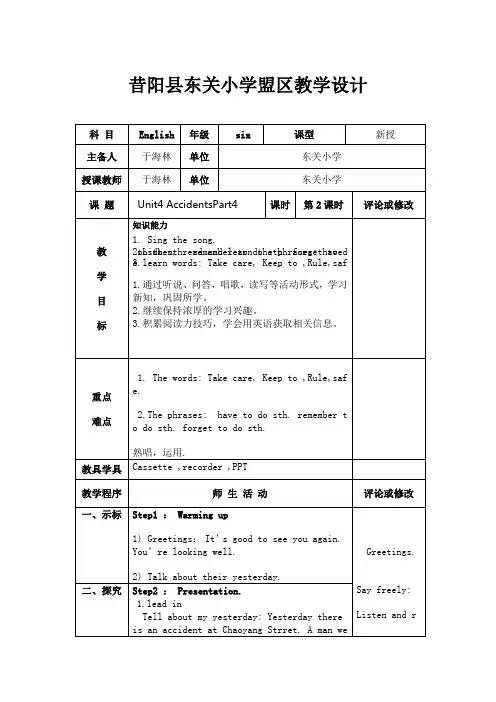
科目
English
年级
six
课型
新授
主备人
于海林
单位
东关小学
授课教师
于海林
单位
东关小学
课题
Unit4AccidentsPart4
课时
第2课时
评论或修改
教
学
目
标
知识能力
1. Sing the song.
2.Listen, read and learn the phrases: have to do sth. remember to do sth. forget to do sth.
2.The phrases: have to do sth. remember to do sth. forget to do sth.
教学难点
熟唱,运用.
教具学具
Cassette ,recorder ,PPT
教学程序
师生活动
评论或修改
一、示标
Step1:Warming up
1) Greetings:It’s good to see you again. You’re looking well.
Don’t forget to _________ _______
your pads.
Listen and read after the tape.
.Do Exx.
板
书
设
计
Unit4 Part4
Take care when you ride your bike.
Wear your helmet so that you’re safe.
5.Please sing the third ,fourth and fifth paragraph.
六年级上册英语课件-Unit 4 Accidents Join in 剑桥英语(共28张PPT)

Let's learn new words. The doctor gave me medicine some medicine. plaster
The doctor put my leg in plaster.
The doctor/My mum/ My friends put a bandage round my leg.
What happened
When
accident
Where to go treatments (治疗)
ending
一、找出下列词划线部分有几种发音:
1. A. stickers picture
B. comics C. thief D. 2 C.
2. A. autograph B. collect postcard D. crocodile 3 3. A. elephant D. phone
bandage
When I was..., I ....
hand
knee
toe
head
I hurt my… I cut my…
When I was
nine ... on holiday in ... ...ing
arm
I broke my neck
foot
I went to a hospital/ a doctor. The
4.________ What can I do ? 5.________ What shall we do ? 6.- ___________ How much is the book ? -20 yuan. 7.- ___________ How many books have you got ? - 11books. 8.- __________ do we need ? - Hot dog. What 9.- __________ are you ? How old - I’m 11 years old. 10.- __________ is your friend? -LiLing. Who 11.- _________are you ? -I’m fine ? How 12.- ____________ How often can you jump in a minute ? – 20 times.
六上Unit 4故事部分教案

Unit 4 Accidents
Designer:Ms Tao
4.从不同方面看待事故,给故事新的标题。
(迁移创新)8.Discuss:Does the cut
only bring bad luck?
9.Think of a better
title.
10.Read a poem.
An accident is not
scary.
Find a way to cope with
it
Even if it is NOT easy.
Bad luck leaves quickly.
Good luck comes for me.
观察学生能否根据故
事内容表达自己的想
法,并想出更合适的
标题。
在学生需要时
给予帮助。
设计意图:本阶段学习活动旨在帮助学生在迁移的语境中,在介绍节日的过程中,创造性地运用所学语言。
学生从课本走向现实生活,在讨论和想标题的过程中,发展语言能力,培养思维能力。
板书设计: Bad luck for Tony?
Use a bandage.
Ask two children for help.
Talking with friends at the beach.
Good。
JoinIn6上Unit4教案
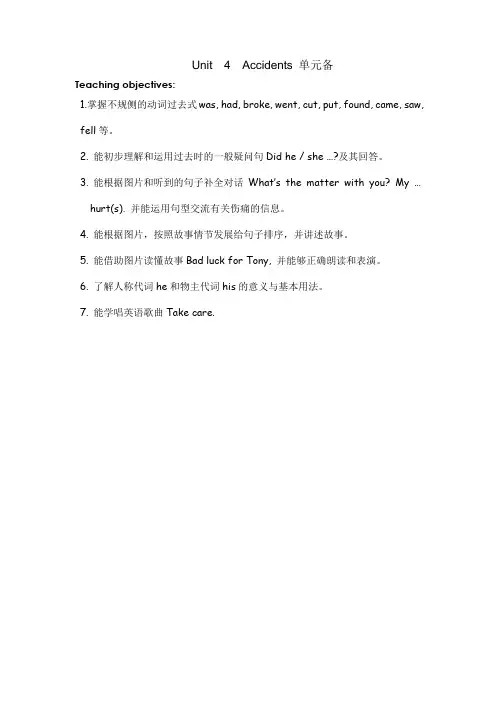
Unit 4 Accidents 单元备Teaching objectives:1.掌握不规侧的动词过去式was, had, broke, went, cut, put, found, came, saw, fell等。
2. 能初步理解和运用过去时的一般疑问句Did he / she …?及其回答。
3. 能根据图片和听到的句子补全对话What’s the matter with you? My …hurt(s). 并能运用句型交流有关伤痛的信息。
4. 能根据图片,按照故事情节发展给句子排序,并讲述故事。
5. 能借助图片读懂故事Bad luck for Tony, 并能够正确朗读和表演。
6. 了解人称代词he和物主代词his的意义与基本用法。
7. 能学唱英语歌曲Take care.Unit 4 Accidents (1)Teaching content:part sixTeaching objectives:1. 复习身体部位的单词.2. 能四会掌握单词:knee, ear, finger, arm, hand, head, leg, shoulder3. 能四会掌握句子:What’s the matter?My … hurts.Teaching difficult points:能四会掌握句子:What’s wrong with you? What’s the matter? Teaching aids: Flashcards ; cassette;Teaching procedures:I. Warm-up1.Review the words.Point to the different parts of the body, and ask Ss to answer the name. Such as knee, ear, finger, arm, hand, head, leg, shoulder.2.Sing a song, head shoulder knees and toesII. Presentations:1.Make a scene with pictures or body language.引导学生理解并学习对话:What’s the matter with you? My … hurt(s). 并在情境中操练对话。
六年级上册英语Unit4Accident第三课时教案剑桥(joinin)版
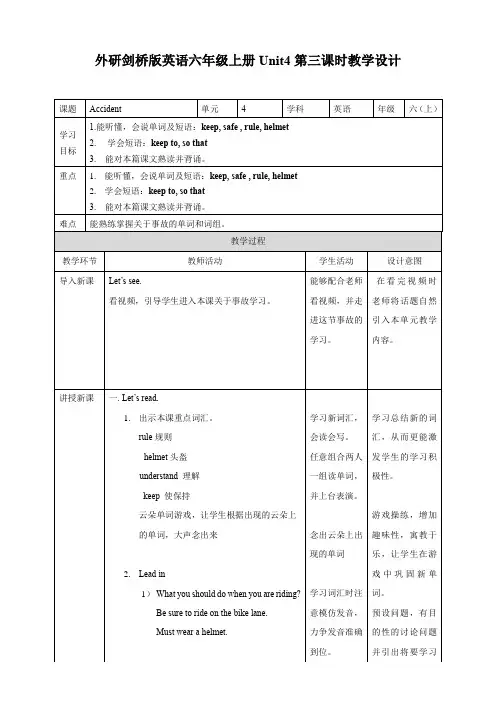
③Oh, no!There’s blood on your foot.
噢,不!你的脚上右血。
there is表示这有,存在
there be的基本结构为:There be+某人(某物)+某时(某地)
Be动词的单复数必须依主语的变化而变化。单数is,复数are
讲授新课
一. Let’s read.
1.出示本课重点词汇。
rule规则
helmet头盔
understand理解
keep使保持
云朵单词游戏,让学生根据出现的云朵上的单词,大声念出来
2.Leadin
1)What you should do when you are riding?
Be sure to ride on the bike lane.
例如:
There is a table in the room.房间里有一张桌子。
There are some birds on the tree.树上有很多鸟。
④Let me see. It’s a deep cut. You need a doctor.
让我看看。伤口很深。你需要看医生。
cut割伤
根据课文内容,回答问题,调动学生的积极性,并有助于学生注意力集中
使学生进一步巩固练习本课重点内容
课堂小结
这节课的教学任务目标是学习单词和短语keep, safe , rule, helmetkeep to, so that等。
本课为新授课,词汇的学习主要通过听,跟读为主要形式。通过灵活多样,丰富多彩的课堂形式的进行,激发学生学习英语的兴趣,增强他们的自信心,通过教学评价的开展,让学生体验到成就感,促进学生学习和发展。
join in外研剑桥英语六年级上册 Unit 4 Accident第四课时Part 5课件
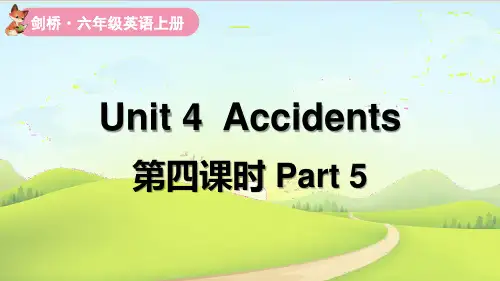
can’t
isn’t
couldn’t wasn’t
won’t = will not 将不会
Please answer: P9-P12
1. Does Tony need stitches? Yes, he does.
2. Can Tony go swimming? No, he can’t.
3. Is he unhappy? Why? No. Because the boy and the girl often play games with him.
Please answer: P5-P8
1. Do the people help them? Why? No. Because they didn’t understand English.
2. Who helps them? A boy and a girl who speak English.
I’m going down to the beach.
I’m=I am
be going to表将要。 此句话时态为一般将来时, 表示将来某一时段的动作
或状态。
I cut my foot down at the beach.
blood: 血
I cut my foot down at the beach.
Listen and read: P9-P12
Role play
Think
A loss, no bad thing or a blessing in disguise. 塞翁失马,焉知非福。
Exercise
根据句意及首字母提示补全单词,请注意用单词的 适当形式填空。
1. The beach l_o_o_k_s_ great for snorkelling. Let’s go! 2. -I’m g_o_in_g__ down to the beach. -OK. 3. Don’t f_o_rg_e_t_ to write your homework. -Yes, Mum. 4. When Joel w_a_s___ eight, he h_a_d___ an accident
Unit4Accidents(教学设计)-2024-2025学年Joinin外研剑桥英语六年级上册
-创作展示:鼓励学生根据自己的课后拓展学习,创作一幅海报或一篇短文,展示他们所学的安全知识和急救技能。
教学反思与总结
回顾本节课的教学,我认为自己在教学方法、策略、管理等方面取得了一定的成果,但也存在一些不足。在教学方法上,我采用了情境教学法和任务型教学法,通过设定真实的生活场景和设计具有挑战性的任务,激发学生的学习兴趣和提高他们的合作能力。在教学策略上,我注重培养学生的自主学习能力和独立思考能力,通过设计预习任务和课后拓展活动,鼓励学生在课后进行自主学习和拓展。在教学管理上,我通过在线平台和微信群监控学生的预习进度,并及时解答学生的问题,确保教学效果。
-监控预习进度:利用平台功能或学生反馈,监控学生的预习进度,确保预习效果。
学生活动:
-自主阅读预习资料:学生按照预习要求,自主阅读预习资料,理解“Accidents”知识点。
-思考预习问题:针对预习问题,进行独立思考,记录自己的理解和疑问。
-提交预习成果:将预习成果(如笔记、思维导图、问题等)提交至平台或老师处。
-反思总结法:引导学生对自己的学习过程和成果进行反思和总结。
作用与目的:
-巩固学生在课堂上学到的“Accidents”知识点和技能。
-通过拓展学习,拓宽学生的知识视野和思维方式。
-通过反思总结,帮助学生发现自己的不足并提出改进建议,促进自我提升。
教学资源拓展
1.拓展资源:
(1)事故案例分析:提供一系列不同类型的事故案例,让学生分析事故发生的原因、后果以及预防措施。
(2)视频:教师选取与事故相关的视频素材,让学生在观看过程中提高英语听力水平。
(3)在线工具:教师利用在线工具,如Google Earth、MapQuest等,让学生查询不同地点的事故信息,提高ቤተ መጻሕፍቲ ባይዱ们的信息处理能力。
剑桥(join in)版六英上电子教案(JQ) Unit4 教案(表格版)
(1)Joel had an accident when he was eight.
(2)He broke his head and his left arm.
(3)He was in hospital for five weeks.
(4)Joseph was on holiday with his parents last year.
Step2:Presentation
(Part 1)
1. Teacher leads to the topic:Accidents using pictures.
2.Ask the questions: Who are they?/Are they
OK?/What’s the matter?
3. Play the tape,let Ss understand the passages.And then tick “Yes or No.”
go—went,cut—cut,put—put
3.Fill in the blanks of part 2 using “he,his”
过程
方法
1.Look,listen and read
2.Read and write,Say some things in the past in English.
教学难点
Make sentences using“Past forms of verbs”
教学、教具
(课件)准备
CAI, tape-recorder
教学流程
教
学
环
节
教师活动
预设学生活动
Step1:Warmingup
T:What did you do yesterday/last week?
Join in六上Unit 4 Accidents完整课件
Let’s read.
Let me see. It’s a deep cut.伤口
(深的)
You need a doctor.
Here’s a bandage.
Ouch, that hurts!
Let’s read.
Excuse me, is there a doctor
in the village? (村庄)
go swimming 去游泳
One day I went swimming.
I cut my foot on a broken bottle.
cut-cut 划伤
broken bottle 破碎的瓶子
My mum put a bandage round it.
put-put 放置
Find out the past tense of these words.
5. There are many (child) in the room. 6. The little girl broke _h_e_r__ (she) arms last month. 7. Did you __g_e_t_(get) up at seven o’clock yesterday morning ? 8. I __w__a_s (be ) short three years ago, but now I ___a_m__ (be) tall.
A look, snorkelling B. looks snorkel C. looks, snorkelling
4. Listen well and keep ______ these rules.
A of B. to C. with
Practice
Joinin小学英语六年级上册教案Unit4_Accidents
Joinin⼩学英语六年级上册教案Unit4_AccidentsUnit4 Accidents教学设计⼀、教学⽬标1. 掌握不规则的动词过去式was, had, broke, went, cut, put, found, came, saw, fell 等。
2. 能初步理解和运⽤过去时的⼀般疑问句Did he/she...?及其回答。
3. 能根据图⽚和听到的句⼦补全对话What’s the matter with you? My ... hurt(s). 并能运⽤句型交流有关伤痛的信息。
4. 能根据图⽚,按照故事情节发展给句⼦排序,并讲述故事。
5. 能借助图⽚读懂故事Bad luck for Tony,并能够正确朗读和表演。
6. 了解⼈称代词he和物主代词his的意义与基本⽤法。
7. 能学唱英语歌曲Take care。
⼆、教学建议1. Look, listen and read.看⼀看,听⼀听,读⼀读。
Step l⽼师利⽤图⽚或课件创设情境,引出本单元话题:Accidents,学⽣理解并学说单词。
Step 2学⽣打开课本到第32页,仔细观察两幅图⽚,⽼师可以⽤问题引导学⽣初步理解,如:Who are they? Are they OK? What’s the matter? 等。
Step 3⽼师播放录⾳,学⽣感知短⽂内容。
Step 4⽼师再次播放录⾳,学⽣在图⽚的提⽰下,理解短⽂内容。
⽼师可以设计⼀些问题以引导学⽣深⼊理解短⽂,如判断对错。
1.Joel had an accident when he was eight.2.He broke his head and his left arm.3.He was in hospital for five weeks.4.Joseph was on holiday with his parents last year.5.He cut his hand when he went swimming.6.His mum put a bandage round his foot.Step 5 师⽣共同核对答案,⽼师借助图⽚和课件帮助学⽣理解并学说新单词broke, cut, broken, bottle, bandage等。