
人教版英语八年级上册专题Unit7Willpeoplehaverobots课后练习一及详解
学科:英语专题:Unit7 Will people have robots主讲教师:纪志杰北京101中学英语教师题1:1.Charlie ________ here next month.A. isn’t workingB. doesn’t workingC. isn’t going to workingD. won’t work2.My mother _______ me a nice present on my next birthday.A. will givesB. will giveC. givesD. give3.–Where is the morning paper? – I ________ it for you at once.A. getB. am gettingC. to getD. will get4. He ________ in three days.A. coming backB. came backC. will come backD. is going to coming back5. 我叔叔今晚要来。
My uncle __________________ tonight.6.明年他打算不住那个小屋。
He __________________in the small house next year.题2:1. They will start working _________________.他们将在半小时后开始工作。
2. He will reach here ______ two days.A. forB. afterC. inD. before题3:1.________ a concert next Saturday.A. There will beB. Will there beC. There can beD. There are2. 花园里有几个孩子。
_________________.3. 她拥有三辆汽车。
_________________.题4:1.30,000 dollars is a large amount of money, but it’s ___________ than we need.A. moreB. very muchC. lessD. very little用few, a few, little, a little填空2.There is ______ wine left in the bottle. Let’s buy some this afternoon.3.She felt ______ tired.4. There are_________ books left. We can lend you some.5.You’ve done a good job. You made ______ mistakes.6. How smart Mary is! She usually spends the ________ time and make the ________ mistakes in her homework than any other student in her class.A. less; fewerB. least; leastC. fewest; leastD. most; fewest7. ----I am worried I’m getting fatter.----You should eat ________ food and do more exercise.A. fewerB. a littleC. lessD. little8. He has ________ friends here and he feels lonely.A.fewer and fewerB.more and moreC.less and lessD.little and little题5:1. Are you going to ________________in the first game?你们会参与这次比赛吗?2. Switzerland didn't________________ in this war.瑞士没有参加这次战争。
3. Electricity ________________ our daily life.电在我们的日常生活中起着重要的作用。
题6:1.Tom and Mary _____ escape from the accident.汤姆和玛丽能够从事故中逃离出来了。
2. They will __________ tell you the news soon.A. be able toB. canC. mustD. may题7:1.Look! There are some children ________over there.A. dancingB. danceC. dancesD. danced2. ___________ some boys___________on the playground now.有一些男孩在操场上踢球。
题8:1. Her step-mother made her ______________ all the housework.她的继母让她做所有的家务。
2. My teacher makes me ___________ my homework every day .A. doB.to doC. doneD. doing课后练习详解题1:答案:1.D 2.B 3.D 4.C 5. will come 6. isn't going to live解析:1.句意:查理下个月不会来这里。
根据时间状语next month表示将来的时间,可知这里应该用一般将来时。
2. 句意:我的母亲将在我的下一个生日时,给我一个很不错的礼物。
根据时间状语on my next birthday表示将来的时间,可知这里应该用一般将来时。
3.句意:--我的晨报在哪里?—我马上给你拿。
根据at once表示可知拿报纸是将要发生的动作,故应该用一般将来时。
4.句意:他在三天后将回来。
根据时间状语in three days表示将来的时间,可知这里应该用一般将来时。
5.根据时间状语tonight表示将来的时间,可知这里应该用一般将来时。
6. 根据时间状语next year表示将来的时间,可知这里应该用一般将来时。
题2:答案:1.in half an hour 2.C解析:1. in以现在为起点,表示将来一段时间以后,常用于将来时态的句子。
2.句意:两天后他将到达这里。
根据谓语动词will可知这里应该用表示将来的时间状语in two days“两天后”,in以现在为起点,表示将来一段时间以后,常用于将来时态的句子。
故选C。
题3:答案:1.A 2. There are some children in the garden. 3. She has three cars.解析:1. 句意:下周六要召开音乐会。
根据时间状语next Saturday表示将来的时间,可知这里应该用一般将来时。
故选A。
2. there be 表示某个时间或地方“存在”某人或某物,这里说的是在花园里有什么。
3. have表示主语“拥有”某人或某物,作宾语的某人或某物属主语所有。
题4:答案:1. C 2.little 3. a little 4. a few 5.few 6.A 7.C 8.A解析:1. 句意:三万美元是一个比较大的一笔钱了,但是它比我需要的要少的多。
因为后有比较连词than,所以这里应该用比较级,又因为这里指的钱少,钱是不可数名词。
故选C。
2. 句意:瓶子里没剩下多少酒,让我们下午去买吧。
根据Let’s buy some this afternoon可知所剩的几乎没有了,故用little修饰不可数名词wine。
3. 句意:她感到有点疲倦。
a little可以用来表示程度。
还可用来修饰形容词。
4. 句意:剩下的书还不少,我可以借给你一些书。
根据We can lend you some.可知有剩余的书,这里用a few修饰books。
a few表示肯定含义。
5. 句意:你的工作做的很好,你出现了很少的错误。
根据You’ve done a good job可知出现的错误应该少了。
因为mistakes是可数名词,所以用few来修饰。
few表示否定含义。
6. 句意:玛丽是多么地聪明呀,她与班里的同学相比,她通常花费更少的时间并且在作业中出现的错误也比较少。
因为她与班里的其他同学相比,后有比较连词,故用比较级。
又因为第一空后面修饰的是不可数名词故用less;第二空后面修饰可数名词故用fewer,故选A。
7. 句意:--我担心我越来越胖。
--你应该少吃多锻炼。
这里是暗含比较,是与以前相比,所以应该用比较级,故排除BD,又因为这里修饰不可数名词food所以用less来修饰。
8. 句意:他在这里的朋友越来越少,他感觉很寂寞。
根据he feels lonely感觉很寂寞,所以这里应该叙述的是朋友越来越少。
因为friends是可数名词所以用.fewer and fewer来修饰。
题5:答案:1. take part 2. take part 3. plays an important part in解析:1. take part in 意为“参加,参与(某事物或某活动,如movement, revolution, meeting, conference, conversation, war等)”这里参加的是比赛。
2. take part in 意为“参加,参与(某事物或某活动,如movement, revolution, meeting, conference, conversation, war等)”这里参加的是战争。
3. plays an important part in起着重要的作用;根据句意应该用一般现在时。
题6:答案:1.were able to 2.A解析:1. be able to可以用于各种时态,表示能力,强调努力的结果。
此处用过去时。
2.句意:他们很快就能告诉你消息了。
can could 表示能力;可能(过去时用could),只用于现在式和过去式(could)。
be able to可以用于各种时态。
题7:答案:1.A 2. There are…playing foo tball解析:1.句意:看!有一些孩子正在那边跳舞。
这里整个句子已经有谓语动词are,所以空格处不缺少谓语动词,故用非谓语动词,children与dance之间是主动关系,故用现在分词,故选A。
人教版英语八年级上册Unit 7《Will people have robots》教学设计

人教版英语八年级上册Unit 7《Will people have robots》教学设计一. 教材分析人教版英语八年级上册Unit 7 “Will people have robots” 主要围绕未来科技的发展,特别是机器人的应用进行展开。
本节课主要通过一个关于未来世界的对话,让学生掌握一般将来时的用法,以及如何谈论未来的一些预测。
教材还包括一些阅读材料和任务,旨在提高学生的阅读理解和口语表达能力。
二. 学情分析八年级的学生已经掌握了基本的英语语法和词汇,对一般现在时和一般过去时已经有了初步的了解。
但是,对于一般将来时的用法和如何准确地谈论未来的预测还需要进一步的讲解和练习。
此外,学生在阅读理解和口语表达方面还需要加强。
三. 教学目标1.学生能够理解和运用一般将来时。
2.学生能够通过阅读材料和对话,了解未来科技的发展趋势。
3.学生能够提高自己的阅读理解和口语表达能力。
四. 教学重难点1.一般将来时的用法。
2.如何准确地谈论未来的预测。
3.阅读理解和口语表达能力的提高。
五. 教学方法1.任务驱动法:通过设定一些与学生生活息息相关的情景,让学生在完成任务的过程中学习和运用语言。
2.交际法:通过模拟真实的交流场景,让学生在实际的语言环境中学习和运用语言。
3.合作学习法:通过小组讨论和合作,让学生相互学习,共同提高。
六. 教学准备1.教材和教学参考书。
2.多媒体教学设备。
3.与课程内容相关的网络资源。
七. 教学过程1.导入(5分钟)通过向学生展示一些机器人的图片,引起学生的兴趣,然后提问:“你们认为未来的人们会拥有机器人吗?”,让学生发表自己的看法。
2.呈现(10分钟)老师通过讲解和示范,向学生介绍一般将来时的用法,并举例说明如何准确地谈论未来的预测。
3.操练(10分钟)学生分组进行角色扮演,模拟真实的交流场景,运用一般将来时进行对话。
老师对学生的表现进行指导和评价。
4.巩固(10分钟)学生阅读教材中的阅读材料,理解并回答相关问题。
人教版英语八上:Unit 7 Will people have robots阅读课说课课件课件
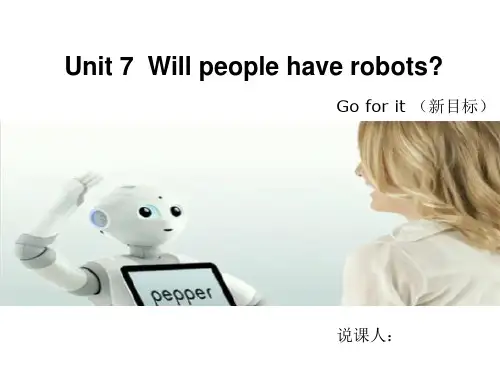
Go for it (新目标)
说课人:
说课内容
教材分析 1
学情分析
教法学法分析
2
教学过程分析
3
板书设计分析
第一部分 教材分析
1
教材地位 及作用
教学目标
教学重难点
教材分析
❖ 教材的地位和作用
本节课是一节阅读课。本科话题是机器人。通 过设置读前预热、读中理解、读后检测和拓展 等活动,让学生了解机器人的由来、发展过程、 对人类生活产生重大影响等,并把所读信息转 化成对话信息,关注语言的使用。引导学生关 注生活,展望和相信未来,崇尚科学,探索和 创造未来,从而对学生进行适当的情感教育的 态度。帮助学生树立远大的理想,增强科学探 索精神。
小组 讨论法
教法 主要通过 任务驱动 的方法开展教学
辅助手段:多媒体、黑板、录音
第三部分 教法学法分析
利用小组活动的机会,积 极用英语和其他同学交流
利用看、听、说和讨论等 有效手段获取信息
学法
1)预测(predicting) 2)关键词(key words) 3)思维导图(mind-map)
返回
第四部分 教学过程分析
Step 5: Discussion and writing
1.Discussion If I have a robot, I hope that it will be like…,
it will be able to…
2.Writing
Sample: I think some future robots might look like spiders. They will be able to help us clean the windows, sweep the snow
新人教版八年级英语上册Unit7-Will-people-have-robots课件

➢ Key sentences: 1. Will people use money in 100 years? 2. People will live to be 200 years old. 3. There will be fewer trees and the
Presentation
1a How will the world be different 100 years from now? Read these predictions. Check (√) A (for agree) or D (for disagree).
___A___D 1. People will have robots in their homes. ___A___D 2. People won’t use money. Everything will be free. ___A___D 3. Books will only be on computer, not on paper. ___A___D 4. Kids won’t go to school. They’ll study at home on
否认句: 主语 + will +not + v.原形
一般疑问句: will +主语 + v.原形
特殊疑问句:特殊疑问词 + 一般疑问句
Yes, I will. 简略答复:
No, tomorrow 明天
next week 下周
next month 下个月 before不久
从现在起我将每天来。 2.结构:be going to/助动词 will + v. 原形
人教版初中英语八年级上册Unit 7 Will people have robots 教案2023
人教版初中英语八年级上册Unit 7 Will people have robots 教案2023人教版初中英语八年级上册Unit 7 Will people have robots 教案一、教学目标1. 语言知识目标:①学习掌握新词汇,如robot, artificial intelligence等;②掌握一般将来时表示将来事实的用法;③学习掌握让步状语从句的构成和用法。
2. 情感态度价值观目标:了解机器人的发展历程和应用,并探索人类与机器人的关系,引导学生正确对待未来科技的发展。
二、教学重难点1. 教学重点:掌握一般将来时的用法,并能够正确使用;熟练使用让步状语从句。
2. 教学难点:培养学生的创新思维和科学素养,让学生探索科技对未来的影响。
三、教学过程1. Warm-up:(1)自主学习单词,了解单词意思及发音;(2)老师播放robot的一些视频及图片,引导学生思考:你所见过的机器人是什么样的?你对机器人的看法是什么?(3)展示一个有趣的Youtube视频《Sophia机器人演讲 UN 人工智能峰会》2. Presentation(1)呈现一些未来的场景和事物,引导学生谈论这些事物是否存在的可能性及可能性大小。
例:By 2030, people will live on Mars. Will humans ever colonize other planets?(2)展示动画视频,呈现未来的机器人,引导学生探究机器人的发展历程,以及机器人在未来的应用与发展。
3. Practice(1)展示一段文本(如下),让学生阅读,并回答问题。
Robots are more and more popular in our daily life. In the future, we will have different types of robots to help us do all kinds of things. For example, we will have robots that can help us clean our homes, do the grocery shopping, and even cook meals. We will also have robots that can work in factories, help doctors do surgery, and take care of the sick and elderly. Some companies are even trying to build robots that can drive cars!1) What types of robots will we have in the future?2) What can robots do for us?3) Can robots drive cars?(2)阅读下面的段落,把下划线部分改为让步状语从句。
八年级英语上册-Unit-7-Will-people-have-robots备课教案-(新版)人教新

一、教材分析
单元教材分析:will + 动词原形 来表达一般将来时态。 学会表达自己对未来的看法;学会谈论自己未来的打算。
二、学情分析
1.八年级处于思维活跃期,对学习本单元有好处,可以进一步开阔学生视野。
2.本单元总体知识结构比较单一,内容相对比较简单。
教学重点:
教学重点:
1)学习掌握一般将来时态的意义和结构。
2) 掌握There be句型的一般将来时态的结构。
(含教法学法、媒体应用等)
教学难点
教学难点:
掌握more/fewer;more/less的用法。
情态动词will + 动词原形来表达一般将来时态。
(同属教学重难点的,在本栏书写)
五、课时安排
三、教学目标
(结合课标)
知识技能
学会表达自己对未来的看法;学会谈论自己未来的打算。。
过程方法
首先进行集中识字,为本单元的学习作好铺垫。其次,采用情景交际法和任务型教学法并充分利用听力材料和阅读材料,训练和提高学生的听力和阅读水平。在听读的基础上创设语言情景和合作探究的方式加强读写训练。培养学生的听、说、读、写综合能力。
Period 1 Se-2d 听说课
Period 3 Section A Grammar Focus-3c语法课
Period 4 Section B1a-1e 听说课
Period 5 Section B2a-2e 阅读课
Period 6 Section B3a-3c阅读课
Period 7 self check and unit review
六、知识结构
七、其它补充
情感态度价值观
人教版初中英语八年级上册《Unit 7 Will people have robots》课件
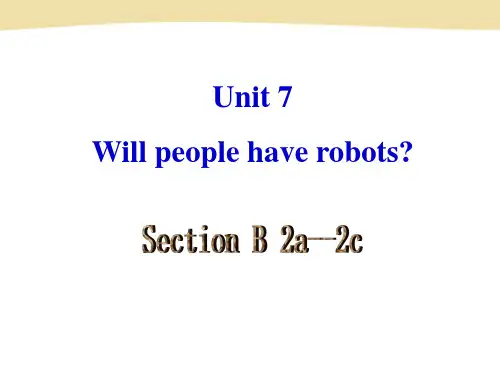
What do they look like ? They look like snakes.
What does it look like?
It looks like a dog.
What can the robots do?
do the housework
do exercise
Play football
Para 2 What will robots be like in the future?
Para 3 What can robots do today? Para 4 What are robots like in movies?
Careful
Reading
Do You Think You
Will Have Your Own Robot?
写作: 内容: If you have your own robot, what will
it look like and what will it do for you?
Write it down and share it with us next class.
dance.
America→Japan
T 2. Some scientists think that there will be
robots like humans, but Mr. White disagree.
T 3.It’s easy for a child to wake up and know
where they are.
F 4. Some people believe that robots will be
able to talk in 35 to 50 years. 25→50
2024年人教版八年级上册英语主题阅读Unit 7 Will people have robots?
Unit 7Will people have robots?Passage1(传统文化)中华传统文化, 博大精深!一起来感受吧!2023 is the Year of the Rabbit in China. Many people think this is a really good year. Why? Maybe it’s connected with the animal rabbit. What do people in different 1think about the animal? Let’s have a look.In Chinese people’s eyes, rabbits are quiet, gentle and smart. They are also very quick. A Chinese expression dongru tuotu is used to 2people who are smart and quick like a rabbit. * In a fairy story, there is a Jade Rabbit living on the 3. It’s the pet of Chang’e who is a goddess (女神)4known in China. This may explain 5rabbits are considered as a symbol of good luck.Also, in ancient China, the more children you had, the luckier and 6you would be. It made the rabbit a lucky sign as well because rabbits are full of 7and fertile (繁殖力强的) in nature.Similarly in the West, rabbits are well-known because they can 8in difficult and surprising conditions, with populations growing fast in a short time. Rabbits are also considered to be very 9in the West. They also think the rabbit’s foot is able to bring good luck.Another 10for good luck found in North America and the UK is to say the word “rabbit”on the first morning of every month.So, maybe the Year of the Rabbit can bring you some good luck, too.1. A. periods B. culturesC. brainsD. situations2. A. require B. check C. praise D. believe3. A. farm B. earth C. desert D. moon4. A. softly B. wisely C. widely D. silently5. A. why B. which C. when D. what6. A. happier B. smarterC. youngerD. noisier7. A. custom B. energy C. danger D. heat8. A. jump B. live C. climb D. dream9. A. moving B. curious C. lucky D. strange10. A. cause B. power C. voice D. traditionPassage2(文化习俗)骑着耕牛, 踏着立春的步伐, 唱着小燕子的歌谣, 来了解立春的文化习俗吧!Beginning of Spring comes. Everything turns green and becomes full of vigor. People can clearly notice that daytime becomes longer and the weather gets warmer. The traditional Chinese lunar calendar divides the year into 24 solar term. Beginning of Spring (立春) is the first solar term of the year. Here are some spring customs (习俗).Flying a kite. Spring is the best season for kite-flying.Erecting the egg (立鸡蛋). In China, it is said that the egg can be set upright on the first day of Beginning of Spring.Wearing fabric swallows (佩燕子). Wearing fabric swallows is a custom in some regions in Shanxi. The swallow is a harbinger of spring and a symbol of prosperity and happiness.Biting the spring. In many parts of China, people observe the custom of “biting the spring” on the first day of Beginning of Spring. They eat spring pancakes, spring rolls, or a few carrots.Making a Spring Ox. This custom in Shanxi is practiced right before Beginning of Spring. When spring comes, many people love spring and they do kinds of activities.Here is the survey about 200 people from different places who love customs.根据短文与图表内容, 选择最佳答案。
人教版八年级上册Unit7WillpeoplehaverobotsSectionB2b教学设计教案
4.教师展示与本节课相关的词汇和短语,如“robots”, “take over”, “perform”, “require”, “be necessary for”等,让学生初步了解并感知这些词汇的用法。
3.学生能够运用目标词汇和句型,描述未来机器人的功能、工作场景及对未来社会的影响。
4.学生能够理解并运用阅读策略,如预测、扫描、细读等,提高阅读理解能力。
(二)过程与方法
1.通过小组合作、讨论、分享等方式,培养学生合作学习和解决问题的能力。
2.通过阅读课文,引导学生运用预测、扫描、细读等阅读策略,提高阅读效率和理解能力。
2.教师对学生的练习成果进行现场批改和指导,帮助学生发现并改正错误。
(五)总结归纳
1.教师引导学生回顾本节课所学内容,总结一般将来时态和目标词汇的用法。
2.学生分享本节课的收获和感悟,以及在学习过程中遇到的困难和解决方法。
3.教师对学生的总结进行补充和归纳,强调重点,提醒学生加强课后复习。
4.教师布置课后作业,巩固本节课所学知识,为下一节课的学习做好准备。
提示:可以从以下几个方面展开:
a.机器人在未来的功能和应用领域。
b.机器人对人类社会的影响。
c.人们对机器人的态度和看法。
3.预习下一节课的内容,提前了解与未来科技相关的词汇和句型,为课堂学习做好准备。
4.搜集与未来科技相关的新闻或资料,下节课分享给同学们,共同探讨未来科技的发展趋势。
作业布置要求:
1.学生在完成作业时,注意语法和词汇的准确性,提高语言表达的流畅性和连贯性。
2.家长协助督促孩子完成作业,关注学习进度,鼓励孩子积极思考,发想象力。
人教版八年级上册Unit 7 Will people have robots? Section课件
八年级人教版上册英语
Unit 7 Will people have robots? Section B 2a-2e (P53)
What do robots look like today? shapes
What can they do? They can do the same things as we do.
Read para.3 and underline the answer.
What can robots in Japan do?
What can’t robots do now?
Will robots think like humans in the future?
Read para.4 and find the answers.
times and never get bored. 3. Some can _w__a_l_k__ and _d_a_n_c_e___. 4. Some can help _l_o_o_k_f_o_r___ people
under__b_u_i_ld_i_n_g_lanks in this paragraph with words from the article.
Unit 7 Will people have robots Section课件人教英语八年级上册
Unit7 Will people have robots?
SectionA 1a-2c精选公开课
Warming-up
Let's enjoy a video about future life.
➢ What will the world be like in 100 years? 100年以后世界将 是什么样子?
A: Only one _c_o_u_n_tr_y_ in the world? _W__il_l there _b_e_ world p_e_a_c_e_?
B: I _h_o_p_e_s_o_. A: I _th_i_n_k_ kids _w_o_n_’_t go to school. They will s_t_u_d_y_ at
A: Will people use money in 100 years? B: No, they won’t. Everything will be free.
Will people live to be 200 years old? A: Yes, they will.
1. People will have robots in their homes. 2. People won’t use money. 3. Books will be only on computers. 4. Kids won’t go to school. 5. People will live to be 200 years old. 6. There will be only one country.
the teacher
the students
2a Listen and circle the words you hear.