
最新仁爱版八年级上册Unit 4 Topic 2 Section C公开课课件
furniture [ˈfɜ:nɪtʃə(r)]
stay away from tall furniture
power line
be careful of fallen power lines
downstairs [ˌdaʊn'steəz]
go downstairs
Task 1 If an earthquake happens ,what should we do to protect ourselves ? Please tick the correct answer.
Task 2 Read 1a and write down the key words under each picture. Retell what we should do based on the key words.
If you are indoors
stay under a strong table or desk
1.How do you understand "the danger is not over when the strong shaking stops"? There will be some shocks after most earthquakes. 2.What does the word “aftershocks” mean ? It means “余震”.
take a lift to go downstairs run out of a room stand in the middle of a room stand near a tall tree protect your head with your arms
What else?___________________
Don't try to...
Read Paragraph 3 and retell it based on the pictures.
outdoors
Move to...
Get away from …
Be very …
Read Paragraph 4 and answer the following questions.
Unit 4 Our World Topic 2 How can we protect ourselves from the earthquake?
Section C
naturalቤተ መጻሕፍቲ ባይዱdisasters
Watch the flash.
shake
doorway
middle
in the middle of the room
Read Paragraph 5 and choose the correct answer.
Pragraph 4
Pragraph 5
Task 4 Read Paragraph 1 and complete the table.
How often many earthquakes happen
How some of these earthquakes are When they can be very serious What many people will be Why we should know some ways every _______ year ______ very ______ strong ________
sit on the floor in a doorway or close to the wall
If you are indoors
protect your head and neck with your arms
stay away from the window
If you are outdoors
move to clear areas
get away from buildings and trees
be careful of fallen power lines
Task3 Read 1a and match each paragraph with the correct main idea.
Pragraph 1 Pragraph 2
Pragraph 3
Check and help others in need near you when you can move around.
Knowing some ways to protect yourselves can keep you safe in the earthquakes. Talk about the ways to protect yourselves when you are indoors. Talk about the ways to protect yourselves when you are outdoors. The danger is not over after the first earthquake because there will be some aftershocks.
the safest place
indoors
Retell Paragraph 2 based on the pictures and the information.
indoors
the safest place …
Sitting on… than...
Remember to ...
Stay away from ...
in ______ cities happen _____
______ hurt
or
________ die
to keep us _______ safe
Read Paragrapy 2 and complete the mind map. under a strong table or desk 1._____________ sitting on the floor in a doorway _____________ the safter place 2._____________ close to a wall
仁爱版八年级上册Unit-4-Topic-2--Section-C公开课课件全
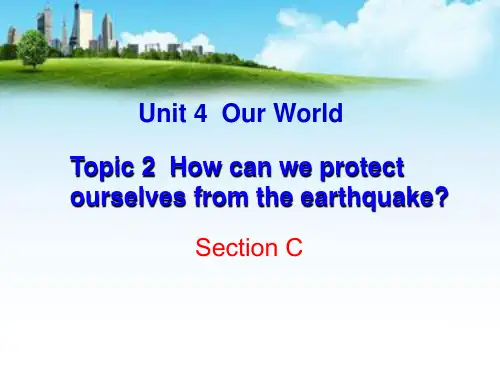
sit on the floor in a doorway or close to the wall
If you are indoors
protect your head and neck with your arms
stay away from the window
If you are outdoors
How some of these earthquakes are _v_e_r_y__ __s_t_r_o_n_g_
When they can be very serious
happen __i_n__ _c_it_ie_s__
What many people will be
__h_u_r_t_ or ___d_i_e___
move to clear areas
get away from buildings and trees
be careful of fallen power lines
Task3 Read 1a and match each paragraph with the correct main idea.
take a lift to go downstairs
run out of a room
stand in the middle of a room
stand near a tall tree
protect your head with your arms
What else?___________________
furniture [ˈfɜ:nɪtʃə(r)]
stay away from tall furniture
power line
be careful of fallen power lines
仁爱版八年级英语上册课件UNIT 4 TOPIC 2 Section C
TOPIC 2 How can we protect ourselves from the earthquake?
Section C
Contents
1 Introduction 2 Content 3 Homework
Introduction
1. What do you know about earthquake? 2. What can we learn from this story?
Question
If there is no earthquake in the world, what will happen? Talk this with your partner.
Many earthquakes happen every year.
Some of these earthquake are
earthquake.
I. Memory all the new words and expressions.
II. Finish the exercises onome information about this story on the internet.
of the building.
If you are out of doors, move to clear
areas. Get away from buildings and
trees. Be very careful of fallen
power lines.
The danger is not over when the strong shaking
If you are indoor when the earthquake
仁爱版英语八年级上册Unit 4 Topic 2《How can we protect oursel
仁爱版英语八年级上册Unit 4 Topic 2《How can we protect ourselves from theearthquake》(SectionC)教学设计一. 教材分析《仁爱版英语八年级上册Unit 4 Topic 2 How can we protect ourselves from the earthquake》是一篇关于地震防护知识的文章。
通过学习这篇文章,学生能够了解地震的特点,掌握一些地震时的自救措施,提高自我保护意识。
本节课的内容与学生的生活紧密相连,有利于激发学生的学习兴趣和积极性。
二. 学情分析八年级的学生已经具备了一定的英语基础,对于生活中的一些常见现象和自我保护意识有一定的了解。
但他们在语言表达和地震防护知识方面还有待提高。
因此,在教学过程中,教师需要关注学生的个体差异,充分调动学生的积极性,引导他们主动参与课堂活动。
三. 教学目标1.知识目标:–学生能够掌握关于地震的词汇和表达方式。
–学生能够理解文章内容,了解地震时的自我保护措施。
–学生能够运用所学知识,进行简单的地震防护措施的表述。
2.能力目标:–学生能够提高听力、口语、阅读和写作能力。
–学生能够通过合作学习,提高团队协作能力。
3.情感目标:–学生能够增强地震防护意识,提高自我保护能力。
–学生能够关心他人,学会在紧急情况下互相帮助。
四. 教学重难点•学生能够掌握地震相关词汇和表达方式。
•学生能够理解文章内容,了解地震时的自我保护措施。
•学生能够运用所学知识,进行地震防护措施的表述。
•学生能够提高听力、口语、阅读和写作能力。
五. 教学方法1.情境教学法:通过设定地震场景,让学生身临其境地学习地震防护知识。
2.任务型教学法:学生分组完成地震防护计划,提高团队合作能力。
3.交际法:引导学生进行地震防护知识的交流,提高口语表达能力。
六. 教学准备1.教师准备:–制作课件和教学材料。
–设计课堂活动和作业。
2.学生准备:–预习相关地震防护知识。
仁爱版八年级英语上册 Unit 4 Topic 2 Section C 课件(共21张PPT)

If you are indoors
remember to protect your head and neck with your arms
stay away from windows, tall furniture and pictures
If you are outdoors
move to clear areas
If you are indoors when the earthquake happens, the s_a_fe_s_t place is under a strong table or desk. Rem__em__b_er_ to protect your head and neck _w_it_h_ your arms. Stay away _fr_om__ windows, tall furniture and pictures.
2. What does the word “aftershocks” mean ? It means “余震”。
3. What is the most important thing to do in the earthquake ? Stay calm.
4. Do you know more ways to protect yourself in the earthquake ?
1. We learn : some words and phrases
翻译:
下楼-----
go downstairs
保持镇静----- stay/keep calm
远离…----- stay/get /keep away from
跑出…----- run out of
靠近----- close to
新仁爱英语八年级上册Unit 4Topic 2 How can we protect ourselves from the earthquake优质课公开课教案
Topic 2 How can we protect ourselves from the earthquake? Section BⅠ. Material analysisSection B的主要教学活动为1a, 3a和3b。
本节课主要通过Miss Wang和班里的学生之间的谈话引出玉树地震的话题,在对话中了解玉树地震的信息。
简单讲述了如何在地震中逃生的问题以及复习双多音节形容词的比较级和最高级形式。
第二部分通过听力训练的方式要求学生学习表达关心的句子。
3a部分主要通过图片、音标的提示,展示了有关灾难的名词。
复习了/ð//θ/的不同发音以及升降调、连读和不完全爆破。
教师在讲解音标的时候可以借助多媒体或者图片,让学生直观地感受唇形、齿形和口型。
Ⅱ. Teaching aimsKnowledge aims:1. 能根据音标正确朗读出单词表中本课的单词:level, sad, calm, typhoon等。
2. 能在老师的引导下,读出句子的升降调、连读和不完全爆破,分清/ð//θ/之间的区别。
3. 能正确拼读并运用单词表中的黑体单词:level, sad等。
能根据音标正确地书写typhoon, flood 等。
4. 能掌握双多音节形容词的比较级和最高级的变化规则,能在具体句子中正确地应用。
5. 能正确运用本课所学知识谈论地震的话题,能够用所学知识向受灾的人们给予关爱。
Skill aims:1. 能听懂有关谈论地震的话题及用形容词比较级最高级谈论关于灾难的话题。
2. 能谈论灾难的情况,并能用所学知识表达自己的关怀。
3. 能正确朗读课本的文本材料及含有/ð//θ/的句子的正确发音。
4. 能用形容词的比较级和最高级写一篇有关灾难程度的文章。
Emotional aims:1. 通过本课学习,了解自然灾害带给人类的危害,学会沉着应对困难。
2. 学会关心他人。
Ⅲ. The key points and difficult pointsKey points:1. 了解有关地震的知识。
仁爱英语八上Unit4 Topic2 SectionC课件
T Do not jump off the tall building.
Writing
Should
Shouldn’t do
A. The safest place is… B. … is safer than … C. Remember to… D. Be very careful of… E. When it’s safe…
① the earthquake.
②
1.If you are indoors, what should and shouldn’t you do? 2.If you are outdoors, how can you protect yourself?
Before the earthquake
③
1.What are aftershocks? 2.How dangerous can they be?
Reading
Reading
Understanding and sharing
Thinking
Thinking
1.When the newscaster was broadcasting earthquake news, another shock came, we call it__a_ft_e_r_s_h_o__c_k. (Para4 )
Aftershocks
While the earthquake
1. To __c_h_e_c_k__ the people around you. 2. The most important thing is to _st_a_y_c_a_l_m.
Safe to move
Writing task: write a passage about how to protect yourself in an earthquake or in a fire.
仁爱八年级上册Unit 4 Topic 2 Section C教学设计
1.Show the same videofor second time.
(1)Where is the newscaster, indoors or outdoors?
(2)Predict:What did he do at last?(全班讨论,超链接到逃跑几秒钟)
(3)If you were him, what will yougnment
writing
1.another video show to tie with the key phrases and sentence structures:
When …happens, …
If you are indoors, you should…. ; you shouldn’t…
Task: Pick out the best works and read them to the partners first and then to the class.
Teaching objects
Students from Junior Three
Teaching approach
VARK learning style; USE teaching style;
CLIL(Content and Language Integrated Learning)
Objectives
1.Read 4 minutes
2. Exchange cards, finish column on the right according to the reading material.
3. Back to the video for the third time. Discuss more details.
八年级英语仁爱版上册Unit4_Topic1_SectionC优质课教案
Unit4 Topic1 SectionC优质课教案指导老师:林志鹏老师练娜老师1. 教材:本节课是八年级上册第四单元第一话题的Section C 部分,主要内容是介绍热带雨林的特征及其热带雨林的重要性。
这个部分是复习巩固Section A和Section B 的形容词比较级,同时又为Section D介绍珍稀动物做好前期的铺垫。
教材与环境保护有关,对学生有教育意义。
2. 学生:八年1班大部分学生的英语知识水平中等,但是也有一部分是成绩弱的学生。
3. 教学的重点: A: 教会学生掌握两种有效的阅读方法 skimming , scanning 并且应用在平时的学习中,实现课程标准要求的阅读技能目标。
B: 教会学生了解热带雨林相关的知识,掌握17个新单词,短语和句型。
4. 教学的难点:如何有效地将两种阅读的方法应用在本章节的阅读中,提高学生阅读水平。
学会续写文章,如何应用关联词进行组词成句,进而写出一篇层次分明,条理清楚的文章,提高学生的写作水平。
5. 教学设计:(1)导入:利用课余时间播放热带雨林的相关视频,让学生事先从视觉上感受热带雨林,创设情景,为授课做好预热的准备工作。
(2)引入新课:借助图片,创设情境教新单词,让学生在语境中预测和掌握单词的用法,同时使用与语篇相关的句子,更有利于学生的理解和接受。
本节课共有17个新单词,但是有的单词其实之前有学过,因此有一两个不呈现,教师用口语进行了复习。
如 reason 。
这些单词的处理为后面环节的理解扫清路碍。
(3)新课传授:第一步,利用阅读方法1 skimming 进行快速阅读,找出两段的中心意思,这样安排的目的是让学生先从整体上感知文章的大致内容。
第二步,大声齐读课文,训练学生的口语表达能力,增加语感,再次了解文章内容。
第三步,利用阅读方法2 scanning 进行仔细阅读,带着任务寻找文章中的特定信息。
分为三部分由简入难:1 : True or False,在处理这个步骤时,我将教材内容进行整合,1C的内容化解在其中,如 cover, lung of the earth, die out 就在讲解中让学生领会了意思,也为后面的环节扫清了理解的障碍。
仁爱版英语八年级上册Unit4Topic2SectionC优秀教学案例
(一)导入新课
在导入新课时,我采用了多媒体课件展示的方式。我向学生展示了一些与一般现在时态疑问句和否定句相关的图片,如图片中的人物正在做某件事情,然后提问学生:“What is he/she doing?”让学生猜测并回答。通过这样的导入方式,我能够激发学生的兴趣,引起他们的注意力,为新课的讲授做好铺垫。
三、教学策略
(一)情景创设
在本节课中,我注重创设真实且贴近学生生活的情景,以激发学生的学习兴趣和积极性。例如,我可以通过展示图片、播放音频或视频等方式,创造一个日常生活中的场景,如学校、家庭、朋友聚会等。在这样的情景中,我可以引导学生运用一般现在时态的疑问句和否定句进行交流,使学生能够更好地理解和运用所学知识。
在教学过程中,我以多媒体课件和实物教学相结合的方式,引导学生通过观察、思考、讨论等方式来理解和掌握一般现在时态的疑问句和否定句的构成及用法。在课堂活动中,我注重培养学生的听说读写能力,通过设置不同的任务和活动,让学生在实际情景中运用所学知识进行交流。
在教学评价方面,我采用了形成性评价和终结性评价相结合的方式。在课堂活动中,我通过观察学生的参与程度、发音准确性、句子结构正确性等方面进行形成性评价。而在课后,我通过布置相关练习题,让学生进行巩固练习,从而进行终结性评价。
(四)反思与评价
在本节课的最后阶段,我组织学生进行反思和评价,帮助他们总结所学知识,发现问题并进行改进。首先,我可以让学生individually或in groups进行口头或书面的自我评价,反思自己在课堂活动中的表现和收获。然后,我可以邀请学生分享他们的评价和感受,让其他学生也能从中受益和学习。最后,我可以对学生的表现进行总结和点评,强调他们的优点和需要改进的地方,以激发他们的学习动力和信心。通过反思与评价,学生可以更好地了解自己的学习状况,提高学习效果。
新仁爱版初中英语八年级上册Unit 4 Topic n C优质课公开课教案
新仁爱版初中英语八年级上册Unit 4 Topic n C优质课公开课教案PPT。
textbook。
blackboard。
XXXIn this lesson。
we will focus on activities 1a and 2.Buildingon the us ns。
XXX。
we will lay the XXX。
XXX。
in the second part of the lesson。
students will be asked to join in the XXX.XXX:Knowledge objectives:1.XXX using ics: thick。
ground。
wet。
cover。
forest。
earth。
surface。
control。
die。
wood。
protect.2.XXX: thick。
ground。
wet。
cover。
forest。
rest。
earth。
surface。
control。
die。
wood。
protect.3.XXX adjectives.XXX:1.To understand the reading material and simple environmental XXX.2.XXX.3.To read and understand the related reading material in the textbook.4.To write a simple environmental XXX.XXX:XXX。
XXX' XXX。
starting with small XXX.The key points of this lesson are as follows:1.XXX.2.Learning about the rest and related knowledge.3.Learning to write a XXX.The difficult points of this lesson are:XXX adjectives.XXX:e appropriate ns such as "and," "but," "however," and "while" when writing to make the article more coherent.2.The last sentence of the us paragraph often hints at the main content of the next paragraph when reading.XXX work.XXX XXX.1.XXX to the students and asks them to choose their favorite and explain why.2.XXX writing.3.The teacher asks students to think about what materials XXX.4.XXX.5.XXX of life。