
外研版八年级英语上册教案Module 1 Unit 1(外研)
Module1 How to learn EnglishUnit 1 Let’s try to speak Englishas much as possible.本课内容为外语教学与研究出版社Module1 Unit1 Let’s try to speak English as much as possible.,本课时主要内容是学习如何学习英语,需要掌握的句型分别是1) We/You should…2) Let’s try to…3) Why not…?4) It’s a good idea to…5) How about…?6) Why don’t we/you…?A.单词和短语:pair, correct, spelling, word, practice, match, meaning, complete, sentence, dictionary, grammar, letter, look up, mistake, make a mistake, understand-understood, advice, should, possible,writedown, notebook, forget-forgot, pronounce, aloud, radio, pronunciation, key, main, excellent, agree, agree with sb., vocabulary, ask for, improve, basic, time, advise, shy, conversation, quickly, natural, suggest, placeB.交际用语:1. Ready?2. That’s a good idea.3. What else?4. Thanks a lot!5. Excellent!6. We should always speak English in class.7. Let’s try to speak English as much as possible.8. Why not write down the mistakes in our notebooks?9. It’s a good idea to spell and pronounce new words aloud.10. How about listening to the radio?11. It’s better not to translate.12. It’s a good idea to check new words every day.2. Structure: Giving advice:1) We/You should…2) Let’s try to…3) Why not…?4) It’s a good idea to…5) How about…?6) Why don’t we/you…?7) It’s better not to…3. Skills:1) Listening and understanding familiar topics (English study).2) Talking about problems in English study and giving advice, conducting conversations in several turns.3) Reading and finding specific information about English study.4) Drafting a letter asking for advice about English study, revising through pair discussion.4. Around the world: English online5. Task: Writing your English study plan.Giving advice: 1) We/You should…2) Let’s try to…3) Why not…? 4) It’s a good idea to…5) How about…? 6) Why don’t we/you…? 7) It’s better not to…Teacher:How to learn English well?Let students express their opinions:reading, watch English movies…. Then show the “apple tree”Step 2 Presentation1.Vocabulary teaching: grammar、pronunciation、word、letter、spelling、dictionary、radio The newly married couple are really a happy pair.那对新婚夫妇真是快乐的一对。
pair n. 两个人,一对儿I really agree with you.我非常赞同你的观点。
agree with sb. 同意某人Sorry, I make a mistake.对不起,我错了。
mistake n.错误;过错But some mistakes are hard to correct.但有些错误很难纠正。
correct v. 改正;纠正Your answer to the question is correct.你对这个问题的回答是正确的。
correct adj. 正确的;对的You can look up this word in the dictionary.你可以在字典里查这个词。
look …up 查;查找Lauren practises the piano every day.劳伦每天练习钢琴。
practise v.练习I don’t understand what you are talking about.我不明白你在说什么。
understand-understood v.理解;明白You should give it a try.你应该试一试。
should v. aux.应该Is it possible to fix my computer?我的电脑能修好吗?possible adj.可能的I will never forget it.我将永远不会忘记。
forget-forgot v.忘;忘记He practises reading aloud every morning.他每天早晨练习朗读。
aloud adv.大声地;出声地The key factor to success is hard work.成功的关键因素是努力工作。
key adj.关键性的,非常重要的We can sum up the main point of the lesson in three sentences. 我们可以用三句话来概括本课要点。
main adj.主要的;最大的She is an excellent teacher.她是一位出色的教师。
excellent adj.极好的;优秀的Step 3 Practice1)ListeningListen and answer the questions. Use the words and expressions in the box.dictionary grammar letter look upmake a mistake understand1.Which word did Daming not understand?He didn’t understand the word “spring”.2.What mistake did Lingling make?She made a grammar mistake. She said “go” instead of “went”.3. How does Daming usually check the spelling of a word?He looks it up in the dictionary.4. Why was it difficult for Daming to check the spelling of cinema?Because he didn’t know the first letter.2)After ListeningListen and readWe should always speak English in class.Let’s try to speak English as much as possible.Why not write down our mistakes in our notebooks?Don’t forget to write down the correct answers next to the mistakes.It’s a good idea to spell and pronounce new words aloud every day.How about listening to the radio or reading English stories?Why don’t we try to find some English pen friends? We can write to them. 3)Learning to learnHow to learn English well?1. We should always speak English in class.2. Let’s tr y to speak English as much as possible.3. Why not write down the mistakes in our notebooks?4. Don’t forget to write down the correct answers next to the mistakes.5. It’s a good idea to spell and pronounce new words aloud every day.6. How about listening to the radio?7. What about reading English stories?8. Why don’t we try to find some Eng lish pen friends? 4)WritingWrite notes about learning English.5) Everyday EnglishStep 4 Wrap upEveryday English●Ready?●That’s a good idea.●What else?●Thanks a lot.●Excellent!略。
外研版-英语-八上-初二上册M1U1教案

Module 1 How to learn EnglishUnit 1 .This i s the f i r s t l esson fo r Grade8s tuden t s,so p r ovid ing gu idance to make l ea rn i ng p lan i s qui te impor tan t.Giving adv ice i s be ing l ea rned in th i s un i t.To unders tand the conversa t ion i nvolv ing ask ing fo r adv ice and g i ving adv iceTo prac t i ce g iv i ng adv ice on Engl i sh l ea rn ing.1. Key words and phrases to l ea r n-t r ans la te,co r rec t, number,r e pea t, wr i te down, mis takes,spe l l ing, g ram m ar,adv ice, pen f r i end2. Learn the fo l l owing key s t ruc t ures-How about…? / Why don’t you …? / You should …. /It’s a good idea… / Try not to…/ Don’t forget to…Find ou t more about e f fec t ive ways o f l ea rn ing Engl i sh.1. Ask s tuden ts t o th ink ou t as 1. Th ink and t e l l1. Rev ise the p revioustop ic.many verbs as poss ib le abou tthe topic “how to learnEnglish”.the answersabout the ve rbsthey come upwith.2. To ge t s tuden t s p reparedfo r the fo l lowing l i s t en ingac t iv i t i e s.2. Ask s tudents t o do Par t 1and then ca l l back the answers 2. Read th roughf rom the c lass .the words in the box and c lass i fy them. Then3. L i s ten and match . (Here the ins t ruc t ions shou ld be g iven c lea r ly to make sure s tuden ts know what todo .) 1. L i s ten and choose the one which i s no t ment ioned . 2. L i s ten aga in and do Act iv i ty 4. And then tu rnto the conversa t ion to make sure the answers a re r igh t . 2. P lay the t ape aga in and ask s tuden ts to do Ac t iv i ty 4. Then ca l l back t he answers .1. Ask s tuden t s t o read a loudin pa i r s . 1. Read in pa i r sa loud .2. Ask s tuden t s t o read ind iv idua l ly and under l ine those they a re not ab le to unders tand . Move a round in the c lass to so lve t he i rproblems .3. Seek adv ice f rom the t eacherto t ack le di f f i cu l t i e s . 4. Su m mar ize the key 1. Show an exam ple and le t1. Iden t i fy thes t ruc tu res o f g iv i ng adv ice.sen tences abou tgiv ing adv ice.2. Take no tes o fthe keys t ruc tu res.3. Prac t i ce thes t ruc tu res inpa i r s on thetop ic in Ac t iv i ty7.作Choose two top i cs to wr i t e abou t wi th the s t ruc tur es jus t l ea rned.业f rom the c lass .the words in the box and c lass i fy them. Then3. L i s ten and match . (Here the ins t ruc t ions shou ld be g iven c lea r ly to make sure s tuden ts know what todo .) 1. L i s ten and choose the one which i s no t ment ioned . 2. L i s ten aga in and do Act iv i ty 4. And then tu rnto the conversa t ion to make sure the answers a re r igh t . 2. P lay the t ape aga in and ask s tuden ts to do Ac t iv i ty 4. Then ca l l back t he answers .1. Ask s tuden t s t o read a loudin pa i r s . 1. Read in pa i r sa loud .2. Ask s tuden t s t o read ind iv idua l ly and under l ine those they a re not ab le to unders tand . Move a round in the c lass to so lve t he i rproblems .3. Seek adv ice f rom the t eacherto t ack le di f f i cu l t i e s . 4. Su m mar ize the key 1. Show an exam ple and le t1. Iden t i fy thes t ruc tu res o f g iv i ng adv ice.sen tences abou tgiv ing adv ice.2. Take no tes o fthe keys t ruc tu res.3. Prac t i ce thes t ruc tu res inpa i r s on thetop ic in Ac t iv i ty7.作Choose two top i cs to wr i t e abou t wi th the s t ruc tur es jus t l ea rned.业f rom the c lass .the words in the box and c lass i fy them. Then3. L i s ten and match . (Here the ins t ruc t ions shou ld be g iven c lea r ly to make sure s tuden ts know what todo .) 1. L i s ten and choose the one which i s no t ment ioned . 2. L i s ten aga in and do Act iv i ty 4. And then tu rnto the conversa t ion to make sure the answers a re r igh t . 2. P lay the t ape aga in and ask s tuden ts to do Ac t iv i ty 4. Then ca l l back t he answers .1. Ask s tuden t s t o read a loudin pa i r s . 1. Read in pa i r sa loud .2. Ask s tuden t s t o read ind iv idua l ly and under l ine those they a re not ab le to unders tand . Move a round in the c lass to so lve t he i rproblems .3. Seek adv ice f rom the t eacherto t ack le di f f i cu l t i e s . 4. Su m mar ize the key 1. Show an exam ple and le t1. Iden t i fy thes t ruc tu res o f g iv i ng adv ice.sen tences abou tgiv ing adv ice.2. Take no tes o fthe keys t ruc tu res.3. Prac t i ce thes t ruc tu res inpa i r s on thetop ic in Ac t iv i ty7.作Choose two top i cs to wr i t e abou t wi th the s t ruc tu res jus t l ea rned.业。
2022年外研版八年级上册《Module 1 Unit 1》公开课教案

Module 5 Lao She Teahouse一、教学内容:Unit 3 Language in use二、课型:Revision and application三、教学目标:1. 正确运用本模块的词汇及短语2、掌握动词不定式作宾语的用法. 并能通过小组合作, 把一部戏剧中的一幕改编成短剧并在班上表演.四、教学重难点:掌握动词不定式作宾语的用法. 并能通过小组合作, 把一部戏剧中的一幕改编成短剧并在班上表演.五、教学准备:本节课型为Revision and application, 根据新课标的要求, 结合教材和学生特点, 主要采用任务型互动式进行教学, 结合情景法、交际法、听说法、归纳法等教学方法实施课堂活动, 开启学生思维, 通过一系列有条理的教学活动, 引导学生自主探究学习和与他人互动合作学习, 让学生体验愉快学习. 本节课所需教具及资料:幻灯、图片、调查表等.达标训练题一、单项选择.〔〕1. Let’s _________ for a walk, shall we?- ____________,A. to goB. goingC. goD. gone( ) 2. The boss made the workers ________ the job on time.A. finish finished C. finishes D. to finish( ) 3. It’s necessary for us __________ Mont Yuntai.A. go climbingB. go to climbC. to go climbingD. goes climbing( ) 4. - Mary, What’s that? - A card. Linda ______ it _______me yesterday.A. sent ; forB. sent ; toC. gives ; forD. gives; to( ) 5. I decide ________ a translator in the future.A. beB. to beC. beingD. am二、阅读理解Most people make their living〔谋生〕with their hands, but Bob makes his living with his feet.Bob’s story began in a small city in England. H is parents were poor. Seven people lived in a small house. Bob had no place to play but on the street.Bob’s father often played football. Little Bob wanted to play football, too. So his father made a soft 〔柔软的〕ball for him to kick. It was a sock full of old cloth. He kicked it every day.At last , Bob learned to kick a real football. And after a few years he could play football very well.根据短文内容, 选择最正确答案.( ) 1.People usually make their living ______________.A. by learning by themselvesB. with their feetC. by playing footballD. with their hands( ) 2. Which of the following is TRUE?A. Bob was born in a small village.B. Bob’s house was very big.C. There were eight people in the family.D. The little boy often played on the street.( ) 3. Why did the father make a soft ball for his son ?A. Because the family all liked footballB. Because Bob also liked to play football.C. Because they had a lot of old cloth.D. Because he didn’t want to throw the sock away.( ) 4. The word “ kick〞in the story means ________.( ) 5. From the story we can see _________________.A. Bob’s ageB. it’s about an American boyC. Bob’s mother’s nameD. the boy became a good foo tball player at last.。
外研版英语八年级上册教案 全册教案
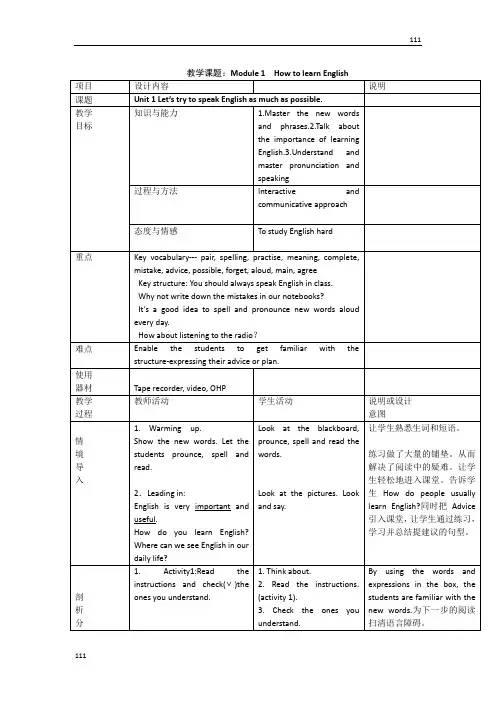
1. Think about. 2. Read the instructions. (activity 1). 3. Check the ones you understand.
说明或设计 意图 让学生熟悉生词和短语。
练习做了大量的铺垫。从而 解决了阅读中的疑难。让学 生轻松地进入课堂。告诉学 生 How do people usually learn English?同时把 Advice 引入课堂,让学生通过练习, 学习并总结提建议的句型。
1. Read the words and phrases. 2. Listen and answer the questions. (Part 2). 1. Make sentences to practice the sentence structure. And then discuss what the sentence structure is like.要学生找出 Part3 中 提出建议的句型。 2. Listen to Part 3 and complete Part 4 then practice reading the dialogue in groups. Then several should be asked to read in public. At last ask some groups to act out part3. 1. Read the dialogue together with the tape recorder. Then read the sentences of Part 5, with the tape recorder. 2. Read the sentences to let the partner check if the sentences are pronounced in a correct way. Talk about problems in learning English and give advice. Students read, write and remember.
外研版八上英语教案
外研版八上英语教案【篇一:新外研版八年级英语上册1-12模块教案】 module 1 how to learn englishunit 1 let’s try to speak english as much as possible.第1、2课时【学习目标】1、(知识与技能):掌握下列重点单词的意思及用法:translate, correct, match number, advice,mistake, message, each, spelling,pronunciation, newspaper, excellent.掌握下列短语的意思及用法:give sb. some advice, write it/them down, speak english, in class, do some concerts, try (not) to do sth., each other, help sb. with sth.2、(过程与方法):通过本节的学习,培养学生的探究精神和创新意识,提高学生解决实际问题的能力。
3、(情感、态度与价值观)掌握学习英语的方法,提高学习英语的兴趣,懂得与人交流,注意语言的得体性。
【重点难点】1.重点句式:how about listening to the radio and reading a newspaper in english?try not to translate every word.you should always speak english in class.why don‘t you write down your mistakes?2.难点:提建议的常用表达方法。
【学法指导】课前在熟读单词与短文的基础上认真完成自主学习内容并能把重点单词短语熟记于心,完成探究内容,对未能解答的问题做上标记,课堂上,跟着老师的指导,完成听读训练,学习新的语法知识,并纠正自己在课前完成的任务。
八年级教案教学设计说教材外研版英语八年级上册Module1八上+M1M2M3

4. Listen and fill in the blanks
Here are some good ways to learn English. We should speak English ___ ___ ____ __ in class. And don’t forget to ___ ____ the correct answers next to the mistakes. It’s a good idea to ____ and ____ new words aloud every day. When we are listening, we don’t need to understand every words. We just need to listen for ______ and _____. Writing is also important. We can try to find some English __________.
Unit 1 评价任务
• 1.反复听对话,回答问题,了解英语学习的 有关建议。
• 2. 小组合作,针对英语学习中出现的问题, 提出建议。
• 3.听课文,用文中出现的词汇完成填空。 • 4.跟读并复述对话中表示提建议的句型。
Unit 1 对话处理
• 1. Listen to the radio and answer the question. • What’s the dialogue about? • 设计意图:让学生了解文本的主旨大意,理清
教材通 研结构
教材分析 学情分析 课标要求 语法结构点击 听说课 读写课
重点词句梳理 学习目标 评价任务
对话(课文)处理 练习
Module 1
外研版八年级上册M11U1课堂教学教案

外研版八年级上册M11U1课堂教学教案授课教师:授课时间:PWP method, task-based method and interactive appro achStep 1 Lead-inStep 2 Consolidate new wordsStep 3 Listen and numberStep 4 Match the wordsStep 5 Listening practice.Step 1 LeadingSs look the pictures and guessthe word according to the sentence.Step 2 Consolidate new wordsLook and say. The teachers showsthe pictures of new words and letthe students to say the new wordsas quickly as possible.Step 3 Listen and number thewords and expressions as you hearthemLet Ss listen to the tape andnumber the words and expressions.Then draw answers from thestudents.Step 4 Match the words andexpressions in Activity 1 with thepicturesRead the words and expressionsand choose the right pictures.Step 5 Listen to Activity 1 andanswer the questionsListen and answer the question:What present do they want to buyfor Lingling?Arousestudents’enthusiasmLearn the new wordslet the students haveinterested in thepassageImprovestudents’listeningand guessing themeaning of newwordsImprove thestudents’reading1’3’10’5’Step 6 read and answerStep 7 Complete the passageStep 8 Homework Step 6 Read the dialogue andanswer the questions1.When can people open thepresent in China?2.Where must people open thepresent immediately?3.Do people accept a presentwith both hands in the West?Step 7 Complete the passage withthe correct form of the words fromthe boxRead the passage and fill in theblanks with the correct form of thewords.Step 8 HomeworkWrite a passage about the schoolrules at your schoollinking wordscorrectlyImprove thestudents’ reading6’10。
八年级英语上册 第一模块三个单元教案 外研版
Module 1 How to learn EnglishUnit 1 Try not to learn translate every word.Teacher Liu Baoxian Grade EightTime 45 minutesTeaching PlanTeaching Contents Unit 1 Try not to learn translate every word.Material & student analysis本模块以"How to learn English"为话题,以学习征求建议、提出建议的方法为主线,介绍了单词分类记忆、根据上下文判断词义、听力细节辨认、反向推理、略读等学习方法。
通过模块学习,除了能掌握上述英语学习方法之外,还可根据老师和同学的建议制定更适合自己的学习计划;同时,模块也综合复习了初一所学的一般现在时、现在进行时、一般将来时和一般过去时的用法。
Studying aims1、To get to know the key vocabulary and key structure.key vocabulary : translate,translation,correct,grammar, pronunciation, advice, else, each, send, orchestra, shy, forget, count key structure:You should always speak English in class.Why don’t you write down the correct spelling?It’s a good idea to check your vocabul ary notebook everyday.She can help me with my homework.2、To understand the dialogue 3 involving advice on learning English .3、To be able to describe what you should do when you study English and make a plan.Important & difficult points 1、提出建议的表达方式。
八年级英语上册 Module 1 How to learn English教案 外研版 教案
外研版英语八年级上Module 1 How to learn English全模块教案I. Teaching goals 模块教学目标II. Teaching material analyzing 教材分析本模块以“How to learn English”为话题,以学习征求建议、提出建议的方法为主线,介绍了单词分类记忆、根据上下文判断词义;听力细节辨认、反向推理;略读等学习方法。
通过模块学习,学生除了能掌握上述英语学习方法之外,还可以根据同学的建议制定更适合自己的学习计划;同时,模块也复习了一般现在时、现在进行时、一般过去时、一般将来时的用法。
Unit 1 通过听、读、说训练,初步学习给别人提建议的方法。
其中活动1要求将所给表示学习活动的词汇分类;活动2要求根据录音判断对话主题;活动3—5听读包含建议的对话并完成填表、答问等任务。
活动6学习英语中的连读法;活动7根据提示口头练习给别人提建议的方法。
Unit 2 通过读、写训练,学会向别人征求建议或给别人提出建议。
其中活动1要求学生列举自己在语言学习活动中遇到的实际困难。
活动2—4要求学生阅读一语言学习“问答专栏”中内容后完成补全句子、回答问题等练习。
活动5—6要求学生根据自己的学习实际,完成一封求助信并征求同学的建议。
Unit 3 对“提供学习建议”的功能项目进行综合训练,并在此基础上完成制定学习计划的任务。
其中活动1、2 要求听取Charlie和Mary的对话,选出所听到的表示建议的句式并完成问答练习。
活动3—5 要求根据所供图片,描述、评论Jack的学习、生活情况,并根据提示问题提出建议。
活动6要求阅读 Helen的问题并用所供表达完成Simon 的回信。
活动7—9是词汇的拓展训练:其中7要求根据图片写出单词;8用所供词汇组成短语;9用所供词汇完成句子。
Around the world给学生介绍了通过多种渠道学习英语的方法。
Module task要求学生反思自己的英语学习,通过图标明晰信息,并根据图标信息制定学习计划;然后小组交流,提出修改建议。
英语外研版八年级上册M1 U1教案
英语外研版八年级上册Module 1 How to learn EnglishUnit 1 Let’s try to speak English as much as possible.教学目标:一、语言目标1.正确使用下列单词:correct, practice, match, complete, advice, understand, forget, main, 2.掌握并运用下列词组:talk about, in class, as much as possible, write down, next to, what else,how about, get to know, agree with.二、技能目标:1. 通过听力训练,能听懂关于如何学习英语的对话,完成相应的练习.2. 学会针对别人的问题提建议.三、教学策略:学案导学1. 本课利用学案,采用任务型教学法,用多媒体等辅助教学手段进行,为学生运用英语进行交际创设情景,实现师生互动,生生互动。
2. 任务型活动策略:学案导学,在做中学,在做中练,在做中巩固往往有良好的效果。
四.教学重点、难点:能听懂关于如何学习英语的对话、学会针对别人的问题提建议. 五.教学过程:Step 1: Lead in: Ask the students to think about why we should learn English?And show them some data and examples to reveal the importance of learning English.Step 2: Listening:1.Listen and answer the 4 questions by using the following words2.Listen to the conversation and answer the question.3. Listen to the conversation again and fill in the blanks.Step3:reading and speaking.1.Read the conversation again and finish the table, then check the answers.2.Work in pairs. Ask and answer the questions by Using the notes in activity3.What should I do to improve:1.My listening2.My speaking3.My reading4.My writingStep 4: Summary and homework.Introduce some other ways to improve English.Ask students to write down their own questions in learning English.。
外研版八上英语《Module1Unit1》说课稿
外研版八上英语《Module 1Unit 1 》说课稿一. 教材分析《Module 1 Unit 1》是外研版八年级上册英语教材的第一单元第一课时,本节课的主要内容是介绍一些基本的日常用语和问候语。
教材主要包括三个部分:听力、口语和阅读。
通过本节课的学习,学生能够掌握一些基本的日常用语,提高他们的听说能力。
二. 学情分析八年级的学生已经具备了一定的英语基础,他们对学习英语有着浓厚的兴趣。
但部分学生在发音和听力方面还存在一些问题,因此,在教学过程中需要特别关注这部分学生的学习情况,帮助他们提高英语水平。
三. 说教学目标1.知识目标:学生能够掌握一些基本的日常用语和问候语,如“Hello”,“Good morning”,“How are you?”等。
2.能力目标:通过听力、口语和阅读的训练,提高学生的英语听说能力。
3.情感目标:激发学生学习英语的兴趣,培养他们积极向上的学习态度。
四. 说教学重难点1.重点:学生能够熟练掌握并运用基本的日常用语和问候语。
2.难点:学生能够正确理解并运用英语进行简单的交流。
五. 说教学方法与手段1.采用任务型教学法,让学生在完成任务的过程中学习英语,提高他们的实践能力。
2.运用多媒体教学手段,如PPT、视频等,丰富教学内容,激发学生的学习兴趣。
3.小组合作学习,鼓励学生互相交流、互相帮助,提高他们的团队协作能力。
六. 说教学过程1.导入:教师通过与学生打招呼,引入本节课的主题,让学生初步感受日常用语的重要性。
2.听力训练:教师播放听力材料,学生听后回答相关问题,提高他们的听力能力。
3.口语练习:教师引导学生进行角色扮演,运用所学日常用语进行交流,提高他们的口语表达能力。
4.阅读理解:教师分发阅读材料,学生阅读后回答相关问题,增强他们的阅读理解能力。
5.巩固提高:教师学生进行小组讨论,运用所学知识进行实际交流,巩固所学内容。
6.总结反馈:教师对学生的学习情况进行总结,给予鼓励和指导,帮助学生提高。