
冀教版 英语课件:九年级上Unit6 Accidents Lesson45-Lesson48
Copyright 2004-2009 版权所有 盗版必究
Different names in different countries Saint Nicholas – a person who always saved sailors from storms ,helped young people and gave gifts to poor people . He was famous in Europe . In Germany ,people called him Sankt Nicholaus. In Holland ____Sinter Klass . In North America , Santa Claus
Copyright 2004-2009 版权所有 盗版必究
Lesson 47 Never catch a dinosaur !
Copyright 2004-2009 版权所有 盗版必究
Studying aims:
知识与能力: 知识与能力: Understand the new words: warn warn sb to do sth warn sb that II 过程与方法:talk ,read and write 过程与方法: III情感,态度与价值观: 情感,态度与价值观: 情感 Be careful everywhere
Copyright 2004-2009 版权所有 盗版必究
Keep quiet !
No litters everywhere ! Don’t jump over !
Slow down !
Copyright 2004-2009 版权所有 盗版必究
Never catch a dinosaur ! Read the diary and pay attention to theses sentences . 1.You could have prevented the accident . (But you didn’t !) 2.You have warned him to use the ladder . 3.She watched me climb higher and higher .
Copyright 2004-2009 版权所有 盗版必究
When the girls wake up the second morning,they were so happy to see that the gold was enough for them to buy many things . From that time children all over the world hang their stockings ,but in different countries ,there are different ways .
Copyright 2004-2009 版权所有 盗版必究
Give an oral report about Danny’s accident , Here are some details about it : decorating the art classroom , a yellow star , warn sb not to do sth , climb high , fall off the chair , on top off, take Brian to hospital , see a doctor ,nothing serious , learn a safety rule …
Be sure you can !
Copyright 2004-2009 版权所有 盗版必究
Don’t start a fire . A fire !
Copyright 2004-2009 版权所有 盗版必究
Copyright 2004-2009 版权所有 盗版必究
Copyright 2004-2009 版权所有 盗版必究
Copyright 2004-2009 版权所有 盗版必究
Do you know more warnings in the daily life ? Let’s see together !
Take care of the Never give up learning ,net grass ,they have games are harmful ! lives as us ,too.
Copyright 2004-2009 版权所有 盗版必究
单项选择: 单项选择: 1.Some people even put up their stockings for their pets C A as well as B also C as well D either D 2.He came up with an idea for a hybrid race _______. A in the 1969 B in 1960s C at 1960s D in the 1960s 3.They walked _______ the forest and found the wounded B bear . A across B through C cross D though A 4.She _______ me to send her an e-mail. A wishes B hopes C excepts D hoped 5. Neither I nor he C _____ able to answer the question . A are B be C is D were D 6.Don’t use water to ________ the kitchen fire . Use baking soda or salt instead . A put on B wear C in D dressed
Copyright 2004-2009 版权所有 盗版必究
Phrases : be mad at / be angry with ( I’m not mad at you .我不生你的气。) be careful / take care (Take care ,the bus is coming 小心点,车来了!) hurt oneself ( Luckily , the boy didn’t hurt himself in the bike accident . 很幸运 ,这个孩 子在自行车事故中没有伤到自己。) at /on the edge of ( Don’t put the soap on the edge of the bathtub.别把肥皂放在浴缸的边上。) warn sb to do sth (I have warned you not to be careless .我警告过你别太粗心的。)
Lesson 45 How safe is your home ?
Copyright 2004-2009 版权所有 盗版必究
Studying aims:
知识与能力: 知识与能力: Grasp the new words: soda ,electrical,appliance ,drawn . Understand the new words: prevent,fire ,instead, slip, bathroom,edge,soap . II 过程与方法:talk ,read and write 过程与方法: III情感,态度与价值观:Be careful at 情感,态度与价值观: 情感 home .
Copyright 2004-2009 版权所有 盗版必究
Writing Exercises :
Imagine you are Danny ,send an e-mail to Li Ming to tell him the accident .Do+n’t forget to+ use the expressions we learned in this unit
Copyright 2004-2009 版权所有 盗版必究
Do you know ? The two most dangerous rooms in the house are bathroom and kitchen . Just because people are careless .Watch the pictures and talk about how to stop these accidents .
Copyright 2004-2009 版权所有 盗版必究
Quick :Finish off the
exercises in your text book
chimney
Copyright 2004-2009 版权所有 盗版必究
Exercises :根据首字母和句意填空
1.Children believe that Santa Claus comes down himney hristmas the c________ and visits them before C_____ , arents but we know our p_____ often pretend to be a father Christmas . 2. Christmas is as p______ as Spring Festival . opular 3. Time is money .So we must try to s_______ it . ave 4. Do you like to listen to the s_____ of Santa tory Claus ? 5. People began to p________ “Sinter Klass” as rounce Santa Claus in the 1600s. ole 6. Santa Claus lives at N orth ________ P______ .
英语:unit 6 《accidents!》教案(3)(冀教版九年级上).doc

Unit 6 Accidents!Lesson 41 After an AccidentTeaching Content:Mastery words and expressions: accident, refuseOral words and expressions: acting, victim, pretend, warning, reporterTeaching Aims:1.Learn about avoid accidents.2.Grasp how to give out warning.Teaching Important Points:1.Talk about accidents.2.Imperatives.Teaching Difficult Points:Giving warnings and express fear.Teaching Pictures: picturesTeaching Aids: audiotape, flashcards, picturesType of lesson: new lessonTeaching Procedure:e to “THINK ABOUT IT”.The teacher asks the students the following questions:Have you ever seen an accident? What happened? Did you help?What should you do if you see an accident happen?When the students are discussing, the teacher write some new words about the accidents on the blackboard. Such as: crash, hurt, badly, serious, put a bandage on, send…to…Step2.Let the students read the text and tell the main idea of this text.S1: It is a play about an accident.S2: Jenny, Danny and Jenny play a role-play about an accident.S3: We learn some new words and expressions on giving warning.Step3. Read the text and encourage the students to ask some questions about the text.They may ask the following questions:1.What’s the meaning of victim?3.What is Brian in this play?Step4. Come to the project.Divide the class into several groups. Now let’s decide who is the victim, who is the reporter and who is the witness.Some students may not know what to say. Show some words and expressions with the help of the flash.Let them show their dialogues in front of the class.Then change the roles in the play and act it out.Step 5. Homework1.Finish off the activity book.2.Go on the next reading in the student book.Summary:Accidents often happen in our daily life. Some of us have the pains of losing our friends. The victims sometimes are very young. So we must pay attention to the traffic rules. We must our value our lives for our parents, families and friends.Lesson42: Be Careful, Danny!Teaching Content;Mastery words and expressions: careful, ceiling, seriousOral words and expressions: ladder, injure, fault, ambulanceTeaching Aims:1.Know more about the accidents.2.What to do when we are in danger.Teaching Important Points:1.Give warnings.2.Imperatives.Teaching Difficult Points:How to do with an accident.Teaching Preparation: pictureTeaching Aids: audiotape, flashcards, picturesStep1. Come to “THINK AOBUT IT”.Show some pictures of accidents to the class. Let them talk about the pictures in groups. If they don’t know the accidents well, show the main points to them. Then let them talk in English about the accidents. Talk about the subjects in class.Step2.Listen to the tape and guess what happens in the text. Let some students retell their ideas.Ask the following questions:What are Danny, Jenny and Brian doing?What’s the matter with Danny?Does Mr. Jones come here?Where do they send Brian?Step3. Read the text and check the answers in Step2. Retell the story but not word by word. They must use their own language.Step4. DiscussLet’s talk about the questions: what do we do when we see an accident? What is the useful and correct ways to save the victims?Divide the class into several groups and talk about the questions.e to “LET’S DO IT”.Finish the task in pairs. Let the students prepare for a while, then act the dialogue out in front of the class.In the discussing, remind the students to speak English. Show words that they don’t know on the blackboard. Walk around the classroom and give them help if necessary.Step6. Homework1.Finish off the activity book.2.Go on the next reading in the student book.Summary:Talking is an important part in the class. When the students talk about this lesson, pay attention to the words and expressions of giving warnings and showing fears. Show some more new words to them about this lesson. Let the students use them as fluently as possible.Mastery words and expressions: patient, safety, rule, drop, rushOral words and expressions: injury, recover, James Noble, bounce, witness, Andrews, icy, MortonTeaching Aims:1.Learn more about the accidents.2.Talk about the injury.Teaching Important Points:1.Do with the victim.2.How does an accident happen?Teaching Difficult Points:Learn to avoid the accidents.Teaching Preparation: picturesTeaching Aids: audiotape, flashcards, picturesType of lesson: new lessonTeaching Procedure:Step1. Guess the end of Brian. What will they do with Brian? If you are Jenny, what will you do?Let some students tell their opinions in front of the class.S1: I will send him to the hospital.S2: I will call an ambulance.S3: I will take care of him carefully in the hospital.S4: I will bring some food to him.S5: I will call her parents.Step2. Read the text and answer the following questions:1.What’s wrong with Brian?2.Does he hurt badly?3.Does Brian’s mother come to the hospital?Let some students answer the questions.Step3. Read the text and check the answers. Encourage them to ask more questions about the text.Stp4. Act the dialogue out.Divide the class into several groups and act out the dialogue. Praise them as more as possible. Use different wordsStep5. Read Part 2 and retell the story.Ask some students to say the main ideas of this part. Remember not to read the text word by word.Step6. Some language points:There’s something wrong with… in a hurry, stop…fromThere’s somethin g wrong with my car.Don’t go in such a hurry.His mother stopped him from playing on the street.Step7. Come to “LET’S DO IT”.Finish the task in pairs. Show them in front of the class.Step8. Homework.1.Finish off the activity book.2.Go on the next reading in the student book.Summary:We should pay attention to the traffic when we are riding. All of the students come to school by bike. Obeying the traffic rules is important for us. We can introduce the traffic rules of other countries to the students. Remember to show them some beautiful pictures.Lesson 44: Please Take CareTeaching Content:Mastery words and expressions: height, careless, bellOral words and expressions: waterslideTeaching Aims:1.Know more about the foreign culture.2.Be careful when we do something dangerous.Teaching Important Points:1.Give out warnings and showing fear.2.Imperatives.Teaching Difficult Points:Teaching Aids: audiotape, flashcards, picturesType of lesson: new lessonTeaching Procedure:Step1.Listen to the tape and be familiar with the foreign song. Play the tape for several times. Let the students sing after it.Step2.Show some pictures to the students. Let them say them in English. Talk about the pictures. The teacher gives new words to help them.Step3. Read the song as a poem line by line.Step4. Imagine the pictures that the song talks about. Act them out in front of the class.Step5. Create new song according to what we learn in this text. Pay attention to the rhyme. Let’s s ing together. Step6.Homework1.Finish off the activity book.2.Go on the next reading in the student book.Summary:Singing foreign songs is difficult for some students. The teacher may learn it well before class. Teach them in the class until they can sing it well. Let’s them listen some more times. Practice more, and they can grasp the song. Let them create more song according to what we learn in this text. They will think the song is easy.Lesson 45: How Safe Is Y our Home?Teaching Content:Mastery words and expressions: prevent, bathroom, fire, instead, soap, edgeOral words and expressions: slip soda, electrical, appliance, downTeaching Aims:1.Prevent accidents from home.2.Know more about your kitchen.Teaching Important Point:1.Give out warning.2.Express fear.Teaching Difficult Points:Teaching Aids: audiotape, flashcards, picturesType of lesson: new lessonTeaching Procedure:Step1. Show a picture of a kitchen to the class. Let them talk about where an accident may happen and how to avoid it.Step2. Come to “THINK ABOUT IT”.Divide the class into several groups. Talk about the questions. After a while, let them have a report in front of the class.Step3. Listen to the tape and answer the following questions:Where are the most dangerous rooms in the house?Step4.Read the text and find the details about the accidents of the kitchens and the bathrooms. These are all facts. Somebody may have the same accidents. It is easy for them to understand.Step5. DiscussionShow some pictures with the help of the flash. Let the students say what something about the accidents in the house. Divide the students in groups and let them finish the task. Then ask some students to give reports in front of the class.Step5: Do with some language points:Show some pictures about the language points. Then show the expressions to the students. prevent…from…, instead, edgeAsk the students to make sentences with the language points above.The policeman prevents him from falling.His mother came to the school instead of him.Don’t stand at the edge of the chair.e to “LET’S DO IT”.Discuss in groups of three or four. Give suggestions about how to keep a safe home. Write down the ideas of group members. Then give a report in front of the class.Step7. Homework1.Finish off the exercises in activity book.2.Go on the next reading in the student book.There is much danger in our life. We must pay attention to it. When we are cooking, we mustn’t let the children near here. The boiling water may hurt them. When we are cutting, the children may touch the knife or the vegetables. Some accidents may happen unexpectedly.Lesson46: Help PeopleTeaching Content:Mastery words and expressions: saveOral words and expressions: beard, Saint Nicholas, sailor, Nikolaus, pole, the North Pole, sleigh, reindeer, Rudolph, chimneyTeaching Aims:1.Know more about the foreign festivals.2.Learn the history of Christmas.Teaching Important Points:1.The history of Christmas.2.The story of Santa Claus.Teaching Difficult Points:The story of Santa Claus.Teaching Preparation: picturesTeaching Aids: Audiotape, flashcards, picturesType of lesson: new lessonTeaching Procedure:Step1. Show some pictures of Christmas to the students. Let them say the main features of Christmas.S1: We can see Christmas cards, Christmas tree and Christmas Eve.S2: We can get Christmas presents and Christmas cards on that day.e to “THINK ABOUT IT’.Ask some students talk about the questions in front of the class. If they h ave some words that they don’t know how to say, the teacher may help them.Christmas is very popular in cities in China. Many shopping centers sell well on that day. They also send Christmas presents and Christmas hats on that day.Step3. Listen to the tape and answer the following question:2.Was there really a Santa Claus?Step4. Read the text and answer the following questions:1.What does Santa Claus wear?2.Where did he come from?Step5. Discuss the text in details. Encourage them to ask more questions about this text.1.Tell the old stories about Santa Claus.2.Do the quick quiz.Step6. Retell the story. Sum the main points of this text. Retell the story in their own words, but not word by word. Step7. Come to “LET’S DO IT”.Finish the task in groups. Write down the composition in the exercise book. Then change it in the group. If they find someone’s composition can’t be understood. They can ask the teacher for help.Step8. Homework1.Finish off the exercises in activity book.2.Go on the next reading in the student book.Summary:Christmas is more and more popular in China. Many foreign festivals have come to China in the past years. We know more about the foreign countries. It is necessary for us students and teachers. When someone asks the story, we can tell him in details. We are very proud of it.Lesson 47: Never Catch a DinosaurTeaching Content:Mastery words and expressions: warnOral words and expressions: She didn’t think…. It took sb. some time to do sth.Teaching Aims:1.Know more about the accidents.2.Prevent the accidents from happening.Teaching Important Points:1.Giving warnings.2.Express fear.Teaching Difficult Points:Teaching Preparation: picturesTeaching Aids: audiotape, flashcards, picturesType of lesson: new lessonTeaching Procedure:Step1. Tell an accident in your life. Say it in front of the class. Let some students find rules in the stories. What should we not do in our daily life?Step2. Listen to the tape and answer the following question:1.Who is the letter from?2.What’s wrong with Li Ming in the text/Step3.Read the text and retell the story in details. Retell the main idea of the text but not word by word.Ask some students to sum the main idea of the text loudly in the class.Step4. Language points:Show some expressions and pictures to the students. Ask the students to make sentences with the language points. rule, higher and higherDo you know the rules of basketball?The city is more and more beautiful.Step5: Come to “LET’S DO IT”.Finish the t ask in oral in class. Let’s see how many students can finish the task with looking at the books. Praise them if you think they do well.Step6. Homework1.Finish off the exercises in activity book.2.Go on the next reading in the student book.Summary:We hear accidents happen every day. Sometimes some traffic accidents happen because the drivers are careless. We must obey the traffic rules if we want to be safe. Sometimes we have accidents because of our carelessness. If we do things more carefully, we are safer.Lesson 48: Unit ReviewTeaching Content:Mastery words and expressions from Lesson 41 to Lesson 47.Teaching Aims:1. Know more about the accidents in the home or on the road.3.Learn more about the Christmas.Teaching Important Points:1.Give warnings.2.Express fear.Teaching Difficult Points:Imperatives.Teaching Preparation: picturesTeaching Aids: audiotape, flashcards, picturesType of lesson: review lessonTeaching Procedure:Step1.Suppose today is Christmas. Give the students some presents. Say something about the Christmas. Encourage them to say more about the presents and Christmas.Step2. Let the students make posters to remind the students to keep safe.Divide the class into groups of three or four. Finish their posters in their groups. Then put them up on the wall. Which group does well? Remember to praise them. Let the students tell their ideas in the class.Step3. Do the exercises on Page 59. Find out the difficulties and show them on the blackboard.Step4. Finish this part “Speaking the Language”.Ask some students to come to the front and act the dialogue out.There are five situations in this part. We can find five pairs of students to act the dialogue out.Step5. Come to “Work in groups”.This is a poster about how to prevent accidents in school. Some students have accidents in school easily. So the parents are worried about the students when they are in school. Make posters and put up in school in obvious places to remind the students.Step6. Homework1.Finish off the exercises in activity book.2.Write a composition about your accidents when you were a child.Summary:It is important for the students to make posters in school. Some students are naughty. Sometimes they can’t realize the danger in their life. Some students are too young to realize the danger. So posters are necessary. They canremind them in the right situations.。
1.7 Unit6 Accidents课件(冀教版九年级上册)
washed their stockings and hung them near the fire .
Nicholas saw this and threw three bags of gold through the chimney because he didn’t want others to know that , and the bags fell in one of the stockings.
What do you think?
Read the text for 4 minutes ,and answer the following questions
.
1.What does he look like? 2.What do the old stories say about Saint Nicholas?
The story of Santa Claus
Once a rich man’s wife died, leaving him three daughters. He had to look after them on a farm himself and became very poor .When the daughters got the time to marry , he had no money to buy anything . At night , the daughters
White beard
In red clothes
Black boots
Where does Santa Claus live?
At the North Pole
What animals pull Santa’s sleigh?
冀教版英语九上《Unit 6 Accidents》(lesson41-44)ppt课件
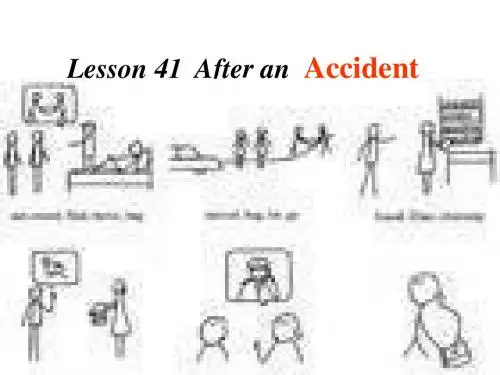
• Actors ( the victim , someone who saw the accident , a doctor , a reporter ) • Each person in your group will pretend to be someone different , and you will pretend that someone has had an accident. Don’t forget to show your classmates : how the accident happened , what happens next …
The new words :
If someone was hurt we say he was injured , What do we call his sick place _____ injury . What do we call a sick person ______ patient . To walk on the right__we must know the traffic rules . He is in danger means he is not safe . danger --safety Don’t rush in the street ,it is dangerous . He dropped his wallet while he was walking with his son. The road is too icy ,be careful.
• "No! no, you two go together. " "NO, no, no…" "you will go and carry water when you can't bear it ." • So they waited and waited. At night a mouse came out to find food. It saw a candle on the table. "Hey! Candle! It is yummy!" the little mouse began to eat the candle. The candle broke and caused fire! "Fire! Fire! Wake up! Carry water quickly!" they ran down to the mountain and carried water. At last, they put out the fire together. • monk和尚 temple 寺庙 pailful 满桶 pail桶 bear 忍受 candle蜡烛 cause引起 fire 火 wake up醒来 put out扑灭
冀教版九上《unit6accidents》word教案和练习
冀教版九上《unit6accidents》word教案和练习Unit6 Accidents一. 教学内容:Unit 6 Accidents(Lesson 41—Lesson 44 )1. 重点单词。
n. accident acting victimwarning reporter ceilingladder fault ambulanceinjury patient safetyrule height bellv. pretend refuse injurerecover bounce rush dropadj. careful serious patient icy careless 2. 重点短语。
have an accident 出事故fall on top of 掉到了……上面be mad at… 生……的气happen to 碰巧in a hurry 匆忙3. 交际用语。
提出警告。
二. 重点、难点解析及词语辨析:1. after an accident 交通事故后(L41)accident n. 事故,意外①Luckily, he was not badly hurt in the traffic accident.幸运地是,他在这场交通事故中受伤不严峻。
拓展by accident 偶然;无意中②I met Lucy by accident today. 今天我偶然遇到Lucy。
2. What happened? 发生了什么事?(L41)happen vi.“发生”,没有被动语态。
多指没有打算的发生;take place “发生”,多强调按打算发生。
例如:①What happened to him last night?昨天晚上发生什么事了?②Many great changes have taken place in China since 1978.1978年以来,中国发生了许多翻天覆地的变化。
英语:Unit-6-《Accidents!》Lesson-43课件(1)(冀教版九年级上)

最新冀教版英语九年级上册《unit 6 accidents》lesson41-48教案.doc

UNIT 6 Accidents!Lessons 41-48Functions:Giving WarningsExpressing FearGrammar:imperativesStructures:be mad athurt oneselfon/at the edge oftake care/be carefulwarn sb.(not) to do (sth.)Lesson 41 After an AccidentLanguage goal:●words and expressions : accident acting victim pretend warningrefuse reporter●key sentences:(don’t) have to have an accidentAbility goals:Acting an accidentEmotion and attitude goals:How to deal with an accidentStrategy goals:Talking about an accidentTeaching activity:Step 1: Come to “think about it”.Step 2: Check to see if the students have previewed the reading as required. Ask if they have any questions concerning the text. Encourage other students to try to answer the questions. Select one or two words from the vocabulary list and ask if anyone has figured out the meaning. If a student replies correctly, ask him or her to share the strategies used to puzzle out the meanings. Remember to give lots of praise for a good try, even if it’s wrong.Step 3: Play the audiotape. Have the class follow the audiotape while looking at the text.Read the test and answer true (T) or false (F).1)Jenny, Danny and Brian are having an accident. ( )2)The victim is the person who is hurt. ( )3)Jenny is good at acting, so she wants to be the victim. ( )4)Danny will be the friend of Jenny; and Brian will pretend a reporter.( )5)At last, Jenny becomes angry with Danny. ( )Step 4: Divide the class into groups of three. Ask each group member to take one of the three roles (Jenny, Danny, or Brian and out the dialogue.Step 5: Come to “Project 1”Introduce and begin unit project 1. This project can cover six lessons. Students will be working in groups of six to prepare and present this role-play project about how to respond to an accident. The “Teaching Techniques ”section at the back of this teacher’s guide provides suggestions for introducing a new project. The following is a step-by-step method of helping students learn and practice this information.Homework:◆Recite the dialogue and write down the new words◆Finish the exercises in the workbookLesson 42 : Be Careful、Danny!Language goal:●words and expressions : careful ceiling ladder injureserious fault●key sentences:Look at this yellow starLet me get the ladder for youAbility goals:Giving WarningsExpressing FearEmotion and attitude goals:Ask for helpStrategy goals:How to giving warnings and expressing fearTeaching activity:Step 1: Come to “Think About It”.Step 2: Check to see if the students have previewed the reading as required. Ask if they have any questions concerning the text. Encourage other students to try to answer the questions. You may simply ask the class what happened to Danny and where it happened. Can the students retell the story?Step 3: Play the audiotape. Have the class follow the audiotape while looking at the text.Step 4: Divide the class into groups of four. Ask each group member to takeone of the four roles (Brain, Jenny, Danny or Mr. Jones) and act out the dialogue. It should be a lot of fun.Step 5:If you have time, divide the reading into five or six parts, and divide the class into five or six groups. Have each group rewrite one part of the reading in the past tense. If there is time, ask each group to read to the class what they have rewritten. You may want to make some comments in the process. Remember to give lots of praise for a good effortTeaching tips:Homework:◆Read the text and write down the new words◆Finish the exercises in the workbookLesson 43 Brian’s InjuryLanguage goal:●Words and expressions: injury patient recover safety ruleJames Noble drop bounce witness Andrews icy Morton rush●Key sentences:Be mad at…, learn a new safety rule, there’s something wrong with…,It’s nothing .seriousAbility goals:Seeing a doctorEmotion and attitude goals:Know about how to deal with an accident.Strategy goals:Have a positive attitude to an accidentTeaching activity:Step 1: Check to see if the students have previewed the reading as required. Ask if they have any questions concerning the text .Encourage other students to try to answer the questions. Select one or two sentences containing key words or phrases and ask if anyone has figured out the meaning. If a student replies correctly, ask meanings. Remember to give lots of praise for a good try, even if it’s wrong.Step 2: Play the audiotape. Have the class follow the audiotape while looking at the text.Read the text and answer true (T) or false (F).1.Brian went to the hospital by bus. ( )2.There was something wrong with Brian’s leg, so he couldn’t walk.( )3.Brian will recover soon because he was not badly hurt. ( )4.Brian’s mother didn’t come to the hospital. ( )5.There was a traffic accident on a cold morning on 15 Street andPark Road. ( )6.Two girls were injured. ( )7.The two girls walked in front of Mrs. Andrews. ( )8.Mrs. Andrews shouted to the girl. But it didn’t work. ( )9.Mrs. Andrews called the ambulance. ( )10.It was the driver who stopped the traffic. ( )11.The driver, Mr. Morton took Ann to hospital at once in his car.( )12.Ann broke her leg, but she will be well in a week. ( )Step 3: Divide the class into groups of six. Ask each group member to take one of the six roles (Brain, Danny, Jenny, Mr. Jones, Dr. Ling or Brain’s mother) and act out the dialogue. Try to make it lively and fun.Step 4: If you have time, ask one or two groups to present their drama to the class.Step 5: Come to “Let’s Do It “.Step 6: If you have time, ask each group to discuss, in English, one of the following topics:There are too many accidents (traffic, mining, fire,) happening in China. List some accidents you know of that have happened recently.What are some of the main causes of the accidents?What can and should we do to stop them from happening again?Teaching tips小组讨论:中学生应该做什么,不应该做什么。
英语:Unit-6-《Accidents!》Lesson-43课件(1)(冀教版九年级上)(1)1
ቤተ መጻሕፍቲ ባይዱ
在春末正午的阳光下 春末,正午的阳光微微耀眼,清风悄悄的施下梦境。河水紧紧的躺着,偶尔翻个身。盎然绿意的柳絮晃啊晃,思绪也跟着一并晃,晃向那似乎消失了的记忆。 春末,蛙声初至,正午的阳光洒在那一望无尽绿的世界。醉人的风拂过稻田,我们提着鱼竿穿行在阡陌之上,天真的笑语在这静谧的光海掀起漂亮的浪花。在四周无人照看的河塘,一起等待期盼可爱的 鱼儿上钩。在耐不住的等待的时光里,一起畅游在这一年最后的春水里,洗净了烦恼,清澈了这纯真的笑颜。
是你我懒得理会,或说做不到,是故一直在强调,或许正因为如此,所以生活中,你我一直在反复强调那些常识。。 开运网 https://
在这个春天,我习惯了看书,没有强迫地去看那些过去自以为枯燥的书,再在习惯中麻木,麻木地看着世间各种不合常理的琐事,最后在麻木中遗忘,遗忘时间,遗忘自己,独不敢遗忘别人。这个世界 需要你们,即使你们一直都在埋怨,也不会真的放弃,只因为留恋,或说怀念至于我,如雨后春笋,世界于我而言,我于世界而言,都没有什么意思的。 春天的美丽,我不敢亵渎,只能远远地看着,看着或快乐,或烦恼的你们,要么分享,要么祝福,从此不敢再说什么,心中的那点破事,就让它埋葬在那吧,反正又不是第一次了。
春天有着太多的故事,我说不完,更说不好,你我都是过来人,自是懂的,至于那些美好,曾经亦曾向往,只是为了生活,难免怠慢了,甚者无奈放弃了。春天只是一个季节,它承受不起太多,请不要 将所有不满都怪在它身上。你我快乐与否,都不能改变什么,也不可能改变什么,只要心怀绝望,每天都可以黑暗;只要心怀希望,每天不敢保证什么,至少还有希望!这些道理很简单,或说肤浅,只
英语:Unit-6-《Accidents!》Lesson-43课件(1)(冀教版九年级上)(1)
Unit 6 Accidents! Lesson 45 课件(冀教版九年级上)
3. 小心刀子!
______ ______ ______ knives! 答案:1. hurt themselves by 3. Be careful with 2. Don’t; put out
4. 在你使用电器设备前,擦干地板。 ______ the floor ______ you ______ electrical appliances. 5. 决不要把小孩单独留在浴缸里。 ______ ______ small children ______ in a bathtub.
【活学活用】
①什么也无法阻止我哥哥出国。
Nothing can ______ my brother ______ ______ abroad.
②吸烟者被禁止在公共场所吸烟。 A smoker is ______ ______ ______ in public. 答案:①prevent/keep/stop; from going ②prevented from smoking
3. Dry the floor before you use electrical appliances. 在你使用电器设备前,擦干地板。 【自主领悟】该句是一个主从复合句,其句子结构如下图所
示:
“祈使句+从句”结构即主从复合结构,该结构中,从句常用 一般现在时代替一般将来时。例如: Don’t worry too much before you take part in the competition. 在你参加比赛前不要 担心太多。
2. Use baking soda or salt instead. 用发酵粉或盐代替。
副词 ,意为“代替,顶替”,它一般 【自主领悟】instead作_____
冀教版九年级英语上册 Lesson 6 【精品课件】
Yours, Li Ming
知识点 1 take out 拿出;切除
eg:Let's begin our class. Please take out your books. 咱们开始上课吧。请把你们的书拿出来。
考向一 take out的宾语若为名词,常放于其后;若宾语为 代词时,放于中间。 eg:You'd better take it out. 你最好把它取出来。 take out 是动副结构;take…out of…“把…… 从……取出来”,是动介结构。 eg:He took his phone out of his bag slowly. 他慢吞吞地把手机从包里掏了出来。
指状态。
once.他太累了,
立刻就睡பைடு நூலகம்了
困倦的;
I feel very sleepy
瞌睡的; 可作表语或定语。 now. 我现在感觉
安静的
非常瞌睡。
典例 Please turn down the TV a little. Father is _s_le_e_p_i_n_g_ (sleep) in the next room.
考向二【易错点】 与take有关的短语: take away 拿走;消除 eg:I want to take away this book. 我想拿走这本书。 take back 退回;收回 eg:I take back what I said. 我收回我说过的话。 take down 记下;写下;拿下 eg:Please take down the pictures from the wall. 请把画从墙上拿下来。 take off 起飞;脱掉;取消