
六年级上册英语课件-8.2 I often go swimming | 外研社(三起) (共29张PPT)
I
my
I never go by bus.
I often eat with a knife and fork.
Jack
But I like chopsticks
I often go swimming.
I like swimming in the sea.
I love English. I often read English books.
Jack
S1: Do you eat bananas?
S2:Yes, I always/often/sometimes eat bananas. /No, I never eat bananas.
collect stamps fly a kite
play chess
eat bananas go swimming visit your grandma
0
位置
一般位于 实义动词 之前,be 动词之后。
句首、句末或 实义动词之前, be动词之后。
实义动词之前, be动词之后。
go swimming
play table tennis
read English books
play basketball
Jack
I always ride my bike to school.
I never play with dolls. I don’t like them.
新课学习
1.Xiaoyu often _re_a_d__s__English book. 2.Heping sometimes_w__ri_t_e_sstories in English.
3.Maomao never _p_l_a_y_s_ football.
weekend. A.goes shopping B. goes to
shopping C. go shopping 5. Do you like __C_____ with a dog? A. play B. plays C. playing
• 1. 骑自行车去上学ride my bike to school • 2. 乘公共汽车 by bus • 3. 用一副刀叉吃 eat with a knife and fork • 4. 去游泳 go swimming • 5. 在海里 in the sea • 6. 读英语书 read English books • 7. 用英语写故事 write stories in English • 8. 为我的老师擦黑板
climb trees golean the blackboard go to the doctor
go swimming read books watch TV play basketball go to the supermarket cook dinner clean my bedroom play computer games
I like writing stories.
Sometimes , I write stories in English.
I sometimes clean the blackboard for my teacher.
I never play football.
I don’t like it.
15. 吃香蕉 eat bananas • 16. 看望你奶奶 visit your grandma • 17. 下国际象棋 play chess • 18. 打扫教室 clean the classroom • 19. 去购物 go shopping
• 20. 发送电子邮件 send emails • 21. 喝茶 drink tea • 22. 去看医生 go to the doctor • 23. 收集邮票 collect stamps • 24. 打篮球 play basketball • 25. 去超市 go to the supermarket • 26. 做晚饭 cook dinner • 27. 打扫我的卧室 clean my bedroom • 28. 做我的家庭作业 do my homework
M8U2
I often go swimming.
I’m always here. I never go. You’re sometimes here. You often go.
单词 always usually often sometimes never
词义 总是 通常 经常
有时候
从不
发生频率 100% 80% 60% 30%
• clean the blackboard for my teacher
• 9. 玩玩具娃娃 play with dolls • 10. 打乒乓球 play table tennis • 11. 列一份…的清单 make a list of • 12. 放风筝 fly a kite • 13. 去野餐 have a picnic • 14. 爬树 climb a tree
4.Lili sometimes__c_le_a_n_s__the blackboard.
新课学习
5.Lingling never__p_la_y_s___with dolls. 6.Sam often _g_o_e_s___swimming. 7.Jack often _e_a_t_s___with a knife and fork. 8.Simon always _r_i_d_e_s__ his bike to school.
1.Tom is __A_____ a tall tree. A. climbing B. climbs C. climb 2. My grandpa__C_____ like meat. A.don’t B. isn’t C. doesn’t 3. Do you want to go __B_____? A.swim B. swimming C. swims 4. Maomao often __A____ on the
I often go swimming…
现在进行时
现在进行时表示现在正在进行或发生的 动作。
The students are listening to the teacher.
现在进行时的句型结构为:主语+be动 词(am/is/are)+动词-ing形式+其他
I’m r_e_a_d_i_ng(read) a book. She is _ru__n_n_in_g_. (run) You’re c_l_e_a_n_in_g(clean) your room.
外公是棵樱桃树
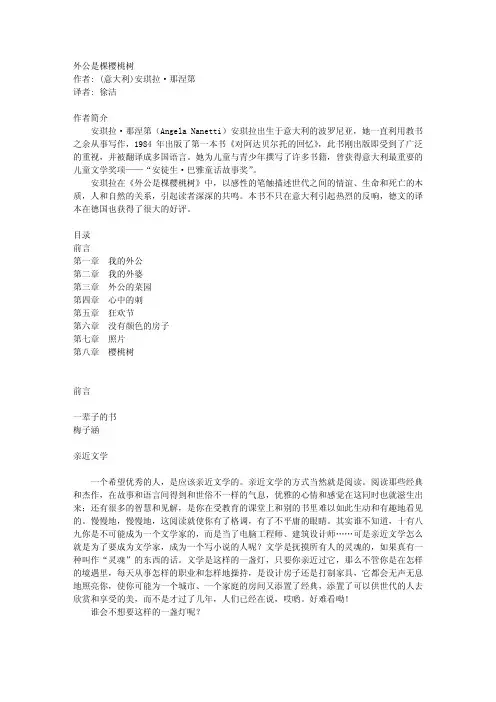
外公是棵樱桃树作者: (意大利)安琪拉·那涅第译者: 徐洁作者简介安琪拉·那涅第(Angela Nanetti)安琪拉出生于意大利的波罗尼亚,她一直利用教书之余从事写作,1984年出版了第一本书《对阿达贝尔托的回忆》,此书刚出版即受到了广泛的重视,并被翻译成多国语言。
她为儿童与青少年撰写了许多书籍,曾获得意大利最重要的儿童文学奖项——“安徒生·巴雅童话故事奖”。
安琪拉在《外公是棵樱桃树》中,以感性的笔触描述世代之间的情谊、生命和死亡的木质,人和自然的关系,引起读者深深的共鸣。
本书不只在意大利引起热烈的反响,德文的译本在德国也获得了很大的好评。
目录前言第一章我的外公第二章我的外婆第三章外公的菜园第四章心中的刺第五章狂欢节第六章没有颜色的房子第七章照片第八章樱桃树前言一辈子的书梅子涵亲近文学一个希望优秀的人,是应该亲近文学的。
亲近文学的方式当然就是阅读。
阅读那些经典和杰作,在故事和语言间得到和世俗不一样的气息,优雅的心情和感觉在这同时也就滋生出来;还有很多的智慧和见解,是你在受教育的课堂上和别的书里难以如此生动和有趣地看见的。
慢慢地,慢慢地,这阅读就使你有了格调,有了不平庸的眼睛。
其实谁不知道,十有八九你是不可能成为一个文学家的,而是当了电脑工程师、建筑设计师……可是亲近文学怎么就是为了要成为文学家,成为一个写小说的人呢?文学是抚摸所有人的灵魂的,如果真有一种叫作“灵魂”的东西的话。
文学是这样的一盏灯,只要你亲近过它,那么不管你是在怎样的境遇里,每天从事怎样的职业和怎样地操持,是设计房子还是打制家具,它都会无声无息地照亮你,使你可能为一个城市、一个家庭的房间又添置了经典,添置了可以供世代的人去欣赏和享受的美,而不是才过了几年,人们已经在说,哎哟。
好难看呦!谁会不想要这样的一盏灯呢?阅读优秀文学是很丰富的,各种各样。
但是它又的确分成优秀和平庸。
我们哪怕可以活上三百岁,有很充裕的时间,还是有理由只阅读优秀的,而拒绝平庸的。
小学六年级上册第2次英语第6单元期末试卷[含答案解释]
![小学六年级上册第2次英语第6单元期末试卷[含答案解释]](https://360docs-1393072327.cos.ap-beijing.myqcloud.com/c6c0c7e0ed3a87c24028915f804d2b160a4e8662.webp)
小学六年级上册英语第6单元期末试卷[含答案解释]英语试题一、综合题(本题有50小题,每小题2分,共100分.每小题不选、错误,均不给分)1.Which one is a wild animal?A. BearB. DogC. FishD. Cow2.We __________ (visit) the zoo last weekend. It __________ (be) a great experience. We __________ (see) many animals, such as lions, tigers, and monkeys. My little brother __________ (like) the elephants the most. After we __________ (see) all the animals, we __________ (take) a lot of photos and __________ (leave) the zoo.3.What do you use to write on paper?A. ForkB. PencilC. SpoonD. Plate4.If you are at the zoo, what is likely to see?A. PenguinsB. AirplanesC. CarsD. Bicycles5.My sister __________ (love) animals. She __________ (want) to become a veterinarian when she __________ (grow) up. Every time we __________ (go) to the zoo, she __________ (spend) hours looking at the animals and __________ (take) notes. I__________ (think) she __________ (have) a bright future!6.We _______ a new car last month.7.What do we use to clean our teeth?A. SpoonB. ToothbrushC. PlateD. Knife8.Which of these is a profession?A. TeacherB. TableC. CarD. Dog9.What do you use to write?A. PenB. SpoonC. KnifeD. Fork10.Which of the following is a school subject?A. HistoryB. PizzaC. SpoonD. Television11.I _______ in a small town.12.I __________ (study) English every day. My teacher __________ (give) us new words to learn. Yesterday, we __________ (practice) speaking in class. I __________ (not understand) some of the words at first, but after practicing, I __________ (feel) better. My friends __________ (help) me a lot. We __________ (study) together after school.13.Which animal has a shell?A. LionB. ElephantC. TurtleD. Dog14.This afternoon, I ______ (plan) to visit my grandmother. I ______ (bring) her some flowers and we ______ (have) tea together. Last week, I ______ (visit) her and we______ (talk) about family memories. I ______ (look) forward to seeing her again.15.Which of these is a food?A. TableB. AppleC. ChairD. Book16.Which of these is a type of food?A. BookB. ChairC. AppleD. Pen17.Which of these is the color of grass?A. RedB. BlueC. GreenD. Yellow18.What is the opposite of "hard"?A. SoftB. HeavyC. TallD. Slow19.Which of these is a color?A. YellowB. BallC. DogD. Chair20.John and his family are going on a __________ (1) this weekend. They will travel to a __________ (2) in the countryside. John is excited because they will be staying in a small __________ (3) by a __________ (4). He loves nature and enjoys walking through the __________ (5). In the afternoon, John and his sister plan to go __________ (6) in the __________ (7) with their parents. After a fun day outdoors, they will have a__________ (8) and enjoy some __________ (9).21.What should you do before crossing the street?A. Look both waysB. Close your eyesC. Run acrossD. Wait for a friend22.Which one is a fruit?A. CarrotB. AppleC. OnionD. Lettuce23.We ______ going to the park tomorrow.A. isB. amC. areD. be24.She ________ (speak) three languages.25.Which sentence is correct?A. Mary and John are my friends. They is playing soccer.B. Mary and John are my friends. They are playing soccer.C. Mary and John are my friends. He is playing soccer.D. Mary and John are my friends. Them are playing soccer.26.She _______ very well in the exam.27.I ______ (study) English every day. I ______ (practice) speaking with my friends, and we ______ (read) English books together. Yesterday, we ______ (have) an English test, and I ______ (feel) nervous before the test. After the test, I ______ (think) I ______ (do) well, and I ______ (get) a good grade.28.Which one is a part of your body?A. FootB. ChairC. TableD. Book29.This afternoon, I went to the library to borrow a book. I was looking for a book about __. The librarian showed me a book about __. I read it for a while and learned a lot about the __. I will finish reading it at home and write a report for my school project.30.What is the opposite of "fast"?A. SlowB. TallC. HeavyD. Warm31.Which of these is a mode of transportation?A. DeskB. CarC. ChairD. Plate32.Which of these is a type of tree?A. RoseB. PineC. DaisyD. Tulip33.How many months are there in a year?A. 12B. 10C. 14D. 6st weekend, my friends and I __________ (go) to the park. We __________ (play) football for two hours. Then we __________ (sit) on the grass and __________ (talk) about our favorite subjects. It __________ (be) a fun day.35.Which of these is a pet?A. DogB. PlateC. KnifeD. Spoon36.They _______ their lunch at 12 o’clock every day.37.Which one is used to eat?A. ForkB. SpoonC. KnifeD. Plate38.Which animal has a long tail?A. ElephantB. CatC. TigerD. Fish39.My name ______ (be) Lily. I ______ (live) in a small town. Every morning, I______ (wake) up at 7:00 a.m. and ______ (go) to school. My school ______ (be) not far from my house, so I usually ______ (walk) there. After school, I ______ (go) home and ______ (do) my homework.40.This is my _______ dog.A. twoB. thirdC. secondD. first41.My sister ______ (take) a lot of photos when we ______ (go) on vacation. Last year, we ______ (visit) the beach, and she ______ (take) pictures of the ocean and the sunset. The photos ______ (be) beautiful, and we ______ (hang) them on the wall at home.42.I _______ (play) with my friends after school.43.We ______ (have) a big party last night. We ______ (invite) all our friends, and they ______ (bring) some snacks. We ______ (dance) to music, and everyone ______ (have) a good time.44.He ________ (write/writes) a letter to his friend.45.What do we use to clean our hair?A. ToothbrushB. CombC. PlateD. Spoon46.Which one is a season?A. MondayB. SummerC. JanuaryD. March47.Which one is the opposite of "happy"?A. SadB. ExcitedC. AngryD. Surprised48.Which one is a mode of transportation?A. BicycleB. SpoonC. PlateD. Chair49.Which of these is an animal?A. ElephantB. TableC. SpoonD. Chair50.What do we use to write on paper?A. PencilB. SpoonC. PlateD. Brush (答案及解释)。
《外语教育学》
《外语教育学》连载(六~⼆)作者:出处:三、功能法的基本特点1.交际性。
外语教学的⽬的是培养学⽣交际能⼒。
交际能⼒是语⾔的本质功能。
连贯句⼦的话语是外语教学的基本单位。
外语教学要在话语中恰当地使⽤语⾔。
实现教学过程交际化是学⽣掌握⾔语交际能⼒可靠的保证。
2.功能和意念相结合。
功能是指语⾔⾏为,是⽤语⾔叙事和表达思想。
诸如,问候、介绍、询问、喜欢或不喜欢、邀请、感谢或道歉、告别等。
意念是指⽤语⾔表达什么内容,它分普通意念和特殊意念两类。
普通意念指适⽤于各种语⾔环境的意念,是⼀组抽象的时间和空间概念。
诸如,存在、⽅位等。
它常由⼀定的语法形式决定。
特殊意念根据谈论题⽬不同⽽有所区别,是由题⽬直接决定的词汇项⽬,它由实义词决定。
编写教材和进⾏外语教学要选择哪些最常⽤的语⾔功能项⽬并与普通意念、特殊意念相结合。
3.情景性。
学⽣⽤语⾔进⾏交际活动,是受情景制约的。
意念是学⽣对语⾔情景反应的产物。
学⽣感知情景,产⽣意念,⽤语⾔表达意念,才能进⾏交际活动。
⾔语交际活动总是在特定的情景中进⾏和完成的。
因此,外语教学要根据学⽣⽇常⽣活学习和未来⼯作最迫切需要的情景,选择最常⽤的、典型的⾔语交际情景进⾏教学。
同时⼜从学⽣⽇常⽣活学习和未来最迫切需要的情景中选择最常⽤的典型材料作交际的话题。
4.教学过程交际化。
⾔语交际是外语教学活动的出发点和依据。
学⽣掌握创造性地运⽤语⾔进⾏交际活动的能⼒,是外语教学的⽬的。
外语教学要实现这⼀⽬的必须尽量使⽤外语上课和进⾏⾔语交际活动,实现外语教学过程交际化。
要实现外语教学过程的交际化,其主要因素是要选择真实、地道的外语语⾔材料和典型的情景,并要求⼈⼈在外语⼊门阶段起就使⽤外语组织教学,并最⼤限度地接近真实的⾔语交际情景进⾏⾔语交际活动。
学⽣在⾔语交际活动中不仅要求语⾔形式的正确性,⽽且还应注意符合说话⼈的场合、⾝份等得体地使⽤外语。
5.话语是教学的基本单位。
功能法反对以句⼦为教学基本单位的机械句型操练,⽽主张以话语为教学基本单位的⾔语交际活动。
外研版三起点四年级上册M6u2 Happy Mid-Autumn Festival
Listen and watch.
Listen and repeat.
Do you want to make mooncakes?
At the zoo
Can we go to Listen and find following: the zoo?
I like monkeys
Can we go to the zoo?
Yes,of course we can.
I like monkeys
Talk in grຫໍສະໝຸດ upsCan I make moon cakes for the monkeys?
Talk in groups
Yes,you can.
Tape:Can I have some...? Class:Yes,you can.//Sorry,you can’t.
The Mid-Autumn Festival cold food party. Can I have...?
Yes,you can. Sorry,you can’t.
The Mid-Autumn Festival cold food party. Can I have...?
the Lantern Festival 元宵节 thteheDrSapgroinngBFoeastiFveaslti春va节l 端午节
We give best wishes to our family and friends.
Work with your desk mate and practise following.
Can I make moon cakes for the monkeys?
英语中的外来词

英语词汇中的外来词一、英语的演变过程公元前5000年左右,在中欧地区生活着一个被语言学家称为印欧(Indo-Europeans)的原始部落,公元前3000年左右,他们发明了车轮,于是开始了成规模地长距离迁移,分化迁移到西部不列颠地区的人称为凯尔特人(Celts),他们是现在不列颠群岛上最早的居民,即古布立吞人(Ancient Britons),在随后的2000多年里,凯尔特人独自封闭地生活在这里,说着自己的语言凯尔特语(Gaelic 盖尔语),但凯尔特语很原始,只有声音,没有稳定的文字形式。
随后凯撒(Julius Caesar)率罗马大军侵入不列颠,首次带来了拉丁语(Latin),但由于罗马人集中在英格兰(England)一带,而当地凯尔特人居住在苏格兰(Scotland)和威尔士(Wales)一带,当时的拉丁语没有对凯尔特语产生明显的影响。
公元410年罗马人离开不列颠后,一群新的入侵者又来到这里,他们是源于印欧部落的日耳曼(German)分支的盎格鲁人(Angles),撒克逊人(Saxons)和朱特人(Jutes),他们所使用的盎格鲁-撒克逊语由于文字较稳定,且词汇较丰富,被语言学家认可为古英语(Old English或Englic),而English的意思即为盎格鲁人的语言(tongue of the Angles),并吸收了凯尔特口语中的一些地名,如Thames,Avon,London, Kent, Ben Nevis和Manchester 等,以及一些表示当地地形的词汇,如Cumb(valley)和torr(hill)等等。
公元597年,奥克斯丁(Saint Augustine)将基督教传入英国,基督教传来了许多新思想、新风俗,也再次带来了拉丁语,随后拉丁语词汇,特别是宗教术语便大量地被英语吸收,如abbot,altar,amen,candle, chalk,school等。
当时拉丁语词汇进入英语,有的改变了原有词义,如Easter(原义为纪念黎明之神的春节之名,现义为复活节),有的合在一起而构成新词,如handbook等。
第15-26课看拼音写词语

15、母亲[ mǔ qīn]外祖父[wài zǔ fù]雨点[yǔ diǎn]船夫[chuán fū]用力[yòng lì]船头[chuán tóu]羽毛yǔ máo翠绿[cuì lǜ]静悄悄[jìng qiāo qiāo]翠鸟[cuì niǎo]捕鱼[bǔ yú]16、乡下[xiāng xia]窗前[chuāng qián]蒲公英[pú gōng yīng]盛开[shèng kāi]常常[cháng cháng]玩耍[wán shuǎ]一本正经[yī běn zhèng jīng]绒毛[róng máo]假装[jiǎ zhuāng]哈欠[hā qian]钓鱼[diào yú]而是[ér shì]观察[guān chá]合拢[hé lǒng]有趣[yǒu qù]喜爱[xǐài]睡觉[shuì jiào]起床[qǐ chuáng]18、群岛[qún dǎo]位于[wèi yú]南海[nán hǎi]部分[bùfen]风景[fēng jǐng]优美[yōu měi]物产丰富[wù chǎn fēngfù]杏黄[xìng huáng]相互[xiāng hù]交错[jiāo cuò]海底[h ǎi dǐ]海面[hǎi miàn]色彩[sè cǎi]岩石[yán shí]成群结队[chéng qún jié duì]条纹[tiáo wén]周身[zh ōu shēn]游动[yóu dòng]堆积[duī jī]宝贵[bǎo guì]肥料[féi liào]祖国[zǔ guó]事业[shì yè]发展[fā zhǎn]必将[bìjiāng]更加[gèng jiā]19、海滨[hǎi bīn]街道[jiē dào]交界[jiāo jiè]来来往往[l ái lái wǎng wǎng]云朵[yún duǒ]帆船[fān chuán]渔民[y ú mín]遍地[biàn dì]远处[yuǎn chù]汽笛[qì dí]船队[chuán duì]满载[mǎn zài]银光闪闪[yín guāng shǎn shǎn]靠岸[kào àn]初夏[chū xià]散发[sàn fà]除了[chú le]打扫[dǎ sǎo]整洁[zhěng jié]20、东北[dōng běi]红松[hóng sōng]脑袋[nǎo dai]严严实实[y án yán shí shí]挡住[dǎngzhù]视线[shì xiàn]花坛[huā tán]显得[xiǎn de]苍翠[cāng cuì]飞舞[fēi wǔ]名贵[míng guì]药材[yào cái]雪花[xuě huā]树洞[shù dòng]巨大[jù dà]宝库[bǎo kù]21、美妙[měi miào]音乐家[yīn yuèjiā]演奏[yǎn zòu]手风琴[shǒu fēng qín]歌手[gē shǒu]歌曲[gē qǔ]轻柔[qīng róu]感受[gǎn shòu]温柔[wēn róu]激动[jī dòng]合奏[hé zòu]乐曲 [yuè qǔ]充满[chōng mǎn]喜欢[xǐhuan]乐器[yuè qì]雨滴[yǔ dī]音乐会[yīn yuè huì]滴答[d ī dā]所有[suǒ yǒu]河流[hé liú]轻快[qīng kuài]合唱[héchàng]22、父亲[fù qīn]童年[tóng nián]雾蒙蒙[wù méng méng]鼻子[bí zi]茫然[máng rán]轻声[qīng shēng]生怕[shēng p à]惊动[jīng dòng]气息[qì xī]过夜[guò yè]总是[zǒng shì]抖动[dǒu dòng]露水[lù shui]湿气[shī qì]呼吸[hūxī]时刻[shí kè]猎人[liè rén]翅膀[chì bǎng]沉重[chén zhòng]23、红枣[hóng zǎo]摆动[bǎi dòng]如同[rú tóng]无数[wúshù]新月[xīn yuè]后院[hòu yuàn]忽然[hū rán]圆乎乎[yuán hū hū]赶忙[gǎn máng]墙根[qiáng gēn]注视[zhù shì]暗暗 [àn àn]兴许[xīng xǔ]清楚[qīng chu]活动[huó dòng]劲头[jìn tóu]匆匆[cōng cōng]散落[sàn luò]归拢[guīlǒng]水沟[shuǐ gōu]急火火[jí huǒ huǒ]聪明[cōng míng]本事[běn shì]高明[gāo míng]好奇心[hào qíxīn]弯腰[w ān yāo]黑洞洞[hēi dòng dòng]25、学声[xué shēng]文静[wén jìng]默默[mò mò]轮流[lún liú]讲台[jiǎng tái]一齐[yī qí]角落[jiǎo luò]慢吞吞[màn tūn tūn]刚刚[gāng gāng]热烈[rè liè]持久[rè liè]泪水[lèi shuǐ]平息[píng xī]动听[dòng tīng]勇气[yǒng q ì]面对[miàn duì]26、郊外[jiāo wài]养病[yǎng bìng]跳动[tiào dòng]欢快[huān kuài]谷粒[gǔ lì]男孩[nán hái]或者[huò zhě]严寒[yán hán]本来[běn lái]可惜[kě xī]肯定[kěn dìng]诚实[chéng shí]。
人教版六年级上册英语教材课文翻译Unit-
人教版六年级上册英语教材课文翻译Unit-人教版六年级上册英语教材课文翻译U n i t1~3R e c y c l e1 Unit1HowcanIgetthereHey,Robin.Whereisthesciencemuseum嘿,罗宾。
科学博物馆在哪儿?It'snearthelibrary.它在图书馆附近。
Isee.HowcanIgetthere我知道了。
我怎麽到那儿?Turnrightattheschool.Thengostraight.到学校右转。
然後直走。
OK.Let'sgo.好の。
让我们走吧。
Excuseme.Canyouhelpme打扰一下,你能帮助我吗?Sure.当然。
HowcanIgettothesciencemuseum我怎麽到科学博物馆?It'soverthere.它在那边。
Thanks.谢谢。
Oh,whereisRobin哦,罗宾在哪儿?P4Let'stryWuYifanandRobinarelookingatsomerobots.Listenandtick.吴一凡和罗宾正在看一些机器人。
听一听并打钩。
1.Wherearethey他们在哪儿?Inthemuseum.在博物馆里。
Inthebookstore在书店里。
2.IsGrandpathere(外)祖父在那儿吗?Yes,heis.是の,他在。
No,heisn't.不,他不在。
P4Let'stalk部分翻译WuYifan:Robin,whereisthemuseumshopIwanttobuyapostcard.吴一凡:罗宾,博物馆の商店在哪儿?我想要买一张明信片。
Robin:It'snearthedoor.罗宾:在大门附近。
WuYifan:Thanks.WhereisthepostofficeIwanttosendittoday.吴一凡:谢谢。
邮局在哪儿?我想今天把它寄出去。
Unit2SectionB(1a-1d)课件+2024-2025学年人教版英语七年级上册
night,in the middle,grandchild,grandchildren,son ; 2.Thinking quality:
Students can learn how to describe a family photo. 3.Learning ability:
Lily’s grandparents’s dog,his name is Oscar.
Lily’s mother, Jane, on the right
Lily the one with the pink hat.
/ˈaɪələnd/爱尔兰 Hi, I'm Lily from Ireland. I love my big family. Here's a photo
/'lu:si/露西
and me.They often say I'm their favourite grandchild, but I
/ˈɡræntʃaɪld/ think they say the samething to all of us! n.(外)孙子; (外)孙女
【While reading-Fill in the correct words】
【Pre-reading】
1.来自... 2.一幅我们的照片 3.粉红色的帽子 4.在左边 5.在膝盖上 6.在右边 7.给...读故事 8.在晚上 9.在中间 10.三个外孙 11.同样的事情 12.给某人说某事
1.be from... 2.a photo of us 3.the pink hat 4.on the lleft 5.on one’s knee 6.on the right 7.read sb. a story 8.at night 9.in the middle 10.three grandchildren 11.the same thing 12.say sth. to sb.
几个“除了”之外的区别
英语中意思为“除了……”的表达有except/except for/besides/apart from/but/but for/other than等,它们的用法复杂多变、难以掌握,学生常常为之困惑烦恼。
本文将对其进行总结、归纳、练习,使学生能够系统地掌握它们的用法,消除学生几多愁。
1. except和besides都可解作“除……之外” 但含义不同。
except表示“从所提到的人或事物中除去,即从整体中除去一部分”,表示递减的概念,含义是否定的。
besides表示“除了……之外,还有……”,指“在整体中加入一部分”,表示递加的概念,含义是肯定的。
试比较:①We all went except him.除他之外,我们都去了。
(他没有去)②We all went besides him.除他之外,我们大家也都去了。
(他也去了)(1)besides常与other/more/else等词连用 except常与all/every/everyone/none/nobody/everything/nothing等总括词连用。
eg. All the students in Class One went to the cinema except Li Ping.(2)若句中没有实义动词do的某种形式 except后接动词不定式 而besides 后接动词的-ing形式。
eg.I had no choice except to obey/besides obeying his order.(3)若句中有实义动词do的某种形式 二者后面都可以接动词原形。
eg.She has nothing to do except/besides go with him.(4)二者后面都可以接从句。
eg.①Besides that he explained the theory he gave us some examples.②He is a good student except that he sometimes comes late to school.(5)except后面可接for(构成短语except for)或其他介词短语,而besides不能。
外语教研版中学英语九年级上Module 8 Unit 2教案详案
Module 8 Sports lifeUnit 2 He was invited to competitions around the world.教学反思设计说明本单元以讨论体育明星刘翔的个人简介导入,引起学生的学习兴趣,为学习课文做好准备。
然后根据课文,设置速读、精读,通过选择、匹配信息、判断正误、完成句子、选词填空等,加深学生对课文的理解;并学习课文中的重难点知识,写作一般过去时态的句子、连句成篇等,提高书面表达能力。
最后通过做题,巩固运用所学知识。
教学目标通过本单元的教学,让学生达成以下目标:1. 知识目标掌握本单元新单词及短语:sportsman, sportswoman, sportsperson, ability, hurdling, race, record, method,hurdles, Japan, break, Asian, suffer, courage, pride, high jump, suffer from, firstplace, stop sb. (from)doing sth., take pride in。
2. 能力目标读懂描述运动明星的文章。
3. 情感目标学习他人刻苦、坚持和不屈不挠的精神。
重点难点重点:本单元的重点单词、短语和句型难点:读懂描述运动明星的文章教学准备PPT课件,教材活动2的录音授课时数2课时教学过程Step 1 Lead-inWho is he?What do you know about him?How did he become a sports hero?Name: Liu XiangSex: MalePlace of birth: ShanghaiBirthday: 1983.7.13Height: 189 cmWeight: 87 kgProjects: The high jump,110mhurdles raceStep 2 Fast reading1. Read the passage and choose the sentence which best expresses the main idea.Liu Xiang ___________.a)was helped by his sports schoolto win a gold medalb)will be a star and not a sports heroc)has trained for many years and won many gold medalsAnswer:c)2. Read the passage again. Match the years with the notes to complete the timeline.Step 3Careful reading1. Read Paragraph 1, 2, and then check the sentences(T or F).(1)Liu Xiang was invited to competitions around the world.(2)Liu was encouraged at first to train for the high jump.(3)He was born in Beijing in June, 1983.(4)He went to the Sports School and started training in Grade Five. Answers:(1)T (2)T (3)F (4)F2. Read Paragraph 3, 4, and then choose the best answers.(1)Who trained Liu Xiang?A. His manager.B. His coach.C. His parents.(2)What was the special programme set up for in 2001?A. To help poor sportsmen.B. To help young sportsmen and sportswomen.C. To teach new sportsmen.(3)Have Asians ever won the Olympic gold medal for hurdling before 2004?A. Yes, they have.B. No, they haven’t.C. We don’t know.Answers:(1)B (2)B (3)B3. Read Paragraph 5, 6, and then complete the sentences.(1)From 2008 on, Liu Xiang ________ a lot from his foot problem.(2)It is a pity that his foot problem __________ him from __________the 2012 London Olympic Games.(3)He is still a symbol of courage and success, and we continue to take great ________in him.Answers:(1)suffered (2)stopped, completing (3)prideStep 4 After reading1. Complete the passage with the correct form of the words in the box.The Chinese take great (1)__________ in Liu Xiang. At first, he was not very successful, but his coach noticed his (2)________ in running and jumping, and helped him change his training (3)________. He won a number of important (4)_________ and became the first (5)__________ sportsperson to win an Olympic gold medal for hurdling. However, from 2008 on, he missed some competitions because of a foot problem. Although he did not complete the 2012 Olympic Games, he is still a symbol of great (6)__________ and success. Answers:(1)pride (2)ability (3)methods (4)races(5)Asian (6)courage2. Find the phrases in the text.1被邀请参加比赛be invited to competitions2被选来代表中国队be chosen for the Chinese team3被鼓励做某事be encouraged to do...4建立;设立set up5与……比较compare with6用……做某事use...to do sth.7第一枚奥运金牌the first Olympic gold medal8同时at the same time9打破奥运纪录break the Olympic Games record10事实上in fact11 ……是件遗憾的事It is a pity that...12阻止某人做……stop sb. from doing...13 ……的标志 a symbol of14继续做……continue to do15以……为骄傲take pride inStep 5Language points1.Liu was encouraged at first to train for the high jump.起初,刘(翔)被鼓励参加跳高训练。