
人教版新目标八年级下册英语Unit 7 大熊猫的生活习性
大熊猫的生活习性
迄今为止,全世界200多个国家和地区几乎濒临绝迹的大熊猫,只有在我国的四川、陕西、甘肃部分地区的深山老林中才能找到它们的身影。
目前全世界的大熊猫总数仅1000只以下,而且数量在不断减少。
根据科学统计有78%的雌性大熊猫不孕,有90%的雄性大熊猫不育,这就给大熊猫的繁殖带来了许多困难。
在动物学上,大熊猫属食肉目。
据考证,大熊猫的古代名称有貘、白豹、虞等。
在200多万年前的更生世早期到100万年前的更生世中晚期,大熊猫已经广布于我国南半部,组成了大熊猫----剑齿象动物群;今天该动物群的许多种已经绝灭,而大熊猫却一直活下来,所以大熊猫有“活化石”之称。
熊猫从分类上讲属於哺乳纲食肉目动物,但食性却高度特化,成为以竹子为生的素食者。
熊猫这种独一无二的生活方式,却是长期自然历史选择适应的结果。
野生熊猫生活在人迹罕见的高山深谷密林之中,并且过着一种悠闲自在的生活。
这里所讲熊猫的活动,是从生态学研究范畴这个角度出发,探讨研究熊猫的巢域与核域、活动节律与作息制度、活动与能量消耗及采取的对策。
野生熊猫栖息於密林之中,它们生长到一定阶段要进行婚配和生育,即发情、求偶、交配、妊娠和育幼。
熊猫平时孤居,到了繁殖季节,雌雄互相吸引,在稠密的竹林里,唱出一曲曲恋歌,由此开始进行各种求爱活动。
熊猫是属於多雄争配制。
它们一生中产仔数量少,且幼仔不易成活。
由於熊猫生殖能力和育幼行为两方面的高度特化,使熊猫的种群增长十分缓慢,如保护管理跟不上,则数量日趋减少。
大熊猫主食竹子,也嗜爱饮水,大多数大熊猫的家园都设在溪涧流水附近,就近便能畅饮清泉。
大熊猫每天至少饮水一次,有的地方虽然食物很丰富,缺了水,也难以找到大熊猫的身影。
到了冬季,当高山流水被冰冻结以後,有的大熊猫也可能因为留恋自己家园的隐蔽条件和食物基地而不惜长途跋涉,沿沟而下,到谷中去饮水,然後返回家园。
大熊猫取水总是求远舍近,日复一日地走出一条明显的饮水路径。
它们到了溪边,以舔吸的方式饮水,若溪水结薄冰或被砂砾填没,则用前掌将冰击碎或用爪挖一个大约25x20米的浅坑舔饮。
大熊猫以竹类为
主要食物,而竹类却难以消化、吸收。
由此,使大熊猫的能量摄入受到极大的限制,它的一切活动都必须考虑到尽量多地摄入能量,尽量少地消耗能量。
大熊猫性情温顺,一般不主动攻击人或其它动物。
当大熊猫听到异常响声时,常常是立即逃避,当逃不掉时,就会像深闺的淑女一般,用前掌蒙面,把头低下,深深地埋在两个前掌中间,并把背脊高高地拱起来。
大熊猫的这种姿式,是一种害怕或生气的表现,但它们不主动出击,但是产仔当妈妈的大熊猫,为了下一代的生命安全,却一改过去的温顺脾气,戒备心很重,不允许任何动物(包括人)接近它那神圣不可侵犯的小宝贝。
大熊猫的视觉极不发达。
这是由於大熊猫长期生活於密密的竹林里,光线很暗,障碍物又多,致使其目光变得十分短浅。
此外由於它的瞳孔像猫一样是纵裂的。
因此,当夜幕降临的傍晚,它们还能活动。
大熊猫的生活习性有哪些
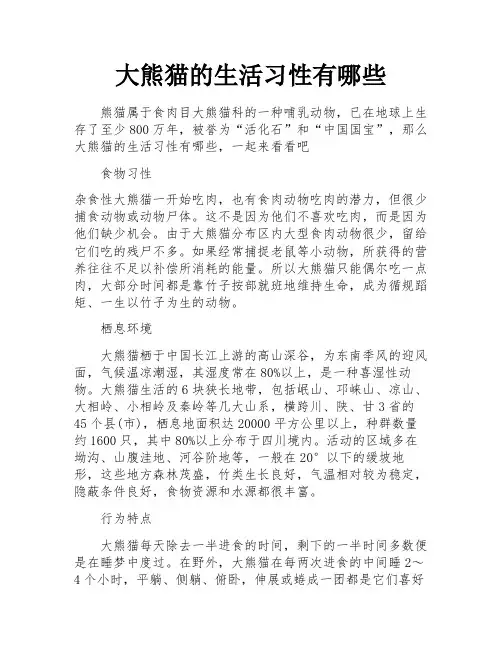
大熊猫的生活习性有哪些熊猫属于食肉目大熊猫科的一种哺乳动物,已在地球上生存了至少800万年,被誉为“活化石”和“中国国宝”,那么大熊猫的生活习性有哪些,一起来看看吧食物习性杂食性大熊猫一开始吃肉,也有食肉动物吃肉的潜力,但很少捕食动物或动物尸体。
这不是因为他们不喜欢吃肉,而是因为他们缺少机会。
由于大熊猫分布区内大型食肉动物很少,留给它们吃的残尸不多。
如果经常捕捉老鼠等小动物,所获得的营养往往不足以补偿所消耗的能量。
所以大熊猫只能偶尔吃一点肉,大部分时间都是靠竹子按部就班地维持生命,成为循规蹈矩、一生以竹子为生的动物。
栖息环境大熊猫栖于中国长江上游的高山深谷,为东南季风的迎风面,气候温凉潮湿,其湿度常在80%以上,是一种喜湿性动物。
大熊猫生活的6块狭长地带,包括岷山、邛崃山、凉山、大相岭、小相岭及秦岭等几大山系,横跨川、陕、甘3省的45个县(市),栖息地面积达20000平方公里以上,种群数量约1600只,其中80%以上分布于四川境内。
活动的区域多在坳沟、山腹洼地、河谷阶地等,一般在20°以下的缓坡地形,这些地方森林茂盛,竹类生长良好,气温相对较为稳定,隐蔽条件良好,食物资源和水源都很丰富。
行为特点大熊猫每天除去一半进食的时间,剩下的一半时间多数便是在睡梦中度过。
在野外,大熊猫在每两次进食的中间睡2~4个小时,平躺、侧躺、俯卧,伸展或蜷成一团都是它们喜好的睡觉方式。
在动物园里面,饲养员每天两次定时给它们喂食,所以大熊猫其他的时间都用来休息。
即使在睡觉的时候大熊猫看起来也很可爱。
非常的灵活,能够把它们笨重的身体摆成各种各样的姿势,最喜欢的姿势便是腿撑在树上,并用手遮住眼睛。
繁殖习性大熊猫栖息于密林之中,生长到一定阶段要进行婚配和生育,即发情、求偶、交媾、妊娠和育幼,雌性大熊猫每年发情一次,每次只有短暂的2~3天,发情时期通常在在每年的3~5月。
成年雌雄大熊猫相互间主要通过气味嗅觉的通讯方式逐渐聚集在一个地方并相互了解、相互吸引,到发情高潮时相互间通过连续不断的咩叫和鸟叫声以及待配姿势等听觉、视觉通讯方式表达爱意并达成配对交媾。
大熊猫的生活习性和特点
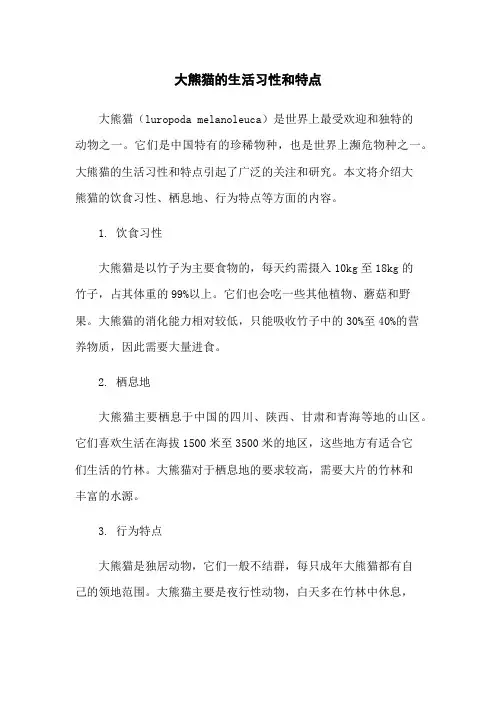
大熊猫的生活习性和特点大熊猫(luropoda melanoleuca)是世界上最受欢迎和独特的动物之一。
它们是中国特有的珍稀物种,也是世界上濒危物种之一。
大熊猫的生活习性和特点引起了广泛的关注和研究。
本文将介绍大熊猫的饮食习性、栖息地、行为特点等方面的内容。
1. 饮食习性大熊猫是以竹子为主要食物的,每天约需摄入10kg至18kg的竹子,占其体重的99%以上。
它们也会吃一些其他植物、蘑菇和野果。
大熊猫的消化能力相对较低,只能吸收竹子中的30%至40%的营养物质,因此需要大量进食。
2. 栖息地大熊猫主要栖息于中国的四川、陕西、甘肃和青海等地的山区。
它们喜欢生活在海拔1500米至3500米的地区,这些地方有适合它们生活的竹林。
大熊猫对于栖息地的要求较高,需要大片的竹林和丰富的水源。
3. 行为特点大熊猫是独居动物,它们一般不结群,每只成年大熊猫都有自己的领地范围。
大熊猫主要是夜行性动物,白天多在竹林中休息,晚上出来觅食。
大熊猫的行动相对缓慢,它们擅长攀爬树木和竹子,也善于游泳。
4. 繁殖与保护大熊猫的繁殖相对困难,雌性大熊猫每年只有2至3天的发情期。
雌性大熊猫会排除其他雄性的追求,只与一个雄性大熊猫交配。
雌性大熊猫怀孕期约135天,通常会产下1至2只幼仔。
幼仔在出生后需要母亲的照料,大约在一岁半至两岁时离开母亲独立生活。
大熊猫是一种宝贵的物种,目前正面临着严重的生存威胁。
保护大熊猫不仅涉及到保护它们的栖息地,还需要加强保护工作,包括建立保护区、加强监测和科学研究等。
附件:本文档附带照片:大熊猫的饮食和行为照片。
法律名词及注释:1. 稀有物种保护法:指中国政府为保护稀有濒危物种而制定的法律法规。
2. 栖息地保护:指在特定地区保护动物或植物的生存环境,包括建立保护区、限制开发等措施。
八年级下册英语第七单元作文熊猫

Pandas: Guardians of the ForestDeep in the dense forests of China, a mysterious creature roams freely, a symbol of peace and harmony with nature. This creature is the panda, a beloved national treasure of China and a global icon of conservation. Pandas are not just animals; they are ambassadors of a message of protection and respect for our planet's natural resources. Pandas are unique among bears, with their black and white fur coat that stands out in the lush green of the bamboo forests. They have a rounded body, short legs, and a distinct black patch around their eyes, giving them a charmingly cute appearance. But behind this cute exterior lies a powerful and adaptive animal that has survived for thousands of years.Pandas spend most of their time eating and sleeping. Their diet consists almost exclusively of bamboo, which they consume in large quantities to sustain their energy needs. Pandas spend up to 12 hours a day eating, and the rest of their time is spent resting or mating. This sedentary lifestyle might seem lazy, but it's actually crucial for their survival in the wild.Pandas are native to China, specifically in the mountainous regions of Sichuan, Shaanxi, and Gansu. These areas provide the perfect habitat for pandas, with an abundance of bamboo and a climate that suits their needs. Pandas are also found in some zoos around the world, where they are cared for and protected from the threats they face in the wild.One of the main threats to pandas is the loss of their natural habitat. As human development expands into panda habitats, the forests are cleared for construction, agriculture, and other activities. This results in a decrease in bamboo availability and an increase in contact with humans, which can lead to poaching and other illegal activities.To conserve pandas and their habitats, China has established several nature reserves and conservation programs. These efforts have helped to increase the panda population in recent years, but the species still faces many challenges. Global cooperation is also crucial, as pandas are a symbol of conservation efforts worldwide.Despite their appearance, pandas are not just cute and cuddly animals; they are also crucial to the health of the forests they inhabit. Pandas help to spread bamboo seeds and maintain the balance of the forest ecosystem. They are also indicators of a healthy environment, as their presence suggests that the area is rich in biodiversity and ecological stability.In conclusion, pandas are not just animals; they are guardians of the forest, ambassadors of conservation, and symbols of peace and harmony with nature. Their survival is crucial not only for their own species but also for the health of the planet. It is our responsibility to protect them and ensure that their habitats are preserved forfuture generations to enjoy.**熊猫:森林的守护者**在中国茂密的森林深处,有一种神秘的生物自由漫步,它是自然和平与和谐的象征。
英语人教版八年级下册Unit 7 Section B (2a--2d)

3. Adult pandas do not have babies very ( often ), and some of the babies only live for a short time because of ( illnesses ).
4. A special program in Chengdu teaches ( children ) about why pandas are ( endangered animals ). 5. The Chinese government is helping to ( save ) the pandas. Scientists also want to better ( understand ) the habits of pandas.
Writing Practice
big
ห้องสมุดไป่ตู้
bamboo
popular Sichuan beautiful
cute black and white famous endangered forest protect
重点讲解
1.research: n./ v. 研究 ;调查 2. keeper: n. 饲养员;保管人 3. awake: adj. 醒着 4. excitement: n. 兴奋;激动 5. run over to…. 跑向…… 6. walk into 走路时撞着 7. fall over 绊倒;摔倒 8. or so 大约 (通常位于数词和时间之后,表示大约的意思。) 9. die from 死于(外因) die from a car accident/an earthquake die of 死于(内因) die of sadness/hunger 10. illness: n. 疾病 11.wild: adj. 野生的 wild animals 12. government: n. 政府;内阁
Unit7 Section B(2a-2c)教案 人教版八年级英语下册

Unit7 What's the highest mountain in the world?Section B(2a-2c)学情分析:本节课涉及热爱与敬畏自然,与自然和谐共生。
学生普遍对此类话题比较感兴趣。
通过描述大熊猫在成都大熊猫繁育研究基地的生活的最象,学生更有画面感的感受到大熊猫的可爱,更能专注于阅读了解更多关于大熊猫的知识。
学生已经具备一定的阅读理解的能力,也有更好的逻辑思维与创新思维能力。
但是本文篇幅较长,对于大部分学生而言具有一定的阅读难度。
教学目标:1.获取大熊猫在成都大能猫繁育研究基地生活的基本信息,梳理、概括文中提到的大熊猫濒危的原因,以及保护大熊猫的方法;2.描述大熊猫的基本信息、大熊猫濒危的原因、保护大熊猫的方法。
思考保护大熊猫的其他办法;3.绘制呼吁大家保护大熊猫的海报。
教学重点:在阅读中运用寻读策略;教学难点:理清文章结构,并能描述大熊猫的基本信息、大熊猫濒危的原因和思考保护大熊猫的方法。
Step1 Lead-inDraw and guess to arouse students' interest and lead in the topic.Step2 Pre-readingBrainstorming: What do you know about pandas?Step3 While-reading1. Fast readingRead and match each paragraph with the main ideas to guide students to match the main idea by key words.2. Careful reading(1) Read paragraph 1 and 2, and finish the timeline and the chart. Develop students creative thinking and the ability to solve problems. (2) Read paragraph 3 and find out the reasons why pandas are endangered.(3) Scan Para3 to find out what these numbers mean.(4) Read paragraph 4 and find ou the ways to protect pandas.(5)Think: What can we do to protect pandas?Step4 Post- readingWork in groups to make a poster about pandas to guide students to use the language they have learned to do things, promote transfer innovation, and inspire deep thinking.The following information must be included1. Introduction about pandas.2. The reasons why pandas are endangered.p. The ways to protect pandasStep5 SummaryFree talk:1. What other endangered animals do you know?2 What impact will the extinction of wildlife have on human life?3. Protect animals. Protect ourselves.Step6 HomeworkWrite a paragraph about other endangered animals and then make a poster.Blackboard designUnit 7 What's the highest mountain in the world?The life At The Chengdu Research BaseThe Reasons Why Pandas Are EndangeredThe Ways to Protect Pandas。
介绍大熊猫生活习性的英语作文

介绍大熊猫生活习性的英语作文Title: The Enchanting Habitats and Lifestyles of the Giant Panda.The giant panda, a national treasure of China and a global icon of conservation, is a species renowned for its unique appearance and intriguing lifestyle. These bear-like creatures, with their distinctive black and white fur coats, inhabit a specific range of mountainous forests in central China, primarily in the provinces of Sichuan, Shaanxi, and Gansu. Their habitats are carefully chosen, as they require a specific combination of bamboo, altitude, and climate to thrive.The giant panda spends the majority of its day feeding on bamboo, consuming up to 30 kilograms of this fibrousplant each day. This incredible appetite is necessary to sustain their large bodies, as bamboo provides relatively little nutrition compared to other foods. Pandas spend upto 14 hours a day eating, with the remainder of their timedevoted to resting and reproducing.Despite their name, pandas are not true bears but belong to the raccoon family. They are solitary creatures, preferring to spend their time alone, except during the breeding season. Males and females will only meet briefly during this time, and even then, they engage in minimal courtship behavior. Mating occurs briefly, and the female will then carry the cub for about four months before giving birth to a single offspring.The cub remains dependent on its mother for the first year of its life, learning to crawl and eventually climb trees. By the time they reach two years old, cubs are considered independent and will begin to explore their environment, searching for suitable habitats and mates. The average lifespan of a giant panda in captivity is about 20 years, with females typically reproducing only every two to three years.Pandas are renowned for their exceptional climbing abilities, often scaling steep cliffs and trees with ease.This adaptation is not only crucial for finding food but also serves as a defense mechanism against predators. Despite their size, pandas are surprisingly agile and can quickly navigate through dense foliage.Their sense of smell is also highly developed, allowing them to locate bamboo even in dense forests. This is particularly important during the winter months, when snow covers the ground, making it difficult to see. Pandas rely on their noses to guide them through the snow, ensuring they can continue to feed.The conservation status of the giant panda is a global concern. Once numbering in the thousands, the species was hunted to near extinction in the early 20th century for its fur and as a curiosity. However, through conservation efforts and the creation of protected habitats, their numbers have begun to recover. Today, the giant panda is listed as "vulnerable" on the IUCN Red List of Threatened Species.Efforts to conserve the species include replantingbamboo forests, reducing poaching, and creating panda reserves where the animals can live safely. The Chinese government has also implemented a captive breeding program, which has been successful in increasing the population of pandas in captivity. These efforts have been met with global support, as the giant panda has become a symbol of conservation efforts worldwide.In conclusion, the giant panda is a remarkable species with unique lifestyle and habitats. Their dependence on bamboo, solitary nature, and exceptional climbing abilities are just a few of the fascinating aspects of their lives. While their conservation status remains a concern, the global community is working tirelessly to ensure their survival for future generations to enjoy.。
大熊猫的生活习性英语作文
大熊猫的生活习性英语作文英文回答:The giant panda (Ailuropoda melanoleuca) is a large, black and white bear that is native to central China. It is one of the most popular animals in the world, and is known for its distinctive appearance and gentle nature.Giant pandas are solitary animals that live in bamboo forests. They are herbivores, and their diet consists almost entirely of bamboo. Pandas spend most of their time eating, sleeping, and playing. They are not territorial, and will often share their food with other pandas.Giant pandas mate once a year, and females give birth to one or two cubs. The cubs are born blind and helpless, and they stay with their mother for up to two years. Pandas reach sexual maturity at around four years of age.Giant pandas are a threatened species, and theirpopulation is declining due to habitat loss and poaching. There are currently only about 1,800 giant pandas left in the wild. The Chinese government has made significant efforts to protect pandas, and has established a number of panda reserves.中文回答:大熊猫(拉丁学名,Ailuropoda melanoleuca)是一种体型庞大,黑白相间的大型熊类,原产于中国中部。
Unit 7 大熊猫的生活习性.doc
大熊猫的生活习性迄今为止,全世界200多个国家和地区几乎濒临绝迹的大熊猫,只有在我国的四川、陕西、甘肃部分地区的深山老林中才能找到它们的身影。
目前全世界的大熊猫总数仅1000只以下,而且数量在不断减少。
根据科学统计有78%的雌性大熊猫不孕,有90%的雄性大熊猫不育,这就给大熊猫的繁殖带来了许多困难。
在动物学上,大熊猫属食肉目。
据考证,大熊猫的古代名称有貘、白豹、虞等。
在200多万年前的更生世早期到100万年前的更生世中晚期,大熊猫已经广布于我国南半部,组成了大熊猫----剑齿象动物群;今天该动物群的许多种已经绝灭,而大熊猫却一直活下来,所以大熊猫有“活化石”之称。
熊猫从分类上讲属於哺乳纲食肉目动物,但食性却高度特化,成为以竹子为生的素食者。
熊猫这种独一无二的生活方式,却是长期自然历史选择适应的结果。
野生熊猫生活在人迹罕见的高山深谷密林之中,并且过着一种悠闲自在的生活。
这里所讲熊猫的活动,是从生态学研究范畴这个角度出发,探讨研究熊猫的巢域与核域、活动节律与作息制度、活动与能量消耗及采取的对策。
野生熊猫栖息於密林之中,它们生长到一定阶段要进行婚配和生育,即发情、求偶、交配、妊娠和育幼。
熊猫平时孤居,到了繁殖季节,雌雄互相吸引,在稠密的竹林里,唱出一曲曲恋歌,由此开始进行各种求爱活动。
熊猫是属於多雄争配制。
它们一生中产仔数量少,且幼仔不易成活。
由於熊猫生殖能力和育幼行为两方面的高度特化,使熊猫的种群增长十分缓慢,如保护管理跟不上,则数量日趋减少。
大熊猫主食竹子,也嗜爱饮水,大多数大熊猫的家园都设在溪涧流水附近,就近便能畅饮清泉。
大熊猫每天至少饮水一次,有的地方虽然食物很丰富,缺了水,也难以找到大熊猫的身影。
到了冬季,当高山流水被冰冻结以後,有的大熊猫也可能因为留恋自己家园的隐蔽条件和食物基地而不惜长途跋涉,沿沟而下,到谷中去饮水,然後返回家园。
大熊猫取水总是求远舍近,日复一日地走出一条明显的饮水路径。
新目标八年级下册英语Unit7完成句子练习题(一)及答案
新目标八年级下册英语Unit7完成句子练习题一完成句子1. 这对夫妇的儿子生下来时有八磅重。
The couple’s son weighed eight pounds. 2. 他们在建造这座桥上花了整整一年的时间。
They the whole year this bridge. 3. 成年大熊猫比幼年大熊猫重好几倍。
An adult panda weighs many thana baby panda.4. 在非洲, 每年许多儿童死于饥饿和疾病。
In Africa, many children hunger and illness every year.5. 种更多的竹子是帮助拯救大熊猫的一种方式。
more bamboo trees one way to help save pandas.6. (出生时), a baby has no tooth.7. An elephant can(活到) 70 to 80 years.8. Pandas are (黑白相间) and they’re so cute and lovely.9. In the old days, many people (死于) hunger and didn’t live long.10. The panda keepers are (照料) those pandas.11. 这个男人比那个男孩重许多倍。
This man weighs that boy. 12.运动员们正在为学校运动会做准备。
The players are the school sports meeting.13. 她太胖,不得不每10分钟就坐下来休息一次。
She was so fat that she had to sit down and rest.14. 这个小女孩花了大约一刻钟画这只猴子。
The little girl about a quarter the monkey. 15. 史密斯一家需要一个更大些的房子住。
大熊猫的生活习性英语作文
Giant Pandas: A Peek into Their UniqueHabitsDeep within the lush bamboo forests of China, the giant panda resides, a national treasure and an icon of conservation efforts worldwide. These adorable creatures, with their black-and-white fur and rounded bodies, exhibit a range of fascinating habits that make them stand out in the animal kingdom.Giant pandas are primarily herbivores, subsisting primarily on a diet of bamboo. It is estimated that they consume up to 30 kilograms of bamboo daily, which they meticulously select and chew with their powerful jaws. While bamboo provides the bulk of their dietary needs, pandas also supplement their diet with small amounts of fruits, eggs, fish, and insects, adding variety to their otherwise monotonous meal plan.Despite their bulk, giant pandas are surprisingly agile climbers. They spend much of their time in trees, where they rest, sleep, and even give birth to their cubs. Their thick fur and padded paws help them navigate the trees withease, while their sharp claws come in handy for climbingand grasping bamboo.Giant pandas are also renowned for their lazy lifestyle. They spend up to 12 hours a day eating, and the rest of the time is spent sleeping or resting. This sedentary behavioris partly due to the low energy content of their bamboo diet, which requires them to conserve energy.What's more, these creatures are incredibly social. Pandas live in small groups or alone, but they ofteninteract with each other through vocalizations like bleats, barks, and whistles. These sounds help them communicatewith their mates, warn off potential threats, and maintain contact with their young.Reproduction is another fascinating aspect of giant panda biology. Female pandas are only fertile for a fewdays each year, making it challenging for them to conceive. Once pregnant, they carry their cubs for about five months, giving birth to tiny, helpless newborns that rely solely on their mother's care for survival.Unfortunately, the giant panda's natural habitat is constantly threatened by deforestation, pollution, andclimate change. As a result, their population has dwindled, making them an endangered species. Conservation efforts, including protected habitats, breeding programs, and public awareness campaigns, are crucial to ensure the survival of these charming creatures.In conclusion, the giant panda's unique habits and challenges in the wild offer a fascinating insight into the diversity of the animal kingdom. From their bamboo-heavy diet to their social interactions and reproductive challenges, these creatures exhibit a range of behaviors that are both enchanting and enlightening. It is our responsibility to protect their habitat and ensure that they can continue to thrive in their natural environmentfor future generations to admire.**大熊猫:一窥其独特的生活习性**在中国郁郁葱葱的竹林深处,居住着大熊猫,它们是国家的瑰宝,也是全球保护努力工作的象征。