
译林版五年级英语上册语法知识点汇总
15.什么问句中不用any?
Can I have some…?和Would you like some…?
16. there be句型是什么意思?
XXX地方有……
17. there be句型的be动词如何使用?
“就近原则”,离be动词最近的是单数或者是不可数名词,就用is,如果是复数就用are
11.不可数名词如何变成可数的?
加量词,如a pair of / a bowl of/ a…of
12.和day有关都用什么?
用on,如果是Eve也用on
13.“舞蹈课”“画画课”这些lesson前的动词要怎样?
加ing,变成dancing lesson、drawing lesson
14.什么时候用any?
57. Shall we…?的意思是“让我们……好吗?”后面的动词用什么形式?
用原形,shall和let一样,后接动词原形
58.给谁送东西是send…to还是for?
send…tosb(某人)
59.为谁买东西用to还是for?
buy…forsb(某人)
60. usually, sometimes, often, always, never,seldom频率从小到大怎么排?
have no…or…
36.give sb(某人) sth(某物)等同于
give sth to sb
37.show sb sth等同于
showsthto sb
38.动词后面加了ing的动词叫什么?
动名词
39. go后面的动词要怎样?
加ing,如go shopping,go boating
40. like后面要接怎样的动词?
May I speak to…? Yes, this is…(speaking)./ Speaking. Is that…? Who’s that? Is XXX there/in?
10.有些单词本来就是复数,如trousers、glasses、noodles等,如何让它们变成单数?
加量词,如a pair of / a bowl of/ a…of
53.怎么让名词或动词变成职业类的词语?
后面加er或or,
54. after和before
after是“在……之后”,before是“在……之前”,这两个词语表示的时间的前后
55. do是什么类型的动词?
助动词,是帮助句子结构成立的动词
56. do my homework和助动词do有什么不同?
do my homework的do是“做”的意思,助动词do本身没有意思,它的存在只是为了帮助句子结构成立
7.一般现在时主语是三单的句子,怎么改成疑问句?
加助动词do,它像快大磁铁,专门吸动词上的s,do+sdoes,被它吸走后动词就变成原形了,如Hehaslunch at school.Doeshehavelunch at school?
8.什么时候用an?
后面的单词是元音发音开头
9.打电话专用语是ቤተ መጻሕፍቲ ባይዱ些?
never<seldom<sometimes<often<usually<always
at
29.序数词怎么用?
前面加the
30. between是什么意思?怎么使用?
指“两者之间”,一般和and连用,如:between the girl and the boy,如果是两样同类的东西,则用复数,如between the trees、between two umbrellas
31. would like和want后面要接动词了,怎么办?
3.英语中,时间和地点一般放在句子的哪里?
要么最前,要么最后
4. whose和who’s的区别
Whose是“谁的”,后接名词,表示询问物品的主人;who’s是“谁是”,后接人,具体询问人是谁
5. fun和funny的区别
fun是有趣、乐趣,funny是滑稽、好笑
6. so、very、too的区别
so是“如此的、那么的”;very是“很、非常”;too是“太”。三个词语意思不同
50.职业不知道用什么提问?
What’s +人?或者What do/does…do?或者What’s xxx’s job?
51. talk和speak怎么分辨?
talk是说话,speak专门用于打电话或者“说语言”,如speak English
52. both和all的区别
both是两个人的“都”;all表示三个人或三个人以上的“都”,还有“所有、全部”的意思
25.如果是There be句型中的东西不知道,怎么提问?
无论画线部分是单数或复数都用“What’s+地点?”
26.动词后如果要接人,这个“人”应该如何变化?
人要用宾格,如show me、let him
27. with后面如果要接人,怎么办?
用宾格,如with them、with her
28.“在几点钟”用什么介词?
重读这个音节,而且这个音节中只有一个元音发音,两头分别两个辅音,如put、swim、run、chat等,这些变成动名词都是双写最后一个字母再加ing
46.什么是“三单”?
he、she、it及可以替换为he、she、it的,还有在划线部分提问时,如果句首是人物部分划线,用who提问,这里的who也是三单,如Mike and Davidlike running.Who likesrunning?
5A必背语法知识点
注意:可以将纸沿表格中间的线一折二,熟背这些知识点!
题目
答案
1. be动词哪三个?
am、are、is
2. It’s time to和It’s time for的区别
to后接动词词组,如It’s time to eat the cake.而for后接名词,如It’s time for the cake.
用to隔开,如would like to run,want to sleep
32. let后要接怎样的动词?
动词原形
33. can后面要接怎样的动词?
动词原形
34.一般疑问句中问和答有什么规律?
问什么答什么Does…? Yes/No, XXX does(not).
35.don'thave…or…同义句是什么?
What
23.如果是ill、fine、tired等感觉不知道,用什么提问?
How
24.如果是the duckon thelake、the teacherin the classroom这类,用什么提问?
Which
如果是数量不知道,用什么提问?
用How many,后面要接复数,如果是there be的句型,不要忘记写are there?如There arefortystudents in my class.How many studentsare therein your class?
动名词(动词+ing)
41.?good at
用be动词
42. be good at后的动词怎么办?
加ing
43.如何给动词加ing?
一般直接加ing、结尾是不发音的e要去e加ing,“汉堡包”结构双写最后一个字母加ing
44.谈论hobby的时候,动词要怎样?
加ing
45.我们所谓的“汉堡包”结构是什么?
47.如果句首是人物划线(Mikegoes to school every day.),需要调位子吗?
不用,直接用Who后面照抄,这里的who作为三单,后面的动词要加s
48.如果句子主语是三单,动词怎么办?
加s
49.动词如何加s
一般是直接加s,如plays、sings;还有加es的,如watches、washes、does;还有结尾是辅音+y,要去y加ies,如flies、tries;还有特殊的,如has
18.修饰不可数名词时用哪个be动词?
用is
19.改写疑问句的口诀是什么?
一般疑问调位子,不能调的前加do
20.如果on the table、in the park等地点划线,用什么提问?
Where
21.如果my father、my teacher等人物划线,用什么提问?
Who
22.如果是“做的事情”或者“东西”不知道用什么提问?
最新译林版五年级(上册)英语语法知识点.docx
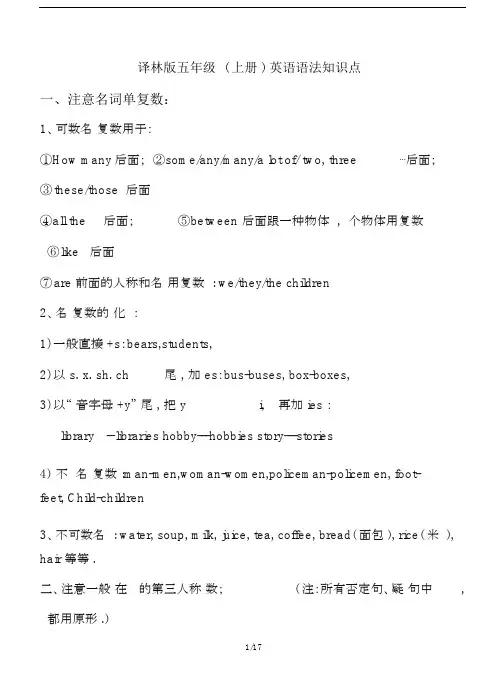
译林版五年级 ( 上册 ) 英语语法知识点一、注意名词单复数:1、可数名复数用于:①How many后面;②some/any/many/a lot of/ two, three⋯后面;③t hese/those 后面④all the后面;⑤between后面跟一种物体,个物体用复数⑥l ike 后面⑦a re 前面的人称和名用复数 : we/they/the children2、名复数的化:1)一般直接 +s:bears,students,2)以 s. x. sh. ch尾,加es:bus-buses, box-boxes,3)以“ 音字母 +y” 尾 , 把 y i,再加ies:library —libraries hobby---hobbies story---stories4)不名复数 :man-men,woman-women,policeman-policemen, foot-feet, Child-children3、不可数名 : water, soup, milk, juice, tea, coffee, bread( 面包 ), rice( 米 ), hair 等等 .二、注意一般在的第三人称数;( 注:所有否定句、疑句中,都用原形 .)( 俗称:三单 )1、肯定句中哪些情况下用第三人称单数:1)人称代词he, she, it作主语时;2)单个人名、地名或称呼作主语时;3)单数可数名词或"this / that / the+单数可数名词"作主语时;4)不可数名词作主语时;5、当数字或字母作主语时, 等等 .2、动词第三人称单数变化规则如下:1)一般情况下 , 动词后面直接加 s. 如: works / plays/ reads2)以 s. x. sh. ch或o结尾的动词,在后面加es.例:teach-teaches, watch-watches, do-does, go-goes3) 以辅音字母 +y 结尾的动词 ,把y变为i,再加es.例: study- studies fly-flies carry-carries4)不规则动词的第三人称单数:have—has;be—is三、人称代词、名词所有格及序数词单数复数一二三一二三主格I you he she It we you they 宾格me you him her It us you them 物主my your his her Its our your their代词我的你的他的她的它的我们的你们的他们的1、主格用来作句中的主语, 用于动词前面 .例: They are doctors.2、宾格用来作句中的宾语 , 放在动词或介词的后面. 本册书上出现的词组:in front of her show her around push me teach you What’s wrong with him?write him a letterHere’s a Christmas card for you. Let me⋯.chat with them on the Internet give it a cake3、形容词性物主代词 +名词形容词性物主代词 , 之所以叫它们形容词是因为他们必须放在名词前面 . 4、名词所有格作形容词性 , 表示所属关系;在人名或称呼后加’s , 以 s 结尾的 , 直接加’ . 如: mother ’s, parent s’5、序数词 first---second---third---fourth1) 序数词一般要与 the 连用; 2)在某一层楼用介词 on.四、选择和用所给词适当形式填空1、哪些情况加动词原形(注:有to时,to跟后面的动词原形放在同一空格)1) want to +动词原形2)would like to +动词原形 3 )it ’ s time to +动词原形4)情态动词 can+动词原形 5 )助动词(do, does , don’t, doesn’t )+动词原形6)let+ 动词原形7)祈使句中动词用原形( 如Do your homework, please.)8)否定句在句首加Don’t (如Don’t do your homework, please)+动词原形2、哪些情况加动词ing1)like 2)go 3)be good at 4)be 5)后面跟名词,如swimming lesson动词 +ing 变化规则如下 :A、直接加上 ing: draw-drawing play-playing read-readingB 、以不发音的 e 结尾 , 去 e 加上 ing skate-skatingmake-making dance-dancingC、以重读闭音节结尾的单词要双写尾字母, 再加上 ing从单词的末尾开始往前数符合“辅音- 元音 - 辅音”结构的 .(注:词尾是 w和 y 的除外 , 如: drawing, playing等除外);run-running sit-sitting put-puttingchat-chattingget-getting swim-swimming stop-stoppingshop-shopping3.形容加名(形名)如: a beautiful girl4.加副(副)如: swim well5.Some和 any 用法 :“some”一般用于肯定句 , “any”用于否定句和疑句 . 但在一些表示委婉求 , 想得到方肯定回答也用“ some”.( 小技巧:末尾是句号 , 句中是 any, 那句型是否定句 )6.There be 构就近原 , be 的取决于跟在后面的名数量.如: There is a teacher and some students in the classroom.7.器前加 the,球前不加the.如:play the piano, play football8.Who 当作特殊的第三人称数 (Who sing s well? )9.一般在构成: 1) 主 +be(am,is,are)+ 其它 . 2)主 +行 +其它 . 关:always, usually, often, sometimes, on Sundays, every⋯( 注:主第三人称数, 加 s, es或音+y , 把 y i 再加 es;其他时候动词用原形 )10.在行关:look, listen, now( 注:be(is am are) +ing,两者缺一不可)11.and 前后一致 .指当句子中有两个或两个以上的共用同一个主, 一般的保持一致.She often go es fishing and take s photos. Let’s go and have some chicken.12、相同意思不同用法的辨析:1)有; there is/are和have/hasthere is/are表示在某地有某物(或某人);表示存在;there be 就近原;have/has 表示某人有某物;表示所属关系;前面必有主.2)也; too-either-alsotoo用于肯定句和疑句句末;either用于否定句句末;also用于句中. 3)都; both-allboth 用于两者都; all用于三者及以上都.4)好; good-wellgood+名;+well .5) 和; with-andwith 是介 , 意思是“和⋯⋯一起” , 后面跟名或代的格.and 是 , 意思是“和” ,用and接两个数名或代作主,用复数 .五、句型①同句:1. It ’s time for sth=It ’s time to do sth.是⋯了(注:for后面跟名;to 后面跟原形)It ’s time for dinner.=It’s time to have dinner.2.What time is it?=What’s the time?几点呢?3.There is(are) no ⋯(s) ⋯=There isn ’t / aren ’t any ⋯没有⋯4.have no⋯= don ’t have (any)没有⋯They have no legs or arms. =They don’t have any legs or arms.5.has no = doesn ’t have (any)没有⋯6.I like picnics. = I like having picnics.{ 注:like 后面跟名复数或名(+ing)}7.show sth ( 某物 ) to sb(某人 ) = show sb ( 某物 ) sth( 某人 )向⋯展示⋯西8.give sth( 某物 ) to sb(某人 )=give sb (某物 ) sth( 某人 )⋯人⋯西9.What a lovely ant!= How lovely the ant is!多么可的啊10.That is Jan’s umbrella.= That umbrella is Jan’s.那是杰的伞11.What’s wrong with him? = What’s the matter with him?他怎么了?②否定句1、有 be 动词( am, is ,are ),be 后直接加 not (am not/ is not=isn ’t/ are not =aren’t);2、有 can,can 后直接加 not (can not=can’t);3、只有动词 , 在动词原形前加don’t ;三单动词前加doesn’t,动词变回原形 .He does his homework. (改成否定句) He doesn’t do his homework.③一般疑问句 :用Yes或No回答的句子1、有 be 动词 ,be 动词提前;2、有 can 或 would,can 或 would 提前;3、只有动词 , 句首加 Do/ Does,动词用原形;注意: I ’m变 Are you ; some变any; my变your; and变or .④特殊疑问句:有特殊疑问词 +一般疑问句There be 句型提问:1、对数量提问:1)How many +名词复数 + are there +介词短语?(注:对 there be 后面可数名词的数量提问时, 无论主语是单数还是复数, 都用复数形式提问)例: There are 24 classrooms in our school? / There is only one classroom in our school? (对划线部分提问)How many classrooms are there in our school?(注:上面两句提问,都是这句子)2)How much +不可数名词 + is there +介词短语?例: There is somemilk in the glass. (对划线部分提问)How much milk is there in the glass?2、对主语提问there be针对主语提问的特殊疑问句的基本结构是:What’s +介词短语?(注:对there be后面的主语提问时, 无论主语是单数还是复数, 都用What’s 提问)例: There are six books on the desk. / There is a book on the desk. ( 对划线部分提问 )What’s on the desk?(注:上面两句提问,都是这句子)⑤感叹句的结构:感叹句常用how或 what 来引导(1)what 引导的感叹句 , 最终修饰的是名词(2)how引导的感叹句 , 最终修饰的是形容词 / 副词What a lovely ant!= How lovely the ant is!多么可爱的蚂蚁啊!对划线提问 , 疑问词:What 问什么; What colour问颜色;What time问具体时间(如几点钟);when 问范围广的时间; where问在哪里;How old问年龄;how many问数量( 可数名词 );how much 1)问数量(不可数名词) ,2 )问价钱; how about 问怎样;who 问谁(人); whose 问谁的东西(问主人);同音词:B—be—bee,C—see—sea,R—are,T—tea,U—you,Y—why, I-eye,too-two-to,four —for,here —hear,there —their, right—write,sun—son,no—know, pair —pear,it ’s—its, buy—by—bye,hi —high,wear—where,aren ’t —aunt, who’s—whose,近义词 ( 或同义词 ) :Many—lots of —a lot of,desk—table,like —love, tall—high near—beside,too —also,listen—hear,look —see,class —lesson, glass —cup, home — house, beautiful—pretty, usually—often,hi —hello, speak—say—talk, river—lake,would like—want, go home—反义词 ( 或对应词 ) :yes—no,this —that,these —those,here —there,go—— close, big —small, fat—thin, tall—short, long —short, black—white, happy—sad, hot—cold, cool—warm,soft—hard, on—under, in front of —behind,in —out,boy—girl,man—woman, wrong—right,down—up,sit —stand,easy—difficult,take off( 脱下 )—put on( 穿上 )完整形式:I ’m—I am, we’re —we are,you’re —you are,he’s—he is, it’s—it is,there ’s—there is,isn ’t —is not who’s—who is, Let ’s—let us, I’d—I would,can’t —can not,don’t —do not,doesn’t —does not特殊的名词复数:man—men,woman—women,policeman —policemen,child —children, foot—feet,fish —fish, people—people, Chinese-Chinese三单动词变化:特殊的: do---does ; go--goes ; have--has ;teach —teaches ; watch--watches; wash--washes;push--pushes ;brush--brushes; catch--catches;study -- studies;fly--flies;其余的直接加 s.动词变名词 :A. 一般情况下在动词后面直接加er.teach-teacher , work—worker, play—player, sing—singer, find —finderB. 以 e 结尾的动词直接加r.write —writer, drive—driver,—dance—dancerC.符合重读闭音节的动词 , 先双写最后一个字母 , 再加 er.run —runner, begin—beginner, swim—swimmerD. 部分单词在词尾加or.visit—visitor, act—actorE. 本身既是动词又是名词.cook—cook, doctor—doctorCulture板块: U1, U2, U3, U5, U6, U7.1). U1: Coffee is popular in Western countries.Tea is popularin China.咖啡在西方国家受欢迎 .茶在中国受欢迎. 2). U2: In the UK, this is the ground floor.In the US, this is the first floor.在英国 , 这是一楼 .在美国,这是一楼. 3). U3: You can see pandas in China.You can see baldeagles in the US.你在中国可以看到熊猫 .你在美国能看到秃鹰.You can see polar bears in Canada.You can see kangaroos in Australia.你在加拿大能看到北极熊.你在澳大利亚能看到袋鼠.4). U5:In the US, we call a policeman a“cop”. In the UK, we call a firefighter a“fireman”.在美国 , 我们称呼警察为cop.在英国,我们称呼消防队员为 fireman.5). U6: We write Chinese addresses like this.我们这样书写中文地址 .(国名—地名—人名 , 由大到小)We write English addresses like this.我们这样书写英文地址.(人名—地名—国名 , 由小到大)6). U7: Basketball is very popular in the US. Football is very popular in the UK.篮球在美国很受欢迎 .足球在英国很受欢迎.Table tennis is very popular in China.乒乓球在中国很受欢迎 .看国旗写国家名 : (U6)UK Australia ChinaCanada____USSound time:U1:U2:U3:U4: U5:U6:U7:U8: U4 Song time:U8 Song time:。
译林版五年级上册英语语法知识点_已整理
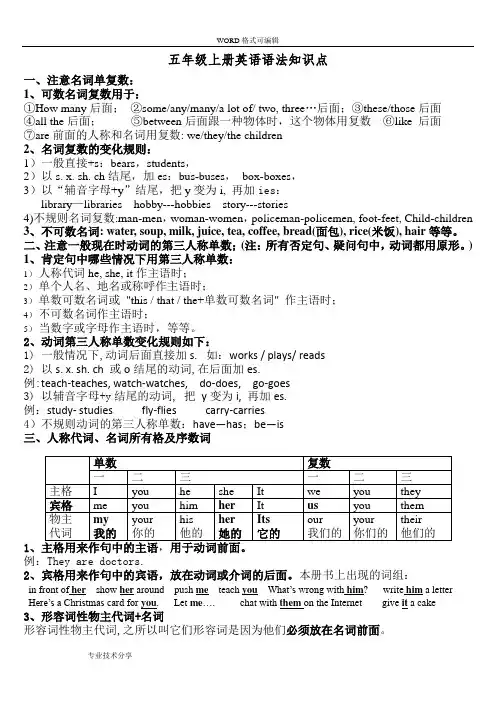
五年级上册英语语法知识点一、注意名词单复数:1、可数名词复数用于:①How many后面;②some/any/many/a lot of/ two, three…后面;③these/those后面④all the后面;⑤between后面跟一种物体时,这个物体用复数⑥like 后面⑦are前面的人称和名词用复数: we/they/the children2、名词复数的变化规则:1)一般直接+s:bears,students,2)以s. x. sh. ch结尾,加es:bus-buses,box-boxes,3)以“辅音字母+y”结尾,把y变为i, 再加ies:library—libraries hobby---hobbies story---stories4)不规则名词复数:man-men,woman-women,policeman-policemen, foot-feet, Child-children3、不可数名词: water, soup, milk, juice, tea, coffee, bread(面包), rice(米饭), hair等等。
二、注意一般现在时动词的第三人称单数;(注:所有否定句、疑问句中,动词都用原形。
)1、肯定句中哪些情况下用第三人称单数:1)人称代词he, she, it作主语时;2)单个人名、地名或称呼作主语时;3)单数可数名词或"this / that / the+单数可数名词" 作主语时;4)不可数名词作主语时;5)当数字或字母作主语时,等等。
2、动词第三人称单数变化规则如下:1) 一般情况下,动词后面直接加s. 如:works / plays/ reads2) 以s. x. sh. ch 或o结尾的动词,在后面加es.例:teach-teaches, watch-watches, do-does, go-goes3) 以辅音字母+y结尾的动词, 把y变为i,再加es.例:study- studies fly-flies carry-carries4)不规则动词的第三人称单数:have—has;be—is三、人称代词、名词所有格及序数词1例:They are doctors.2、宾格用来作句中的宾语,放在动词或介词的后面。
译林版五年级英语上册语法要点梳理

译林版五年级英语上册语法要点梳理1. 一般现在时- 表示经常发生的动作或存在的状态,或者陈述普遍真理。
- 动词原形作谓语。
- 表示第三人称单数时,动词加-s或-es。
2. 一般过去时- 表示过去某个时间发生的动作或存在的状态。
- 动词过去式作谓语。
- 表示动词是不规则变化的过去式时,需熟记其过去式形式。
3. 现在进行时- 表示现在进行或发生的动作。
- 助动词be的各种形式与动词的现在分词形式连用。
4. 一般将来时- 表示将来要发生的动作或存在的状态。
- 助动词will与动词原形连用。
5. 可数名词和不可数名词- 可数名词可以用来表示一个或多个,可以用a或an修饰单数形式,也可以用数词修饰。
- 不可数名词表示无法分割的事物或抽象概念,通常不能用a或an修饰,也不能用数词修饰。
6. 形容词比较级- 形容词比较两个或多个人或事物的程度。
- 形容词比较级的构成规则是在形容词后加-er,若形容词以e结尾则直接加-r,若形容词以辅音字母+y结尾,则变y为i,再加-er。
- 形容词比较级的否定形式是在比较级前加not。
- 形容词比较级的表示方式也有不规则变化,需熟记。
7. 物主代词- 表示所属关系。
- 有形式和物质两种形式。
8. 人称代词的宾格形式与形容词性物主代词的形式- 宾格形式用作动词的宾语,常见的人称代词宾格形式有me, you, him, her, it, us, them。
- 形容词性物主代词用于修饰名词,通常放在名词前面,常见的形容词性物主代词有my, your, his, her, its, our, their。
9. 动词的过去分词- 表示被动或完成的动作。
- 过去分词通常由动词的过去式形式加-ed构成,也有一些不规则的形式需熟记。
10. 常见的情态动词- 情态动词用来表示说话人对某个动作或状态的态度、推测、能力、意愿等。
- 常见的情态动词有can, could, may, might, must, shall, should, will, would。
牛津译林版小学英语五年级上学期语法知识点汇总
1.一般现在时- 动词的原形用于第三人称单数时,加s或es。
- He/She/It + 动词原形 + 其他。
- I/We/You/They + 动词原形 + 其他。
- 动词的否定句,在动词前加do not或doesn’t。
- 动词的一般疑问句,将助动词do/does置于句首。
-使用一般现在时,描述经常发生的事情、客观事实或普遍真理。
例句:- He eats an apple every day.(他每天吃一个苹果。
)- They play football on Saturdays.(他们在周六踢足球。
)- She doesn’t like carrots.(她不喜欢胡萝卜。
)- Do you go to school by bus?(你坐公交车上学吗?)- Does he have a pet dog?(他有一只宠物狗吗?)2.一般过去时-动词的过去式形式。
- 动词的过去式的构成规则:大多数动词加-ed或-d,部分规则发生变化。
例句:- I played basketball yesterday.(我昨天打篮球。
)- She didn’t wat ch TV last night.(昨晚她没看电视。
)- Did you visit your grandparents last weekend?(你上周末去看望你的祖父母了吗?)- Did they have breakfast at home this morning?(他们今天早上在家吃早餐了吗?)3.现在进行时- am/is/are + 动词的ing形式 + 其他。
-表示现在正在进行的动作。
-“现在正在进行”可以和“现在正在发生”混淆,要根据上下文进行判断。
例句:- She is eating lunch now.(她现在正在吃午饭。
)- They are playing basketball in the park.(他们正在公园打篮球。
译林英语 五年级上册简易语法 知识点
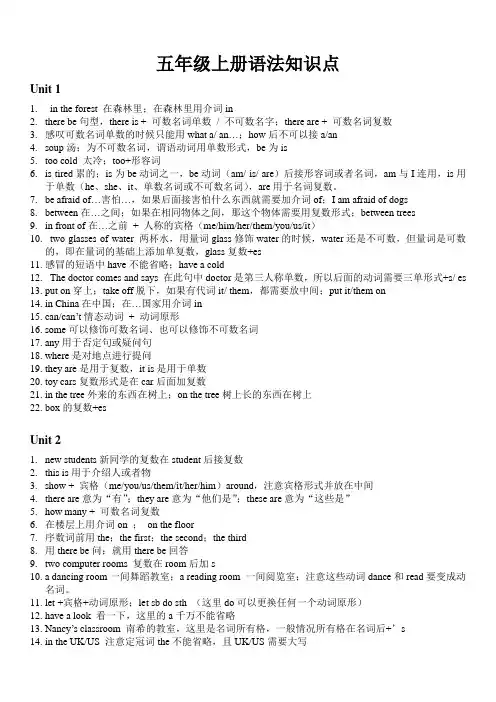
五年级上册语法知识点Unit 11.in the forest 在森林里;在森林里用介词in2.there be句型,there is + 可数名词单数/ 不可数名字;there are + 可数名词复数3.感叹可数名词单数的时候只能用what a/ an…;how后不可以接a/an4.soup汤;为不可数名词,谓语动词用单数形式,be为is5.too cold 太冷;too+形容词6.is tired累的;is为be动词之一,be动词(am/ is/ are)后接形容词或者名词,am与I连用,is用于单数(he、she、it、单数名词或不可数名词),are用于名词复数。
7.be afraid of…害怕…,如果后面接害怕什么东西就需要加介词of;I am afraid of dogs8.between在…之间;如果在相同物体之间,那这个物体需要用复数形式;between trees9.in front of在…之前+ 人称的宾格(me/him/her/them/you/us/it)10.two glasses of water 两杯水,用量词glass修饰water的时候,water还是不可数,但量词是可数的,即在量词的基础上添加单复数,glass复数+es11.感冒的短语中have不能省略;have a cold12.The doctor comes and says 在此句中doctor是第三人称单数,所以后面的动词需要三单形式+s/ es13.put on穿上;take off脱下,如果有代词it/ them,都需要放中间;put it/them on14.in China在中国;在…国家用介词in15.can/can’t情态动词+ 动词原形16.some可以修饰可数名词、也可以修饰不可数名词17.any用于否定句或疑问句18.where是对地点进行提问19.they are是用于复数,it is是用于单数20.toy cars复数形式是在car后面加复数21.in the tree外来的东西在树上;on the tree树上长的东西在树上22.box的复数+esUnit 21.new students新同学的复数在student后接复数2.this is用于介绍人或者物3.show + 宾格(me/you/us/them/it/her/him)around,注意宾格形式并放在中间4.there are意为“有”;they are意为“他们是”;these are意为“这些是”5.how many + 可数名词复数6.在楼层上用介词on ;on the floor7.序数词前用the;the first;the second;the third8.用there be问;就用there be回答9.two computer rooms 复数在room后加s10.a dancing room一间舞蹈教室;a reading room 一间阅览室;注意这些动词dance和read要变成动名词。
[译林版]五年级英语上册语法重点要点整理
![[译林版]五年级英语上册语法重点要点整理](https://360docs-1393072327.cos.ap-beijing.myqcloud.com/36d26655b94ae45c3b3567ec102de2bd9705de51.webp)
[译林版]五年级英语上册语法重点要点整
理
1. 名词
- 可数名词和不可数名词
- 单数和复数形式的变化规则
2. 代词
- 人称代词:主格、宾格、形容词性物主代词和名词性物主代词
- 物主代词的所有格形式
3. 动词
- 动词的时态:一般现在时、一般过去时和一般将来时
- 动词的形式:基本形式、第三人称单数形式
- 动词的否定形式和疑问形式
- 动词的存在形式:is, am, are
4. 形容词
- 形容词的比较级和最高级形式
- 形容词的修饰位置
5. 副词
- 副词修饰动词,形容词和副词
- 副词的比较级和最高级形式
6. 介词
- 常见介词的用法和意义
- 介词短语的位置和作用
7. 冠词
- 定冠词和不定冠词的用法和区别
8. 数词
- 基数词和序数词的用法
9. 句子
- 简单句和复合句的区别
- 句子的基本结构:主语、谓语和宾语- 选择合适的连词连接句子
- 肯定句、否定句和疑问句的形式和变化规则
以上是[译林版]五年级英语上册的语法重点要点整理。
>注意:这份文档整理的是课本的语法重点,但具体内容可能因版次或版本不同而略有差异。
请以教材为准。
完整版)译林版五年级英语上册知识点汇总
完整版)译林版五年级英语上册知识点汇总In the forest。
there is a house。
There is some soup on the table.2)there are用于复数名词,如:There are three bears in front of her.2.形容词的比较级和最高级1)比较级用于两者之间的比较,如:This soup is too cold.(太冷了)/This soup is colder than that one.(这汤比那汤更冷)2)最高级用于三者或三者以上之间的比较,如:XXX.(这汤是最冷的)3.介词的用法1)in front of表示“在……前面”,如:There are three bears in front of her.2)XXX表示“在……旁边”,如:XXX.3)een表示“在……中间”,如:XXX.4.动词的用法1)have表示“吃/喝”,如:Have some cakes.(吃些蛋糕)2)find表示“找到/发现”,如:Find their cousin.(发现他们的表弟)3)can/cannot(can’t)表示“能/不能”,如:Bobby cannot see any cakes in the fridge.(XXX看不到冰箱里有蛋糕)小改写:1.在森林里有一座房子。
There is a house in the forest.2.桌子上有一些汤。
There is some soup on the table.3.在她的前面有三只熊。
There are three bears in front of her.4.这汤太冷了。
This soup is too cold.5.多么漂亮的房子!What a beautiful house!6.她又饿又渴。
XXX.7.XXX看不到冰箱里有蛋糕。
Bobby cannot see any cakes in the fridge.In the school bag。
[译林版]五年级英语上册语法知识点汇总
五年级英语上册语法知识点总结一.1.there be 句型表示“某处有某物”。
be动词要根据“物”的单复数变化:单数is,复数are, 不可数名词用is.例:There is a book on the desk.There are some books on the desk.There is some orange juice in the glass.2.there be 句型变一般疑问句时, be动词提前, some 变为any。
例:Is there a book on the desk? Yes, there is.Are there any books on the desk? No, there aren’t.Is there any orange juice in the glass? Yes, there is.3. 就近原则:be动词根据离它最近名词单复数选择is或are。
例:There is a swing and two slides in the garden.There are two slides and a swing in the garden.4.某处没有某物,在be动词后面加not(is not可以缩写为isn’t,are not可以缩写为aren’t)例:There is no bread on the plate.There isn’t any bread on the plate.There aren’t any pictures on the plate.二.have, has表示“某人有某物”1.have用于I, we, you, they或复数人称:I/We/You/They/Ben and Mike have a table.2.has 用于第三人称单数(he, she, it,单数人称)He/She/My father has a bike.3.疑问句:What do you have? I have a doll.What does he have? He has a book..三.how many (多少)后的可数名词要用复数。
[译林版]五年级英语上册语法要点整理
[译林版]五年级英语上册语法要点整理本文档整理了[译林版]五年级英语上册的语法要点,旨在帮助学生快速了解和掌握这些语法知识。
一、动词的时态1. 一般现在时:表示经常发生的动作或常态。
例如:- I eat breakfast every day.(我每天吃早饭。
)- They play soccer on weekends.(他们在周末踢足球。
)2. 一般过去时:表示过去发生的动作或状态。
例如:- She watched a movie last night.(她昨晚看了电影。
)- We visited our grandparents during the summer vacation.(我们在暑假期间拜访了祖父母。
)3. 现在进行时:表示现在正在进行的动作。
例如:- He is studying for the exam.(他正在为考试而研究。
)- They are playing basketball in the park.(他们正在公园里打篮球。
)4. 一般将来时:表示将来要发生的动作或状态。
例如:- I will go to the park tomorrow.(我明天要去公园。
)- They will have a party next week.(他们下周要举办一个聚会。
)二、名词的单复数1. 可数名词的复数形式:- 一般在名词末尾加-s:book - books(书 - 书籍)- 以s、x、ch、sh结尾的名词,加-es:bus - buses(公交车 - 公交车)- 以辅音字母+y结尾的名词,变y为i,再加-es:baby - babies (婴儿 - 婴儿)2. 不可数名词的表示方式:- 不可数名词不加s或es,一般用量词来表示数量:water (水),tea(茶)等三、形容词的比较级和最高级1. 比较级的构成:- 一般在形容词后面加-er:big - bigger(大 - 更大)- 以字母e结尾的形容词,加-r:nice - nicer(好 - 更好)- 以辅音字母+y结尾的形容词,变y为i,再加-er:happy - happier(快乐 - 更快乐)2. 最高级的构成:- 一般在形容词前面加the,再在形容词后面加-est:small - the smallest(小 - 最小)- 以字母e结尾的形容词,加-st:nice - the nicest(好 - 最好)- 以辅音字母+y结尾的形容词,变y为i,再加-est:happy -the happiest(快乐 - 最快乐)以上是[译林版]五年级英语上册的语法要点整理,希望能对学生的学习有所帮助。
译林版五年级英语上册语法知识点汇总。
译林版五年级英语上册语法知识点汇总。
1.be动词包括am、is、are。
2.It’s time to后接动词词组,表示该做某事的时间到了;而It’s time for后接名词,表示该做某事的时候到了。
3.时间和地点一般放在句子的开头或结尾。
4.Whose是“谁的”,后接名词,询问物品的主人;who’s 是“谁是”,后接人,具体询问人是谁。
5.fun表示有趣、乐趣;XXX表示滑稽、好笑。
6.so表示“如此的、那么的”;very表示“很、非常”;too 表示“太”。
7.在一般现在时主语是第三人称单数的句子中,将助动词do改为does,放在句首,变成疑问句。
8.当后面的单词是元音发音开头时,使用an。
9.打电话时可以使用May I speak to…?或者Is that…。
Who’s that。
Is XXX there/in?等专用语。
10.将这些单词变成单数需要根据它们的词性进行变化,如trousers变成trouser,glasses变成glass,加量词则需要根据数量进行变化。
11.可以使用量词来表示不可数名词的数量,如a bottle of water,a cup of coffee等。
12.和day有关的词汇包括weekday、XXX、Monday、XXX等。
13.在lesson前的动词需要加上-ing形式,如dancing lesson、XXX等。
14.any通常用于否定句和疑问句中,表示任何一个或任何一些。
15.在肯定句中不需要使用any。
16.there be句型表示“有”或“存在”的意思。
17.在there be句型中,be动词需要根据后面的主语进行变化,如there is、there are等。
18.在修饰不可数名词时,需要使用is作为be动词。
19.改写疑问句的口诀是将句子中的助动词或be动词提到句首,如Does XXX?改写为XXX。
20.如果地点划线,可以使用Where来提问,如Where is the table。