
人教版七年级英语下册unit4精炼版
Examples
肯定祈使句
否定祈使句
1. Sit down. 2. Come in. 3. Eat at home. 4. Listen to music outside.
Don’t sit down. Don’t come in . Don’t eat at home.
Don’t listen to music outside.
2019/4/26
22
Do you know the places that have rules? And what rules do you know?
family rules 家规 school rules 校规 class rules 班规 library rules 图书馆规则 dining rules 就餐规则
morning. 我爸爸今天上午到达了北京。 ② The farmer arrived at / got to an old house and knocked at the door. 那个农民到达了一个旧房子前并且敲了敲 门。
Let's 是Let us 的缩写 Let's包括听话人 Let us 不包括听话人
祈使句注意事项
句尾加疑问句 will you, 加强语气(反义疑问句)
Don't tell anyone, will you?
Let us go, will you?
Let's go, shall we?
对祈使句的回答 ---Remember to do it. ----Yes, I will. ---Don't forget to do it. ---- No, I won't. ---Let's go there together. -----Yes, Let's/No, Let's not.
祈使句否定形式
动词原形前加do not ( don't) Don't waste time on it. Don't forget my words. Please don't be late.
祈使句Let形式
Let +me/us/him....+动词原形
Let me introduce myself. Let us have a rest. Let's play a game.
A: Can we be late for class? B: No, we can’t. We can’t be late for class. Don’t be late for class.
A: Can we eat in the classrooms? B: No, we can’t. We can’t eat in the classrooms.
time.
2. Don’t run in the hallways.
3. Don’t eat in the classroom. You must eat in
the dining hall.
4. Don’t listen to music in class.
5. Don’t fight.
2019/4/26
Grammar Focus
Don't run in the hallways. Don't fight. What are the rules? We must be on time for class.
Can we eat in the classroom? No, we can't, but we can eat in the dining hall. Can we wear a hat in class? Yes, we can./No, we can't. Does he have to wear a uniform at school? Yes, he does./No, he doesn't. What do you have to do? We have to be quiet in the library.
32
1 What else? else 别的,其他的 常放在疑问代词who,what,which或 something,anything,nothing,anyone,everyone等 不定代词之后
Who else can you see ? Is there anything else in your bag?
Living in the society, we have to keep rules 遵守规则 we can’t break rules 违反规则
What can we do at school? What can’t we do at school?
be late for class = arrive late for class
1. Don’t arrive late for class. 不要上课迟到。 arrive vi. 到达
When did he arrive yesterday? 昨天他什么时候到达的?
2019/4/26
37
arrive in / at与get to 的区别 ① My father arrived in / got to Beijing this
1a Which rules are these students breaking? Write the number of the rule next to the student.
SCHOOL RULES
1. Don’t arrive late for class. You must be on
in great danger.
Unit 4
Don’t eat in class.
Section A
Do you know the meanings of the following signs?
No talking!
No visitors!
No fire!
No mobile phones!
in the hallways.
.
Don’t run in the hallways.
A: Can you fight? B: No, We can’t. We can’t fight.
Don’t fight.
A: Can we play it in the classrooms? B: No, we can’t. But we can play it outside. Don’t play sports in the classrooms. Play sports outside.
5. Do your homework at school.
Don’t do your homework at school.
EXERCISE
1.____me an e-mail before you come to Hangzhou.I'll meet you at the airport. A.Sending B.To send C.Sends D.Send
拓展
else 还可以放在疑问副词when,where,how 等的后面。 where else do you want to go ? When else can I meet you ?
2 That makes the teacher really unhappy. make 使,让 make +宾语+形容词 使某人/某物.... Internet makes our lives easy. The TV show makes us happy.
Don’t eat in the classrooms.
A: Can we eat in the dining hall? B: Yes, we can eat in the dining hall.
We can eat in the dining hall.
A: Can we run in the hallways? B: No, we can’t. We can’t run
比较一下
Tom is playing on my side.
陈述句
Tom, play on my side.
祈使句
祈使句
1.祈使句是表示命令、叮嘱、号召等的句子; 2.通常省略主语you; 3.句中谓语动词用动词原形; 4. 读音为降调
Stand up.
Give me some water, please.
2.----______dressed now! we have to go in ten minutes.
----OK,Mom.
A.Getting
B.Get C.To get
D.Gets
3.--What are the rules at your school ?
---Don't run in the hallways and ____ arrive late for class.
拓展e
1. make + 宾语+ 不带to的不定式
Music makes us feel relaxed
2.make+宾语+ 名词
Most pop singers make music their career.
2d Role-play the conversation.
2019/4/26
35
John:Hi,my name's john.It's my fiirst day at school. Alice: Hi, John.I'm Alice.This is a great school,but there are a lot of rules. John:Really?What aБайду номын сангаасe some of the rules? Alice:Well,don't be late for class.This is very important. John:OK,So we must be on time.Can we bring music players to school? Alice:No,we can't.And we always have to wear the school uniform. John: I see. Alice: Oh,and we also have to be quiet in the library.
人教版七年级下册英语unit4知识点+经典练习题
人教版七年级下册英语unit4知识点+经典练习题人教版七年级下册英语unit4 知识点+经典练习题Unit4.Don’t run in the hall way!One:重点词组1.class rules班规;school rules校规;a lot of/lots of rules许多规则;make rules制定规则;follow the rules遵守规则;wear schol uniforms穿校服;wear a hat戴帽子;listen to(the music\the tape)听音乐/听磁带;watch the video/DVD/VCD.观看---;eat in the dinning hall在餐厅吃饭;fight with others与别人打架;run in the hall way在大厅过道跑步;2.arrive late for class上课迟到;be late for class上课迟到;be late for school上学迟到;be quiet安静的;be noisy吵闹的;make the /your bed整理床铺;talk aloud/loudly大声交谈;make much noise大声喧哗;relax yourself放松你自己;3. Too many/too much太多;on school nights在学校的晚上;make dinner做饭;on time准时;Have to---必须,不得不;Two:重点句型1. don’t +v! 请不要---(否定祈使句)(1)Please don’t run in the hall way!请别在大厅过道跑步!(2)Don’t fight with others,please.请不要和别人打架!(3)Don’t make much noise吵杂声at the library!别在图书馆发出吵闹声!(4)Don’t talk aloud/loudly in class!请别在课堂上大声交谈!(5)Don’t listen to music in class!请别在课堂上听音乐!(6)Don’t eat in the classroom,plea se!请别在教室吃东西!(7)Please don’t arrive late for class\school!上学/课请不要迟到!Please don’t be l ate for class/school.(8)Tom,please don’t read in bed!(9)Don’t be noisy!请不要吵闹!(10)Please be quiet!请保持安静!2.-What are the rules?/-We must be on time for class.3.-What are the school rules?有哪些校规啊?-What are the class rules?有哪些班规啊?4.What do you have to do?你一定得做什么啊?5.-Can we (eat in the clsssroom/wear a hat in class)?我们必须---吗?6.-Do you have to get to school before 8am?-Does she have to wear a uniform at school?7(1)There are lots of things to do.There are lots of things you can do.你有许多事情可以做(2)They make rules to help us,we have to follow these rules.(3)You should listen to music to relax yourself.你应当听音乐来放松一下你自己。
人教版七年级下册英语unit4单元全套课件
➢ 中考链接
【2019·江苏宿迁】 — __D_o_n_’_t_m__a_k_e_ (not make) a mess on
the balcony, Betty. — Sorry, I won’t.
【2019·四川南充】
— Mum, may I play computer games
Ⅱ.组句。
1. late, don't, for school, arrive Don’t arrive late for school.
2. music, listen to, in the classroom, don't Don’t listen to music in the classroom.
Children like to listen to music. 孩子们喜欢听音乐。 3) sound“听起来”, 它是系动词,后面 接形容词等。例如: That sounds great. 那听起来真不错。 It sounds like fun. 听起来挺有趣。
3. fight 打架,争吵
1) 作动词用: Jack never fights with his brother. 杰克从不和他的弟弟打架。
1) listen 听;用来提醒某人注意,后面不跟事物。 Listen! Who’s singing in the classroom? 听!谁在教室里唱歌?
2) 如果后面跟要听的事物,应跟介词to再跟事物。 Listen to our teacher carefully. 认真听老师讲。
hear, listen和sound都有“听”的意思, 但三者是有区别的。 1) hear “听说” , 侧重于“听” 的内容。例如:
Unit 4 核心考点讲练-七年级英语下册(人教版)
e.g. Let’s go! 咱们走吧! 注意: 有时可在祈使句的句首或句尾加上please,使语气显得客气、 有礼貌。如果在句尾加please,应该用逗号与前句隔开。 e.g. Go this way, please. 请这边走。
词时,省略介词。
reach vt. reach + 地点
arrive in Shanghai
to
get
reach
【语境应用】用arrive, get或reach完成句子。 1) When will your uncle _a_r_r_i_v_e_? 2) I usually _g_e_t _to__/_a_r_r_iv_e__a_t_/_r_e_a_c_h school at seven o’clock. 3) We’ll _g_e_t_t_o_/_a_r_r_i_v_e_i_n_/_r_e_a_c_hHong Kong soon. 4) When do you usually __g_e_t_t_o_/__a_rr_i_v_e_a_t_/_r_e_a_c_h__ your
【运用】完成句子 (1) 你可以把你的朋友们带到派对来。
You can __b_r_in__g_ _y_o_u_r___ _f_r_ie_n_d_s_ __t_o____ the party. (2) 请帮我把我的书包拿到教室去。
Please help me _t_a_k_e___ __m__y___ _s_ch__o_o_lb_a_g_ __to_____ the classroom.
完成句子。 (1) Mike穿着一件棕色的夹克衫。
Mike _w__e_a_r_s_ __a_____ _b__ro_w__n_ _j_a_ck__et__. (2) 你为什么总是戴一顶帽子?
Unit4复习课件+2022-2023学年人教版英语七年级下册+
13. 清洗餐具 14. 做早饭 15. 在上学期间的晚上 16. 制订/遵守规则 17. 铺床 18. 思考;考虑 19.(对某人)要求严格
do the dishes make breakfast on school nights make/ follow rules make one’s bed think about be strict with sb.
Later I have to go to the Children’s Palace to learn the piano. 10.我没有任何乐趣。
I never have any fun. never为always的否定, any 用在否定句中. 11. 我必须帮妈妈做晚饭。
I have to help my mother make dinner.
26.遵循;跟随v.
follow 29.头发;毛发n.
keep hair
keep+adj. 留短发 keep hair short
30. 学习;学会v.
learn learn to do
learn from sb/sth.
I. 根据句意及括号内所给单词的提示填空。 1. I have to ____g_o__(go) to bed early every day. 2. Jane, don't _s_w_i_m___(swim) in the river. 3. Please __b__ri_n_g_(bring) two small boxes to class next week. 4. Mom, can I __p_la_y___(play) computer games for half an hour? 5. He must _h_a_v_e___(have) some milk at night.
人教版英语七年级下册Unit4Don’teatinclass.知识点及课后作业
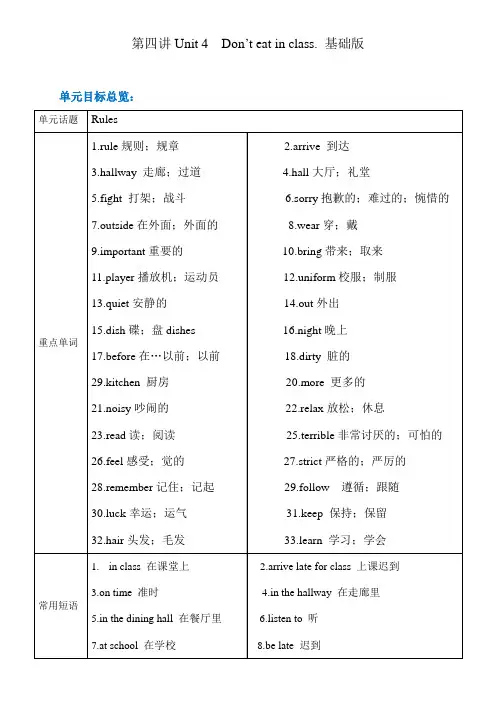
第四讲Unit 4 Don’t eat in class. 基础版单元目标总览:【知识点详解】1、Don’t arrive late for class.上课不要迟到。
1)arrive 意为“到达”。
arrive at+小地点,arrive in +大地点。
◆I will arrive in Beijing next week. 我下周到北京。
◆I arrived at the small village on a cold morning. 在一个寒冷的早晨我到达了那个小村庄。
2)arrive 后面跟地点副词here, there, home时,不需要跟介词。
◆arrive home 到家arrive here 到这儿2、You must be on time.你必须准时。
(1)on time&in timeon time 意为“按时,准时”,指按照规定的时间或者指定的时间做某事;而in time指“及时”,指不迟到或在规定的时间之前或者接近所规定的时间做某事。
◆We must arrive there on time. 我们必须按时到达那里。
At last, the police arrived there in time. 最后警察及时赶到了那里。
(2)must情态动词,意为“必须”,不能单独做谓语,必须和动词原形以其构成谓语;其后接动词原形;其否定形式mustn’t意为“禁止,千万不要”◆I must do my homework before dinner.晚饭前我必须做完作业。
3、Don’t listen to music in class.不要再课堂上听音乐。
(1)listen 是不及物动词,意为“听,倾听”,强调听的动作,后面接宾语时要加上介词to。
◆We should listen to the teacher carefully. 我们应该认真听老师讲课。
◆Listen! Someone is singing in the garden. 听! 有人在花园里唱歌。
人教版七年级英语下册Unit4 要点详解3

Don’t eat in class. 要点详解1. Don’t run in the hallways. 不要在走廊内乱跑。
此句是祈使句的否定式,表示命令别人不要做某事。
祈使句表示请求、命令、建议、劝告或征求对方意见等,其否定形式是在前面加上don’t构成,肯定形式是以动词原形开头。
在句首或句尾加上please,使语气变得委婉,如果在句尾加please,要用逗号隔开。
e.g. Sit down, please. 请坐。
Please don’t sit down. 请别坐下。
Don’t swim in the river. 别在河里游泳。
2. Which rules are these students breaking? 这些学生在违反哪些规章制度?此句中break为动词,意思为“违背,违反,不依从,不服从,不遵守”,后常接法律、规则、诺言等做宾语。
e.g. He always breaks the rules of school. 他总是违反校规。
He broke his words. 他失言了。
Don’t break the law! 别犯法!3. What else do you have to do? 你还有别的不得不做的事吗?else做副词,表示“另外,其他”,放在something,someone,somebody等复合代词或者what,who, where,when等疑问代词或副词之后,e.g. Would you like anything else? 你还要点别的东西吗?Where else do you want to go? 你还想去别的什么地方吗?4. John, you have to wear sports shoes for gym class. 约翰,体育课你得穿运动鞋。
have to do “不得不做某事”侧重于客观上的“必须,不得不”解,和其他情态动词的区别在于它具有人称的变化。
人教版丨七年级下册英语Unit4单词,知识梳理,词汇句式精讲
人教版丨七年级下册英语Unit4单词/知识梳理/词汇句式精讲Unit 4单词(音标)rule [ruːl] n.规则;规章arrive [ə'raɪv]v.到达(be) on time 准时hallway ['hɔːlweɪ] n.走廊;过道hall [hɔːl]n.大厅;礼堂dining hall餐厅listen ['lɪs(ə)n]v.听;倾听listen to…听……fight [faɪt]v. & n.打架;战斗sorry ['sɒrɪ]adj.抱歉的;难过的;惋惜的outside [aʊt'saɪd; 'aʊtsaɪd]adv.在外面adj. 外面的wear [weə]v.穿;戴important [ɪm'pɔːt(ə)nt]adj.重要的bring [brɪŋ]v.带来;取来uniform ['juːnɪfɔːm]n.校服;制服quiet ['kwaɪət]adj.安静的out [aʊt]adv.外出go out 外出(娱乐)practice ['præktɪs]v. & n.练习dish [dɪʃ]n.碟;盘do the dishes清洗餐具before [bɪ'fɔː]prep. & conj.在…以前adv.以前make (one’s) bed铺床dirty ['dɜːtɪ]adj.脏的kitchen ['kɪtʃɪn]n.厨房more [mɔː]adj. & pron.更多的noisy ['nɒɪzɪ]adj.吵闹的relax [rɪ'læks]v.放松;休息read [riːd]v.读;阅读terrible ['terɪb(ə)l]adj.非常讨厌的;可怕的feel [fiːl]v.感受;觉的strict [strɪkt]adj.严格的;严厉的be strict (with sb)(对某人)要求严格remember [rɪ'membə] v.记住;记起follow ['fɒləʊ]v.遵循;跟随follow the rules遵守规则luck [lʌk] n.幸运;运气keep [kiːp] v.保持;保留hair [heə] n.头发;毛发learn [lɜːn] v. 学习;学会Clark [kla:k]克拉克(姓;男名)Amy [eɪmɪ]埃米(女名)Molly['mɒlɪ]莫莉(女名)New York [nju: jɔ:k]纽约unit4课本教材人教版丨七年级下册英语Unit4单词/知识梳理/词汇句式精讲!人教版丨七年级下册英语Unit4单词/知识梳理/词汇句式精讲!人教版丨七年级下册英语Unit4单词/知识梳理/词汇句式精讲!人教版丨七年级下册英语Unit4单词/知识梳理/词汇句式精讲!人教版丨七年级下册英语Unit4单词/知识梳理/词汇句式精讲!◆短语归纳1. on time 准时,按时2. listen to…听……3. in class 在课上4. be late for 做……迟到5. have to 不得不6. be quiet 安静7. go out 外出8. do the dishes 清洗餐具9. make breakfast 做早饭10. make (one’s) bed 铺床11. be noisy 吵闹12. keep one’s hair short 留短发13. play with sb. 和某人一起玩14. play the piano 弹钢琴15. have fun 玩得高兴16. make rules 制订规则◆用法集萃1. Don’t + 动词原形+其他。
人教版英语七年级下册 Unit 4 语法精讲
知识点大全SA语法:祈使句祈使句的概念:表达说话人对对方的劝告、叮嘱、请求或命令等。
因此,祈使句中一般没有主语,但根据其句意,实际上是省略了主语you。
特点:祈使句句末用感叹号或句号,朗读时,常用降调。
在表达请求或劝告时,在祈使句前或句末可加上please,以使句子的语气更加缓和或客气。
祈使句一般没有时态的变化,也不能与情态动词连用。
语法:祈使句的肯定句式祈使句的肯定句式一般分为以下三种类型:1. Do型。
结构:实意动词的原形+(其它成分)e.g. Go! 走!/出发!e.g. Leave, please! 请离开!e.g. Go home after school. 意译:放学给我回家。
2. Be型。
结构:be动词+表语(形容词、名词或介词短语等) +(其他成分)。
e.g. Please be quiet! 请安静。
e.g. Be a good boy! 做个乖孩子。
e.g. Be good to people, please. 请友好待人。
e.g. Be careful when you cross the street.过马路时要小心。
3.Let型。
结构:Let+宾语+动词原形+(其它成分)。
例如:e.g. Let it go. 随它吧。
e.g. Let’s go now. 让我们现在就出发吧。
e.g. Let us go home, please. 请让我们回家吧。
(啰嗦:注意let us与let’s的区别)语法:祈使句的否定句式祈使句的否定句式,通常情况下在句首加上Don’t,一般分为以下四种类型:1.Do型与Be型句首加Don’t。
e.g. Don’t say that again! 别再那样说了!e.g. Don’t come back! 别回来了!e.g. Don’t be loud. 别吵。
e.g. Don’t be sad. 别难过了。
e.g. Don’t be afraid of me. 别怕我。
人教版七年级下册英语Unit 4 知识点语法归纳总结
Unit 4 Don’t eat in class.1.短语归纳2.典句必背3.用法集萃(1)Don’t arrive late for class. 不要上课迟到❖arrive in❖arrive at(2)You must be on time. 你必须准时。
❖on time是固定搭配,意为“按时;准时”。
例:Don’t worry. The train will arrive on time. 别担心。
火车会准时到达的。
❖常见的time短语(3)Don’t listen to music in class. 不要上课时听音乐牛刀小试—Do you like the songs by Taylor?一Yes. Country music ______ nice and full of feelings.A. SoundsB.listensC. hearsD. looks(4)This is very important. 这是很重要的❖important作形容词,意为“重要的”。
如:The first lesson is very important. 第一课是很重要的❖反义词:unimportant adj. 不重要的❖派生词:importance n. 重要;重要性(5)Can we bring music players to school? 我们可以把音乐播放器带到学校里来吗?❖bring作动词,意为“带来;拿来”例:Don’t forget to bring your homework here. 不要忘记把你的家庭作业带过来❖辨析bring, take, carry和get牛刀小试Don’t forget _____ your photos here when you come to school.A.bringingB. to takeC. takingD. to bring(6)Oh, and we also have to be quiet in the library. 哦,我们在图书馆里还必须保持安静❖quiet作形容词,意为“安静的”,可以用来修饰人,也可以用来形容地点或场所等。
人教版七年级英语下册Unit1-4精讲精练
人教版七年级英语下册Unit1-4精讲精练I. 词组归纳1. 在邮局和电子游戏中心之间________________2. 在公用电话对面_________________3. 带我的狗去散步_________________4. 打的去…… _________________5. 玩得高兴_________________6. 在附近_________________7. 直走_________________ 8. 向左转_________________9. 在图书馆的右边_________________ 10. 欢迎来到花园小区!_________________ 11. 一幢有一个美丽花园的房子________________12. ……的开始__________________13. 一个消遣的好地方_________________ 14. 去我家的路__________________15. 有点儿,稍微___________________ 16. 在晚上___________________17. 吃草和树叶__________________ 18. 想要,愿意__________________19. 与某人交谈___________________ 20. 冰茶___________________21. 也,还,而且___________________ 22. 参加校园剧的演出___________________ 23. 点一份比萨___________________ 24. 有一份护士的工作给你____________________ 25. 售货员_________________ 26. 5~12岁的儿童_________________27. 银行职员_________________ 28. 警察局_________________29. 出去,外出_________________ 30. 想成为_________________31. 与……一起工作__________________ 32. 把某物给某人__________________33. 从某人处得到某物__________________ 34. 穿一套白色的制服__________________II. 句型归纳1. -_______ _______ a supermarket? -No, there isn’t.2. -_______ the park? -It’s _______ Center Street.3. -_______ the hotel? -It’s next _______ the bank.4. -_______ _______ he like koala bears? -Because they’re _______ of cute.5. -_______ _______ ________ pizza would you like?-I’d like a pepperoni pizza, please.6. -_______ _____ pizza would she like? -_____ like a medium pizza.7. -_______ would they like _______ their pizza?-They’d like mushrooms, onions and olives.8. _______ _______ he do? -He’s a reporter.9. -_______ _______ he? -He’s a doctor.10. -_______ _______ she want to _______? -A sales assistant.III. 考点归纳1. 关于问路及回答的常用语1) Excuse me, is there a ...?Excuse me, where is the ...?Excuse me, which is the way to the ...?Excuse me, can you tell me the way to the ...?Excuse me, can you tell me how to get to the ...?Excuse me, how can I get to the ...?2) Go/Walk straight (along the street).Go/Walk along/up/down the street.Go/Walk along/up/down the street to the end.Go/Walk along/up/down the street about ten minutes.Turn (to the) left/right.Turn left/right at the traffic lights.Turn left/right at the second turning. (= Take the second turning on the left/right.)2. There’s a bank on the Central Street. 在中心路有一个银行。