
人教新目标版版八年级英语下册Unit9 Section A(56
1.sb.have /has been to sp. 意为“某人曾经去过某地”,
但现在已不在那里了, ”已经回来,侧重指经历,后
可接次数,如once,twice,three times等,表示 “去过某地几次”,也可和 just,never,ever等连 2.sb.have/has gone to sp.
the International Museum of Toilets
in India
Hangzhou National Tea Museum
What’s the full name of each museum?
the American Computer Museum
the International Museum of Toilets
1. My father has been to Beijing twice. 我父亲去过北京两次。 2.I have never been to the Great Wall. 我从未去过长城。 3.—Where is Jim?吉姆在哪里? —He has gone to England.
他去英国了(尚未回来)
the Hangzhou National Tea Museum (Linlin)
2. What do you think is the most interesting thing about each museum?
American Computer Museum-the special computer can play chess even better than humans. the International Museum of Toilets-many different kinds of toilets
Science History Art
Nature Space
museum museum museum museum museum
Claudia Sarah √
√
√
√
√
√
Ask and answer questions about the places in 1b.
A: Let’s go somewhere different today. B: OK. Where do you want to go? A: Have you ever been to the space
Conversation 2 1. Linda has been to the amusement park. T/F 2. Linda went to the amusement park yesterday. T/F 3. Linda is going to the amusement park again by bike. T/F
意为“某人已经去某地了”,可能在去某地的路上, 也可能到达了某地。总之,说话时该人不在现场, 一般不用第一人称、第二人称代词作句子的主语。
3.sb.have/has been in sp.
表示“在某地呆了多少时间”,常与时间段状语连用
space museum Have you ever been to a space museum?
Conversation 3 1. Frank had a great time at the water park. T/F 2. Frank’s friend has never been to the water park. T/F 3. Frank and his friend are going skating. T/F
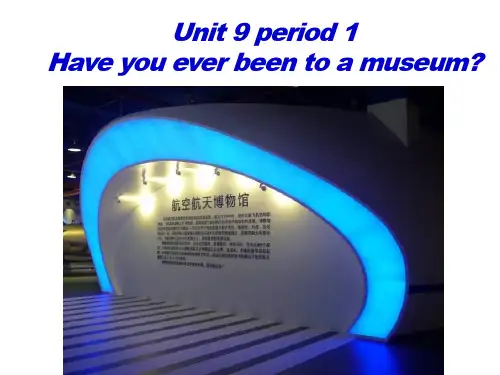
Unit 9 Section A Have you ever been to a museum?
Move your eyes … Use your hands… Share your ideas… Encourage yourself to… Use your head… Make a difference !
4. 我了解了一些电影的知识。 I _le_a_r_n_e_d_a_b_o_u_t_ some information about movie. 5. 他的粗心导致了这次失败。 His carelessness _l_e_d_ _t_o_ this failure.
Name the kinds of museums that you know.
for false. Conversation 1
1. Tina went to the space museum last year. T/F 2. John has never been to the space museum. T/F 3. They are going to take the subway. T/F
5.somewhere adv.
1. 太空博物馆 2. 游乐场 3. 水上乐园 4. 照相机;摄影
机;摄像机 5.在某处,到某
处
1a Which of these places would you like to visit? Rank them from 1(most) to 6 (least).
Hangzhou National Tea Museum
Scanning
1. Which three museums do the students talk about?
the American Computer Museum (Ken) the International Museum of Toilets (Amy)
museum? B: No, I haven’t. How about you? A: …
Listening 2
2a Look at the map of the town. Listen and circle the places you hear.
Listening 2 2b Listen again and circle T for true or F
2c Look at the map in 2a and make conversations about the places.
A: Have you ever been to the space museum?
B: Yes, I have. How abo极ut 好you的?
A: No, I haven’t. B: Oh, it’s fantastic. Let’s go tomorrow. A: OK. How are we going to get there? B: We can take the subway.
1.When did Sarah visit the National Science Museum?
A. Today B. Yesterday C. Last year 2. When did Claudia visit the nature museum? A. Last year B. Last summer C. Last school trip 3. What may the relationship be between the
定语
It’s really interesting, isn’t it? It’s a great way to spend a Saturday afternoon.
I camped in the mountains with some friends. We put up a tent and cooked outside.
history museum Have you ever been to a history museum?
art museum Have you ever been to an art museum?
water park Have you ever been to a water park?
two speakers? A. Friends B. Teacher and student C. Mother and kid.
1b Listening 1
Listen. Have these students ever been to these places? Check (√) the boxes.
zoo Have you ever been to a zoo?
amusement park
Have you ever been to an amusement park?
A: Have you ever been to…? B: Yes, I have./ No, I haven’t.
1. space museum 2. amusement park 3. water park 4. camera n.
4.Mr Wang isn't here.He has gone to Qingdao.
王先生不在这里。他去青岛了
5.I have been in Shanghai for three years. 我在上海已有三年了。 6.He has been in London for half a month. 他来伦敦已有半个月了。
space museum____ history museum____
art museum ____ water park ____
zoo ____
amusement park ____
Talk something about the picture.
Sarah
Claudia
Listening 1 Choose the best answer.
So, what did you do on the weekend?
You should try it!
That sounds fun. I’ve never been camping.
人教新目标八年级英语下册第九单元(SectionA)

新目标版英语八年级下册Unit 9 Have you ever been to a museum?(Section A)一、根据句意及首字母提示完成单词1、根据句意及首字母提示完成单词(1)I hope that they will have a w________ time in the amusement park.(2)Have you ever b________ to a museum?(3)Most people of Taiwan island came from Guangdong P________.(4)Then the performers give us a wonderful p________.(5)The house i________ is not particularly to my mind, but I like its environment.二、用括号内所给动词的适当形式填空2、用括号内所给动词的适当形式填空(1)I ________ (study) English at this school for three years.(2)Yao Ming ________ (go) to America three months ago.(3)I need ________ (improve) my spoken English.初中英语- 2 - (4)Do you have any problem ________ (get) to the top of the hill?(5)To be ________ (honesty), it was one of the best novels that I have ever read.(6)It's fun ________ (learn) another language.(7)Next month Harry ________ (visit) his grandparents with his parents.(8)—Where is Mr. Wang?—He ________ (go) to the library. He wants to borrow some library books.(9)At first she ________ (think) about going camping, but later she changed her mind.(10)How long have you been ________ (wait) here?三、根据句意及汉语提示完成句子3、根据句意及汉语提示完成句子(1)There are so many different kinds of ________(坐便器)in the museum.(2)I make my dream come true by chance this time, and it's really ________(难以置信的).(3)With the teacher's help, he has made great ________ (进步) in English.(4)They tried their best to make their work ________(完美的).(5)Most of the ________(德国人)speak German.初中英语- 3 - 四、用所给词的适当形式填空4、用所给词的适当形式填空(1)This is a difficult ________ (society) problem to solve.(2)It's a (an) ________ (usual) experience, and few people have chances to do it.(3)Would you like ________ (collect) shells with me?(4)He was moving ________ (rapid) around the room.(5)We ________ (learn) English last night.五、单选题5、Jessica's parents always encourage her __________ out her opinions.A 、speakB 、speakingC 、to speakD 、will speak6、It is our hope that we can live in a __________ world and say goodbye to wars for ever.初中英语- 4 - A 、similarB 、peacefulC 、familiarD 、natural7、Liu Ying is good at singing. She sings __________ the famous singer, CoCo. A 、as well asB 、as good asC 、as better asD 、as the best as8、—Will you please go to see the movie with me?—No, I won't. I __________ it already.A 、sawB 、have seenC 、seeD 、will see初中英语- 5 -9、—This is a useful dictionary, I think.—So it is, and it's __________ unusual one.A 、theB 、anC 、aD 、不填10、—Which do you prefer, rice or noodles?—_________, thanks. I am not hungry. I only need some water. A 、NeitherB 、EitherC 、BothD 、All11、—Have you got any books on English grammar? I want to borrow __________. —Yes, here you are. But you must return it by Friday.初中英语- 6 - A 、oneB 、itC 、someD 、that12、My host tried to cook __________ for me when I studied in New Zealand.. A 、different somethingB 、different anythingC 、something differentD 、anything different13、Miss Lin __________ a lot of work for the poor area since 2010. A 、doesB 、didC 、has doneD 、will do14、Anna is going on a tour of Xi'an, and she wants to __________ Chinese history.初中英语- 7 - A 、dream ofB 、learn aboutC 、look throughD 、pass on15、—Have you ever read English novels?—__________.A 、Yes, I didB 、Yes, I haveC 、No, I haveD 、No, I don't16、When I walked past the park, I saw some old people __________ Chinese Taiji.A 、doesB 、didC 、doingD 、are doing初中英语- 8 - 17、—I have never been to European countries. What about you? —__________.A 、I tooB 、Me tooC 、I eitherD 、Me neither18、—Have you __________ been to Xiamen?—No, __________.A 、ever, neverB 、never; everC 、ever, everD 、never; never19、— I feel stressed from time to time. Could you give me some advice? —__________ sharing your worries with your parents?初中英语- 9 - A 、Why don't youB 、How aboutC 、Why notD 、Would you like20、—Hello! Is that Mr. Jiang?—No, he __________ Guiyang. He will be back in more than two weeks.A 、goesB 、wentC 、has gone toD 、has been to21、It's a fine day today. How about __________?A 、go campingB 、go to camp初中英语- 10 - C 、going campingD 、to go to camp22、When you move somewhere new, the first thing is to find a place __________. A 、to liveB 、living inC 、to live inD 、living23、—How long have you __________ here?—For two days. I __________ here the day before yesterday. A 、been; cameB 、come, cameC 、came; cameD 、come, was24、—__________ you __________ in this school for more than ten years? —Yes, I __________ here in 2002.A、Did; come, cameB、Have; been; cameC、Did; come; have beenD、Have; come; came六、从方框中选择合适的词(组),并用其适当形式完成句子25、从方框中选择合适的词(组),并用其适当形式完成句子(1)I have a great sports ________.(2)I have been ________ English for ten years.(3)The story ________ is good. But he didn't tell it well.(4)—________ you ever ________ to an amusement park? —Yes, I have.(5)They ________ a tent by the fire.七、语法专练26、语法专练(1) They have ever been to an English-speaking country. (改为一般疑问句) ________ they ever to________ an English-speaking country?(2)Have your parents read the book twice? (作肯定回答和否定回答)肯定回答:________否定回答:________八、口语交际27、重新排列以下句子,组成一个完整的对话。
Unit9 sectionA重要知识点讲解课件人教版八年级英语下册
Jennifer likes to listen to music; so do I.
10.“so + 主语+动词”,这一结构用来表示对上文情况给 予进一步的肯定或确认。
---It was cold yesterday.昨天很冷。 ---So it was.确实是这样。
--- The students study hard.学生们学习很努力。 ---So they do.他们确实很努力。
--- He went to Shanghai yesterday.他昨天去北京了。 ---So he did.他确实去了。
1.— Have you ______ been to Xiamen? — No, ___A_____.
使用这一结构应注意以下几点: 一、注意结构中and 与标点符号的使用。 这一结构是一个完整的倒装句,因此,若前一句用句号,则so 应大写第一个字母。
Jennifer likes to listen to music. So do I.
若前一句用逗号,则so 前须加and,构成并列分句; Jennifer likes to listen to music, and so do I.
当前面的陈述句中有否定词few, little, never, no, nobody, hardly, seldom等词时,其后的简短疑问句应用肯定形式。 He can hardly swim, __ca_n__h_e_?
We have a little water, _d_o__w_e__?
以let’s开头的反义疑问句,简短疑问句部分用shall we;以let us 开头的反义疑问句,简短疑问部分用will you.
人教版初中英语课标版八年级下册第九单元SectionAperiod1共13张PPT
2. Make up a conversation. 3. Report his or her trip.
cities / fun places
.
Listen again for more information
Peter has been to … his opinions
1.
the
Palace
Museum .
wonderful many beautiful
2. treasures .
the Great Wall
3. loved it but too many people .
- When did you go there? - Who did you go with? - How did you go there? - What fun places have you ever been
to in that city? -What other wonderful things have you ever seen/ eaten / tried/ heard about there?
Peter has been to …
his opinions
the Palace Museum
wonderful many beautiful treasures
the Great Wall
loved it but too many people
The Bird’s Nest
——
the Terracotta Army
新课标人教版八年级英语下册Unit 9 Have you ever been to an amuse
—So did Tina.
中国地图
蒂娜也去了。
—He has been a soldier for two years.
要点点拨
他已经当了两年兵了。
go inline skating 滑旱冰
—So have I.
我也是。
全析提示
3.Look at the map of the town.Listen and circle the places 助动词 have 和 has 可以与前面的
you hear.
主语缩略’ve 和’s。
看城镇的地图。听录音并圈出你听到的地方。
如:we’ve,they’ve,he’s,
water world 水上世界
it’s 等。
city library 城市图书馆
have not 常缩略为 haven’t,has
fun times amusement park
如果说“欢迎回家”该怎么说呢?
把 1a 中你的回答和你搭档的回答对照一下。
Wele back home!
4.For me,“I have to!” is number two.
对我来说“I have to!”是第二位的。
要点点拨
5.Listen to a teacher interview a student.Circle the newsletter 业务通讯;新闻信札
route“路线、小路、小巷”,使
The main attraction was a Charlie Chaplin film.
用 X 围也较小。course 表示船的
吸引人的主要是查理·卓别林的电影。
“航道”或飞机的“航线”。
The idea of being a teacher has little attraction to young
2019-2020学年人教新目标英语八年级下册Unit9SectionA(1a-1c)教案

(五)总结回顾(用时5分钟)
今天的学习,我们了解了形容词比较级和最高级的基本概念、重要性和应用。同时,我们也通过实践活动和小组讨论加深了对这些知识点的理解。我希望大家能够掌握这些知识点,并在日常生活中灵活运用。最后,如果有任何疑问或不明白的地方,请随时向我提问。
此外,我也意识到在课堂教学中,对于学生的反馈需要更加及时和具体。在接下来的教学中,我会尽量在学生回答问题时给予及时的鼓励和指导,让他们知道自己的进步和需要改进的地方。
2. 1b部分:提供三个问题情境,让学生运用所学的形容词比较级和最高级进行问答练习,巩固知识点。
3. 1c部分:设置一个小组活动,让学生在小组内讨论并完成一个形容词比较级和最高级的练习,提高学生的实际运用能力。
二、核心素养目标
本节课的核心素养目标主要包括以下方面:
1.语言能力:通过学习形容词比较级和最高级,使学生能够熟练运用所学词汇描述人物、事物和场景,提高学生的英语表达能力。
2.教学难点
-不规则形容词比较级和最高级的记忆:学生往往对不规则变化的形容词比较级和最高级感到难以记忆,如“good”变为“better”和“best”,需要通过重复练习和记忆策略来突破。
-比较级和最高级的语境应用:学生在实际语境中可能难以决定何时使用比较级和最高级,特别是在涉及到三者或以上比较的复杂句子中。
-搭配使用的副词:学生需要了解并运用与比较级和最高级搭配的副词,如“a little”, “a lot”, “much”, “even”等,以增强语言表达的丰富性。
举例:
-形容词“big”的比较级是“bigger”,最高级是“biggest”。
英语人教版八年级下册unit9 Section A1a-2c
3.Ask the students to listen to the conversations one by one and finish three tasks .
4.Let Ss listen and repeat the second conversation.
3. Students will be able to tell the differences between the Present Perfect Tense and the Simple Past Tense.
Moral objects:
Students will be motivated to love the nature and love life.
Step 7
Summary& Homework
1.Lead students to recall what they have learned in this period.
2.Give students some exercises to do after class.
1.Recall what they learned and ask questions if they have.
Unit 9 Have you ever been to an amusement park?
By Pan Qi
Analysis
of
teaching material
This period is aiming at talking about past experiences using the Present Perfect Tense. The first period serves as an introduction and a leading-in part. The material in talking are mostly from the recent life and is familiar to them, so they will be interested in it. A series of questions and plenty of pictures are used to attract students’ attention. And listening pair work and group work are also used in this period.
人教版 八年级英语 下册 Unit_9_Have_you_ever_been_to_a_museum
dish.
Tapescripts:
Boy 1: So, Peter, how long have you been in China? Peter: I’ve been here for two weeks, but I’m going back to Australia tomorrow. Boy 1: Have you traveled much? Peter: Yes, I have. I’ve seen many interesting things. Boy 1: Have you visited the Palace Museum? Peter: Yes, I have. I went there last week. It was wonderful. There were so many beautiful treasures. Boy 1: And have you been to the Great Wall?
1st listening
1b
Listen to a student interviewing a foreign student. Check (√) the questions you hear.
___√_ Have you visited the Palace Museum?
___√_ Have you been to the Great Wall?
2019-2020学年人教新目标英语八年级下册Unit9SectionA(3a-3c)教案
四、教学流程
(一)导入新课(用时5分钟)
同学们,今天我们将要学习的是《Unit9 SectionA(3a-3c)》这一章节。在开始之前,我想先问大家一个问题:“你们在旅行中有没有遇到过难忘的事情?”这个问题与我们将要学习的内容密切相关。通过这个问题,我希望能够引起大家的兴趣和好奇心,让我们一同探索如何用英语描述过去的旅行经历。
-难点二:在描述复杂事件时,学生可能难以将多个动作按照时间顺序和逻辑关系串联起来,如:“First, we visited the Forbidden City, then we went to Tiananmen Square, and at last we had dinner in a restaurant.”
-学生能够用过去完成时描述在过去某个时间点之前已经完成的动作,如:“By the time you called me, I had finished my homework.”
2.教学难点
(1)区分并正确使用过去进行时和过去完成时;
(2)在口语和写作中灵活运用过去时态描述复杂事件;
(3)记忆和使用本节课的重点词汇和短语;
3.成果分享:每个小组将选择一名代表来分享他们的讨论成果。这些成果将被记录在黑板上或投影仪上,以便全班都能看到。
(五)总结回顾(用时5分钟)
今天的学习,我们了解了过去时态的基本概念、重要性和应用。通过实践活动和小组讨论,我们也加深了对过去时态的理解。我希望大家能够掌握这些知识点,并在日常交流中灵活运用。最后,如果有任何疑问或不明白的地方,请随时向我提问。
人教版英语八年级下册Unit 9 - Section A教材全解知识点课件
D. wonderful somewhere
3a
• It's really interesting, isn't it? 这是一个反意疑问句。 反意疑问句是由“陈述部分+附加疑问部分”构成。 附加疑问部分常译为“是不是?”“不是吗?”“是吧?”“对吗?”等。
3a
• It's really interesting, isn't it? 这是一个反意疑问句。 反意疑问句是由“陈述部分+附加疑问部分”构成。 附加疑问部分常译为“是不是?”“不是吗?”“是吧?”“对吗?”等。 反意疑问句要遵循以下原则: ①前肯后否,前否后肯。即:陈述部分为肯定时,附加疑问部分为 否定;陈述部分为否定时,附加疑问部分为肯定。 We can go to the island by ship, can't we? Tom hasn't been to an amusement park, has he?
1a
• Let's go to one tomorrow. 辨析 one, that与 it ③it用于指代前文中提到过的同一事物。 -Do you like the game? -Yes, I like it.
- Nick, I lost my pen and I couldn't find ________ anywhere. - There are many pens in that box. Just take_______. A. it;it B. it; one C. one;it D. one; one
1a
• Me neither. 我也没去过。 Me neither.常用于口语中,意为“我也没/不.....” 此处相当于“Neither have I.”或“I haven't, either.“ Sb./Sth. + neither. 表示前面所述的否定情况也同样适合于其他人或物。 - Lucy can't play the guitar. - Me neither. [拓展]“Me too."意为“我也一样/我也如此” Sb./Sth. +too.表示前面所述的肯定情况也同样适合于其他人或物 - She likes shits made of silk. - Me too.
八年级下册英语新目标第九单元SectionA(3A-3C)PPT
2. become better
3. uncommon
4. peaceful5.Biblioteka improve4. quiet
5. made
6.invented
6/15/2015
6. quick
Which of the underlined words in the 3c passage have the following meanings?
6/15/2015
3b
Read the article again and answer the following questions
6/15/2015
1. What does Ken say about the American Computer Museum?
It’s unbelievable that technology has progressed in such a rapid way.
history museum
museum
computer museum
6/15/2015
art museum
nature museum space museum
American
Computer
Museum
6/15/2015
the International Museum of Toilets in India
6/15/2015
6/15/2015
A: Have you ever been to…? B: Yes, I have./ No, I haven’t.
6/15/2015
Name the kinds of museums that
you know.