
小学英语新外研版(一起)四年级上册M3 U1
小学英语新外研版(一起) 四年级上册
市实小 清风制作
• You _______yesterday.
• • • • watched TV listened to music cooked fish phoned
• When do you usually get up? • How do you usually go to school?
Lingling watched TV and played with her toys . (yesterday )
Listen and follow.
• Choose 3 or 4 papers • Make sentences use “didn’t”
On Mondays
She usually ____ _____at 7.
• Lingling usually gets up at 7. But she didn’t get up at 7 yesterday.
Why?
America Independence day
独立纪念日
July 4th 7月4日
• 美国国庆节,日期为7月4日,以纪念1776 年7月4日大陆会议通过《独立宣言》。宣 告美利坚合众国脱离英国而独立。
England National bethan Ⅱ
伊丽莎白二世的生日
April 21th 4月21日
• the bad weather the second Saturday of June 6月的第二个星期六
Listen point and find “didn’t”
Let’s do two by two.
At 7
Lingling usually gets up at 7 on Mondays .
She usually walks to school.
have English at school
She usually has English at school.
time usual
last weekend
Listen and answer
• ①Did Lingling get up at 7 yesterday? • ②Did Lingling walk to school yesterday? • ③Did Lingling have English at school yesterday?”
watch TV
She usually _____ ____ school.
She usually ____ ____ at school.
Yesterday
• She____ ___ ___ at 7.
• She didn’t ___ ____ school. • She ___ ____ it.
Make a survey
小学英语新外研版(一起)四年级上册M3U1 教案

1、完成仿写
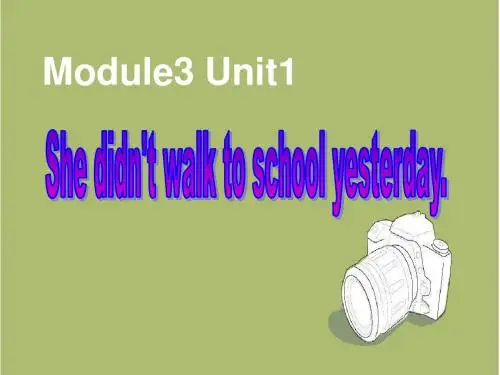
Yesterday, Lingling didn’t …
五、Cooler:
1、本单元单词抄写5遍
2、完成workbook unit 1.
What do you usually do?
1)Did Lingling get up at 7 yesterday?
2)Did Lingling walk to school yesterday?
2. say the sentences: I usually ……..
二、Presentation
1、老师随意问学生:“When do you usually get up?”“How often do you usually go to school?”
2、老师对学生说:“Lingling usually gets up at 7, but she didn’t get up at 7 yesterday. Why?”老师边说边做动作,尤其是说到“didn’t”时,要摆手示意,让学生初步理解“didn’t”的意思。老师让学生先自有猜测一下Lingling昨天7点半没有起床的原因。
1. Fill the blanks. \
She didn’t _____ ______ at 7 yesterday.
She didn’t ____ to school yesterday.
She didn’t _____ ______ yesterday.
3. play a card game.
板书设计
M3U1 She didn’t walk to school yesterday.
… usually… She didn’t …
get up walk to school have English
(新)外研版四年级上册M3U1-4课件(省优)

milk 牛奶
drinking milk
正在喝牛奶
soybean milk 豆浆
drinking
soybean milk 正在喝豆浆
Unit 1 what are they doing?
D:Let’s get on the bus.We can see lots of interesting things.
Module 3 Unit 1
What are they doing ?
• What’s he doing? • He’s runing.
let’s
(让)我们
get on
上(车)
lots of
许多
resting 有趣的
thing
物品,东西
look at 看
people
人
park
公园
lake 湖 row 划 boat 船 men 男人(复数);
She's reading a book. He's taking pictures. She's watching TV. He's playing with a toy train.
在英文中,当描述一个正在发生的动作时
我们要使用现在进行时。
现在进行时句子结构:
主语+be动词+动词ing+其他
be动词:在英语中有三个am, is are,每个句子中只有一个be 动词,选择哪个,主语来判定。
I You She He
is She is… =She’s… is He is… =He’s… am I am… =I’m…
are You are…=You’re
【外研版】(一起)四上:M3《U1 She didn’t walk to school yesterday》(1)
Lingling _____ TV and _____ with her toys.
Summary.
For
example: She didn’t get up at 7 yesterday. She didn’t walk to school. She didn’t have English at school.
学情分析
学生三年级接触过过去时,但只是was were,其 它动词的过去时都没有学。本教材从第二模块开 始系统讲解过去时。第二模块中只学了8个规则动 词的过去时即:clean---cleaned wash—washed finish—finished help—helped paint—painted watch—watched phone—phoned cook—cooked ; 学生也学过一般现在时,对单词usually比较熟悉。 学生学过这两种时态对本课的学习有很大的帮助。 但是将这两种时态结合在一起讨论,对学生来说 可能会有一定的困难。对国庆节的讲解,学生应 该比较感兴趣,都是自己经历过的事,描述起来 会比较简单。
1. Lead-in.
What about Lingling?
Play the record.
On Mondays
up gets She usually ______ ____ at half past six.
to school She usually walks ______ ____ ______.
教学内容
本课是四年级新标准英语第七册第三模块 第一课时,按照教材的设计以及中年级英 语教学的建议,本课主要要求学生掌握 didn’t的正确用法以及结合一般现在时描述 自己或别人特殊的一天,同时要熟练运用 第二模块中所涉及到的过去时动词。在正 确朗读、回答问题、理解短文的基础上培 养学生的阅读能力和初步的仿说、仿写能 力。 运用微课程使学生提前做好预习。
外研版一起点四年级上册英语 Module 3 Unit 1课件
2 Listen, point and find “didn't”.
×
She usually walks to school. But she didn't walk to school yesterday.
第七页,共二十一页。
2 Listen, point and find “didn't”.
was ill.
A. walked
B. walk
C. walks
2. She watched TV and ________ with her ball.
A. play
第十九页,共二十一页。
B. played
随堂练习
用所给单词的正确形式填空。
ห้องสมุดไป่ตู้
1. My sistedrid_n_'t_w__a_lk____(not walk)to school
×
She usually has English at school. But she didn't have it yesterday.
第八页,共二十一页。
2 Listen, point and find “didn't”.
√
欢度国庆
Yesterday was National Day!
第九页,共二十一页。
外研版一起点四年级上册英语 Module 3 Unit 1课件
科 目:英语 适用版本:外研版 适用范围:【教师教学】
Module 3
Unit 1 She didn't walk to
school yesterday.
第一页,共二十一页。
单元新词
didn't=did not
外研版四年级上册英语课件-M3U1
英语·外研社版·四年级上
Game-- Let's read ,do and say. IH’mHSeHSISH’ehs’hdemhe’eseo’ep’s’ssi’’rlspnsapefglsyawlarlwaiyydumnayiiinigmntnionncggrmgtighnaifiignnbabnoa.gggaloe.kstbeikbtoTxeaeoVetl.knlb.r.ncaiislsl..es.
They’re doing taijiquan.
They’re = They are
chess 国际象棋
[tʃes]
They’re playing chess.
They’re rowing a dragon boat.
It’s interesting.
row划船 [rəʊ]
dragon龙 ['dræ g(ə)n]
C:They’re… D:Yes,I like…,… is very interesting. A:I like…,too.Let’s…. BandCandD:OK,let’s go.
Exercise
一、根据要求写出单词的相应形式。
1.do(现在分词)___d_oi_n_g_____ 2.drinking(原形)___d_ri_nk______ 3.kid(复数形式)___k_i_ds_______ 4.men(单数形式)___m_a_n______ 5.row(现在分词)__r_o_w_in_g_____
Exercise
三、单项选择。
1._______ are they doing?
A. What
小学-英语-外研版-四上Module 3 unit1
They’re…
doing Taijiquan
rowing a dragon boat
playing chess
drinking milk
What are they doing?
They are singing. They are dancing. They are running. They are swimming.
(be) he doing ?
• 4. What is
(be) your mother drinking?
• 5.His father is
(swim).
• 6.I am
s(wwimrmitineg) a letter.
writing
Now write the answers. Use the words in the box.
What is he doing? He is reading books.
What is she doing? She is watching TV.
Let’s get on the bus. We can see lots of interesting things .
Look at the people in the park.
Do, doing, doing taijiquan
新外研版四年级英语上册M3U1
Do, do, doing, doing taijiquan
Row, row, rowing, rowing a dragon boat
Play, play, playing, playing chess
Drink, drink, drinking, drinking soya milk
Look at the cloc . It's twelve now. I'm hungry .k
What is he doing? He is reading books.
What is she doing? She is watching TV.
What is he doing? He is having breakfast.
What is she doing? She is telling a story.
Module 3 Unit 1 What are they doing ?
I say read , you say reading I say watch, you say watching I say listen ,you say listening I say play , you say playing I say talk, you say talking I say take, you say taking I say write , you say writing
doing Taijiquan
rowing a dragon boat
playing chess
drinking milk
What are they doing?
They are singing They are dancing They are running They are swimming
新外研版四年级英语上册M3U1-5.ppt
bit kid milk apple cat can man dress chess get men tree street see
dog cock clock lot not
• 14、Thank you very much for taking me with you on that splendid outing to London. It was the first time that I had seen the Tower or any of the other famous sights. If I'd gone alone, I couldn't have seen nearly as much, because I wouldn't have known my way about.
。2021年1月14日星期四2021/1/142021/1/142021/1/14 15、会当凌绝顶,一览众山小。2021年1月2021/1/142021/1/142021/1/141/14/2021 16、如果一个人不知道他要驶向哪头,那么任何风都不是顺风。2021/1/142021/1/14January 14, 2021
Words and expressions.
let’s =let us get on lots of interesting thing lake men (man的复数) hungry
让我们 上(车) 许多 有趣的 物品,东西,事情 湖 男人,人 饥饿的
What are the kids doing ? They ’re listening to music .
小学英语新外研版(一起)四年级上册M3 U1 学案 修改
小学英语新外研版(一起)四年级上册小学英语四年级上册第 3 模块第 1 单元预习单本模块单词:————————————————————————————- ————————————————————————————---------------------------------------------------------- 不懂的单词:————————————————————————————- ————————————————————————————---------------------------------------------------------- 本模块短语:————————————————————————————- ————————————————————————————------------------------------------------------------- 本模块重点句型:————————————————————————————- ————————————————————————————-------------------------------------------------------小学英语四年级上册第 3 模块第 1 单元学案主备人:吴文萃审核人:时间: 2015.09.16【学习目标】1.知识目标词汇:能够听懂、认读、会说、会写:didn’t=did not能够听懂、认读、会说:National Day学会didn’t 的结构和用法。
2.能力目标能够认读句型:She didn’t walk to school yesterday.能理解文本大意,能正确流利的朗读课文。
3.情感价值目标以National Day为契机,培养学生热爱祖国、热爱家乡的美好情感。
【自学反馈】1.自己朗读didn’t, National Day, get up, walk to, have English小组内检查朗读熟练且准确()准确较熟练()准确不熟练()【合作探究】Group work:When do you usually get up?How do you usually go to schoolListen, p oint and find “didn’t”Read the text with questions①She didn’t get up at 7 yesterday, why?②Did Lingling get up at 7 yesterday?③Did Lingling walk to school yesterday?④Did Lingling have English at school yesterday?”【当堂检测】1)Mr Pan usually ______ up at half past six.2)But he ______ get up at half past six yesterday.3)He usually ______ to work.4)But he didn’t ______ to work yesterday.5)Yesterday _______ Sunday.【拓展提升】Make a survey。
小学英语新外研版(一起)四年级上册m3u1 4.1
What does she usually do on Mondays?
注:一般动词的 第三人称单数要 加 s或es。 have 的第三人 称单数要变成 has.
She usually has Enபைடு நூலகம்lish on Mondays.
What does she usually do on Mondays?
用于对过去时 间的否定。
我要去学校,天天不迟到~
yesterday
She didn’t walk to school.
yesterday
She didn’t have English.
Listen and answer T or F
• 1.lingling usually gets up at 6. ( ) • 2.Lingling walked to school yesterday. ( ) • 3.Lingling didn’t have English yesterday.( ) • 4.Yesterday was National Day. ( )
have English
What does she usually do on Mondays?
She usually gets up on Mondays.
What does she usually do on Mondays?
She usually walks to school on Mondays.
精品课件
小学英语新外研版(一起) 四年级上册
市实小 清风制作
Module 3 unit 1
She didn’t walk to school yesterday.
•Speak out