
牛津深圳版七年级英语上册Module1MylifeUnit2Dailylife第5课时写作课件
深圳沪教版初中英语七年级上课文+知识点
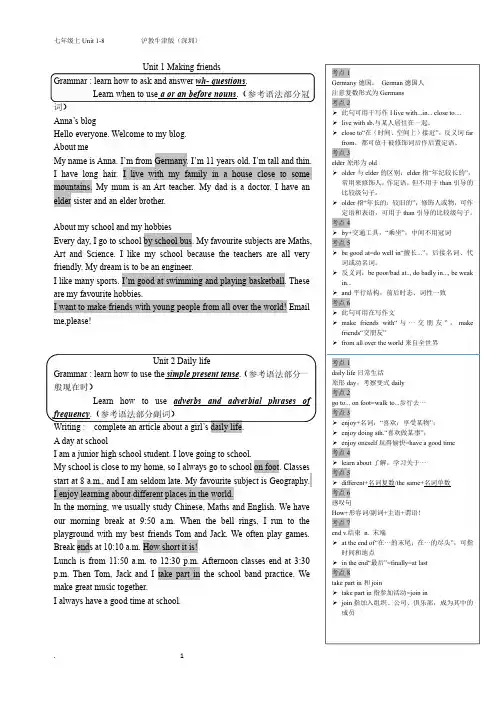
Anna’s blogHello everyone.Welcome to my blog.About meMy name is Anna.I’m from Germany.I’m 11years old.I’m tall and thin.I have long hair.I live with my family in a house close to some mountains.My mum is an Art teacher.My dad is a doctor.I have an elder sister and an elder brother.About my school and my hobbiesEvery day,I go to school by school bus.My favourite subjects are Maths,Art and Science.I like my school because the teachers are all very friendly.My dream is to be an engineer.I like many sports.I’m good at swimming and playing basketball.These are my favourite hobbies.I want to make friends with young people from all over the world!Email me,please!I am a junior high school student.I love going to school.My school is close to my home,so I always go to school on foot.Classes start at 8a.m.,and I am seldom late.My favourite subject is Geography.I enjoy learning about different places in the world.In the morning,we usually study Chinese,Maths and English.We have our morning break at 9:50a.m.When the bell rings,I run to the playground with my best friends Tom and Jack.We often play games.Break ends at 10:10a.m.How short it is!Lunch is from 11:50a.m.to 12:30p.m.Afternoon classes end at 3:30p.m.Then Tom,Jack and I take part in the school band practice.We make great music together.I always have a good time at school.and fields.Some places are very hot,and some are very cold.There are many different plants.Some are large.Some are small.All plants need light and water.There are different animals on Earth too.Some live on the land.Some fly in the sky.Some live under the water.There are also many people like you and me on Earth.The Earth provides us with air,water and food.It is our home.Today,there is a lot of pollution.We burn things to make energy.This pollutes the air.We put our rubbish into the sea and under the ground.This pollutes the Earth and kills animals and plants.We must stop doing these things.It is important for us to protect the Earth for our future.SpringIn spring,the weather starts to get warm.The wind blows gently.It often rains.Plants start to grow.Everything turns green.It is exciting to take a trip in spring.SummerThe weather is hot in summer.The sun shines brightly.Many people like to go to the beach and swim in the sea.It is nice to eat ice cream in the hot weather.AutumnIn autumn,everything changes.Leaves turn brown,red or yellow and start falling from the trees.It is nice to go on a picnic at this time of year because the weather is cool and dry.WinterWinter is often cold and snowy.Children love winter because they love to play in the snow.It is interesting to make snowmen.People usually spend time with their relatives during the Spring Festival.考点1The Earth 独一无二,要用冠词on earth 世界上on the earth 在地球上考点2此句可用于环境类写作provide sb.with sth.=provide sth.for sb.“为某人提供某物”The sun provides us with heat and light.=The sun provides heat and light for us.考点3pollution “污染”,不可数名词 pollute “污染”,动词 polluted “受污染的”,形容词/过去分词考点4put...into “把···倒入···;将···注入···”拓展:put up 提出、张贴;put off 推迟;put away 把···收起来;put down 放下,写下;put on 穿上,增加(体重);put out 扑灭,熄灭考点5stop doing sth.停止做某事stop to do sth.停下来去做另一件事考点6此句可用在写作文It is +adj.for sb.to do sth.“对于某人来说,做某事是...的”注:当形容词表示人物性格、特点时,for 要变为of 。
牛津版深圳七年级英语上册《Module 1 My life 2 daily life》教学目标
牛津版深圳七年级英语上册《Module1My life2daily life》教学目标【本讲教育信息】一.教学内容:Module1Change Unit2Seasonal changes1、重点短语2、重点句型3、情态动词must的用法4、动词get的用法二.知识总结与归纳1、重点短语in September in summer in the playgroundsee…doing have ice-cream plenty of2.重点句型You must wear white shirts with short sleeves.There are more flowers in the garden in summer.Not many students like playing in the playground.You can see plenty of bees flying in the garden.3.情态动词must的用法情态动词的定义:情态动词是一种本身有一定的词义,表示说话人的情绪,态度或语气的动词,但不能单独作谓语,只能和其他动词原形构成谓语。
情态动词的位置:情态动词在句中放在谓语动词之前,谓语动词前若有助动词,则在助动词之前,疑问句中,情态动词则在主语之前。
情态动词的特点:情态动词无人称和数的变化,情态动词后面跟的动词需用原形,否定式构成是在情态动词后面加“not”。
个别情态动词有现在式和过去式两种形式,过去式用来表达更加客气,委婉的语气,时态性不强,可用于过去,现在或将来。
情态动词must的用法:must用来指一般现在时和一般将来时,过去式可用have to的过去式代替。
I must finish my work today.After such a long walk,you must be tired.He must be the man I am looking for.Must I return the book tomorrow?You mustn’t work all the time.4、动词get的用法表示从一种状态到另一种状态(1)形容词作表语He got angry.get较多地与形容词比较级连用。
牛津深圳版七年级英语上册Module1-My-life-Unit2-Daily-life第2课时阅读
8
7.Break ends at 10:10.How Short it is! 休息在 10:10 结束。多短啊! (1)end at 在……时间结束
(2)how+adj.(+主+谓)= what+(a/an)+adj.+n.(+主+谓) how 主要修饰形容词和副词,what 修饰名词。如: How short it is! = What short time it is!
使/让某人做某事
15.have a good time = enjoy oneself = have(great)fun
玩得愉快
11/23/2020
14
二、完成句子,每空限填一词。
1.我和我爸爸妈妈每周去购物两次。
I go shopping with my parents twice
a
week .
11/23/2020
12
6.love doing sth.= like doing sth. = enjoy doing sth. 喜欢做某事
7.practise doing sth.
练习做某事
8.be close to = near = beside = not far away from
接近;靠近
牛津深圳版七年级英语上册Module1-My-lifeUnit2-Daily-life第2课时阅读课件
栏目导航
课时精讲 课时过关 课后拓展
11/23/2020
2
课时精讲
课文重点句子讲解。
1.I am a junior high school student. I love going to school.
牛津深圳版七年级上册Module 1 My life Unit 2 Daily life lang
A day at school
Language points
01
I always go to school on foot.
= walk to school
I always walk to school.
What other ways can we go to school?
【一试身手】根据汉语意思,补全英语句子。 1. 西蒙的妈妈经常步行去集市。
06
Then Tom, Jack and I
1. take part in和join in常指参tak加e 某pa项rt 活in 动the,并在其
中发挥一定作用。
school band practice.
2. join单独用的时候多指加入jo某in个in团体、组织、党派、
人To群m等, J,a成ck为an其d中I 的joi一n 员in。the school band practice.
Simon's mother often goes to the ma.rket on foot /walks to the market
02 Classes start at 8 a.m.
同义词:begin 反义词:end
I start to时w间asahtm8y:3c0lotph.ems.. I start pla表y达ingatth9e:5pi0anao..m.
Last week, they had a good timein the park.
when
【要点链接】
when可以作疑问副词,表示“什么时候”; 也可以作连词,表示“当……的时候”,引导时间状语从句。如:
When will we leave? 我们什么时候走?
广州深圳牛津版七年级到九年级初中英语目录以及语法
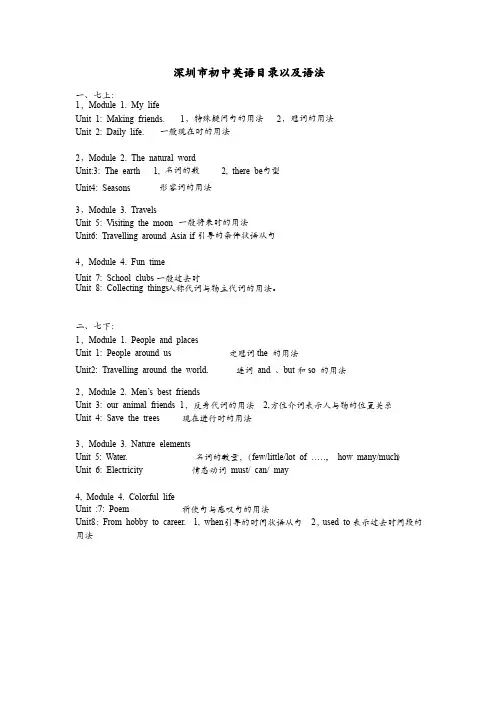
深圳市初中英语目录以及语法一、七上:1,Module 1. My life Unit 1: Making friends. 1,特殊疑问句的用法2,冠词的用法Unit 2: Daily life. 一般现在时的用法2,Module 2. The natural word 句型Unit:3: The earth 1, 名词的数2, there be 句型Unit4: Seasons 形容词的用法3,Module 3. Travels Unit 5: Visiting the moon 一般将来时的用法Unit6: Travelling around Asia if引导的条件状语从句4,Module 4. Fun time Unit 7: School clubs 一般过去时Unit 8: Collecting things 人称代词与物主代词的用法。
二、七下:1,Module 1. People and places Unit 1: People around us 定冠词the 的用法Unit2: Travelling around the world. 连词and 、but和so 的用法2,Module 2. Men’s best friends Unit 3: our animal friends 1,反身代词的用法2,方位介词表示人与物的位置关系Unit 4: Save the trees 现在进行时的用法3,Module 3. Nature elements Unit 5: Water. 名词的數量,(few/little/lot of ……,how many/much)Unit 6: Electricity 情态动词must/ can/ may 4, Module 4. Colorful life Unit :7: Poem 祈使句与感叹句的用法Unit8:From hobby to career. 1, when引导的时间状语从句2,used to 表示过去时间段的用法八上:1, Module 1:amazing things Unit 1: Encyclopedias some、any 、somebody、nobody、anybody 等不定代词Unit 2: Numbers 序数词与基数词的用法2, Module 2: Science and technology Unit 3: Computers 形容词比较级与最高级的用法Unit 4: Invention 形容词比较级不规则用法,形容词原级的基本用法3, Module3;Culture and history Unit 5: Educational exchange 现在完成时的用法Unit 6: Ancient stories 现在完成时的用法4,Module4: School life Unit 7: Memory 条件状语从句(if 与unless)Unit 8: English Week 情态动词should与had better 的用法八下:1, Module 1:Social communication Unit 1: Helping those in need 动词不定式Unit 2: Body language 动名词的用法2,Module 2: Arts and crafts Unit 3: Traditional skills 被动语态Unit 4: Cartoons and comic strips 含有情态动词的被动语态与现在完成时的被动语态3, module 3: Animals Unit 5:Save the endangered animals it +is+adj+for sb to do sth/it is adj of sb to do sth Unit 6: Pets 副词的用法及构成4, module 4:Discovery Unit 7: The unknown world 原因状语的用法(as/because/because of/since/for)Unit 8: Life in the future 过去进行时九上:1, unit 1: Wise men in history. 英语常见句型:反意疑问句、疑问句、祈使句、感叹句2, unit 2: Great minds 动词不定式3, unit3: Family life 连系动词的用法4, unit4: Problems and advice 句子的成分:主谓宾、定状补5, unit 5: Action although/though 引导的让步状语从句6,unit 6: Healthy diet 宾语从句7, unit 7: The adventures of Tom Sawyer 定语从句8,unit 8: surprise endings 介词九下:1,unit 1: Great explorations 结果状语从句so/such …that,too…to等目的状语为主2,unit 2:Culture shock 状语从句以so that 、in order that 目的状语为主3, unit 3: The environment same/like/ different 及其搭配三者之间的运用4, unit 4: Natural disasters it 做形式主语的用法5,unit 5: Sports 动词的时态、语态6,unit 6: caring for your health 宾语从句。
牛津深圳版七年级英语上册课文

七年级英语教科书(上册)牛津深圳版Unit 1 Making friendsGrammar : learn how to ask and answer wh- questions.Learn when to use a or an before nouns.Writing : plete an email to a new friendAnna’s blogHello everyone. Wele to my blog.About meMy name is Anna. I’m from Germany. I’m 11 years old. I’m tall and thin.I have long hair. I live with my family in a house close to some mountains. My mum is an Art teacher. My dad is a doctor. I have an elder sister and an elder brother.About my school and my hobbiesEvery day, I go to school by school bus. My favourite subjects are Maths, Art and Science. I like my school because the teachers are all very friendly. My dream is to be an engineer.I like many sports. I’m good at swimming and playing basketball. These are my favourite hobbies.I want to make friends with young people from all over the world! Email me,please!Vocabulary1.Hello everyone.a all peopleb some people2.I live with my family in a house close to some mountains.a nearb far away from3.I like my school because the teachers are all very friendly.a happyb nice and kind4.These are my favourite hobbies.a things I must dob things I like doing in my free time5.I want to make friends with young people from all over the world.a some countries inb every country inUnit 2 Daily lifeGrammar : learn how to use the simple present tense.Learn how to use adverbs and adverbial phrases of frequency. Writing : plete an article about a girl’s daily life.A day at schoolI am a junior high school student. I love going to school.My school is close to my home, so I always go to school on foot. Classes start at 8 a.m., and I am seldom late. My favourite subject is Geography.I enjoy learning about different places in the world.In the morning, we usually study Chinese, Maths and English. We have our morning break at 9:50 a.m. When the bell rings, I run to the playground with my best friends Tom and Jack. We often play games. Break ends at 10:10 a.m. How short it is!Lunch is from 11:50 a.m. to 12:30 p.m. Afternoon classes end at 3:30 p.m. Then Tom, Jack and I take part in the school band practice. We make great music together.I always have a good time at school.Vocabulary1.Classes start at 8 a.m., and I am seldom late.a oftenb not often2.We have our morning break at 9:50 a.m.a a short time between lessonsb a short holiday3.When the bell rings, I run to the playground with my best friends Tom and Jack.a make a soundb is quiet4.Afternoon classes end at 3:30 p.m.a stopb begin5.We make great music together.a with each otherb every dayUnit 3 The EarthGrammar : learn how to use countable and uncountable nouns.Learn how to use the pattern there is / are......Writing : plete a report on protecting the Earth.Protect The EarthThe Earth is a beautiful place. There are forests and rivers, mountains and fields. Some places are very hot, and some are very cold.There are many different plants. Some are large. Some are small. All plants need light and water. There are different animals on Earth too. Some live on the land. Some fly in the sky. Some live under the water.There are also many people like you and me on Earth. The Earth provides us with air, water and food. It is our home.Today, there is a lot of pollution. We burn things to make energy. This pollutes the air. We put our rubbish into the sea and under the ground. This pollutes the Earth and kills animals and plants.We must stop doing these things. It is important for us to protect the Earth for our future.Vocabulary1.The Earth provides us with air, water and food.a givesb shows2.We burn things to make energy.a set.... on fireb make ... very strong3.This pollutes the air.a make ... cleanb makes ... dirty4.This pollutes the Earth and kills animals and plants.a cleans b makes (i)5.It is important for us to protect the Earth for our future.a keep ... safeb changeUnit 4 SeasonsGrammar : learn how to use adjectivesWriting : write about your favourite seasonThe four seasonsSpringIn spring, the weather starts to get warm. The wind blows gently. It often rains. Plants start to grow. Everything turns green. It is exciting to take a trip in spring.SummerThe weather is hot in summer. The sun shines brightly. Many people like to go to the beach and swim in the sea. It is nice to eat ice cream in the hot weather.AutumnIn autumn, everything changes. Leaves turn brown, red or yellow and start falling from the trees. It is nice to go on a picnic at this time of year because the weather is cool and dry.WinterWinter is often cold and snowy. Children love winter because they love to play in the snow. It is interesting to make snowmen. People usually spend time with their relatives during the Spring Festival.Vocabulary1 all the things -------- eveything2 sends out light -------- shine3 not wet --------- dry4 with a lot of snow -------- snowy5 use time to do something -------- spend6 people in the same family -------- relativesUnit 5 Visiting the MoonGrammar : learn how to use the simple future tense with will.Learn how to use the simple future tense with be going to Writing : write a plan for visiting the Space HotelA trip to space----- by Jerry10 October 2053I’m so happy! Tomorrow I’ll be one of the first students to travel into space. The spaceship will leave the Earth at 9 a.m. It’ll take us to the Moon. I can’t wait!The Moon is around 380,000 kilometres from the Earth, so it’ll take us about four days to get there. There’s no gravity in space, so we’ll all be able to float aroud in the spaceship. We’ll have to tie ourselves to our beds so that we won’t float away in our sleep! Without gravity, our bodies may get weak, so we’ll have to do exercises every day.When we arrive, I’m going to walk on the Moon. I’ll have to wear a spacesuit to help me breathe because there’s no air on the Moon. I’m going to take as many photos as I can, that is, if my camera still works up there...Vocabulary1.If you leave a place, you it.a go tob go away from2.If you have to do something, you do it.a canb must3.If you tie something, you .a hold two or more things together with a ropeb make something into a rope4.When you breathe, you .a keep yourself warmb take air into and send it out of your bodyUnit 6 Travelling around AsiaGrammar : learn how to use conditional sentencesWriting : make a travel guideVisiting ShanghaiShanghai is one of the largest cities in the world. If you like sightseeing, you will love it!People’s SquarePeople’s Square is in the centre of Shanghai. It is a large public area with green grass, fountains and birds. If you visit People’s Square, you can also see famous buildings around it, such as the Shanghai Grand Theatre and the Shanghai Museum.The BundThe Bund is where old Shanghai meets new Shanghai. If you walk along the Bund, you will see many old buildings. The Pudong New Area, just across the Huangpu River, has many modern buidlings. At night, these tall buildings light up the sky in every direction.Yu GardenYu Garden is a traditional garden. If you enjoy his history and natural beauty, you will love this garden. There are many beautiful buildings, bridges and ponds. You can also buy different snacks just outside the garden.Vocabulary1 Sightseeing usually refers to .....2 The centre is.....3 A modern building is .....4 Examples of traditional food are ....5 the natural world means....Unit 7 school busGrammar : learn how to use the simple past tenseWriting : plete a poster for the Insect Club.The Clubs FairLinda and Leo are new students at Rosie Bridge School. Last month, they attended the Clubs Fair.First, Linda and Leo learnt about the Rocket Club.“ Our club will teach you how to build rockets. Then you can launch them into the sky,” a boy said, “ watch!”He took a rocket and lauched it. The rocket disappeared into the sky. Linda and Leo were very surprised.“Will it go all the way into space?” Linda asked.“ Of course it won’t,” a girl from another club shouted. “Our club is better. e and join the Solar Power Club.”“ What do you do?” asked Leo.“ We make wonderful machines. They only use solar power. Look!”She took a toy car from the table and then used a remote control to drive it all around the playground.“ It uses power from the Sun,” said Linda. “ That’s amazing!”Linda and Leo learnt about many clubs. After the fair, they felt very excited.“ I want to join all the clubs,” said Linda.“ Me too!” said Leo.Vocabulary1 At a fair, people let you things.a takeb look at or buy2 When you attend a class, you it.a leaveb go to have3 When a mum teaches her child to make a cake, she .a shows him/ her how to do itb makes it for him/ her4 If something disappears, .a everyone can see itb no one can see it5 If something is amazing, it is very .a good and surprisingb bad and tiringUnit 8 Collecting thingsGrammar : learn how to use personal pronouns, possessive adjectives and possessive pronouns.Writing : write a short article about your collectionUnusual collectionsSam and Helen’s grandparents collect almost everything. There are eight doorbells on their front door.“ This silver doorbell is my favourite,” said Helen. She pushed it and soon Grandpa opened the door.“ e in, my dear grandson and granddaughter!” he said.“ Who started collecting doorbells, Grandpa?” asked Sam.“ Your grandma, “he answered. “ She loves doorbells.”“ What do you like collecting, Grandpa?” asked Helen.“ I like collecting newspaper.”They went inside and saw newspaper everywhere.“ Hello children!” called Grandma. “ Let’s have some tea.”The children followed her into the living room and saw lots of toys there. There was hardly any space for the children to sit down.“ Whose toys are these?” asked Helen.“ They’re ours,” said Grandma. “ We both like collecting toys.”“ But remember,” said Grandpa, “ we have a lot of free time! You have your school work to do, so you shouldn’t spend too much time collecting things!”Vocabulary1.My friend will e to visit me in a short time from now. ---- soon2.There are tall buildings all over the area. ---- everywhere3.I walked behind my grandma to the kitchen. ---- followed4.I can almost not keep my eyes open. ---- hardly5.What do you do when you are not busy? ---- free。
Unit 2 Daily life单元知识归纳-七年级英语上册牛津深圳版(广州沈阳通用)
沪教牛津版七年级上册Module 1 My lifeUnit 2 Daily life【目标】通过本单元的学习,学生的综合语言能力要达到以下语言能力目标:1.听:能听懂有关日常生活的对话或短文2.说:能够谈论自己和他人的日常生活;3读:能够阅读有关他人的日常生活的文章;4.写:能够描写自己和他人的学校生活或业余活动。
【重点单词】掌握本单元重点单词的音、形、义、性、用1.daily每日的,日常2.article文章3.never从不4.table tennis乒乓球5.ride骑,驾驶ually常地7.so因此,所以8.seldom不常,很少9.Geography地理10.break休息11.bell钟,铃12.ring(使)发出钟声,响起铃声13.end结束,终止14.band乐队15.practice练习16.together在一起17.market集市,市场18.guitar吉他19.grade年级【重点短语】掌握本单元重点短语并能熟练造句1.junior high school初级中学2.on foot步行3.take part in参加4.have a good time(= enjoy oneselfhave fun)过得愉快5.go to bed去睡觉6.get up起床7.once or twice a week每周一两次8.play the piano弹钢琴9.learn about了解10.in the morning在上午11.how long多长时间12.in the world在世界上13.from..to..从....到……14.at school在学校15.go home回家16.enjoy doing sth.喜欢做某事17.between.and.在…和…之间18.by bus乘公共汽车19.how often多久一次20.in the middle of在……中间21.at the end of在…末22.at the beginning在开头23.play table tennis打乒兵球24.play computer games玩电脑游戏25.do morning exercises做早操26.have classes上课27.a piece of一片28.have lunch吃午饭29.Help sb. with sth.帮助某人做某事30.think of...as....把…看作…【经典句型】理解本单元经典句型的句意并能就本单元话题“日常生活”熟练运用这些句型1. How long is the school lunchtime?学校的午餐时间多长?2. My school is close to my home, so I always go to school on foot.我的学校离我家很近,所以我总是步行去上学。
牛津深圳初中英语七上《Module 1 My life 2 daily life》word教案 (5)
Unit 2 Our daily lifePeriod OneTeaching target1 Talking about cartoons.2 Talking about daily lives.3 Skimming the passage.4 Learning the new words.1. Ask students the following question:What sentence do students say most often in school?2. Give students some time to look at the cartoon . Ask them toread the three sentences in this cartoon carefully.3. QuestionWhat can we learn from this cartoon?4. Meaning of this cartoonThis cartoon is shown to tell us that something may happen bychance. The question Hi asked is an IQ one. But Lo's answer was 'Idon't know.' But it is the right answer to the question that Hiasked. So we can conclude that something may happen by chance thatwe haven't expected.And also, this cartoon is about school life. And the main passagein this Unit is also about the school life.Daily life talk1.Write 'daily life' on the board.Write 'day ' daily' as well. Ask students to guess the meaning of'daily'.Then have them work out the meaning of 'daily life'.Introducedaily / a. that happens or comes every day or once aday每日的;每天一次的Introduce: daily English, daily talk2. QuestionWhat do you usually do in your daily life?3 .Have students look at the pictures in A andask What do you know about…? Ask them to talkabout themselves with these activities by using the followingsentence patterns.I … every day.I … once/twice a week.I never …4 Invite some more able students to talk more about their dailylives.Skimming1. Review the meaning of 'skim' with students. Invite one or twostudents to tell the meaning of 'skim'.2. Ask students to look at the title, the subtitle and the pictureson page 19 in the passage.subtitle / n. subheading副标题;小标题3. Have students finish the exercise in B Look and think.similar / a. the same in some ways but not completely thesame类似的;相似的be similar to 与…相似be different from 与…不同expect / v. think that somebody or something will come or thatsomething will happen 预料;预计4. Check the answers orally.。