
人教版小学PEP英语五年级下册知识点归纳
人教版小学PEP英语五年级下册知识点归纳PEP五年级英语下册各单元知识点Unit 1 My day一、重点词汇。
五、重点句型。
1、询问别人什么时候做某事的句型及回答。
句型结构:问:When do you+动词短语原形+其他?(你/你们什么时候做某事?)答:I/We(+频度副词)+动词短语原形+at+具体时间(我/我们通常在几点做某事。
)例:问:When do you go to bed?(你什么时候上床睡觉?)答:I go to bed at 9:00p.m (我晚上9点上床睡觉。
)注意:当主语是第三人称单数(he,she,it,单个人名或单数名词)时,助动词do 要变成does,句型结构是:When does+主语(第三人称单数)+动词短语原形+其他?2、询问别人周末做什么的句型及回答。
句型结构:问:What do you do on theweekend?(你周末做什么?)答:I(+频度副词)+动词(短语)+其他。
例:问:What do you do on theweekend?(你周末做什么?)答:I usually read books. (我通常看书。
)注意:当主语是第三人称单数(he,she,it,单个人名或单数名词)时,助动词do 要变成does,句型结构是:What does+主语(第三人称单数)+do+on the weekend?六、四会句子:When do you finish class in the morning ? 你们上午的课到几点结束?We finish class at 1 o’clock . 我们一点钟结束上午的课。
What do you do on the weekend ? 你周末做什么?I often watch TV and play ping-pong with my father . 我经常看电视,也常和我爸爸一起打乒乓球。
七、语音:cl /kl/ clean clock class cleverpl /pl / plate eggplant please play Unit 2 My favourite season三、重点句型1、询问别人天气怎么样的句型及回答。
句型结构:问:What’sthe weather like+时间+地点?(······天气怎么样?)答:It’s+表示天气的形容词例:问:What’s the weather like in winter in Beijing?(北京冬天的天气怎么样)答:It’s cold and windy.(有风而且寒冷。
)2、询问别人最喜欢的季节句型及回答。
句型结构:问:Which season do you likebest? (你最喜欢的季节是哪一个?)答:I like+季节+best或直接说季节名称。
同义句还有:What’s your favourite season?3、询问别人喜欢某个季节的原因的句型及回答。
句型结构:问:Why do you like+季节名称?或直接用“Why”来提问。
答:一般要用“because”引导的句子来说明理由,可以从天气相关的活动等方面来说。
例:问:Why do you likespring?(你为什么喜欢春天?)答:Because I can fly kites.(因为我能放风筝。
)问:Why do you like summer?(你为什么喜欢夏天?)答:Because I can go swimmingeveryday.(因为我每天都能去游泳。
)问:Why do you like autumn?(你为什么喜欢秋天?)答:Because the weather is cool.(因为天气凉爽。
)问:Why do you like winter?(你为什么喜欢冬天?)答:Because I can make a snowman.(因为我能堆雪人。
)四、四会句子:Which season do you like best , Mike ? 迈克,你最喜欢哪个季节?Winter . 冬天。
Why ?为什么?Because I like summervacation ! 因为我喜欢暑假!五、语音:br /br/ brown library brother umbrellagr /gr/ green grapes grandpa growUnit 3 My school calendar二、常用节假日名称。
New Year’s Day元旦(1.1)Tree Planting Day 植树节(3.12)Easter 复活节April Fool’s Day愚人节(4.1)May Day 劳动节(5.1)Mother’s Day母亲节(每年五月的第二个星期天)Children’s Day 儿童节(6.1)Father’s Day父亲节(每年六月的第三个星期天)Teachers’Day教师节(9.10)China’s National Day国庆节(10.1)Mid-Autumn Day 中秋节(农历八月十五)Thanksgiving Day 感恩节(11月第4个周四)Christmas圣诞节(12.25)summer vacation暑假winter vacation寒假三、活动名称sports meet 运动会Easterparty 复活节聚会school trip 学校旅行Chinese test 语文测试singingcontest歌咏比赛birthday party生日聚会四、介词in 、on、at的用法。
1、in后面+上午/下午/晚上/月份/季节/年份。
如:inthe morning, in April, in winter, in 2015.2、on的后面+具体的某一天。
如:onMonday, on April 3rd, on Friday morning.3、at后面+具体的时间点或与其他词构成固定搭配。
如:at six o’clock, at 12:30,at noon.五、重点句型。
1、问答某个活动或节日在几月份的句型及回答。
句型结构:问:When is+活动或节日名称?答:It’s in+月份。
例:问:When is Christmas?(圣诞节在什么时候?)答:It’s in December.(在十二月。
)2、询问别人将要做什么的句型及回答。
句型结构:问:What will you do+其他?答:I will····=I’ll···例:问:What will you do for your mum on Mother’s Day?(母亲节你将为你妈妈做什么?)答:I’ll give her some flowers.(我将送给她一些花。
)3、表达“我们将要···”的句型。
We’ll···=Wewill 后面+动词原形,这是一个一般将来时的句子,表示将来某个时间要发生的动作或事情。
例:We’llhave a school trip.(我们将有一次学校旅行。
)We’llhave a singing contest.(我们将有一次歌咏比赛。
)We’lltake a dancing class.(我们将要上一节舞蹈课。
)六、四会句子:When is the party ? 聚会什么时候举行?It’s in April . 在4月。
When is the trip this year ? 今年的(秋)游在什么时候?It’s in October . We’ll go to the Great Wall . 在10月。
我们将去长城。
七、语音:ch / ʧ/ China chicken lunch teacher/k/ school Christmassh /ʃ/ sheep fish shirt shortsUnit 4 When is Easter ?二、用序数词表示具体的日期在英语中,“几月几日”可以先说“月”,再说“日”,其中“日”要用序数词,书写时序数词前可以有“the”,也可以没有。
但读日期时,the必须读出来。
如果要表示某年某月某日,通常按照“月、日、年”的顺序。
例如:March 3rd 读法是:March the third翻译是:3月3日。
June1st,2014 读法是:Junethe first, two thousand and fourteen翻译是:2014年6月1日。
三、基数词变序数词的口诀记忆基变序有规律,结尾加上th;一二三特殊记,结尾各是t,d,d;八减t九去e,f来把ve替;y改为ie,结尾仍有th;若是遇到几十几,只变个位就可以。
四、重点句型1、询问别人具体日期的句型及回答。
句型结构:问:When is+节日/活动?(···是哪天?)答:It’s on+月份+序数词。
·(··月···日)例:When is Children’s Day?(儿童节是哪天?)答:It’s on June 1st. (6月1日)2、询问生日的句型及回答句型结构:问:When is+某人的+birthday? (···生日是哪天?)答:It’s on+具体的日期。
例:问:When is your grandma’s birthday?(你奶奶的生日是哪天?)答:Her birthday is on June16th.(她的生日是6月16日。
)问:When is Miss White’sbirthday?(怀特小姐的生日是哪天?)答:It’s on July 1st. (7月1日。
)五、四会句子:When is April Fool’s Day ? 愚人节是哪天?It’s on April 1st . 它在4月1日。
When is your birthday ? 你的生日在哪天?My birthday is on April 4th.我的生日是4月4日。
六、语音:th字母组合数词发清音;代词和ther 字母组合发浊音th /θ/three thin thirteen maths / ð/ this that mother brothe rUnit 5 Whose dog is it ?四会:mine 我的yours 你(们)的his 他的hers她的theirs 他们的;她们的;它们的ours 我们的climbing (正在)攀登;攀爬eating(正在)吃playing (正在)玩jumping(正在)跳drinking(正在)喝(水)sleeping (正在)睡觉三会:each 每一;各个other 其他each other 相互excited 兴奋的;激动的like 像……那样二、掌握的短语climb trees 爬树play football 踢足球look at 看a beautiful painting 一幅美丽的画in the kitchen在厨房play with each other一起玩耍drink water 喝水listen to music 听音乐read books读书三、名词性物主代词和形容词性物主代词表示所有关系的代词叫做物主代词,即表示事物主人的代词。
小学英语人教PEP五年级下册复数记忆顺口溜
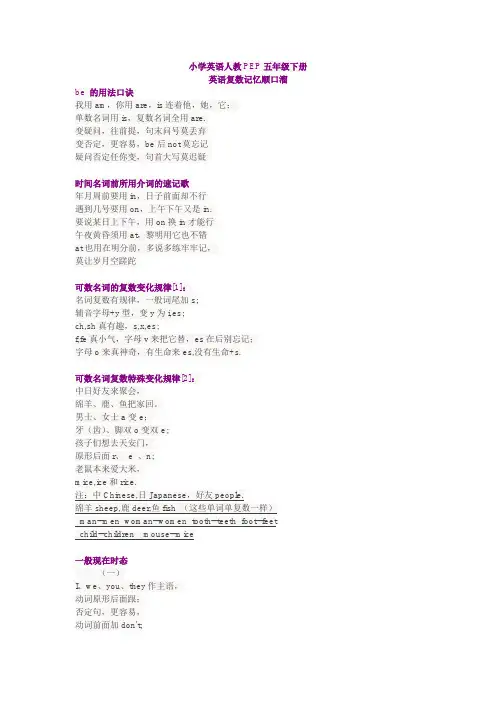
小学英语人教PEP五年级下册英语复数记忆顺口溜be 的用法口诀我用am,你用are,is连着他,她,它;单数名词用is,复数名词全用are.变疑问,往前提,句末问号莫丢弃变否定,更容易,be后not莫忘记疑问否定任你变,句首大写莫迟疑时间名词前所用介词的速记歌年月周前要用in,日子前面却不行遇到几号要用on,上午下午又是in.要说某日上下午,用on换in才能行午夜黄昏须用at,黎明用它也不错at也用在明分前,多说多练牢牢记,莫让岁月空蹉跎可数名词的复数变化规律[1]:名词复数有规律,一般词尾加s;辅音字母+y型,变y为i,es;ch,sh真有趣,s,x,es;f,fe真小气,字母v来把它替,es在后别忘记;字母o来真神奇,有生命来es,没有生命+s.可数名词复数特殊变化规律[2]:中日好友来聚会,绵羊、鹿、鱼把家回。
男士、女士a变e;牙(齿)、脚双o变双e;孩子们想去天安门,原形后面r、e 、n;老鼠本来爱大米,mice,ice和rice.注:中Chinese,日Japanese,好友people.绵羊sheep,鹿deer,鱼fish (这些单词单复数一样)man--men woman--women tooth--teeth foot--feet一般现在时态(一)I、we、you、they作主语,动词原形后面跟;否定句,更容易,动词前面加don't;疑问句,别着急,句首Do,来帮你,后面问号别忘记;肯定回答用Yes,I、we、you、they加上do;否定回答要用No,I、we、you、they加don't.(二)主语三单他、她、它,动三形式后面压,词尾一般s加;辅音字母+y型,变y为i,es;ch,sh真有趣,s,x,es;三个特殊那里去?has、goes和does;否定句,记住它,动词前面doesn't;疑问句,别着急,句首Does,来帮你;肯定回答用Yes,he、she、it加does;否定回答要用No,he、she、it、doesn't;Does、doesn't来帮你,后面动词定注意,恢复原形要切记。
PEP人教版小学英语五年级下册第一单元第五页Let27s talk知识讲解
Unit 1 This is my day Page 5 Let’s talk
Learning aims:
1. 能熟练朗读对话; 2. 能准确翻译对话。
Guiding 1:
请同学们认真朗读 第5页的Let’s talk中的 对话,并划出不会读的 内容,三分钟后,小组 交流。
你什么时候去上学? 在7:00。 你呢?
也在7:00。
Learning aims:
1. 能熟练朗读对话; 2. 能准确翻译对话。
When do you get up? 你什么时候起床? At 6:00. What about you? 在6:00。你呢? I usually get up at 6:30. 我通常在6:30起床。 When do you eat breakfast? 你什么时候吃早饭? At 6:20. 在6:20。 When do you go to school? 你什么时候去上学? At 7:00. And you? 在7:00。 你呢? At 7:00,too. 也在7:00。
Guiding 2:
请同学们把Page5 Let’s talk中的内容翻译 为汉语,遇到不会的内 容请划出来,三分钟后, 小组交流。
When do you get up?你什么时候起床?
At 6:00. 在6:00。 What about you?
你呢?
I usually get up at 6:30. 我通常在6:30起床。
When do you eat breakfast?20。 When do you go to school?
你什么时候去上学?
At 7:00. And you? 在7:00。 你呢?
PEP五年级英语下册Unit1-6重点知识小结

Unit 1 This Is My Daydo morning exercises晨练eat breakfast吃早饭have english class上英语课play sports进行体育运动eat dinner吃晚饭when什么时候evening夜晚;晚上get up起床at在……点钟usually通常;一般noon中午climb mountains爬山go shopping购物;买东西play the piano弹钢琴visit grandparents看望祖父母go hiking去远足weekend周末often经常sometimes有时候话题1:日常生活时态:一般现在时1.When do you do morning exercises? 你什么时候做早操?I usually do morning exercises at 8:00. 我经常八点钟做早操。
(I usually get up at 12:00 at noon . 我经常在中午十二点起床。
) 2.When do you eat dinner ? 你什么时候吃晚餐?I eat dinner at 7:00 in the evening. 我在晚上七点种吃晚餐。
3.When is the best time to go to Beijing? Fall. 最好在什么时候去北京?秋天。
Unit 2 My Favourite Seasonspring春天summer夏天fall秋天winter冬天season季节which哪一个best最;极swim游泳fly kites放风筝skate滑冰make a snowman堆雪人plant trees种树why为什么because因为sleep 睡觉话题2:季节时态:一般现在时1.Which season do you like best ? I like spring best.(Spring.)你最喜欢是什么季节?我最喜欢春季。
小学英语人教版PEP五年级下册1-6单元知识点总结
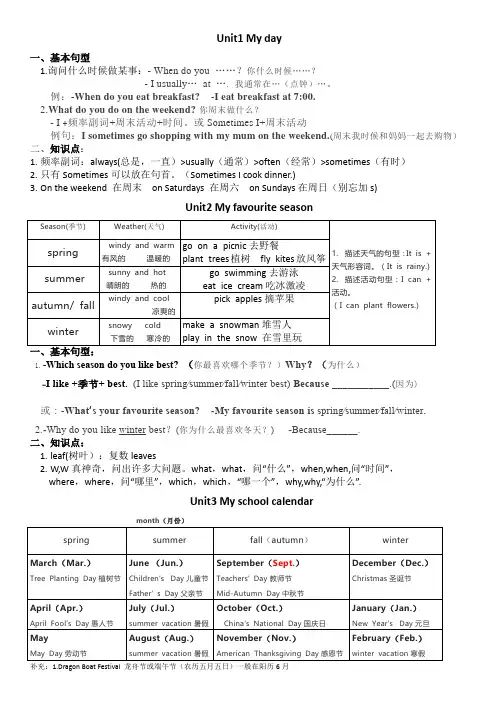
Unit1 My day一、基本句型1.询问什么时候做某事:- When do you ……?你什么时候……?- I usually…at …. 我通常在…(点钟)…。
例:-When do you eat breakfast?-I eat breakfast at 7:00.2.What do you do on the weekend?你周末做什么?- I +频率副词+周末活动+时间。
或Sometimes I+周末活动例句:I sometimes go shopping with my mum on the weekend.(周末我时候和妈妈一起去购物)二、知识点:1.频率副词:always(总是,一直)>usually(通常)>often(经常)>sometimes(有时)2.只有Sometimes可以放在句首。
(Sometimes I cook dinner.)3.On the weekend 在周末on Saturdays 在周六on Sundays在周日(别忘加s)Unit2 My favourite season1.-Which season do you like best? (你最喜欢哪个季节?)Why?(为什么)-I like +季节+ best.(I like spring∕summer∕fall∕winter best) Because ___________.(因为)或:-What‘s your favourite season? -My favourite season is spring∕summer∕fall∕winter.2.-Why do you like winter best?(你为什么最喜欢冬天?) -Because______.二、知识点:1.leaf(树叶):复数leaves2.W,W真神奇,问出许多大问题。
what,what,问“什么”,when,when,问“时间”,where,where,问“哪里”,which,which,“哪一个”,why,why,“为什么”.Unit3 My school calendar补充:1.Dragon Boat Festival 龙舟节或端午节(农历五月五日)一般在阳历6月2.月份首字母大写。
人教PEP版小学五年级下册英语第三单元知识点
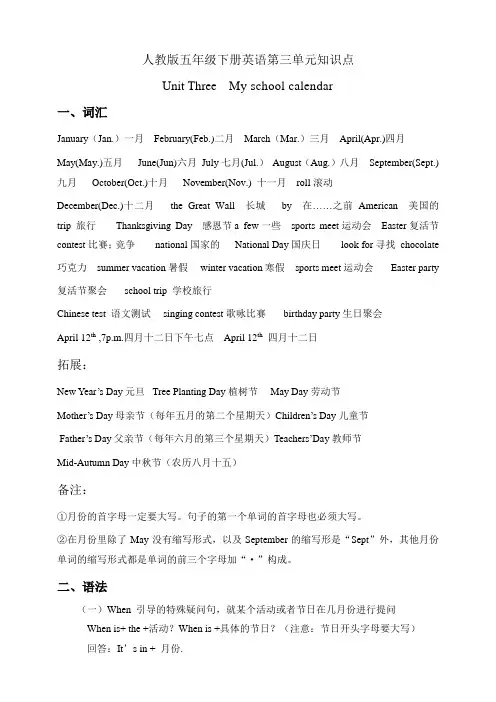
人教版五年级下册英语第三单元知识点Unit Three My school calendar一、词汇January(Jan.)一月February(Feb.)二月March(Mar.)三月April(Apr.)四月May(May.)五月June(Jun)六月July七月(Jul.)August(Aug.)八月September(Sept.)九月October(Oct.)十月November(Nov.) 十一月roll滚动December(Dec.)十二月the Great Wall 长城by 在……之前American 美国的trip 旅行Thanksgiving Day 感恩节a few一些sports meet运动会Easter复活节contest比赛;竞争national国家的National Day国庆日look for寻找chocolate 巧克力summer vacation暑假winter vacation寒假sports meet运动会 Easter party 复活节聚会 school trip 学校旅行Chinese test 语文测试 singing contest歌咏比赛 birthday party生日聚会April 12th ,7p.m.四月十二日下午七点April 12th四月十二日拓展:New Year’s Day元旦 Tree Planting Day 植树节 May Day 劳动节Mother’s Day母亲节(每年五月的第二个星期天)Children’s Day 儿童节Father’s Day父亲节(每年六月的第三个星期天)Teachers’Day教师节Mid-Autumn Day 中秋节(农历八月十五)备注:①月份的首字母一定要大写。
句子的第一个单词的首字母也必须大写。
②在月份里除了May没有缩写形式,以及September的缩写形是“Sept”外,其他月份单词的缩写形式都是单词的前三个字母加“·”构成。
人教版英语(PEP)五年级下册 Unit 5 知识点、1-6课时 课课练含答案

人教版PEP英语五年级下册Unit 5 知识点、1-6课时课课练含答案Unit 5 Whose dog is it? 知识点一、核心词汇1.名词性物主代词: mine 我的yours 你(们)的his 他的hers 她的theirs 他们的;她们的;它们的ours 我们的2.动词: climbing (正在)攀登;攀爬eating (正在)吃playing (正在)玩耍jumping (正在)跳drinking (正在)喝(水)sleeping (正在)睡觉二、了解词汇1. 单词:each 每一;各个other 其他excited 兴奋的;激动的like 像……那样2. 短语: each other 相互三、核心句型1.The yellow picture is mine. 那幅黄颜色的画是我的。
解读:这是表达某物是某人的句型。
举一反三: This bag is hers. 这个包是她的。
2.Are these all ours? 这些都是我们的画吗? 解读:这是询问某物是不是某人的一般疑问句。
举一反三: — Is the pencil yours? 这是你的铅笔吗?— Yes, it is. 是的。
3.— Whose is it? 它是谁的? — It ’s Zhang Peng ’s. 是张鹏的。
解读:当表示物品的从属关系时用名词性物主代词或名词所有格来表示。
人称代词表名称主格 宾格 形容词性 物主代词 名词性 物主代词I(我) me(我) my(我的) mine(我的) you(你;你们) you(你;你们) your(你的;你们的) yours(你的;你们的)he(他) him(他) his(他的) his(他的) she(她)her(她) her(她的) hers(她的) it(它) it(它) its(它的) its(它的) we(我们) us(我们) our(我们的) ours(我们的) they [他(她;它)们]them [他(她;它)们]their [他(她;它)们的]theirs [他(她;它)们的]4.— Is he drinking water? 他在喝水吗?— No, he isn’t. He’s eating. 不,不是。
最新人教pep版小学英语毕业课本知识点单元复习第17课时五年级下册 Unit 5
是你的。
返回目录
4. A: Is he drinking water? 他在喝水吗?
重 B: No, he isn't. He's eating.
不是。他在吃东西。
点 句 5. A: Are these rabbits eating? 这些兔子在吃东西吗?
返回目录
8. eating (eat的-ing形式) (正在)吃 重 9. playing (play的-ing形式) (正在)玩耍 点 单 10. jumping (jump的-ing形式) (正在)跳 词 11. drinking (drink的-ing形式) (正在)喝(水)
12. sleeping (sleep的-ing形式) (正在)睡觉
返回目录
单元整体提升
一、Read and write.写出下列单词的名词性物主代词。
1.my→___m_i_n_e_____
2. your→y_o_u_r_s______
3. his→__h_i_s______ 5. our→__o_u__rs_____
4.her→_h_e_r_s______ 6. their→___th__ei_r_s___
store is ___t_h_e_ir_s___.
5. A: Look! That's my dog.
B: Yes, It's ___y_o_u__r___ dog. The dog is ___y_o_u_r_s___.
6. A: Sam and Peter, wash ____y_o_u_r___ hands.
返回目录
新人教版PEP 【小学五年级英语下册】 单元知识点 归纳总结
新人教版PEP 【小学五年级英语下册】单元知识点归纳总结Unit 1 My DayIn this unit。
we learn some core vocabulary words。
phrases。
and XXX.Core Vocabulary:1.Verbs: take (studying)。
go to (class)2.Nouns: dancing。
exercise。
sports3.Phrases: do morning exercises。
eat breakfast。
play sports。
eat dinner。
go for a walk。
go shopping。
clean my room。
take a dancing class。
have a classXXX Vocabulary:1.Verbs: start。
shop。
work。
need。
live。
win。
sound2.Nouns: Spain。
play。
letter。
island。
cave3.ns: after4.XXX: when。
XXX。
a.m。
p.m。
why。
last。
also。
busy5.nal Vocabulary: frequency adverbs (always。
usually。
sometimes)Phrases:watch TV。
eat lunch。
go to bed。
go swimming。
go home。
go to schoolCore Sentence Structure:When do you do morning exercises?" "At 7 o'clock."XXX phrase is "good job" to praise XXX.Which season do you like best。
I like winter best。
This sentence means "which one do you like the most" and "like。
人教版PEP英语五年级下册Unit1-My-Day知识点归纳与练习(含答案)
Unit 1 My Day【重点词汇】一、表示一日三餐eat breakfast = have breakfast吃早饭eat dinner= have dinner吃晚饭【拓展】eat lunch = have lunch吃午饭二、表示上什么课:have … class 上……课(1)have a Chinese class 上语文课(2)have a PE class 上体育课(3)have a music class上音乐课(4)have a maths class上数学课(5)have a science class上科学课(6)have an English class上英语课(7)have an art class 上美术课(8)take a dancing class上舞蹈课take a cooking class上烹饪课take学习;上(课)dancing跳舞;舞蹈三、与运动相关词组play sports进行体育活动do morning exercises晨练go for a walk散步play football踢足球play basketball打篮球play ping-pong打乒乓球四、日常生活相关clean my room打扫我的房间wash my face洗脸wash my clothes洗衣服get up 起床go to bed上床睡觉watch TV看电视do homework做家庭作业go shopping去购物go fishing去钓鱼go swimming去游泳go hiking去远足五、频度副词1.什么是频度副词?表示动作频率的词被称为“频度副词”,例如:usually/sometimes/always/等,这些词在程度上有区别。
2.常见频度副词按频率大小排列如下:always(100%)>usually(80%)>often(60%)>sometimes(20%~40%)> never (0%)3.注意频度副词的使用位置:①We usually go to school at seven in the morning.②What do you often do on the weekend?六、常见时间的表达方式1.at + 具体的几点钟;at noon在中午;at night在晚上2.in +月份/季节/早中晚例如:in the morning/afternoon/evening3.关于on表示时间的几种情况:①on + 星期几;②on + 几月几日;③on the weekend在周末;④on Monday morning星期一早上。
【口袋书】人教版PEP五年级下册英语 基础知识汇总
人教版PEP五年级下册基础知识汇总Unit 1 My day.重点单词:[四会]dancing 跳舞;舞蹈exercise 活动;运动take 学习;上(课)[三会]after 在(时间)后start 开始usually 通常地;惯常地Spain 西班牙late 晚;迟a.m.午前;上午p.m.午后;下午why 为什么shop 去买东西;购物work 工作last 上一个的;刚过去的sound 听起来好像also 还;也busy 忙的need 需要play 戏剧;剧本letter 信live 居住island 岛always 总是;一直cave 山洞;洞穴win 获胜重点短语:eat breakfast 吃早饭have … class 上…课play sports 进行体育运动do morning exercises 做早操eat dinner 吃晚饭clean my room 打扫我的房间go for a walk 散步go shopping 去买东西;购物take a dancing class 上舞蹈课go swimming 去游泳start class 开始上课last night 昨天晚上after lunch 午饭以后a lot of fun 许多乐趣live on an island 住在一座岛上be good at sports 擅长体育运动字母组合cl 发/kl/ 音:clean 打扫clock 钟class 课;班级clever 聪明的clock 钟字母组合pl 发/pl/ 音:plate 盘子;碟子eggplant 茄子please 请play 玩耍;戏剧重点句型:1.询问别人什么时候做某事的问句及回答:-- When do/does + 主语+ 动词(短语)原形(+ 其他)?-- 主语(+ 频度副词)+ 动词(短语)原形/ 第三人稀单数形式+ at + 具体时间/ At + 具体时间.-- When do you get up? 你什么时候起床?-- I get up at 5 o'clock. 我5点起床。