
(冀教版)六年级英语上册教案 Unit 2 Lesson 13
冀教版六年级上册英语
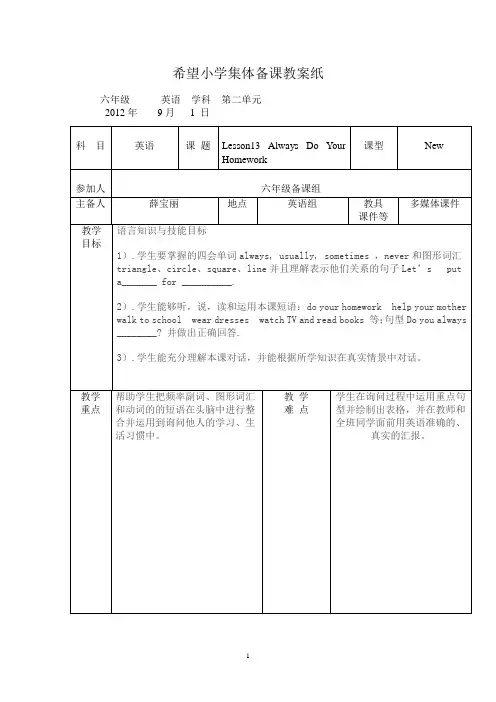
课题:Lesson13 Always do your homework!
授课班级:六(1)
教学目标:
1.学习、巩固always、usually、sometimes、和never在句中的用法。
2.学习单词chart ,sentence。
重点与难点:
重点:学习、巩固表示频率副词always、usually、sometimes、和never的意思和用法区别。
难点:频率副词always、usually、sometimes、和never在实际生活中的应用。
教学步骤
Step1:Class Opening
1) Greeting
2) (Warm-up/Revision)
What shapes are they?
How many triangles/lines/circles/squares do you see?
Give some examples of triangles/lines/circles/squares in our life?
Step2:New Concepts
1) T: What do you do during a day?
如:do my homework
help my mother
walk to school
wear dresses
brush my teeth
have lunch
read books
watch TV
2)T:Which do you always do?
引导学生用“always”句型回答。
3)Game:Never Never
4)呈现/操练(Presentation/Practice)
a) 教师出示课件,打出对话
A: Do you always do your homework?
B: Yes.
A: Good. Let us put a triangle for always.
b)听录音并跟读。
c) T: Now we are going to make a chart. What is a chart?
I will show you .
用多媒体展示chart,并对chart以简单介绍。
提问学生:Can you guess what Li Ming/Jenny/Steven/Danny always does?
d) 把书中的chart制成空的表格,发给每个学生,学生听录音,并做“Listen and tick”练习。
e) 让学生再听一遍录音,教师边提问边与学生核对答案。
5) Group Work
以小组为单位,开始操练。
6)拓展巩固
Step3:Homework
将制作chart的任务延伸到课外,采访对象不限,采访问题也不限,要求每人制作一份chart。
冀教版六年级英语上册第十三课
A: Good. Let us put a triangle/circle/square/line for always/usually/sometimes/never.
1、分别介绍频率副词的意义:always总是usually通常sometimes有时
never从来不
2、讲解句型:Let’s put a ____ for____.(让我们用___表示____.)
Do you always____________________? (你总是干_________吗?)
教
后
反
思
教学
重点
帮助学生把频率副词、图形词汇和动词的的短语在头脑中进行整合并运用到询问他人的学习、生活习惯中。
教学
难点
学生在询问过程中运用重点句型并绘制出表格,并在教师和全班同学面前用英语准确的、真实的汇报。
教
学
过
程
教学程序与策略
个性化修改
教学过程:
一、问候
1.Hello!How are you? How’s the weather?
2. Discuss in pairs.
3. Ask the students answer the questions.
(设计意图:学生带着问题听录音,初步感知对话情节,在接下来的阅读中进一步体会对话中的新语言,了解对话的内容,目的是巩固所学的新语言知识,为学生进。
作
业
设
计
七:家庭作业
1.让学生在课堂上写单词。下课背诵单词。
2.将制作chart的任务延伸到课外,采访对象不限采访问题也不限,要求每人制作一份chart。
3.背诵一个好句子。Time is money.
冀教版《Lesson13-Seasons》教学设计
冀教版《Lesson13-Seasons》教学设计第一篇:冀教版《Lesson13-Seasons》教学设计冀教版小学英语六年级上册 Lesson 13 《Seasons》教学一、Analysis of the teaching materialThe theme of Unit3: Winter in Canada .It mainly describes Li Ming's arrival in Canada where he has spent the winter happily with good friends.And introduced the climate, clothing, sports and so on in winter .In addition, this class is the first class of this unit .It mainly let the students know about the different seasons have different weather in a year .And we wear different clothes in different seasons .Enable the students describe the seasons with some sentences and learn the common sense of life .This class lays the foundation for the teaching of the whole unit.二、Analysis of the studentsIt is the fourth year that students are in sixth grade, and their English basic knowledge system has begun to form.The students have mastered the words and sentences about the weather and clothing. In addition, theteaching content of this lesson is closely related to the students' real life, and it can actively mobilize students' enthusiasm and stimulate the enthusiasm of learning English.三、Teaching objectives1. Goals of knowledge and skills (1) Students will be able to aurally understand ,orally use, recognize and spell the following vocabulary: season, winter, spring, summer, autumn (2)Students will be able to recognize, understand and use these sentences: Winter, spring, summer and autumn are seasons. Winter is cold. There is ice and snow. In winter, I put on my hat, scarf and winter coat. In spring, I take off my winter clothes.2.Goals of process and method In the teaching, through games, video, situational dialogues and other forms, enhance the interest of English learning and cultivate students' ability to communicate in English.3.Goals of emotional attitudes and values (1) To cultivate students' love of nature and aesthetic appreciation by understanding the characteristics of different seasons. (2) Through setting up the situation, we will keep the interest of learning English in cooperative learning.4.Key pointsStudents will be able to aurally understand ,orally use, recognize and spell the following vocabulary: season, spring,summer,autumn,winter. Be able to use sentences introduce seasonal climate features and scenery.5.Difficult points Students will be able to recognize、understand and use he following sentences: I take off shorts and T-shirts. I put on my trousers and sweater. In real life, use English to communicate with others about the clothing of different seasons.四、Teaching methods As we all know: the main instructional aims of learning English in primary school is to cultivate pupils’ basic abilities of listening and speaking and their good sense of the English language. So in this lesson I’ll mainly use “Task-base d”teaching method. That is to say, I will let the students learn in real situations, finish a task by making a survey to help the students to get a better understanding of the key structure of the dialogue. I will arrange four kinds of activities: guessing game, working in group,finishing a survey and having a competition. 四、Teaching aids PPT、some cards、some pictures of clothes、some pictures of clothes、tape五、Teaching time: One class.六、Teaching procedure.:Step 1.warming up1、Greeting T: Hello, boys and girls. Nice to see you. How are you today? S: Very well, thanks. T: How is the weather today? S: It’s sunny/cloudy/windy……. T: How do you feel? S: I feel happy. T: I feel happy, too.2、Let’s watch a video. T: Do you want to watch a video? S: Yes. T: Let’s watch the video together. After watching T: Is it beautiful? S: Yes. T: Who can tell me what the four parts are? S: We can say the four parts are seasons. T: Good job! Read after me s-e-a-s-o-n season. How many seasons are there in a year? S: Four. T: What are they? S: spring, summer, winter, autumn. T: The whole saying is: Winter, spring, summer and autumn are seasons. Now listen to the tape and repeat. Purpose: It is important to form a better English learning surrounding for the students by watching a video and doing some total physical response and at the same time it provides situations to review learned knowledge for the next step. Step 2 Presentation1、Seasons T: First of all. Let’s enjoy some pictures and answer me some questions.1、What can you see in this picture?2、How do you feel?3、How is the weather? S: There is__________. Ifeel___________. It is__________. T: Now can you guess which season it is? S: It is winter T: We can also say: This is winter. Follow me. Winter, winter, winter (from low to aloud) So can you say a sentence with winter. S: This is winter. Winter is cold. There is ice and snow. T: Next every group select a little teacher. And choose one season to complete the following questions according the answers of winter.1、2、3、 Which season is it? This is______. How do you feel? Spring/Summer/Autumn is_________. What can you see? There is _________. T: After talking ,which little teacher want to show your answers to your class in front of the classroom. I will give the gifts to the best group. Then listen to the tape and follow it. Purpose: Throughthe pi ctures, students can master the word “winter”, and through the teacher's description, students can feel the weather characteristics of winter, and the words are over extended to the sentences, leading the students to say the complete sentences.To make the students actively involved in the classroom. Be the master of learning. The tape can train Students’ abilities of listening and reading.2、Let’s play a guessing game.I will play four voice: the sound of birds, the sound of rain, the sound of fallen leaves, the howling wind. At last, I will give some gifts(fallen leaves )as their rewards to the best group. Purpose: Stimulate students’ interest.3、Different clothes in different clothes T: We all know the weather is different in different seasons, so we wear different clothes in different seasons. Have you remember the words of clothes? Look at these clothes? Do you know them? Let’s race to be the first to answer the question. After that T: Now it is winter. I feel cold .So I put on my coat. Let’s read it and act it outat the same time. So we can say a sentence with the clothes pictures: In winter, I put on my scarf, hat and winter coat. T: Look at me. What am I doing now? S: Yes, “脱下”So it is “take off” in English. T: Follow me. put on, put on, put on. take off, take off, take off. Next, listen to the tape and choose the right clothes in different seasons. Purpose: Let the students practice th e usage of “put on and take off”. And enable the students know different clothes in different seasons. Step 3 Practice Let’s do it. Open your books and turn to Page39.work in groups and write the answers. At last, I will give some gifts(fallen leaves)as their rewards to the good students. Purpose: Let the students practice to how to describe the seasons. Step4.Conclusion and Homework Today’s class is over. Can you tell us what you have learnt in this class?1、Four seasons: season. winter, spring, summer, autumn2、How to say something about the four seasons.3、We wear different clothes in different seasons.4、put on /take off. I design for homework after class, according to the law of the pupil cognition and activenature. 1.Make a chant of four season. 2.You can draw a picture or take some pictures of your favorite season, and write some sentences on it. Purpose: To stimulate students’ interest of learning English and wide their knowledge about communication across cultures.七、layout design Lessen13 Seasons Winter, spring, summer and autumn are seasons. Winter is cold. There is ice and snow. In winter, I put on my hat, scarf and winter coat. In spring, I take off my winter clothes.八、Teaching reflection: This lesson is mainly about the four words of winter, spring, summer, autumn and the different characteristics of the four seasons. And the teaching of two verb phrases of put on, take off. The characteristics of this course is through the different features of the seasons are discussed in different seasons wearing different clothes. If just boring professor, students will be like a monk chanting, not easy to remember, students are very easy to forget. In order to let the students learn something to keep in mind. By setting the students personally feel personally on the scene of the weather features is necessary. At the same time, the use of multimedia to use a lot of picturesmake the children play while learning, let them learn, play in the middle of school. Also can cultivate the English language sense, improve the students' oral communication ability. Of course, this lesson also has some shortcomings. Such as :There is a lot of knowledge in this class. Time is limited. So some students may not master well. The students learned today without proper development. In addition, in the process of teaching put not to open, formal, rigid and monotonous, the extension of the traditional one, which is not conducive to mobilize students' learning enthusiasm and interest. I should improve the teaching skill in the following teaching.第二篇:lesson13seasons教学设计Lesson 13: seasons一、教学目标:1. 知识目标掌握并能运用表示季节的四个单词winter spring summer autumn及表示天气情况的词cold warm hot cool ice sun wind2. 能力目标能运用所学的语言知识在创设的情境中进行熟练的交际,并在此基础上能将其应用于日常生活之中。
(冀教版)六年级英语下册 《unit2Lesson13》教案设计1

(冀教版)六年级英语下册《unit2Lesson13》教案设计1教学目标1.能够听、说、读、写词汇:“tomorrow, postcard, letter, email, message”。
2.能够使用“What are you going to do…?” “I am going to…” 进行日常交际。
3.能够按照要求写一封明信片。
教学重难点•词汇的掌握和运用。
•“What are you going to do…?” 的运用。
教学准备•PPT、录音机、明信片。
教学过程Step 1: Pre-task preparation(10 分钟)•Greetings•Warming up: 师生问候,生命令学生回答老师的问题。
T: Good morning/afternoon, class! S: Good morning/afternoon, teacher! T: How are you today? S: I am fine/good/thank you. How about you? T: I am fine, too. Thank you. Let’s begin our lesso n now.•Presentation: 教师播放 PPT 制作的卡片和明信片的图片,引出新单词: postcard, letter, email, message。
逐一呈现图片并让学生模仿并跟读。
T: Today we are going to talk about sending postcards. Do you know what a postcard is? (Show the picture) S: Postcard. T: Very good. Now,do you know what a letter is? (Show the picture) S: Letter. T: Great! How about email? (Show the picture) S: Email. T: Excellent! One more word: message. Can you say it? (Show the picture) S: Message.Step 2: While-task procedure(25 分钟)1.Listening: 播放录音(Tape Script 1),让学生初步了解对话情景。
冀教版六上英语Lesson 13 Seasons教案

冀教版六年级上册英语六年级上册Lesson 13: Seasons教学分析1、教材分析:本单元的话题是四季。
本课需要学习有关四季的四个名词winter, spring, summer, autumn和四季的不同特征以及put on, take off 两个动词短语。
本课的特点是通过描述四季的不同特征,讨论在不同季节所穿戴不同的服装,本课可以与本单元及四年级曾经学过的12个月份和表示天气的单词整合在一起。
2、学生分析:学生已经掌握了有关天气和服装的单词及句型,他们感兴趣的话题是在不同的季节里面做什么样的活动,因为本节课主要突出写作训练,所以学生需要利用小组合作学习的方式来帮助他们完成写作任务。
培养学生学会分析学习任务和自己的特点并根据这些条件来制定适当的学习计划,提高学习的效果和效率。
教学目标1、知识与技能目标:(1)学生能听懂、会说、认读并书写下列词汇:season, winter, spring, summer, autumn(2)学生能认读、理解并运用下列句子:Winter, spring, summer and autumn are seasons.Winter is cold. There is ice and snow.In winter, I put on my hat, scarf and winter coat.In spring, I take off my winter clothes.2、情感态度目标:(1)通过了解不同季节的特征,培养学生对大自然的热爱之情和审美观。
(2)培养学生发展调控策略,形成自主学习能力,培养学生归纳总结单词发音规则和不同句式的写作规则。
教学重难点1、重点:(1)掌握有关四季的四个名词:winter, spring, summer, autumn, season关于服装的新单词:mittens/mitts, scarf和put on ,take off。
六年级英语上册unit2Lesson13Alwaysdoyourhomework教案冀教版

Unit2SchoolinCanadaLesson13Alwaysdoyourhomework!教课目的:1.学习、稳固always、usually 、sometimes、和never在句中的用法。
2.学习单词chart,dry,bike,wear,sentence 。
要点与难点:要点:学习、稳固表示频次副词always、usually 、sometimes、和never的意思和用法区别。
难点:频次副词always、usually 、sometimes、和never在实质生活中的应用。
教课步骤Step1:ClassOpeningGreeting设计思路:上课前师生相互问候,有助于学生养成有礼貌的好习惯。
热身/复习(Warm-up/Revision)值日生取出上节课用各种图形拼成的卡通图形,向全班同学展现,并提出以下问题:Whatshapesarethey?Howmanytriangles/lines/circles/squaresdoyousee?Givesomeexamplesoftriangles/lines/circles/squaresinourlife?设计思路:每日上课前三分钟值日生向全班同学咨询或表演一些与单元话题相关的内容,本课需展现自制图形,一是给值日生充足展现成就的机遇,领会到一种成就感;二是由学生充当小老师,调换其余学生的踊跃性,提升口语社交的能力;三是复习旧知,在课与课之间起承前启后的作用。
Step2:NewConceptsT:Whatdoyoudoduringaday?学生尽可能多得用英语描绘自己在一天中的活动,用短语的形式表达:如:domyhomeworkhelpmymotherwalktoschool1weardressesbrushmyteethhavelunchreadbookswatchTV设计思路:学生回想学过的短语,检查他们对所学知识的掌握程度。
养成勤动脑,擅长思虑的习惯,发展思想水平。
冀教版《Lesson13-Seasons》教学设计
冀教版小学英语六年级上册Lesson 13 《Seasons》教学一、Analysis of the teaching materialThe theme of Unit3: Winter in Canada .It mainly describes Li Ming's arrival in Canada where he has spent the winter happily with good friends.And introduced the climate, clothing, sports and so on in winter .In addition, this class is the first class of this unit .It mainly let the students know about the different seasons have different weather in a year .And we wear different clothes in different seasons .Enable the students describe the seasons with some sentences and learn the common sense of life .This class lays the foundation for the teaching of the whole unit.二、Analysis of the studentsIt is the fourth year that students are in sixth grade, and their English basic knowledge system has begun to form.The students have mastered the words and sentences about the weather and clothing. In addition, the teaching content of this lesson is closely related to the students' real life, and it can actively mobilize students' enthusiasm and stimulate the enthusiasm of learning English.三、Teaching objectives1. Goals of knowledge and skills(1) Students will be able to aurally understand ,orally use, recognize and spell the following vocabulary: season, winter, spring, summer, autumn(2)Students will be able to recognize, understand and use these sentences: Winter, spring, summer and autumn are seasons.Winter is cold. There is ice and snow.In winter, I put on my hat, scarf and winter coat.In spring, I take off my winter clothes.2.Goals of process and methodIn the teaching, through games, video, situational dialogues and other forms, enhance the interest of English learning and cultivate students' ability to communicate in English.3.Goals of emotional attitudes and values(1) To cultivate students' love of nature and aesthetic appreciation by understanding the characteristics of different seasons.(2) Through setting up the situation, we will keep the interest of learning English in cooperative learning.4.Key pointsStudents will be able to aurally understand ,orally use, recognize and spell the following vocabulary: season, spring,summer,autumn,winter.Be able to use sentences introduce seasonal climate features and scenery.5.Difficult pointsStudents will be able to recognize、understand and use he following sentences: I take off shorts and T-shirts. I put on my trousers and sweater. In real life, use English to communicate with others about the clothing of different seasons.四、Teaching methodsAs we all know: the main instructional aims of learning English in primary school is to cultivate pupils’ basic abilities of listening and speaking and their good sense of the English language. So in this lesson I’ll mainly use “Task-based” teaching method. That is to say, I will let the students learn in real situations, finish a task by making a survey to help the students to get a better understanding of the key structure of the dialogue. I will arrange four kinds of activities: guessing game, working in group,finishing a survey and having a competition.四、Teaching aidsPPT、some cards、some pictures of clothes、some pictures of clothes、tape五、Teaching time:One class.六、Teaching procedure.:Step 1.warming up1、GreetingT: Hello, boys and girls. Nice to see you. How are you today?S: Very well, thanks.T: How is the weather today?S: It’s sunny/cloudy/windy…….T: How do you feel?S: I feel happy.T: I feel happy, too.2、Let’s watch a video.T: Do you want to watch a video?S: Yes.T: Let’s watch the video together.After watchingT: Is it beautiful?S: Yes.T: Who can tell me what the four parts are?S: We can say the four parts are seasons.T: Good job!Read after me s-e-a-s-o-n season. How many seasons are there ina year?S: Four.T: What are they?S: spring, summer, winter, autumn.T: The whole saying is: Winter, spring, summer and autumn are seasons.Now listen to the tape and repeat.Purpose: It is important to form a better English learning surrounding for the students by watching a video and doing some total physical response and at the same time it provides situations to review learned knowledge for the next step.Step 2 Presentation1、SeasonsT: First of all. Let’s enjoy some pictures and answer me some questions.1、What can you see in this picture?2、How do you feel?3、How is the weather?S: There is__________.I feel___________.It is__________.T: Now can you guess which season it is?S: It is winterT: We can also say: This is winter. Follow me. Winter, winter, winter(from low to aloud)So can you say a sentence with winter.S: This is winter. Winter is cold. There is ice and snow.T: Next every group select a little teacher. And choose one season to complete the following questions according the answers of winter.1、Which season is it? This is______.2、How do you feel? Spring/Summer/Autumn is_________.3、What can you see? There is _________.T: After talking ,which little teacher want to show your answers to your class in front of the classroom. I will give the gifts to the best group.Then listen to the tape and follow it.Purpose: Through the pictures, students can master the word “winter”, and through the teacher's description, students can feel the weather characteristics of winter, and the words are over extended to the sentences, leading the students to say the complete sentences.To make the students actively involved in the classroom. Be the master of learning.The tape can train Students’ abilities of listening and reading.2、Let’s play a guessing game.I will play four voice: the sound of birds, the sound of rain, the sound of fallen leaves, the howling wind. At last, I will give some gifts(fallen leaves )as their rewards to the best group.Purpose: Stimulate students’ interest.3、Different clothes in different clothesT: We all know the weather is different in different seasons, so we wear different clothes in different seasons. Have you remember the words of clothes? Look at these clothes? Do you know them? Let’s race to be the first to answer the question.After thatT: Now it is winter. I feel cold .So I put on my coat. Let’s read it and act it out at the same time. So we can say a sentence with the clothes pictures: In winter, I put on my scarf, hat and winter coat.T: Look at me. What am I doing now?S: Yes, “脱下”So it is “take off” in English.T: Follow me. put on, put on, put on. take off, take off, take off.Next, listen to the tape and choose the right clothes in different seasons.Purpose: Let the students practice the usage of “put on and take off”. And enable the students know different clothes in different seasons.Step 3 PracticeLet’s do it. Open your books and turn to Page39.work in groups and write the answers. At last, I will give some gifts(fallen leaves)as their rewards to the good students.Purpose: Let the students practice to how to describe the seasons.Step4.Conclusion and HomeworkToday’s class is over. Can you tell us what you have learnt in this class?1、Four seasons: season. winter, spring, summer, autumn2、How to say something about the four seasons.3、We wear different clothes in different seasons.4、put on /take off.I design for homework after class, according to the law of the pupil cognition and active nature.1.Make a chant of four season.2.You can draw a picture or take some pictures of your favoriteseason, and write some sentences on it.P urpose: To stimulate students’ interest of learning English and wide their knowledge about communication across cultures.七、layout designLessen13 SeasonsWinter, spring, summer and autumn are seasons.Winter is cold. There is ice and snow.In winter, I put on my hat, scarf and winter coat.In spring, I take off my winter clothes.八、Teaching reflection:This lesson is mainly about the four words of winter, spring, summer, autumn and the different characteristics of the four seasons. And the teaching of two verb phrases of put on, take off. The characteristics of this course is through the different features of the seasons are discussed in different seasons wearing different clothes. If just boring professor, students will be like a monk chanting, not easy to remember, students are very easy to forget. In order to let the students learn something to keep in mind. By setting the students personally feel personally on the scene of the weather features is necessary. At the same time, the use of multimedia to use a lot of pictures make the children play while learning, let them learn, play in the middle of school. Also can cultivate the English language sense, improve the students' oral communication ability. Of course, this lesson also has some shortcomings. Such as :There is a lot of knowledge in this class. Time is limited. So some students may not master well. The students learned today without proper development. In addition, in the process of teaching put not to open, formal, rigid and monotonous, the extension of the traditional one, which is not conducive to mobilize students' learning enthusiasm and interest. I should improve the teaching skill in the following teaching.。
(冀教版)六年级英语上册教案Unit2Lesson
冀教版六年级英语上册教案Lesson 12 How Many Are There(一)教学目标:知识目标:1.掌握可数名词复数的3种情况。
2.掌握句子单复数的用法,This is a/an +名词的单数形式These are +名词的复数形式能力目标:1.可以根据教师的提问做出相应的回答。
2.可以复述录音机所说的句子。
3.能根据图片信息说出简单的句子。
情感态度与价值观:激发孩子们学习英语的兴趣和好奇心,提高他们的语言表达能力。
(二)重难点:1.以”s” “sh” “ch” “x”为结尾的可数名词变复数时,在词尾后加-es2.不规则变化,如:下列词man, woman, child 等等。
(三)教具准备:录音机、教学磁带、课件(四)学情分析:学生已经掌握了很多的可数名词的复数形式,因而使本节课的教学就减少了不少负担,教师整理得有条有理,学习的内容对学生来说就简单容易多了。
(五)教学设计:一、歌曲导入,激发兴趣T: Today there are many teachers study with us. Are you happyS: Yes, we are happy.T : How to express your happiness ,×××S1: Sing a song.T: Good idea! Let’s sing a song of “This is the way”. OkS: Ok.(设计意图:通过师生一起歌曲演唱,给学生创造了轻松愉快的课堂气氛,有助于师生情感的交流,使学生很自然的驶入了英语课堂。
)二、新授T: Are you ready for English classS: Yes, we are ready.T: Well, Today we will learn Lesson 12 How Many Are There Now read together.S: Lesson 12 How Many Are ThereT: I have many pictures in the TV. Do you want to seeS: Yes.1. Pencils and stamps.T : (课件图片) What is thisS1: This is a pencil .(板书pencil)T: How many are there How manyS2: One pencil.T: Yes, this is one pencil. (课件句子)T : (课件图片) What are theseS3: These are pencils .(板书pencils)T: Good. We can use‘many’in this sentence .Who canS4: These are many pencils.T: How many are thereS5: Eleven pencils.以同种方式教授This is a stamp . These are many stamps .(板书stamp,stamps)(设计意图:呈现图片可以给他们以刺激,问答的形式可以使其保持注意力,并锻炼其语言的准确性。
六年级上册英语教案(冀教版) (2)
六年级上册英语(冀教版)Lesson2教案blackboard, teach the pronunciation of “au” . Show the houses I made it.S: This is a house.T: L et’s go to Jenny’s house. First, listen and answer the questions:How many bedrooms are there in Jenny’s house?How many floors (楼层) are there in Jenny’s house?S: There are four bedrooms in Jenny’s house.S2: There are two floors. T: Yes, two floors. (Teach floor using the card and PPT. Show the first floor and the second floor) How many floors are there in this office building?S: There are four floors. We are on the second floor.This time listen and imitate, then answer the questions: How many rooms are there on the first floor? What are they ?How many rooms are there on the second floor? What are they ?T: Jenny’s house is big. There are eight rooms. Let’s go inside and have a look. T: Which room do you want to go?S: I want to go to room 1. T: What’s this? 学生猜(show ppt用猜图片的方式,遮住一部分,让学生猜study)S: It’s a bed.T: What room is it?S: It’s a bedroom.(write “bedroom” on the blackboard)T: Do you have a bedroom? S: Yes, I do.T: What’s in your bedroom? S: There is a bed/a lamp /a closet in my bedroom. Xx, what’s in your bedroom?S2: There is a mirror and some flowers in my bedroom.T: A beautiful bedroom. Let’s go on. Which room do you want to go?S: I want to go to room 2. (for example)T: (PPT) A living room. This is a living room. What can you do in the living room? S: I can watch TV in the living room.T: Which program do you like best?S: Cartoons./Films...T: What’s your favo urite cartoon character?S: …T: What else can you do in the living room?S: I can sit on the sofa/read the newspaper/play checkers with my father/talk with my frien ds on the phone…T: There is another name ofliving room. We call it sittingroom. They are the same.T: Let’s go on. Which roomdo you want to go?S: I want to go to room 3.T: (PPT) A bathroom. Theweather is so hot. I need totake a bath in the…S: Bathroom.(拓展:take a bath 和take ashower 的区别,用图展示bathtub 和shower)T: Do you like to take a bathor take a shower? What elsedo we need in the bathroom?We need it everyday, so it isa toilet (pay more attentionabout the pronunciation )Practice toilet one by one.T: Guess, which room is it?Your mother always cooksthere.S: It is kitchen. (write ki andchen on the blackboard thenwrite t, tell students t issilent )T: Who cooks in the kitchen?配合教师的问题,积极回答S: My mother or my father.T: What’s in the kitchen?S: There is a pot/fryingpan/flour/eggs/milk/butter…T: Look, what is it? There aremany books in it.(show ppt用猜图片的方式,遮住一部分,让学生猜study)T: Right. It is the study.Chant: (齐说)Study, study,。
冀教版六年级英语上学期unit2教案教学设计
冀教版六年级英语上学期unit2教案教学设计2、教材分析本课所选的内容是冀教版小学六年级英语第七册第二单元。
本单元围绕李明在加拿大的学校生活展开,要求学生掌握一些有关于校园生活学习的词汇和句型。
本课时在以雨天为背景的情境下,使学生了解要求学生能掌握词汇umbrella,Ms,driver理解四个频率副词always, often, sometimes, never,结合日常生活进行交流,使所学语言功能化。
教学目标知识与技能目标(1)学生能够听懂、会说、认读和书写词汇umbrella,Ms,driver (2)学生能在图片的帮助下理解always,often,sometimes,never等表示频度的词汇。
(3)学生能认读、理解运用下列问句Do you always go to school by bus? 情感态度目标通过活动、游戏使学生产生学习英语的兴趣;通过分享有关于自己的信息让学生敢于、乐于开口,积极参与交流。
并让学生在学习的过程中,培养他们的合作意识和竞争意识。
学习策略目标培养学生通过小组合作学习从而提高学习的效率。
让学生在情景中运用本课的语言点。
帮助学生掌握频率副词,指导学生灵活运用这些频率副词进行自主的交流活动。
教学重难点(1)重点:学生能够听懂、会说、认读和书写umbrella,Ms,driver (2)难点:利用频率副词,使用一般疑问句进行问答。
教学准备雨伞教学过程教学步骤教师活动学生活动设计意图Warming-up (5 minutes) Greetings and Revision 1、经过简短的问好之后,吟唱歌曲January, February, one and two. T: Are you ready for our class? Good morning! How’s the weather today? Let’s sing a song about the weather, OK? 2、谈论不同季节的天气,人们的穿着,复习服装名词学生利用所学知识,组织自己的语言。
(冀教版)六年级英语上册 《Lesson2 Jenny’s House》教案设计1
(冀教版)六年级英语上册Lesson2 Jenny’s House 教案设计1一、教学目标1.能够听懂、会读、会说以下单词:door, window, garden, kitchen, living room, bathroom, bedroom。
2.通过图片、动作、课堂游戏等形式,理解掌握以上房间及物品的英文表达。
3.通过听力、口语练习,提高学生英语口语能力和表达能力。
4.了解并学会使用句型“Where is/are…?”和“Is there/are there…?”。
二、教学重难点1.教学重点:房间及物品的英文表达。
2.教学难点:引导学生使用句型“Where is/are…?”和“Is there/are there…?”。
三、教学过程1. 导入新课1.师生问候,引出主题并展示图片。
2.每张图片进行点名,学生回答“Here!”。
3.老师介绍图片内容,鼓励学生跟读图片中的单词。
2. 学习新词汇1.老师出示房间的图片,进行单词、发音和图片的拼读训练。
2.学生模仿老师,用正确的英语语音和语调快速认读。
3. 认知新知识1.针对教学难点,老师设计带图示的问答游戏。
2.引导学生使用句型“Where is/are…?”和“Is there/are there…?”,举例表述当下所在房间及物品的位置和是否有某物,进行答题训练。
4. 运用新知识1.将生活中常见常用的房间用具和物品,写在图片上。
2.老师指定学生口述哪个物品放在哪个房间,邀请学生回答“Is there/are there…?”或者“Where is/are…?”。
5. 拓展知识1.老师设计小组活动,让同学们在小组内互相提问和回答。
2.老师以某个房间为主题,让学生自由发挥汇报,分享与该房间相关的实用口语表达和文化信息。
四、教学评价1.学生熟练掌握新单词和句型,完成了小组活动和汇报任务。
2.学生理解新知识和运用能力得到了提高。
3.学生参与积极热情,课堂气氛活跃。