
外研版(三起)-英语-六年级下册-Module 2 Unit 2 It will snow in Harbin. 教案
Module 2
Unit 2 It will snow in Harbin.
一、教材分析
本课时主要学习谈论将来的天气状况。
能听懂、会说并认读:It will snow. It will be sunny.之类的语句。
二、教学目标
(一)知识目标:
1. 能听说并认读:tomorrow will shall
2. 能听懂、会说并认读:It will snow. It will be sunny.之类的语句。
3. 能准确书写:snow rain sunny windy等。
(二)能力目标:
能运用How’s the weather in …tomorrow? It will snow. It will be sunny.之类的语句谈论将来的天气状况。
(三)情感目标:
1. 培养学生的英语思维习惯。
2. 激发学生对现实生活的关注与热爱。
三、教学重难点
运用How’s the weather tomorrow? It will snow. It will be sunny.之类的语句谈论将来的天气。
rain snow 与sunny windy cloudy的用法区别。
四、教学准备
课本、CD 、PPT课件、单词卡等。
五、教学过程
Step1: Warm-up
1.Greetings:
2.Let’s enjoy a song:How is the weather? ( 播放课本CD)
3. Review the five words: snow rain sunny windy cloudy
①Look and say quickly: (看卡读词:看图说词)
②Listen , draw and show quickly.(听单词画天气符号)
【设计意图】复习巩固5个与天气有关的单词,为新授课的顺利进行打下基础。
4. Free talk:
T: How’s the weather today? 引导学生根据实际情况回答:It’s sunny.(windy, cloudy, raining, snowing) 同时板书此问句。
T: (课件显示城市及天气状况)Look!How’s the weather in Beijing today?
S: It’s…
示范之后,找学生当小老师进行提问。
(此时通过图片认识Hong Kong)
【设计意图】复习巩固前面学过的How’s the weather today?为本课的How’s the weather tomorrow?学习打下基础,并为新课的导入做好铺垫。
Step2: Presentation
导入:T:How’s the weather today? …How about tomorrow? How’s the weather tomorrow (此时将板书中的today换成tomorrow)
出示词卡学习tomorrow:to–mor–row.分音节让学生听清楚,然后模仿。
(一)Watch, listen and answer:播放课本CD
1. How many cities do you hear?
2. What are they?
(二). Watch and listen again, then answer these questions.
1. How’s the weather in Shenyang tomorrow?
2. How’s the weather in Hong Kong tomorrow?
3. How’s the weather i n Beijing tomorrow?
逐一回答问题,板书并学习新句:
1. It will snow. Will, will, will, it will snow.
2. It will rain. Will, will, will, it will rain.
3. It will be sunny. Be sunny, be sunny, it will be sunny.
Chant together, in groups, in pairs, one by one.
4. Sum-up: We can also say: It will be windy. It will be cloudy.
板书后引导学生自己去发现问题,总结规律:rain snow 前不加be;而windy sunny cloudy 前必须加be。
Step3: Practice
1. Read the dialogue in groups of three and show for class.
2. Look, ask and answer: 课件展示课本中的地图
①认读地图中的地名,熟悉其地理位置。
②Ask and answer in T and Ss, boys and girls, in groups, in pairs.
How’s the weather in …tomorrow? It’s…
3. I can say: (show for class)当个优秀天气预报员
It will snow in Harbin.
It will be windy in Qingdao.
It will be sunny in Xining.
It will rain in Kunming.
It will be cloudy in Hong Kong.
4. Let’s copy: rain snow sunny windy
Step4: Consolidation
课件展示某些城市今天和明天的天气情况,让学生去描述。
比一比谁是英语小天才。
可以先进行小组内交流,然后进行个人展示。
如: It’s raining in Shanghai today. It will be cloudy tomorrow.
【设计意图】有意识的将今天和明天的天气状况的表达形式进行比较运用,有利于强化记忆,同时也提高了操练难度。
Step5: Summary
1.邀请学生自己总结:这节课你学到了什么?
2.回家听全国天气预报,记录6个城市明天的天气情况,用英语向爸爸妈妈汇报。
下节课向同学们展示你是怎样向爸妈汇报的。
五、课后作业
1.熟记本单元的单词与句子
2.与父母练习本单元的对话。
外研版(三起)-英语-六年级下册-Module 2 Unit 2 It will snow in Harbin 精品教案

Module 2 Unit 2 It will snow in Harbin.教学目标:1.掌握有关天气的单词;2.能用一般将来时态句型描述未来天气情况;3.可以根据天气情况合理安排自己的活动。
教学重难点:1.有关天气的单词:rain. snow. sunny. warm. hot. windy. cold.2.用It’s gong to…句型描述未来天气。
教学准备:PPT教学过程:Step1:Warm-up.Greeting. Say ‘hello’ to everyone.Step2:Lead-in.I have a picture for you. Please look at the screen. Do you know what’s this?Show a picture of the weather report. Read it after teacher. Today we will learn something about the weather.Step3: New lesson.1.Learn the new words.I have some pictures about the weather. Do you know them ?Show a picture of ‘rain’Read the word after the teacher.Read it one by one.Learn the other words like this way.2.Practice.Look and match.3.Learn the new sentence.st class we learned the future tense.How to describe the weather in thefuture? For example,We can say:A:What’ the weather going to be like in Shihezi?B:It’s going to rain in Shihezi.B:It’s going to be windy in Shihezi.b.Read the dialogue after the teacher.c.Practice the dialogue with your parter.Step4. Practice.I have a picture of the weather tomorrow. I need some weather reporters to help me. You can choose one city,who can ?a.Ask some students to report the weather.b.Ask one student to report the weather of all the cities.Step5.Exercise.a.Please look at the screen. This is the weather of Shihezi next week.Can you report it?b.According to the weather, what are you going to do? Make your own plan.c.Ask some students to show their plan.d.Do exercise book. Activity 3.Step6. Homework.a.预报五个城市的天气情况;b.根据石河子未来的天气情况安排自己的活动。
外研版(三年级起点)六年级下册Module2 Unit2 It will snow in Harbin
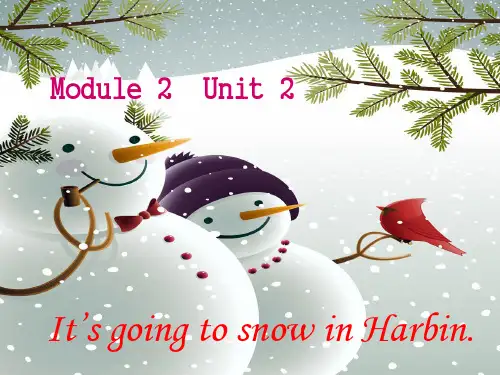
Listen and answer.
What is the girl going to do today? She is going to go to the park to play. what is the girl going to do after dinner? She is going to play chess and I’ll be the winner! What is the girl going to do tonignt? She is going to bed and say have a good night.
What’s the weather going to be like in Harbin? It’s going to snow in Harbin. What’s the weather going to be like in Beijing? It’s going to rain in Beijing. What’s the weather going to be like in Xi’an? It’s going to cold and windy in Xi’an. What’s the weather going to be like in Sanya? It’s going to warm and sunny in Sanya.
rain
windy cold
sunny snow
hot warm
未来一周的天气预报表
Sunday
Monday
Tuesday
Wednesday
Thursday
Friday
Saturday
The Weather Tomorrow
2020年最新外研版(三起)小学英语六年级下册Module2Unit2Itwillsnow
Module2 Unit 2It will snow in Harbin .教案【教学目标】1. 知识目标:(1).能听说、认读有关天气的单词:sunny、warm、windy、cloudy、 cold、hot、snow、 rain. (2). 理解并运用句型:It will snow in Harbin. It will be warm and sunny in Sanya( 3 ) . 能正确理解并流利朗读活动2的句子,能完成活动3和活动5的操练。
2. 技能目标:学生能模仿课文,用It will (be) … 句型谈论未来的天气。
3. 情感目标:(1)通过本课的学习了解天气预报。
(2)培养学生熟悉生活,对生活中常用句子的理解和运用。
【教学重点】(1)理解并运用句型:It will snow in Harbin. It will be warm and sunny in Sanya .(2)学生能模仿课文,用It will (be) … 句型谈论未来的天气。
【教学难点】学生能模仿课文,用It will (be) … 句型谈论未来的天气。
【教学准备】PPT、单词卡片、天气图片若干张、配套资源光盘。
【教学流程】Step 1 Warming up and review1. Greetings. (师生间进行简单的问候。
)2. Let’s review .What time is it ? 对整点和半点的复习。
Say the activities 用“be going to ”造句,说出下列活动。
3. Let’s chant.:播放 (Activity1: Listen and chant) 的歌曲,活跃课堂气氛。
Step 2 Presentation and PracticeActivity 2、Listen and read1. 谈话导入天气预报。
T :Look! What’s the weather like today? (老师拉开窗帘, 阳光照进来)Ss: It’s sunny.T :What’sthe weather going to be like tomorrow ? Guess !2. 出示一些有关天气的图片,利用图片复习和教授下列单词:sunny、warm、windy、cloudy、cold、hot、snow、rain.。
六年级英语下册教案-Module2 Unit2 It will snow in Harbin.-外研
六年级英语下册教案-Module2 Unit2 It will snow in Harbin.外研社(三起点)教学目标1.能够听懂并理解关于天气预报的基本信息。
2.能够正确使用单词和短语:snow,freezing,windy,sunny,It’s going to rain,It’s going to be hot/cold/windy,put on,take off,get ready。
3.能够灵活运用学过的语言知识谈论天气以及做出相应的服装和行为准备。
4.能够提高听、说、读、写、译的能力,培养学生良好的口语表达和听力技巧。
教学内容本课时主要是通过典型城市哈尔滨典型天气变化的案例,让学生了解并理解天气预报的基本信息和如何根据天气做出合适的服装和行为准备,了解中国广大地域的多样性,及时更新对语言和文化知识的学习,提高听、说、读、写、译的能力。
教学重点1.学生能够听懂并理解天气预报的基本信息。
2.学生能够正确使用单词和短语:snow,freezing,windy,sunny,It’s going to rain,It’s going to be hot/cold/windy,put on,take off,get ready。
教学难点学生能够根据天气做出合适的服装和行为准备,提高口语表达和听力技巧。
教学过程Step 1 导入新课通过询问学生前一天晚上晚上的天气,来导入本课时的内容,引导学生谈论如何做好出行准备。
Step 2 预习导入教师引导学生关注天气变化,通过播放天气预报视频,学生听取关于哈尔滨的天气预报信息,并在个人板书上对信息进行记录。
确认大致的天气情况。
Step 3 新知呈现按照天气情况,教师引导学生讨论做好相应的服装、行为准备,学生手头板书上记录下各种准备措施。
Step 4 创新练习教师按照听力内容呈现新单词和短语,让学生回答相关问题,并反复练习,慢慢巩固学习。
教师展示各种服装和行为准备,让学生自己选择正确的准备方式,并用使用“Put on”或“Take off”短语,以及其他相关单词和短语,在板书上写下自己的准备方法。
外研版(三起点)六年级英语下册《Module2_Unit2_名师教案》

Module 2 Unit 2 It will snow in Harbin.教学设计一、教学目标:1、知识目标:学会运用snow, rain, sunny, hot, cold, warm, windy等表示天气的单词,进行句型It will snow in Harbin.等描述天气的语句的运用。
2、能力目标:学生能口头运用句型It will snow in Harbin.等描述天气的语句描述某地的天气。
3、情感目标:让学生感知只要通过自己的努力,不怕困难,坚持不懈,就一定会成功。
二、教学重点:1、复习有关季节和天气的词,snow, rain, sunny, hot, cold, warm, windy2、掌握It will +动词原形和It will be +形容词两种描述未来天气的新句型。
三、教学难点:It will +动词原形和It will be +形容词两种句型的对比。
四、教学准备:单词卡,图片,点读笔、CAI课件五、教学过程:Step 1: Warm-up Greetings.Hello, boys and girls.I’m your new English teacher today.I’m Lucy.I hope we can have awonderfuland interesting English learning trip.Now let’s have achantabout“weather”.Sunny, cloudy, windy, rainy.It’s hot today.Sunny, cloudy, wind y, rainy.It’s cold tonight. (Say and do.)(设计意图:通过简短的自我介绍拉近与孩子们的距离;并通过带领孩子们朗读有关天气的韵律诗,初步感知有关天气的词汇;并辅以相应的动作,可让孩子们放松课前的紧张心情,为后面的轻松入课做好铺垫。
外研版(三起)(2012)小学英语六年级下册Module 2 Unit 2 It will snow
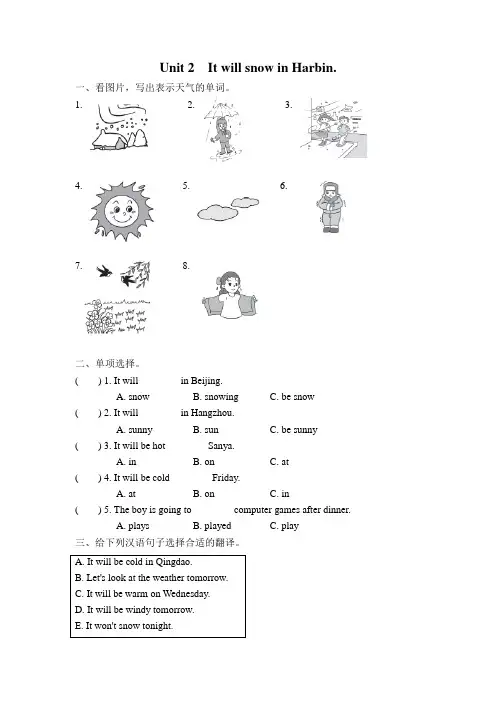
Unit 2It will snow in Harbin.一、看图片,写出表示天气的单词。
1. 2. 3.____________________________________ 4. 5. 6.____________________________________ 7. 8.________________________二、单项选择。
() 1. It will________ in Beijing.A. snowB. snowingC. be snow() 2. It will________ in Hangzhou.A. sunnyB. sunC. be sunny() 3. It will be hot________ Sanya.A. inB. onC. at() 4. It will be cold________ Friday.A. atB. onC. in() 5. The boy is going to________ computer games after dinner.A. playsB. playedC. play三、给下列汉语句子选择合适的翻译。
A. It will be cold in Qingdao.B. Let's look at the weather tomorrow.C. It will be warm on Wednesday.D. It will be windy tomorrow.E. It won't snow tonight.() 1. 明天将会有风。
() 2. 我们来看一下明天的天气。
() 3. 今晚不会下雪。
() 4. 青岛将会很冷。
() 5. 周三将会很暖和。
四、用所给词的适当形式填空。
1. It will be________ (sun) in Beijing.2. It will be________ (cloud) in Haikou.3. It will________ (snowy) in Harbin.4. It will________ (rainy) on Saturday.5. It will be________ (wind) tomorrow.五、根据图片,预报各城市的天气。
六年级下册英语教案-Module 2Unit 2 It will snow in Harbin∣外研
六年级下册英语教案-Module 2 Unit 2 It will snow inHarbin∣外研版(三起)教学目标1.能听、说、读、写单词 snow, ice 和 snowman。
2.能听、说、读、写句子 It will snow in Harbin。
3.能听懂并能正确应答有关天气的基本问题。
4.能够使用一般将来时描述未来的天气情况。
教学重点1.It will snow in Harbin 句型的运用2.描述未来的天气情况教学难点1.一般将来时的运用2.如何用英语描述未来的天气情况教学准备1.雪花、 snowman 模型等教具2.天气预报的图片和视频(可打印或电子版)3.用于练习一般将来时的练习册教学过程第一步:热身1.与学生进行问答互动:What’s the weather like today?、What’s your favorite weather?并引入本节课的主题It will snow in Harbin。
第二步:教学新单词1.展示 snow、ice 和 snowman 的图片,分别说出它们的单词,并让学生读一遍。
2.引导学生用所学单词造句。
3.练习新单词的拼写。
第三步:教授新课1.出示图片及天气预报,学生观察预报并根据天气预报描述明天的天气情况。
学生可以根据下面的问题进行描述:–Will it rain/snow/be sunny tomorrow?–What will it be like tomorrow?2.在黑板上出示 It will snow in Harbin 这个句子,并解释一般将来时的作用。
3.向学生展示如何回答和问询天气的问题。
第四步:练习与拓展1.给出一些关于描述时间、地点的问题并引导学生口头回答问题,回答的句子需包含一般将来时。
–What will you do next Sunday?–Will it be hot in July?–Will you have a picnic tomorrow?2.分组活动,让学生根据天气预报拍照并编写新的天气预报。
外研版六下Module2 Unit2 It will snow in Harbin
It will be snowy in Harbin . It will snow in Harbin .
明天将会下雪。
Do you want to be a weather reporter?
listen and read
将会温暖晴朗
What will the weather be like in Harbin ? --- lt will snow in Harbin . What will the weather be like in Beijing ? --- lt will rain in Beijing . What will the weather be like in Xi’an ? --- lt will be cold and windy in Xi'an . What will the weather be like in Sanya ? --- It will be warm and sunny in Sanya.
Listen and repeat.
Let's look at the weather tomorrow.lt will snow in Harbin . lt will rain in Beijing . lt will be cold and windy in Xi'an and it will be warm and sunny in Sanya.
kāīāı
开火车了
Let’s try
S1:lt will be hot on Friday. S2: It won't be sunny in Hangzhou. S3: lt will be rainy on Monday . S4: It won't be windy in Shenyang.
外研版三起六年级英语下册Module 2Unit 2It will snow in Harbin课件
外研版·六年级下册
Let’s sing
Fill and retell
It’s a _b_e_a_u_t_i_fu_l_ day. Daming, Simon and his mum are going to _h_a_v_e__a_p_i_c_n_i_c_ in the park. Simon is _h_u_n_g_r_y at half past eleven. But they are going to _e_a_t_ at half past twelve. In the park they see lovely d_u_c_k_s_ on the _p_o_n_d_ and black _c_lo_u_d_s_ in the sky. Daming thinks it’s
that day?
Look and guess
—What are you going to do today?
—I’m going to _t_h_e_p_a_r_k_ _t_o_p_l_a_y_.
—What are you going to do after dinner?
—I’m going to p__la_y__c_h_e_s_s and I’ll be the winner!
Daming, Simon and his mum are going to visit some places.
They pay attention to the weather this time. Let’s guess the weather in these places.
Look and guess
六年级下册英语教案-Module 2 Unit2《It will snow in Harbin》外研
六年级下册英语教案-Module 2 Unit2《It will snow in Harbin》外研社(三起点)教学目标1.学习新单词和短语:distance, degree, weather, cloudy, rainy, snowy, sunny, will, thermometer2.学会使用句型:It will snow in Harbin. What will the weather belike tomorrow? It will be rainy/cold/sunny tomorrow. How do you know that? It says so on TV. It is (degree) today.3.了解哈尔滨的气候和名胜古迹,并学习使用地图和比例尺。
教学准备1.教材《英语(三起点)》六年级下册,Module 2 Unit2 《It will snow in Harbin》一课2.PPT课件、小黑板、彩色粉笔和记录表3.集合麻将或字卡教学过程Step 1 导入新课1.老师向学生介绍当天将要学习的内容:“同学们,今天我们要学习英语第二单元的第二个课时《It will snow in Harbin》。
”2.引导学生了解哈尔滨的情况,调动学生的学习兴趣。
Step 2 新知识讲解1.老师用幻灯片展示学生新单词和短语的图片,读音,并要求学生跟读:distance, degree, weather, cloudy, rainy, snowy, sunny, will, thermometer。
2.配合PPT,教授新的句型:It will snow in Harbin. What will the weather be like tomorrow? It will be rainy/cold/sunny tomorrow. How do you know that? It says so on TV. It is (degree) today。