
Unit 2 Friends 四年级英语下册 剑桥小学英语 原Join in 第二单元教学精品课件
Her
name is
,
·
,
spiders
Linda
books
She likes
,
frogs dogs
,
and
.
kites
caps
He is my best friend. His name is Terry. likes kites ,caps, cats,
butterflies cars
Terry
cats
He
rats
rats, cars and butterflies.
cats cars
rats
books
music caps frogs
butterflies kites
dogs sport
spiders
Linda
Terry
fruit :
apple
banana pear
orange
Look and read:
His name is Terry. He is my best friend. He likes kites and cars. He likes caps and cats. He likes butterflies and rats.
She is my best friend.
banana
• I like bananas.
bananas
• pear
• I like pears.
• pears
• grape
• grapes
• I like grapes.
• orange
• oranges
• I like oranges.
• tomato
• I like tomatos.
What fruit do you like? I like ...... What vegetable do you like? I like......
Fruit: apples pineapples菠萝
bananas grapes葡萄 pears梨 oranges橙子,橘子
Vegetables: tomatoes西红柿
• What is your favourite subject? • My favourite subject is ...
My friend
• • • • • • • My friend is Eve. She is nine years old. Her birthday is in June. She likes dogs, music and sport. She has got two dogs. She can play the piano. Her favourite sport is table tennis. • • • • • • • My friend is Jason. He is nine years old. His birthday is in June. He likes dogs, music and sport. He has got two dogs. He can play the piano. His favourite sport is table tennis.
• tomatoes
• pepper
• peppers
• I like peppers.
cucumber
• I like cucumbers.
cucumbers
• potato
• I like potatoes. • potatoes
•Chinese leaves
• I like Chinese leaves.
Unit 2
Friends
What animal do you like?
I like ….
cats
dogs
frogs
butterflies
rats(mice)
spiders
What else do you like?
I like ….
cars
caps
kites
books
music
sport
Let’s listen.
car
cars
rat
rats
music
sport
spider man
spider
spiders
She likes…
Linda
He likes...
Terry
Look and read:
Her name is Linda. She is my best friend. She likes music and sport. She likes books and dogs. She likes spiders,she likes frogs.
peppers辣椒 potatoes 土豆 cucumbers黄瓜 Chinese leaves大白菜
Try to guess what subject it is!
Chinese
math
English
P.science
• What subject do you like? • I like ...
• What is your favourite subject? • My favourite subject is ...
我们都有哪些课程 subjects? • • • • • • • Chinese Maths English P.E. Music Art Science
• What subject do you like? • I like ...
grape
pineapple
Vegetables:
tomato potato
pepper
cucumber
Chinese leaves
Fruit:
• apple
Fruit:
• apples
• I like apples.
• pineapple
• I like pineapples. • pineapples
apple
banana pear
orange
grape
pineapple
Vegetables:
tomato potato
pepper
cucumber
Chinese leaves
Let’s play.
Chinese
Math
English
P.E.
Art
Music
Science
• What subject do you like? • I like ...
• What is your favourite subject? • My favourite subject is ...
Unit 2
Friends
cats
dogs
frogs
butterflies
rats(mice)
spiders
cars
caps
kites
books
music
sport
fruit :
教学内容《Join In》剑桥小学英语 学生用书
教学内容:《Join In》剑桥小学英语学生用书2(五年级)Unit 10 of Book 2 Holidays:A story --- The monster.执教者:武汉市光谷第一小学汪远琦一.教材说明《剑桥少儿英语》是英国剑桥大学出版社2000年最新出版的教材。
它以非英语国家的少年儿童为学习对象,学习内容与小学生的生活紧密相连,吸收了大量新的教学思想和方法,充分运用国际上先进的外语教学研究成果,注重学生运用语言能力的培养,使教材和教学过程成为对少年儿童各种外显的语言活动与智能开发和英语综合运用能力的优化整合。
同时,教学内容也可根据实际情况自由随意组合,适时调整。
本教材的突出特点体现在以下几个方面:1.学生为主体,全面提高学生的素质;2.教学方法先进,反映国际教学的趋势;3.目标设置科学,符合国家小学英语课程目标的要求;4.教材内容广泛,体现现代社会的气息;5.教学资源丰富,促进小学课程的拓展。
二.教学指导思想在《英语课程标准》的引领下,我将本课的指导思想确定为:让学生主体参与,主动探究,合作互动,协调发展。
基本教法为:创设情境,营造和谐氛围;强化听说,突出学生主体地位;培养语感,发展学生潜能。
面向全体,引导学生参与学习过程,适当利用教辅手段,充分体现英语的学科特点,注重听说能力的培养,尽量全英语组织教学,逐步培养学生良好的听力以及运用语言的能力。
基本学法:学生个体活动,小组合作,全班齐动交替进行,让学生在“动”、“玩”、“乐”的中爱学,轻松获取知识,变以往学生被动接受知识的过程为主动探究、创造的过程。
三.教学设计.Ⅰ.Teaching Aims.(教学目标)1.Knowledge Aims.(知识目标).(1)能理解故事内容,并学习和使用现在进行时这种新的时态;(2)能给故事设计一个合理地结尾;(3)能运用简单的对话进行交流,并能听、说、演故事。
2.Ability Aims.(能力目标).通过实践性学习培养学生的听、说、读、写,以及综合运用英语进行交际的能力。
剑桥英语四年级下册Unit 2 Friends(1)课件
• What’s your favorite subject? • My favorite subject is PE.
2020/6/10
Let’s talk!
• What’s your favorite subject? • My favorite subject is computer studies.
Her name is Lily. She is my best friend.
She likes dogs and cats. She likes music a’s he/she like? 他/她是个什么样的人?
常用于询问某人的 特征。
Let’s learn A: What is your favourite day?
Unit 2
Friends
Let's learn new words
fruit 水果
subject 科目;
学科
2020/6/10
Chinese
汉语;中文
2020/6/10
music 音乐
2020/6/10
science 科学
2020/6/10
maths 数学
2020/6/10
Let’s talk about our friends!
This is Ann. She is nine years old. Her birthday is in May. She likes books.
Her favourite book is Julia and Wolves.
Homework
放学后用今天学到的句型 向父母介绍你的朋友。
See you !
你最喜欢的科目是什么?
B: My favorite day is …
《Join_In》剑桥小学英语导学案例
《Join_In》剑桥小学英语导学案例《Join_In》剑桥小学英语导学案例《Join In》1剑桥小学英语导学案例――四年级小学英语教材Colours---Let’s learn and work in groups武汉市洪山区广埠屯小学夏爱华《Join_In》剑桥小学英语导学案例《Join In》1剑桥小学英语导学案――四年级小学英语教材Unit 2: Colours(Part 9)武汉市洪山区广埠屯小学夏爱华一.设计背景教案,是教师教学活动的设计。
过去,我们教师备课都是自己备课,把备课的各个环节呈现在备课本中,上课都是用传统模式,学生按照教师设计的那样一步一步学,教师似乎成了课堂的主体,而学案,就是学生学习活动的设计。
那么导学案究竟是什么呢?是指以导学案为载体,以导学为方法,教师的指导为主导,学生的自主学习为主体,师生共同合作完成教学任务的一种教学模式。
显而易见,这对我们的教师要求又提高了,不仅要自己备课,还要通过导学案清楚明白的告诉学生该怎么样去学,让学生成为课堂的主体。
导学案的作用主要在“导”,所以我们在编制导学案时要根据教学内容编制合适的导学案,导学案发到学生手中,让学生很快就能明白什么是重点,什么是难点,如何突破难点。
对所学内容如何去思考,考虑知识点的思路是什么要给学生明确的指导。
同时导学案中还应包含所学内容的知识点的结构和关联知识点。
导学案既不是练习题,也不仅仅是知识点的罗列。
导学案的关键是编制,一份好的导学案要为学生创设了更多的自主学习的机会和自主探究的主体活动平台,给学生提供了充足的思维时空。
《Join_In》剑桥小学英语导学案例二.导学案的编制导学案的编制是重中之重。
如何编好导学案,我认为需要做到以下几点:(一)导学案的编写主要按课时进行,与教师上课同步,教师要把握好导学案的量,不可过多也不可过少,这就需要教师要了解每个学龄段孩子的特点,有很多教师遇到这样的问题,有时候一堂课导学案上不完,我想量没把握好是其中重要的原因。
四年级Unit2Friends 剑桥英语Join in (共16张PPT)
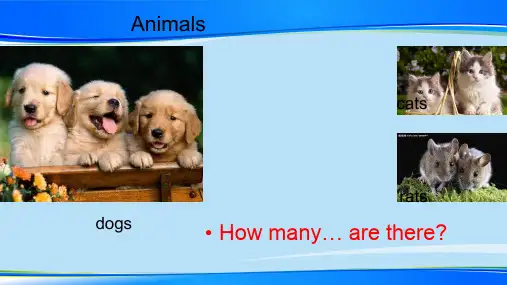
3. Listen and write the names.
Describe your classmate and guess.
His/ Her hair is … His/ Her favourite food is … His/ Her favourite colour is … His/ Her pet is … Who is he/ she?
My best friend is Pat. Her favourite colour is yellow. She has red hair. She likes apples. Her pat is a cat.
My best friend is Liz. She’s got a dog. Her favouritur is blue. Her hair is brown.
3. Listen and write the names.
Look and describe the pictures.
She’s got a cat. Her favourite food is apples. Her hair is red.
3. Listen and write the names.
3. Listen and write the names.
Listen and repeat.
My best friend is Sue. She’s got a dog. Her favourite food is pizza. Sue’s favourite colour is yellow. Her hair is red.
4. Summary
Unit 2 Friends
My best friend My best friend is … He/ She is … His/ Her
四年级下册英语教案-Unit2 Friends join in 剑桥英语
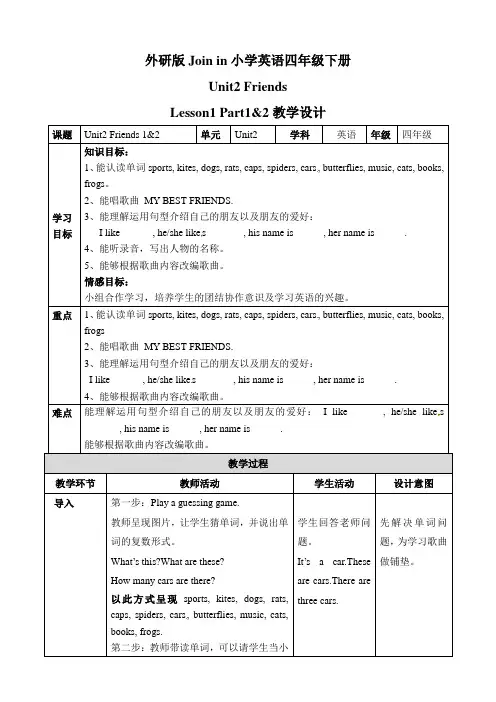
外研版Join in小学英语四年级下册Unit2 FriendsLesson1 Part1&2教学设计课题Unit2 Friends 1&2单元Unit2学科英语年级四年级学习目标知识目标:1、能认读单词sports, kites, dogs, rats, caps, spiders, cars, butterflies, music, cats, books, frogs。
2、能唱歌曲MY BEST FRIENDS.3、能理解运用句型介绍自己的朋友以及朋友的爱好:I like ______, he/she like s _______, his name is______, her name is______.4、能听录音,写出人物的名称。
5、能够根据歌曲内容改编歌曲。
情感目标:小组合作学习,培养学生的团结协作意识及学习英语的兴趣。
重点1、能认读单词sports, kites, dogs, rats, caps, spiders, cars, butterflies, music, cats, books, frogs2、能唱歌曲MY BEST FRIENDS.3、能理解运用句型介绍自己的朋友以及朋友的爱好:I like ______, he/she like s _______, his name is______, her name is______.4、能够根据歌曲内容改编歌曲。
难点能理解运用句型介绍自己的朋友以及朋友的爱好:I like ______, he/she like s _______, his name is______, her name is______.能够根据歌曲内容改编歌曲。
教学过程教学环节教师活动学生活动设计意图导入第一步:Play a guessing game.教师呈现图片,让学生猜单词,并说出单词的复数形式。
What’s this?What are these?How many cars are there?以此方式呈现sports, kites, dogs, rats, caps, spiders, cars, butterflies, music, cats, books, frogs.第二步:教师带读单词,可以请学生当小学生回答老师问题。
剑桥join in3课文分析
一、《剑桥小学英语JOIN IN》教材介绍:《剑桥小学英语JOIN IN》是英国剑桥大学出版社2000年的最新版本教材,该教程是以非英语国家少年儿童为学习对象的,本套教材非常显著的特点之一是借鉴了Gardner的多元智能理论,是以20世纪末国际教育心理学,语言教学理论的最新研究成果——多元智能理论(Theory of Multiple Intelligences)作为编写的主导思想。
智能理论认为人具有7种智能特征:语言、数学逻辑思维、音乐、空间、运动、人际和自我调节。
《剑桥小学英语JOIN IN》特别注重对少年儿童认知系统与心理机制的开发,教材的设计力图让他们的各种智能特征得以表现,如:用生动的卡通画和有声有色的语言夸张表现的方式,启动孩子们对英语的感知能力;用强烈音乐节奏刺激的英语韵文,让孩子们轻松自然地形成良好的发音习惯和标准的发音;用易学而又优美动听的英语歌曲,使孩子们在艺术的陶冶中得到英语表现的美感;用模仿、做游戏、表演等多种活动形式,激发每个孩子的兴趣,培养他们的合作精神。
总之是一套很有思想,有创意的教材,老师能否把这些多种智能考虑在内,尤其是在评估学生时能否充分发掘这些智能就显得非常重要。
二、《剑桥小学英语JOIN IN》的特点1、.以学生为主体,全面提高学生素质学生的发展是学科教材及其教学过程设计的出发点和归宿。
《剑桥小学英语JOIN IN》教程的书名及其设计,确立了其教学过程必须是学生参与学习的过程。
本教程采用了全身反应教学法的理论,组织学生在―身体运动‖动脑,动口,动手,动耳等活动中学习,整体提高认知水平;在―做事情‖唱歌、做游戏,表演,访谈等实践中,充分发挥他们的各项智能特征,反复不断地感知和使用英语,提高其语言技能,形成其学习策略。
2、《剑桥小学英语JOIN IN》教程的教学目标循序渐进,设置科学该教材的编写依据语言学习的客观规律,充分体现不同年龄段和不同语言水平学生的学习特点和学习需要。
新版四年级下册英语课件Unit2Friends 剑桥英语Join in (共16张)
Linda Terry
3. Listen and write the names.
Look and describe the pictures.
She’s got a dog. Her favourite food is pizza. Her hair is brown.
3. Listen and write the names.
Describe your classmate and guess.
His/ Her hair is … His/ Her favourite food is … His/ Her favourite colour is … His/ Her pet is … Who is he/ she?
Look and describe the pictures.
She’s got a dog. Her favourite food is pizza. Her hair is red.
3. Listen and write the names.
Listen and write.
Liz
Pat
Sue
Unit 2 Friends
Question 1
Have you got a friend?
• Yes, I have. No, I haven’t.
• Linda
• Terry
Listen and sing the song
My best friends
2. Listen, sing and circle.
3. Listen and write the names.
Look and describe the pictures.
外研社剑桥小学英语Join_in四年级上册整体课时教案
外研社剑桥小学英语Join_in四年级上册整体课时教案Starter Unit Let's begin第一学时:The pupils learn to understand:How are you today? I’m fine/OK.Goodbye.The pupils learn to use:What’s your name? I’m (Alice).How are you? I’m fine. I’m OK.Activities and skills:Decoding meaning from teacher input.Using phrases for interaction in class.Greeting each other.I Introduce oneself.Asking someone’s mane.Teaching process:Step 1: Warm—up.Sing a song. Hello, what’s your name?Step 2: Presentation.1. What’s your name? I’m….(1) The teacher introduces herself, saying:Hello, /Good morning, I’m Miss Sun.(2) Asks a volunteer’s name:What’s your name?The teacher prompt the pupil by whispering, I’m (Alice).(3) Asks all the pupils the same question and help those who need it by whisperingI’m….2. How are you today? I’m fine. I’m OK.(1) The teacher explains the meaning of How are you today? (2) Tell the class to ask the question all together and introduce two answers,I’m (notvery) fine/I’m Ok.(3) Asks all the pupils the same question and make sure that all the students can reply.Step3: Speak English in class.1. Tells the pupils to open their books at page3, look at the four photographs, andlisten to the tape.2. Asks the pupils to dramatise the situations depicted in the four photographs. Avolunteer will play the part of the parts of the other pupils, answering as a group.第二学时:The pupils learn to use these new words:Sandwich, hamburger, hot dog, puller, cowboy, jeans, cinema, walkman, snack bar, Taxi, clown, superstar.Activities and skills:Singing the song and colouring picture frames.Teaching process:Step 1:Warm—up:Greetings:(1) Good morning!(2) I’m Miss Sun. What’s your name?I’m (Alice, John…).(3) How are you today?I’m fine/OK.Step 2: New words.1. Learn to say these words one by one using flash cards.2. Guessing game.Is it a cowboy/snack bar…?No, it isn’t. Yes, it is.3. Read them following teacher.4. Colour the frames.(1)Open book at page4, take your colour pens. Listen and colour.(2)Colour your (hamburger, orange…).(3)Let’s check.The hamburger is orange.Step 3: Sing the song.1. Listen to the tape.2. Teacher sings the words.3. Learn to say the words.4. Let’s sing it one sentence by one sent ence.5. Sing the song and do the actions together.Step 4: Say good—bye.Goodbye, children.Goodbye, Miss Sun. See you next time.第三学时:The pupils learn to understand:Watch me. Stretch. Clap your hands. Stand back to back.Stand nose to nose. Stand arm in arm. The pupils learn to use: Good morning./Morning. Good afternoon. Good evening.Good night.Activities and skills:Carrying out action story.Listening to the tape and filling numbers.Teaching process:Step 1: Warm—up(1) Greetings.(2) Play guessing game with flash cards. (3) Sing the song: English is easy.Step 2: Mime the action story.1. The teacher and the pupils listen to the instructions on the cassette. The teacherperforms each action and the pupils watch and then imitate the teacher. Repeat thisstage several times.2. The teacher gives the instructions in the same order which the pupils heard them onthe cassette during Phase 1. The pupils listen and do the actions one at a time,following the teacher’s instructions.3. The teacher gives the instructions in jumbled order. The pupils listen and performsthe actions one at a time.Step 3: Listen and fill in the numbers.(1) Listen and mime.(2) Fill in the numbers.(3) Check it. Make sure that everyone is correct.Step 4: Learn to say.The teacher draws a clock on blackboard. When it is 7:30, says “Good morning” or“Morning” to the pupils. The pupils answer “Good morning” or “Morning”.“Good afternoon”, “Good evening” and “Good night” are the same above.第四学时:The pupils learn to use:How are you? I’m fine/very well/OK.Thank you. And you?Nice to meet you. Nice to meet you, too.Activities and skills:Speaking and comprehension:Teaching process:Step1: Warm—up.1. Greetings.Good morning. /Morning.Good afternoon.2. Sing a song: Join in.Step 2: Let’s read and act.1. T: Hello, I’m Miss Sun. What’s your name?S: Hi, I’m Alice.T: Nice to meet you.Tell the student that he or she should say “Nice to meet you, too.”Have this conversation with others, and make sure that all the pupils can say itcorrectly.2. Other sentences just to be taught and learnt like those above.3. Actions:(1). Pair work: Two pupils to act the conversations. (2). Boys and girls competition.Step 3: The end.Goodbye, children.Goodbye, Miss Sun.Unit 1 Numbers第一学时:The pupils learn to understand:The tiger jump.Do the numbers rock.The pupils learn to say:Numbers 1—12.Twelve o’clock; do the numbers rock.Yippee!Let’s do the tiger jump.Your turn.Activities and skills:Singing the song: The numbers rock.Saying the chant : The tiger jump.Colouring the numbers.Listening to conversations and matching the names of children with numbers ondice.Playing two number games.Teaching process:Step 1: Warm—up.1. Count numbers from 1 to 10.2. Sing the song. Hop.Step 2: Listen and sing the song. The numbers rock. 1. Learn to say:11 eleven, 12 twelve. Twelve o’clock.2. Listen and say the chant.Step 3: Listen and say the chant.1. The teacher says the chant and performances in the same order,the pupils follow.2. Teacher says, pupils do in the same order.3. The teacher saysand pupils do in the jumbled order. 4. Listen to the tape and say the chant, do the actions.Step 4: Colour the numbers.1. Show numbers’ cards 1—12 to the pupils. Count them.2. Open book at page9, match numbers with the words.3. Colour them and check them.Step 5: Listen and match.1. Teacher writes numbers on the blackboard. The pupils read them.For example: 3, 6, 1 5, 4 5, etc.2. Listen and match then check.3. learn to say “Your turn.”4. Play the game in class.第二学时:The pupils learn to understand:What’s in the box?Guess the number.Super prize!Come on, (Fred).Here is your prize, Emma.Thank you, Emma.Great!The pupils learn to use:What’s in the box?Snails! Yuk!How many?Activities and skills,Listening to and understanding a story. Playing game: “Guess the number.”Teaching process:Step 1: Warm—up.1. Say the chant : The tiger jump.2. Sing the song: The numbers rock.Step 2: A game. Guess the number. 1. Count numbers 1—12.2. Shows the pupils numbers’ cards, guess the number.3. Take a box, put some glass balls in it. Shows them a glass ball, asks:What’s this? What’s in t he box? How many?If the pupils are right, says “Great! Here is your prize.” And give them a glass ball.Step 3: A story. The snails.1. Teacher says, You will hear a story. The snails. Please listen carefully.2. Listen to the tape several times.3. Make sure that the pupils fully understand the meaning of this story.4. Play this game in class.第三学时:The pupils learn to understand:Guess the number.The pupils learn to use:Twelve is two plus ten, now let’s start again.How many?Yes. / No.Activities and skills:Saying the rhyme.Playing two number games.Teaching process:Step 1: Warm—up.Sing the song. The numbers rock.Step 2: Listen and say the rhyme. 1. Count numbers 1—12.2. Read the words line by line several times.3. listen to the tape, say the rhyme.4. Asks a group of 6-7 pupils stand in a circle, and say the rhyme, see who is left out.Step 3: Play a game.1. Teacher asks a pupil to come to the front of the class and demonstrate the game asshown in the first two pictures.2. Play in pairs and proceed in the same way for the second game.3. Play this game one by one.第四学时:The pupils learn to understand and use:What’s your phone number?Activities and skills:Listening and taking notes of phone numbers and saying what they are.Asking other pupils for their phone numbers and taking notes.Teaching process:Step1: Warm—up.1. Count numbers 1—12.2. Say the rhyme.Step 2: Listen and write the phone numbers.1. Draw a big telephone on the board. Introduce the word Phone or telephone immediately followed by the sentence My phone number is ….2. Listen and write.Tell the pupils that they are going to hear some recorded interviews, and that theyhave to listen and discover the telephone numbers of a few children. Read the names of the children out loud and ask the pupils to repeat them. Listen to the tape several times and write.3. Let’s check.Step 3: Write your phone numbers.1. The pupils write their phone number. Tell them how to read the number.2. Read your number yourself.Step 4: Asks children’s phone number.1. Teacher asks, what’s your phone number? A volunteer answers, other pupils write down.2. Work in pairs.3. The pupils ask and answer each other, and write.4. Let’s check.第五学时:Teaching aims:1. Learn to say:How many girls/boys/flags…can you see?Let me count. I can see….2. Learn to say:What is (seven) plus (twelve)?What is (eleven) minas (nine)?3. Write the numbers 1—12.Teaching process:Step 1: A game.Prepare a box which is full of glass balls. Shows them the box, and asks, what’s in it?Let pupil guess, and then someone touches it. (Glass balls.)How many? How many glass balls? How many glass balls can you see? Count, please. The pupil counts. One, two, three, four…Step 2: Learn to say.1. Teacher chooses a group of pupils, and asks, how many girls can you see? Tellsthem to reply, let me count. And then, count. One, two,…. Tells them to say, I can see…2. Repeat this exercise several times.3. Ask and answer with other words which they learned, such as boys, flags, dogs…Step 3: Learn to say.1. Write those below on the blackboard:7+5 8+2 11-96+4 12-9 2+2Point a pupil to read them.2. The teacher asks What is 7 plus 5,Make sure that each pupil can reply “It’s…” correctly.3. Pupils open book at page 15, work in pairs.Some pairs of pupils wok in class.Step 4: Complete the word puzzle.1. Show the pupils flashcards of numbers 1—12. Read them, and spell the words. 2. Open book at page 15, complete the 14th exercise.3. Check it.Unit 2 Colours第一学时:The pupils learn to understand:What colour is this/The pupils learn to use:Colours: red, orange, yellow, green, blue, purple, pink, black, white.I like (green) and (red); I like orange, too.Oh, what a rainbow!Activities and skills:Listening to words and pointing at the appropriate pictures in the box.Sing a song.Teaching process:Step 1: warm—up.1. Greetings.Good morning. / Good afternoon.2. Sing a song. Butterfly.Step 2: Listen and point—presentation.1. Introduce the following colours: red, orange, yellow, green, blue, purple, pink, white and black.Show the pupils colours with the help of coloured flash cards and objects in the classroom,2. Say the words.(1) Show a colour and say the word several times, then ask thepupils to repeat it. (2) Name a colour and ask the pupils to touch something of that colour. 3. A game.(1) Teacher names a colour, four pupils touch an object of the correct colour. The last pupil is “out”. The winner is the person who touches the correct one first.(2) Asks of the pupils to take over the role of the teacher.(3) Proceed in the same way for the other remaining colours.Step 3: Listen and point.Open their book at page 16, listen to the tape carefully, point the corresponding colour.Step 4: Listen and sing s song. Rainbow.1. Draw a picture of a rainbow on the board and introduce the word Rainbow.2. Listen to the word and repeat it.3. Sing the song following the tape.第二学时:The pupils learn to understand:1. What colour is (the wizard’s house)?2. I’m from Italy; (Great Britain; Argentina; Brazil).The pupils learn to use:I’m (Lucia). I’m from China. This is my flag.Activities and skills:Finding out from a listening text wha t colour the wizard’s house is (listening for detail).第三学时:The pupils learn to understand:Help.Open the door.The pupils learn to use:(Green), please. Here you are.Good night! Good morning!What’s this? Wow!Activities and skills:Listening to and understanding a story.Teaching process:Step 1: Warm—up.1. Sing a song. The rainbow.2. (1) Teacher walks around the classroom asking the pupils:Blue, please. Green, please, etc.The pupils should give me a colored pencil requested. (2) Do the same exercise by the pupils in pairs.Step 2: The story.1. Introduce and practise new vocabulary. Here you are. Help. Open the door. What’s this?2. Pupils listen to the text two or three times with their books closed and try toimagine what is happening from the tone of the voices and blackboard noises. 3. Pupils listen two or three times with their books open.4. Pupils listen one more time with their eyes closed and try to imagine what they saw in the text.Step 3: Act out the story.Two pupils for wizards, somebody to make the noises of boiling water, and explosion, colored bottles.第四学时:The pupils learn to understand:What’s my favourite colour? Is it (blue)?What’s your favourite colour?Yes, that’s right.The pupils learn to use:Guess.What’s my favourite colour? Is it (blue)?What’s your favourite colour?Yes, that’s right.Activities and skills:Playing a game based on the principle of information gap.Completing dialogues in writing.Listening to a chant and circling patches of colour.Saying a chant.Doing a crossword puzzle.Teaching process:Step 1: Play a guessing game.1. Ask a pupil to touch a part of the coloured fish.The teacher can’t see what colour the pupil is touching and, naming several different colours, should try to guess.2. Once the pupils have understand the way game works, they can play in pairs and exchange roles.Step 2: Complete the dialogues.1. Learn to write the words and sentence:Green, blue, white, please.Here you are.2. Ask the pupils to look carefully at the four scenes and to complete the dialogues according to what they see in the pictures.Step 3: A chant.1. The pupils should listen to the chant once all the way through.2. Then they listen a second time, but this time the tape should be stopped after each question to give the pupils time to circle the colour.3. Finally they listen a third time to check the answers.The teacher should check that the pupils have understood and ask which colours theyhave circled. The pupils say the colours in the correct order.4. The teacher writes them on the blackboard. The pupils copy the words.5. Repeat the chant in two separate groups.第五学时:The pupils learnt to understand:What about you?What about this?What’s that over t here?The pupils learn to use:I’m from (America).I like (red) best.What’s your favourite colour?What colour do you like?Activities and skills:Speaking those sentences in groups. Talking about the birthplace and the favourite colours of themselves.Teaching process:Step1: Warm—up1. Say the chant: what’s your favourite colour?2. Revise the words: Great Britain, Italy, Brazil, Argentina.I’m from China.Step 2: Let’s learn and work in groups.1. Introduce new words.America, England, Canada, best, about. 2. Learn to say.I’m….I’m from….I like (red) best.3. Introduce how to use “what about you?”. Make sure that everyone has understoodit.4. Read the sentences.Step 3: Work in the groups.1. Pair work.2. Teacher and student act in class.3. Work in tablemates as the model.Step 4: Let’s talk.1. Introduce new words: jeep, over there.2. Using some flashcards, ask and answer. T: What’s this? (A car.)S: It’s a car.T: What colour is it?S: It’s (red).And tell the volunte er to say: It’s a Chinese car. All the class repeat it.The teacher shows them another flashcard, and asks: What about this? Make sure that the student can answer it correctly.3. Talk about the flashcards in pairs.4. Let’s talk in class.Unit 3 School things第一学时:The pupils learn to understand:What colour is the wizard’s schoolbag,The pupils learn to use:Pen, pencil, pencil case, schoolbag, ruler, eraser, book..Activities and skills:Listening to the words on the tape and filling in the numbers in the book. Listening to the tape and finding out what colour the wizard’s schoolbag is.Teaching process:Step1: Warm--up.1. Show pupils some school things, such as:pencil, book, pen, schoolbag, pencil case. Ask pupils: What’s this? It’s a (p en).2. A game Toby says:Touch your (pen). Take your (book).Step2: Listen and fill in the numbers.1. Introduce the new vocabulary using regalia, rule, eraser,2. The pupils open their books at Page 24.The teacher reads the words, first in the order in which they are presented and then injumbled order, ask the pupils to point to the corresponding picture.3. Listen and fill in the numbers.(1) The first time, the pupils listen to the tape without interruptions for general dothe exercise by themselves.(2) The second time, the pupils listen to the tape without interruptions so that everybody can do the exercise.Check the answer. Name the objects and ask the pupils to answer with the corresponding numbers.Step3. Listen. What colour is the wizards schoolbag.1. Tell the pupils in Chinese that they have to discover the colour of the wizards schoolbag.2. Give them an example.The pupils point to the word start, the teacher says blue and the pupils point to the blue square. Then say ruder and the pupils touch the ruder.Proceed in this way from ruder to yellow, and then to pencil to blue to eraser.At this point ask what colour is the wizards schoolbag? (Blue). 3. Listen to the tape and follow the sequence of squares using a pencil. 4. Listen two or three times to check the answer.第二学时:The pupils learn to understand:Open your (schoolbag).Take out (a ruler).Take out (two books).What’s this? A skipping rope.Hooray!The pupils learn to use:Three pens, four pencils, two books.Activities and skills:Understanding instructions and miming actions.Listening to the tape and filling in numbers.Teaching process:Step 1: Warm—up.Ask and answer.Show the pupils a ruler, a pen , a schoolbag, two erasers, four books, three pencils. Ask: What’s this? What colour is it? How many books can you see? Etc.Step 2: New word.Show them a skipping rope and teach the new word.Step 3: Mime the action story.1. The teacher and the pupils listen to the instructions on the cassette. The teacher performs each action and the pupils watch and then imitate the teacher. Repeat this stage several times.2. The teacher gives the instructions in the same order which the pupils heard them on the cassette during Phase 1. The pupils listen and do the a ctions one at a time, following the teacher’s instructions.3. The teacher gives the instructions in jumbled order. The pupils listen and performs the actions one at a time.Step 4: Listen and fill in the numbers.(4) Listen and mime.(5) Fill in the numbers.(6) Check it. Make sure that everyone is correct.第三学时:The pupils learn to understand:How many (red) things are there?The pupils learn to use:Two pens, three erasers, four pens, five rulers.Activities and skills:Reading what is in the picture and colour frames around word groups in the appropriate colour.Counting school things in a picture puzzle.Teaching process:Step1: Warm—up.A guessing game.1. Show the pupils a box which is full of pens, pencils, rulers, erasers, and books.And ask the pupils to guess how many pens/ pencils/rulers/erasers/books are there?T: Guess! How many (pens)?2. When the pupils guess correctly, ask them: What colou are the (two pens)?Step 2: Read and colour the frames.1. Introduce how to do the exercise.Point out to the pupils that there are 10 pictures and only five boxes on the right. Thepupils have to colour the frames of the boxes on the right following the example. Theframe of the box containing the words two pens, is orange like the two pens in thedrawing.2. The pupils colour the frames themselves.3. Check the answer.Ask the pupils to say which colours match which words.Step3: Count and write the numbers.1. Read the sentences several times. And translate the questions.2. The pupils write exercise in the book.3. Check the answer.Ask the question and the pupils answer orally.第四课时 :Teaching aim And demand:1. The pupils learn to understand:Stop it.Come here, Timmy.Help me, please.Where’s my pencil case?It’s not here.I’ve got it!2. Acticities and skills:Decoding the meaning of the language in a story. Important and Difficult front:Understand the sentences of the story.Teaching process:Step 1:Warming-up1. Sing an English song: Join in.2. Revise the school thing. Which have learnt in this unit.3. Revise the sentence: Here is your prize. Here is my prize.Step 2 : Presentation1. Listen to the story.2. Ask the students to open their books at page 28.3. Ask them listen to the tape, listen to an English story.4. Ask the students to tell the meaning of the story.Step 3 : Learn to understand the sentences.1. Ask some students do a action, then say: Stop it, xxx.” Let the students tell themeaning of the sentence. Then practise it.2. Pre tend to find something, and say: Where’s my pen?” Ask the students to say whatam I doing. And tell the meaning of the sentence.3. Ask someone xxx, help me, please.” Let him/her find things with me. Then ask them to tell the meaning of the sentence.4. Practise the two Sentences in pairs.5. Say:It’s not here,” while finding the thing. Let them say the meaning of thesentence. Then practise it.6.When finding the thing, say: I’ve got it!” Let the students tell the meaning of thesentence. then practise to say it.Step 4 : Consolidation1. Listen again and say the sentences after the tape.2. Perform the story in the class.第五学时 :Teaching aim And demand:1. The pupils learn to use:How many desks are there?What about Chairs?How many pens have you got?2. Activities and skills:Let’s read.Let’s work in groups.Important and difficult point: Read the conversation.Teaching process:Step 1 : Revision1. Sing an English song: In our classroom.2. Show some pictures to the students and ask them to read it. (desks). (chairs).3. Revise the colours.4. Revise the sentences. Which they have leaned in previous class.5. Spell the words.Step 2 : PresentationA: Learn to say the conversation.1. Show a picture to the students.2. Ask the m How many desks are there”?3. Ask: What about Chairs? How many chairs are there?”4. Show some other things to the student, practise to the sentence How many(desks)are there?”5. Read the conversation to the students, ask them to tell me the meaning of theconversation.6. Read the conversation after the teacher several times. Then practise by themselvesin pairs, until they can read it correctly.7. Ask someone to perform the conversation in the front of the classroom.Step 3 : Play a game and do the group work.1. Send something to the students.2. Ask them one by one: How many pens have you got?” Answer the question in steadof the students. Then ask them to tell me the meaning of the sentence. 3. Ask them to read the sentence after the teacher several times. 4. Practise the sentence by themselves, until they can read it correctly. 5. Do the group work.第六学时 (12. Revision)Teaching aim And demand:1. The pupils learn to read the sentences:I have got (a small room).It’s (nice) and (cle an).There is (a bed) (in my room).There is (a computer) (on the desk).I often work at the desk.2. Activitise and skills: Read the text.Important and difficult point:Can read the text of the lesson.Teaching process:Step 1 :Revision1. Sing an English song.2. Spell and read the words:pencil, pencil case, pen, book, eraser, ruler, schoolbag. 3. Look the pictures and say.Two pencils two blue pencils ect.5. Ask and answer:How many pencils are there?How many blue things are there?How many pens have you got?Step 2 :PresentationA : Look at the pictures, learn to say the new words. 1. Point the thing and say the English of it.2. Ask the students to read the word after the teacher. (bed computer)3. Practise to say the words by themselves, and then say out loudly, until they can redit correctly.B : Look at the picture again. Ask and answer:Where is the (bed),1. Ask the students to look at the picture and answer: Where is the bed?2. Answer in stead of the students: It’s in t he room.e the same way to teach:It’s by the window.It’s on the desk.Step 3: Learn to say the text.1. Look at the picture and listen to the teacher read the text.2. Ask them to tell the meaning of the text.3. Read the text after the teacher several times.4. Practise to read the text by themselves, until they can read it correctly.5. Ask someone to point the picture and say the text.Unit 4 Pets第一学时:Teaching aim And demand:1. The pupils learn to use:What have you got?Have you got a pet? Yes, I have.2. Learn to use the words:Cat dog mouse fish budgie, rabbit. Hamster. 3. Activities and skills: Saying a chantListening to a cassette and finding out what the wizard’s pet is.Important and difficult point:pictures, radio and tape.Teaching process:REVISION:1. Sing an English song: join in.2. Conversation:What’s your favourite colour?What colour is the schoolbag? ect.PRESENTATION:A: Learn to say the six new words.1. Learn to say the word: cat.Show a picture of a cat to the students, tell them: This is a cat.” Ask them to read the word after the teacher several times. Then practise by themselves, until they canread the word correctly.e the same way to teach the other words: dog, mouse, fish,budgie, rabbit.3.Fun time.Listen to the sound of these animals or mine these animals. Ask the students to saythe words and at the same time point to the corresponding flashcard.B: Learn to say the sentences.1. Learn to say the sentence: Have you got a pet?Pretend to need a pen and ask a pupil: Have you got a pen? If necessary translatethe sentence.2. Read the sentence after the teacher several times.3. Practise the sentence by themselves:Use the flashcard and ask the students:Have you got a (ha mster)? And then answer “Yes.” And then ask the students to askthe teacher answer.e the same way to teach:What have you got?C: Listen and say the chant.Play the chant two or three times and ask the pupils to repeat it, until they can readit correctly.D: Listen and find the wizard’s pet.Ask the same way before.BLACKBOARD DESIGN:PetsCat dog mouseFish budgiz rabbit。
剑桥小学英语《Joinin》3Unit5time(grade6)
Unit 5 Time
Time is money. 一寸光阴一寸金。
What’s the time ? What’s the time ?
It’s three o’clock. It’s half past seven.
任务
• 1、四人小组合作完成。 • 2、翻译作习时间表中的所有时刻。 • 3、展示成果。
Homework
1、past\half\quarter\to\o’clock (每个单词5遍)
2、抄写句型What’s the time? 和 What time is it? 各2遍,并用整点、 一刻、半点、差来回答问句。
Practice
7. Look at the watches and fill in the correct numbers.
671938245
8.Look at the watches and clocks.Listen and fill in the correct numbers.
624 1 9 5 8 7 10 3
It’s two o’clock.
It’s eight o’clock.
It’s half past ten.
It’s half past twelve.
What’s the time? It’s ten past ten.
= What time is it?
It’s quarter past twelve.
What time is it? It’s five to nine.
What’s the time? It’s twenty to eleven.
[三年级英语]剑桥小学英语Joinin
《剑桥小学英语Join in —入门阶段》西关小学王贺青一、教材分析:(一).教材特点:《Join in 》教材的突出特点表现在以下几个方面:1.以学生为主体,全面提高学生的素质。
2.教学方法先进,反映国际教学的趋势。
3.目标设置科学,符合国家小学英语课程目标要求。
4.教材内容广泛,体现现代社会的气息。
5.教学资源丰富,有利于小学课程的拓展。
本套教材非常显著的特点之一是借鉴了多元智能理论,儿童的能力和智力各不相同,每个人的学习方式也不一样,教材中用语言、数学逻辑思维、音乐、空间、身体运动等不同的语言载体来开发学生的多元智能学习语言,在语言学习的过程中关注孩子们方方面面的成长,评价系统、全面,是一套很有思想,有创意的教材,老师能否把这些多种智能考虑在内,尤其是在评估学生时能否充分发掘这些智能就显得非常重要。
其次,本教材借鉴的另一重要理论是全身反应法(TPR)。
根据这个理论,人们只有在视觉、听觉和身体方面全面参与,学习才能稳定持久。
那种认为学生只要顺利完成书本中的练习便能学会语言结构和单词的看法是错误的,或者只对少数通过语言智能和逻辑数学智能形式学习的学生有效。
另外,这套教材的编写适合西方的国情,而给中国小学英语教师的教学带来一定的难度,如,对教材体系难以把握,教材中的文化背景涉及到的国家多,对教师自身的英语文化知识是很大的挑战,任务型教学适合小班教学,不少教学活动在我们现在七、八十人的大班里很难开展。
所以我们在解读教材时,有时有必要根据自己的学情和班情,将教材上语言活动进行相应的调整。
(二)、大纲要求激发和培养学生学习英语的兴趣,使学生树立信心,养成良好的学习习惯和形成有效的学习策略,发展自主学习的能力和合作精神;使学生掌握一定的英语基础知识和听、说、读、写技能,形成一定的综合语言运用能力;培养学生的观察、记忆、思维、想像能力和创新能力(精神);帮助学生了解世界和中西方文化的差异,拓展视野,培养爱国主义精神,形成健康的人生观,为他们的终生学习和发展打下良好基础。